clock SMART FORTWO COUPE 2012 User Guide
[x] Cancel search | Manufacturer: SMART, Model Year: 2012, Model line: FORTWO COUPE, Model: SMART FORTWO COUPE 2012Pages: 228, PDF Size: 12.76 MB
Page 92 of 228
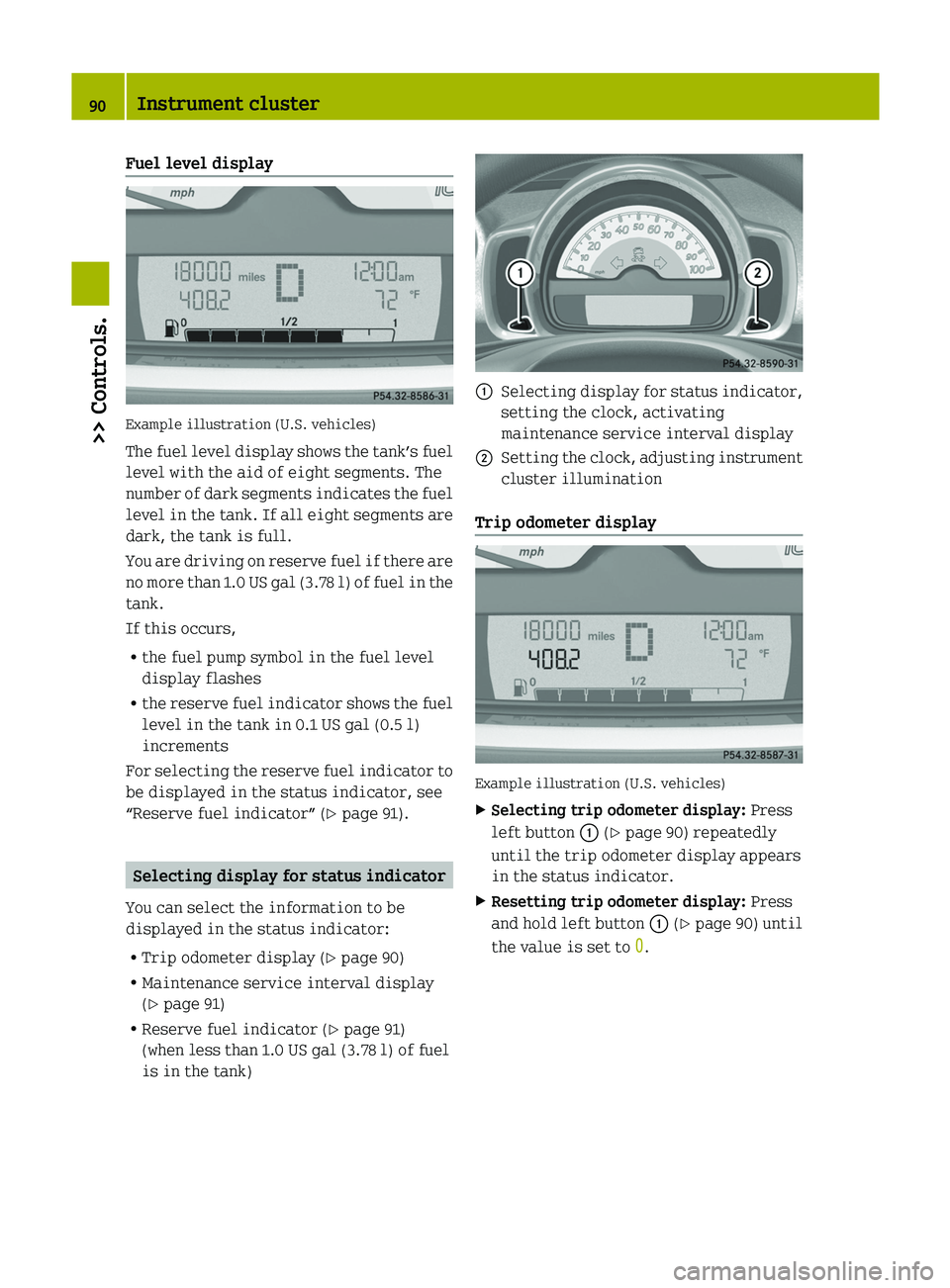
Fuel level display
Example illustration (U.S. vehicles)
The
fuel level display shows the tank’s fuel
level with the aid of eight segments. The
number of dark segments indicates the fuel
level in the tank. If all eight segments are
dark, the tank is full.
You are driving on reserve fuel if there are
no more than 1.0 US gal (3.78 l) of fuel in the
tank.
If this occurs,
R the fuel pump symbol in the fuel level
display flashes
R the reserve fuel indicator shows the fuel
level in the tank in 0.1 US gal (0.5 l)
increments
For selecting the reserve fuel indicator to
be displayed in the status indicator, see
“Reserve fuel indicator” (Y page 91). Selecting display for status indicator
You can select the information to be
displayed in the status indicator:
R Trip odometer display ( Y page 90)
R Maintenance service interval display
(Y page 91)
R Reserve fuel indicator (Y page 91)
(when less than 1.0 US gal (3.78 l) of fuel
is in the tank) :
Selecting display for status indicator,
setting the clock, activating
maintenance service interval display
; Setting the clock, adjusting instrument
cluster illumination
Trip odometer display Example illustration (U.S. vehicles)
X
Selecting trip odometer display: Press
left button : (Y page 90) repeatedly
until the trip odometer display appears
in the status indicator.
X Resetting trip odometer display: Press
and hold left button : (Y page 90) until
the value is set to 0.90
Instrument cluster>> Controls.
Page 94 of 228
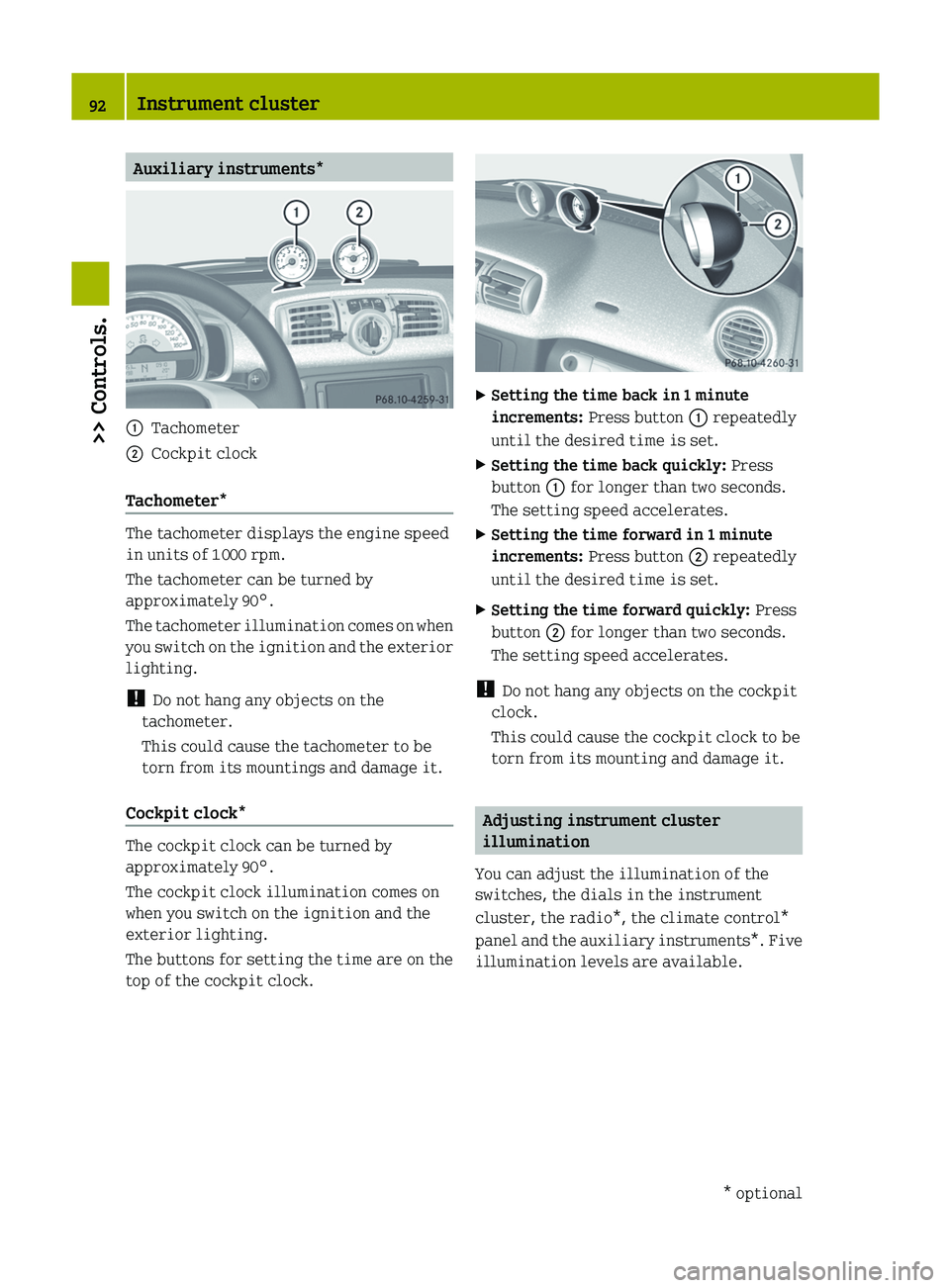
Auxiliary instruments*
:
Tachometer
; Cockpit clock
Tachometer* The tachometer displays the engine speed
in units of 1
000 rpm.
The tachometer can be turned by
approximately 90°.
The
tachometer illumination comes on when
you switch on the ignition and the exterior
lighting.
! Do not hang any objects on the
tachometer.
This could cause the tachometer to be
torn from its mountings and damage it.
Cockpit clock* The cockpit clock can be turned by
approximately 90°.
The cockpit clock illumination comes on
when you switch on the ignition and the
exterior lighting.
The
buttons for setting the time are on the
top of the cockpit clock. X
Setting the time back in 1 minute
increments: Press button : repeatedly
until the desired time is set.
X Setting the time back quickly: Press
button : for longer than two seconds.
The setting speed accelerates.
X Setting the time forward in 1 minute
increments: Press button ; repeatedly
until the desired time is set.
X Setting the time forward quickly: Press
button ; for longer than two seconds.
The setting speed accelerates.
! Do not hang any objects on the cockpit
clock.
This could cause the cockpit clock to be
torn from its mounting and damage it. Adjusting instrument cluster
illumination
You can adjust the illumination of the
switches, the dials in the instrument
cluster, the radio*, the climate control*
panel
and the auxiliary instruments*. Five
illumination levels are available. 92
Instrument cluster
>> Controls.
* optional
Page 119 of 228
?
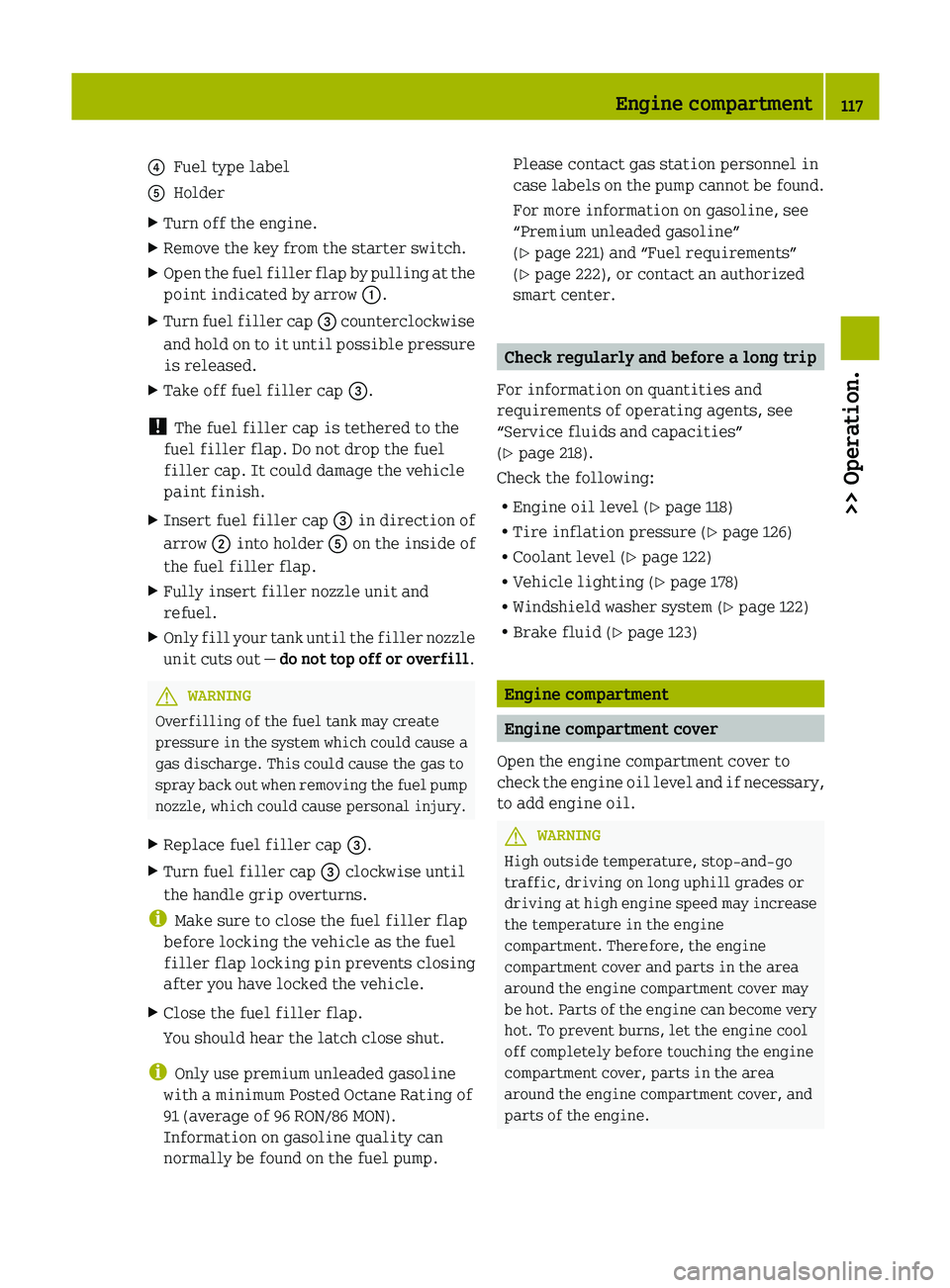
Fuel type label
A Holder
X Turn off the engine.
X Remove the key from the starter switch.
X Open the fuel filler flap by pulling at the
point indicated by arrow :.
X Turn fuel filler cap = counterclockwise
and hold on to it until possible pressure
is released.
X Take off fuel filler cap =.
! The fuel filler cap is tethered to the
fuel filler flap. Do not drop the fuel
filler cap. It could damage the vehicle
paint finish.
X Insert fuel filler cap = in direction of
arrow ; into holder A on the inside of
the fuel filler flap.
X Fully insert filler nozzle unit and
refuel.
X Only fill your tank until the filler nozzle
unit
cuts out — do not top off or overfill .G
WARNING
Overfilling of the fuel tank may create
pressure in the system which could cause a
gas discharge. This could cause the gas to
spray
back out when removing the fuel pump
nozzle, which could cause personal injury.
X Replace fuel filler cap =.
X Turn fuel filler cap = clockwise until
the handle grip overturns.
i Make sure to close the fuel filler flap
before locking the vehicle as the fuel
filler flap locking pin prevents closing
after you have locked the vehicle.
X Close the fuel filler flap.
You should hear the latch close shut.
i Only use premium unleaded gasoline
with a minimum Posted Octane Rating of
91 (average of 96 RON/86 MON).
Information on gasoline quality can
normally be found on the fuel pump. Please contact gas station personnel in
case
labels on the pump cannot be found.
For more information on gasoline, see
“Premium unleaded gasoline”
(Y page 221) and “Fuel requirements”
(Y page 222), or contact an authorized
smart center. Check regularly and before a long trip
For information on quantities and
requirements of operating agents, see
“Service fluids and capacities”
(Y page 218).
Check the following:
R Engine oil level ( Y page 118)
R Tire inflation pressure ( Y page 126)
R Coolant level ( Y page 122)
R Vehicle lighting ( Y page 178)
R Windshield washer system (Y page 122)
R Brake fluid (Y page 123) Engine compartment
Engine compartment cover
Open the engine compartment cover to
check
the engine oil level and if necessary,
to add engine oil. G
WARNING
High outside temperature, stop-and-go
traffic, driving on long uphill grades or
driving
at high engine speed may increase
the temperature in the engine
compartment. Therefore, the engine
compartment cover and parts in the area
around the engine compartment cover may
be hot. Parts of the engine can become very
hot. To prevent burns, let the engine cool
off completely before touching the engine
compartment cover, parts in the area
around the engine compartment cover, and
parts of the engine. Engine compartment
117
>> Operation. Z
Page 124 of 228
Coolant
G
WARNING
In order to avoid potentially serious burns:
R Use extreme caution when opening the
service flap if there are any signs of
steam or coolant leaking from the
cooling system, or if the coolant
temperature warning lamp ? in the
instrument cluster indicates that the
coolant is overheated.
R Do
not remove the pressure cap on coolant
reservoir if coolant temperature is
above 158¦ (70¥). Allow engine to cool
down before removing cap. The coolant
reservoir contains hot fluid and is under
pressure.
R Using a rag, slowly turn the cap
approximately 1
/ 2 turn to relieve excess
pressure. If opened immediately,
scalding hot fluid and steam will be
blown out under pressure.
The engine coolant is a mixture of water
and anticorrosion/antifreeze. To check the
coolant level the vehicle must be parked on
level ground and the engine must have
cooled down. For more information, see
“Coolants” (Y page 223).
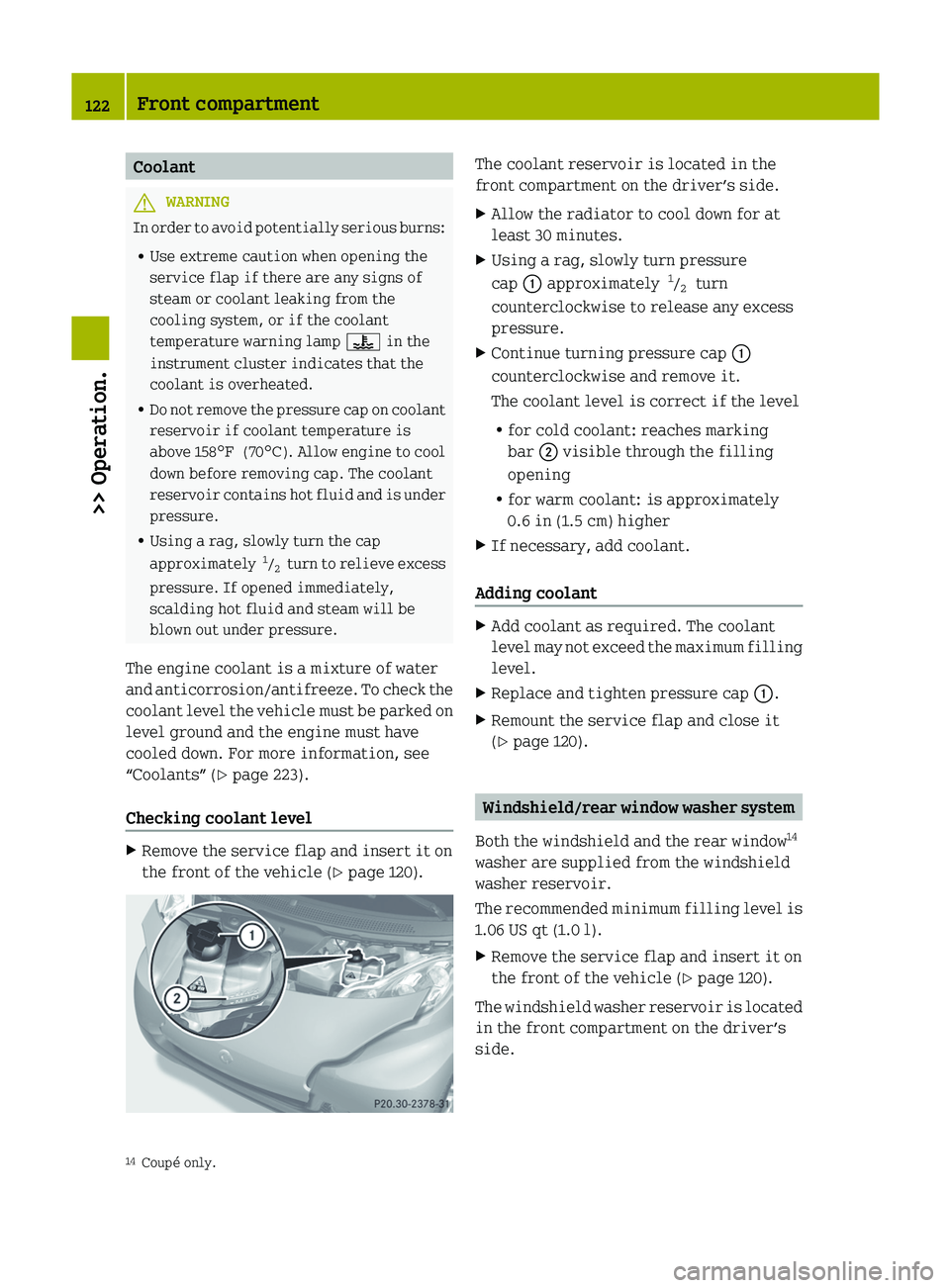
Checking coolant level X
Remove the service flap and insert it on
the front of the vehicle ( Y page 120). The coolant reservoir is located in the
front compartment on the driver’s side.
X
Allow the radiator to cool down for at
least 30 minutes.
X Using a rag, slowly turn pressure
cap : approximately 1
/ 2 turn
counterclockwise to release any excess
pressure.
X Continue turning pressure cap :
counterclockwise and remove it.
The coolant level is correct if the level
R
for cold coolant: reaches marking
bar ; visible through the filling
opening
R for warm coolant: is approximately
0.6 in (1.5 cm) higher
X If necessary, add coolant.
Adding coolant X
Add coolant as required. The coolant
level
may not exceed the maximum filling
level.
X Replace and tighten pressure cap :.
X Remount the service flap and close it
(Y page 120). Windshield/rear window washer system
Both the windshield and the rear window 14
washer are supplied from the windshield
washer reservoir.
The
recommended minimum filling level is
1.06 US qt (1.0 l).
X Remove the service flap and insert it on
the front of the vehicle ( Y page 120).
The windshield washer reservoir is located
in the front compartment on the driver’s
side.
14 Coupé only.122
Front compartment
>> Operation.
Page 155 of 228
Exterior Special
considerations Lightly soiled
Hand-/Automatic
car washes Heavily soiled
Hand-/Automatic
car washes
Wheels and wheel
covers Two-layer metallic
paint (high-gloss) Car shampoo
concentrate, rim
care Car shampoo
concentrate, rim
care
Retractable soft top PAC fabric Car shampoo
concentrate, soft
top cleaner,
impregnation spray Car shampoo
concentrate, soft
top cleaner,
impregnation spray
Removing insects
Remove insect remains before you start to
wash the vehicle.
X
Spray insect remover on.
X Allow insect remover to work in briefly.
X Rub in gently with a soft cloth or sponge.
X Rinse with plenty of water.
X Treat the cleaned surface with hard wax.
Removing tar Remove any tar marks before washing the
vehicle.
X
Apply tar remover with a soft cloth.
X Allow tar remover to work in briefly.
X Rub in gently.
X Rinse with plenty of water.
X Treat the cleaned surface with hard wax.
Vehicle washing In the winter, thoroughly remove all traces
of road salt as soon as possible.
When
washing the vehicle underbody, do not
forget to clean the inner sides of the
wheels.
Washing your vehicle by hand
X Wash the vehicle using car shampoo
concentrate and a sponge.
X Rinse with clean water.
X Towel dry the vehicle. !
Do not wash the vehicle in direct
sunlight. The body panel surfaces and
paint finish may be damaged.
Washing your vehicle in an automatic car
wash
i When running your vehicle through an
automatic car wash, water droplets can
run
down the inside of the side windows.
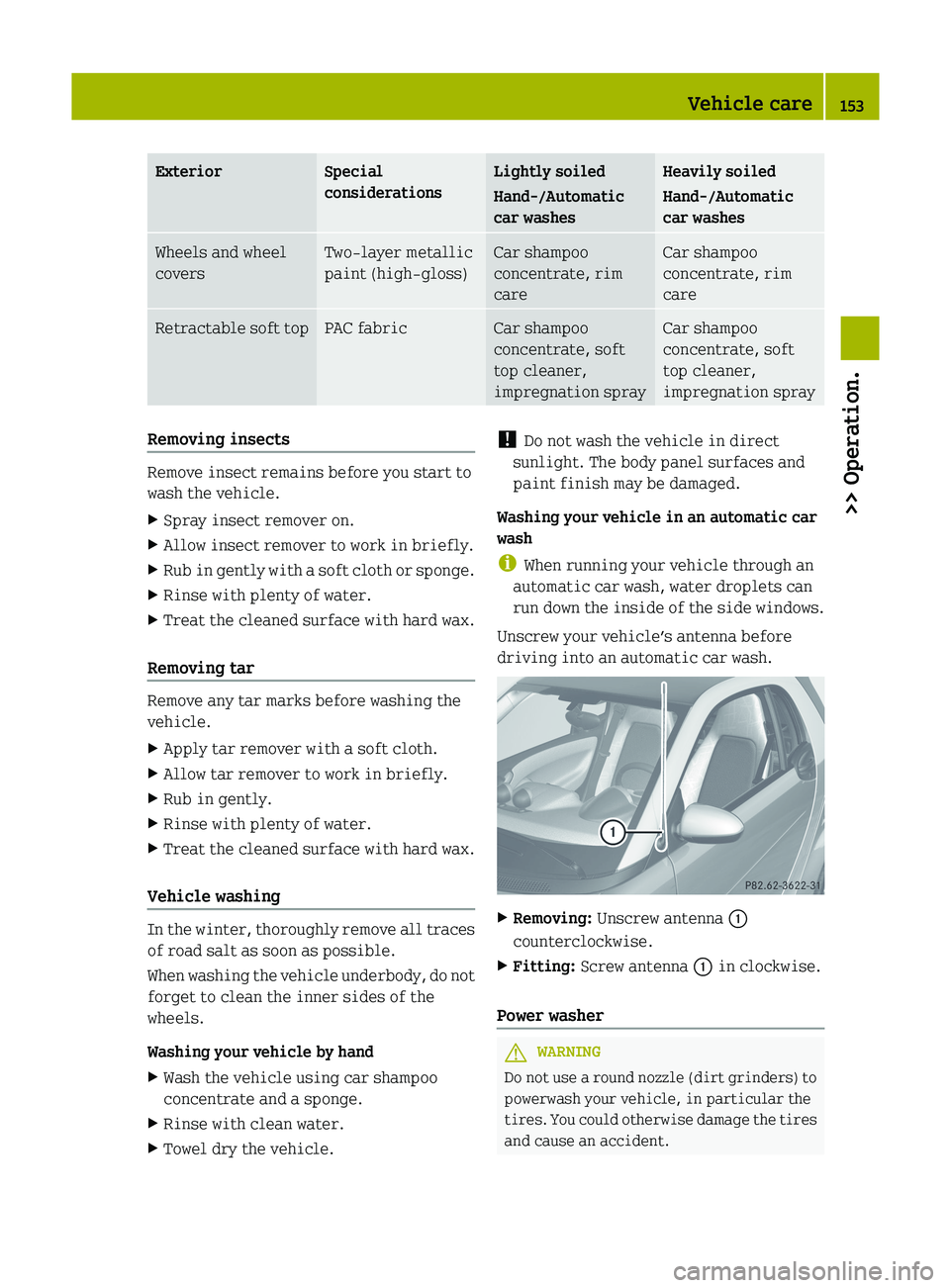
Unscrew your vehicle’s antenna before
driving into an automatic car wash. X
Removing: Unscrew antenna :
counterclockwise.
X Fitting: Screw antenna : in clockwise.
Power washer G
WARNING
Do not use a round nozzle (dirt grinders) to
powerwash your vehicle, in particular the
tires.
You could otherwise damage the tires
and cause an accident. Vehicle care
153
>> Operation. Z
Page 160 of 228
Where will I find ...
Tire repair kit
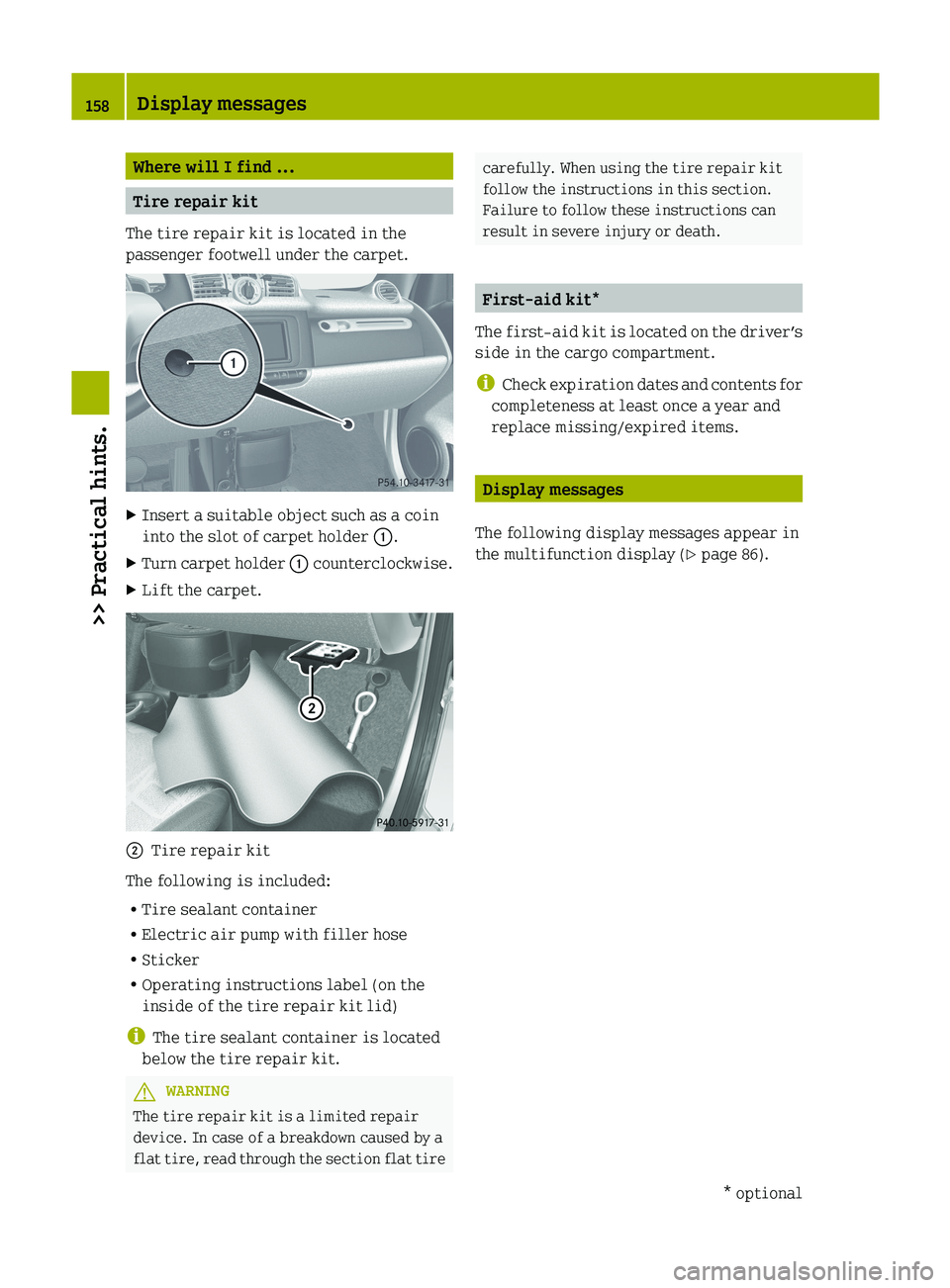
The tire repair kit is located in the
passenger footwell under the carpet. X
Insert a suitable object such as a coin
into the slot of carpet holder :.
X Turn carpet holder : counterclockwise.
X Lift the carpet. ;
Tire repair kit
The following is included:
R Tire sealant container
R Electric air pump with filler hose
R Sticker
R Operating instructions label (on the
inside of the tire repair kit lid)
i The tire sealant container is located
below the tire repair kit. G
WARNING
The tire repair kit is a limited repair
device. In case of a breakdown caused by a
flat
tire, read through the section flat tire carefully. When using the tire repair kit
follow the instructions in this section.
Failure to follow these instructions can
result in severe injury or death.
First-aid kit*
The
first-aid kit is located on the driver’s
side in the cargo compartment.
i Check expiration dates and contents for
completeness at least once a year and
replace missing/expired items. Display messages
The following display messages appear in
the multifunction display ( Y page 86).158
Display messages
>> Practical hints.
* optional
Page 183 of 228
Replacing bulbs for front lamps
Before you start to replace a bulb for a
front lamp, do the following first:
X Turn the exterior lamp switch to position
$ (Y page 64).
X Switch off the ignition.
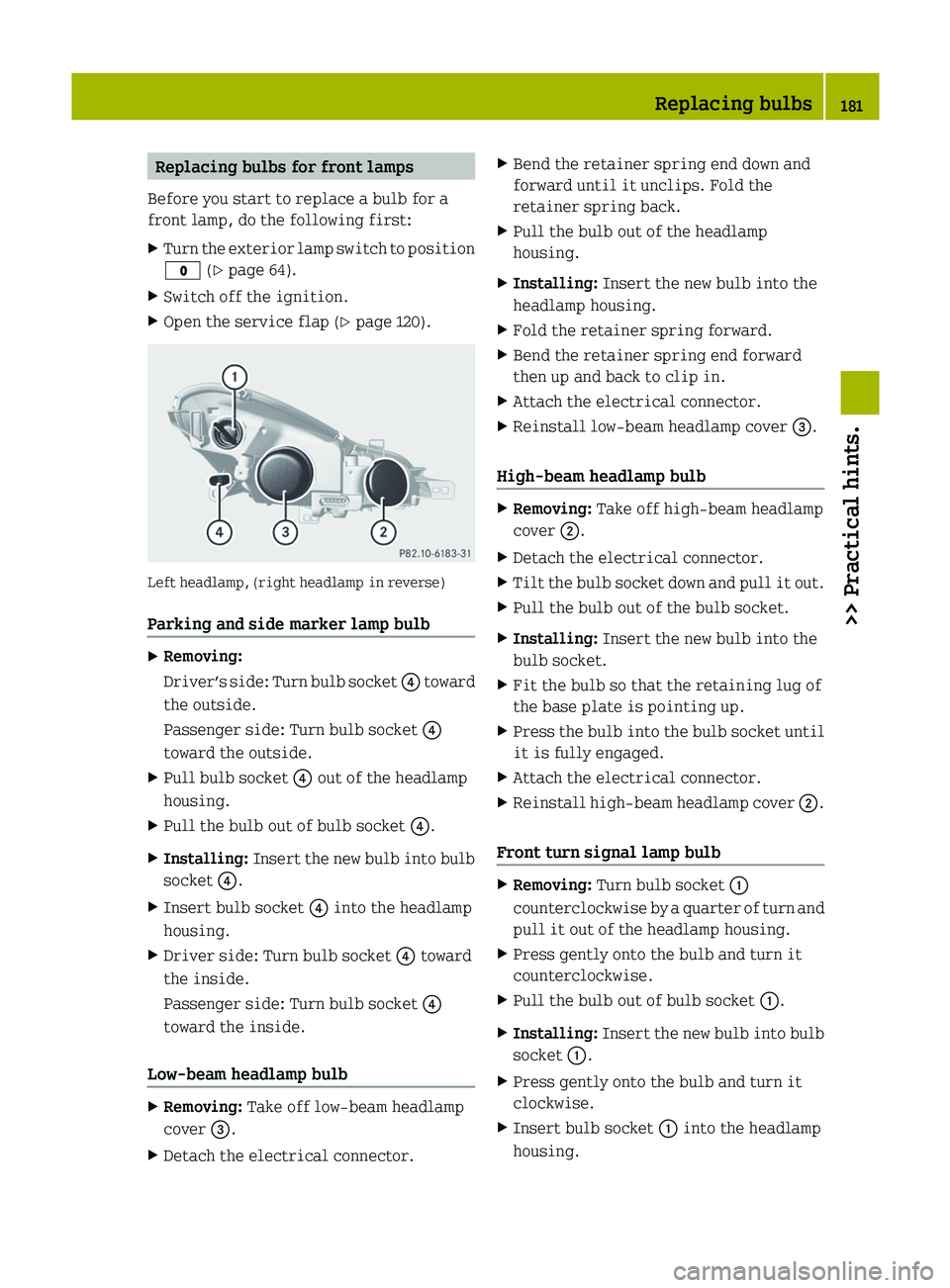
X Open the service flap (Y page 120). Left headlamp, (right headlamp in reverse)
Parking and side marker lamp bulb
X
Removing:
Driver’s
side: Turn bulb socket ? toward
the outside.
Passenger side: Turn bulb socket ?
toward the outside.
X Pull bulb socket ? out of the headlamp
housing.
X Pull the bulb out of bulb socket ?.
X Installing:
Insert the new bulb into bulb
socket ?.
X Insert bulb socket ? into the headlamp
housing.
X Driver side: Turn bulb socket ? toward
the inside.
Passenger side: Turn bulb socket ?
toward the inside.
Low‑beam headlamp bulb X
Removing: Take off low‑beam headlamp
cover =.
X Detach the electrical connector. X
Bend the retainer spring end down and
forward until it unclips. Fold the
retainer spring back.
X Pull the bulb out of the headlamp
housing.
X Installing: Insert the new bulb into the
headlamp housing.
X Fold the retainer spring forward.
X Bend the retainer spring end forward
then up and back to clip in.
X Attach the electrical connector.
X Reinstall low‑beam headlamp cover =.
High‑beam headlamp bulb X
Removing: Take off high‑beam headlamp
cover ;.
X Detach the electrical connector.
X Tilt the bulb socket down and pull it out.
X Pull the bulb out of the bulb socket.
X Installing: Insert the new bulb into the
bulb socket.
X Fit the bulb so that the retaining lug of
the base plate is pointing up.
X Press the bulb into the bulb socket until
it is fully engaged.
X Attach the electrical connector.
X Reinstall high‑beam headlamp cover ;.
Front turn signal lamp bulb X
Removing: Turn bulb socket :
counterclockwise
by a quarter of turn and
pull it out of the headlamp housing.
X Press gently onto the bulb and turn it
counterclockwise.
X Pull the bulb out of bulb socket :.
X Installing:
Insert the new bulb into bulb
socket :.
X Press gently onto the bulb and turn it
clockwise.
X Insert bulb socket : into the headlamp
housing. Replacing bulbs
181
>> Practical hints. Z
Page 184 of 228
The arrow on bulb socket : must be in
line with the line on the headlamp
housing.
X Turn bulb socket : clockwise by a
quarter of turn.
Side turn signal lamp bulb X
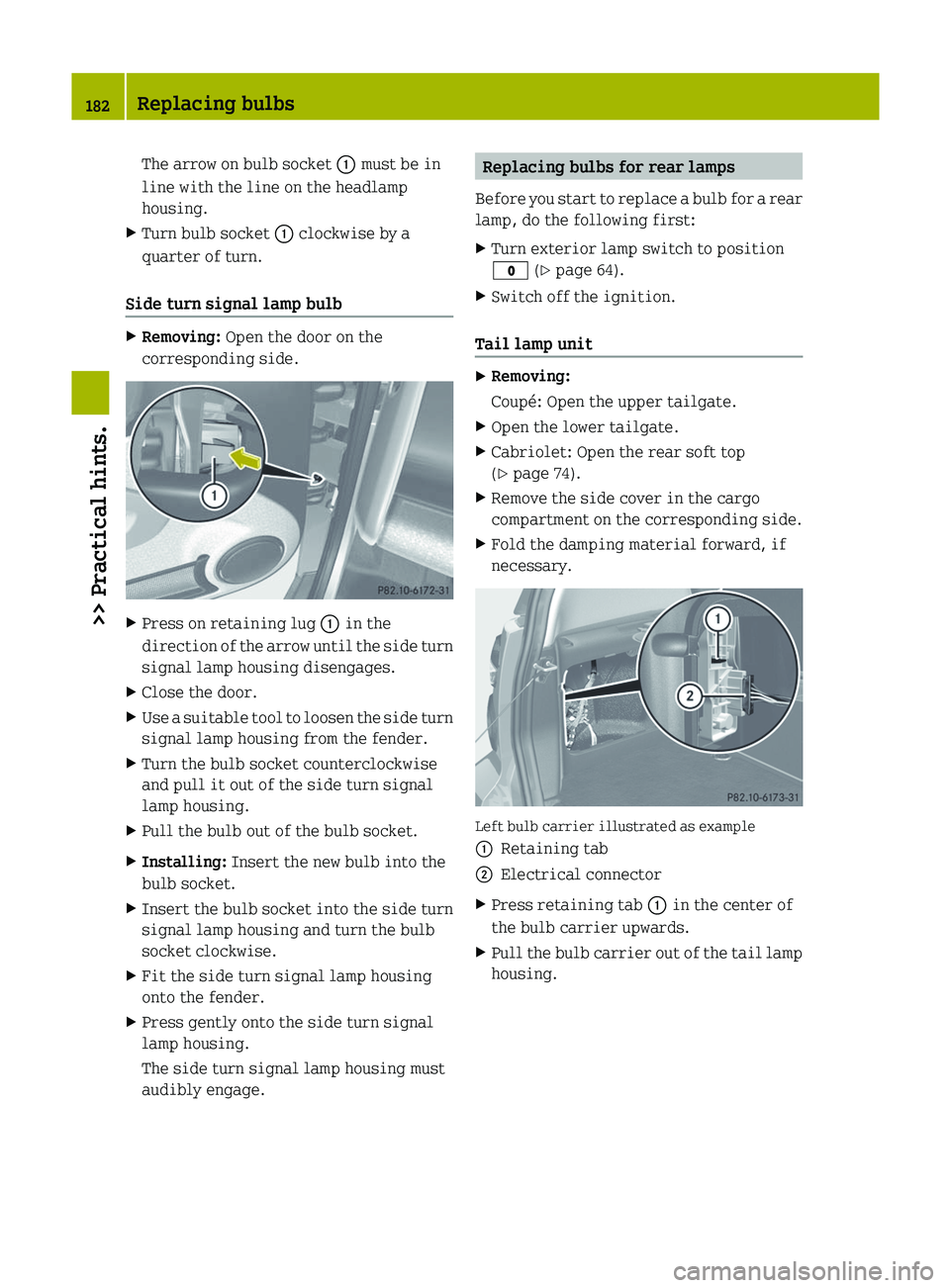
Removing: Open the door on the
corresponding side. X
Press on retaining lug : in the
direction of the arrow until the side turn
signal lamp housing disengages.
X Close the door.
X Use a suitable tool to loosen the side turn
signal lamp housing from the fender.
X Turn the bulb socket counterclockwise
and pull it out of the side turn signal
lamp housing.
X Pull the bulb out of the bulb socket.
X Installing: Insert the new bulb into the
bulb socket.
X Insert the bulb socket into the side turn
signal lamp housing and turn the bulb
socket clockwise.
X Fit the side turn signal lamp housing
onto the fender.
X Press gently onto the side turn signal
lamp housing.
The side turn signal lamp housing must
audibly engage. Replacing bulbs for rear lamps
Before
you start to replace a bulb for a rear
lamp, do the following first:
X Turn exterior lamp switch to position
$ (Y page 64).
X Switch off the ignition.
Tail lamp unit X
Removing:
Coupé: Open the upper tailgate.
X Open the lower tailgate.
X Cabriolet: Open the rear soft top
(Y page 74).
X Remove the side cover in the cargo
compartment on the corresponding side.
X Fold the damping material forward, if
necessary. Left bulb carrier illustrated as example
:
Retaining tab
; Electrical connector
X Press retaining tab : in the center of
the bulb carrier upwards.
X Pull the bulb carrier out of the tail lamp
housing.182
Replacing bulbs
>> Practical hints.
Page 185 of 228
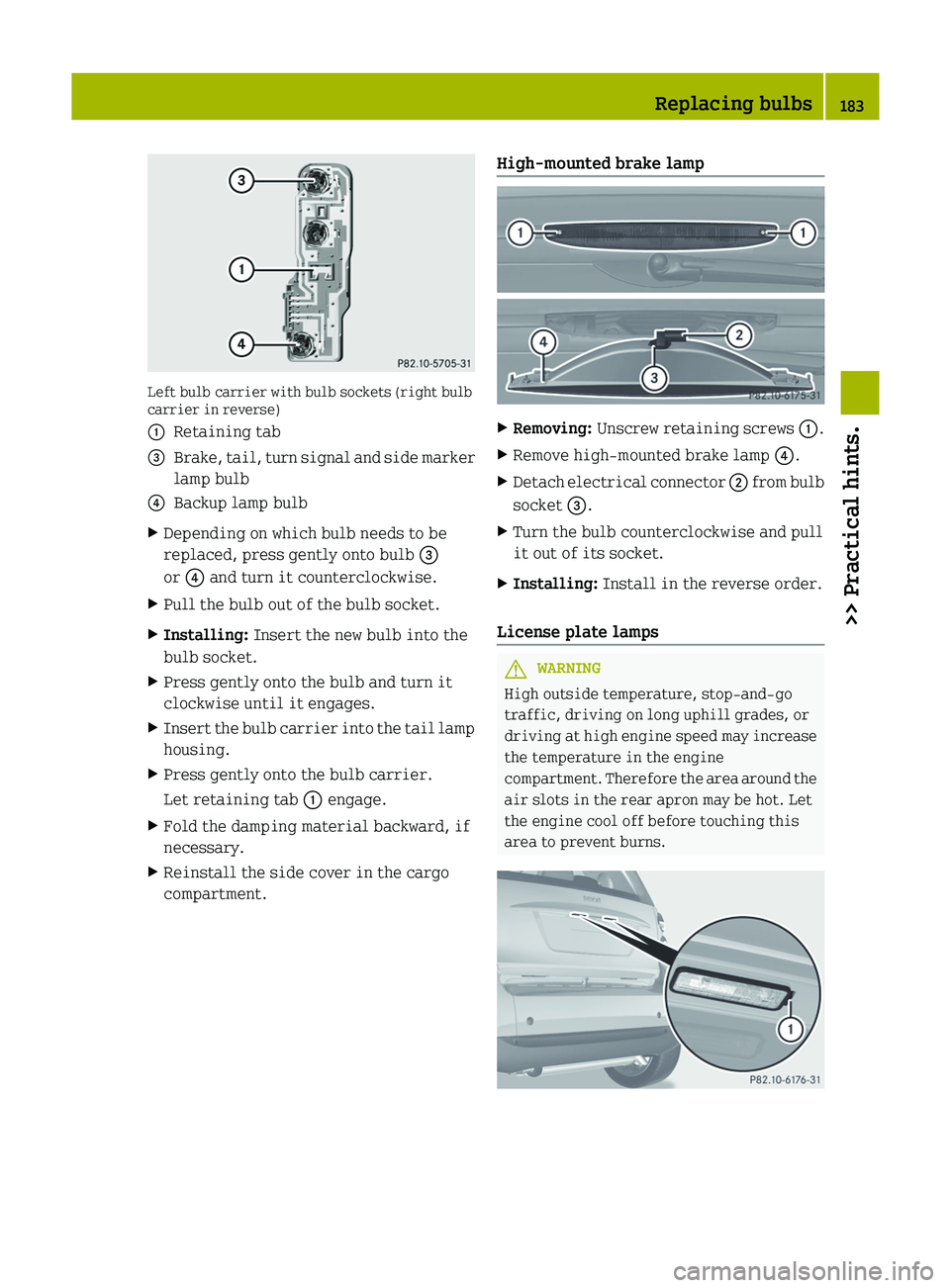
Left bulb carrier with bulb sockets (right bulb
carrier in reverse)
:
Retaining tab
= Brake, tail, turn signal and side marker
lamp bulb
? Backup lamp bulb
X Depending on which bulb needs to be
replaced, press gently onto bulb =
or ? and turn it counterclockwise.
X Pull the bulb out of the bulb socket.
X Installing: Insert the new bulb into the
bulb socket.
X Press gently onto the bulb and turn it
clockwise until it engages.
X Insert the bulb carrier into the tail lamp
housing.
X Press gently onto the bulb carrier.
Let retaining tab : engage.
X Fold the damping material backward, if
necessary.
X Reinstall the side cover in the cargo
compartment. High-mounted brake lamp X
Removing: Unscrew retaining screws :.
X Remove high-mounted brake lamp ?.
X Detach electrical connector ;
from bulb
socket =.
X Turn the bulb counterclockwise and pull
it out of its socket.
X Installing: Install in the reverse order.
License plate lamps G
WARNING
High outside temperature, stop-and-go
traffic, driving on long uphill grades, or
driving
at high engine speed may increase
the temperature in the engine
compartment. Therefore the area around the
air slots in the rear apron may be hot. Let
the engine cool off before touching this
area to prevent burns. Replacing bulbs
183
>> Practical hints. Z
Page 200 of 228
key is in the starter switch. Otherwise
the alternator and other electronic
components could be severely damaged.
Have the battery checked regularly at an
authorized smart center.
Refer to Maintenance Booklet for
maintenance intervals or contact an
authorized smart center for further
information.
! Never invert the terminal connections! Disconnecting, removing, charging,
reinstalling and reconnecting the
battery
Disconnecting the battery i
If the battery is disconnected or
discharged
R the key will not turn in the starter
switch
R the automatic transmission will
remain in park position P
For more information see “Jump
starting” ( Y page 199).
X Engage the parking brake.
X Move the gear selector lever to park
position P.
X Turn off all electrical accessories.
X Turn off the engine.
X Open the passenger door.
X Move the passenger seat to the rear as far
as possible.
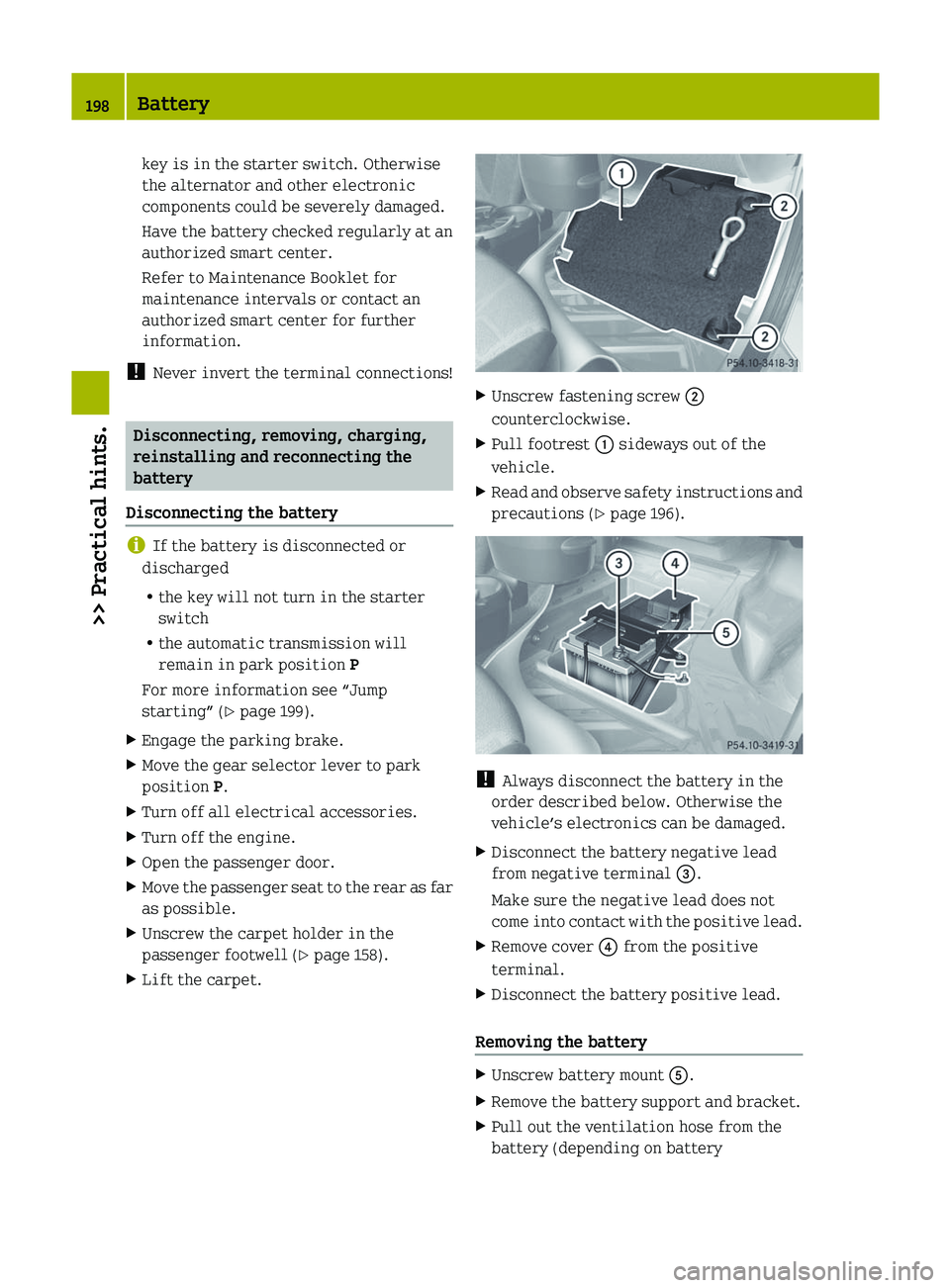
X Unscrew the carpet holder in the
passenger footwell (Y page 158).
X Lift the carpet. X
Unscrew fastening screw ;
counterclockwise.
X Pull footrest : sideways out of the
vehicle.
X Read and observe safety instructions and
precautions (Y page 196). !
Always disconnect the battery in the
order described below. Otherwise the
vehicle’s electronics can be damaged.
X Disconnect the battery negative lead
from negative terminal =.
Make sure the negative lead does not
come
into contact with the positive lead.
X Remove cover ? from the positive
terminal.
X Disconnect the battery positive lead.
Removing the battery X
Unscrew battery mount A.
X Remove the battery support and bracket.
X Pull out the ventilation hose from the
battery (depending on battery198
Battery
>> Practical hints.