service SMART FORTWO COUPE 2012 Owner's Manual
[x] Cancel search | Manufacturer: SMART, Model Year: 2012, Model line: FORTWO COUPE, Model: SMART FORTWO COUPE 2012Pages: 228, PDF Size: 12.76 MB
Page 124 of 228
Coolant
G
WARNING
In order to avoid potentially serious burns:
R Use extreme caution when opening the
service flap if there are any signs of
steam or coolant leaking from the
cooling system, or if the coolant
temperature warning lamp ? in the
instrument cluster indicates that the
coolant is overheated.
R Do
not remove the pressure cap on coolant
reservoir if coolant temperature is
above 158¦ (70¥). Allow engine to cool
down before removing cap. The coolant
reservoir contains hot fluid and is under
pressure.
R Using a rag, slowly turn the cap
approximately 1
/ 2 turn to relieve excess
pressure. If opened immediately,
scalding hot fluid and steam will be
blown out under pressure.
The engine coolant is a mixture of water
and anticorrosion/antifreeze. To check the
coolant level the vehicle must be parked on
level ground and the engine must have
cooled down. For more information, see
“Coolants” (Y page 223).
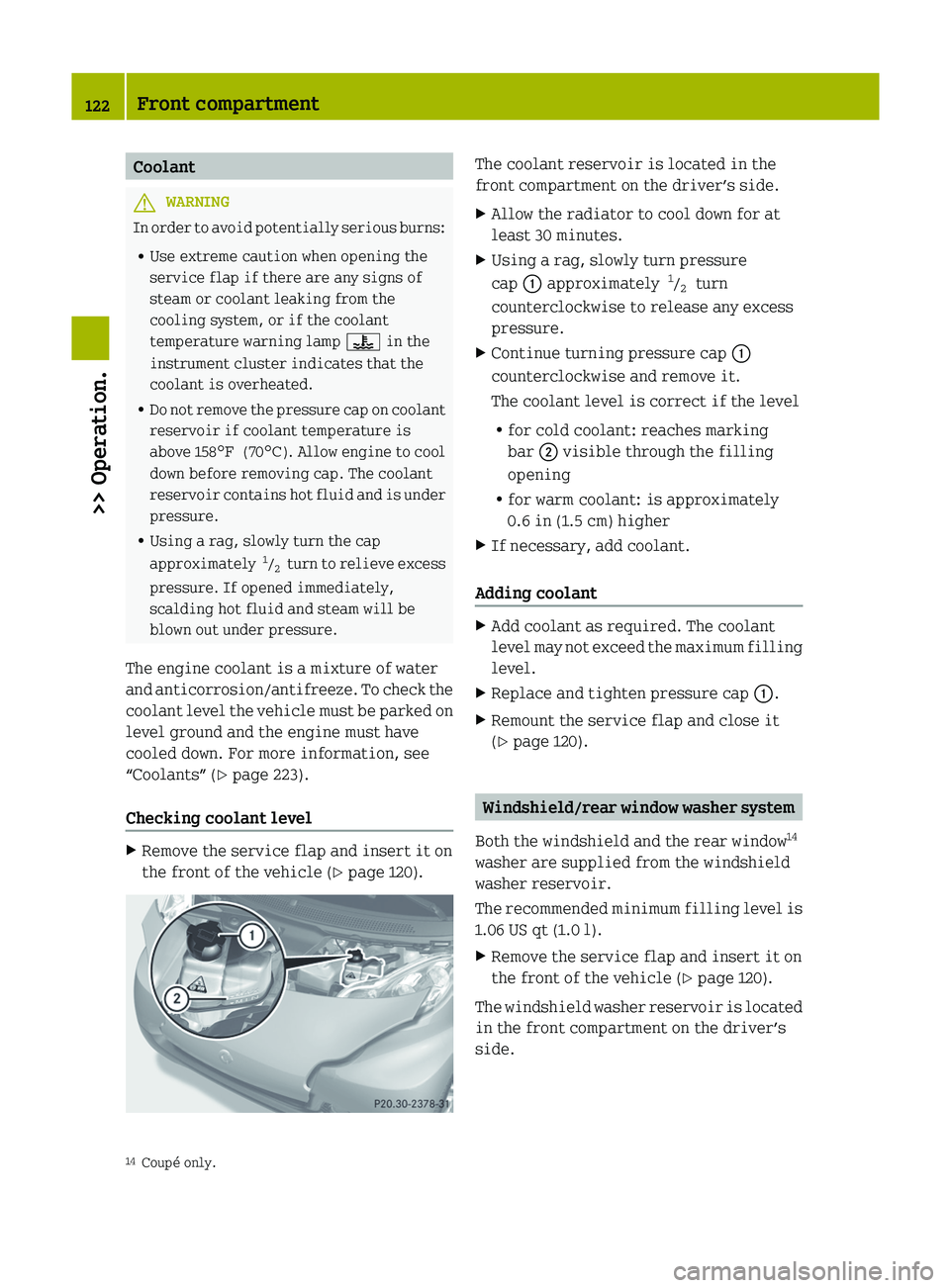
Checking coolant level X
Remove the service flap and insert it on
the front of the vehicle ( Y page 120). The coolant reservoir is located in the
front compartment on the driver’s side.
X
Allow the radiator to cool down for at
least 30 minutes.
X Using a rag, slowly turn pressure
cap : approximately 1
/ 2 turn
counterclockwise to release any excess
pressure.
X Continue turning pressure cap :
counterclockwise and remove it.
The coolant level is correct if the level
R
for cold coolant: reaches marking
bar ; visible through the filling
opening
R for warm coolant: is approximately
0.6 in (1.5 cm) higher
X If necessary, add coolant.
Adding coolant X
Add coolant as required. The coolant
level
may not exceed the maximum filling
level.
X Replace and tighten pressure cap :.
X Remount the service flap and close it
(Y page 120). Windshield/rear window washer system
Both the windshield and the rear window 14
washer are supplied from the windshield
washer reservoir.
The
recommended minimum filling level is
1.06 US qt (1.0 l).
X Remove the service flap and insert it on
the front of the vehicle ( Y page 120).
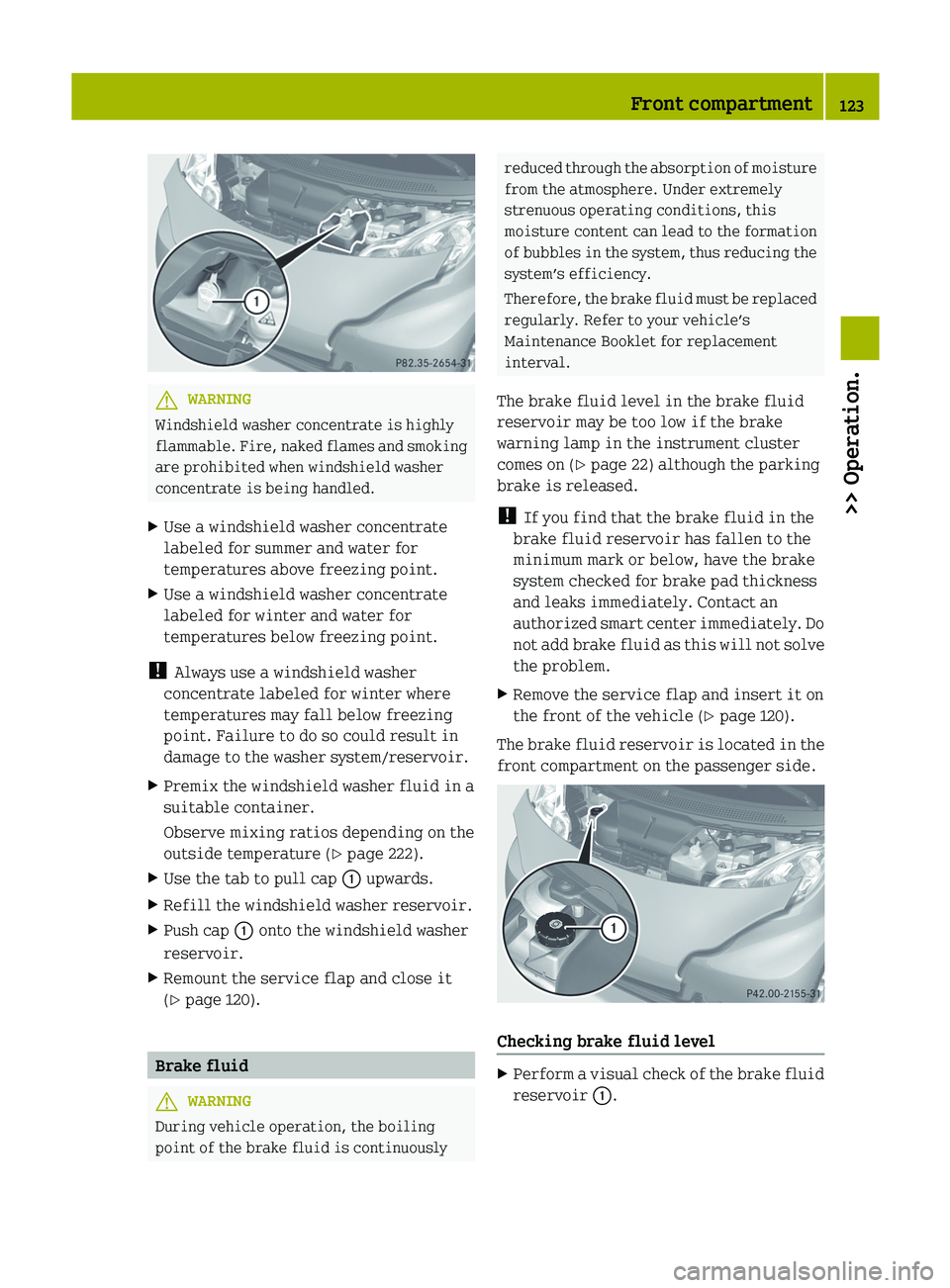
The windshield washer reservoir is located
in the front compartment on the driver’s
side.
14 Coupé only.122
Front compartment
>> Operation.
Page 125 of 228
G
WARNING
Windshield washer concentrate is highly
flammable. Fire, naked flames and smoking
are prohibited when windshield washer
concentrate is being handled.
X Use a windshield washer concentrate
labeled for summer and water for
temperatures above freezing point.
X Use a windshield washer concentrate
labeled for winter and water for
temperatures below freezing point.
! Always use a windshield washer
concentrate labeled for winter where
temperatures may fall below freezing
point. Failure to do so could result in
damage to the washer system/reservoir.
X Premix the windshield washer fluid in a
suitable container.
Observe mixing ratios depending on the
outside temperature
(Y page 222).
X Use the tab to pull cap : upwards.
X Refill the windshield washer reservoir.
X Push cap : onto the windshield washer
reservoir.
X Remount the service flap and close it
(Y page 120). Brake fluid
G
WARNING
During vehicle operation, the boiling
point of the brake fluid is continuously reduced through the absorption of moisture
from the atmosphere. Under extremely
strenuous operating conditions, this
moisture content can lead to the formation
of
bubbles in the system, thus reducing the
system’s efficiency.
Therefore, the brake fluid must be replaced
regularly. Refer to your vehicle’s
Maintenance Booklet for replacement
interval.
The brake fluid level in the brake fluid
reservoir may be too low if the brake
warning lamp in the instrument cluster
comes on (Y page 22) although the parking
brake is released.
! If you find that the brake fluid in the
brake fluid reservoir has fallen to the
minimum mark or below, have the brake
system checked for brake pad thickness
and leaks immediately. Contact an
authorized smart center immediately. Do
not add brake fluid as this will not solve
the problem.
X Remove the service flap and insert it on
the front of the vehicle ( Y page 120).
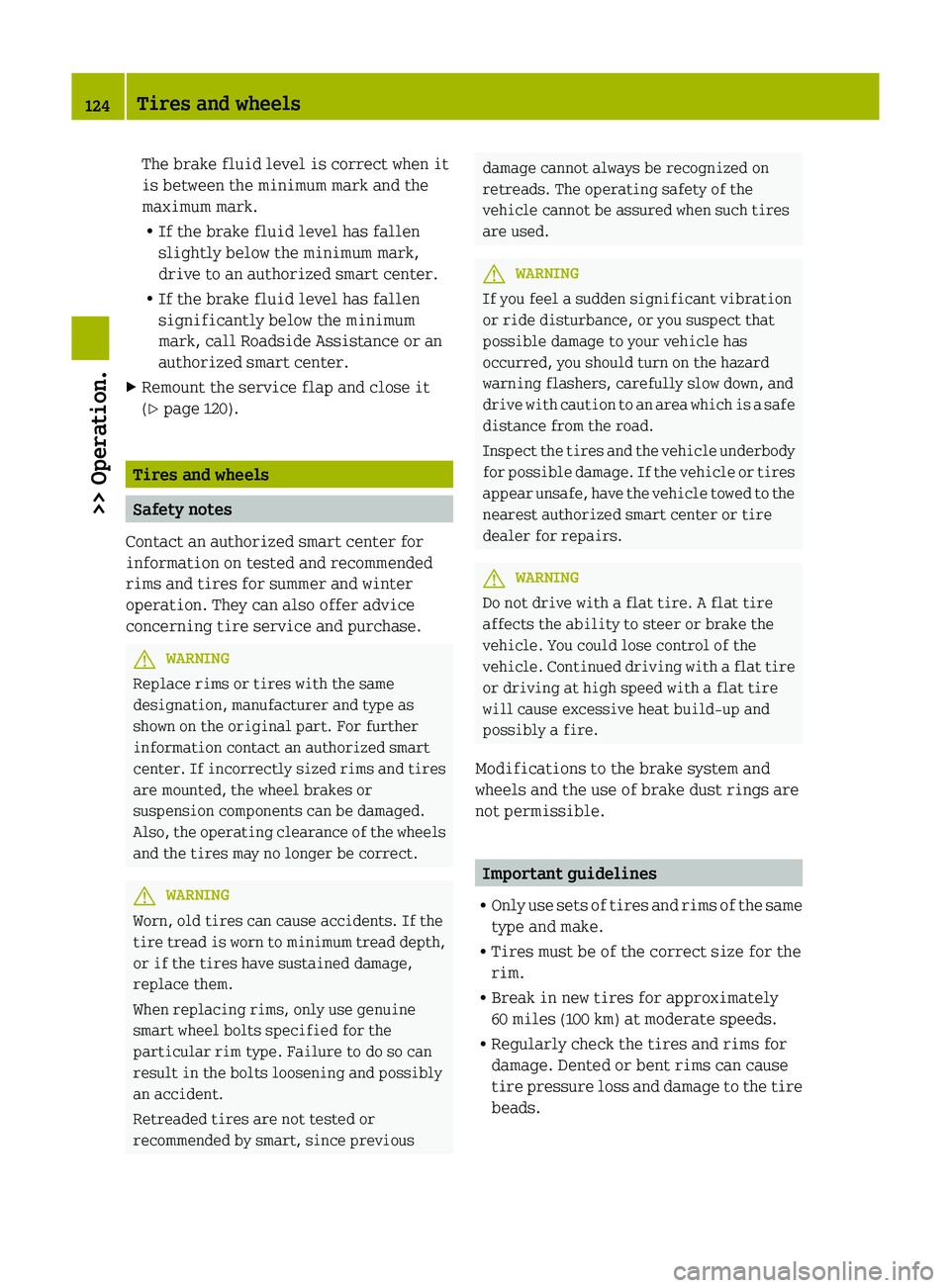
The brake fluid reservoir is located in the
front compartment on the passenger side. Checking brake fluid level
X
Perform a visual check of the brake fluid
reservoir :. Front compartment
123
>> Operation. Z
Page 126 of 228
The brake fluid level is correct when it
is between the minimum mark and the
maximum mark.
R
If the brake fluid level has fallen
slightly below the minimum mark,
drive to an authorized smart center.
R If the brake fluid level has fallen
significantly below the minimum
mark, call Roadside Assistance or an
authorized smart center.
X Remount the service flap and close it
(Y page 120). Tires and wheels
Safety notes
Contact an authorized smart center for
information on tested and recommended
rims and tires for summer and winter
operation. They can also offer advice
concerning tire service and purchase. G
WARNING
Replace rims or tires with the same
designation, manufacturer and type as
shown on the original part. For further
information contact an authorized smart
center.
If incorrectly sized rims and tires
are mounted, the wheel brakes or
suspension components can be damaged.
Also, the operating clearance of the wheels
and the tires may no longer be correct. G
WARNING
Worn, old tires can cause accidents. If the
tire
tread is worn to minimum tread depth,
or if the tires have sustained damage,
replace them.
When replacing rims, only use genuine
smart wheel bolts specified for the
particular rim type. Failure to do so can
result in the bolts loosening and possibly
an accident.
Retreaded tires are not tested or
recommended by smart, since previous damage cannot always be recognized on
retreads. The operating safety of the
vehicle cannot be assured when such tires
are used.
G
WARNING
If you feel a sudden significant vibration
or ride disturbance, or you suspect that
possible damage to your vehicle has
occurred, you should turn on the hazard
warning flashers, carefully slow down, and
drive
with caution to an area which is a safe
distance from the road.
Inspect the tires and the vehicle underbody
for possible damage. If the vehicle or tires
appear unsafe, have the vehicle towed to the
nearest authorized smart center or tire
dealer for repairs. G
WARNING
Do not drive with a flat tire. A flat tire
affects the ability to steer or brake the
vehicle. You could lose control of the
vehicle.
Continued driving with a flat tire
or driving at high speed with a flat tire
will cause excessive heat build-up and
possibly a fire.
Modifications to the brake system and
wheels and the use of brake dust rings are
not permissible. Important guidelines
R Only
use sets of tires and rims of the same
type and make.
R Tires must be of the correct size for the
rim.
R Break in new tires for approximately
60 miles (100 km) at moderate speeds.
R Regularly check the tires and rims for
damage. Dented or bent rims can cause
tire pressure loss and damage to the tire
beads.124
Tires and wheels
>> Operation.
Page 135 of 228
For more information on tire load rating
(Y page 137).
For information on calculating total and
cargo load capacities ( Y page 131).Direction of rotation
Unidirectional tires offer added
advantages, such as better hydroplaning
performance.
To benefit, however, you must
make sure the tires rotate in the direction
specified.
An arrow on the sidewall indicates the
intended direction of rotation (spinning)
of the tire. Tire care and maintenance
G
WARNING
Regularly check the tires for damage.
Damaged tires can cause tire inflation
pressure loss. As a result, you could lose
control of your vehicle.
Worn, old tires can cause accidents. If the
tire
tread is badly worn, or if the tires have
sustained damage, replace them.
Check the tire inflation pressure at least
once a month. For more information on
checking tire inflation pressure, see
“Recommended tire inflation pressure”
(Y page 125).
Tire inspection Every time you check the tire inflation
pressure, you should also inspect your
tires for the following
R
excessive treadwear ( Y page 133)
R cord
or fabric showing through the tire’s
rubber
R bumps, bulges, cuts, cracks or splits in
the tread or side of the tire
Replace the tire if you find any of the above
conditions. Life of tire G
WARNING
Tires should be replaced after 6 years,
regardless of the remaining tread.
The
service life of a tire is dependent upon
varying factors including but not limited
to
R driving style
R tire inflation pressure
R distance driven
Tread depth G
WARNING
Although the applicable federal motor
vehicle safety laws consider a tire to be
worn when the treadwear indicators (TWI)
become visible at approximately
1
/ 16 in
(1.6 mm), we recommend that you do not allow
your tires to wear down to that level. As
tread depth approaches 1
/ 8 in (3 mm), the
adhesion properties on a wet road are
sharply reduced.
Depending upon the weather and/or road
surface (conditions), the tire traction
varies widely.
Do not allow your tires to wear down too far.
Adhesion properties on wet roads are
sharply reduced at tread depths of less
than 1
/ 8 in (3 mm).
Treadwear indicators (TWI) are required by
law. These indicators are located in six
places on the tread circumference and
become visible at a tread depth of
approximately 1
/ 16 in (1.6 mm), at which
point the tire is considered worn and
should be replaced.
Recommended minimum tire tread depth:
Summer tires 1
/ 8 in (3 mm)
Winter tires 1
/ 6 in (4 mm) Tires and wheels
133>> Operation. Z
Page 136 of 228
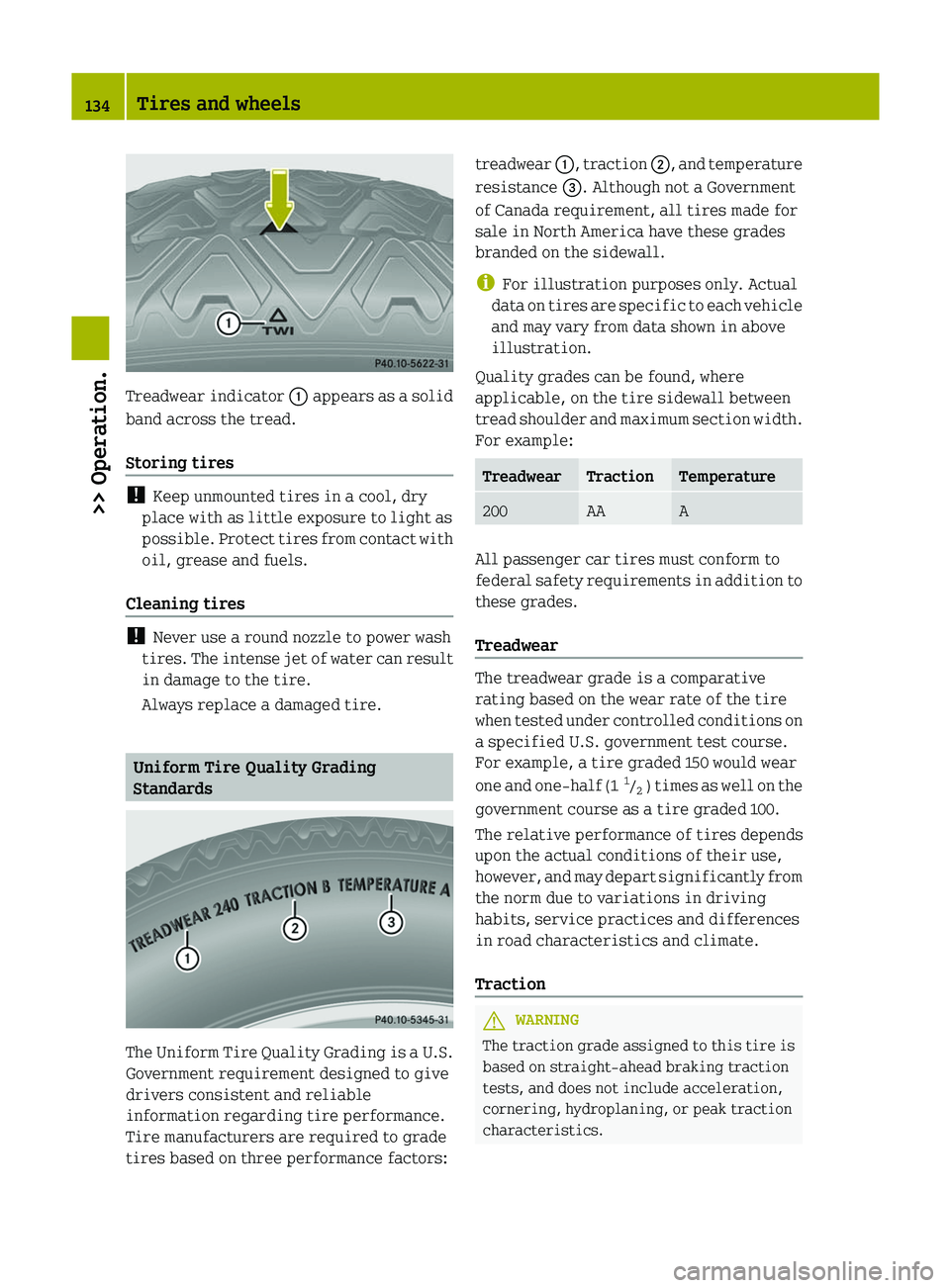
Treadwear indicator
: appears as a solid
band across the tread.
Storing tires !
Keep unmounted tires in a cool, dry
place with as little exposure to light as
possible.
Protect tires from contact with
oil, grease and fuels.
Cleaning tires !
Never use a round nozzle to power wash
tires.
The intense jet of water can result
in damage to the tire.
Always replace a damaged tire. Uniform Tire Quality Grading
Standards
The Uniform Tire Quality Grading is a U.S.
Government requirement designed to give
drivers consistent and reliable
information regarding tire performance.
Tire manufacturers are required to grade
tires based on three performance factors: treadwear
:,
traction ;, and temperature
resistance =. Although not a Government
of Canada requirement, all tires made for
sale in North America have these grades
branded on the sidewall.
i For illustration purposes only. Actual
data on tires are specific to each vehicle
and may vary from data shown in above
illustration.
Quality grades can be found, where
applicable, on the tire sidewall between
tread shoulder and maximum section width.
For example: Treadwear Traction Temperature
200 AA A
All passenger car tires must conform to
federal
safety requirements in addition to
these grades.
Treadwear The treadwear grade is a comparative
rating based on the wear rate of the tire
when
tested under controlled conditions on
a specified U.S. government test course.
For example, a tire graded 150 would wear
one and one-half (1 1
/ 2 ) times as well on the
government course as a tire graded 100.
The relative performance of tires depends
upon the actual conditions of their use,
however, and may depart significantly from
the norm due to variations in driving
habits, service practices and differences
in road characteristics and climate.
Traction G
WARNING
The traction grade assigned to this tire is
based on straight-ahead braking traction
tests, and does not include acceleration,
cornering, hydroplaning, or peak traction
characteristics. 134
Tires and wheels
>> Operation.
Page 139 of 228
Tire load rating
G
WARNING
The tire load rating must always be at least
half of the GAWR of your vehicle. Otherwise,
tire failure may result and cause an
accident and/or serious personal injury to
you or others.
Always replace rims and tires with the same
designation, manufacturer and type as
shown on the original part. G
WARNING
Do not overload the tires by exceeding the
specified load limit as indicated on the
Tire and Loading Information placard on
the
driver’s door B‑pillar. Overloading the
tires can overheat them, possibly causing
a blowout. Overloading the tires can also
result in handling or steering problems, or
brake failure.
Tire load rating A is a numerical code
associated with the maximum load a tire
can support.
For example, a load rating of 91
corresponds to a maximum load of 1 356 lbs
(615 kg) the tire is designed to support.
See also “Maximum tire load” ( Y page 132)
where the maximum load associated with
the load index is indicated in kilograms
and lbs.
For additional information on tire load
rating, see “Load identification”
(Y page 138).
Tire speed rating G
WARNING
Even when permitted by law, never operate
a vehicle at speeds greater than the
maximum speed rating of the tires.
Exceeding the maximum speed for which
tires are rated can lead to sudden tire
failure,
causing loss of vehicle control and
possibly resulting in an accident and/or
personal injury and possible death, for you
and for others. Regardless of the tire speed rating, local
speed
limits should be obeyed. Use prudent
driving speeds appropriate to prevailing
conditions.
Tire speed rating B indicates the
approved maximum speed for the tire.
Summer tires Index Speed rating
Q up to 100 mph (160 km/h)
R up to 106 mph (170 km/h)
S up to 112 mph (180 km/h)
T up to 118 mph (190 km/h)
H up to 130 mph (210 km/h)
V up to 149 mph (240 km/h)
W up to 168 mph (270 km/h)
Y up to 186 mph (300 km/h)
ZR...Y above 186 mph (300 km/h)
ZR...(Y) above 186 mph (300 km/h)
ZR above 149 mph (240 km/h)
R
At the tire manufacturer’s option, any
tire with a speed capability above
149 mph (240 km/h) can include a “ZR” in
the size designation (for example:
245/40 ZR18). To determine the maximum
speed
capability of the tire, the service
description for the tire must be referred
to.
The service description is comprised of
tire load rating A and tire speed rating
B.
If your tire includes “ZR” in the size
designation and no service description
is given, the tire manufacturer must be
consulted for the maximum speed
capability.
If a service description is given, the
speed capability is limited by the speed Tires and wheels
137
>> Operation. Z
Page 140 of 228
symbol in the service description.
Example: 245/40 ZR18 97Y.
In this example, “97Y” is the service
description. The letter “Y” designates
the speed rating and the speed
capability of the tire is limited to
186 mph (300 km/h).
R Any tire with a speed capability above
186
mph (300 km/h) must include a “ZR” in
the size designation AND the service
description must be placed in
parenthesis. Example:
275/40 ZR 18 (99Y). The “(Y)” speed rating
in parenthesis designates the maximum
speed capability of the tire as being
above 186 mph (300 km/h). Consult the tire
manufacturer for the actual maximum
permissible speed of the tire.
All-season and winter tires Index Speed rating
Q M+S
15 up to 100 mph (160 km/h)
T M+S
15 up to 118 mph (190 km/h)
H M+S
15 up to 130 mph (210 km/h)
V M+S
15 up to 149 mph (240 km/h)
i
Not
all M+S rated tires provide special
winter performance. Make sure the tires
you use show M+S and the mountain/
snowflake marking i on the tire
sidewall. These tires meet specific snow
traction performance requirements of
the Rubber Manufacturers Association
(RMA) and the Rubber Association of
Canada (RAC) and have been designed
specifically for use in snow conditions. Load identification
i
For illustration purposes only. Actual
data
on tires are specific to each vehicle
and may vary from data shown in above
illustration.
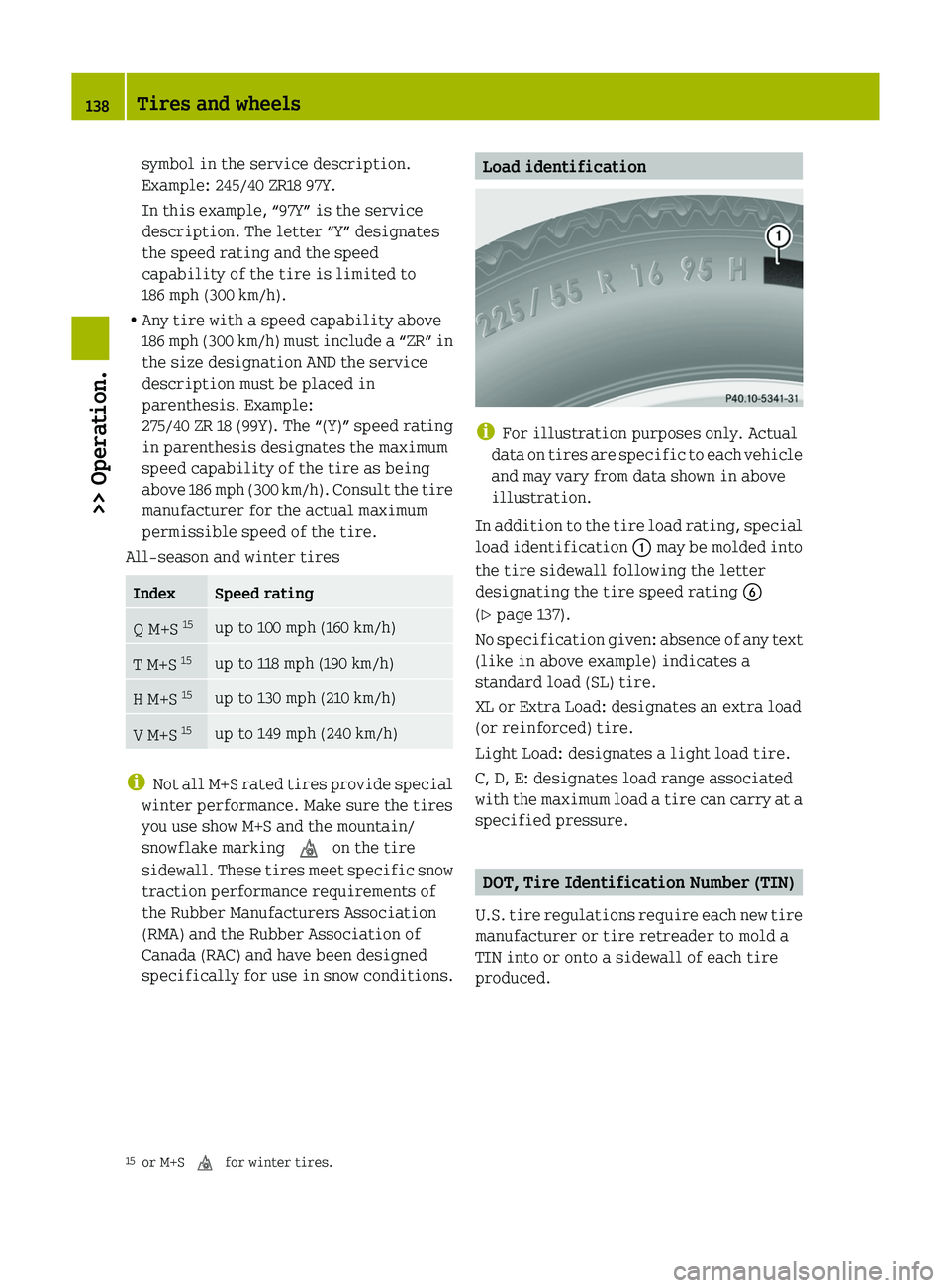
In addition to the tire load rating, special
load identification : may be molded into
the tire sidewall following the letter
designating the tire speed rating B
(Y page 137).
No specification given: absence of any text
(like in above example) indicates a
standard load (SL) tire.
XL or Extra Load: designates an extra load
(or reinforced) tire.
Light Load: designates a light load tire.
C, D, E: designates load range associated
with the maximum load a tire can carry at a
specified pressure. DOT, Tire Identification Number (TIN)
U.S.
tire regulations require each new tire
manufacturer or tire retreader to mold a
TIN into or onto a sidewall of each tire
produced.
15 or M+S i for winter tires.138
Tires and wheels
>> Operation.
Page 144 of 228
Treadwear indicators
Narrow bands, sometimes called “wear
bars” that show across the tread of a tire
when
only 1
/ 16 in (1.6 mm) of tread remains.
Uniform Tire Quality Grading Standards A tire information system that provides
consumers with ratings for a tire’s
traction, temperature and treadwear.
Ratings are determined by tire
manufacturers using U.S. government
testing
procedures. The ratings are molded
into the sidewall of the tire.
Vehicle maximum load on the tire Load on an individual tire that is
determined by distributing to each axle
its share of the maximum loaded vehicle
weight and dividing it by two.
Winter driving
Before the onset of winter, have your
vehicle winterized at an authorized smart
center.
This service includes:
R Check of anticorrosion and antifreeze
concentration.
R Addition of washer concentrate to the
water of the windshield/rear window.
Use a windshield washer concentrate
labeled for winter which is formulated
for temperatures below freezing point
(Y page 222).
R Battery
test. Battery capacity drops with
decreasing ambient temperature. A well
charged battery helps to make sure the
engine can be started, even at low
ambient temperatures.
R Tire change. Winter tires
G
WARNING
Winter tires with a tread depth of less
than 1
/ 6 in (4 mm) must be replaced. They
are no longer suitable for winter
operation.
Always use winter tires at temperatures
below 45 ¦ (7¥) and whenever wintry road
conditions
prevail. Not all M+S rated tires
provide special winter performance. Make
sure the tires you use show the mountain/
snowflake marking i on the tire
sidewall. These tires meet specific snow
traction performance requirements of the
Rubber Manufacturers Association (RMA)
and the Rubber Association of Canada (RAC)
and have been designed specifically for
use in snow conditions. Use of winter tires
is the only way to achieve the maximum
effectiveness of the ABS and ESP ®
in winter
operation.
For safe handling, make sure all mounted
winter tires are of the same make and have
the same tread design.
For information on winter tires for your
vehicle model, see the "Technical data"
section (Y page 217).
Always observe the speed rating of the
winter tires installed on your vehicle. If
the maximum speed for which your tires are
rated is below the speed rating of your
vehicle, you must place a notice to this
effect where it will be seen by the driver.
Such notices are available at your tire
dealer or any authorized smart center. Snow chains*
! Remember
that snow chains must always
be compatible with the tire sizes of a
vehicle. Snow chains that are approved
by smart are only permitted for the
following tire size:
175/55 R15 on the rear axle. 142
Winter driving
>> Operation.
* optional
Page 146 of 228
important to keep in mind that a
considerably higher degree of effort is
necessary to brake and steer the vehicle.
Adapt your driving accordingly.
Brakes
G
WARNING
Make sure not to endanger any other road
users when carrying out braking
maneuvers.
Refer to the description of the hydraulic
brake assistant
(Y page 48).
! Because the ESP ®
operates
automatically, the engine must be turned
off (ignition switched off) when the
parking brake is being tested on a brake
test dynamometer. Active braking action
through the ESP ®
may otherwise seriously
damage the brake system which is not
covered by the smart Limited Warranty.
Brake pad wear or a leak in the brake system
may be the reason for low brake fluid level
in the brake fluid reservoir.
The brake fluid level in the brake fluid
reservoir may be too low if the brake
warning lamp in the instrument cluster
comes on (Y page 22) although the parking
brake is released.
Have the brake system inspected
immediately. Contact an authorized smart
center.
All checks and service work on the brake
system should be carried out by qualified
technicians only. Contact an authorized
smart center.
Only install brake pads and use brake fluid
recommended by smart.
Inclines !
When driving down long and steep
grades,
relieve the load on the brakes by
shifting into a lower gear to use the engine’s braking power. This helps
prevent overheating of the brakes and
reduces brake pad wear.
When
using the engine’s braking power, a
drive wheel may not spin for an extended
period of time, e.g. on slippery road
surfaces. This may cause serious damage
to the drive- train which is not covered
by the smart Limited Warranty.
High and low stresses G
WARNING
Resting your foot on the brake pedal will
cause excessive and premature wear of the
brake pads.
It can also result in the brakes
overheating, thereby significantly
reducing their effectiveness and your
ability to stop the vehicle in sufficient
time to avoid an accident.
After
hard braking, it is advisable to drive
on for some time, rather than immediately
park, so that the air stream will cool down
the brakes faster.
If your brake system is normally only
subjected to moderate loads, you should
occasionally test the effectiveness of the
brakes by applying above-normal braking
pressure at higher speeds. This will also
enhance the grip of the brake pads. G
WARNING
Make sure not to endanger any other road
users when carrying out these braking
maneuvers.
Wet road surface G
WARNING
After driving in heavy rain for some time
without applying the brakes or through
water
deep enough to wet brake components,
the first braking action may be somewhat
reduced and increased pedal pressure may
be necessary to obtain expected braking 144
Driving instructions
>> Operation.
Page 148 of 228
Catalytic converter
Your smart is equipped with monolithic-
type catalytic converter, an important
element in conjunction with the oxygen
sensors to achieve substantial control of
the pollutants in the exhaust emissions.
Keep your vehicle in proper operating
condition by following our recommended
maintenance instructions as outlined in
your Maintenance Booklet. G
WARNING
The catalytic converter can become very
hot. Coming into contact with the catalytic
converter could result in burns.
Note the following:
R Do not remove the protective heat guards.
R Do not apply any underseal.
R As with any vehicle, do not idle, park, or
operate this vehicle in areas where
combustible materials such as grass,
hay, or leaves can come into contact with
the hot exhaust system, as these
materials could be ignited and cause a
vehicle fire.
! To prevent damage to the catalytic
converter, only use premium unleaded
gasoline in this vehicle.
Any noticeable irregularities in engine
operation should be repaired promptly.
Otherwise, excessive unburned fuel may
reach the catalytic converter, causing it
to overheat and potentially start a fire.
It is essential to observe the following
points, as there is otherwise a danger of
overheating and the catalytic converter
may be damaged.
R Fill up only with premium unleaded
gasoline. Even small quantities of
leaded gasoline can damage the catalytic
converter.
R Make sure you adhere to the prescribed
service intervals.
R Never run the fuel tank empty. R
If
the engine starts to misfire, bring the
vehicle to an immediate standstill
without endangering traffic.
R If the engine fails to start the first time,
you should not try to start it any more
than three times in succession.
R Do not try to start for more than four
seconds at a time. Tires
G
WARNING
If you feel a sudden significant vibration
or ride disturbance, or you suspect that
possible damage to your vehicle has
occurred, you should turn on the hazard
warning flashers, carefully slow down, and
drive
with caution to an area which is a safe
distance from the road.
Inspect the tires and the vehicle underbody
for possible damage. If the vehicle or tires
appear unsafe, have the vehicle towed to the
nearest smart center or tire dealer for
repairs.
Treadwear indicators (TWI) are required by
law. These indicators are located in six
places on the tread circumference and
become visible at a tread depth of
approximately 1
/ 16 in (1.6 mm), at which
point the tire is considered worn and
should be replaced.
The treadwear indicator appears as a solid
band across the tread. G
WARNING
Although the applicable federal motor
vehicle safety laws consider a tire to be
worn when the treadwear indicators (TWI)
become visible at approximately
1
/ 16 in
(1.6 mm), we recommend that you do not allow
your tires to wear down to that level. As
tread depth approaches 1
/ 8 in (3 mm), the
adhesion properties on a wet road are
sharply reduced. 146
Driving instructions
>> Operation.