weight SMART FORTWO COUPE 2012 Owner's Manual
[x] Cancel search | Manufacturer: SMART, Model Year: 2012, Model line: FORTWO COUPE, Model: SMART FORTWO COUPE 2012Pages: 228, PDF Size: 12.76 MB
Page 74 of 228
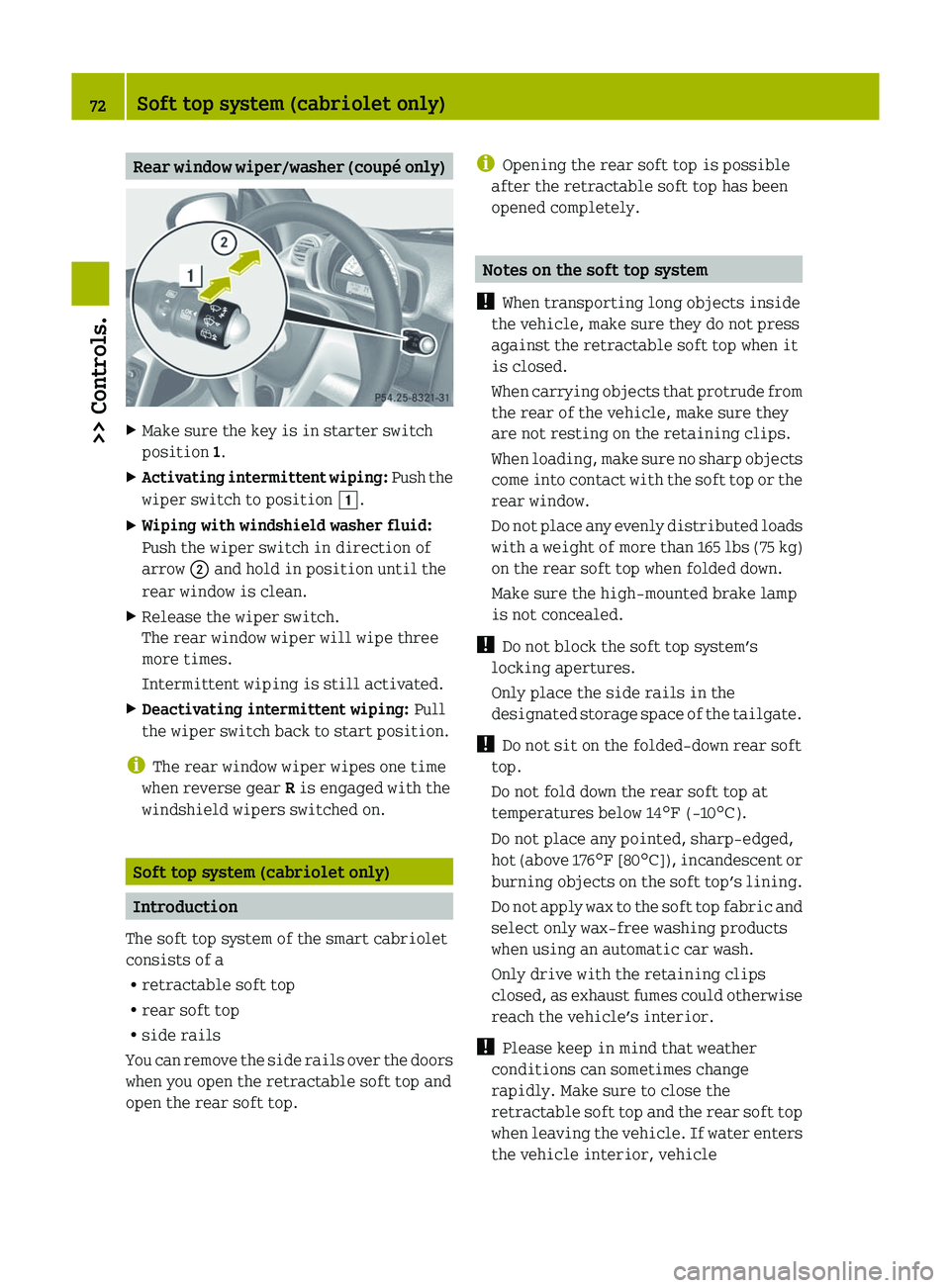
Rear window wiper/washer (coupé only)
X
Make sure the key is in starter switch
position 1.
X Activating intermittent wiping: Push the
wiper switch to position 1.
X Wiping with windshield washer fluid:
Push the wiper switch in direction of
arrow ; and hold in position until the
rear window is clean.
X Release the wiper switch.
The rear window wiper will wipe three
more times.
Intermittent wiping is still activated.
X Deactivating intermittent wiping: Pull
the wiper switch back to start position.
i The rear window wiper wipes one time
when reverse gear R is engaged with the
windshield wipers switched on. Soft top system (cabriolet only)
Introduction
The soft top system of the smart cabriolet
consists of a
R retractable soft top
R rear soft top
R side rails
You
can remove the side rails over the doors
when you open the retractable soft top and
open the rear soft top. i
Opening the rear soft top is possible
after the retractable soft top has been
opened completely. Notes on the soft top system
! When transporting long objects inside
the vehicle, make sure they do not press
against the retractable soft top when it
is closed.
When
carrying objects that protrude from
the rear of the vehicle, make sure they
are not resting on the retaining clips.
When loading, make sure no sharp objects
come into contact with the soft top or the
rear window.
Do not place any evenly distributed loads
with a weight of more than 165 lbs (75 kg)
on the rear soft top when folded down.
Make sure the high-mounted brake lamp
is not concealed.
! Do not block the soft top system’s
locking apertures.
Only place the side rails in the
designated storage space of the tailgate.
! Do not sit on the folded-down rear soft
top.
Do not fold down the rear soft top at
temperatures below 14 ¦ (-10¥).
Do not place any pointed, sharp-edged,
hot (above 176 ¦ [80¥]), incandescent or
burning objects on the soft top’s lining.
Do not apply wax to the soft top fabric and
select only wax-free washing products
when using an automatic car wash.
Only drive with the retaining clips
closed, as exhaust fumes could otherwise
reach the vehicle’s interior.
! Please keep in mind that weather
conditions can sometimes change
rapidly. Make sure to close the
retractable soft top and the rear soft top
when leaving the vehicle. If water enters
the vehicle interior, vehicle 72
Soft top system (cabriolet only)
>> Controls.
Page 110 of 228
event of an accident. For this reason, heavy
objects must be tied down.
Vehicle occupants could be injured by
objects
being thrown around in the vehicle
in the event of
R hard braking
R a change of direction
R an accident G
WARNING
Do not place any objects on the mounted
cargo compartment cover blind.
Vehicle occupants could be injured by
objects
being thrown around in the vehicle
in the event of
R hard braking
R a change of direction
R an accident G
WARNING
Only place light loads in the parcel net
bag.
Do not transport heavy, sharp-edged or
fragile objects in the parcel net bag. The
parcel net bag cannot sufficiently secure
loads in an accident.
Vehicle occupants could be injured by
objects being thrown around in the vehicle
in the event of
R hard braking
R a change of direction
R an accident
Observe the loading guidelines.
The cargo compartment cover blind
R serves to protect objects that are stored
in the vehicle’s cargo compartment from
prying eyes
R prevents smaller objects from
penetrating into the passenger
compartment from the cargo
compartment; however, it is not intended
to act as a load restraining device The parcel net bag
R
is
for storing small, lightweight objects
R prevents small objects from sliding
around inside the passenger
compartment
! If objects are placed on the cargo
compartment cover blind when mounted,
the cover may be damaged.
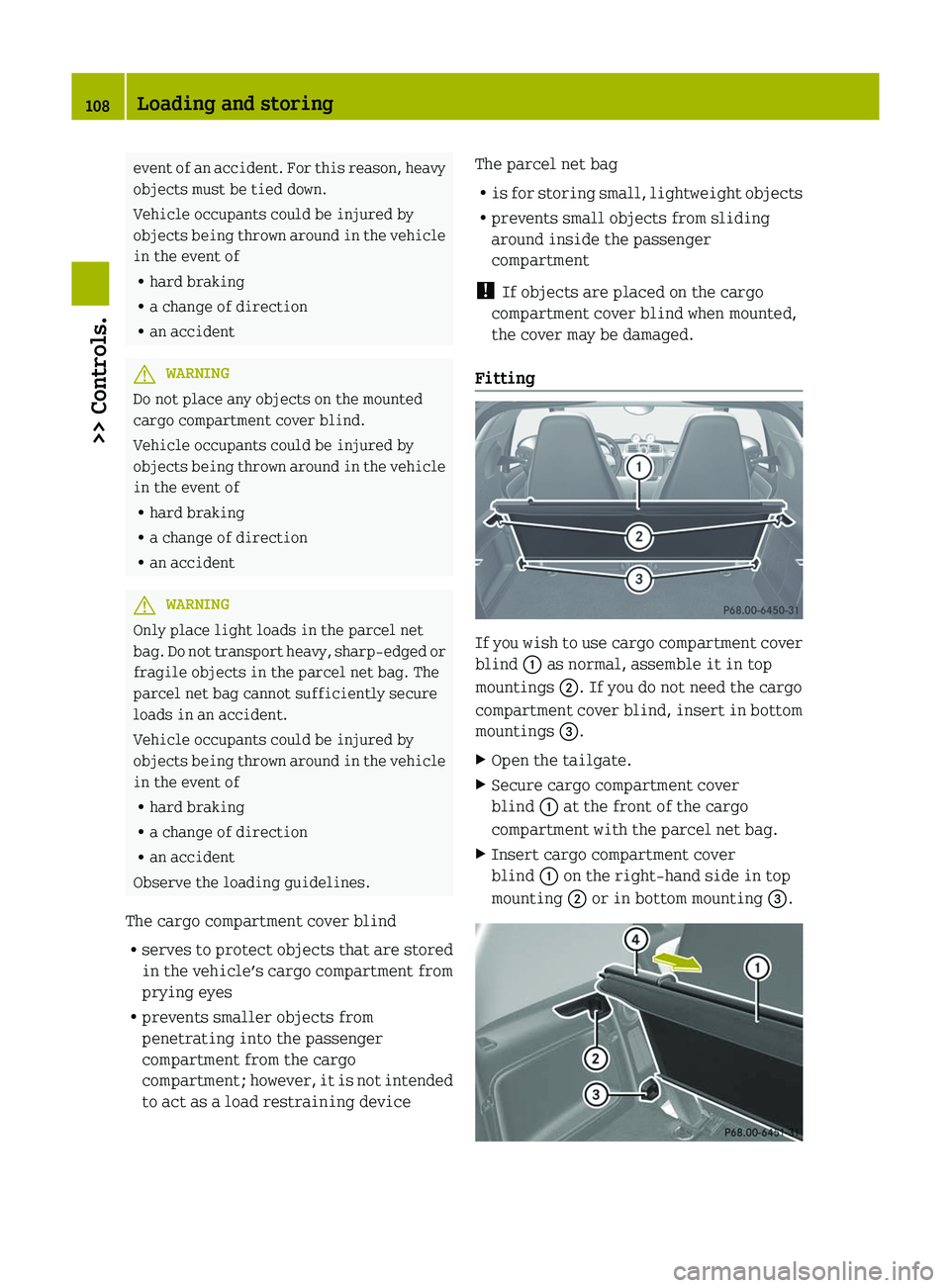
Fitting If you wish to use cargo compartment cover
blind : as normal, assemble it in top
mountings ;. If you do not need the cargo
compartment
cover blind, insert in bottom
mountings =.
X Open the tailgate.
X Secure cargo compartment cover
blind : at the front of the cargo
compartment with the parcel net bag.
X Insert cargo compartment cover
blind : on the right-hand side in top
mounting ; or in bottom mounting =.108
Loading and storing
>> Controls.
Page 113 of 228
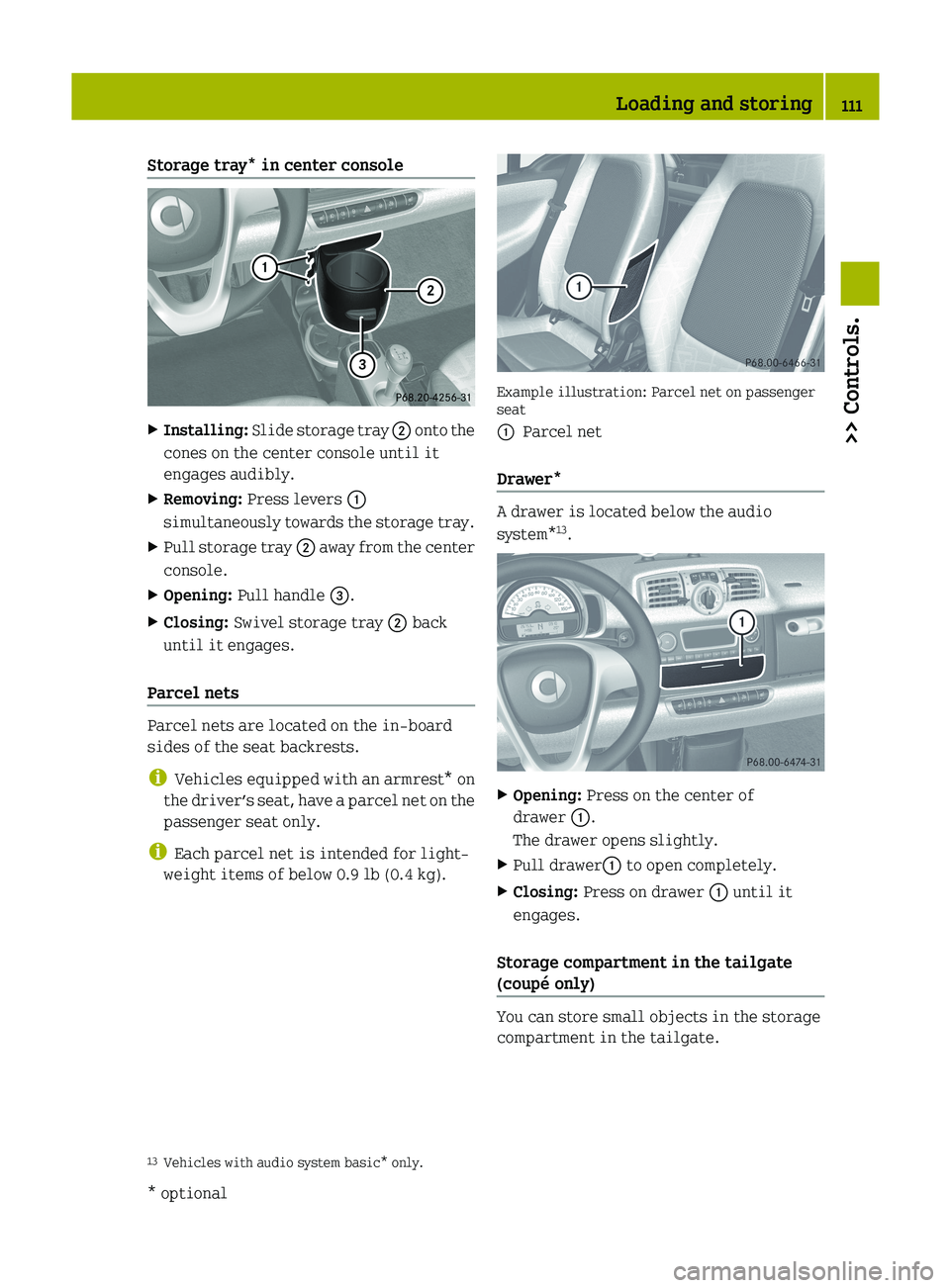
Storage tray* in center console
X
Installing: Slide storage tray ; onto the
cones on the center console until it
engages audibly.
X Removing: Press levers :
simultaneously
towards the storage tray.
X Pull storage tray ;
away from the center
console.
X Opening: Pull handle =.
X Closing: Swivel storage tray ; back
until it engages.
Parcel nets Parcel nets are located on the in-board
sides of the seat backrests.
i
Vehicles equipped with an armrest*
on
the driver’s seat, have a parcel net on the
passenger seat only.
i Each parcel net is intended for light-
weight items of below 0.9 lb (0.4 kg). Example illustration: Parcel net on passenger
seat
:
Parcel net
Drawer* A drawer is located below the audio
system*
13
. X
Opening: Press on the center of
drawer :.
The drawer opens slightly.
X Pull drawer: to open completely.
X Closing: Press on drawer : until it
engages.
Storage compartment in the tailgate
(coupé only) You can store small objects in the storage
compartment in the tailgate.
13 Vehicles with audio system basic* only. Loading and storing
111
>> Controls.
* optional Z
Page 114 of 228
X
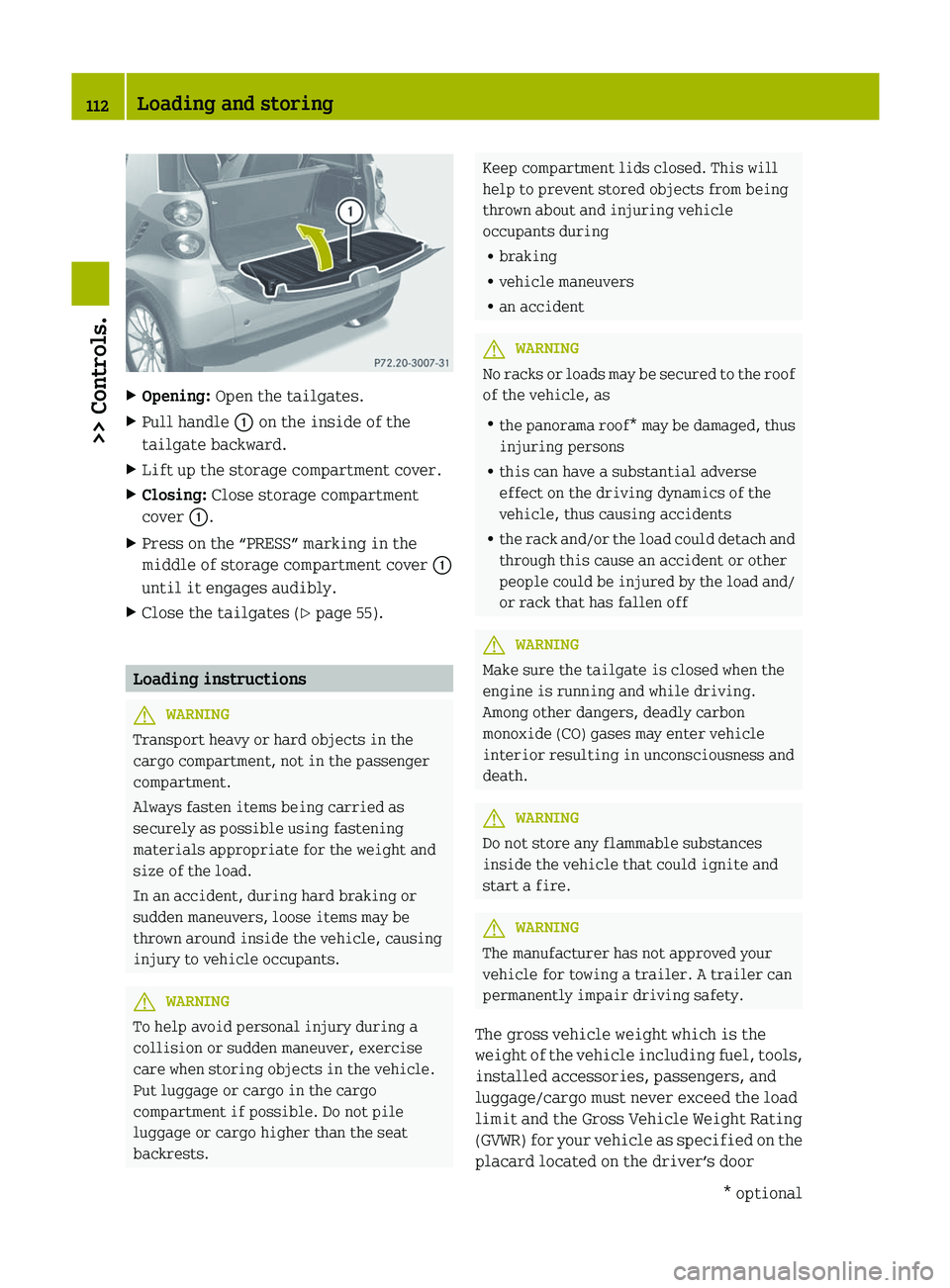
Opening: Open the tailgates.
X Pull handle : on the inside of the
tailgate backward.
X Lift up the storage compartment cover.
X Closing: Close storage compartment
cover :.
X Press on the “PRESS” marking in the
middle of storage compartment cover :
until it engages audibly.
X Close the tailgates ( Y page 55).Loading instructions
G
WARNING
Transport heavy or hard objects in the
cargo compartment, not in the passenger
compartment.
Always fasten items being carried as
securely as possible using fastening
materials appropriate for the weight and
size of the load.
In an accident, during hard braking or
sudden maneuvers, loose items may be
thrown around inside the vehicle, causing
injury to vehicle occupants. G
WARNING
To help avoid personal injury during a
collision or sudden maneuver, exercise
care when storing objects in the vehicle.
Put luggage or cargo in the cargo
compartment if possible. Do not pile
luggage or cargo higher than the seat
backrests. Keep compartment lids closed. This will
help to prevent stored objects from being
thrown about and injuring vehicle
occupants during
R
braking
R vehicle maneuvers
R an accident G
WARNING
No racks or loads may be secured to the roof
of the vehicle, as
R the
panorama roof* may be damaged, thus
injuring persons
R this can have a substantial adverse
effect on the driving dynamics of the
vehicle, thus causing accidents
R the rack and/or the load could detach and
through this cause an accident or other
people could be injured by the load and/
or rack that has fallen off G
WARNING
Make sure the tailgate is closed when the
engine is running and while driving.
Among other dangers, deadly carbon
monoxide (CO) gases may enter vehicle
interior resulting in unconsciousness and
death. G
WARNING
Do not store any flammable substances
inside the vehicle that could ignite and
start a fire. G
WARNING
The manufacturer has not approved your
vehicle for towing a trailer. A trailer can
permanently impair driving safety.
The gross vehicle weight which is the
weight
of the vehicle including fuel, tools,
installed accessories, passengers, and
luggage/cargo must never exceed the load
limit and the Gross Vehicle Weight Rating
(GVWR) for your vehicle as specified on the
placard located on the driver’s door 112
Loading and storing
>> Controls.
* optional
Page 115 of 228
B‑pillar (Y page 214). In addition, the
load must be distributed in such a way so
that the weight on each axle never exceeds
the
Gross Axle Weight Rating (GAWR) for the
front and rear axle. The GVWR and GAWR for
your vehicle are indicated on the
certification label which can be found on
the driver’s door B‑pillar.
For more information, see “Loading the
vehicle” ( Y page 130).
The handling characteristics of a fully
loaded vehicle depend greatly on the load
distribution. It is therefore recommended
to load the vehicle with the heaviest items
being placed towards the front of the
vehicle.
Please pay attention to and comply with the
following instructions when loading the
vehicle and transporting cargo:
R Always place items being carried
against seat backrests, and fasten them
as securely as possible.
R The heaviest portion of the cargo should
always be kept as low as possible against
seat backrests.
R Do not stack loads higher than the top
edge of the head restraints.
R Make sure no luggage/cargo items can get
above or next to the driver’s and/or
passenger seat into the passenger
compartment.
R Make sure luggage/cargo is properly
secured.
R Always use, if so equipped, cargo net*
when transporting cargo.
Do not carry any unnecessary weight in the
vehicle. This increases vehicle weight,
which results in increased energy
consumption. Useful features
Sun visors
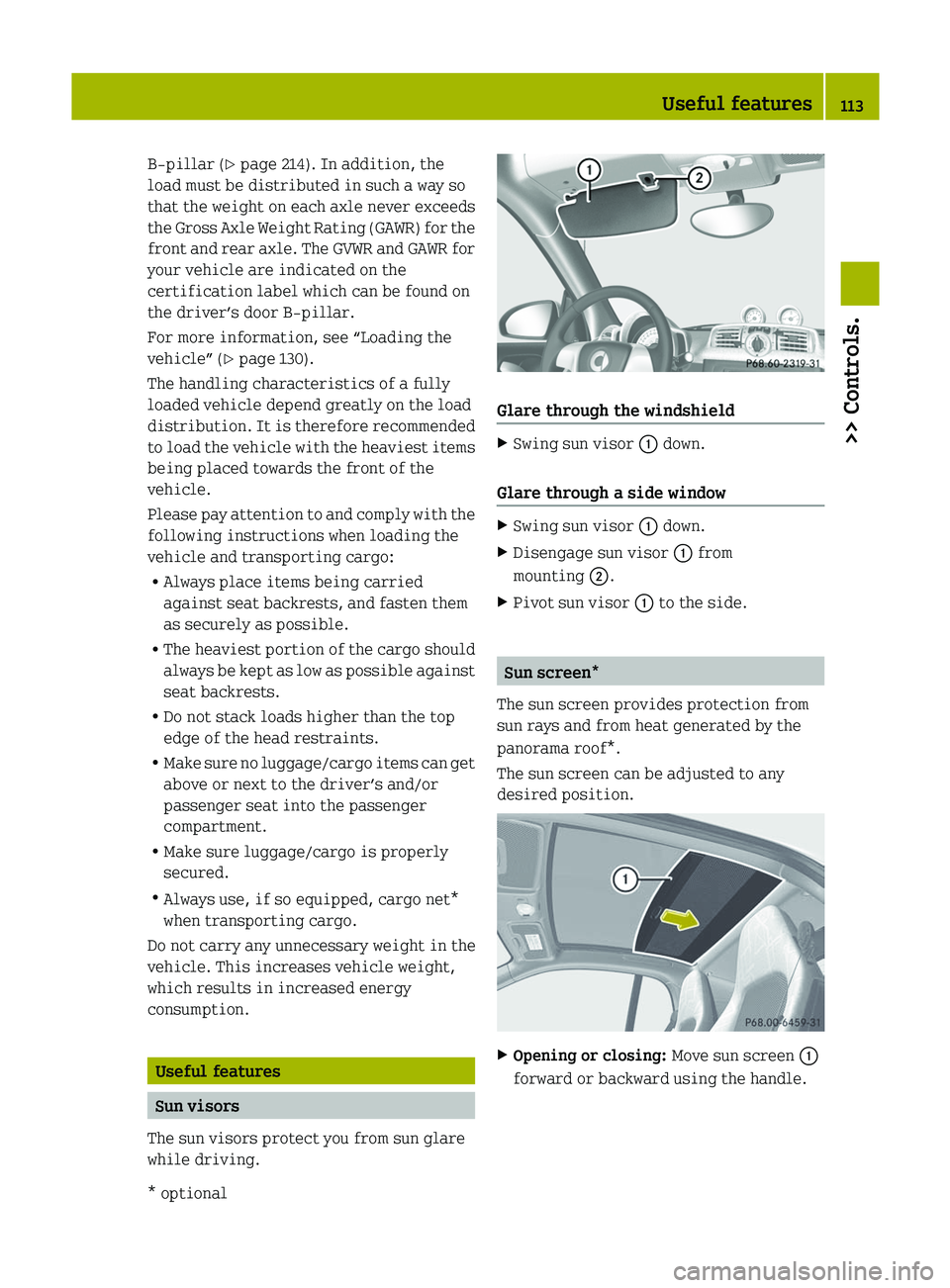
The sun visors protect you from sun glare
while driving. Glare through the windshield
X
Swing sun visor : down.
Glare through a side window X
Swing sun visor : down.
X Disengage sun visor : from
mounting ;.
X Pivot sun visor : to the side. Sun screen*
The sun screen provides protection from
sun rays and from heat generated by the
panorama roof*.
The sun screen can be adjusted to any
desired position. X
Opening or closing: Move sun screen :
forward or backward using the handle. Useful features
113
>> Controls.
* optional Z
Page 128 of 228
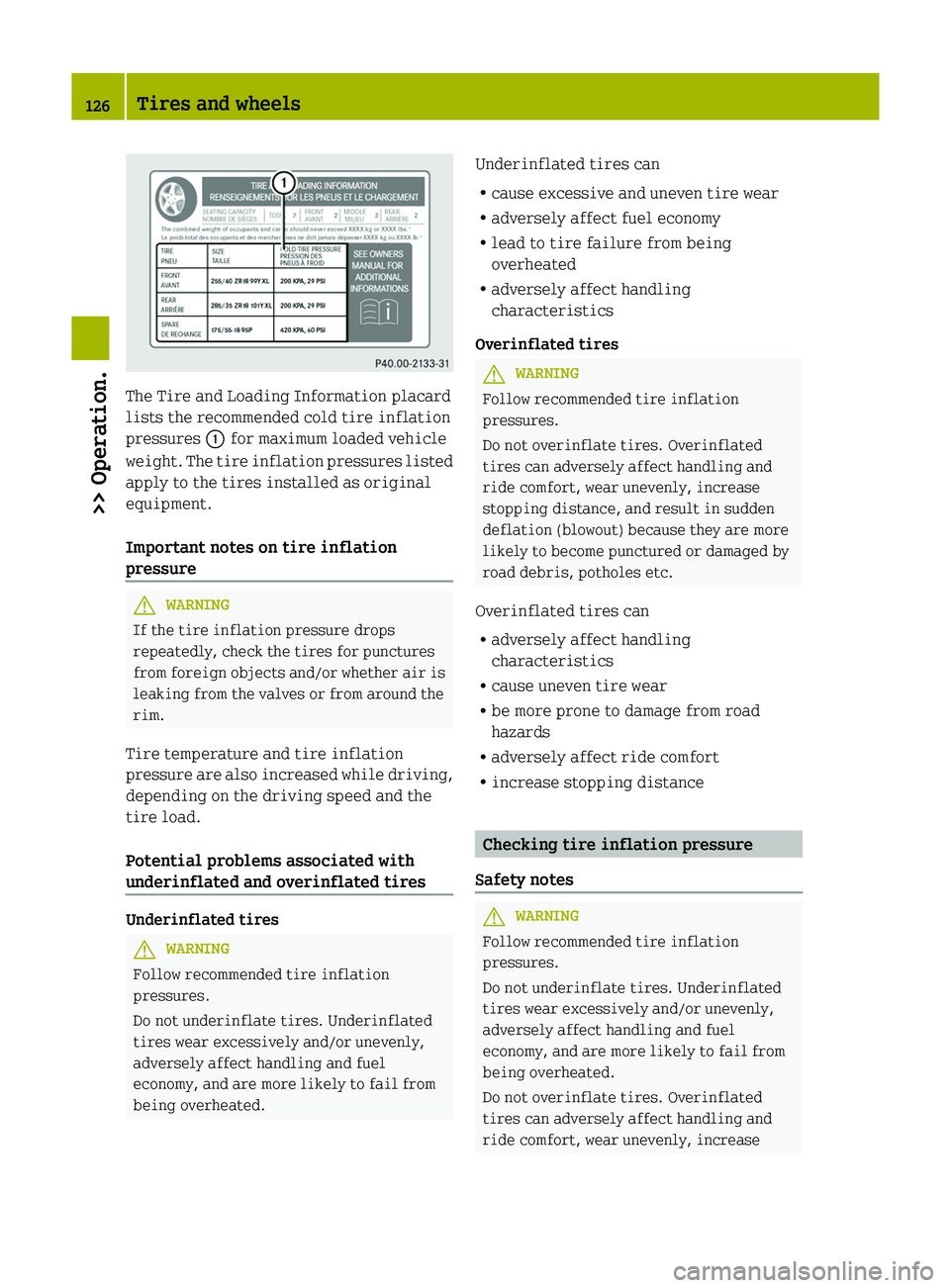
The Tire and Loading Information placard
lists the recommended cold tire inflation
pressures
: for maximum loaded vehicle
weight.
The tire inflation pressures listed
apply to the tires installed as original
equipment.
Important notes on tire inflation
pressure G
WARNING
If the tire inflation pressure drops
repeatedly, check the tires for punctures
from
foreign objects and/or whether air is
leaking from the valves or from around the
rim.
Tire temperature and tire inflation
pressure are also increased while driving,
depending on the driving speed and the
tire load.
Potential problems associated with
underinflated and overinflated tires Underinflated tires
G
WARNING
Follow recommended tire inflation
pressures.
Do not underinflate tires. Underinflated
tires wear excessively and/or unevenly,
adversely affect handling and fuel
economy, and are more likely to fail from
being overheated. Underinflated tires can
R
cause excessive and uneven tire wear
R adversely affect fuel economy
R lead to tire failure from being
overheated
R adversely affect handling
characteristics
Overinflated tires G
WARNING
Follow recommended tire inflation
pressures.
Do not overinflate tires. Overinflated
tires can adversely affect handling and
ride comfort, wear unevenly, increase
stopping distance, and result in sudden
deflation (blowout) because they are more
likely to become punctured or damaged by
road debris, potholes etc.
Overinflated tires can
R adversely affect handling
characteristics
R cause uneven tire wear
R be more prone to damage from road
hazards
R adversely affect ride comfort
R increase stopping distance Checking tire inflation pressure
Safety notes G
WARNING
Follow recommended tire inflation
pressures.
Do not underinflate tires. Underinflated
tires wear excessively and/or unevenly,
adversely affect handling and fuel
economy, and are more likely to fail from
being overheated.
Do not overinflate tires. Overinflated
tires can adversely affect handling and
ride comfort, wear unevenly, increase 126
Tires and wheels
>> Operation.
Page 132 of 228
Always follow the recommended tire
inflation pressure (
Y page 125) for proper
tire inflation. Loading the vehicle
Two labels on your vehicle show how much
weight it may properly carry.
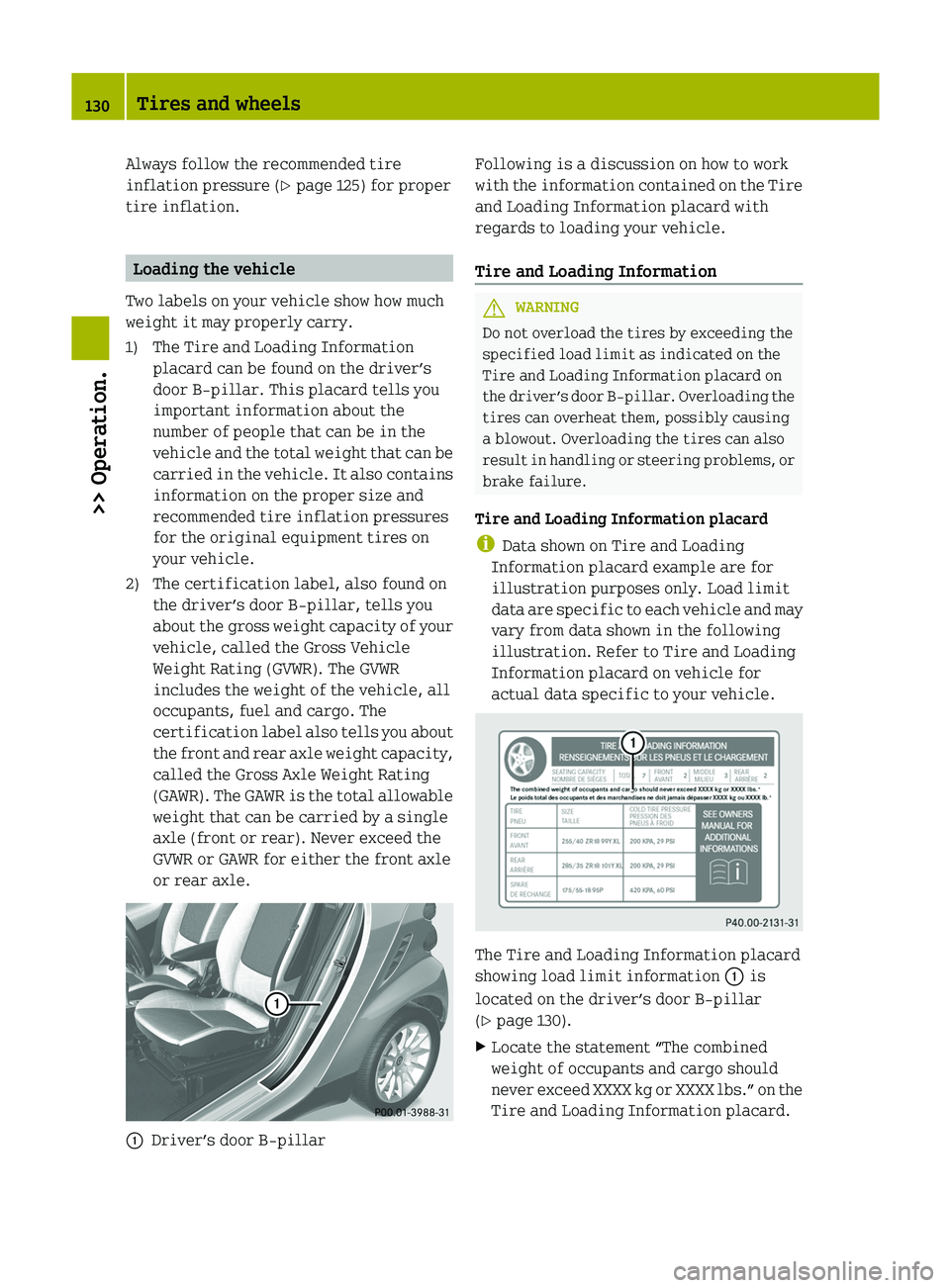
1) The Tire and Loading Information placard can be found on the driver’s
door B‑pillar. This placard tells you
important information about the
number of people that can be in the
vehicle
and the total weight that can be
carried in the vehicle. It also contains
information on the proper size and
recommended tire inflation pressures
for the original equipment tires on
your vehicle.
2) The certification label, also found on the driver’s door B‑pillar, tells you
about
the gross weight capacity of your
vehicle, called the Gross Vehicle
Weight Rating (GVWR). The GVWR
includes the weight of the vehicle, all
occupants, fuel and cargo. The
certification label also tells you about
the front and rear axle weight capacity,
called the Gross Axle Weight Rating
(GAWR). The GAWR is the total allowable
weight that can be carried by a single
axle (front or rear). Never exceed the
GVWR or GAWR for either the front axle
or rear axle. :
Driver’s door B‑pillar Following is a discussion on how to work
with
the information contained on the Tire
and Loading Information placard with
regards to loading your vehicle.
Tire and Loading Information G
WARNING
Do not overload the tires by exceeding the
specified load limit as indicated on the
Tire and Loading Information placard on
the
driver’s door B‑pillar. Overloading the
tires can overheat them, possibly causing
a blowout. Overloading the tires can also
result in handling or steering problems, or
brake failure.
Tire and Loading Information placard
i Data shown on Tire and Loading
Information placard example are for
illustration purposes only. Load limit
data are specific to each vehicle and may
vary from data shown in the following
illustration. Refer to Tire and Loading
Information placard on vehicle for
actual data specific to your vehicle. The Tire and Loading Information placard
showing load limit information
: is
located on the driver’s door B‑pillar
(Y page 130).
X Locate the statement “The combined
weight of occupants and cargo should
never
exceed XXXX kg or XXXX lbs.” on the
Tire and Loading Information placard. 130
Tires and wheels
>> Operation.
Page 133 of 228
The combined weight of all occupants and
cargo/luggage should never exceed the
weight referenced in that statement.
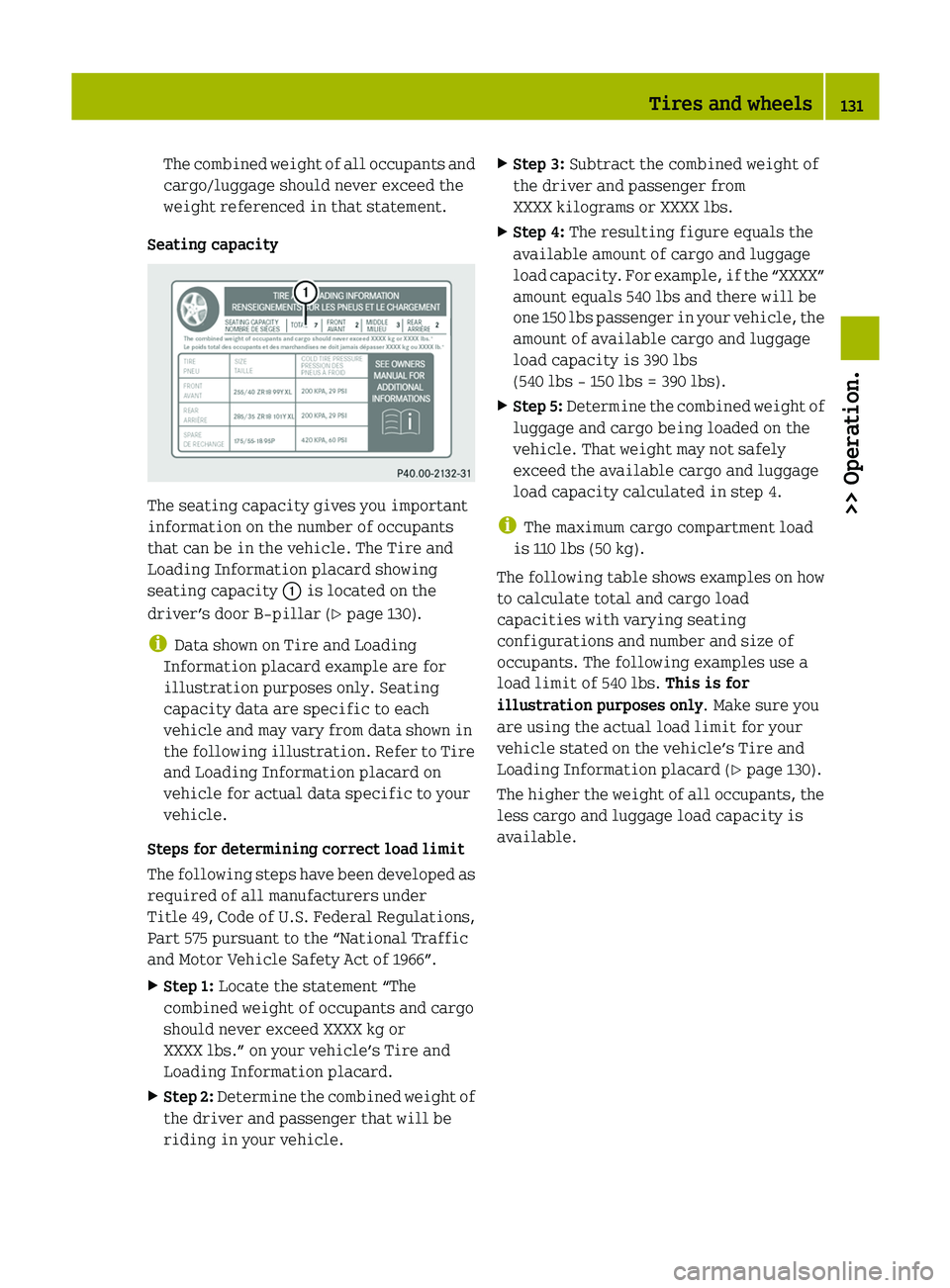
Seating capacity The seating capacity gives you important
information on the number of occupants
that can be in the vehicle. The Tire and
Loading Information placard showing
seating capacity : is located on the
driver’s door B‑pillar (
Y page 130).
i Data shown on Tire and Loading
Information placard example are for
illustration purposes only. Seating
capacity data are specific to each
vehicle and may vary from data shown in
the
following illustration. Refer to Tire
and Loading Information placard on
vehicle for actual data specific to your
vehicle.
Steps for determining correct load limit
The following steps have been developed as
required of all manufacturers under
Title 49, Code of U.S. Federal Regulations,
Part 575 pursuant to the “National Traffic
and Motor Vehicle Safety Act of 1966”.
X Step 1: Locate the statement “The
combined weight of occupants and cargo
should never exceed XXXX kg or
XXXX lbs.” on your vehicle’s Tire and
Loading Information placard.
X Step 2:
Determine the combined weight of
the driver and passenger that will be
riding in your vehicle. X
Step 3: Subtract the combined weight of
the driver and passenger from
XXXX kilograms or XXXX lbs.
X Step 4: The resulting figure equals the
available amount of cargo and luggage
load
capacity. For example, if the “XXXX”
amount equals 540 lbs and there will be
one 150 lbs passenger in your vehicle, the
amount of available cargo and luggage
load capacity is 390 lbs
(540 lbs - 150 lbs = 390 lbs).
X Step 5:
Determine the combined weight of
luggage and cargo being loaded on the
vehicle. That weight may not safely
exceed the available cargo and luggage
load capacity calculated in step 4.
i The maximum cargo compartment load
is 110 lbs (50 kg).
The
following table shows examples on how
to calculate total and cargo load
capacities with varying seating
configurations and number and size of
occupants. The following examples use a
load limit of 540 lbs. This is for
illustration purposes only . Make sure you
are using the actual load limit for your
vehicle stated on the vehicle’s Tire and
Loading Information placard (Y page 130).
The higher the weight of all occupants, the
less cargo and luggage load capacity is
available. Tires and wheels
131>> Operation. Z
Page 134 of 228

Examples for steps 1 to 3
Example 1 Example 2
Step 1 Combined weight limit of
occupants
and cargo from Tire and
Loading Information placard 540 lbs 540 lbs
Step 2 Number of occupants (driver and
passenger)
2 1
Occupants weight
Occupant 1: 150 lbs
Occupant 2: 180 lbs Occupant 1: 150 lbs
Combined weight of all occupants
330 lbs 150 lbs
Step 3 Available cargo weight (total load
limit from Tire and Loading
Information placard minus
combined weight of all occupants)
540 lbs - 330 lbs =
210 lbs 540 lbs - 150 lbs =
390 lbs
Certification label
Even after careful determination of the
combined
weight of all occupants and cargo
as to not exceed the permissible load
limit, you must make sure your vehicle
never exceeds the Gross Vehicle Weight
Rating (GVWR) and the Gross Axle Weight
Rating (GAWR) for either the front or rear
axle. You can obtain the GVWR and GAWR
from the certification label. The
certification label can be found on the
driver’s door B‑pillar, see “Technical
data” (Y page 214).
Gross Vehicle Weight Rating (GVWR) means:
The total weight of the vehicle, all
occupants, and all cargo must never exceed
the GVWR.
Gross Axle Weight Rating (GAWR) means:
The total allowable weight that can be
carried by a single axle (front or rear).
To assure that your vehicle does not exceed
the maximum permissible weight limits
(GVWR and GAWR for front and rear axle),
have the loaded vehicle (including driver,
passenger, and all cargo) weighed on a
suitable commercial scale. Maximum tire load
G
WARNING
Do not overload the tires by exceeding the
specified load limit as indicated on the
Tire and Loading Information placard on
the
driver’s door B‑pillar. Overloading the
tires can overheat them, possibly causing
a blowout. Overloading the tires can also
result in handling or steering problems, or
brake failure. i
For illustration purposes only. Actual
data
on tires are specific to each vehicle
and may vary from data shown in above
illustration.
The maximum tire load : is the maximum
weight the tires are designed to support. 132
Tires and wheels
>> Operation.
Page 141 of 228
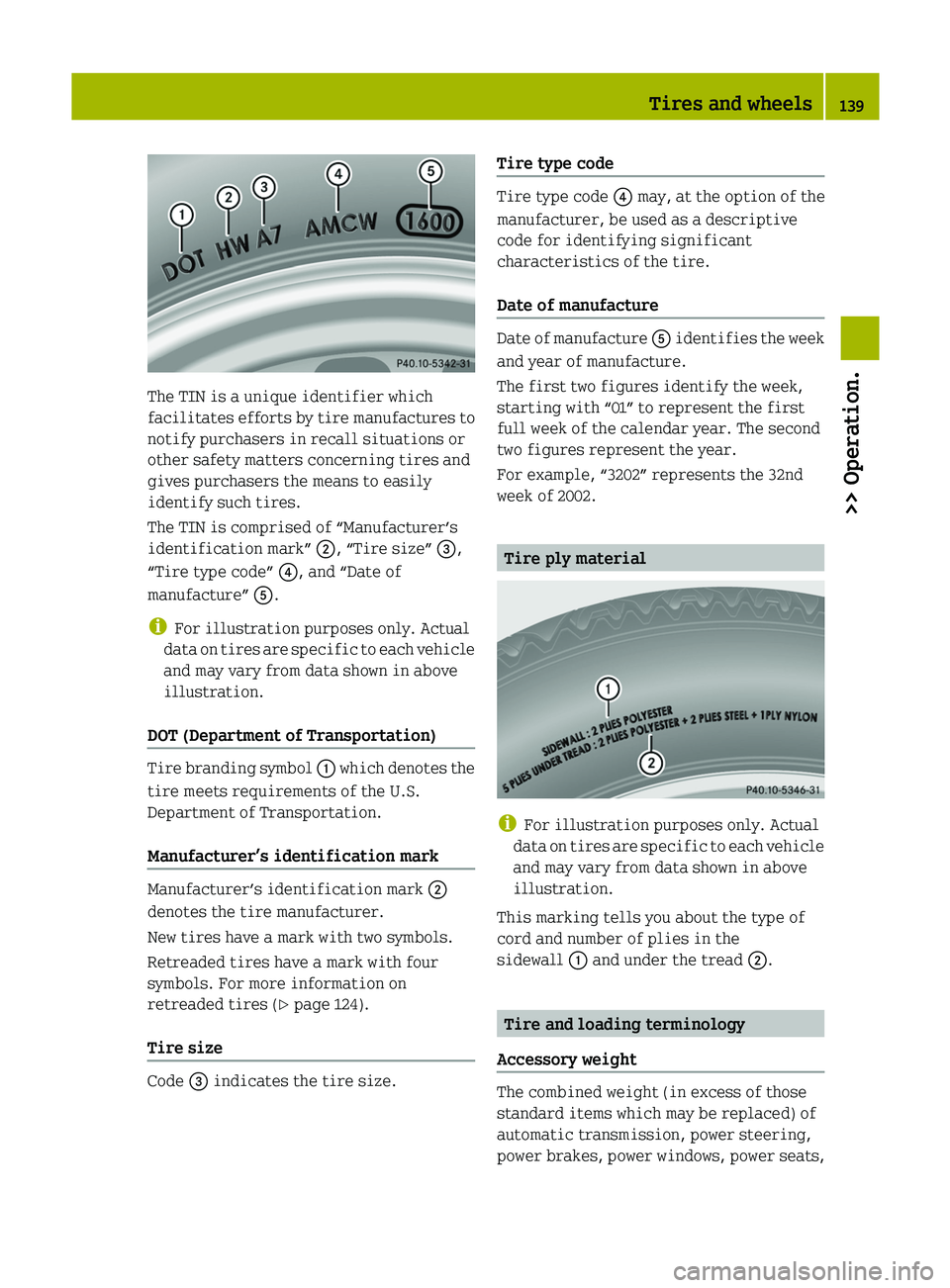
The TIN is a unique identifier which
facilitates
efforts by tire manufactures to
notify purchasers in recall situations or
other safety matters concerning tires and
gives purchasers the means to easily
identify such tires.
The TIN is comprised of “Manufacturer’s
identification mark” ;, “Tire size” =,
“Tire type code” ?, and “Date of
manufacture” A.
i For illustration purposes only. Actual
data on tires are specific to each vehicle
and may vary from data shown in above
illustration.
DOT (Department of Transportation) Tire branding symbol
:
which denotes the
tire meets requirements of the U.S.
Department of Transportation.
Manufacturer’s identification mark Manufacturer’s identification mark
;
denotes the tire manufacturer.
New tires have a mark with two symbols.
Retreaded tires have a mark with four
symbols. For more information on
retreaded tires ( Y page 124).
Tire size Code = indicates the tire size. Tire type code Tire type code
? may, at the option of the
manufacturer, be used as a descriptive
code for identifying significant
characteristics of the tire.
Date of manufacture Date of manufacture
A
identifies the week
and year of manufacture.
The first two figures identify the week,
starting with “01” to represent the first
full week of the calendar year. The second
two figures represent the year.
For example, “3202” represents the 32nd
week of 2002. Tire ply material
i
For illustration purposes only. Actual
data
on tires are specific to each vehicle
and may vary from data shown in above
illustration.
This marking tells you about the type of
cord and number of plies in the
sidewall : and under the tread ;. Tire and loading terminology
Accessory weight The combined weight (in excess of those
standard items which may be replaced) of
automatic transmission, power steering,
power brakes, power windows, power seats, Tires and wheels
139
>> Operation. Z