steering SMART FORTWO COUPE 2012 Owner's Guide
[x] Cancel search | Manufacturer: SMART, Model Year: 2012, Model line: FORTWO COUPE, Model: SMART FORTWO COUPE 2012Pages: 228, PDF Size: 12.76 MB
Page 169 of 228
Problem Possible causes/consequences and
M Solutions÷
The ESP ®
warning lamp
flashes while
driving. The ESP
®
has engaged because of detected traction loss in at
least one tire.
X When driving off, apply as little throttle as possible.
X While driving, ease up on the accelerator pedal.
X Adapt your speed and driving to the prevailing road and
weather conditions. ÷
The ESP ®
warning lamp
illuminates
continuously
while the
engine is
running. The ESP
®
is not operational due to a system failure.
X Have the system checked at an authorized smart center. The ESP
®
is not available.
X Have the system checked at an authorized smart center. G
WARNING
When the ESP ®
warning lamp is illuminated continuously, the ESP ®
is not available or not
operational due to a system failure.
Adapt
your speed and driving to the prevailing road conditions and the non-operating status
of the ESP ®
.
i It may be possible to clear a system failure by restarting the engine.
X Restart the engine.
If
the warning lamp still does not go out, have the system checked at an authorized smart
center immediately.
i More information on the ESP ®
can be found in the “Safety” section (Y page 47). Problem Possible causes/consequences and
M SolutionsD
The yellow EPS*
warning lamp
illuminates
while the
engine is
running. The Electronic Power Steering (EPS)* is not available.
X
Have the EPS* checked at an authorized smart center
immediately. G
WARNING
When the EPS* is not available a higher degree of effort is necessary to steer the vehicle.
Have the system checked at an authorized smart center. What to do if ...
167
>> Practical hints.
* optional Z
Page 174 of 228
Tire Pressure Monitoring System (TPMS)*
Problem Possible causes/consequences and
M Solutionsh
The yellow
combination
low tire
pressure/TPMS
malfunction
telltale
illuminates
continuously. The TPMS detects a loss of pressure in at least one tire.
X
Carefully bring the vehicle to a halt, avoiding abrupt
steering and braking maneuvers. Observe the traffic
situation around you.
X Check and correct tire inflation pressure as required
(Y page 126).
If the tire inflation pressure in the respective tire(s) has
(have) been corrected, the combination low tire pressure/TPMS
malfunction telltale goes out after a few minutes of driving.
See also “Restarting the TPMS” (Y page 129). h
The
combination
low tire
pressure/TPMS
malfunction
telltale flashes
60 seconds and
then stays
illuminated. There is a malfunction in the TPMS.
X
Have the TPMS checked at an authorized smart center.
After the malfunction has been remedied the combination low
tire pressure/TPMS malfunction telltale goes out after a few
minutes of driving. G
WARNING
Each tire should be checked monthly when cold and inflated to the inflation pressure
recommended by the vehicle manufacturer on the Tire and Loading Information placard. If
your vehicle has tires of a different size than the size indicated on the Tire and Loading
Information placard, you should determine the proper tire inflation pressure for those
tires.
As
an added safety feature, your vehicle has been equipped with a tire pressure monitoring
system (TPMS) that illuminates a low tire pressure telltale when one or more of your tires
is significantly underinflated.
Accordingly, when the low tire pressure telltale illuminates, you should stop and check your
tires as soon as possible, and inflate them to the proper pressure. Driving on a significantly
underinflated tire causes the tire to overheat and can lead to tire failure.
Underinflation also reduces fuel efficiency and tire tread life, and may affect the vehicle’s
handling and stopping ability. Please note that the TPMS is not a substitute for proper tire
maintenance, and it is the driver’s responsibility to maintain correct tire pressure, even
if underinflation has not reached the level to trigger illumination of the TPMS low tire
pressure telltale.
Your vehicle has also been equipped with a TPMS malfunction indicator to indicate when
the system is not operating properly. The TPMS malfunction indicator is combined with the 172
What to do if ...
>> Practical hints.
* optional
Page 188 of 228
X
Removing: Fold the wiper arm away from
the
rear window until you feel it engage.
X Fold wiper blade :
away from the wiper
arm in direction of arrow ; until it
disengages from its mounting.
X Detach wiper blade :.
X Installing:
Push the new wiper blade onto
the wiper arm until you feel it engage.
X Fold the wiper blade into a position
parallel to the wiper arm.
X Fold the wiper arm backward to rest on
the rear window.
Make sure to hold on to the wiper when
folding the wiper arm back.
! Make sure the wiper blade is properly
installed. An improperly installed
wiper blade may cause rear window
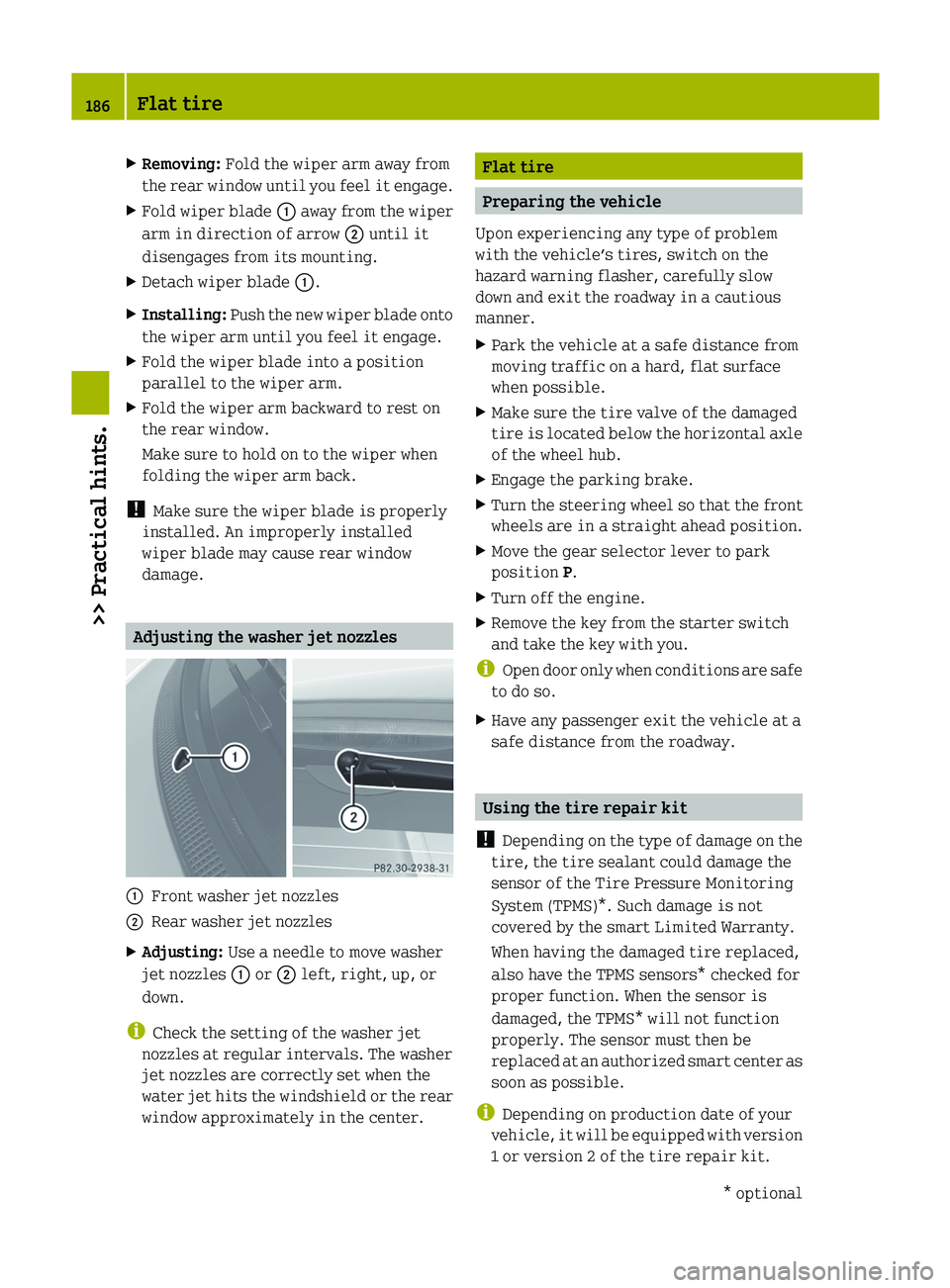
damage. Adjusting the washer jet nozzles
:
Front washer jet nozzles
; Rear washer jet nozzles
X Adjusting: Use a needle to move washer
jet nozzles : or ; left, right, up, or
down.
i Check the setting of the washer jet
nozzles at regular intervals. The washer
jet nozzles are correctly set when the
water
jet hits the windshield or the rear
window approximately in the center. Flat tire
Preparing the vehicle
Upon experiencing any type of problem
with the vehicle’s tires, switch on the
hazard warning flasher, carefully slow
down and exit the roadway in a cautious
manner.
X Park the vehicle at a safe distance from
moving traffic on a hard, flat surface
when possible.
X Make sure the tire valve of the damaged
tire
is located below the horizontal axle
of the wheel hub.
X Engage the parking brake.
X Turn the steering wheel so that the front
wheels are in a straight ahead position.
X Move the gear selector lever to park
position P.
X Turn off the engine.
X Remove the key from the starter switch
and take the key with you.
i Open
door only when conditions are safe
to do so.
X Have any passenger exit the vehicle at a
safe distance from the roadway. Using the tire repair kit
! Depending
on the type of damage on the
tire, the tire sealant could damage the
sensor of the Tire Pressure Monitoring
System (TPMS)*. Such damage is not
covered by the smart Limited Warranty.
When having the damaged tire replaced,
also have the TPMS sensors* checked for
proper function. When the sensor is
damaged, the TPMS* will not function
properly. The sensor must then be
replaced at an authorized smart center as
soon as possible.
i Depending on production date of your
vehicle, it will be equipped with version
1 or version 2 of the tire repair kit. 186
Flat tire
>> Practical hints.
* optional
Page 193 of 228
result in handling or steering problems, or
brake failure.
X Drive to the nearest authorized smart
center, to have the damaged tire
replaced.
X Contact an authorized smart center as
soon as possible to obtain a new filler
hose and a new tire sealant container.
X Bring used tire sealant materials to an
authorized smart center for proper
disposal.
X Replace your tire sealant container
every 4 years. Replacement containers
are available at any authorized smart
center. G
WARNING
After changing a tire, contact a smart
center to make sure the bolts holding the
wheel to the car are tight enough.
Otherwise, the wheels could come off. Each
bolt should be tightened to a torque of
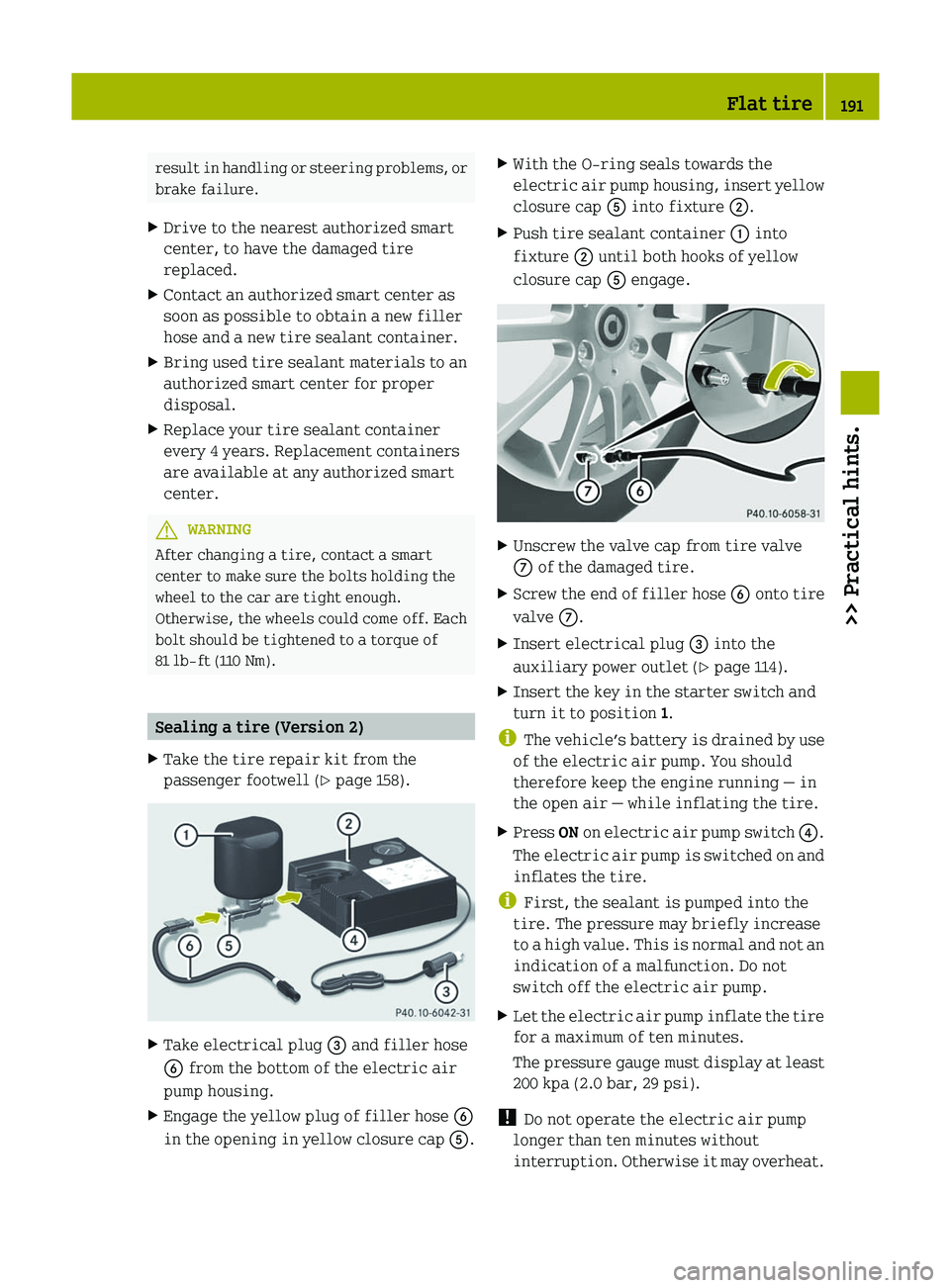
81 lb‑ft (110 Nm). Sealing a tire (Version 2)
X Take the tire repair kit from the
passenger footwell (Y page 158). X
Take electrical plug = and filler hose
B from the bottom of the electric air
pump housing.
X Engage the yellow plug of filler hose B
in the opening in yellow closure cap A.X
With the O-ring seals towards the
electric
air pump housing, insert yellow
closure cap A into fixture ;.
X Push tire sealant container : into
fixture ; until both hooks of yellow
closure cap A engage. X
Unscrew the valve cap from tire valve
C of the damaged tire.
X Screw the end of filler hose B onto tire
valve C.
X Insert electrical plug = into the
auxiliary power outlet
(Y page 114).
X Insert the key in the starter switch and
turn it to position 1.
i The
vehicle’s battery is drained by use
of the electric air pump. You should
therefore keep the engine running — in
the open air — while inflating the tire.
X Press ON
on electric air pump switch ?.
The electric air pump is switched on and
inflates the tire.
i First, the sealant is pumped into the
tire. The pressure may briefly increase
to
a high value. This is normal and not an
indication of a malfunction. Do not
switch off the electric air pump.
X Let the electric air pump inflate the tire
for a maximum of ten minutes.
The
pressure gauge must display at least
200 kpa (2.0 bar, 29 psi).
! Do not operate the electric air pump
longer than ten minutes without
interruption.
Otherwise it may overheat. Flat tire
191
>> Practical hints. Z
Page 195 of 228
Information placard located on the
driver’s door B‑pillar).
R
To increase the tire inflation
pressure: Switch on the electric air
pump.
R To decrease the tire inflation
pressure: Press deflate button D.
Recheck the tire inflation pressure
with the electric air pump’s pressure
gauge E.
X When the tire inflation pressure is
correct, unscrew the end of filler
hose ? from tire valve C.
X Screw the valve cap onto the tire valve. X
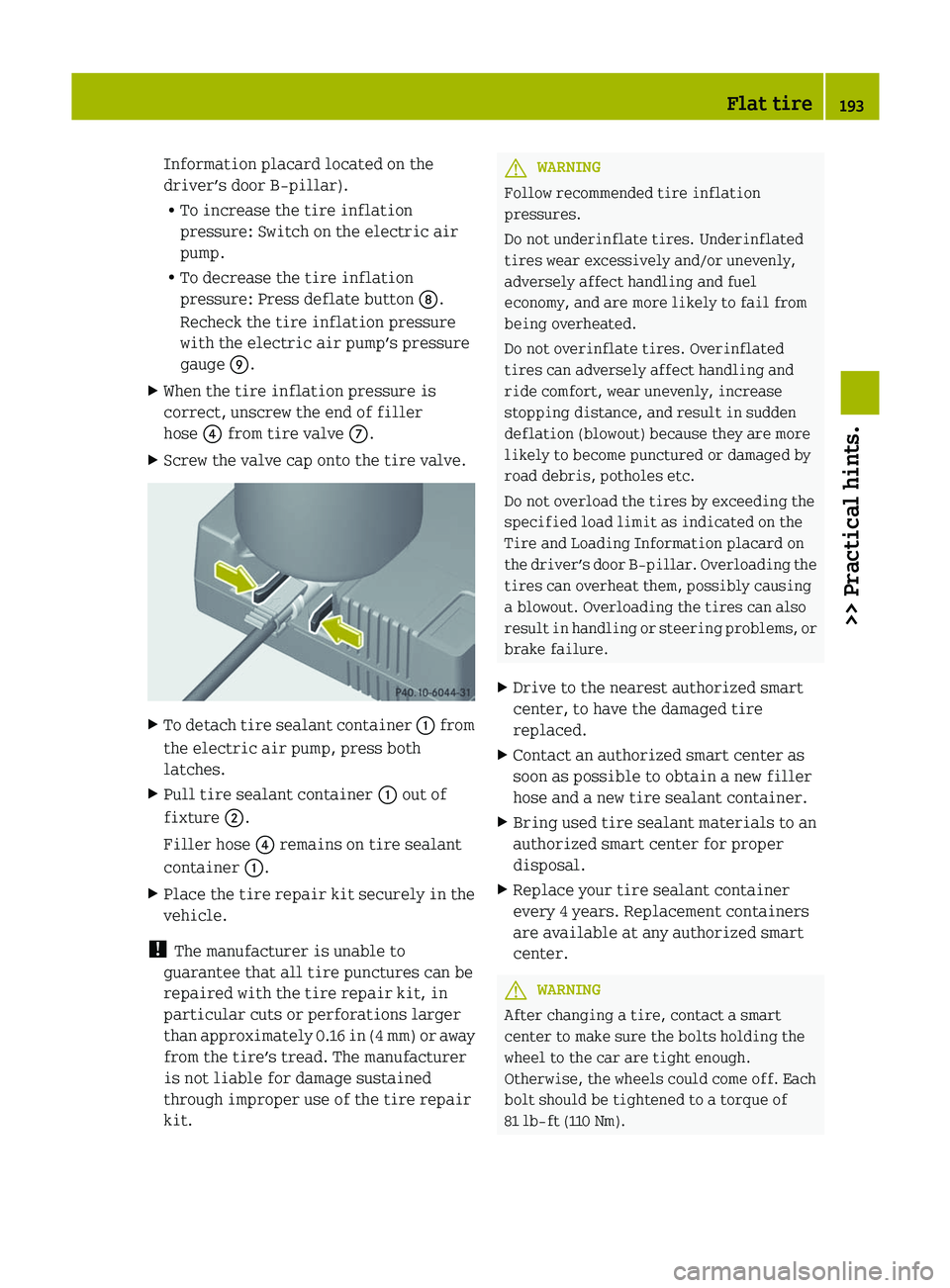
To detach tire sealant container : from
the electric air pump, press both
latches.
X Pull tire sealant container : out of
fixture ;.
Filler hose ? remains on tire sealant
container :.
X Place the tire repair kit securely in the
vehicle.
! The manufacturer is unable to
guarantee that all tire punctures can be
repaired with the tire repair kit, in
particular cuts or perforations larger
than
approximately 0.16 in (4 mm) or away
from the tire’s tread. The manufacturer
is not liable for damage sustained
through improper use of the tire repair
kit. G
WARNING
Follow recommended tire inflation
pressures.
Do not underinflate tires. Underinflated
tires wear excessively and/or unevenly,
adversely affect handling and fuel
economy, and are more likely to fail from
being overheated.
Do not overinflate tires. Overinflated
tires can adversely affect handling and
ride comfort, wear unevenly, increase
stopping distance, and result in sudden
deflation (blowout) because they are more
likely to become punctured or damaged by
road debris, potholes etc.
Do not overload the tires by exceeding the
specified load limit as indicated on the
Tire and Loading Information placard on
the
driver’s door B‑pillar. Overloading the
tires can overheat them, possibly causing
a blowout. Overloading the tires can also
result in handling or steering problems, or
brake failure.
X Drive to the nearest authorized smart
center, to have the damaged tire
replaced.
X Contact an authorized smart center as
soon as possible to obtain a new filler
hose and a new tire sealant container.
X Bring used tire sealant materials to an
authorized smart center for proper
disposal.
X Replace your tire sealant container
every 4 years. Replacement containers
are available at any authorized smart
center. G
WARNING
After changing a tire, contact a smart
center to make sure the bolts holding the
wheel to the car are tight enough.
Otherwise, the wheels could come off. Each
bolt should be tightened to a torque of
81 lb‑ft (110 Nm). Flat tire
193
>> Practical hints. Z
Page 196 of 228
Wheel change
Preparing the vehicle
X Park the vehicle on a hard, flat surface
when possible.
X Turn on the hazard warning flasher.
X Turn the steering wheel so that the front
wheels
are in a straight-ahead position.
X Engage the parking brake.
X Move the gear selector lever to park
position P.
X Turn off the engine.
X Have any passenger exit the vehicle at a
safe distance from the roadway. Removing the wheel
G
WARNING
When jacking up the vehicle, only use a
suitable jack. Observe the manufacturer’s
safety instructions.
The jack must be designed for jacking up
this vehicle at the jack take-up brackets
built into both sides of the vehicle.
The jack is intended only for lifting the
vehicle
briefly for wheel changes. It is not
suited for performing maintenance work
under the vehicle. To help avoid personal
injury, use the jack only to lift the vehicle
during a wheel change.
Never get beneath the vehicle while it is
supported by the jack. Keep hands and feet
away from the area under the lifted vehicle.
Always lower the vehicle onto sufficient
capacity jackstands before working under
the vehicle.
Always firmly engage the parking brake and
block the wheels with wheel chocks or other
sizeable objects before raising the
vehicle with the jack. Do not release the
parking brake while the vehicle is raised.
Make sure the ground on which the vehicle
is standing and where you place the jack is solid, level and not slippery. If necessary,
use
a large underlay. On slippery surfaces,
such as tiled floors, you should use a non-
slip underlay, for example a rubber mat.
Do not use wooden blocks or similar objects
to support the jack. Otherwise the jack may
not be able to achieve its load-bearing
capacity if it is not at its full height.
The jack must always be vertical when in
use. Always try to use the jack on level
surface. If you do not position the jack
correctly, the vehicle can fall off the jack
and seriously or fatally injure you or
others.
Never start the engine when the vehicle is
raised.
Also observe the notes on the jack.
X Make sure to have a suitable jack 18
,
wheel
wrench 18
and wheel chock 18
.
Contact an authorized smart center for
information on which jack and wheel
wrench are required.
X Prepare the vehicle as described
(Y page 194).
X Make sure the surface is level.
Prevent the vehicle from rolling away by
blocking
wheels with wheel chocks or other
sizeable objects:
X Place one wheel chock or other sizeable
object in front of and another wheel
chock or other sizeable object behind
the wheel that is diagonally opposite to
the wheel being changed.
18 Not included and not available as factory equipment.194
Wheel change
>> Practical hints.
Page 204 of 228
X
Remove the jumper cables from negative terminals = and ? first.
X Remove the jumper cables from positive terminals : and ;.
You can now switch on the headlamps.
X Remount the positive terminal cover.
X Have the battery checked at the nearest authorized smart center. Towing
About towing
This section offers information on towing
methods for breakdown situations,
emergency towing, and flat towing smart
vehicles. Recommended towing method -
Breakdown situation
smart recommends that the vehicle be
transported with all wheels off the ground
using a flatbed carrier truck or
appropriate wheel lift/dolly equipment.
X Switch off the tow‑away protection* and
interior motion sensor*
(Y page 49).
! To
prevent damage during transport, do
not tie down the vehicle by its chassis or
suspension parts — use only wheel straps
to position and hold down the vehicle.
Improper tie down on a flatbed carrier
truck or trailer can damage suspension
parts and body panels. Emergency towing
When circumstances do not permit the
recommended towing method, the vehicle
may
be towed with all wheels on the ground
using a strap or tow bar connected to
another vehicle. Only tow the vehicle as far
as necessary to have the vehicle moved to a
safe location where the recommended
towing method can be employed. G
WARNING
If circumstances require towing the
vehicle with all wheels on the ground,
always tow with a tow bar if:
R the engine will not run
R there is a malfunction in the brake
system
R there is a malfunction in the power
supply or in the vehicle’s electrical
system
A
tow bar is necessary to adequately control
the towed vehicle.
Prior to towing the vehicle with all wheels
on the ground, make sure the gear selector
lever is in neutral position N and the
ignition is switched off. G
WARNING
With the engine not running, there is no
power assistance for the brake and
steering* systems. In this case, it is
important to keep in mind that a
considerably higher degree of effort is
necessary to brake and steer the vehicle.
Adapt your driving accordingly.
! Do not tow the vehicle with the front
axle raised. Doing so may cause serious
damage to the brake system which is not
covered by the smart Limited Warranty.
! Before towing the vehicle observe the
following instructions:
R Do not tow with sling-type equipment
attached
to suspension parts. This may202
Towing
>> Practical hints.
* optional