lock SMART FORTWO COUPE 2012 Workshop Manual
[x] Cancel search | Manufacturer: SMART, Model Year: 2012, Model line: FORTWO COUPE, Model: SMART FORTWO COUPE 2012Pages: 228, PDF Size: 12.76 MB
Page 152 of 228
Coolant temperature
During severe operating conditions and
stop-and-go city traffic, the coolant
temperature may rise.
! Excessive coolant temperature causes
the red coolant temperature warning
lamp ? in the instrument cluster to
come on.
The engine should not be operated with
the red coolant temperature warning
lamp ? illuminated. Doing so may
cause serious engine damage which is
not covered by the smart Limited
Warranty.
For more information on coolant
temperature warning lamp ( Y page 170).G
WARNING
Driving when your engine is overheated can
cause some fluids which may have leaked
into the engine compartment to catch fire.
You could be seriously burned.
Steam
from an overheated engine can cause
serious burns which can occur just by
opening the engine hood. Stay away from the
engine if you see or hear steam coming from
it.
Stop the vehicle in a safe location away
from other traffic. Turn off the engine, get
out of the vehicle and do not stand near the
vehicle until the engine has cooled down. Driving abroad
Abroad,
there is an extensive smart service
network at your disposal. If you plan to
drive into areas which are not listed in the
index of your smart center directory, you
should request pertinent information from
an authorized smart center. Symmetrical low beams
i If you drive in countries where
vehicles drive on the other side of the
road than the country in which the
vehicle is registered, you must have the
headlamps
modified for symmetrical low
beams. Relevant information can be
obtained at any authorized smart center. Vehicle care
Care tips
Regular and proper care will help to
maintain the value of your vehicle. The
best way to protect your vehicle from
harmful environmental influences is to
wash it and use protective treatments
regularly.
smart recommends that you care for the
paintwork
at least twice a year (e.g. in the
spring and autumn). G
WARNING
Many cleaning products can be hazardous.
Some are poisonous, others are flammable.
Always follow the instructions on the
particular container. Always open your
vehicle’s doors or windows when cleaning
the inside.
Never use fluids or solvents that are not
designed for cleaning your vehicle.
Always lock away cleaning products and
keep them out of reach of children.
! Follow
the care tips. Wash your vehicle
preferably by hand.
While in operation or even while parked,
your vehicle is subjected to varying
external influences, which left unchecked
can attack the paint as well as the vehicle
underbody and lead to permanent damage. 150
Vehicle care
>> Operation.
Page 155 of 228
Exterior Special
considerations Lightly soiled
Hand-/Automatic
car washes Heavily soiled
Hand-/Automatic
car washes
Wheels and wheel
covers Two-layer metallic
paint (high-gloss) Car shampoo
concentrate, rim
care Car shampoo
concentrate, rim
care
Retractable soft top PAC fabric Car shampoo
concentrate, soft
top cleaner,
impregnation spray Car shampoo
concentrate, soft
top cleaner,
impregnation spray
Removing insects
Remove insect remains before you start to
wash the vehicle.
X
Spray insect remover on.
X Allow insect remover to work in briefly.
X Rub in gently with a soft cloth or sponge.
X Rinse with plenty of water.
X Treat the cleaned surface with hard wax.
Removing tar Remove any tar marks before washing the
vehicle.
X
Apply tar remover with a soft cloth.
X Allow tar remover to work in briefly.
X Rub in gently.
X Rinse with plenty of water.
X Treat the cleaned surface with hard wax.
Vehicle washing In the winter, thoroughly remove all traces
of road salt as soon as possible.
When
washing the vehicle underbody, do not
forget to clean the inner sides of the
wheels.
Washing your vehicle by hand
X Wash the vehicle using car shampoo
concentrate and a sponge.
X Rinse with clean water.
X Towel dry the vehicle. !
Do not wash the vehicle in direct
sunlight. The body panel surfaces and
paint finish may be damaged.
Washing your vehicle in an automatic car
wash
i When running your vehicle through an
automatic car wash, water droplets can
run
down the inside of the side windows.
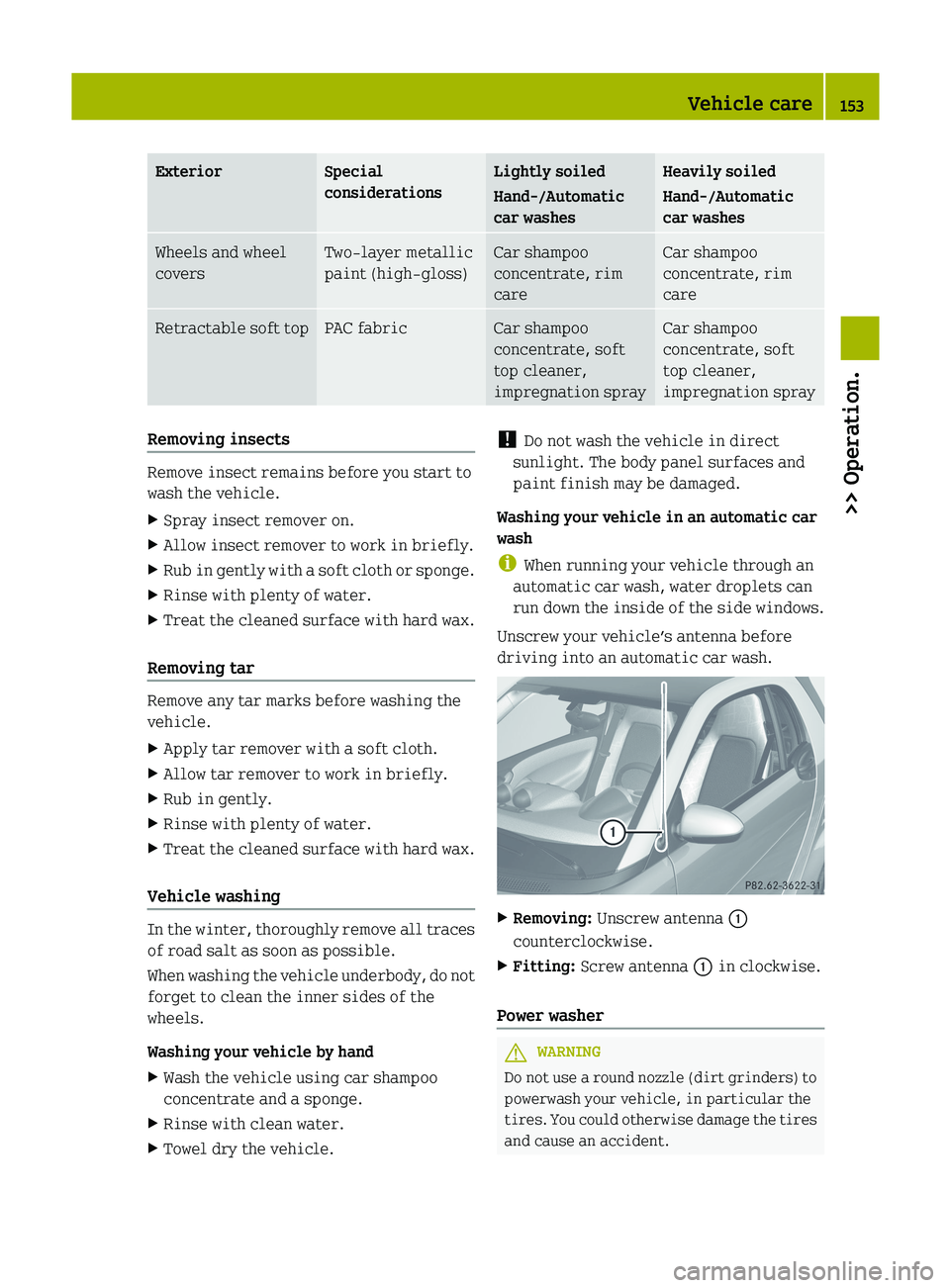
Unscrew your vehicle’s antenna before
driving into an automatic car wash. X
Removing: Unscrew antenna :
counterclockwise.
X Fitting: Screw antenna : in clockwise.
Power washer G
WARNING
Do not use a round nozzle (dirt grinders) to
powerwash your vehicle, in particular the
tires.
You could otherwise damage the tires
and cause an accident. Vehicle care
153
>> Operation. Z
Page 159 of 228
>> Practical hints.Where will I find ...
.......................... 158
Display messages ............................. 158
What to do if ... ............................... 162
Unlocking/locking manually ...............176
Replacing transmitter battery ............177
Replacing bulbs ...............................
178
Replacing wiper blades ..................... 184
Flat tire ........................................ 186
Wheel change .................................. 194
Battery .......................................... 196
Jump starting .................................. 199
Towing .......................................... 202
Fuses ............................................ 205
Page 160 of 228
Where will I find ...
Tire repair kit
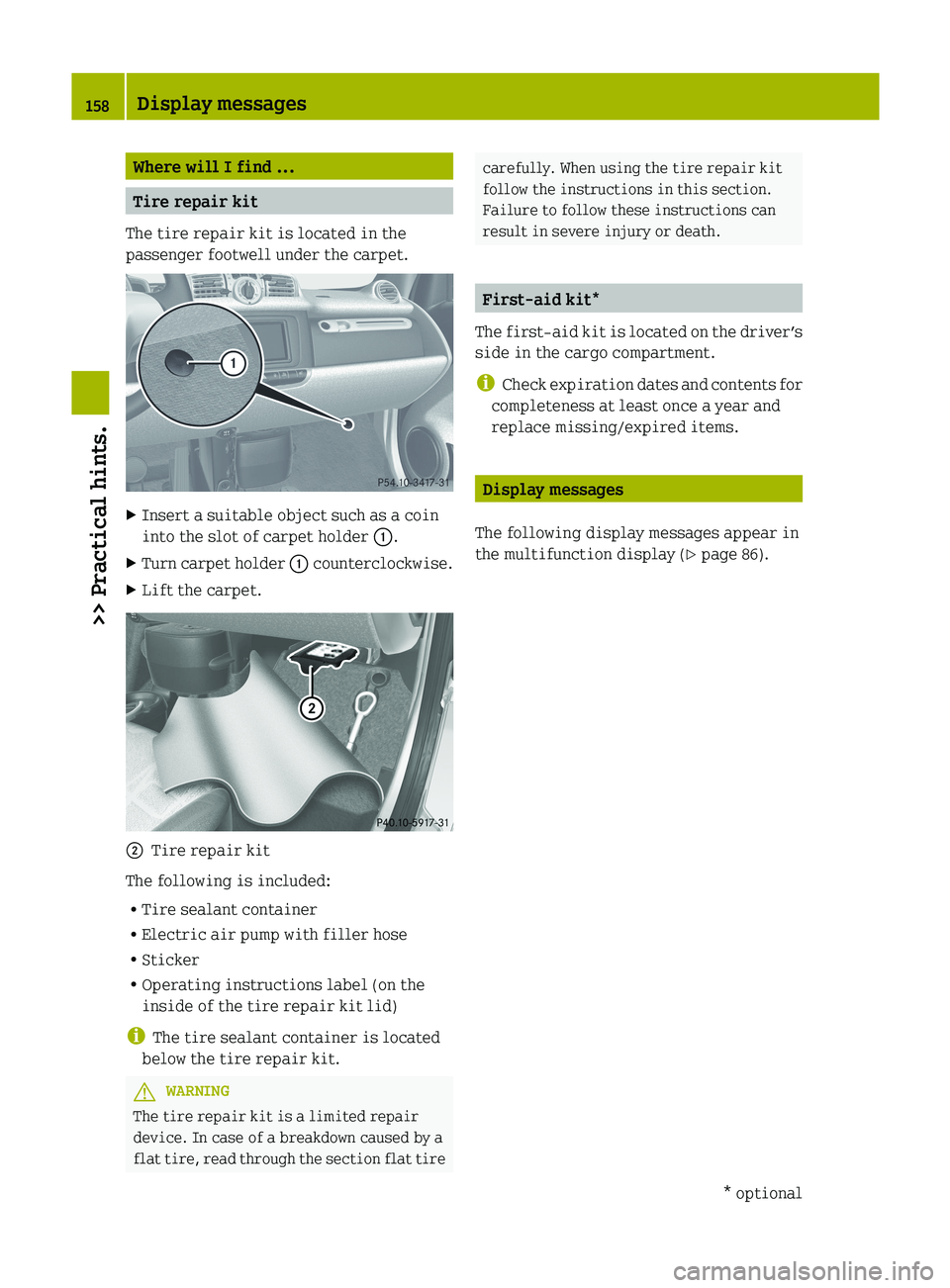
The tire repair kit is located in the
passenger footwell under the carpet. X
Insert a suitable object such as a coin
into the slot of carpet holder :.
X Turn carpet holder : counterclockwise.
X Lift the carpet. ;
Tire repair kit
The following is included:
R Tire sealant container
R Electric air pump with filler hose
R Sticker
R Operating instructions label (on the
inside of the tire repair kit lid)
i The tire sealant container is located
below the tire repair kit. G
WARNING
The tire repair kit is a limited repair
device. In case of a breakdown caused by a
flat
tire, read through the section flat tire carefully. When using the tire repair kit
follow the instructions in this section.
Failure to follow these instructions can
result in severe injury or death.
First-aid kit*
The
first-aid kit is located on the driver’s
side in the cargo compartment.
i Check expiration dates and contents for
completeness at least once a year and
replace missing/expired items. Display messages
The following display messages appear in
the multifunction display ( Y page 86).158
Display messages
>> Practical hints.
* optional
Page 165 of 228
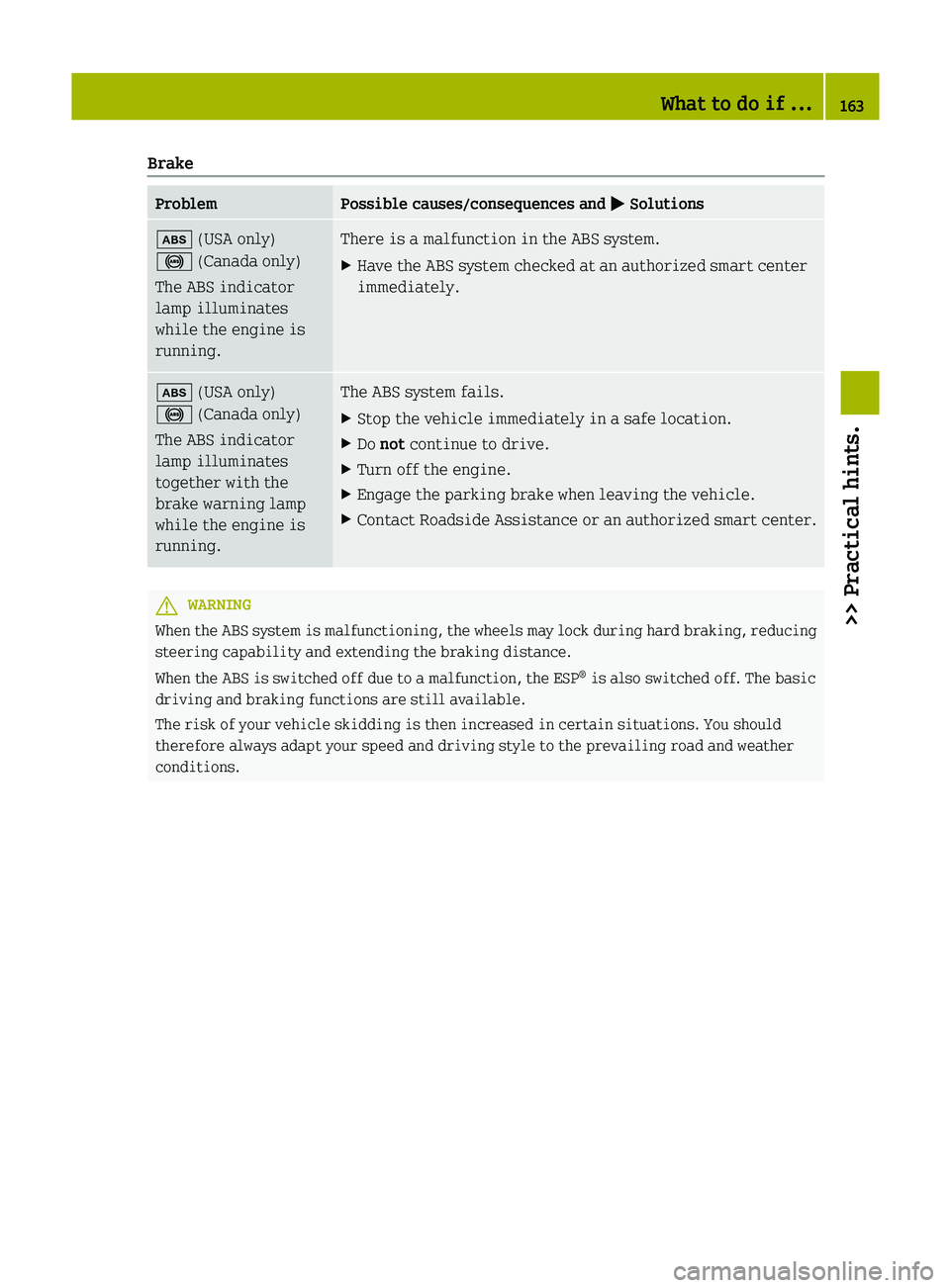
Brake
Problem Possible causes/consequences and
M Solutionsò (USA only)
! (Canada only)
The ABS indicator
lamp illuminates
while the engine is
running. There is a malfunction in the ABS system.
X
Have the ABS system checked at an authorized smart center
immediately. ò (USA only)
! (Canada only)
The ABS indicator
lamp illuminates
together with the
brake warning lamp
while the engine is
running. The ABS system fails.
X
Stop the vehicle immediately in a safe location.
X Do not continue to drive.
X Turn off the engine.
X Engage the parking brake when leaving the vehicle.
X Contact Roadside Assistance or an authorized smart center. G
WARNING
When the ABS system is malfunctioning, the wheels may lock during hard braking, reducing
steering capability and extending the braking distance.
When the ABS is switched off due to a malfunction, the ESP ®
is also switched off. The basic
driving and braking functions are still available.
The risk of your vehicle skidding is then increased in certain situations. You should
therefore always adapt your speed and driving style to the prevailing road and weather
conditions. What to do if ...
163>> Practical hints. Z
Page 176 of 228
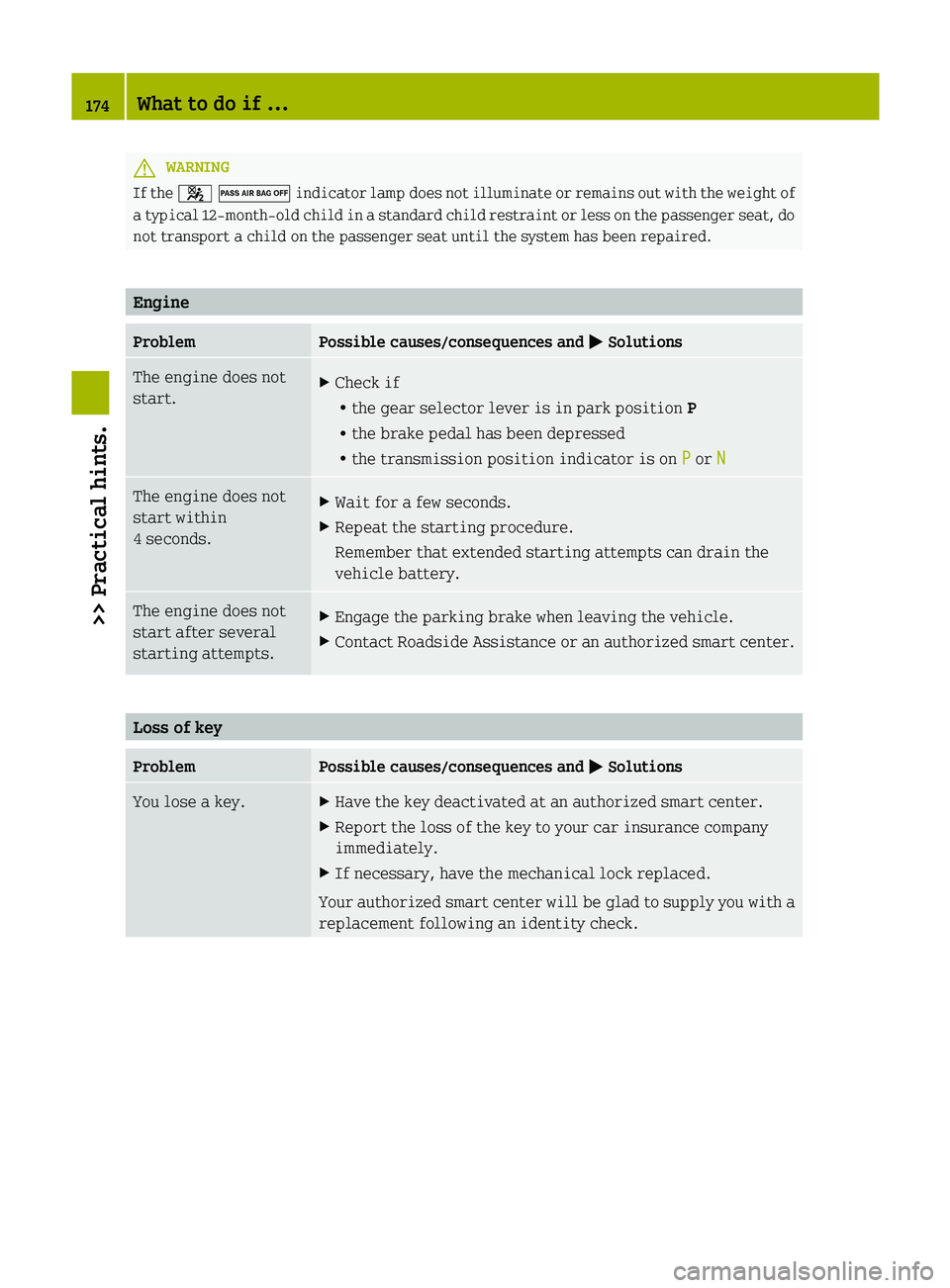
G
WARNING
If the 4 0 indicator lamp does not illuminate or remains out with the weight of
a typical 12‑month‑old child in a standard child restraint or less on the passenger seat, do
not transport a child on the passenger seat until the system has been repaired. Engine
Problem Possible causes/consequences and
M SolutionsThe engine does not
start.
X
Check if
R
the gear selector lever is in park position P
R the brake pedal has been depressed
R the transmission position indicator is on P or NThe engine does not
start within
4 seconds.
X
Wait for a few seconds.
X Repeat the starting procedure.
Remember that extended starting attempts can drain the
vehicle battery. The engine does not
start after several
starting attempts.
X
Engage the parking brake when leaving the vehicle.
X Contact Roadside Assistance or an authorized smart center. Loss of key
Problem Possible causes/consequences and
M SolutionsYou lose a key. X
Have the key deactivated at an authorized smart center.
X Report the loss of the key to your car insurance company
immediately.
X If necessary, have the mechanical lock replaced.
Your authorized smart center will be glad to supply you with a
replacement following an identity check. 174
What to do if ...
>> Practical hints.
Page 177 of 228
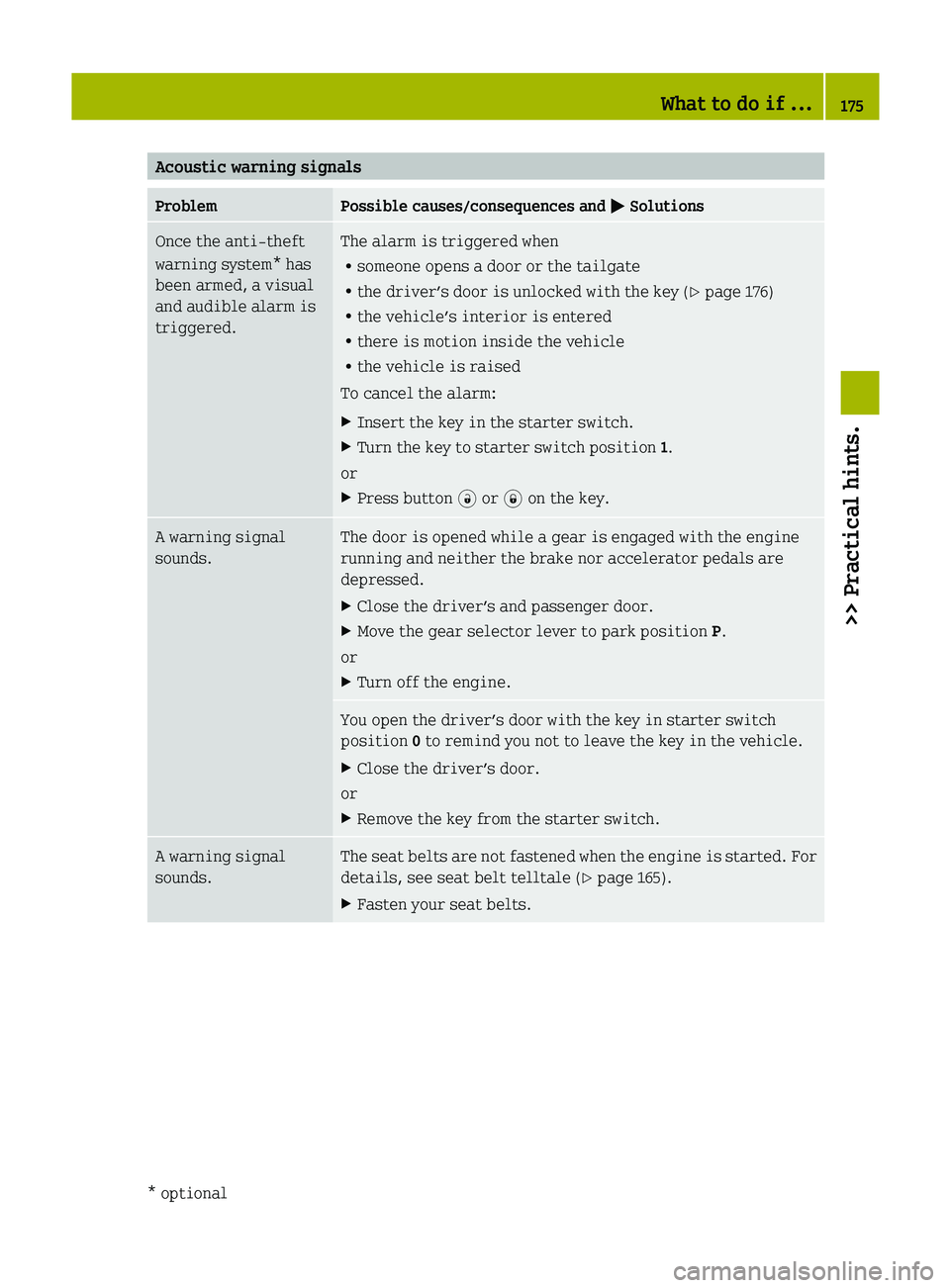
Acoustic warning signals
Problem Possible causes/consequences and
M SolutionsOnce the anti-theft
warning system* has
been armed, a visual
and audible alarm is
triggered. The alarm is triggered when
R
someone opens a door or the tailgate
R the driver’s door is unlocked with the key (Y page 176)
R the vehicle’s interior is entered
R there is motion inside the vehicle
R the vehicle is raised
To cancel the alarm:
X Insert the key in the starter switch.
X Turn the key to starter switch position 1.
or
X Press button # or * on the key.A warning signal
sounds. The door is opened while a gear is engaged with the engine
running and neither the brake nor accelerator pedals are
depressed.
X
Close the driver’s and passenger door.
X Move the gear selector lever to park position P.
or
X Turn off the engine. You open the driver’s door with the key in starter switch
position 0 to remind you not to leave the key in the vehicle.
X
Close the driver’s door.
or
X Remove the key from the starter switch. A warning signal
sounds. The seat belts are not fastened when the engine is started. For
details, see seat belt telltale (
Y page 165).
X Fasten your seat belts. What to do if ...
175>> Practical hints.
* optional Z
Page 178 of 228
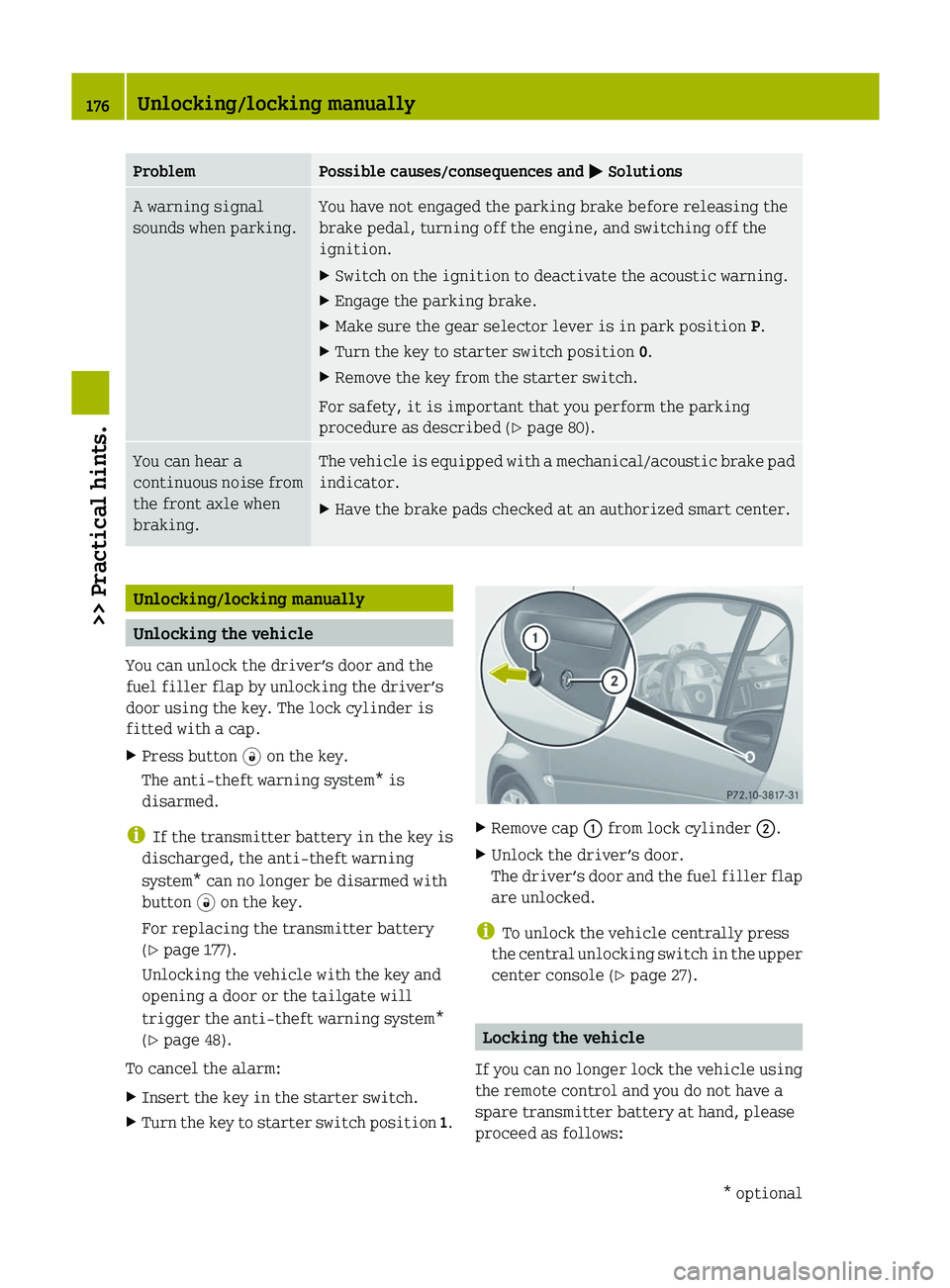
Problem Possible causes/consequences and
M SolutionsA warning signal
sounds when parking. You have not engaged the parking brake before releasing the
brake pedal, turning off the engine, and switching off the
ignition.
X
Switch on the ignition to deactivate the acoustic warning.
X Engage the parking brake.
X Make sure the gear selector lever is in park position P.
X Turn the key to starter switch position 0.
X Remove the key from the starter switch.
For safety, it is important that you perform the parking
procedure as described (Y page 80). You can hear a
continuous
noise from
the front axle when
braking. The vehicle is equipped with a mechanical/acoustic brake pad
indicator.
X
Have the brake pads checked at an authorized smart center. Unlocking/locking manually
Unlocking the vehicle
You can unlock the driver’s door and the
fuel filler flap by unlocking the driver’s
door using the key. The lock cylinder is
fitted with a cap.
X Press button # on the key.
The anti-theft warning system* is
disarmed.
i If the transmitter battery in the key is
discharged, the anti-theft warning
system* can no longer be disarmed with
button # on the key.
For replacing the transmitter battery
(Y page 177).
Unlocking the vehicle with the key and
opening a door or the tailgate will
trigger the anti-theft warning system*
(Y page 48).
To cancel the alarm:
X Insert the key in the starter switch.
X Turn the key to starter switch position 1. X
Remove cap : from lock cylinder ;.
X Unlock the driver’s door.
The
driver’s door and the fuel filler flap
are unlocked.
i To unlock the vehicle centrally press
the
central unlocking switch in the upper
center console ( Y page 27). Locking the vehicle
If
you can no longer lock the vehicle using
the remote control and you do not have a
spare transmitter battery at hand, please
proceed as follows: 176
Unlocking/locking manually
>> Practical hints.
* optional
Page 179 of 228
X
Open the driver’s door.
X Press the central locking switch
(Y page 54).
The indicator lamp on the central
locking
switch comes on, when the starter
switch is in position 1.
The indicator lamp on the central
locking switch flashes, when the starter
switch is in position 0.
X Remove the key from the starter switch,
take it with you, and close all doors.
The vehicle is now locked and the anti-
theft warning system* is armed. Closing the rear soft top
If the rear soft top does not lock properly
after being closed, proceed as follows:
X Stop the vehicle in a safe location.
X Engage the parking brake.
X Make sure the key is in starter switch
position 1.
X Fold up the rear soft top completely.
The rear soft top stops in the unlocked
position.
X Within one minute, press and hold symbol
G on the retractable soft top switch
for 15 seconds twice.
The rear soft top closes the locking
hooks.
X Close the retractable soft top
completely.
X Have the rear soft top checked at an
authorized smart center. Replacing transmitter battery
Notes
The
remote control’s transmitter battery is
almost spent when the turn signals flash
rapidly nine times in a row when locking
the vehicle. i
If you do not replace the transmitter
battery, after about 100 more times you
will no longer be able to lock or unlock
the vehicle using the remote control.
X Replace the transmitter battery.
or
X Have the transmitter battery replaced at
an authorized smart center. G
WARNING
Batteries contain poisonous and corrosive
substances. Therefore keep the batteries
out of reach of children.
If
a battery is swallowed, seek medical help
immediately.
Batteries contain materials that can harm
the environment if disposed of improperly.
Recycling of batteries is the preferred
method of disposal. Many states/provinces
require sellers of batteries to accept old
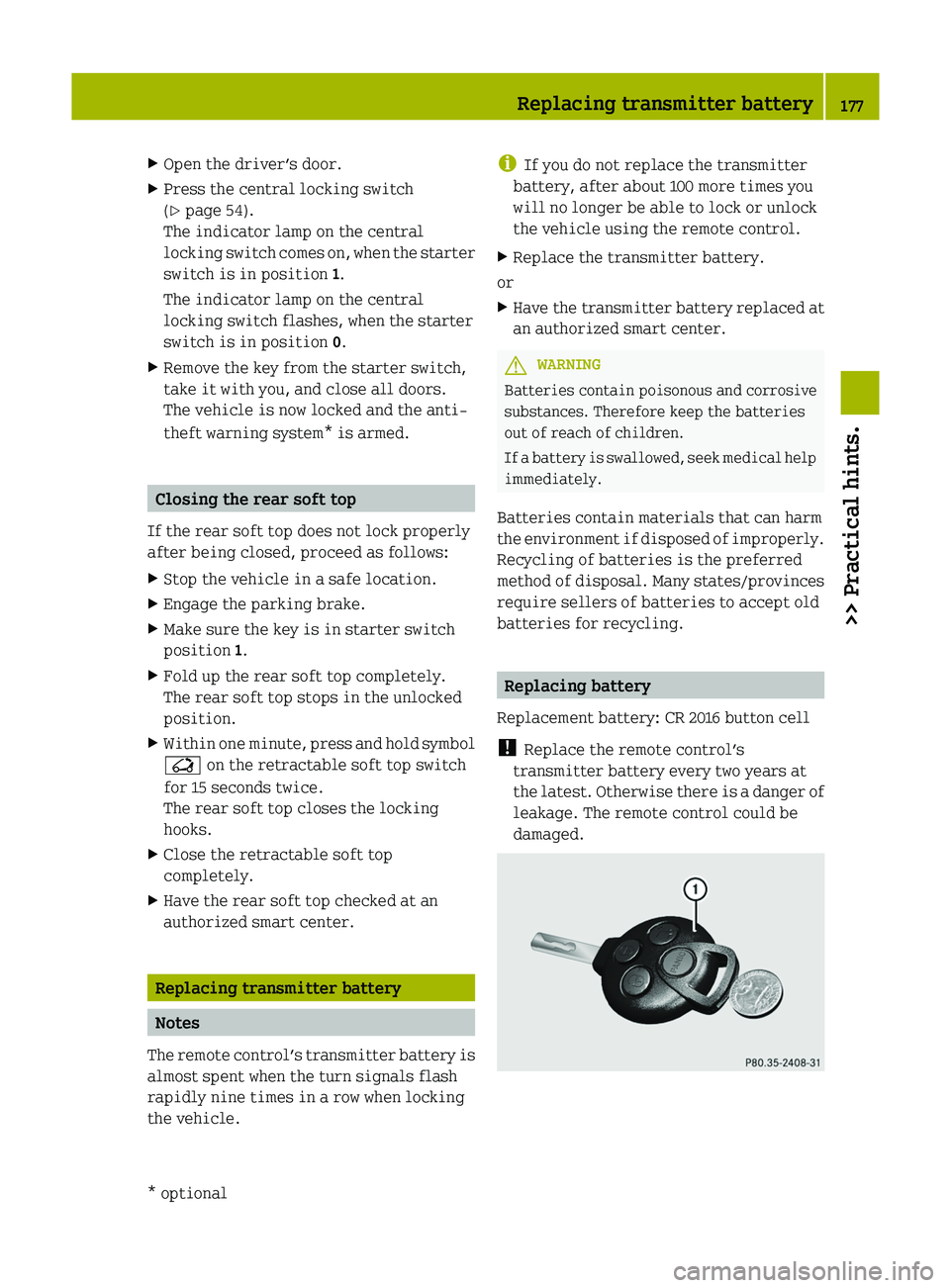
batteries for recycling. Replacing battery
Replacement battery: CR 2016 button cell
! Replace the remote control’s
transmitter battery every two years at
the
latest. Otherwise there is a danger of
leakage. The remote control could be
damaged. Replacing transmitter battery
177
>> Practical hints.
* optional Z
Page 183 of 228
Replacing bulbs for front lamps
Before you start to replace a bulb for a
front lamp, do the following first:
X Turn the exterior lamp switch to position
$ (Y page 64).
X Switch off the ignition.
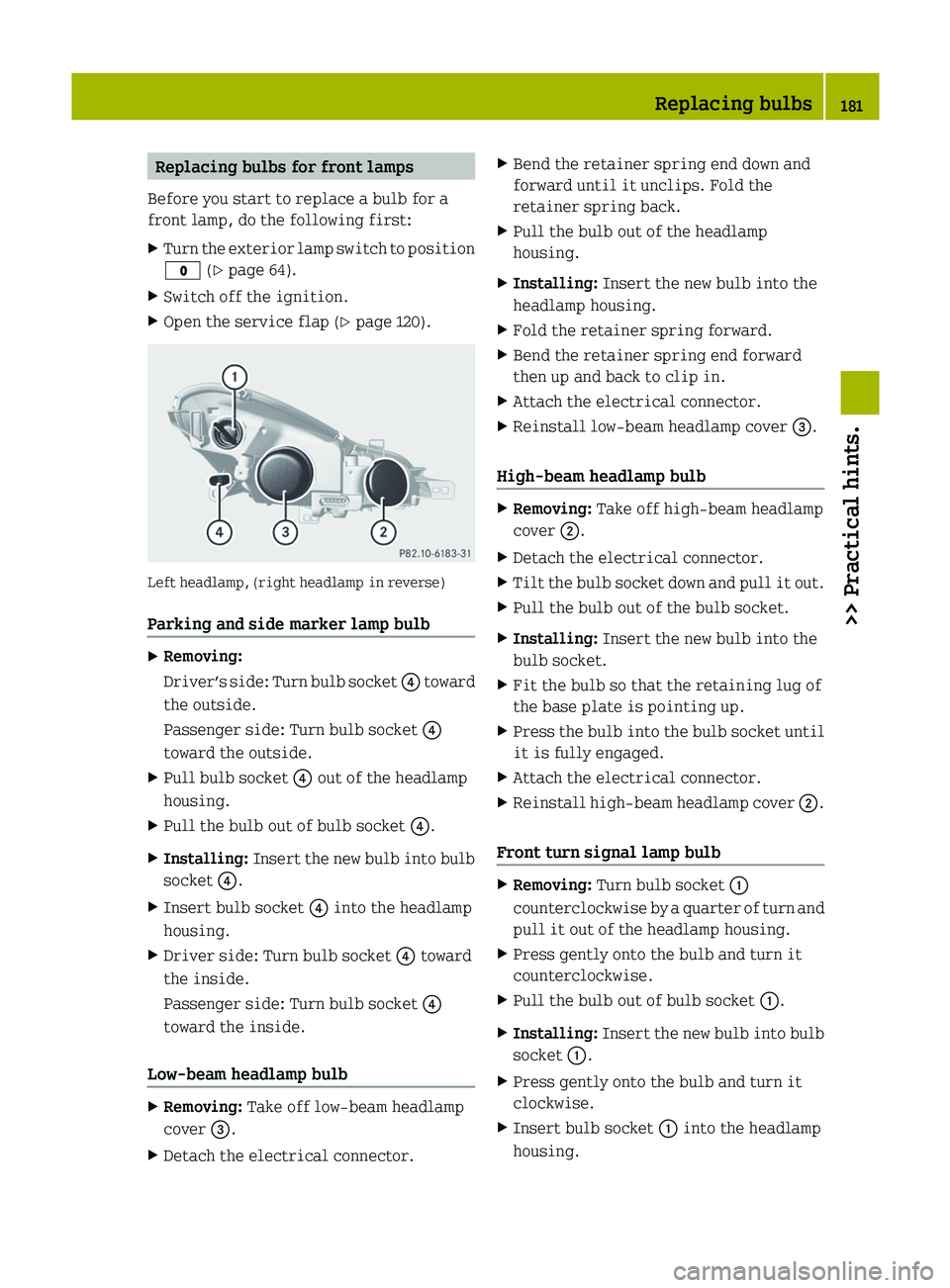
X Open the service flap (Y page 120). Left headlamp, (right headlamp in reverse)
Parking and side marker lamp bulb
X
Removing:
Driver’s
side: Turn bulb socket ? toward
the outside.
Passenger side: Turn bulb socket ?
toward the outside.
X Pull bulb socket ? out of the headlamp
housing.
X Pull the bulb out of bulb socket ?.
X Installing:
Insert the new bulb into bulb
socket ?.
X Insert bulb socket ? into the headlamp
housing.
X Driver side: Turn bulb socket ? toward
the inside.
Passenger side: Turn bulb socket ?
toward the inside.
Low‑beam headlamp bulb X
Removing: Take off low‑beam headlamp
cover =.
X Detach the electrical connector. X
Bend the retainer spring end down and
forward until it unclips. Fold the
retainer spring back.
X Pull the bulb out of the headlamp
housing.
X Installing: Insert the new bulb into the
headlamp housing.
X Fold the retainer spring forward.
X Bend the retainer spring end forward
then up and back to clip in.
X Attach the electrical connector.
X Reinstall low‑beam headlamp cover =.
High‑beam headlamp bulb X
Removing: Take off high‑beam headlamp
cover ;.
X Detach the electrical connector.
X Tilt the bulb socket down and pull it out.
X Pull the bulb out of the bulb socket.
X Installing: Insert the new bulb into the
bulb socket.
X Fit the bulb so that the retaining lug of
the base plate is pointing up.
X Press the bulb into the bulb socket until
it is fully engaged.
X Attach the electrical connector.
X Reinstall high‑beam headlamp cover ;.
Front turn signal lamp bulb X
Removing: Turn bulb socket :
counterclockwise
by a quarter of turn and
pull it out of the headlamp housing.
X Press gently onto the bulb and turn it
counterclockwise.
X Pull the bulb out of bulb socket :.
X Installing:
Insert the new bulb into bulb
socket :.
X Press gently onto the bulb and turn it
clockwise.
X Insert bulb socket : into the headlamp
housing. Replacing bulbs
181
>> Practical hints. Z