wheel SMART FORTWO COUPE 2012 Workshop Manual
[x] Cancel search | Manufacturer: SMART, Model Year: 2012, Model line: FORTWO COUPE, Model: SMART FORTWO COUPE 2012Pages: 228, PDF Size: 12.76 MB
Page 146 of 228
important to keep in mind that a
considerably higher degree of effort is
necessary to brake and steer the vehicle.
Adapt your driving accordingly.
Brakes
G
WARNING
Make sure not to endanger any other road
users when carrying out braking
maneuvers.
Refer to the description of the hydraulic
brake assistant
(Y page 48).
! Because the ESP ®
operates
automatically, the engine must be turned
off (ignition switched off) when the
parking brake is being tested on a brake
test dynamometer. Active braking action
through the ESP ®
may otherwise seriously
damage the brake system which is not
covered by the smart Limited Warranty.
Brake pad wear or a leak in the brake system
may be the reason for low brake fluid level
in the brake fluid reservoir.
The brake fluid level in the brake fluid
reservoir may be too low if the brake
warning lamp in the instrument cluster
comes on (Y page 22) although the parking
brake is released.
Have the brake system inspected
immediately. Contact an authorized smart
center.
All checks and service work on the brake
system should be carried out by qualified
technicians only. Contact an authorized
smart center.
Only install brake pads and use brake fluid
recommended by smart.
Inclines !
When driving down long and steep
grades,
relieve the load on the brakes by
shifting into a lower gear to use the engine’s braking power. This helps
prevent overheating of the brakes and
reduces brake pad wear.
When
using the engine’s braking power, a
drive wheel may not spin for an extended
period of time, e.g. on slippery road
surfaces. This may cause serious damage
to the drive- train which is not covered
by the smart Limited Warranty.
High and low stresses G
WARNING
Resting your foot on the brake pedal will
cause excessive and premature wear of the
brake pads.
It can also result in the brakes
overheating, thereby significantly
reducing their effectiveness and your
ability to stop the vehicle in sufficient
time to avoid an accident.
After
hard braking, it is advisable to drive
on for some time, rather than immediately
park, so that the air stream will cool down
the brakes faster.
If your brake system is normally only
subjected to moderate loads, you should
occasionally test the effectiveness of the
brakes by applying above-normal braking
pressure at higher speeds. This will also
enhance the grip of the brake pads. G
WARNING
Make sure not to endanger any other road
users when carrying out these braking
maneuvers.
Wet road surface G
WARNING
After driving in heavy rain for some time
without applying the brakes or through
water
deep enough to wet brake components,
the first braking action may be somewhat
reduced and increased pedal pressure may
be necessary to obtain expected braking 144
Driving instructions
>> Operation.
Page 149 of 228

Depending upon the weather and/or road
surface (conditions), the tire traction
varies widely.
Specified
tire inflation pressures must be
maintained. This applies particularly if
the tires are subject to high loads (e.g.
high speeds, heavy loads, high ambient
temperatures). G
WARNING
Do not drive with a flat tire. A flat tire will
affect
your ability to steer or brake and may
cause you to lose control of the vehicle.
Continued driving with a flat tire or
driving at high speed with a flat tire will
cause excessive heat build-up and possibly
a fire.
For more information, see “Tires and
wheels” (Y page 124). Hydroplaning
Depending on the depth of the water layer
on the road, hydroplaning may occur
resulting in a loss of control, even at low
speeds and with new tires. Reduce vehicle
speed, avoid track grooves in the road and
apply
brakes cautiously when it is raining. Tire traction
The
safe speed on a wet, snow covered or icy
road is always lower than on a dry road.
You should pay particular attention to the
condition of the road whenever the outside
temperatures are close to the freezing
point. G
WARNING
If ice has formed on the road, tire traction
will be substantially reduced. Under such
weather
conditions, drive, steer and brake
with extreme caution.
smart recommends winter tires
(Y page 142) with a minimum tread depth of approximately
1
/ 6 in (4 mm) on all four
wheels for the winter season to ensure
normal
balanced handling characteristics.
On packed snow, they can reduce your
stopping distance compared to summer
tires.
Stopping distance, however, is still
considerably greater than when the road is
not covered with snow or ice. Exercise
appropriate caution.
! Avoid spinning of a drive wheel for an
extended period when driving off on
slippery road surfaces. Otherwise, the
drivetrain could be damaged, which is
not covered by the smart Limited
Warranty. Tire speed rating
Regardless of the tire speed rating, local
speed
limits should be obeyed. Use prudent
driving speeds appropriate to prevailing
conditions. G
WARNING
Even when permitted by law, never operate
a vehicle at speeds greater than the
maximum speed rating of the tires.
Exceeding the maximum speed for which
tires are rated can lead to sudden tire
failure,
causing loss of vehicle control and
possibly resulting in an accident and/or
personal injury and possible death, for you
and for others.
An electronic speed limiter prevents your
vehicle from exceeding a speed of 90 mph
(145 km/h).
The factory equipped tires on your vehicle
may have a tire speed rating above the
maximum speed permitted by the
electronic speed limiter.
Make sure your tires have the required tire
speed rating as specified for your vehicle
in the “Technical data section” Driving instructions
147
>> Operation. Z
Page 150 of 228
(Y page 217), for example when purchasing
new tires.
For
information on how to identify the tire
speed rating on a tire’s sidewall, see “Tire
size designation, load and speed rating”
(Y page 136).
If you are uncertain about the correct
reading of the information given on a
tire’s sidewall, any authorized smart
center will be glad to assist you.
i For information on speed ratings for
winter tires, see “All-season and winter
tires” ( Y page 137). Winter driving instructions
The
most important rule for slippery or icy
roads is to drive sensibly and to avoid
abrupt acceleration, braking and steering
maneuvers.
When the vehicle is in danger of skidding,
move gear selector lever to neutral
position N. Try to keep the vehicle under
control by corrective steering action.
For information on driving with snow
chains*, see “Snow chains*” (Y page 142). G
WARNING
On slippery road surfaces, never downshift
in order to obtain braking action. This
could result in drive wheel slip and
reduced
vehicle control. Your vehicle’s ABS
will not prevent this type of loss of control.
Road salts and chemicals can adversely
affect braking efficiency. Increased pedal
force may become necessary to produce the
normal braking effect.
Depressing the brake pedal periodically
when traveling at length on salt-strewn
roads can bring road-salt-impaired
braking efficiency back to normal.
If the vehicle is parked after being driven
on salt-treated roads, the braking
efficiency should be tested as soon as
possible after driving is resumed. G
WARNING
Make sure not to endanger any other road
users when carrying out these braking
maneuvers. G
WARNING
If the vehicle becomes stuck in snow, make
sure
snow is kept clear of the exhaust pipe
and from around the vehicle with the engine
running. Otherwise, deadly carbon
monoxide (CO) gases may enter vehicle
interior resulting in unconsciousness and
death.
To assure sufficient fresh air ventilation,
open a window slightly on the side of the
vehicle not facing the wind. G
WARNING
The outside temperature display is not
designed
to serve as an ice-warning device
and is therefore unsuitable for that
purpose. Indicated temperatures just
above the freezing point do not guarantee
that the road surface is free of ice.
For more information, see “Winter driving”
(Y page 142). Standing water
! Do not drive through flooded areas or
water of unknown depth. Before driving
through water, determine its depth.
Never accelerate before driving into
water. The bow wave could force water
into the engine and auxiliary
equipment, thus damaging them.
If you must drive through standing water,
drive
slowly to prevent water from entering
R the front compartment
R the engine compartment
R the passenger compartment
Water in these areas could cause damage to
electrical components or wiring of the
engine or transmission, or could result in 148
Driving instructions
>> Operation.
* optional
Page 155 of 228
Exterior Special
considerations Lightly soiled
Hand-/Automatic
car washes Heavily soiled
Hand-/Automatic
car washes
Wheels and wheel
covers Two-layer metallic
paint (high-gloss) Car shampoo
concentrate, rim
care Car shampoo
concentrate, rim
care
Retractable soft top PAC fabric Car shampoo
concentrate, soft
top cleaner,
impregnation spray Car shampoo
concentrate, soft
top cleaner,
impregnation spray
Removing insects
Remove insect remains before you start to
wash the vehicle.
X
Spray insect remover on.
X Allow insect remover to work in briefly.
X Rub in gently with a soft cloth or sponge.
X Rinse with plenty of water.
X Treat the cleaned surface with hard wax.
Removing tar Remove any tar marks before washing the
vehicle.
X
Apply tar remover with a soft cloth.
X Allow tar remover to work in briefly.
X Rub in gently.
X Rinse with plenty of water.
X Treat the cleaned surface with hard wax.
Vehicle washing In the winter, thoroughly remove all traces
of road salt as soon as possible.
When
washing the vehicle underbody, do not
forget to clean the inner sides of the
wheels.
Washing your vehicle by hand
X Wash the vehicle using car shampoo
concentrate and a sponge.
X Rinse with clean water.
X Towel dry the vehicle. !
Do not wash the vehicle in direct
sunlight. The body panel surfaces and
paint finish may be damaged.
Washing your vehicle in an automatic car
wash
i When running your vehicle through an
automatic car wash, water droplets can
run
down the inside of the side windows.
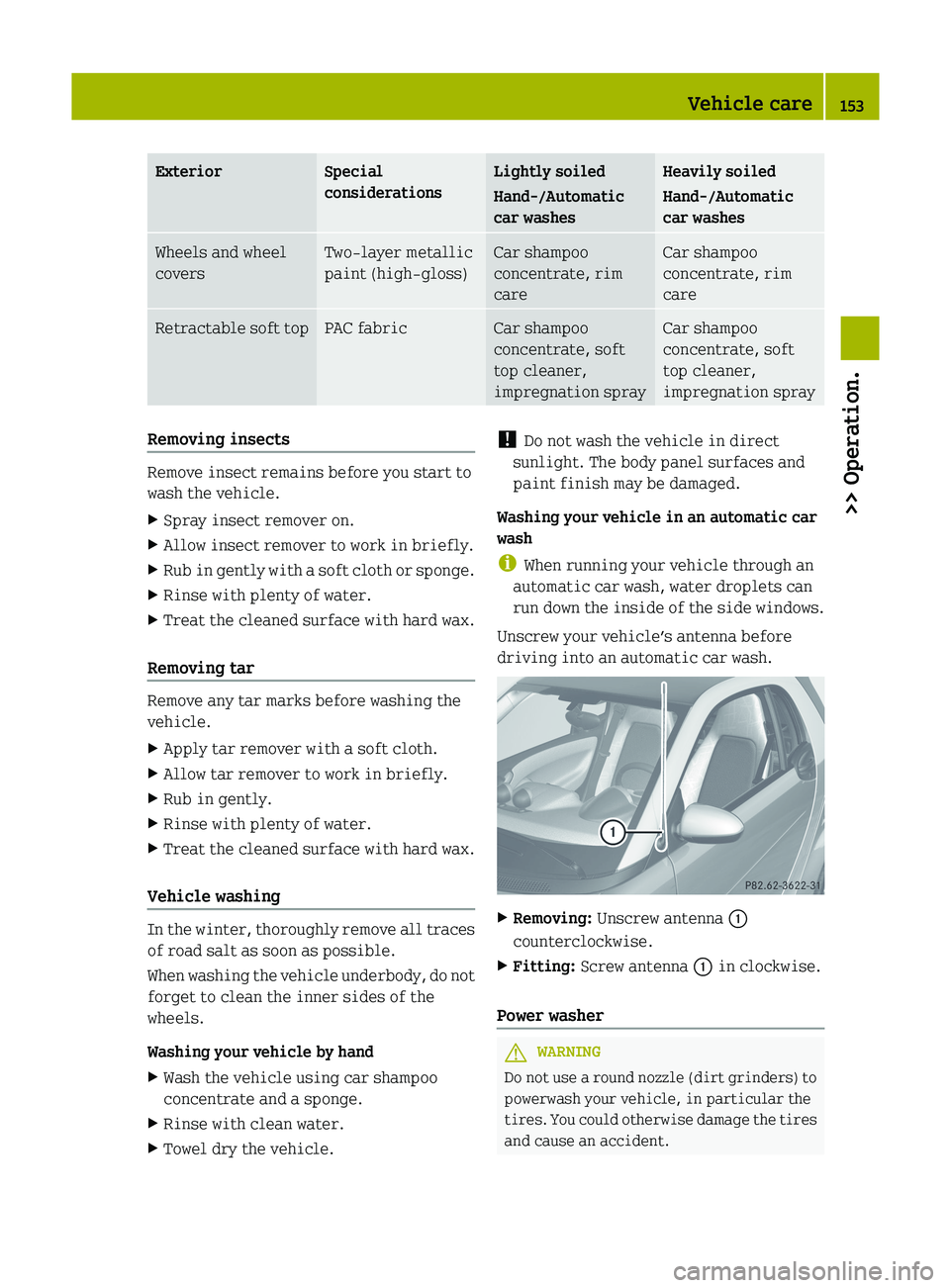
Unscrew your vehicle’s antenna before
driving into an automatic car wash. X
Removing: Unscrew antenna :
counterclockwise.
X Fitting: Screw antenna : in clockwise.
Power washer G
WARNING
Do not use a round nozzle (dirt grinders) to
powerwash your vehicle, in particular the
tires.
You could otherwise damage the tires
and cause an accident. Vehicle care
153
>> Operation. Z
Page 156 of 228
!
Do not aim directly at
R electrical parts
R electrical connectors
R seals
R other rubber parts
The distance should be at least 3.9 in
(10 cm) and the water temperature must
not exceed 140¦ (60¥). Follow the
instructions provided by the power
washer manufacturer on maintaining a
distance between the vehicle and the
nozzle of the power washer.
Always keep the jet of water moving
across the surface.
! Powerwashing could damage
R the high-voltage battery
R the drive system
R the engine compartment
Do not powerwash these components.
Wheel cover* X
Wash the wheel cover with shampoo and a
soft brush or in the car wash.
Decorative foils !
Decorative foils are permanently
adhered to the painted parts of the
vehicle and cannot be removed.
! Do not expose the foils to solvents,
gasoline or diesel.
i When
cleaning with a power washer, note
the following guideline values:
R Water temperature max. 176 ¦ (80¥)
R Minimum distance 11.8 in (30 cm)
R Jet of water strike at a right angle Paintwork care
The
frequency with which you care for your
paintwork is dependent on
R how much the vehicle is used
R where you normally park the vehicle (e.g.
in a garage or under a tree)
R the season
R weather and environmental influences
Rectifying paintwork damage You can use a touch-up paint pen to repair
minimal stone chip damage and scratches.
Recommended touch-up paint pens can be
obtained in a smart center.
i
For
any major paintwork damage, please
contact a smart center. Exterior Repair options
Plastic parts (body
panels) with
clearcoat Clearcoat touch-up
paint pen
Body panels with
base coat and
clearcoat recommended
touch-up paint pen
set in the relevant
color
tridion safety cell recommended
touch-up paint pen
set in the relevant
color
Soft top system (cabriolet only)
Regular care will protect the retractable
soft top and the rear soft top against
external influences, helping to preserve
its value. Use only an approved soft top
cleaner when removing dirt from the soft
top.
! Never clean the soft top using a power
washer,
as water could get into the inside
of the vehicle. 154
Vehicle care
>> Operation.
* optional
Page 159 of 228
>> Practical hints.Where will I find ...
.......................... 158
Display messages ............................. 158
What to do if ... ............................... 162
Unlocking/locking manually ...............176
Replacing transmitter battery ............177
Replacing bulbs ...............................
178
Replacing wiper blades ..................... 184
Flat tire ........................................ 186
Wheel change .................................. 194
Battery .......................................... 196
Jump starting .................................. 199
Towing .......................................... 202
Fuses ............................................ 205
Page 163 of 228

Display messages Possible causes/consequences and
M Solutions6
Reserve Fuel The fuel level has dropped below the reserve mark.
X
Refuel at the next gas station. Ö
Driver´s Door Ajar The driver’s door is open.
X
Close the driver’s door. Ø
Door Ajar The passenger door is open.
X
Close the passenger door. Õ
Tailgate Open A tailgate or the rear soft top
17
is open.
X Close the tailgates or the rear soft. Display messages Possible causes/consequences and
M Solutionsh
Check
Tire Pressure The tire inflation pressure in at least one tire is
significantly below the reference value.
X
Carefully bring the vehicle to a halt, avoiding abrupt
steering and braking maneuvers.
X Check and adjust tire inflation pressure as required
(Y page 126).
X If necessary, change the wheel ( Y page 194).G
WARNING
Each tire should be checked monthly when cold and inflated to the inflation pressure
recommended by the vehicle manufacturer on the Tire and Loading Information placard. If
your vehicle has tires of a different size than the size indicated on the Tire and Loading
Information placard, you should determine the proper tire inflation pressure for those
tires.
As
an added safety feature, your vehicle has been equipped with a tire pressure monitoring
system (TPMS) that illuminates a low tire pressure telltale when one or more of your tires
is significantly underinflated.
Accordingly, when the low tire pressure telltale illuminates, you should stop and check your
tires as soon as possible, and inflate them to the proper pressure. Driving on a significantly
underinflated tire causes the tire to overheat and can lead to tire failure.
Underinflation also reduces fuel efficiency and tire tread life, and may affect the vehicle’s
handling and stopping ability. Please note that the TPMS is not a substitute for proper tire
maintenance, and it is the driver’s responsibility to maintain correct tire pressure, even
if underinflation has not reached the level to trigger illumination of the TPMS low tire
pressure telltale.
17 cabriolet only. Display messages
161
>> Practical hints.
Z
Page 164 of 228

Your vehicle has also been equipped with a TPMS malfunction indicator to indicate when
the
system is not operating properly. The TPMS malfunction indicator is combined with the
low tire pressure telltale. When the system detects a malfunction, the telltale will flash for
approximately 1 minute and then remain continuously illuminated.
This sequence will continue upon subsequent vehicle start-ups as long as the malfunction
exists. When the malfunction indicator is illuminated, the system may not be able to detect
or signal low tire pressure as intended.
TPMS malfunctions may occur for a variety of reasons, including the installation of
incompatible replacement or alternate tires or wheels on the vehicle that prevent the TPMS
from functioning properly. Always check the TPMS malfunction telltale after replacing one
or more tires or wheels on your vehicle to ensure that the replacement or alternate tires
and wheels allow the TPMS to continue to function properly. Display messages Possible causes/consequences and
M SolutionsÒ
Danger: Ice
(Canada only) The outside temperature is below 3
¥. The road may be icy.
X Adjust your driving style to the prevailing road and weather
conditions. G
WARNING
The display message Danger:
Ice is not designed as an ice-warning device and is therefore
unsuitable for that purpose.
Indicated temperatures just above the freezing point do not guarantee that the road surface
is free of ice. The road may still be icy, especially in wooded areas or on bridges. Your
vehicle could start to skid if you do not adjust your driving style accordingly.
Therefore, always adjust your driving style to the prevailing road and weather conditions. What to do if ...
Warning and indicator lamps in the
instrument cluster
General information If any of the following lamps in the
instrument
cluster fails to come on during
the bulb self-check when switching on
ignition (Y page 57), have the respective
bulb checked and replaced if necessary. 162
What to do if ...
>> Practical hints.
Page 165 of 228
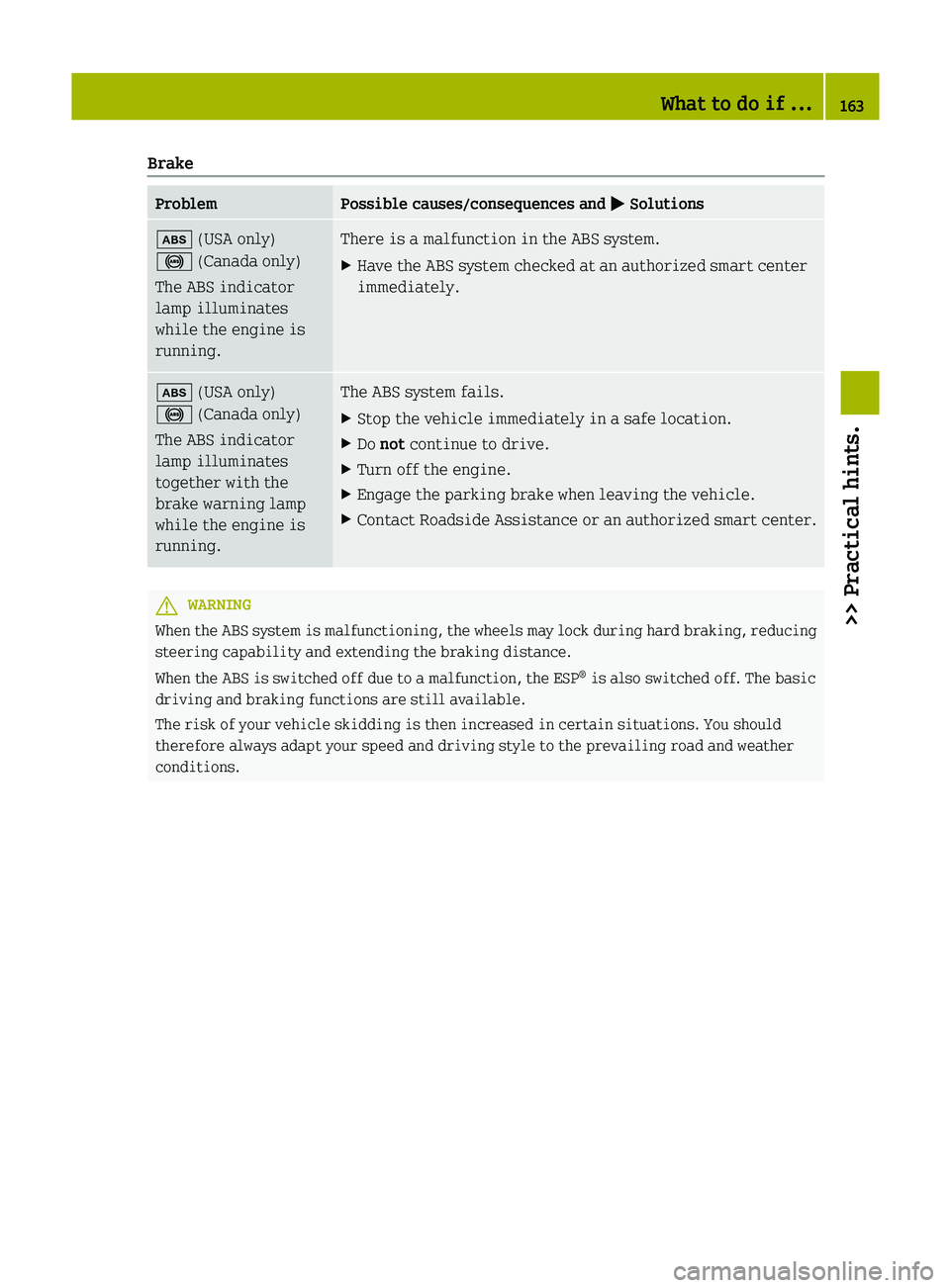
Brake
Problem Possible causes/consequences and
M Solutionsò (USA only)
! (Canada only)
The ABS indicator
lamp illuminates
while the engine is
running. There is a malfunction in the ABS system.
X
Have the ABS system checked at an authorized smart center
immediately. ò (USA only)
! (Canada only)
The ABS indicator
lamp illuminates
together with the
brake warning lamp
while the engine is
running. The ABS system fails.
X
Stop the vehicle immediately in a safe location.
X Do not continue to drive.
X Turn off the engine.
X Engage the parking brake when leaving the vehicle.
X Contact Roadside Assistance or an authorized smart center. G
WARNING
When the ABS system is malfunctioning, the wheels may lock during hard braking, reducing
steering capability and extending the braking distance.
When the ABS is switched off due to a malfunction, the ESP ®
is also switched off. The basic
driving and braking functions are still available.
The risk of your vehicle skidding is then increased in certain situations. You should
therefore always adapt your speed and driving style to the prevailing road and weather
conditions. What to do if ...
163>> Practical hints. Z
Page 175 of 228
low tire pressure telltale. When the system detects a malfunction, the telltale will flash for
approximately 1 minute and then remain continuously illuminated.
This sequence will continue upon subsequent vehicle start-ups as long as the malfunction
exists.
When the malfunction indicator is illuminated, the system may not be able to detect
or signal low tire pressure as intended.
TPMS malfunctions may occur for a variety of reasons, including the installation of
incompatible replacement or alternate tires or wheels on the vehicle that prevent the TPMS
from functioning properly. Always check the TPMS malfunction telltale after replacing one
or more tires or wheels on your vehicle to ensure that the replacement or alternate tires
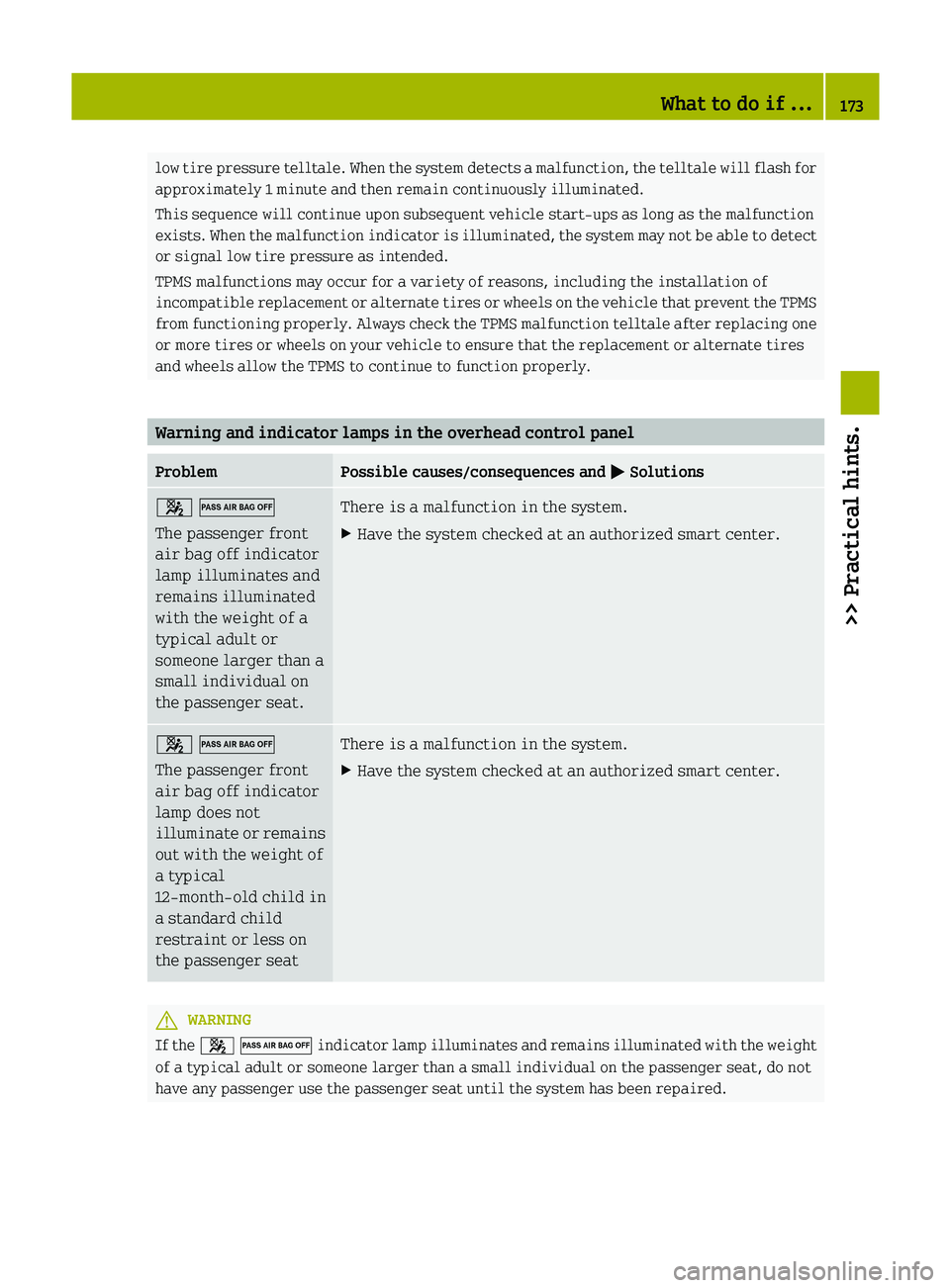
and wheels allow the TPMS to continue to function properly. Warning and indicator lamps in the overhead control panel
Problem Possible causes/consequences and
M Solutions4 0
The passenger front
air bag off indicator
lamp illuminates and
remains illuminated
with the weight of a
typical adult or
someone larger than a
small individual on
the passenger seat. There is a malfunction in the system.
X
Have the system checked at an authorized smart center. 4 0
The passenger front
air bag off indicator
lamp does not
illuminate
or remains
out with the weight of
a typical
12‑month‑old child in
a standard child
restraint or less on
the passenger seat There is a malfunction in the system.
X
Have the system checked at an authorized smart center. G
WARNING
If the 4 0
indicator lamp illuminates and remains illuminated with the weight
of a typical adult or someone larger than a small individual on the passenger seat, do not
have any passenger use the passenger seat until the system has been repaired. What to do if ...
173
>> Practical hints. Z