seats SMART FORTWO COUPE 2012 Owners Manual
[x] Cancel search | Manufacturer: SMART, Model Year: 2012, Model line: FORTWO COUPE, Model: SMART FORTWO COUPE 2012Pages: 228, PDF Size: 12.76 MB
Page 6 of 228
A
ABS (Antilock Brake System) .............46
Indicator lamp ........................ 163
Accessory weight .......................... 139
Accidents Air bags .................................. 33
Additives
Engine oil .............................. 221
Gasoline ................................ 222
Address change .............................. 15
Air bags ....................................... 33
Children ..................................
33
Front, driver and passenger ......... 36
Front, passenger ....................... 36
Head-thorax ............................. 37
Knee bag .................................. 37
Passenger front air bag off
indicator lamp ..................... 28, 41
Safety guidelines ...................... 35
SRS indicator lamp ...................166
Thorax-pelvis .......................... 38
Window curtain ......................... 38
Air conditioning
see HVAC ................................ 102
Air conditioning refrigerant ..........221
Air pressure see Tire inflation pressure
Air pressure (tires) ....................... 140
Air vents ..................................... 104
Alarm system see Anti-theft systems
Ambient lighting ........................... 70
Anticorrosion/antifreeze ............... 223
Antiglare, Interior rear view
mirror ......................................... 62
Antilock Brake System see ABS
Anti-theft systems ......................... 48
Anti-theft warning system ........... 48
Electronic immobilizer .............. 48
Interior motion sensor ...............49
Tow-away alarm ......................... 49
Aquaplaning
see Hydroplaning
Armrest ........................................ 59
Aspect ratio (tires) ....................... 140Audio system
................................. 98
Basic ...................................... 99
Navigation/multimedia ..............99
Automatic headlamp mode ................65
Automatic locking .......................... 53
Automatic transmission ..................82
Display message .......................
159
Driving tips ............................. 84
Emergency operation (limp-
home mode) ............................... 86
Gear selector lever .................... 82
Gear selector lever positions ...... 83
Gearshift pattern ...................... 82
Hill-start assist system .............. 84
Manual gearshifting .................. 84
Shifting procedure .................... 83
Auxiliary instruments
Cockpit clock ........................... 92
Tachometer .............................. 92
AUX socket .................................... 99 B
Backrest see Seats
Backup lamp ................................. 180
Bar (air pressure unit) ................... 140
Battery Charging ................................ 196
Indicator lamp ........................ 168
Jump starting .......................... 199
Removing and installing ............196
Battery (key)
Replacing the transmitter
battery ................................... 177
Bead (tire) .................................. 140
Brake fluid .................................. 123
Checking ................................ 123
Brake lamp .................................. 180
Brake pedal ................................... 81
Brakes ........................................ 144
Parking brake ........................... 80
Warning lamp .......................... 164
Break-in period ........................... 116
Bulbs Front ..................................... 179
Rear ...................................... 180
Replacing ............................... 1784
Index
Page 9 of 228
G
Gasoline see Fuel
GAWR (Gross Axle Weight Rating) ...... 140
Gear selector lever ........................ 82
Transmission positions .............. 83
Global locking/unlocking ................53
Glove box .................................... 110
Gross Axle Weight Rating see GAWR
Gross Vehicle Weight
see GVW
Gross Vehicle Weight Rating
see GVWR
GVW (Gross Vehicle Weight) .............140
GVWR (Gross Vehicle Weight Rating) ..140 H
Halogen headlamps see Headlamps
Hazard warning flasher ................... 69
Headlamps Automatic headlamp mode ............65
Daytime running lamp mode .........66
High-beam flasher ..................... 67
High-beam headlamps ................. 67
LED daytime running lamps
(Canada only) ............................ 67
LED daytime running lamps (USA
only) ....................................... 67
Low-beam headlamps .................. 65
Switch ..................................... 64
Head-thorax air bags ......................37
Heated exterior rear view mirrors .....62
Heated seats .................................. 60
Heating see HVAC ................................ 102
Height adjustment
Seats ...................................... 59
High-beam flasher .......................... 67
High-beam headlamps ................67, 179
Indicator lamp ........................ 169
High-mounted brake lamp ...............180
Hill-start assist system ..................84HVAC (Heating, Ventilation, Air
Conditioning) ..............................
102
Air distribution ...................... 105
Air recirculation .....................107
Air vents ................................ 104
Air volume .............................. 106
Defrosting .............................. 106
Rear window defroster ............... 106
Temperature ............................
104
Hydraulic brake assistant ................48
Hydroplaning ............................... 147 I
Identification labels ....................213
Identification number, vehicle
(VIN) .......................................... 214
Infant and child restraint systems see Children in the vehicle
Inflation pressure
see Tires, Inflation pressure
Inside door handle ......................... 54
Instrument cluster .....................22, 24
Illumination ............................ 92
Lamps, indicator and warning ..... 162
Instrument panel
see Instrument cluster
Instruments and controls
see Cockpit
Interior motion sensor .................... 49
Interior rear view mirror ................62
Interior storage spaces see Storage compartments
Intermittent wiping
Rear window wiper ..................... 72
Windshield wipers ..................... 71 J
Jump-starting .............................. 199 K
Key ............................................. 52
Loss of ................................... 174
Replacing the transmitter
battery ................................... 177
Kilopascal (air pressure unit) .........140 Index
7
Page 12 of 228
S
Safety Driving safety systems
...............46
Occupant safety ......................... 30
Reporting defects ...................... 16
Safety belts
see Seat belts
Seat belt force limiter .................... 33
Seat belts ..................................... 31
Children in the vehicle ..............42
Fastening ................................ 62
Proper use of ............................ 31
Safety guidelines ...................... 35
Safety notes .............................. 31
Telltale ................................. 165
Seating capacity ........................... 131
Seats ........................................... 58
Adjustment ............................... 59
Armrest ................................... 59
Heating ................................... 60
Passenger seat .......................... 60
Self-test
OCS (Occupant Classification
System) ................................... 42
SRS ......................................... 30
Service
see Maintenance
Service, parts .............................. 212
Service and warranty Booklet .................................. 212
Service flap ................................ 120
Service interval display ..................91
Service life (tires) ....................... 133
Side marker lamps ......................... 179
Sidewall (tires) ............................ 141
Side windows Operation ................................ 77
Signs and labels ........................... 213
smart surround sound system ...........100
Snow chains ................................. 142
Snow tires see Winter tires
Soft top system .............................. 72
Cleaning the soft top fabric ....... 154
Locking rear soft top manually ....177
Mounting the side rails .............. 76Opening and closing the rear
soft top
............................... 56, 74
Opening and closing the
retractable soft top
...............56, 73
Removing the side rails .............. 75
Storing the side rails ................75
Sound package .............................. 100
SRS (Supplemental Restraint
System)
Indicator lamp ........................ 166
Standing water, driving through ......148
Starter switch positions ..................57
Starting the engine ........................ 78
Status indicator ............................ 90
Steering wheel gearshift control ......26
Storage compartments ....................109
Coin holder ............................. 110
Door pockets ............................ 110
Drawer .................................... 111
Glove box ................................ 110
in the tailgate ......................... 111
Parcel nets .............................. 111
Storage tray in center console ..... 111
Storage trays next to steering
wheel ..................................... 110
Storing tires ............................... 134
Sun screen ................................... 113
Sun visors ................................... 113 T
Tailgate Closing ............................... 55, 57
Opening .............................. 54, 56
Tail lamps ................................... 180
Technical data Air conditioning refrigerant ..... 221
Brake fluid ............................. 221
Coolant .................................. 223
Engine oil additives .................
221
Engine oils ............................. 220
Fuel requirements .................... 222
Gasoline additives ................... 222
Identification labels ................ 213
Premium unleaded gasoline ........ 221
Rims and tires ......................... 217
Service fluids and capacities .....21810
Index
Page 32 of 228
Occupant safety
Introduction
The smart vehicle is equipped with seat
belts
and dual stage air bags to protect you
in a crash. However, children can be killed
or seriously injured by an inflating air
bag. Indeed, there is a stronger risk of
serious death or bodily injury when an air
bag deploys on a child positioned in a
rear-facing child seat in the passenger
seat. Because this vehicle has only two
front seats and no backseat, it is limited
as are other two-seat vehicles, in the
extent to which it may restrain children
traveling in the passenger front seat. Many
states have laws against placing children
of certain ages in the front seat of a
vehicle that has both front and back seats.
Those laws make exceptions to permit
children to be restrained in the front seat
of two seat vehicles. Special instructions
and warnings are provided below about
when and if you may restrain a child in the
passenger seat of the smart vehicle. Under
certain circumstances, it is appropriate
for the passenger air bag not to operate
when a child is restrained in a car seat in
the passenger seat, and this vehicle is
equipped with technology to accomplish
this. Please pay very close attention to the
instructions and warnings below,
particularly as they relate to children.
In this section you will learn the most
important facts about the restraint system
components of the vehicle.
The restraint systems are:
R Seat belts ( Y page 31)
R Child restraints ( Y page 43) Additional protection potential is
provided by:
R
Supplemental Restraint System (SRS)
with
- Air bags (Y page 33)
- Air bag control unit (with crash
sensors)
- Emergency Tensioning Devices and
seat belt force limiters
(Y page 33)
R Air bag system components with
-Passenger front air bag off indicator
lamp (Y page 41)
- Passenger seat with Occupant
Classification System (OCS)
(Y page 39)
Although independent systems, their
protective functions work in conjunction
with each other.
i For information on infants and
children traveling with you in the
vehicle and restraint systems for infants
and children, see “Children in the
vehicle” ( Y page 42).
The SRS system conducts a self-test when
the ignition is switched on and in regular
intervals while the engine is running. This
facilitates detection of malfunctions. The
SRS indicator lamp 6 in the instrument
cluster comes on when the ignition is
switched on and goes out after
approximately four seconds.
The SRS components are in operational
readiness if the SRS indicator lamp 6
is not lit when the engine is running.
A malfunction in the system has been
detected if the SRS indicator lamp 6
R fails to go out after approximately 4
seconds after the ignition was switched
on
R does not come on at all
R comes on after the engine was started or
while driving 30
Occupant safety
>> Safety.
Page 35 of 228
should be positioned as low as possible
on the hips to avoid any possible
pressure on the abdomen.
R Never place your feet on the instrument
panel, dashboard or on the seat. Always
keep
both feet on the floor in front of the
seat.
R When using a seat belt to secure infant or
toddler restraints or children in booster
seats, always follow the child seat
manufacturer’s instructions. Emergency Tensioning Devices (ETDs)
and seat belt force limiters
The seat belts are equipped with
Emergency Tensioning Devices and seat
belt force limiters.
Emergency Tensioning Devices are
designed to activate in the following
cases:
R in frontal or rear-end impacts
exceeding the system deployment
threshold
R if the restraint systems are operational
and functioning correctly
R in collisions with high vehicle
deceleration/acceleration in the
longitudinal direction, e.g. a head-on
collision
R on passenger side when the seat is
occupied and the seat belt is fastened
R independently of the front air bags
When activated, Emergency Tensioning
Devices
remove slack from the seat belts in
such a way that the seat belts fit more
snugly against the body. Seat belt force
limiters, when activated, reduce the force
exerted by the seat belts on occupants
during a crash.
When the emergency tensioning device is
triggered, the SRS indicator lamp 6 in
the instrument cluster illuminates, see
“SRS indicator lamp” ( Y page 166). G
WARNING
Once they have been triggered, Emergency
Tensioning
Devices will no longer function
properly and must be replaced. smart
recommends that you visit a qualified
workshop to have this done. In particular,
work relevant to safety or on safety-related
systems must be carried out at a qualified
specialist workshop.
Comply with safety regulations when
disposing of Emergency Tensioning
Devices. These regulations are available at
any smart center.
The belt force limiter is designed to
operate in unison with the front air bag,
which absorbs a portion of the seat belt’s
decelerating forces, distributing the load
over a larger area.
In the event of a head-on or rear-end
collision, the emergency tensioning
device is activated if the vehicle is
decelerated or accelerated sufficiently in
the longitudinal direction at the start of
impact with the ignition switched on. Air bags
Air bags can reduce the severity of
injuries in serious collisions, e.g. in a
head-on collision or a side impact. G
WARNING
Air bags are designed to reduce the
potential of injury in certain frontal
impacts (front air bags and knee bags), or
side impacts (head-thorax air bags,
window
curtain air bags and thorax-pelvis
air bags) which may cause significant
injuries. However, no system available
today can completely eliminate injuries
and fatalities.
The deployment of the air bags temporarily
releases a small amount of dust from the air
bags. This dust is neither injurious to your
health, nor does it indicate a fire in the
vehicle. The dust might cause some Occupant safety
33
>> Safety.
Z
Page 44 of 228
R
Do not lean on the armrests or lift
yourself
from the seat by using the handle
over the door as this may cause the OCS to
be unable to correctly approximate the
occupant weight category.
R Only have the seat repaired or replaced
by an authorized smart center.
R Read and observe all warnings in this
chapter.
Self-test Occupant Classification
System After turning the key in the starter switch
to position
1 or 2, the 4 0
indicator lamp located in the center
console illuminates. If an adult occupant
is properly sitting on the passenger seat
and
the system senses the occupant as being
an adult, the 4 0 indicator
lamp will illuminate and go out after
approximately 4 seconds.
If the seat is not occupied and the system
senses the passenger seat as being empty,
the 4 0 indicator lamp will
illuminate and not go out. G
WARNING
If the 4 0 indicator lamp does
not illuminate immediately after starting
the engine, the system is not functioning.
You
must contact an authorized smart center
before seating any child on the passenger
seat.
More information can be found in the
“Practical hints” section ( Y page 173).G
WARNING
Never place anything between seat cushion
and child seat (e.g. pillow), since it
reduces the effectiveness of the Occupant
Classification System. The bottom of the
child seat must make full contact with the
passenger seat cushion. An incorrectly
mounted
child seat could cause injuries to the child in case of an accident, instead of
increasing protection for the child.
Follow the manufacturer’s instructions for
installation of child seats.
Children in the vehicle
If an infant or child is traveling with you
in the vehicle:
X Secure the child using an infant or child
restraint
appropriate to the age and size
of the child.
X Make sure the infant or child is properly
secured
at all times while the vehicle is
in motion. G
WARNING
Do not leave children unattended in the
vehicle,
even if they are secured in a child
restraint system. The children could
R injure themselves on parts of the vehicle
R be seriously or fatally injured through
excessive exposure to extreme heat or
cold
Do not expose the child restraint system to
direct sunlight. The child restraint
system’s metal parts, for example, could
become very hot, and the child could be
burned on these parts.
If children open a door, they could
R injure other persons
R get out of the vehicle and injure
themselves or be injured by following
traffic
Do not carry heavy or hard objects in the
passenger compartment unless they are
firmly secured in place.
For more information, please refer to the
“Loading and storing section”. 42
Occupant safety
>> Safety.
Page 53 of 228
>> Controls.Opening and closing
.......................... 52
Starter switch positions .....................57
Seats .............................................. 58
Mirrors ........................................... 61
Seat belts ........................................ 62
Lighting ......................................... 64
Windshield wipers ............................ 70
Soft top system (cabriolet only)
............ 72
Side windows .................................... 77
Driving and parking .......................... 78
Transmission ................................... 82
Instrument cluster ............................. 86
Control system* ................................ 93
Audio system* .................................. 98
Driving systems ............................... 100
HVAC (Heating, Ventilation, Air Con-
ditioning) ...................................... 102
Loading and storing ......................... 107
Useful features ................................ 113
Page 60 of 228
g
For removing key
1
Ignition (power supply for all
electrical consumers) and driving
position
All lamps (except low‑beam
headlamp indicator lamp,
high‑beam headlamp indicator
lamp, and turn signal indicator
lamps unless activated) in the
instrument cluster come on. If a
lamp
in the instrument cluster fails
to come on when the ignition is
switched on, have it checked and
replaced if necessary. If a lamp in
the instrument cluster remains on
after starting the engine or comes
on while driving, refer to “Warning
and indicator lamps in the
instrument cluster” ( Y page 162).2
Starting (
Y page 78)i
When you switch on the ignition, the
indicator and warning lamps (except
low‑beam headlamp indicator lamp,
high‑beam
headlamp indicator lamp, and
turn signal indicator lamps unless
activated) in the instrument cluster
come on. The indicator and warning
lamps (except low‑beam headlamp
indicator lamp, high‑beam headlamp
indicator lamp, and turn signal
indicator lamps if activated) will go out
when the engine is running. This
indicates that the respective systems
are operational. Seats
Safety notes
G
WARNING
All seat adjustments, as well as fastening
of seat belts, must be done before the
vehicle is operated. G
WARNING
When adjusting the seat, make sure no one
becomes trapped.
Do not adjust the driver’s seat while
driving. Adjusting the seat while driving
could
cause the driver to lose control of the
vehicle.
Never ride in a moving vehicle with the seat
backrest in an excessively reclined
position as this can be dangerous. You
could slide under the seat belt in a
collision. If you slide under the seat belt,
it could apply force at the abdomen or neck,
potentially causing serious or fatal
injuries. The seat backrest and seat belts
provide the best restraint when the wearer
is in a position that is as upright as
possible and seat belts are properly
positioned on the body.
Your seat must be adjusted so that you can
correctly fasten your seat belt.
Observe the following points:
R Adjust the seat backrest until your arms
are slightly angled when holding the
steering wheel.
R Adjust the seat to a comfortable seating
position that still allows you to reach the
accelerator/brake pedal safely. The
position should be as far back as
possible with the driver still able to
operate the controls properly.
R Never place hands under the seat or near
any moving parts while a seat is being
adjusted.
Failure to do so could result in an accident
and/or serious personal injury.
Observe the notes on the air bag system. G
WARNING
Children 12 years old and under must be
seated and properly secured in an
appropriately sized infant restraint,
toddler restraint, or booster seat
recommended
for the size and weight of the58
Seats
>> Controls.
Page 61 of 228
child. For additional information, see
“Children in the vehicle”.
A child’s risk of serious or fatal injuries
is significantly increased if the child
restraints are not properly secured in the
vehicle and/or the child is not properly
secured in the child restraint.
G
WARNING
Contact an authorized smart center if the
seats have become damaged.
The
seat is an integral part of the vehicle’s
safety system in the same way as seat belts
and air bags. Damage to the seats may
reduce their ability to protect the
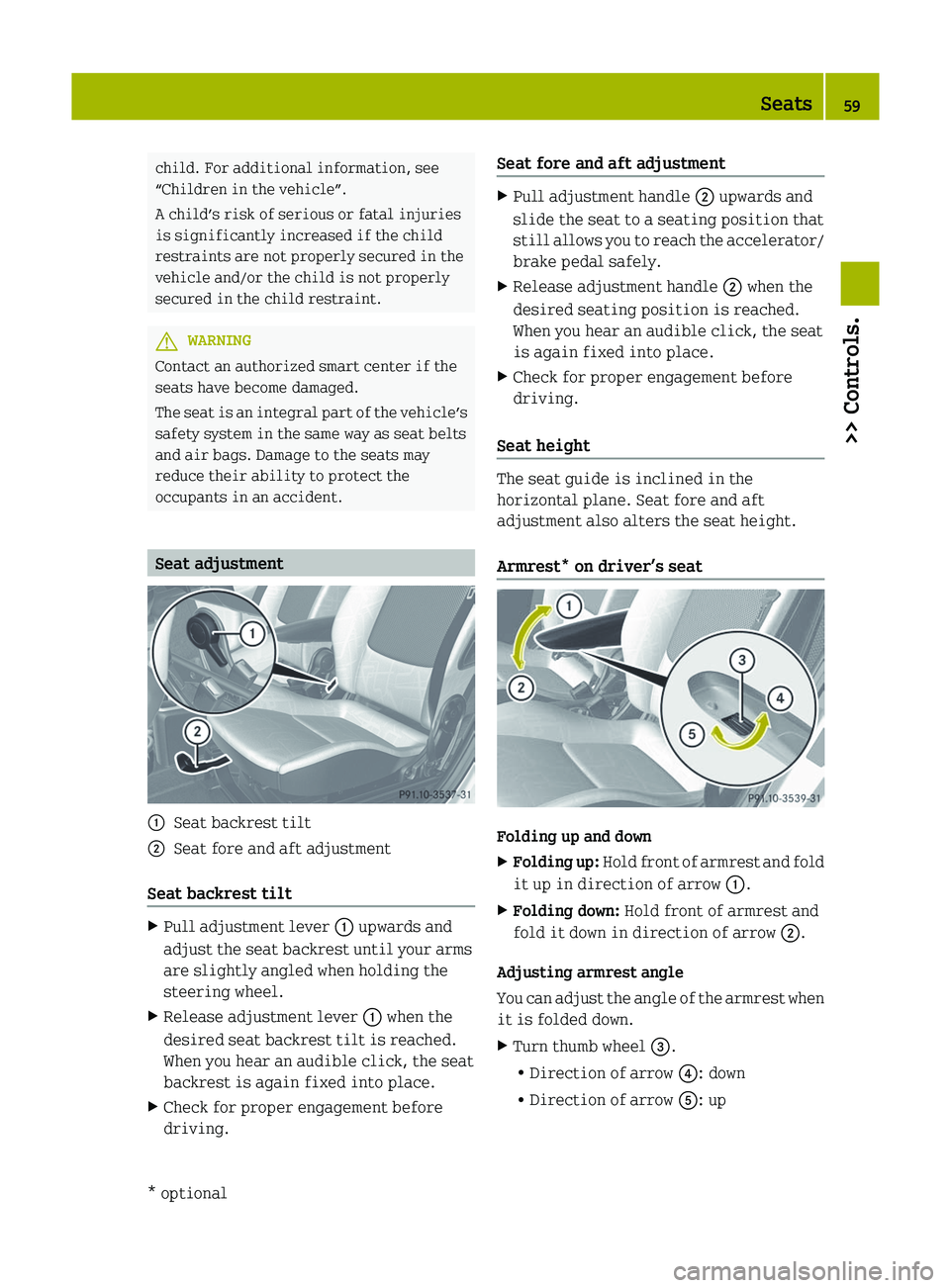
occupants in an accident. Seat adjustment
:
Seat backrest tilt
; Seat fore and aft adjustment
Seat backrest tilt X
Pull adjustment lever : upwards and
adjust the seat backrest until your arms
are slightly angled when holding the
steering wheel.
X Release adjustment lever : when the
desired seat backrest tilt is reached.
When you hear an audible click, the seat
backrest is again fixed into place.
X Check for proper engagement before
driving. Seat fore and aft adjustment X
Pull adjustment handle ; upwards and
slide the seat to a seating position that
still
allows you to reach the accelerator/
brake pedal safely.
X Release adjustment handle ; when the
desired seating position is reached.
When you hear an audible click, the seat
is again fixed into place.
X Check for proper engagement before
driving.
Seat height The seat guide is inclined in the
horizontal plane. Seat fore and aft
adjustment also alters the seat height.
Armrest* on driver’s seat
Folding up and down
X
Folding up:
Hold front of armrest and fold
it up in direction of arrow :.
X Folding down: Hold front of armrest and
fold it down in direction of arrow ;.
Adjusting armrest angle
You
can adjust the angle of the armrest when
it is folded down.
X Turn thumb wheel =.
R
Direction of arrow ?: down
R Direction of arrow A: up Seats
59
>> Controls.
* optional Z
Page 62 of 228
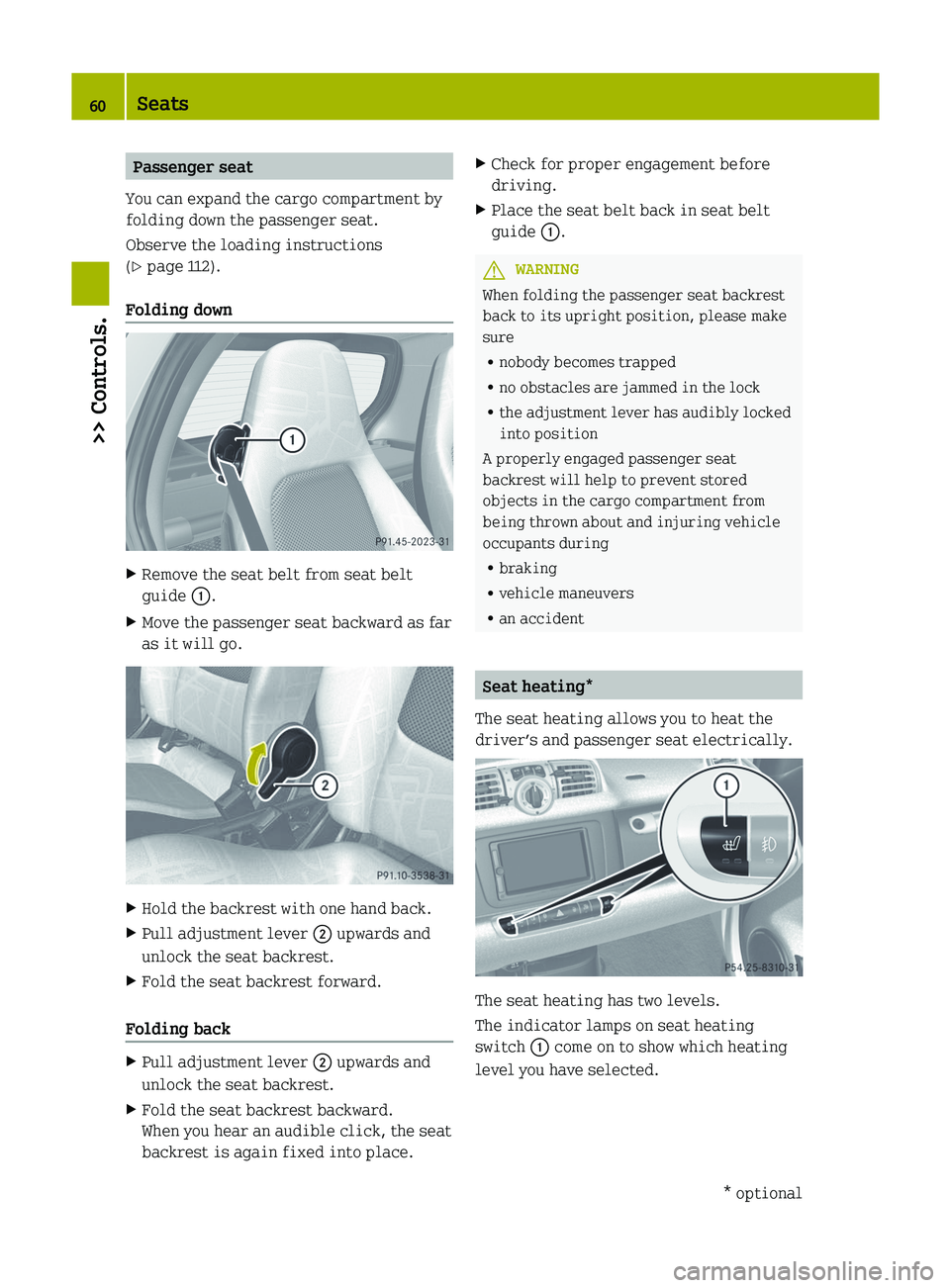
Passenger seat
You can expand the cargo compartment by
folding down the passenger seat.
Observe the loading instructions
(Y page 112).
Folding down X
Remove the seat belt from seat belt
guide :.
X Move the passenger seat backward as far
as it will go. X
Hold the backrest with one hand back.
X Pull adjustment lever ; upwards and
unlock the seat backrest.
X Fold the seat backrest forward.
Folding back X
Pull adjustment lever ; upwards and
unlock the seat backrest.
X Fold the seat backrest backward.
When you hear an audible click, the seat
backrest is again fixed into place. X
Check for proper engagement before
driving.
X Place the seat belt back in seat belt
guide :. G
WARNING
When folding the passenger seat backrest
back to its upright position, please make
sure
R nobody becomes trapped
R no obstacles are jammed in the lock
R the adjustment lever has audibly locked
into position
A properly engaged passenger seat
backrest will help to prevent stored
objects in the cargo compartment from
being thrown about and injuring vehicle
occupants during
R braking
R vehicle maneuvers
R an accident Seat heating*
The seat heating allows you to heat the
driver’s and passenger seat electrically. The seat heating has two levels.
The indicator lamps on seat heating
switch : come on to show which heating
level you have selected.60
Seats>> Controls.
* optional