truck SMART FORTWO COUPE 2012 Owners Manual
[x] Cancel search | Manufacturer: SMART, Model Year: 2012, Model line: FORTWO COUPE, Model: SMART FORTWO COUPE 2012Pages: 228, PDF Size: 12.76 MB
Page 39 of 228
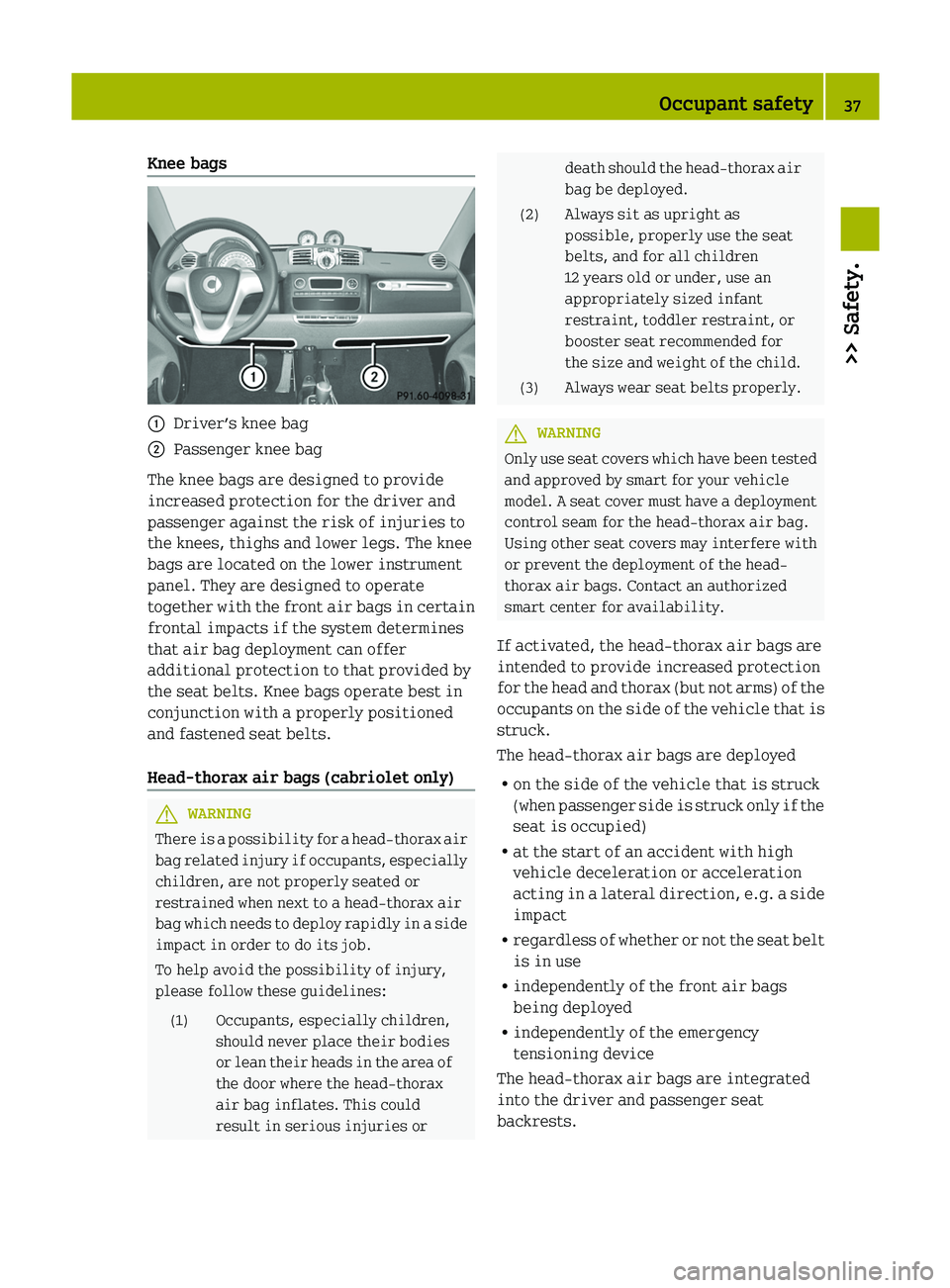
Knee bags
:
Driver’s knee bag
; Passenger knee bag
The knee bags are designed to provide
increased protection for the driver and
passenger against the risk of injuries to
the knees, thighs and lower legs. The knee
bags are located on the lower instrument
panel. They are designed to operate
together
with the front air bags in certain
frontal impacts if the system determines
that air bag deployment can offer
additional protection to that provided by
the seat belts. Knee bags operate best in
conjunction with a properly positioned
and fastened seat belts.
Head-thorax air bags (cabriolet only) G
WARNING
There is a possibility for a head-thorax air
bag
related injury if occupants, especially
children, are not properly seated or
restrained when next to a head-thorax air
bag which needs to deploy rapidly in a side
impact in order to do its job.
To help avoid the possibility of injury,
please follow these guidelines:
(1) Occupants, especially children, should never place their bodies
or
lean their heads in the area of
the door where the head-thorax
air bag inflates. This could
result in serious injuries or death should the head-thorax air
bag be deployed.
(2) Always sit as upright as possible, properly use the seat
belts, and for all children
12 years old or under, use an
appropriately sized infant
restraint, toddler restraint, or
booster seat recommended for
the
size and weight of the child.
(3) Always wear seat belts properly. G
WARNING
Only use seat covers which have been tested
and approved by smart for your vehicle
model.
A seat cover must have a deployment
control seam for the head-thorax air bag.
Using other seat covers may interfere with
or prevent the deployment of the head-
thorax air bags. Contact an authorized
smart center for availability.
If activated, the head-thorax air bags are
intended to provide increased protection
for the head and thorax (but not arms) of the
occupants on the side of the vehicle that is
struck.
The head-thorax air bags are deployed
R on the side of the vehicle that is struck
(when passenger side is struck only if the
seat is occupied)
R at the start of an accident with high
vehicle deceleration or acceleration
acting in a lateral direction, e.g. a side
impact
R regardless of whether or not the seat belt
is in use
R independently of the front air bags
being deployed
R independently of the emergency
tensioning device
The head-thorax air bags are integrated
into the driver and passenger seat
backrests. Occupant safety
37
>> Safety. Z
Page 138 of 228
A
Manufacturer
B Tire ply material ( Y page 139)
C Tire size designation, load and speed
rating (Y page 136)
D Load identification (Y page 138)
E Tire name
i For illustration purposes only. Actual
data
on tires are specific to each vehicle
and may vary from data shown in above
illustration.
For more information, see “Rims and
tires” ( Y page 217).
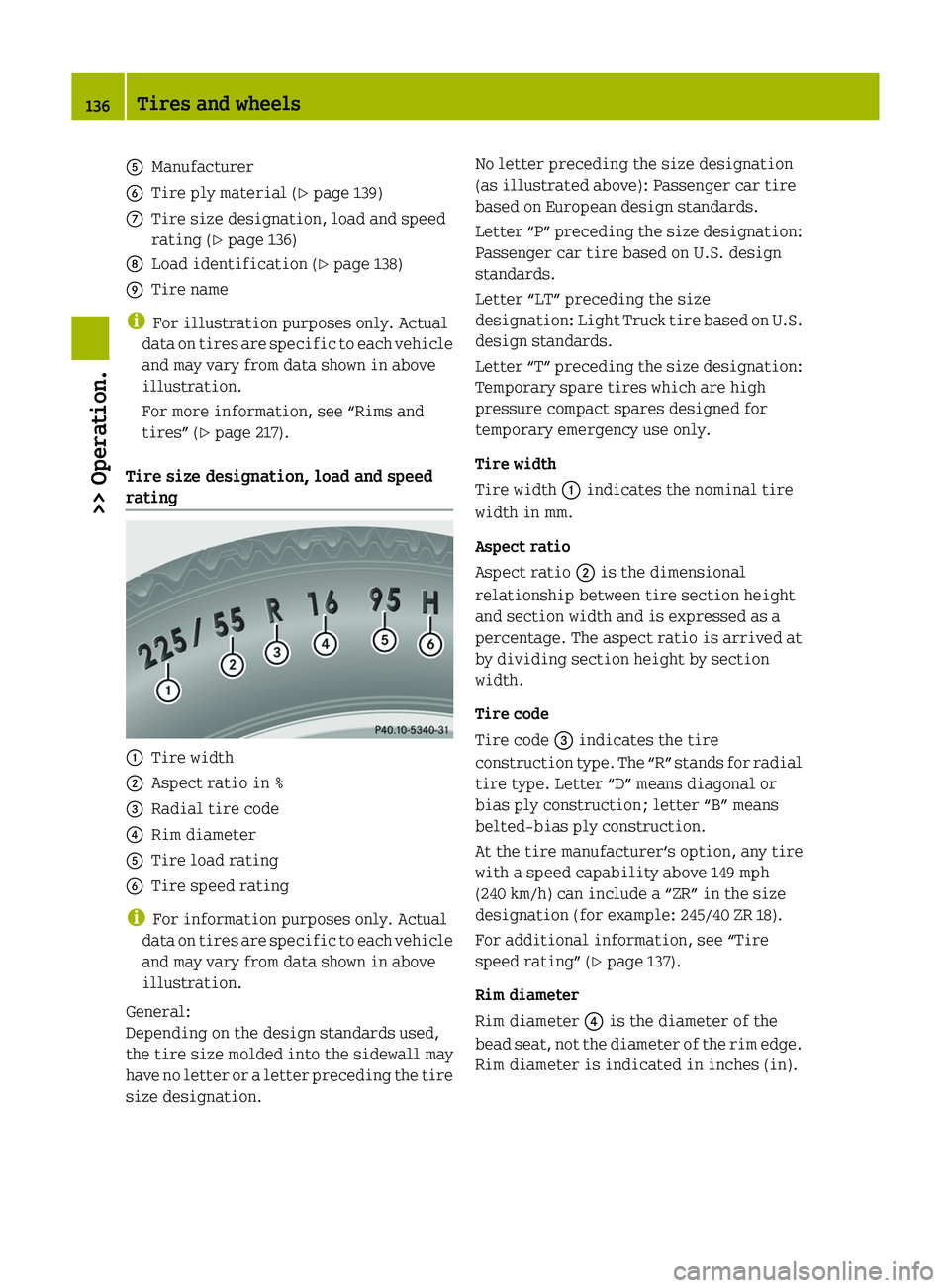
Tire size designation, load and speed
rating :
Tire width
; Aspect ratio in %
= Radial tire code
? Rim diameter
A Tire load rating
B Tire speed rating
i For information purposes only. Actual
data
on tires are specific to each vehicle
and may vary from data shown in above
illustration.
General:
Depending on the design standards used,
the tire size molded into the sidewall may
have no letter or a letter preceding the tire
size designation. No letter preceding the size designation
(as illustrated above): Passenger car tire
based on European design standards.
Letter
“P” preceding the size designation:
Passenger car tire based on U.S. design
standards.
Letter “LT” preceding the size
designation: Light Truck tire based on U.S.
design standards.
Letter “T” preceding the size designation:
Temporary spare tires which are high
pressure compact spares designed for
temporary emergency use only.
Tire width
Tire width : indicates the nominal tire
width in mm.
Aspect ratio
Aspect ratio ; is the dimensional
relationship between tire section height
and section width and is expressed as a
percentage. The aspect ratio is arrived at
by dividing section height by section
width.
Tire code
Tire code = indicates the tire
construction type. The “R” stands for radial
tire type. Letter “D” means diagonal or
bias ply construction; letter “B” means
belted-bias ply construction.
At the tire manufacturer’s option, any tire
with a speed capability above 149 mph
(240 km/h) can include a “ZR” in the size
designation (for example: 245/40 ZR 18).
For additional information, see “Tire
speed rating” (Y page 137).
Rim diameter
Rim diameter ? is the diameter of the
bead seat, not the diameter of the rim edge.
Rim diameter is indicated in inches (in). 136
Tires and wheels
>> Operation.
Page 204 of 228
X
Remove the jumper cables from negative terminals = and ? first.
X Remove the jumper cables from positive terminals : and ;.
You can now switch on the headlamps.
X Remount the positive terminal cover.
X Have the battery checked at the nearest authorized smart center. Towing
About towing
This section offers information on towing
methods for breakdown situations,
emergency towing, and flat towing smart
vehicles. Recommended towing method -
Breakdown situation
smart recommends that the vehicle be
transported with all wheels off the ground
using a flatbed carrier truck or
appropriate wheel lift/dolly equipment.
X Switch off the tow‑away protection* and
interior motion sensor*
(Y page 49).
! To
prevent damage during transport, do
not tie down the vehicle by its chassis or
suspension parts — use only wheel straps
to position and hold down the vehicle.
Improper tie down on a flatbed carrier
truck or trailer can damage suspension
parts and body panels. Emergency towing
When circumstances do not permit the
recommended towing method, the vehicle
may
be towed with all wheels on the ground
using a strap or tow bar connected to
another vehicle. Only tow the vehicle as far
as necessary to have the vehicle moved to a
safe location where the recommended
towing method can be employed. G
WARNING
If circumstances require towing the
vehicle with all wheels on the ground,
always tow with a tow bar if:
R the engine will not run
R there is a malfunction in the brake
system
R there is a malfunction in the power
supply or in the vehicle’s electrical
system
A
tow bar is necessary to adequately control
the towed vehicle.
Prior to towing the vehicle with all wheels
on the ground, make sure the gear selector
lever is in neutral position N and the
ignition is switched off. G
WARNING
With the engine not running, there is no
power assistance for the brake and
steering* systems. In this case, it is
important to keep in mind that a
considerably higher degree of effort is
necessary to brake and steer the vehicle.
Adapt your driving accordingly.
! Do not tow the vehicle with the front
axle raised. Doing so may cause serious
damage to the brake system which is not
covered by the smart Limited Warranty.
! Before towing the vehicle observe the
following instructions:
R Do not tow with sling-type equipment
attached
to suspension parts. This may202
Towing
>> Practical hints.
* optional