winter tires SMART FORTWO COUPE 2012 Owners Manual
[x] Cancel search | Manufacturer: SMART, Model Year: 2012, Model line: FORTWO COUPE, Model: SMART FORTWO COUPE 2012Pages: 228, PDF Size: 12.76 MB
Page 7 of 228
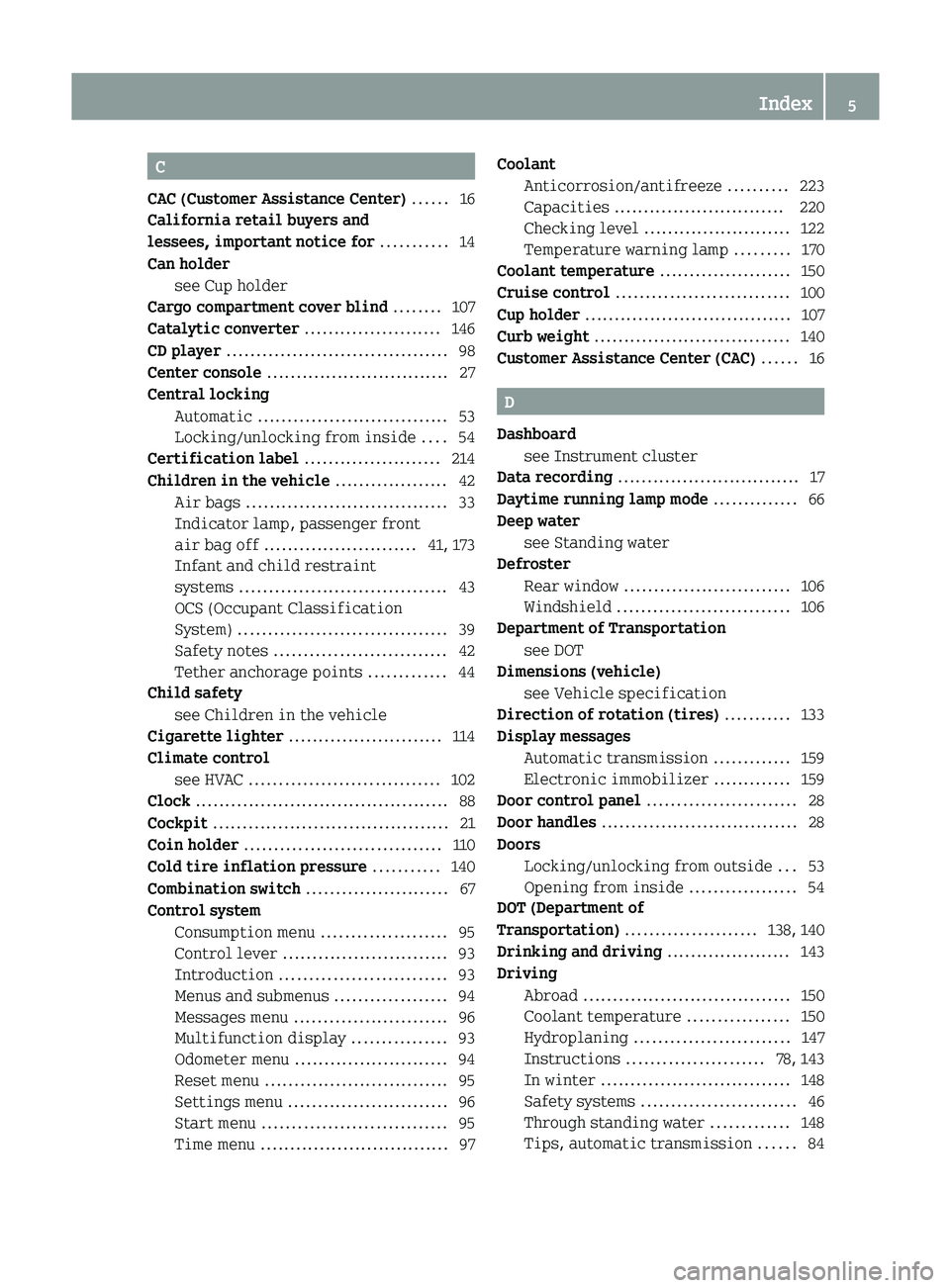
C
CAC (Customer Assistance Center) ......16
California retail buyers and
lessees, important notice for ...........14
Can holder see Cup holder
Cargo compartment cover blind ........107
Catalytic converter ....................... 146
CD player ..................................... 98
Center console ............................... 27
Central locking Automatic ................................ 53
Locking/unlocking from inside ....54
Certification label ....................... 214
Children in the vehicle ................... 42
Air bags .................................. 33
Indicator lamp, passenger front
air bag off .......................... 41, 173
Infant and child restraint
systems ................................... 43
OCS (Occupant Classification
System) ................................... 39
Safety notes ............................. 42
Tether anchorage points ............. 44
Child safety
see Children in the vehicle
Cigarette lighter .......................... 114
Climate control see HVAC ................................ 102
Clock ........................................... 88
Cockpit ........................................ 21
Coin holder ................................. 110
Cold tire inflation pressure ...........140
Combination switch ........................ 67
Control system Consumption menu ..................... 95
Control lever ............................ 93
Introduction ............................ 93
Menus and submenus ................... 94
Messages menu .......................... 96
Multifunction display ................ 93
Odometer menu .......................... 94
Reset menu ............................... 95
Settings menu ........................... 96
Start menu ............................... 95
Time menu ................................ 97Coolant
Anticorrosion/antifreeze .......... 223
Capacities .............................
220
Checking level ......................... 122
Temperature warning lamp .........170
Coolant temperature ......................150
Cruise control ............................. 100
Cup holder ................................... 107
Curb weight ................................. 140
Customer Assistance Center (CAC) ......16 D
Dashboard see Instrument cluster
Data recording ............................... 17
Daytime running lamp mode ..............66
Deep water see Standing water
Defroster
Rear window ............................ 106
Windshield ............................. 106
Department of Transportation
see DOT
Dimensions (vehicle)
see Vehicle specification
Direction of rotation (tires) ...........133
Display messages Automatic transmission .............159
Electronic immobilizer ............. 159
Door control panel ......................... 28
Door handles ................................. 28
Doors Locking/unlocking from outside ...53
Opening from inside .................. 54
DOT (Department of
Transportation) ...................... 138, 140
Drinking and driving ..................... 143
Driving Abroad ................................... 150
Coolant temperature .................150
Hydroplaning .......................... 147
Instructions ....................... 78, 143
In winter ................................ 148
Safety systems .......................... 46
Through standing water ............. 148
Tips, automatic transmission ...... 84 Index
5
Page 12 of 228
S
Safety Driving safety systems
...............46
Occupant safety ......................... 30
Reporting defects ...................... 16
Safety belts
see Seat belts
Seat belt force limiter .................... 33
Seat belts ..................................... 31
Children in the vehicle ..............42
Fastening ................................ 62
Proper use of ............................ 31
Safety guidelines ...................... 35
Safety notes .............................. 31
Telltale ................................. 165
Seating capacity ........................... 131
Seats ........................................... 58
Adjustment ............................... 59
Armrest ................................... 59
Heating ................................... 60
Passenger seat .......................... 60
Self-test
OCS (Occupant Classification
System) ................................... 42
SRS ......................................... 30
Service
see Maintenance
Service, parts .............................. 212
Service and warranty Booklet .................................. 212
Service flap ................................ 120
Service interval display ..................91
Service life (tires) ....................... 133
Side marker lamps ......................... 179
Sidewall (tires) ............................ 141
Side windows Operation ................................ 77
Signs and labels ........................... 213
smart surround sound system ...........100
Snow chains ................................. 142
Snow tires see Winter tires
Soft top system .............................. 72
Cleaning the soft top fabric ....... 154
Locking rear soft top manually ....177
Mounting the side rails .............. 76Opening and closing the rear
soft top
............................... 56, 74
Opening and closing the
retractable soft top
...............56, 73
Removing the side rails .............. 75
Storing the side rails ................75
Sound package .............................. 100
SRS (Supplemental Restraint
System)
Indicator lamp ........................ 166
Standing water, driving through ......148
Starter switch positions ..................57
Starting the engine ........................ 78
Status indicator ............................ 90
Steering wheel gearshift control ......26
Storage compartments ....................109
Coin holder ............................. 110
Door pockets ............................ 110
Drawer .................................... 111
Glove box ................................ 110
in the tailgate ......................... 111
Parcel nets .............................. 111
Storage tray in center console ..... 111
Storage trays next to steering
wheel ..................................... 110
Storing tires ............................... 134
Sun screen ................................... 113
Sun visors ................................... 113 T
Tailgate Closing ............................... 55, 57
Opening .............................. 54, 56
Tail lamps ................................... 180
Technical data Air conditioning refrigerant ..... 221
Brake fluid ............................. 221
Coolant .................................. 223
Engine oil additives .................
221
Engine oils ............................. 220
Fuel requirements .................... 222
Gasoline additives ................... 222
Identification labels ................ 213
Premium unleaded gasoline ........ 221
Rims and tires ......................... 217
Service fluids and capacities .....21810
Index
Page 13 of 228
Vehicle specification (model
BRABUS) .................................
216
Vehicle specification (model
passion) ................................. 215
Vehicle specification (model
pure) ..................................... 215
Windshield/rear window washer
system ............................. 220, 222
Technical data (dimensions)
see Vehicle specification
Technical data (weights)
see Vehicle specification
Temperature
Coolant .................................. 150
Interior temperature ................ 104
Outside ................................... 89
Tether anchorage points
see Children in the vehicle
Thorax-pelvis side air bags .............38
Tightening torque Wheels ................................... 135
TIN (Tire Identification
Number) ................................. 138, 141
Tire and Loading Information
placard ....................................... 130
Tire and loading terminology ..........139
Tire Identification Number see TIN
Tire inflation pressure
Checking ................................ 126
Important notes on .................... 126
Placard on driver’s door B-
pillar .................................... 130
Tire labeling ............................... 135
Tire load rating ........................... 141
Tire ply composition and material
used ........................................... 141
Tire Pressure Monitoring System
(TPMS) ........................................ 127
Tire repair kit ....................... 158, 186
Tires .................................... 124, 217
Air pressure ........................... 125
Care and maintenance ............... 133
Cleaning ................................ 134
Direction of rotation, spinning .. 133
Driving instructions ................146
Flat tire ................................. 186Important notes on tire
inflation pressure ....................
126
Inflation pressure ..............126, 127
Information placard .................130
Inspection .............................. 133
Labeling ................................ 135
Load rating ............................. 141
Ply composition and material
used ...................................... 141
Problems under-/overinflation ... 126
Retreads ................................. 124
Rims and tires (technical data) ... 217
Rotation ................................. 135
Service life ............................ 133
Sizes ..................................... 217
Snow chains ............................ 142
Speed rating ................ 137, 141, 147
Storing .................................. 134
Temperature ...................... 126, 135
Terminology ............................ 139
Tire Identification Number ..138, 141
Tire Pressure Monitoring
System (TPMS) .......................... 127
Traction ...................... 134, 141, 147
Tread ..................................... 141
Tread depth ....................... 133, 142
Treadwear indicators ..........133, 142
Vehicle maximum load on ...........142
Wheel change ........................... 194
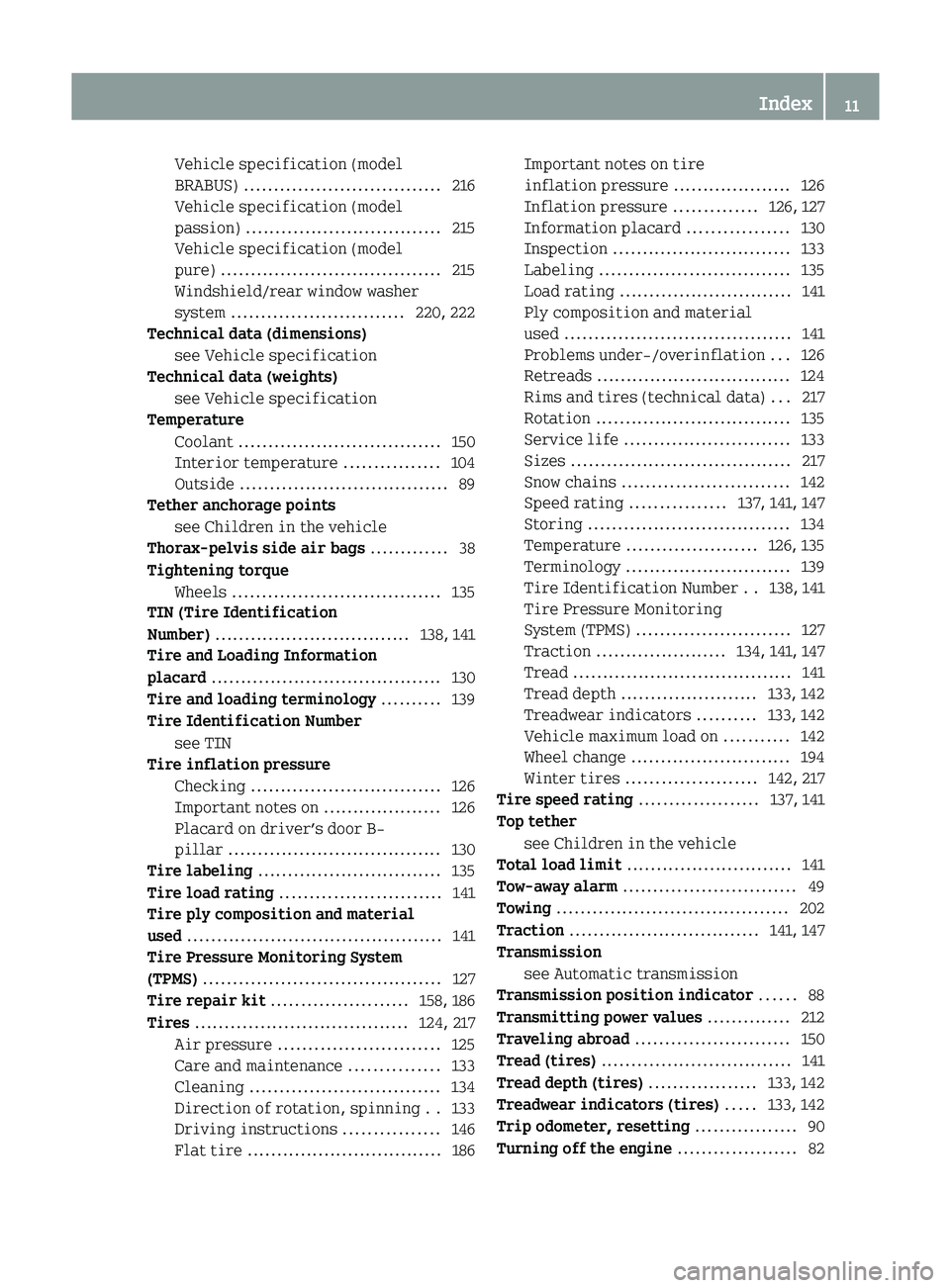
Winter tires ...................... 142, 217
Tire speed rating .................... 137, 141
Top tether see Children in the vehicle
Total load limit ............................ 141
Tow-away alarm ............................. 49
Towing ....................................... 202
Traction ................................ 141, 147
Transmission see Automatic transmission
Transmission position indicator ......88
Transmitting power values ..............212
Traveling abroad .......................... 150
Tread (tires) ................................ 141
Tread depth (tires) .................. 133, 142
Treadwear indicators (tires) .....133, 142
Trip odometer, resetting .................90
Turning off the engine .................... 82 Index
11
Page 14 of 228
Turn signal lamps
......................... 179
Turn signals ................................. 68
Indicator lamps ....................... 169U
Uniform Tire Quality Grading
Standards .............................. 134, 142
Unleaded gasoline, premium ........... 221
Unlocking the vehicle ..................... 52
Manually .................................
176
USB socket .................................... 99V
Vehicle Bulbs ..................................... 178
Care ...................................... 150
Identification Number (VIN) .......214
Locking/unlocking
....................52
Modifications and alterations,
Operating safety ....................... 15
Towing ................................... 202
Unlocking/locking manually ....... 176
Vehicle dimensions
see Vehicle specification
Vehicle Identification Number
(VIN) .......................................... 214
Vehicle lighting ............................ 64
Vehicle loading Instructions ............................ 112
Load limit .............................. 131
Roof rack ................................ 112
Terminology ............................ 139
Vehicle maximum load on the tire ....142
Vehicle specification Model BRABUS .......................... 216
Model passion ......................... 215
Model pure .............................. 215
Vehicle washing
see Vehicle care
Vehicle weights
see Vehicle specification
Ventilation
see HVAC ................................ 102 W
Warning signals Anti-theft warning system .......... 175
Brake pads .............................. 176
Door ...................................... 175
Parking .................................. 176
Seat belt reminder system
....165, 175
Warranty coverage ......................... 212
Warranty information ......................13
Washer fluid Mixing ratio ........................... 222
Refilling ............................... 122
Wiping .................................... 71
Washer jet nozzles ......................... 186
Washing the vehicle ......................150
Weights (vehicle) see Vehicle specification
Wheel change ............................... 194
Wheel cover ................................. 194
Wheels, sizes ............................... 217
Wheels, Tires and .......................... 124
Where will I find...? First-aid kit ........................... 158
Tire repair kit ........................ 158
Window curtain air bags ..................38
Windshield Washer fluid ....................... 71, 222
Wipers .................................... 70
Windshield wipers .......................... 70
Adjusting washer jet nozzles ...... 186
Rain-light sensor ...................... 71
Replacing wiper blades ............. 184
Winter driving
Driving instructions ................148
Snow chains ............................ 142
Tires ..................................... 142
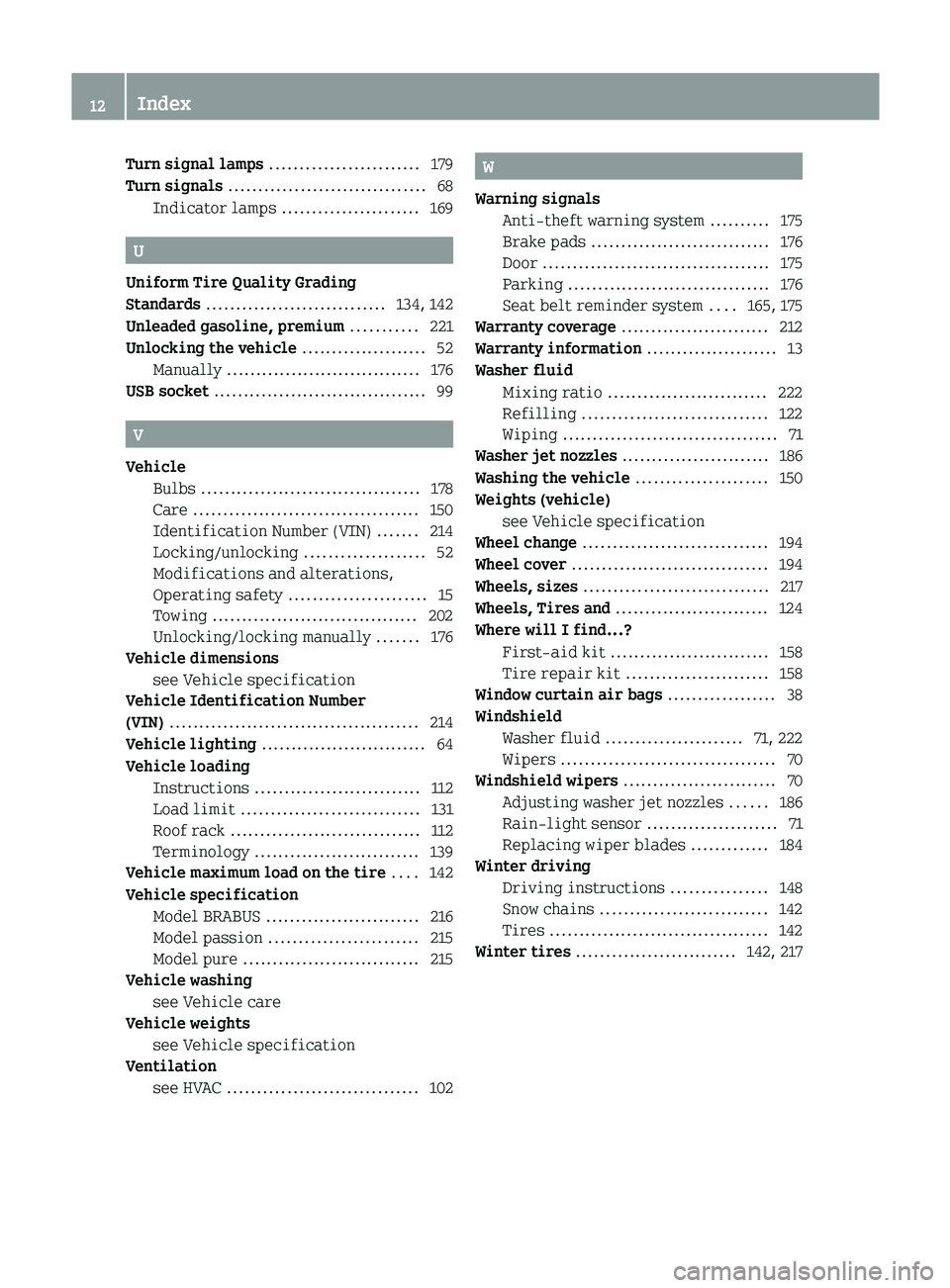
Winter tires ........................... 142, 21712
Index
Page 48 of 228
The product label with FCC ID and IC
certification
number can be found in the
battery case.
i Canada only:
This device complies with RSS‑210 of
Industry Canada. Operation is subject to
the following two conditions:
1. This device may not cause
interference, and
2. this device must accept any
interference received, including
interference that may cause undesired
operation of the device.
Any unauthorized modification to this
device could void the user’s authority to
operate the equipment.
The product label with FCC ID and IC
certification number can be found in the
battery case. Driving safety systems
Introduction
G
WARNING
The following factors increase the risk of
accidents:
R Excessive speed, especially in turns
R Wet and slippery road surfaces
R Following another vehicle too closely
The driving safety systems described in
this section cannot reduce these risks or
prevent the natural laws of physics from
acting on the vehicle.
Always adapt your driving style to the
prevailing road and weather and traffic
conditions and keep a safe distance to
other road users and objects on the street.
i In winter operation, the maximum
effectiveness of the ABS, the hydraulic
brake assistant, and the ESP ®
is only
achieved with winter tires ( Y page 142)
or snow chains* as required. Antilock Brake System (ABS)
G
WARNING
Do not pump the brake pedal. Use firm,
steady brake pedal pressure instead.
Pumping the brake pedal defeats the
purpose of the ABS and significantly
reduces braking effectiveness.
The Antilock Brake System (ABS) regulates
the
brake pressure so that the wheels do not
lock during braking. This allows you to
maintain the ability to steer your vehicle.
On slippery road surfaces, the ABS will
respond even to light brake pressure.
The ABS indicator lamp in the instrument
cluster (Y page 22) comes on when you
switch on the ignition. It goes out when the
engine is running.
Braking At the instant one of the wheels is about to
lock up, a slight pulsation can be felt in
the
brake pedal, indicating that the ABS is
regulating the brake pressure.
X Keep firm and steady pressure on the
brake pedal while experiencing the
pulsation.
Continuous, steady brake pedal pressure
yields
the advantages provided by the ABS,
namely braking power and the ability to
steer the vehicle.
A pulsating brake pedal can be an
indication of hazardous road conditions
and functions as a reminder to take extra
care while driving.
Emergency brake maneuver X
Keep continuous full pressure on the
brake pedal. G
WARNING
When the ABS is malfunctioning, the
hydraulic brake assistant and the ESP ®
are
also switched off. 46
Driving safety systems
>> Safety.
* optional
Page 117 of 228
>> Operation.The first 1000 miles (1500 km)
..............116
At the gas station ............................. 116
Engine compartment .......................... 117
Front compartment ........................... 120
Tires and wheels .............................. 124
Winter driving ................................ 142
Driving instructions ........................143
Driving abroad ................................ 150
Vehicle care ................................... 150
Page 126 of 228
The brake fluid level is correct when it
is between the minimum mark and the
maximum mark.
R
If the brake fluid level has fallen
slightly below the minimum mark,
drive to an authorized smart center.
R If the brake fluid level has fallen
significantly below the minimum
mark, call Roadside Assistance or an
authorized smart center.
X Remount the service flap and close it
(Y page 120). Tires and wheels
Safety notes
Contact an authorized smart center for
information on tested and recommended
rims and tires for summer and winter
operation. They can also offer advice
concerning tire service and purchase. G
WARNING
Replace rims or tires with the same
designation, manufacturer and type as
shown on the original part. For further
information contact an authorized smart
center.
If incorrectly sized rims and tires
are mounted, the wheel brakes or
suspension components can be damaged.
Also, the operating clearance of the wheels
and the tires may no longer be correct. G
WARNING
Worn, old tires can cause accidents. If the
tire
tread is worn to minimum tread depth,
or if the tires have sustained damage,
replace them.
When replacing rims, only use genuine
smart wheel bolts specified for the
particular rim type. Failure to do so can
result in the bolts loosening and possibly
an accident.
Retreaded tires are not tested or
recommended by smart, since previous damage cannot always be recognized on
retreads. The operating safety of the
vehicle cannot be assured when such tires
are used.
G
WARNING
If you feel a sudden significant vibration
or ride disturbance, or you suspect that
possible damage to your vehicle has
occurred, you should turn on the hazard
warning flashers, carefully slow down, and
drive
with caution to an area which is a safe
distance from the road.
Inspect the tires and the vehicle underbody
for possible damage. If the vehicle or tires
appear unsafe, have the vehicle towed to the
nearest authorized smart center or tire
dealer for repairs. G
WARNING
Do not drive with a flat tire. A flat tire
affects the ability to steer or brake the
vehicle. You could lose control of the
vehicle.
Continued driving with a flat tire
or driving at high speed with a flat tire
will cause excessive heat build-up and
possibly a fire.
Modifications to the brake system and
wheels and the use of brake dust rings are
not permissible. Important guidelines
R Only
use sets of tires and rims of the same
type and make.
R Tires must be of the correct size for the
rim.
R Break in new tires for approximately
60 miles (100 km) at moderate speeds.
R Regularly check the tires and rims for
damage. Dented or bent rims can cause
tire pressure loss and damage to the tire
beads.124
Tires and wheels
>> Operation.
Page 135 of 228
For more information on tire load rating
(Y page 137).
For information on calculating total and
cargo load capacities ( Y page 131).Direction of rotation
Unidirectional tires offer added
advantages, such as better hydroplaning
performance.
To benefit, however, you must
make sure the tires rotate in the direction
specified.
An arrow on the sidewall indicates the
intended direction of rotation (spinning)
of the tire. Tire care and maintenance
G
WARNING
Regularly check the tires for damage.
Damaged tires can cause tire inflation
pressure loss. As a result, you could lose
control of your vehicle.
Worn, old tires can cause accidents. If the
tire
tread is badly worn, or if the tires have
sustained damage, replace them.
Check the tire inflation pressure at least
once a month. For more information on
checking tire inflation pressure, see
“Recommended tire inflation pressure”
(Y page 125).
Tire inspection Every time you check the tire inflation
pressure, you should also inspect your
tires for the following
R
excessive treadwear ( Y page 133)
R cord
or fabric showing through the tire’s
rubber
R bumps, bulges, cuts, cracks or splits in
the tread or side of the tire
Replace the tire if you find any of the above
conditions. Life of tire G
WARNING
Tires should be replaced after 6 years,
regardless of the remaining tread.
The
service life of a tire is dependent upon
varying factors including but not limited
to
R driving style
R tire inflation pressure
R distance driven
Tread depth G
WARNING
Although the applicable federal motor
vehicle safety laws consider a tire to be
worn when the treadwear indicators (TWI)
become visible at approximately
1
/ 16 in
(1.6 mm), we recommend that you do not allow
your tires to wear down to that level. As
tread depth approaches 1
/ 8 in (3 mm), the
adhesion properties on a wet road are
sharply reduced.
Depending upon the weather and/or road
surface (conditions), the tire traction
varies widely.
Do not allow your tires to wear down too far.
Adhesion properties on wet roads are
sharply reduced at tread depths of less
than 1
/ 8 in (3 mm).
Treadwear indicators (TWI) are required by
law. These indicators are located in six
places on the tread circumference and
become visible at a tread depth of
approximately 1
/ 16 in (1.6 mm), at which
point the tire is considered worn and
should be replaced.
Recommended minimum tire tread depth:
Summer tires 1
/ 8 in (3 mm)
Winter tires 1
/ 6 in (4 mm) Tires and wheels
133>> Operation. Z
Page 140 of 228
symbol in the service description.
Example: 245/40 ZR18 97Y.
In this example, “97Y” is the service
description. The letter “Y” designates
the speed rating and the speed
capability of the tire is limited to
186 mph (300 km/h).
R Any tire with a speed capability above
186
mph (300 km/h) must include a “ZR” in
the size designation AND the service
description must be placed in
parenthesis. Example:
275/40 ZR 18 (99Y). The “(Y)” speed rating
in parenthesis designates the maximum
speed capability of the tire as being
above 186 mph (300 km/h). Consult the tire
manufacturer for the actual maximum
permissible speed of the tire.
All-season and winter tires Index Speed rating
Q M+S
15 up to 100 mph (160 km/h)
T M+S
15 up to 118 mph (190 km/h)
H M+S
15 up to 130 mph (210 km/h)
V M+S
15 up to 149 mph (240 km/h)
i
Not
all M+S rated tires provide special
winter performance. Make sure the tires
you use show M+S and the mountain/
snowflake marking i on the tire
sidewall. These tires meet specific snow
traction performance requirements of
the Rubber Manufacturers Association
(RMA) and the Rubber Association of
Canada (RAC) and have been designed
specifically for use in snow conditions. Load identification
i
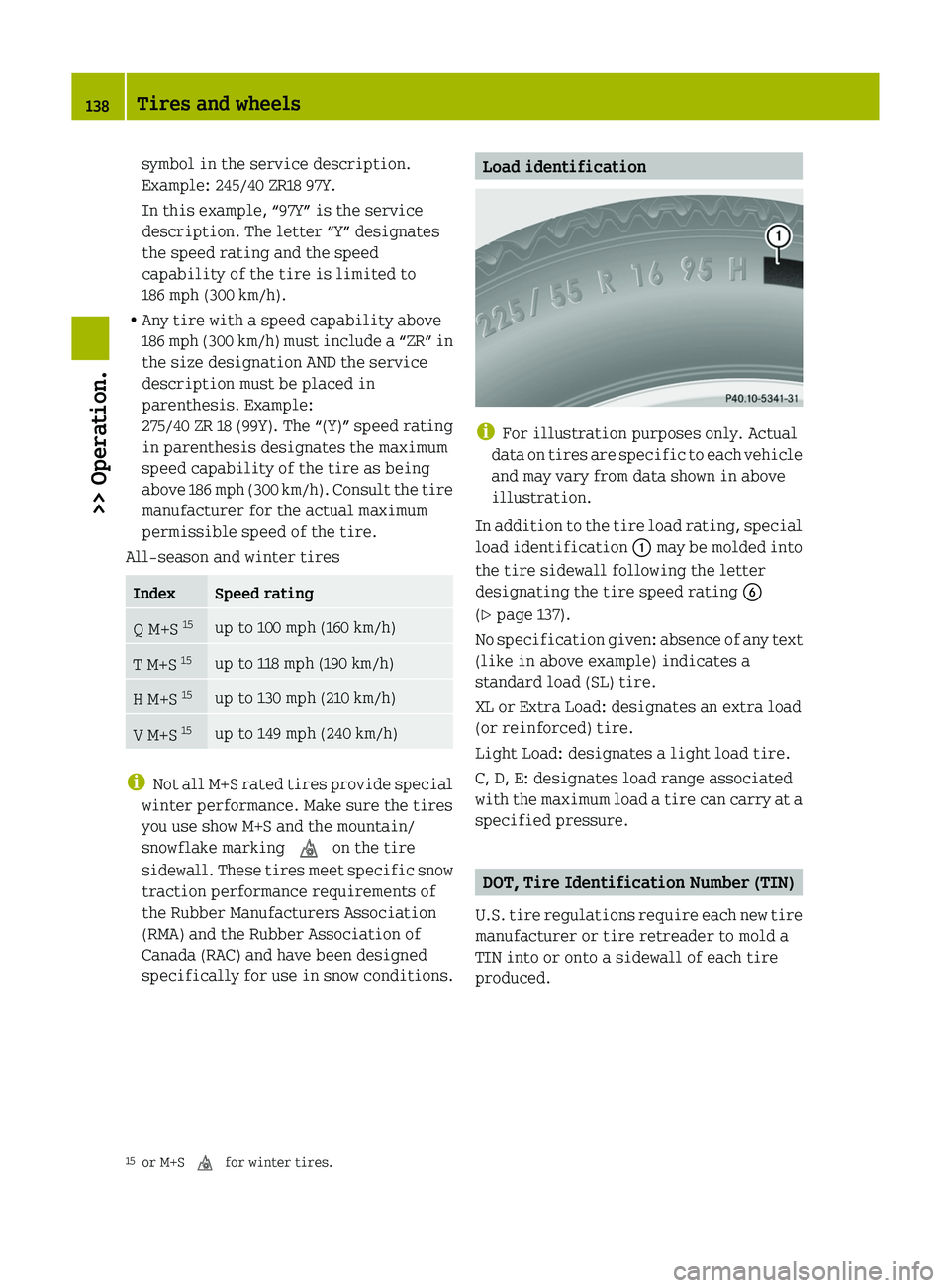
For illustration purposes only. Actual
data
on tires are specific to each vehicle
and may vary from data shown in above
illustration.
In addition to the tire load rating, special
load identification : may be molded into
the tire sidewall following the letter
designating the tire speed rating B
(Y page 137).
No specification given: absence of any text
(like in above example) indicates a
standard load (SL) tire.
XL or Extra Load: designates an extra load
(or reinforced) tire.
Light Load: designates a light load tire.
C, D, E: designates load range associated
with the maximum load a tire can carry at a
specified pressure. DOT, Tire Identification Number (TIN)
U.S.
tire regulations require each new tire
manufacturer or tire retreader to mold a
TIN into or onto a sidewall of each tire
produced.
15 or M+S i for winter tires.138
Tires and wheels
>> Operation.
Page 144 of 228
Treadwear indicators
Narrow bands, sometimes called “wear
bars” that show across the tread of a tire
when
only 1
/ 16 in (1.6 mm) of tread remains.
Uniform Tire Quality Grading Standards A tire information system that provides
consumers with ratings for a tire’s
traction, temperature and treadwear.
Ratings are determined by tire
manufacturers using U.S. government
testing
procedures. The ratings are molded
into the sidewall of the tire.
Vehicle maximum load on the tire Load on an individual tire that is
determined by distributing to each axle
its share of the maximum loaded vehicle
weight and dividing it by two.
Winter driving
Before the onset of winter, have your
vehicle winterized at an authorized smart
center.
This service includes:
R Check of anticorrosion and antifreeze
concentration.
R Addition of washer concentrate to the
water of the windshield/rear window.
Use a windshield washer concentrate
labeled for winter which is formulated
for temperatures below freezing point
(Y page 222).
R Battery
test. Battery capacity drops with
decreasing ambient temperature. A well
charged battery helps to make sure the
engine can be started, even at low
ambient temperatures.
R Tire change. Winter tires
G
WARNING
Winter tires with a tread depth of less
than 1
/ 6 in (4 mm) must be replaced. They
are no longer suitable for winter
operation.
Always use winter tires at temperatures
below 45 ¦ (7¥) and whenever wintry road
conditions
prevail. Not all M+S rated tires
provide special winter performance. Make
sure the tires you use show the mountain/
snowflake marking i on the tire
sidewall. These tires meet specific snow
traction performance requirements of the
Rubber Manufacturers Association (RMA)
and the Rubber Association of Canada (RAC)
and have been designed specifically for
use in snow conditions. Use of winter tires
is the only way to achieve the maximum
effectiveness of the ABS and ESP ®
in winter
operation.
For safe handling, make sure all mounted
winter tires are of the same make and have
the same tread design.
For information on winter tires for your
vehicle model, see the "Technical data"
section (Y page 217).
Always observe the speed rating of the
winter tires installed on your vehicle. If
the maximum speed for which your tires are
rated is below the speed rating of your
vehicle, you must place a notice to this
effect where it will be seen by the driver.
Such notices are available at your tire
dealer or any authorized smart center. Snow chains*
! Remember
that snow chains must always
be compatible with the tire sizes of a
vehicle. Snow chains that are approved
by smart are only permitted for the
following tire size:
175/55 R15 on the rear axle. 142
Winter driving
>> Operation.
* optional