charging SMART FORTWO COUPE 2013 Owner's Manual
[x] Cancel search | Manufacturer: SMART, Model Year: 2013, Model line: FORTWO COUPE, Model: SMART FORTWO COUPE 2013Pages: 218, PDF Size: 2.69 MB
Page 119 of 218

Problems with the charging process
Problem Possible causes/consequences and
0001 Solutions
The charge socke
tflap
does not open. The charge socket flap is not unlocked.
X
Unlock the vehicle (Y page 51). The batteries of the key are discharged.
X
Unlock the vehicle with the key manually (Y page 170). The charge socket flap is unlocked but the opening mechanism
is jammed.
X
Lock and unlock the vehicle again.
If the opening mechanism is still jammed:
X Contact an authorized electric drive smart center. The charging cable
cannot be inserted
into the vehicle power
socket. The vehicle power socket is locked.
X
Make sure that the gear selector lever is in position P.The charging cable
plug cannot be
removed from the
vehicle power socket. The charging cable plug is not unlocked.
X
Press the 0007button on the key.
The charging cable plug in the vehicle power socket is
released.
X Remove the charging cable plug from the vehicle power
socket. Intelligent charging management
If you wish to charge economically and with
minimal damage to the battery, you must set
a departure time (Y page 86). This option
to optimize the charging process depends
on your electricity contract and the local
power supplier. Your vehicle detects this
option automatically. Depending on the
departure time which is set, the charging
process of the high-voltage battery may not
be started immediately or may be
interrupted during the process. Front compartment
Service flap
Remove the service flap to check the
battery coolant level, windshield washer
reservoir level, and brake fluid level.
Insert the service flap on the front of the
vehicle so that it does not get damaged or
dirty.
i The service flap has a strap on the rear
side that ties it to the vehicle body. G
WARNING
Always turn the key to starter switch
position 0and remove the key from the Front compartment
117>> Operation.
Z
Page 149 of 218

Keep in mind, however, that due to the
technica lrequirements of the smart fortwo
electric drive and its high-voltage power
systems, the vehicle should be serviced
only at an authorized electric drive smart
center.
If you plan to operate your vehicle in
foreign countries, please be aware that:
R Service facilities or replacement parts
may not be readily available.
R The AC power sockets in some countries,
especially overseas, require different
plugs on the charging cable.
R Charging stations may not be available. Symmetrical low beams
i If you drive in countries where
vehicles drive on the other side of the
road than the country in which the
vehicle is registered, you must have the
headlamps modified for symmetrical low
beams. Relevant information can be
obtained at any authorized electric
drive smart center. Vehicle care
Care tips
Regular and proper care will help to
maintain the value of your vehicle. The
best way to protect your vehicle from
harmful environmental influences is to
wash it and use protective treatments
regularly.
smart recommends that you care for the
paintwork at least twice a year (e.g. in the
spring and autumn). G
WARNING
Many cleaning products can be hazardous.
Some are poisonous, others are flammable.
Always follow the instructions on the
particular container. Always open your vehicle’s doors or windows when cleaning
the inside.
Never use fluids or solvents that are not
designed for cleaning your vehicle.
Always lock away cleaning products and
keep them out of reach of children.
! Follow the care tips. Wash your vehicle
preferably by hand.
While in operation or even while parked,
your vehicle is subjected to varying
external influences, which left unchecked
can attack the paint as well as the vehicle
underbody and lead to permanent damage.
Such damage is caused not only by extreme
and varying climatic conditions, but also
by:
R Air pollution
R Road salt
R Tar
R Gravel and stone chipping
To avoid paint damage, you should
immediately remove:
R Insects
R Bird droppings
R Tree sap, etc.
R Grease and oil
R Brake fluid
R Coolant
R Fuel
R Tar spots
! Failure to remove such dirt
immediately can cause damage to the
paint or the soft top fabric*.
Environmental influences are not
covered by the smart Limited Warranty.
Frequent washing reduces and/or
eliminates the aggressiveness and potency
of the above adverse influences. Vehicle care
147>> Operation.
* optional Z
Page 159 of 218

Display messages Possible causes/consequences and
0001 Solutions
0001
Drive System
0001Switch Engine Off There is a malfunction in the drive train. If the drive system
continues to run, the drive train can become damaged.
In addition, the red 0001warning lamp in the instrument
cluster lights up and a warning signal sounds.
X Switch off the drive system.
X Do not continue driving.
X Contact an authorized electric drive smart center. 0007
Do Not Tow
(Away) Either the drive or the high‑voltage system is faulty.
In addition, the
0002warning lamp in the instrument cluster
lights up.
X It is recommended to have the vehicle transported by a
qualified specialist workshop.
Do not tow the vehicle on its own wheels. 0007
Charging Not
Possible There is a malfunction in the on-board charger. The
high‑voltage battery cannot be charged.
X
Contact an authorized electric drive smart center. 0007
Parking Lock
Inactive The gear selector lever is in position
P, but the parking lock
is not detected.
In addition, a warning signal sounds.
X Apply the parking brake.
X Move the gear selector lever to another position, e.g. to R.
X Move the gear selector lever to Pagain. 0001
Driver´s Door Ajar The driver’s door is open.
X
Close the driver’s door. 0002
Door Ajar The passenger door is open.
X
Close the passenger door. 0003
Tailgate Open A tailgate or the rear soft top
9
is open.
X Close the tailgates or the rear soft. 0003
Charge Cable
Connected The charging cable is inserted in the vehicle power socket.
The vehicle cannot be moved.
In addition, a warning signal sounds.
X
To drive off, remove the charging cable from the vehicle
power socket and stow the cable in the vehicle. 9
cabriolet only. Display messages
157>> Practical hints. Z
Page 160 of 218
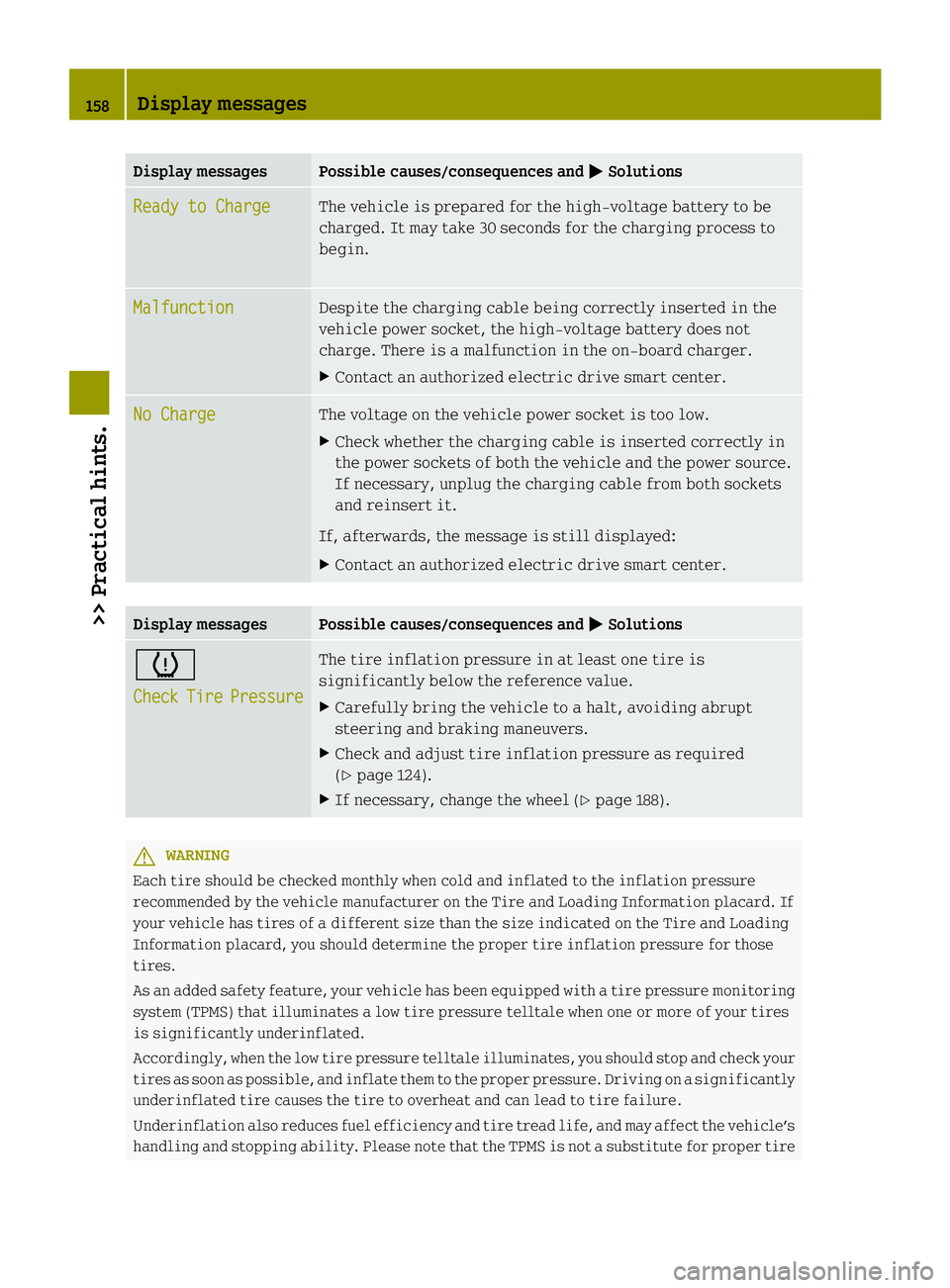
Display messages Possible causes/consequences and
0001 Solutions
Ready to Charge The vehicle is prepared for the high‑voltage battery to be
charged. It may take 30 seconds for the charging process to
begin.
Malfunction Despite the charging cable being correctly inserted in the
vehicle power socket, the high‑voltage battery does not
charge. There is a malfunction in the on-board charger.
X
Contact an authorized electric drive smart center. No Charge The voltage on the vehicle power socket is too low.
X
Check whether the charging cable is inserted correctly in
the power sockets of both the vehicle and the power source.
If necessary, unplug the charging cable from both sockets
and reinsert it.
If, afterwards, the message is still displayed:
X Contact an authorized electric drive smart center. Display messages Possible causes/consequences and
0001 Solutions
0008
Check
Tire Pressure The tire inflation pressure in at least one tire is
significantly below the reference value.
X
Carefully bring the vehicle to a halt, avoiding abrupt
steering and braking maneuvers.
X Check and adjust tire inflation pressure as required
(Y page 124).
X If necessary, change the wheel (Y page 188).G
WARNING
Each tire should be checked monthly when cold and inflated to the inflation pressure
recommended by the vehicle manufacturer on the Tire and Loading Information placard. If
your vehicle has tires of a different size than the size indicated on the Tire and Loading
Information placard, you should determine the proper tire inflation pressure for those
tires.
As an adde dsafety feature, your vehicle has been equipped with a tire pressure monitoring
system (TPMS) that illuminates a low tire pressure telltale when one or more of your tires
is significantly underinflated.
Accordingly, when the low tire pressure telltale illuminates, you should stop and check your
tires as soon as possible, and inflate them to the proper pressure. Driving on a significantly
underinflated tire causes the tire to overheat and can lead to tire failure.
Underinflation also reduces fuel efficiency and tire tread life, and may affect the vehicle’s
handlin gand stopping ability. Pleas enote that the TPMS is not a substitute for proper tire 158
Display messages>> Practical hints.
Page 194 of 218

Disconnecting, removing, charging,
reinstalling and reconnecting 12‑volt
battery
Disconnecting the 12-volt battery i
If the 12-volt battery is disconnected
or discharged
R turning the key in the starter switch
will have no effect
R the transmission will remain in park
position P
For more information see “Jump
starting” (Y page 193).
X Engage the parking brake.
X Move the gear selector lever to park
position P.
X Turn off all electrical accessories.
X Switch off the drive system.
X Open the passenger door.
X Move the passenger seat to the rear as far
as possible.
X Unscrew the carpet holder in the
passenger footwell (Y page 154).
X Lift the carpet. X
Unscrew fastening screw 0003
counterclockwise.
X Pull footrest 0002sideways out of the
vehicle.
X Read and observ esafety instructions and
precautions (Y page 190). !
Always disconnect the battery in the
order described below. Otherwise the
vehicle’s electronic scan be damaged.
X Disconnect the battery negative lead
from negative terminal 002B.
Make sure the negative lead does not
come into contact with the positive lead.
X Remove cover 002Afrom the positive
terminal.
X Disconnect the battery positive lead.
Removing the 12-volt battery X
Unscrew battery mount 0028.
X Remove the battery support and bracket.
X Pull out the ventilation hose from the
battery.
Depending on battery arrangement in
your vehicle model, the ventilation hose
is located either on the left or right side
of the battery.
X Remove the battery.
Charging the 12-volt battery G
WARNING
Avoid creating sparks when charging the
battery as escaping gases are flammable.
Keep open flames away from the battery and
do not smoke.
Do not touch the battery terminal with metal
objects and do not remove the battery
charger’s terminal clamps until the battery
charger has been switched off and no 192
Batteries>> Practical hints.
Page 195 of 218

further gas is being discharged by the
batteries.
Only charge the battery in
awell ventilated
area.
There is a risk of acid burns during the
charging procedure due to the gases which
escape from the battery. Do not lean over
the battery when it is being charged. G
WARNING
Never charge a battery while still installed
in the vehicle. Gases may escape during
charging and cause explosions that may
result in paint damage, corrosion or
personal injury.
X Charge battery in accordance with the
instructions of the battery charger
manufacturer.
! Only use chargers of a correct and
suitable voltage.
! Never attempt to recharge a frozen
battery. Have the battery checked at a
smart center. The battery housing could
be damaged.
Reinstalling the 12-volt battery X
Reinstall the charged battery. Follow the
previously described steps in reverse
order.
! The battery, its filler caps and the
ventilation hose must always be securely
installed when the vehicle is in
operation.
Reconnecting the 12-volt battery !
Always connect the battery in the order
described below. Otherwise the
vehicle’s electronics can be damaged.
X Turn off all electrical accessories.
X Remove the key from the starter switch.
! Never invert the terminal connections! X
Connect the battery positive lead and
fasten cover 002A(Ypage 192).
X Connect battery negative lead 002B
(Y page 192).
i After battery power (e.g. due to
reconnection) was interrupted, you will
have to set the clock (Y page 90).
i Have the battery’s charge status and
acid level checked at the start of the cold
season at a an authorized electric drive
smart center. Jump starting
Notes
G
WARNING
Failure to follow these directions will
cause damage to the electronic components,
and can lead to a battery explosion and
severe injury or death.
Never lean over batteries while connecting
or jump starting, you might get injured.
Battery fluid contains sulfuric acid. Do not
allow this fluid to come in contact with
eyes, skin or clothing. In case it does,
immediately flush affected area with
water, and seek medical help if necessary.
A battery will also produce hydrogen gas,
which is flammable and very explosive.
Keep flames or sparks away from battery,
avoid improper connection of jumper
cables, smoking, etc.
Attempting to jump start a frozen battery
can result in it exploding, causing
personal injury.
Read all instructions before proceeding.
! Do not tow‑start vehicle. It is not
possible to tow-start the vehicle.
Attempting to do so may seriously damage
the drivetrain which would not be
covered by the smart Limited Warranty.
If the 12-volt battery is discharged, the
drive system cannot be started, regardless Jump starting
193>> Practical hints. Z