flat tire SMART FORTWO COUPE 2013 Owner's Manual
[x] Cancel search | Manufacturer: SMART, Model Year: 2013, Model line: FORTWO COUPE, Model: SMART FORTWO COUPE 2013Pages: 218, PDF Size: 2.69 MB
Page 146 of 218

occurred, you should turn on the hazard
warning flashers, carefully slow down, and
drive with caution to an area which is a safe
distance from the road.
Inspect the tires and the vehicle underbody
for possible damage. If the vehicle or tires
appear unsafe, have the vehicle towed to the
nearest smart center or tire dealer for
repairs.
Treadwear indicators (TWI) are required by
law. These indicators are located in six
places on the tread circumference and
become visible at a tread depth of
approximately 1
/ 16 in (1.6 mm), at which
point the tire is considered worn and
should be replaced.
The treadwear indicator appears as a solid
band across the tread. G
WARNING
Although the applicable federal motor
vehicle safety laws consider a tire to be
worn when the treadwear indicators (TWI)
become visible at approximately 1
/ 16 in
(1.6 mm), we recommend that you do not allow
your tires to wear down to that level. As
tread depth approaches 1
/ 8 in (3 mm), the
adhesion properties on a wet road are
sharply reduced.
Depending upon the weather and/or road
surface (conditions), the tire traction
varies widely.
Specified tire inflation pressures must be
maintained. This applies particularly if
the tires are subject to high loads (e.g.
high speeds, heavy loads, high ambient
temperatures). G
WARNING
Do not drive with a flat tire. Aflat tire will
affect your ability to steer or brake and may
cause you to lose control of the vehicle.
Continued driving with a flat tire or
driving at high speed with a flat tire will cause excessive heat build-up and possibly
a fire.
For more information, see “Tires and
wheels” (Y page 122). Hydroplaning
Depending on the depth of the water layer
on the road, hydroplaning may occur
resulting in a loss of control, even at low
speeds and with new tires. Reduce vehicle
speed, avoid track grooves in the road and
apply brakes cautiously when it is raining. Tire traction
The safe speed on awet, snow covered or icy
road is always lower than on a dry road.
You should pay particular attention to the
condition of the road whenever the outside
temperatures are close to the freezing
point. G
WARNING
If ice has formed on the road, tire traction
will be substantially reduced. Under such
weather conditions, drive, steer and brake
with extreme caution.
smart recommends winter tires
(Y page 140) with a minimum tread depth of
approximately 1
/ 6 in (4 mm) on all four
wheels for the winter season to ensure
normal balanced handling characteristics.
On packed snow, they can reduce your
stopping distance compared to summer
tires.
Stopping distance, however, is still
considerably greater than when the road is
not covered with snow or ice. Exercise
appropriate caution.
! Avoid spinning of a drive wheel for an
extended period when driving off on
slippery road surfaces. Otherwise, the
drivetrain could be damaged, which is 144
Driving instructions>> Operation.
Page 155 of 218

>> Practical hints.Where will
Ifind ... .......................... 154
Display messages ............................. 155
What to do if ... ............................... 159
Unlocking/locking manually ...............170
Replacing transmitter battery ............171
Replacing bulbs .............................. 172
Replacing wiper blade s..................... 178
Flat tire ........................................ 180
Wheel change ................................... 188
Batteries ....................................... 190
Jump starting .................................. 193
Towing ........................................... 196
Fuses ............................................. 198
Page 156 of 218

Where will
Ifind ... Tire repair kit
The tire repair kit is located in the
passenger footwell under the carpet. X
Insert a suitable object such as a coin
into the slot of carpet holder 0002.
X Turn carpet holder 0002counterclockwise.
X Lift the carpet. 0003
Tire repair kit
The following is included:
R Tire sealant container
R Electric air pump with filler hose
R Sticker
R Operating instructions label (on the
inside of the tire repair kit lid)
i The tire sealant container is located
below the tire repair kit. G
WARNING
The tire repair kit is a limited repair
device. In case of a breakdown caused by a
flat tire, read through the section flat tire carefully. When using the tire repair kit
follow the instructions in this section.
Failure to follow these instructions can
result in severe injury or death.
First-aid kit*
The first-aid kit is located on the driver’s
side in the cargo compartment.
i Check expiration dates and contents for
completeness at least once a year and
replace missing/expired items. 154
Where will
Ifind ...>> Practical hints.
* optional
Page 160 of 218
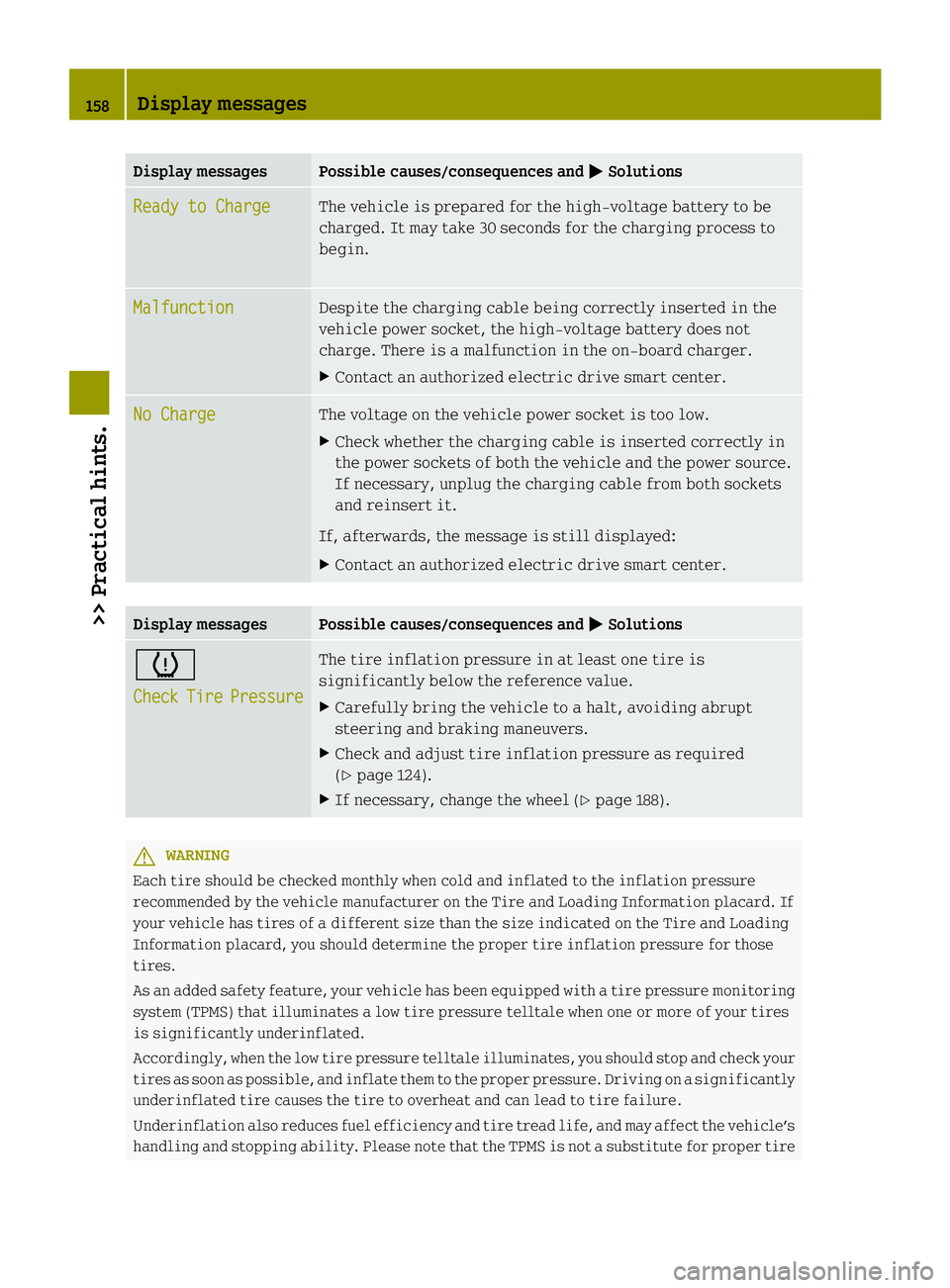
Display messages Possible causes/consequences and
0001 Solutions
Ready to Charge The vehicle is prepared for the high‑voltage battery to be
charged. It may take 30 seconds for the charging process to
begin.
Malfunction Despite the charging cable being correctly inserted in the
vehicle power socket, the high‑voltage battery does not
charge. There is a malfunction in the on-board charger.
X
Contact an authorized electric drive smart center. No Charge The voltage on the vehicle power socket is too low.
X
Check whether the charging cable is inserted correctly in
the power sockets of both the vehicle and the power source.
If necessary, unplug the charging cable from both sockets
and reinsert it.
If, afterwards, the message is still displayed:
X Contact an authorized electric drive smart center. Display messages Possible causes/consequences and
0001 Solutions
0008
Check
Tire Pressure The tire inflation pressure in at least one tire is
significantly below the reference value.
X
Carefully bring the vehicle to a halt, avoiding abrupt
steering and braking maneuvers.
X Check and adjust tire inflation pressure as required
(Y page 124).
X If necessary, change the wheel (Y page 188).G
WARNING
Each tire should be checked monthly when cold and inflated to the inflation pressure
recommended by the vehicle manufacturer on the Tire and Loading Information placard. If
your vehicle has tires of a different size than the size indicated on the Tire and Loading
Information placard, you should determine the proper tire inflation pressure for those
tires.
As an adde dsafety feature, your vehicle has been equipped with a tire pressure monitoring
system (TPMS) that illuminates a low tire pressure telltale when one or more of your tires
is significantly underinflated.
Accordingly, when the low tire pressure telltale illuminates, you should stop and check your
tires as soon as possible, and inflate them to the proper pressure. Driving on a significantly
underinflated tire causes the tire to overheat and can lead to tire failure.
Underinflation also reduces fuel efficiency and tire tread life, and may affect the vehicle’s
handlin gand stopping ability. Pleas enote that the TPMS is not a substitute for proper tire 158
Display messages>> Practical hints.
Page 161 of 218
maintenance, and it is the driver’s responsibility to maintain correct tire pressure, even
if underinflation has not reached the level to trigger illumination of the TPMS low tire
pressure telltale.
Your vehicle has also been equipped with a TPMS malfunction indicator to indicate when
the system is not operatin gproperly. The TPMS malfunction indicator is combined with the
low tire pressure telltale. When the system detects amalfunction, the telltale will flash for
approximately 1 minute and then remain continuously illuminated.
This sequence will continue upon subsequent vehicle start-ups as long as the malfunction
exists. When the malfunction indicator is illuminated, the system may not be able to detect
or signal low tire pressure as intended.
TPMS malfunctions may occur for a variety of reasons, including the installation of
incompatible replacement or alternate tires or wheels on the vehicle that prevent the TPMS
from functioning properly. Always check the TPMS malfunction telltale after replacing one
or more tires or wheels on your vehicle to ensure that the replacement or alternate tires
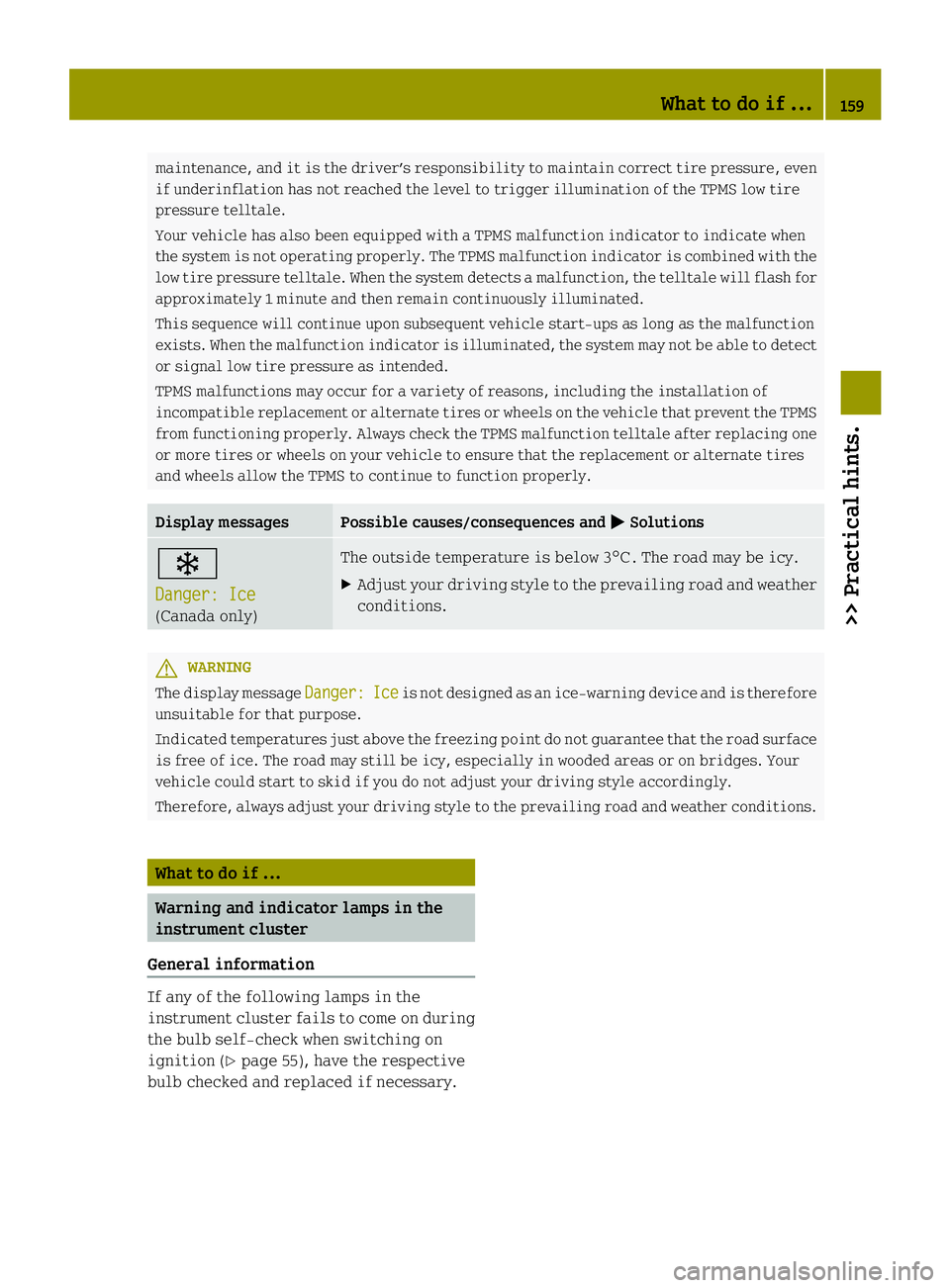
and wheels allow the TPMS to continue to function properly. Display messages Possible causes/consequences and
0001 Solutions
0001
Danger: Ice
(Canada only) The outside temperature is below 3
¥. The road may be icy.
X Adjust your driving style to the prevailing road and weather
conditions. G
WARNING
The display message Danger: Ice is not designed as an ice-warning device and is therefore
unsuitable for that purpose.
Indicated temperatures just above the freezing point do not guarantee that the road surface
is free of ice. The road may still be icy, especially in wooded areas or on bridges. Your
vehicle could start to skid if you do not adjust your driving style accordingly.
Therefore, always adjust your driving style to the prevailing road and weather conditions. What to do if ...
Warning and indicator lamps in the
instrument cluster
General information If any of the following lamps in the
instrument cluster fails to come on during
the bulb self-check when switching on
ignition (Y page 55), have the respective
bulb checked and replaced if necessary. What to do if ...
159>> Practical hints. Z
Page 168 of 218

Problem Possible causes/consequences and
0001 Solutions
0001
The yellow
drive
diagnostics
indicator lamp
comes on while
driving. There may be a malfunction in the drive system.
X
Have the vehicle checked at an authorized electric drive
smart center immediately. 0001
The red drive
diagnostics
warning lamp
comes on while
driving. There may be a malfunction in the drive system.
X
Stop the vehicle immediately in a safe location.
X Do not continue to drive.
X Switch off the drive system.
X Engage the parking brake when leaving the vehicle.
X Contact Roadside Assistance or an authorized electric drive
smart center. Tire Pressure Monitoring System (TPMS)*
Problem Possible causes/consequences and
0001 Solutions
0008
The yellow
combination
low tire
pressure/TPMS
malfunction
telltale
illuminates
continuously. The TPMS detects a loss of pressure in at least one tire.
X
Carefully bring the vehicle to a halt, avoiding abrupt
steering and braking maneuvers. Observe the traffic
situation around you.
X Check and correct tire inflation pressure as required
(Y page 124).
If the tire inflation pressure in the respective tire(s) has
(have) been corrected, the combination low tire pressure/TPMS
malfunction telltale goes out after a few minutes of driving.
See also “Restarting the TPMS” (Y page 126).0008
The
combination
low tire
pressure/TPMS
malfunction
telltale flashes
60 seconds and
then stays
illuminated. There is a malfunction in the TPMS.
X
Have the TPMS checked at an authorized electric drive smart
center.
After the malfunction has been remedied the combination low
tire pressure/TPMS malfunction telltale goes out after a few
minutes of driving. G
WARNING
Each tire should be checked monthly when cold and inflated to the inflation pressure
recommended by the vehicle manufacturer on the Tire and Loading Information placard. If 166
What to do if ...>> Practical hints.
* optional
Page 169 of 218

your vehicle has tires of a different size than the size indicated on the Tire and Loading
Information placard, you should determine the proper tire inflation pressure for those
tires.
As an added safety feature, your vehicle has been equipped with a tire pressur emonitoring
system (TPMS) that illuminates a low tire pressure telltale when one or more of your tires
is significantly underinflated.
Accordingly, when the low tire pressure telltale illuminates, you should stop and check your
tires as soon as possible, and inflate them to the proper pressure. Driving on a significantly
underinflated tire causes the tire to overheat and can lead to tire failure.
Underinflation also increases energy consumption, reduces tire tread life, and may affect
the vehicle’s handling and stopping ability. Please note that the TPMS is not a substitute
for proper tire maintenance, and it is the driver’s responsibility to maintain correct tire
pressure, even if underinflation has not reached the level to trigger illumination of the
TPMS low tire pressure telltale.
Your vehicle has also been equipped with a TPMS malfunction indicator to indicate when
the system is not operating properly. The TPMS malfunction indicator is combined with the
low tire pressure telltale. When the system detects amalfunction, the telltale will flash for
approximately 1 minute and then remain continuously illuminated.
This sequence will continue upon subsequent vehicle start-ups as long as the malfunction
exists. When the malfunction indicator is illuminated, the system may not be able to detect
or signal low tire pressure as intended.
TPMS malfunctions may occur for a variety of reasons, including the installation of
incompatible replacement or alternate tires or wheels on the vehicle that prevent the TPMS
from functioning properly. Always check the TPMS malfunction telltale after replacing one
or more tires or wheels on your vehicle to ensure that the replacement or alternate tires
and wheels allow the TPMS to continue to function properly. What to do if ...
167>> Practical hints. Z
Page 182 of 218

X
Removing: Fold the wiper arm away from
the rear window until you feel it engage.
X Fold wiper blade 0002away from the wiper
arm in direction of arrow 0003until it
disengages from its mounting.
X Detach wiper blade 0002.
X Installing: Push the new wiper blade onto
the wiper arm until you feel it engage.
X Fold the wiper blade into a position
parallel to the wiper arm.
X Fold the wiper arm backward to rest on
the rear window.
Make sure to hold on to the wiper when
folding the wiper arm back.
! Make sure the wiper blade is properly
installed. An improperly installed
wiper blade may cause rear window
damage. Adjusting the washer jet nozzles
0002
Front washer jet nozzles
0003 Rear washer jet nozzles
X Adjusting: Use a needle to move washer
jet nozzles 0002or0003 left, right, up, or
down.
i Check the setting of the washer jet
nozzles at regular intervals. The washer
jet nozzles are correctly set when the
water jet hits the windshield or the rear
window approximately in the center. Flat tire
Preparing the vehicle
Upon experiencing any type of problem
with the vehicle’s tires, switch on the
hazard warning flasher, carefully slow
down and exit the roadway in a cautious
manner.
X Park the vehicle at a safe distance from
moving traffic on a hard, flat surface
when possible.
X Make sure the tire valve of the damaged
tire is locate dbelow the horizontal axle
of the wheel hub.
X Engage the parking brake.
X Turn the steering wheel so that the front
wheels are in a straight ahead position.
X Move the gear selector lever to park
position P.
X Switch off the drive system.
X Remove the key from the starter switch
and take the key with you.
i Open door only when conditions are safe
to do so.
X Have any passenger exit the vehicle at a
safe distance from the roadway. Using the tire repair kit
! Depending on the type of damage on the
tire, the tire sealant could damage the
sensor of the Tire Pressure Monitoring
System (TPMS)*. Such damage is not
covered by the smart Limited Warranty.
When having the damaged tire replaced,
also have the TPMS sensors* checked for
proper function. When the sensor is
damaged, the TPMS* will not function
properly. The sensor must then be
replaced at an authorized electric drive
smart center as soon as possible.
i Depending on production date of your
vehicle, it will be equipped with version
1 or version 2 of the tire repair kit. 180
Flat tire>> Practical hints.
* optional
Page 183 of 218

Please make sure to refer to the
description of the tire repair kit in your
vehicle before sealing a tire.
The tire repair kit can be used to seal
punctures of up to approximately 0.16 in
(4 mm) on the tire tread.
The tire repair kit enables you to drive on
the sealed tire to the nearest authorized
electric drive smart center.
X You should have the sealed tire replaced
at an authorized electric drive smart
center. G
WARNING
Take care not to allow the contents of the
tire sealant to come in contact with hair,
eyes or clothing. The tire sealant is
harmful if inhaled, swallowed or absorbed
through the skin - causes skin, eye and
respiratory irritation. Wear gloves while
using this product if they are available.
Any contact with eyes or skin should be
flushed immediately with plenty of water.
If clothing comes in contact with the tire
sealant, change clothing as soon as
possible.
In case of allergic reaction or rash, consult
a physician immediately. Notes
R Small tire punctures, particularly those
in the tread, can be sealed with the tire
sealant.
R The tire sealant can be used in ambient
temperatures from ‑4 ¦(‑20¥ ) to
104¦ (+40¥ ).
R Do not remove any foreig nobjects such as
nails or screws that have penetrated the
tire.
R Do not use the tire sealant if the tire has
been damaged by being driven when
insufficiently inflated (e.g. bumps,
cuts, cracks etc. on the tire). R
Allow escaped tire sealant to dry, then
peel it off.
R Immediately wash all painted surfaces
that came into contact with the tire
sealant using a damp cloth.
R Avoid skin and eye contact with the tire
sealant.
R Do not swallow the tire sealant.
R Allow the tire sealant that is inside the
damaged tire to dry and dispose of
together with the tire.
R Do not use the tire sealant after the
expiration date has elapsed (see top of
container).
Instead, have it replaced at an
authorized electric drive smart center. G
WARNING
The tire sealant is alimited repair device.
The tire sealant cannot be used for cuts or
punctures larger than approximately
0.16 in (4 mm) and tire damage caused by
driving with extremely low tire inflation
pressure, or on a flat tire, or a damaged
wheel.
Do not drive the vehicle under such
circumstances.
If you are unsure of the condition of the tire
or have any question whatsoever about its
suitability for driving contact the nearest
authorized electric drive smart center for
assistance or call Roadside Assistance. G
WARNING
Please review the instructions below for
using the tire repair kit. If you are not
confident that you can competently follow
the instructions for using this kit, do not
use the kit, but instead call for Roadside
Assistance. G
WARNING
Keep the tire sealant out of reach of
children. If swallowed, rinse mouth
immediately with plenty of water and drink
plenty of water. Flat tire
181>> Practical hints.
Z
Page 184 of 218

Do not induce vomiting!
Consult a physician immediately.
Keep away from open flame, heat source or
sparks. Do not smoke.
Sealing a tire (Version 1)
X Take the tire repair kit from the
passenger footwell (Y page 154).
X Open the tire repair kit lid. 0002
Flange lid
0003 Pressure gauge
002B Vent screw
002A Filler hose with stopper
0028 Operating instructions label
0029 Electrical plug
0018 Electric air pump switch
0019 Sticker
001A Tire sealant container
X Remove sticker 0019from the tire repair
kit.
X Attach sticker 0019where it will be easily
seen by the driver on the instrument
cluster.
X Unwind electrical plug 0029and filler
hose 002A. X
Unscrew flange lid 0002.
X Unscrew the lid of tire sealan tcontainer
001A.M ake sure not to damage the aluminum
seal. X
Screw tire sealant container 001Aonto
flange 001B.
Make sure the container is threaded
correctly onto the flange. This punctures
the aluminum seal of the tire sealant
container.
X Unscrew the valve cap from the tire valve
of the damaged tire.
X Close vent screw 002B.
X Pull off the stopper of filler hose 002A.182
Flat tire>> Practical hints.