warning SMART FORTWO COUPE 2014 Owners Manual
[x] Cancel search | Manufacturer: SMART, Model Year: 2014, Model line: FORTWO COUPE, Model: SMART FORTWO COUPE 2014Pages: 222, PDF Size: 16.17 MB
Page 196 of 222

placard located on the driver’s door
B‑pillar).
R
To increase the tire inflation pres-
sure: Switch on the electric air pump.
R To decrease the tire inflation pres-
sure: Press deflate button 006C. Recheck
the tire inflation pressure with the
electric air pump’s pressure gauge
006D.
X When the tire inflation pressure is cor-
rect, unscrew the end of filler hose 0085
from tire valve 006B.
X Screw the valve cap onto the tire valve. X
To detach tire sealant container 0043from
the electric air pump, press both
latches.
X Pull tire sealant container 0043out of fix-
ture 0044.
Filler hose 0085remains on tire sealant
container 0043.
X Place the tire repair kit securely in the
vehicle.
! The manufacturer is unable to guaran-
tee that all tire punctures can be
repaired with the tire repair kit, in par-
ticular cuts or perforations larger than
approximately 0.16 in (4 mm) or away from
the tire’s tread. The manufacturer is not
liable for damage sustained through
improper use of the tire repair kit. G
WARNING
Follow recommended tire inflation pres-
sures.
Do not underinflate tires. Underinflated
tires wear excessively and/or unevenly,
adversely affect handling and energy con-
sumption of the vehicle, and are more
likely to fail from being overheated.
Do not overinflate tires. Overinflated
tires can adversely affect handling and
ride comfort, wear unevenly, increase
stopping distance, and result in sudden
deflation (blowout) because they are more
likely to become punctured or damaged by
road debris, potholes etc.
Do not overload the tires by exceeding the
specified load limit as indicated on the
Tire and Loading Information placard on
the driver’s door B‑pillar. Overloading the
tires can overheat them, possibly causing
a blowout. Overloading the tires can also
result in handling or steering problems, or
brake failure.
X Drive to the nearest authorized electric
drive smart center, to have the damaged
tire replaced.
X Contact an authorized electric drive
smart center as soon as possible to
obtain a new filler hose and a new tire
sealant container.
X Bring used tire sealant materials to an
authorized electric drive smart center
for proper disposal.
X Replace your tire sealant container
every 4 years. Replacement containers
are available at any authorized electric
drive smart center. G
WARNING
After changing a tire, contact an author-
ized electric drive smart center to make
sure the bolts holding the wheel to the car
are tight enough. Otherwise, the wheels
could come off. Each bolt should be tight-
ened to a torque of 81 lb‑ft (110 Nm). 194
Flat tire>> Practical hints.
Page 197 of 222

Wheel change
Preparing the vehicle
X Park the vehicle on a hard, flat surface
when possible.
X Turn on the hazard warning flasher.
X Turn the steering wheel so that the front
wheels are in a straight-ahead position.
X Engage the parking brake.
X Move the gear selector lever to park
position P.
X Switch off the drive system.
X Have any passenger exit the vehicle at a
safe distance from the roadway. Removing the wheel
G
WARNING
When jacking up the vehicle, only use a
suitable jack. Observe the manufacturer’s
safety instructions.
The jack must be designed for jacking up
this vehicle at the jack take-up brackets
built into both sides of the vehicle.
The jack is intended only for lifting the
vehicle briefly for wheel changes. It is not
suited for performing maintenance work
under the vehicle. To help avoid personal
injury, use the jack only to lift the vehicle
during a wheel change.
Never get beneath the vehicle while it is
supported by the jack. Keep hands and feet
away from the area under the lifted vehicle.
Always lower the vehicle onto sufficient
capacity jackstands before working under
the vehicle.
Always firmly engage the parking brake and
block the wheels with wheel chocks or other
sizeable objects before raising the vehi-
cle with the jack. Do not release the parking
brake while the vehicle is raised.
Make sure the ground on which the vehicle
is standing and where you place the jack is solid, level and not slippery. If necessary,
use a large underlay. On slippery surfaces,
such as tiled floors, you should use a non-
slip underlay, for example a rubber mat.
Do not use wooden blocks or similar objects
to support the jack. Otherwise the jack may
not be able to achieve its load-bearing
capacity if it is not at its full height.
The jack must always be vertical when in
use. Always try to use the jack on level sur-
face. If you do not position the jack cor-
rectly, the vehicle can fall off the jack and
seriously or fatally injure you or others.
Never switch on the drive system when the
vehicle is raised.
Also observe the notes on the jack.
X Make sure to have a suitable jack 10
, wheel
wrench 10
and wheel chock 10
.
Contact an authorized electric drive
smart center for information on which
jack and wheel wrench are required.
X Prepare the vehicle as described
(Y page 195).
X Make sure the surface is level.
Prevent the vehicle from rolling away by
blocking wheels with wheel chocks or other
sizeable objects:
X Place one wheel chock or other sizeable
object in front of and another wheel
chock or other sizeable object behind
the wheel that is diagonally opposite to
the wheel being changed.
X On wheel to be changed, loosen but do not
yet remove the wheel bolts (approx-
imately one full turn with wheel wrench).
! Only position the jack on the desig-
nated take-up brackets.
You must not position the jack under the
high-voltage battery. Otherwise, the
high-voltage battery could be damaged.
10 Not included and not available as factory equipment. Wheel change
195>> Practical hints. Z
Page 198 of 222

Warning label
The take-up brackets are identified by the
embossed recesses in the area of the door
sills. X
Position jack 0044under take-up
bracket 0043so that it is always vertical
as seen from the side, even if the vehicle
is parked on an incline.
X Jack up the vehicle until the wheel is a
maximum of 1.2 in (3 cm) from the ground.
X Unscrew and remove the wheel bolts.
! Do not place wheel bolts in sand or dirt.
This could result in damage to the wheel
bolts and wheel hub threads.
X Remove the wheel. Mounting the wheel
G
WARNING
Always replace wheel bolts that are dam-
aged or rusted.
Never apply oil or grease to wheel bolts. Damaged wheel hub threads should be
repaired immediately. Do not continue to
drive under these circumstances! Contact
an authorized electric drive smart center
or call Roadside Assistance.
Incorrect wheel bolts or improperly tight-
ened wheel bolts can cause the wheel to
come off. This could cause an accident. Be
sure to use the correct wheel bolts.
G
WARNING
Only use genuine smart wheel bolts. Other
wheel bolts may come loose.
Do not tighten the wheel bolts when the
vehicle is raised. Otherwise the vehicle
could fall off the jack.
X Clean contact surfaces of wheel and wheel
hub.
! To avoid paint damage, place wheel flat
against hub and hold it there while
installing first wheel bolt. X
Guide the wheel onto the wheel hub and
push it on.
X Insert two wheel bolts and tighten them
slightly.
X Install last wheel bolt and tighten it
slightly.
X Lower the vehicle until the vehicle is
resting fully on its own weight.
X Remove the jack.
X Tighten the wheel bolts. Observe a tight-
ening torque of 80 lb-ft (110 Nm). 196
Wheel change>> Practical hints.
Page 199 of 222

G
WARNING
Have the tightening torque checked after
changing a wheel. The wheels could come
loose if they are not tightened to a torque
of 80 lb-ft (110 Nm).
i The Tire Pressure Monitoring System
(TPMS)* only functions on wheels that are
equipped with the proper electronic
sensors (Y page 131). Batteries
Notes on the vehicle’s electrical sys-
tem
The vehicle’s electrical system provides
power for the electric drive and all elec-
trical consumers or components of the
vehicle.
Power is supplied to the vehicle via two
batteries:
R 12-volt battery
R High-voltage battery Notes on the 12‑volt battery
Your vehicle’s 12‑volt battery is located in
the passenger footwell below the footrest
(Y page 199).
The 12 volt battery should always be suffi-
ciently charged in order to achieve its
rated service life. Refer to the Scheduled
Maintenance Guide (USA only) or the
Service booklet (Canada only) for battery
maintenance intervals.
If you use your vehicle mostly for short-
distance trips, you will need to have the
12 volt battery charge checked more fre-
quently.
When replacing the battery, always use bat-
teries approved by smart. For information,
contact an authorized electric drive smart
center. If you do not intend to operate your vehicle
for an extended period of time, consult an
authorized electric drive smart center
about steps you need to observe. G
WARNING
Observe all safety instructions and pre-
cautions when handling automotive batter-
ies. Risk of explosion.
Fire, open flames and
smoking are prohibited
when handling batteries.
Avoid creating sparks. Battery acid is caustic.
Do not allow it to come
into contact with skin,
eyes or clothing.
Wear suitable protective
clothing, especially
gloves, apron and face-
guard. Wear eye protection.
Rinse any acid spills
immediately with clear
water. Contact a physician
if necessary. Keep children away.
Follow the instructions in
this Operator’s Manual. G
WARNING
Failure to follow these instructions can
result in severe injury or death.
Observe all safety instructions and pre-
cautions when handling automotive batter-
ies.
Never lean over batteries while connect-
ing, you might get injured. Batteries
197>> Practical hints.
* optional Z
Page 200 of 222

Battery fluid contains sulfuric acid. Do not
allow this fluid to come in contact with
eyes, skin or clothing. In case it does,
immediately flush affected area with water
and seek medical help if necessary.
A battery will also produce hydrogen gas,
which is flammable and explosive. Keep
flames or sparks away from battery, avoid
improper connection of jumper cables,
smoking, etc. G
WARNING
Do not place any metal objects on a battery.
You could otherwise cause a short circuit
and the battery’s highly flammable chemi-
cals could ignite.
Never allow any metal object to contact both
battery terminals or the positive terminal
and the vehicle body at the same time. This
might short circuit the battery and ignite
the highly flammable and explosive hydro-
gen gas generated by the battery, causing
serious personal injury. G
WARNING
Keep flames or sparks away from battery,
avoid improper connection of jumper
cables, smoking, etc.
R When disconnecting the battery, always
disconnect the negative terminal first,
followed by positive terminal.
R When connecting the battery, always con-
nect the positive terminal first, fol-
lowed by the negative terminal.
R Do not loosen or disconnect the battery
terminal clips while the drive system is
running or the key is in the starter
switch.
! Never loosen or detach battery terminal
clamps while the drive system is running
or the key is in the starter switch. Oth-
erwise, electronic components could be
severely damaged.
Have the battery checked regularly at an
authorized electric drive smart center. Refer to Maintenance Booklet for main-
tenance intervals or contact an author-
ized electric drive smart center for fur-
ther information.
! Never invert the terminal connections! Notes on the high‑voltage battery
Have work on the high-voltage battery per-
formed by an authorized electric drive
smart center only. Observe the safety notes
on (Y page 16) as well as the notes on the 12-
volt battery (Y page 197). G
WARNING
The electrolyte of the high-voltage bat-
tery, i.e. the battery fluid, is toxic and
caustic. Do not allow this fluid to come in
contact with eyes, skin or clothing, for
example in case of an accident.
In case it does, immediately flush affected
area with water and seek medical help
immediately.
The high-voltage battery is located in the
vehicle underbody. Keep this in mind when
jacking up the vehicle. The vehicle has
designated take-up brackets for the jack.
For more information, see (Y page 196).
! Only position the jack on the desig-
nated take-up brackets.
You must not position the jack under the
high-voltage battery. Otherwise, the
high-voltage battery could be damaged. 198
Batteries>> Practical hints.
Page 201 of 222
Disconnecting, removing, charging,
reinstalling and reconnecting 12‑volt
battery
Disconnecting the 12-volt battery i
If the 12-volt battery is disconnected
or discharged
R turning the key in the starter switch
will have no effect
R the transmission will remain in park
position P
For more information see “Jump start-
ing” (Y page 200).
X Engage the parking brake.
X Move the gear selector lever to park
position P.
X Turn off all electrical accessories.
X Switch off the drive system.
X Open the passenger door.
X Move the passenger seat to the rear as far
as possible.
X Unscrew the carpet holder in the
passenger footwell (Y page 160).
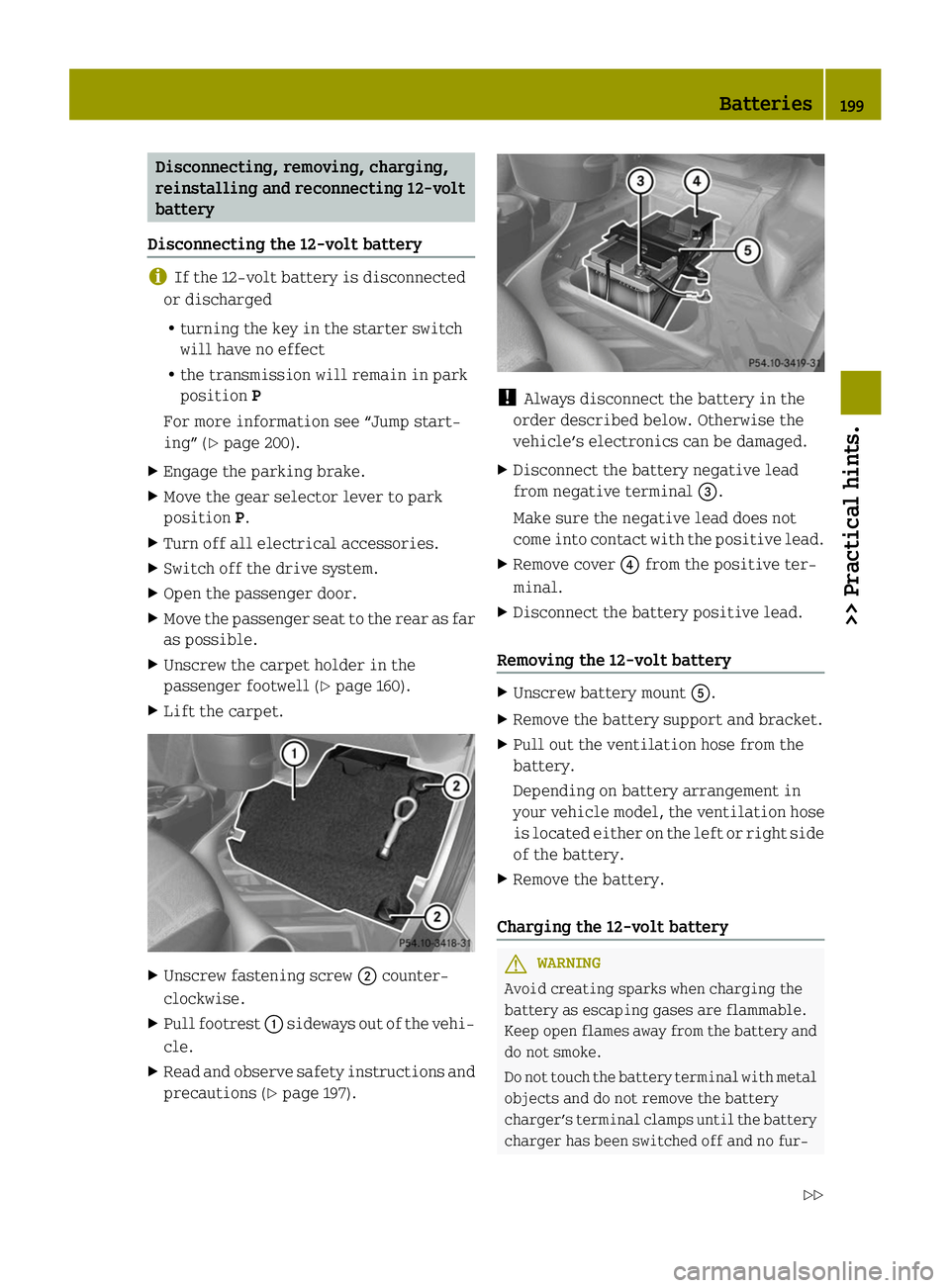
X Lift the carpet. X
Unscrew fastening screw 0044counter-
clockwise.
X Pull footrest 0043sideways out of the vehi-
cle.
X Read and observe safety instructions and
precautions (Y page 197). !
Always disconnect the battery in the
order described below. Otherwise the
vehicle’s electronics can be damaged.
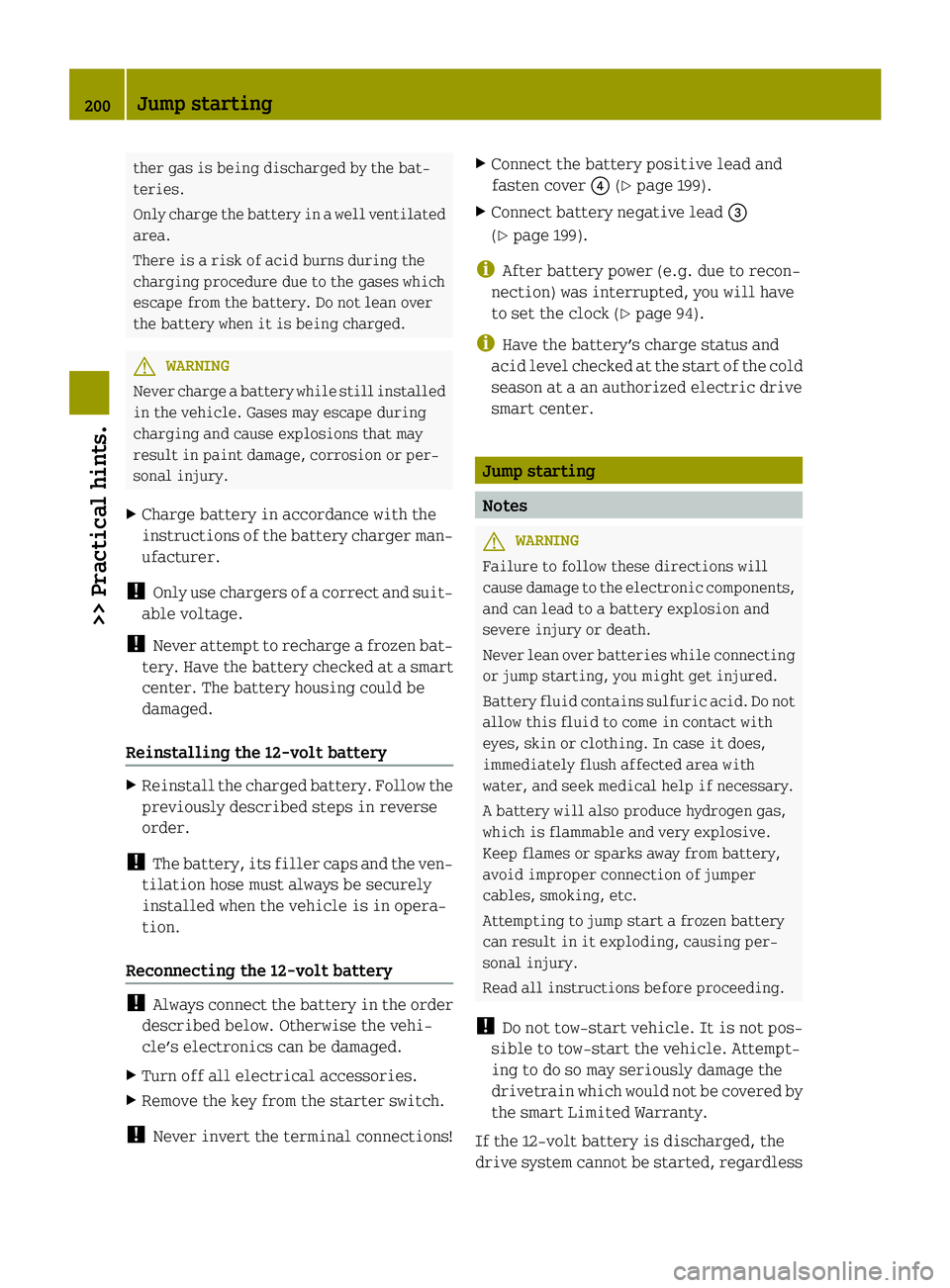
X Disconnect the battery negative lead
from negative terminal 0087.
Make sure the negative lead does not
come into contact with the positive lead.
X Remove cover 0085from the positive ter-
minal.
X Disconnect the battery positive lead.
Removing the 12-volt battery X
Unscrew battery mount 0083.
X Remove the battery support and bracket.
X Pull out the ventilation hose from the
battery.
Depending on battery arrangement in
your vehicle model, the ventilation hose
is located either on the left or right side
of the battery.
X Remove the battery.
Charging the 12-volt battery G
WARNING
Avoid creating sparks when charging the
battery as escaping gases are flammable.
Keep open flames away from the battery and
do not smoke.
Do not touch the battery terminal with metal
objects and do not remove the battery
charger’s terminal clamps until the battery
charger has been switched off and no fur- Batteries
199>> Practical hints.
Z
Page 202 of 222
ther gas is being discharged by the bat-
teries.
Only charge the battery in a well ventilated
area.
There is a risk of acid burns during the
charging procedure due to the gases which
escape from the battery. Do not lean over
the battery when it is being charged. G
WARNING
Never charge a battery while still installed
in the vehicle. Gases may escape during
charging and cause explosions that may
result in paint damage, corrosion or per-
sonal injury.
X Charge battery in accordance with the
instructions of the battery charger man-
ufacturer.
! Only use chargers of a correct and suit-
able voltage.
! Never attempt to recharge a frozen bat-
tery. Have the battery checked at a smart
center. The battery housing could be
damaged.
Reinstalling the 12-volt battery X
Reinstall the charged battery. Follow the
previously described steps in reverse
order.
! The battery, its filler caps and the ven-
tilation hose must always be securely
installed when the vehicle is in opera-
tion.
Reconnecting the 12-volt battery !
Always connect the battery in the order
described below. Otherwise the vehi-
cle’s electronics can be damaged.
X Turn off all electrical accessories.
X Remove the key from the starter switch.
! Never invert the terminal connections! X
Connect the battery positive lead and
fasten cover 0085(Ypage 199).
X Connect battery negative lead 0087
(Y page 199).
i After battery power (e.g. due to recon-
nection) was interrupted, you will have
to set the clock (Y page 94).
i Have the battery’s charge status and
acid level checked at the start of the cold
season at a an authorized electric drive
smart center. Jump starting
Notes
G
WARNING
Failure to follow these directions will
cause damage to the electronic components,
and can lead to a battery explosion and
severe injury or death.
Never lean over batteries while connecting
or jump starting, you might get injured.
Battery fluid contains sulfuric acid. Do not
allow this fluid to come in contact with
eyes, skin or clothing. In case it does,
immediately flush affected area with
water, and seek medical help if necessary.
A battery will also produce hydrogen gas,
which is flammable and very explosive.
Keep flames or sparks away from battery,
avoid improper connection of jumper
cables, smoking, etc.
Attempting to jump start a frozen battery
can result in it exploding, causing per-
sonal injury.
Read all instructions before proceeding.
! Do not tow‑start vehicle. It is not pos-
sible to tow-start the vehicle. Attempt-
ing to do so may seriously damage the
drivetrain which would not be covered by
the smart Limited Warranty.
If the 12-volt battery is discharged, the
drive system cannot be started, regardless 200
Jump starting>> Practical hints.
Page 203 of 222
of whether the high-voltage battery is
charged or not. Jump starting will not help
to start the drive system if the high-volt-
age battery is drained. The high-voltage
battery must then be charged.
The drive system can be started with jumper
cables and the fully charged battery of
another vehicle or an equivalent starter
pack.
Observe the following:
R Do not start the drive system if the bat-
tery is frozen. Let the battery thaw out
first.
R Only jump start from batteries with the
same voltage rating (12 V). Jump starting
with a more powerful battery could dam-
age the vehicle’s electrical system. Such
damage will not be covered by the smart
Limited Warranty.
R Only use jumper cables with sufficient
cross-section and insulated terminal
clamps.
R Should the battery be drained com-
pletely, let the donating power source
charge the vehicle for several minutes
before reattempting the starting proc-
ess. G
WARNING
Keep flames or sparks away from battery. Do
not smoke.
Observe all safety instructions and pre-
cautions when handling automotive batter-
ies. Jump starting
201>> Practical hints. Z
Page 205 of 222

X
Remove the jumper cables from negative terminals 0087and 0085first.
X Remove the jumper cables from positive terminals 0043and 0044.
You can now switch on the headlamps.
X Remount the positive terminal cover.
X Have the 12-volt battery checked at the nearest authorized electric drive smart center.
i Please keep in mind that it will take quite some time to charge the 12-volt battery.
When you switch off the drive system after driving a short distance, you may not be able
to start it again.
Charge the 12-volt battery completely as soon as possible. Towing
About towing
This section offers information on towing
methods for breakdown situations and
emergency towing. Recommended towing method - Break-
down situation
! To prevent damage during transport, do
not tie down the vehicle by its chassis or
suspension parts — use only wheel straps
to position and hold down the vehicle.
Improper tie down on a flatbed carrier
truck or trailer can damage suspension
parts and body panels.
smart recommends that the vehicle be
transported with all wheels off the ground
using a flatbed carrier truck or appropri-
ate wheel lift/dolly equipment.
Always have your vehicle transported:
R when the 0075warning lamp for the high-
voltage system lights up in the instru-
ment cluster
R when the Do not tow (away)
Do not tow (away) message
appears in the instrument cluster
R when the multifunction display is inop-
erative R
when one or several of the following
warning lamps light up:
-00ED Drive diagnostics (red)
- 003D 12‑Volt battery
0052 Power steering
R if the brake pedal already starts to pul-
sate just after towing begins
R if you have to transport the vehicle over
long distances
X Switch off the tow‑away protection* and
interior motion sensor* (Y page 50). Emergency towing
When circumstances do not permit the rec-
ommended towing method, the vehicle may
be towed with all wheels on the ground
using a strap or tow bar connected to
another vehicle. Only tow the vehicle as far
as necessary to have the vehicle moved to a
safe location where the recommended tow-
ing method can be employed. G
WARNING
If circumstances require towing the vehi-
cle with all wheels on the ground, always tow
with a tow bar if:
R the drive system will not run
R there is a malfunction in the brake sys-
tem
R there is a malfunction in the power sup-
ply or in the vehicle’s electrical system Towing
203>> Practical hints.
* optional Z
Page 206 of 222
A tow bar is necessary to adequately control
the towed vehicle.
Prior to towing the vehicle with all wheels
on the ground, make sure the gear selector
lever is in neutral position Nand the igni-
tion is switched on. G
WARNING
With the drive system inactive, there is no
power assistance for the brake and steering
systems. In this case, it is important to
keep in mind that a considerably higher
degree of effort is necessary to brake and
steer the vehicle. Adapt your driving
accordingly.
! The vehicle may be towed only for dis-
tances up to 30 miles (50 km) and at a
speed not to exceed 30 mph (50 km/h).
Otherwise, the electric drive or the
high-voltage system could be damaged.
! Do not tow other vehicles.
Otherwise, the drive system or compo-
nents of the high-voltage system could be
damaged.
! Do not tow the vehicle with the front
axle raised. Doing so may cause serious
damage to the brake system which is not
covered by the smart Limited Warranty.
! Before towing the vehicle observe the
following instructions:
R Do not tow with sling-type equipment
attached to suspension parts. This may
cause damage to the supports if towing
on a bumpy road.
R Towing the vehicle should only be done
using the properly installed towing
eye bolt. Never attach a tow cable, tow
rope, or tow rod to the vehicle chassis,
frame, or suspension parts.
! Make sure the gear selector lever is in
neutral position Nwhile towing the
vehicle. Doing otherwise may result in
significant drive train damage. !
Towing the vehicle with a luggage
rack* mounted is not permissible. The
vehicle must not be towed by the luggage
rack*.
i If the 12-volt battery is disconnected
or discharged, the gear selector lever
will remain locked in park position P.
Contact an authorized electric drive
smart center for assistance or call Road-
side Assistance.
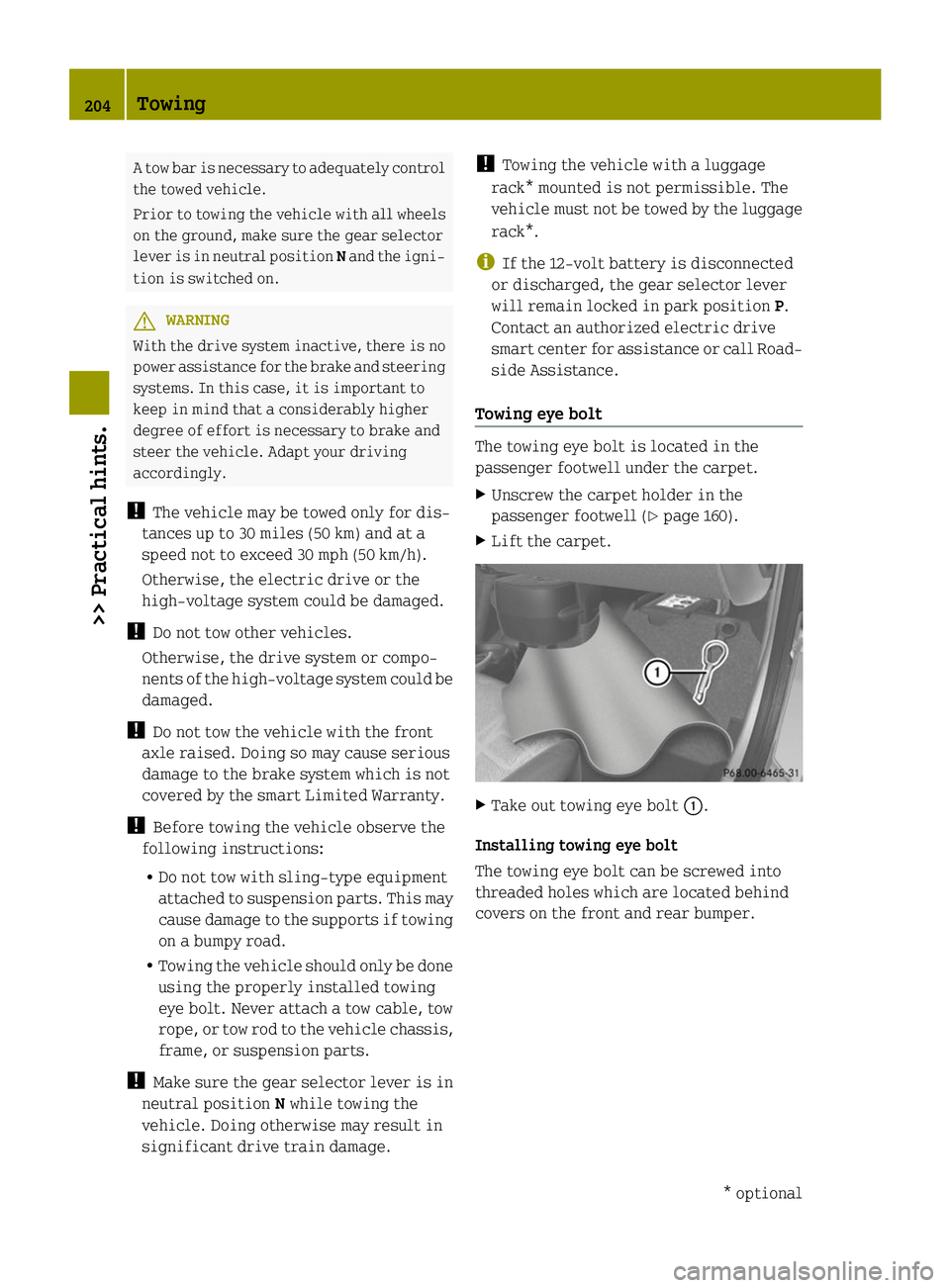
Towing eye bolt The towing eye bolt is located in the
passenger footwell under the carpet.
X
Unscrew the carpet holder in the
passenger footwell (Y page 160).
X Lift the carpet. X
Take out towing eye bolt 0043.
Installing towing eye bolt
The towing eye bolt can be screwed into
threaded holes which are located behind
covers on the front and rear bumper. 204
Towing>> Practical hints.
* optional