key SMART FORTWO COUPE 2014 Service Manual
[x] Cancel search | Manufacturer: SMART, Model Year: 2014, Model line: FORTWO COUPE, Model: SMART FORTWO COUPE 2014Pages: 222, PDF Size: 16.17 MB
Page 178 of 222

Loss of key
Problem Possible causes/consequences and
0050
0050Solutions You lose a key. X
Have the key deactivated at an authorized electric drive
smart center.
X Report the loss of the key to your car insurance company
immediately.
X If necessary, have the mechanical lock replaced.
Your authorized electric drive smart center will be glad to
supply you with a replacement following an identity check. Acoustic warning signals
Problem Possible causes/consequences and
0050 0050Solutions A warning signal
sounds while driving. You are driving with the parking brake engaged.
X
Release the parking brake (Y page 77).A warning signal
sounds when opening
the driver’s door. You have opened the driver’s door while the exterior lighting
is still switched on.
X
Turn the exterior lamp switch to position 003F.A warning signal
sounds. The door is opened while a gear is engaged with the drive sys-
tem running and neither the brake nor accelerator pedals are
depressed.
X
Close the driver’s and passenger door.
X Move the gear selector lever to park position P.
or
X Switch off the drive system. You open the driver’s door with the key in starter switch posi-
tion
0to remind you not to leave the key in the vehicle.
X Close the driver’s door.
or
X Remove the key from the starter switch. A warning signal
sounds. The seat belts are not fastened when the drive system is
started. For details, see seat belt telltale (Y page 168).
X Fasten your seat belts. 176
What to do if ...>> Practical hints.
Page 179 of 222

Problem Possible causes/consequences and
0050
0050Solutions A warning signal
sounds when parking. You have not engaged the parking brake before releasing the
brake pedal and switching off the drive system.
X
Switch on the ignition to deactivate the acoustic warning.
X Engage the parking brake.
X Make sure the gear selector lever is in park position P.
X Turn the key to starter switch position 0.
X Remove the key from the starter switch.
For safety, it is important that you perform the parking pro-
cedure as described (Y page 77).You can hear a contin-
uous noise from the
front axle when brak-
ing. The vehicle is equipped with a mechanical/acoustic brake pad
indicator.
X
Have the brake pads checked at an authorized electric drive
smart center. Unlocking/locking manually
Unlocking the vehicle
You can unlock the driver’s door and the
charge socket flap by unlocking the
driver’s door using the key. The lock cyl-
inder is fitted with a cap.
X Press button 0034on the key.
i For replacing the transmitter battery
(Y page 178). X
Remove cap 0043from lock cylinder 0044.
X Unlock the driver’s door.
The driver’s door and the charge socket
flap are unlocked. i
To unlock the vehicle centrally press
the central unlocking switch in the upper
center console (Y page 27). Locking the vehicle
If you can no longer lock the vehicle using
the remote control and you do not have a
spare transmitter battery at hand, please
proceed as follows:
X Open the driver’s door.
X Press the central locking switch
(Y page 53).
The indicator lamp on the central lock-
ing switch comes on, when the starter
switch is in position 1.
The indicator lamp on the central lock-
ing switch flashes, when the starter
switch is in position 0.
X Remove the key from the starter switch,
take it with you, and close all doors.
The vehicle is now locked. Unlocking/locking manually
177>> Practical hints. Z
Page 180 of 222

Closing the rear soft top
If the rear soft top does not lock properly
after being closed, proceed as follows:
X Stop the vehicle in a safe location.
X Engage the parking brake.
X Make sure the key is in starter switch
position 1.
X Fold up the rear soft top completely.
The rear soft top stops in the unlocked
position.
X Within one minute, press and hold symbol
0055 on the retractable soft top switch
for 15 seconds twice.
The rear soft top closes the locking
hooks.
X Close the retractable soft top com-
pletely.
X Have the rear soft top checked at an
authorized electric drive smart center. Replacing transmitter battery
Notes
The remote control’s transmitter battery is
almost spent when the turn signals flash
rapidly nine times in a row when locking
the vehicle.
i If you do not replace the transmitter
battery, after about 100 more times you
will no longer be able to lock or unlock
the vehicle using the remote control.
X Replace the transmitter battery.
or
X Have the transmitter battery replaced at
an authorized electric drive smart
center. G
WARNING
Batteries contain poisonous and corrosive
substances. Therefore keep the batteries
out of reach of children.
If a battery is swallowed, seek medical help
immediately. Batteries contain materials that can harm
the environment if disposed of improperly.
Recycling of batteries is the preferred
method of disposal. Many states/provinces
require sellers of batteries to accept old
batteries for recycling. Replacing battery
Replacement battery: CR 2016 button cell
! Replace the remote control’s transmit-
ter battery every two years at the latest.
Otherwise there is a danger of leakage.
The remote control could be damaged. X
Insert a suitable object such as a coin
into the slot at the eyelet of the key hous-
ing.
X Carefully turn the coin until key housing
top half 0043is unlatched.
X Open key housing top half 0043to the side. X
Remove transmitter battery 0044from the
board. 178
Replacing transmitter battery>> Practical hints.
Page 181 of 222

!
Check the polarity when inserting the
new transmitter battery. You could oth-
erwise damage parts of the electrical
system. When inserting the batteries,
make sure they are clean and free of lint.
X Insert the new transmitter battery.
X Press both halves of the key housing
together again.
X Check the operation of the remote
control. Replacing bulbs
About replacing bulbs
Safe vehicle operation depends on proper
exterior lighting and signaling. It is
therefore essential that all bulbs and lamp
assemblies are in good working order at all
times.
Correct headlamp adjustment is extremely
important. Have headlamps checked and
readjusted at regular intervals and when a
bulb has been replaced. Contact an author-
ized electric drive smart center for head-
lamp adjustment. G
WARNING
Bulbs and bulb sockets can be very hot.
Allow the lamp to cool down before changing
a bulb. Otherwise you could be burned if you
touch them.
Keep bulbs out of the reach of children.
Halogen lamps contain pressurized gas. A
bulb can explode if you:
R touch or move it when hot
R drop the bulb
R scratch the bulb
Wear eye and hand protection.
i If the headlamps or front fog lamps* are
fogged up on the inside as a result of
high humidity, driving the vehicle a
distance with the lights on should clear
up the fogging. Notes on bulb replacement:
R
Only use bulbs of the same type and with
the specified watt rating.
R Switch the lights off before replacing a
bulb to prevent short circuits.
R Always use a clean lint-free cloth when
handling bulbs.
R Your hands should be dry and free of oil
and grease.
R Avoid touching the glass of the bulb with
bare fingers.
R If the newly installed bulb does not come
on, contact an authorized electric drive
smart center.
R Have the bulbs for the front fog lamps*
and the LED daytime running lamps*
replaced at an authorized electric drive
smart center. Replacing bulbs
179>> Practical hints.
* optional Z
Page 187 of 222
X
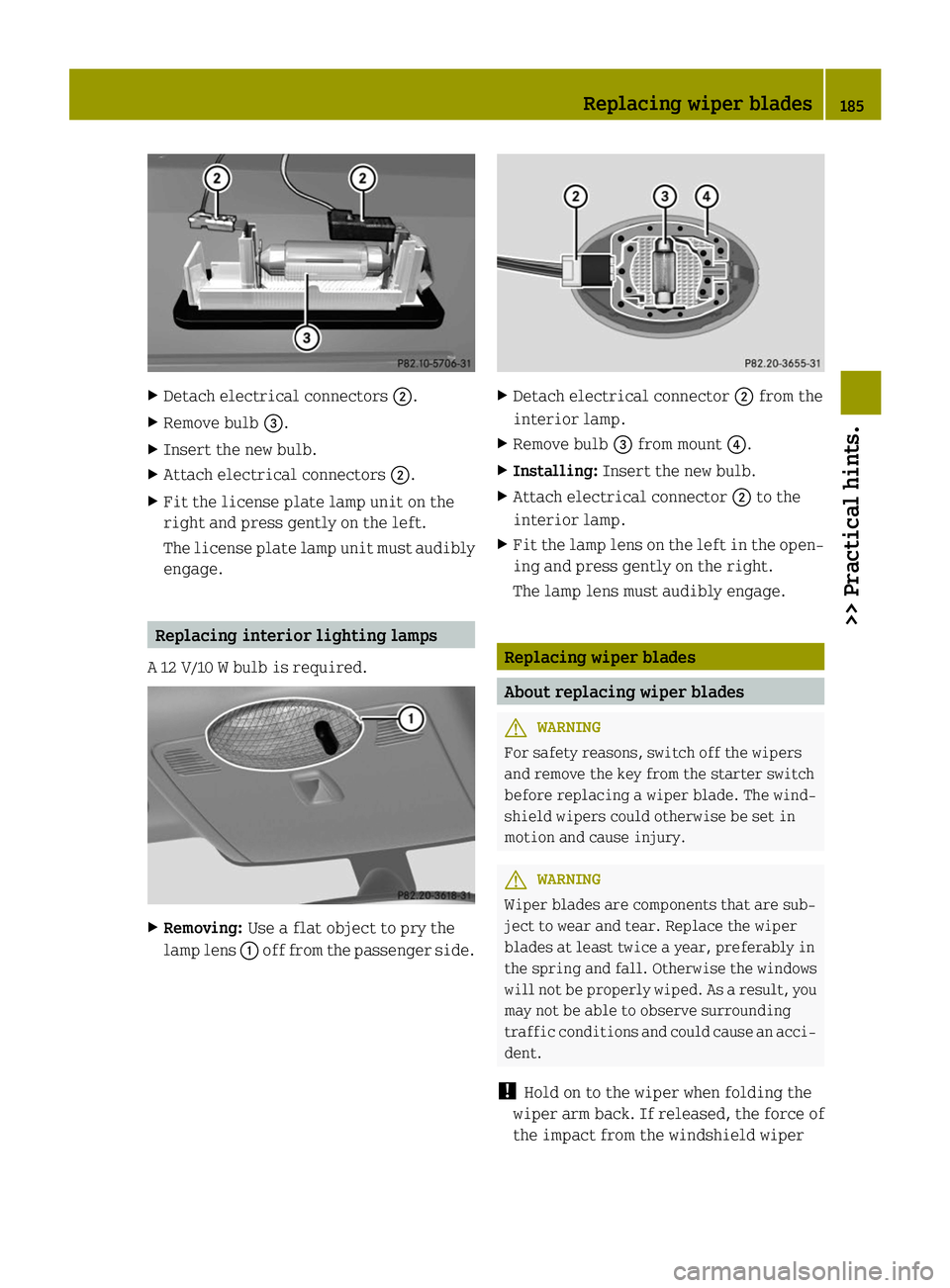
Detach electrical connectors 0044.
X Remove bulb 0087.
X Insert the new bulb.
X Attach electrical connectors 0044.
X Fit the license plate lamp unit on the
right and press gently on the left.
The license plate lamp unit must audibly
engage. Replacing interior lighting lamps
A 12 V/10 W bulb is required. X
Removing: Use a flat object to pry the
lamp lens 0043off from the passenger side. X
Detach electrical connector 0044from the
interior lamp.
X Remove bulb 0087from mount 0085.
X Installing: Insert the new bulb.
X Attach electrical connector 0044to the
interior lamp.
X Fit the lamp lens on the left in the open-
ing and press gently on the right.
The lamp lens must audibly engage. Replacing wiper blades
About replacing wiper blades
G
WARNING
For safety reasons, switch off the wipers
and remove the key from the starter switch
before replacing a wiper blade. The wind-
shield wipers could otherwise be set in
motion and cause injury. G
WARNING
Wiper blades are components that are sub-
ject to wear and tear. Replace the wiper
blades at least twice a year, preferably in
the spring and fall. Otherwise the windows
will not be properly wiped. As a result, you
may not be able to observe surrounding
traffic conditions and could cause an acci-
dent.
! Hold on to the wiper when folding the
wiper arm back. If released, the force of
the impact from the windshield wiper Replacing wiper blades
185>> Practical hints. Z
Page 188 of 222
tensioning spring could crack the wind-
shield.
Do not allow the wiper arms to contact the
windshield glass without a wiper blade
inserted.
We recommend that you have this work
carried out at an authorized electric
drive smart center.
To ensure proper visibility
R it is vital that you have wiper blades that
are in perfect shape
R clean the wiper blades regularly with a
cleaning agent
R remove any tough dirt stains with a
sponge or brush Windshield wiper blades
! Do not pull on the wiper blade inserts.
They could tear.
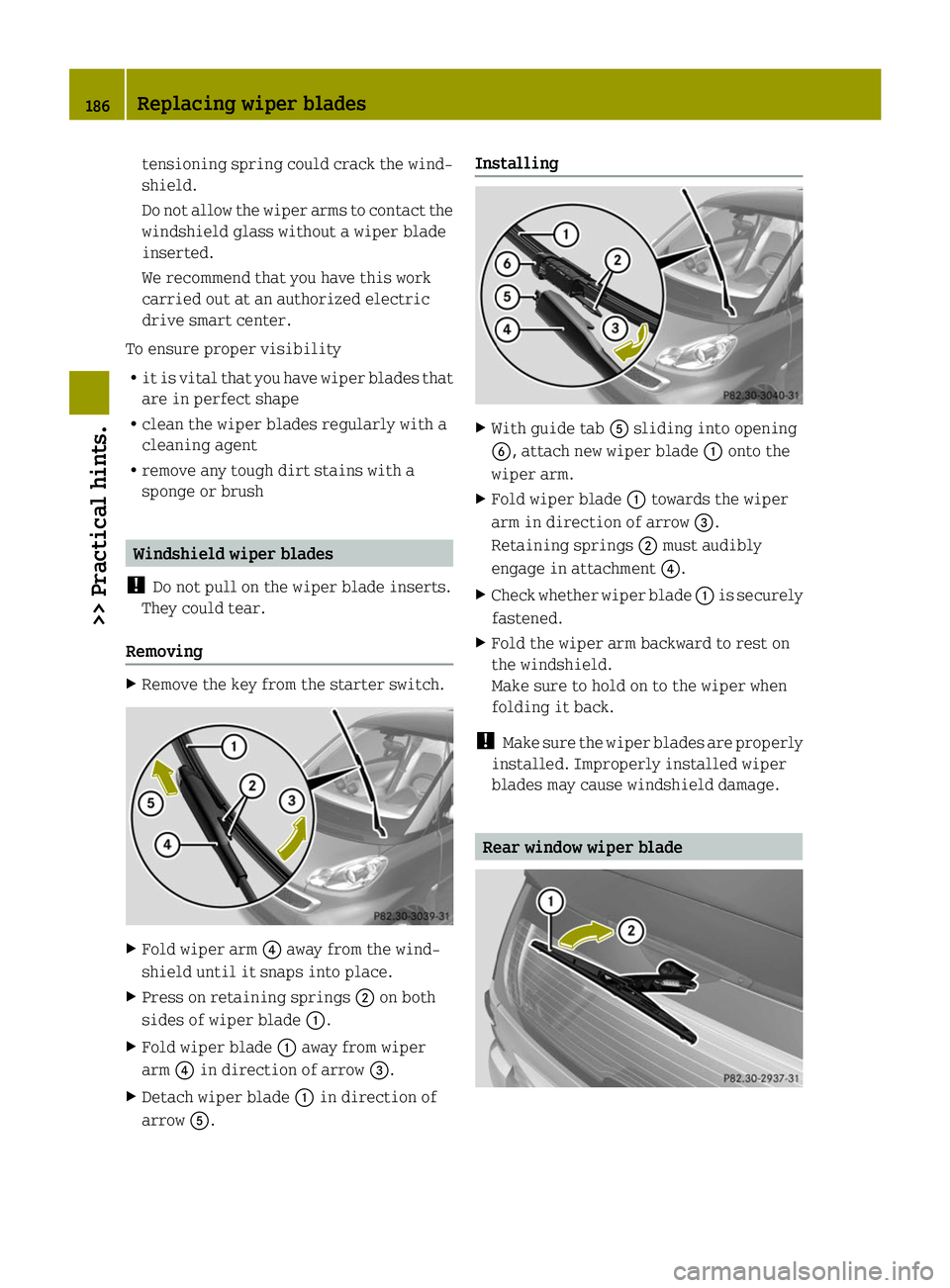
Removing X
Remove the key from the starter switch. X
Fold wiper arm 0085away from the wind-
shield until it snaps into place.
X Press on retaining springs 0044on both
sides of wiper blade 0043.
X Fold wiper blade 0043away from wiper
arm 0085in direction of arrow 0087.
X Detach wiper blade 0043in direction of
arrow 0083. Installing
X
With guide tab 0083sliding into opening
0084, attach new wiper blade 0043onto the
wiper arm.
X Fold wiper blade 0043towards the wiper
arm in direction of arrow 0087.
Retaining springs 0044must audibly
engage in attachment 0085.
X Check whether wiper blade 0043is securely
fastened.
X Fold the wiper arm backward to rest on
the windshield.
Make sure to hold on to the wiper when
folding it back.
! Make sure the wiper blades are properly
installed. Improperly installed wiper
blades may cause windshield damage. Rear window wiper blade186
Replacing wiper blades>> Practical hints.
Page 189 of 222

X
Removing: Fold the wiper arm away from
the rear window until you feel it engage.
X Fold wiper blade 0043away from the wiper
arm in direction of arrow 0044until it
disengages from its mounting.
X Detach wiper blade 0043.
X Installing: Push the new wiper blade onto
the wiper arm until you feel it engage.
X Fold the wiper blade into a position par-
allel to the wiper arm.
X Fold the wiper arm backward to rest on
the rear window.
Make sure to hold on to the wiper when
folding the wiper arm back.
! Make sure the wiper blade is properly
installed. An improperly installed
wiper blade may cause rear window dam-
age. Adjusting the washer jet nozzles
0043
Front washer jet nozzles
0044 Rear washer jet nozzles
X Adjusting: Use a needle to move washer
jet nozzles 0043or0044 left, right, up, or
down.
i Check the setting of the washer jet noz-
zles at regular intervals. The washer jet
nozzles are correctly set when the water
jet hits the windshield or the rear win-
dow approximately in the center. Flat tire
Preparing the vehicle
Upon experiencing any type of problem
with the vehicle’s tires, switch on the haz-
ard warning flasher, carefully slow down
and exit the roadway in a cautious manner.
X Park the vehicle at a safe distance from
moving traffic on a hard, flat surface
when possible.
X Make sure the tire valve of the damaged
tire is located below the horizontal axle
of the wheel hub.
X Engage the parking brake.
X Turn the steering wheel so that the front
wheels are in a straight ahead position.
X Move the gear selector lever to park
position P.
X Switch off the drive system.
X Remove the key from the starter switch
and take the key with you.
i Open door only when conditions are safe
to do so.
X Have any passenger exit the vehicle at a
safe distance from the roadway. Using the tire repair kit
! Depending on the type of damage on the
tire, the tire sealant could damage the
sensor of the Tire Pressure Monitoring
System (TPMS)*. Such damage is not cov-
ered by the smart Limited Warranty.
When having the damaged tire replaced,
also have the TPMS sensors* checked for
proper function. When the sensor is dam-
aged, the TPMS* will not function prop-
erly. The sensor must then be replaced at
an authorized electric drive smart
center as soon as possible.
i Depending on production date of your
vehicle, it will be equipped with version
1 or version 2 of the tire repair kit.
Please make sure to refer to the descrip- Flat tire
187>> Practical hints.
* optional Z
Page 192 of 222

X
Screw the end of filler hose 0085onto tire
valve 006F.
X Insert electrical plug 0084into the aux-
iliary power outlet (Y page 110).
X Insert the key in the starter switch and
turn it to position 1.
i The vehicle’s 12‑volt battery is drained
by use of the electric air pump. You
should therefore keep the drive system
running while inflating the tire. X
Press Ion electric air pump switch 006B.
The electric air pump is switched on and
inflates the tire.
i First, the sealant is pumped into the
tire. The pressure may briefly increase
to a high value. This is normal and not an
indication of a malfunction. Do not
switch off the electric air pump.
X Let the electric air pump inflate the tire
for a maximum of ten minutes.
Pressure gauge 0044must display at least
180 kPa (1.8 bar, 26 psi). !
Do not operate the electric air pump
longer than ten minutes without inter-
ruption. Otherwise it may overheat.
You may operate the electrical air pump
again after it has cooled off.
X If a tire inflation pressure of at least
180 kPa (1.8 bar, 26 psi) is not attained,
turn off the electric air pump by press-
ing 0on electric air pump switch 006B.
X Unscrew the end of filler hose 0085from
tire valve 006F.
X After clearing the area around the vehi-
cle of people and obstacles, drive vehi-
cle back or forth very slowly approx-
imately 30 ft (10 m).
This serves to better distribute the tire
sealant material inside the tire.
X Screw the end of filler hose 0085onto tire
valve 006F.
X Inflate the tire again. G
WARNING
If a tire inflation pressure of
180 kPa (1.8 bar, 26 psi) is not attained, the
tire is too severely damaged for the tire
sealant to provide a reliable tire repair.
In this case, the tire sealant cannot prop-
erly seal the tire.
Do not drive the vehicle.
Contact the nearest authorized electric
drive smart center for assistance or call
Roadside Assistance.
X After attaining a tire inflation pressure
of at least 180 kPa (1.8 bar, 26 psi), press
0 on electric air pump switch 006B.
The electric air pump is switched off.
X Turn the key in the starter switch to
position 0.
X Unscrew the end of filler hose 0085from
tire valve 006F.
X Plug filler hose with the stopper.
X Tire sealant container 006Dremains
screwed onto flange 006E.190
Flat tire>> Practical hints.
Page 194 of 222

X
Drive to the nearest authorized electric
drive smart center, to have the damaged
tire replaced.
X Contact an authorized electric drive
smart center as soon as possible to
obtain a new filler hose and a new tire
sealant container.
X Bring used tire sealant materials to an
authorized electric drive smart center
for proper disposal.
X Replace your tire sealant container
every 4 years. Replacement containers
are available at any authorized electric
drive smart center. G
WARNING
After changing a tire, contact an author-
ized electric drive smart center to make
sure the bolts holding the wheel to the car
are tight enough. Otherwise, the wheels
could come off. Each bolt should be tight-
ened to a torque of 81 lb‑ft (110 Nm). Sealing a tire (Version 2)
X Take the tire repair kit from the
passenger footwell (Y page 160).X
Take electrical plug 0087and filler hose
0084 from the bottom of the electric air
pump housing.
X Engage the yellow plug of filler hose 0084
in the opening in yellow closure cap 0083.X
With the O-ring seals towards the elec-
tric air pump housing, insert yellow clo-
sure cap 0083into fixture 0044.
X Push tire sealant container 0043into fix-
ture 0044until both hooks of yellow closure
cap 0083engage. X
Unscrew the valve cap from tire valve
006B of the damaged tire.
X Screw the end of filler hose 0084onto tire
valve 006B.
X Insert electrical plug 0087into the aux-
iliary power outlet ( Ypage 110).
X Insert the key in the starter switch and
turn it to position 1.
i The vehicle’s 12‑volt battery is drained
by use of the electric air pump. You
should therefore keep the drive system
running while inflating the tire.
X Press ONon electric air pump switch 0085.
The electric air pump is switched on and
inflates the tire.
i First, the sealant is pumped into the
tire. The pressure may briefly increase
to a high value. This is normal and not an
indication of a malfunction. Do not
switch off the electric air pump.
X Let the electric air pump inflate the tire
for a maximum of ten minutes.
The pressure gauge must display at least
200 kpa (2.0 bar, 29 psi).
! Do not operate the electric air pump
longer than ten minutes without inter-
ruption. Otherwise it may overheat. 192
Flat tire>> Practical hints.
Page 195 of 222

You may operate the electrical air pump
again after it has cooled off.
X If a tire inflation pressure of at least
200 kpa (2.0 bar, 29 psi) is not attained,
turn off the electric air pump by press-
ing OFF on electric air pump switch 0085.
X Unscrew the end of filler hose 0085from
tire valve 006B.
X After clearing the area around the vehi-
cle of people and obstacles, drive vehi-
cle back or forth very slowly approx-
imately 30 ft (10 m).
This serves to better distribute the tire
sealant material inside the tire.
X Screw the end of filler hose 0085onto tire
valve 006B.
X Inflate the tire again. G
WARNING
If a tire inflation pressure of
200 kPa (2.0 bar, 29 psi) is not attained, the
tire is too severely damaged for the tire
sealant to provide a reliable tire repair.
In this case, the tire sealant cannot prop-
erly seal the tire.
Do not drive the vehicle.
Contact the nearest authorized electric
drive smart center for assistance or call
Roadside Assistance.
X After attaining a tire inflation pressure
of at least 200 kPa (2.0 bar, 29 psi), press
OFF on electric air pump switch 0085.
The electric air pump is switched off.
X Turn the key in the starter switch to
position 0.
X Unscrew the end of filler hose 0085from
tire valve 006B.
X Place the tire repair kit securely in the
vehicle.
X Drive off immediately.
The tire sealant will distribute itself
evenly inside the tire. G
WARNING
Do not exceed vehicle speed of 50 mph
(80 km/h). A tire sealant repair is not
designed to operate at higher speeds.
The sticker must be attached on the instru-
ment cluster where it will be easily seen by
the driver.
Vehicle handling characteristics of a tire
sealant repaired tire may change. Adapt
your driving accordingly.
X After driving for about 1.8 miles (3 km)
or ten minutes, stop and exit the vehicle
taking all of the appropriate safety pre-
cautions.
X Take the tire repair kit from the vehicle.
X Screw the end of filler hose 0085onto tire
valve 006B. X
Check the tire inflation pressure using
pressure gauge 006D. G
WARNING
If tire inflation pressure has fallen below
130 kPa (1.3 bar, 19 psi) do not continue to
drive the vehicle.
Park your vehicle safely away from the
roadway and contact the nearest authorized
electric drive smart center or call Road-
side Assistance.
Have the damaged tire replaced.
X If the tire inflation pressure is at least
130 kPa (1.3 bar, 19 psi), inflate or deflate
the tire to correct tire inflation pres-
sure (see Tire and Loading Information Flat tire
193>> Practical hints. Z