air condition SMART FORTWO COUPE 2015 User Guide
[x] Cancel search | Manufacturer: SMART, Model Year: 2015, Model line: FORTWO COUPE, Model: SMART FORTWO COUPE 2015Pages: 222, PDF Size: 5.02 MB
Page 102 of 222
i
The range of the vehicle is decreased
when the air conditioner is switched on.
i In warmer weather, ventilate the
passenger compartment for a short
period of time before utilizing the air
conditioning.
Further information on the "Air condition- ing before start" function can be found on
(Y page 90). 100
Air conditioning with climate control>> Controls.
Page 103 of 222
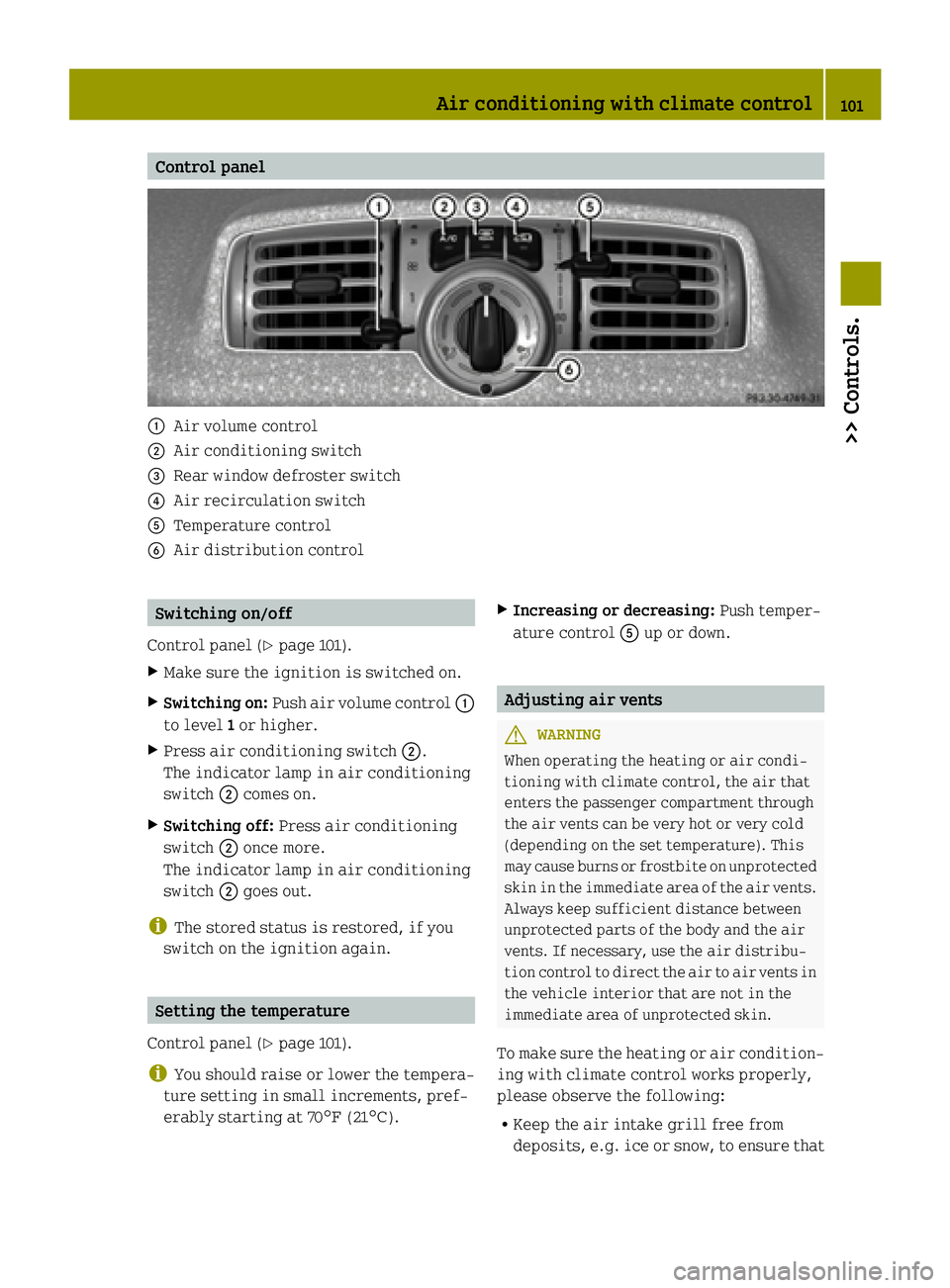
Control panel
:
Air volume control
; Air conditioning switch
= Rear window defroster switch
? Air recirculation switch
A Temperature control
B Air distribution control Switching on/off
Control panel (Y page 101).
X Make sure the ignition is switched on.
X Switching on: Push air volume control :
to level 1or higher.
X Press air conditioning switch ;.
The indicator lamp in air conditioning
switch ;comes on.
X Switching off: Press air conditioning
switch ;once more.
The indicator lamp in air conditioning
switch ;goes out.
i The stored status is restored, if you
switch on the ignition again. Setting the temperature
Control panel (Y page 101).
i You should raise or lower the tempera-
ture setting in small increments, pref-
erably starting at 70¦ (21¥).X
Increasing or decreasing: Push temper-
ature control Aup or down. Adjusting air vents
G
WARNING
When operating the heating or air condi-
tioning with climate control, the air that
enters the passenger compartment through
the air vents can be very hot or very cold
(depending on the set temperature). This
may cause burns or frostbite on unprotected skin in the immediate area of the air vents.
Always keep sufficient distance between
unprotected parts of the body and the air
vents. If necessary, use the air distribu-
tion control to direct the air to air vents in the vehicle interior that are not in the
immediate area of unprotected skin.
To make sure the heating or air condition-
ing with climate control works properly,
please observe the following:
R Keep the air intake grill free from
deposits, e.g. ice or snow, to ensure that Air conditioning with climate control
101>> Controls. Z
Page 104 of 222
fresh air can flow freely into the vehicle
interior.
R Do not obstruct air vents or ventilation
grilles in the vehicle interior.
i For draft-free ventilation, move the
sliders for the center air vents and side air vents to the middle position.
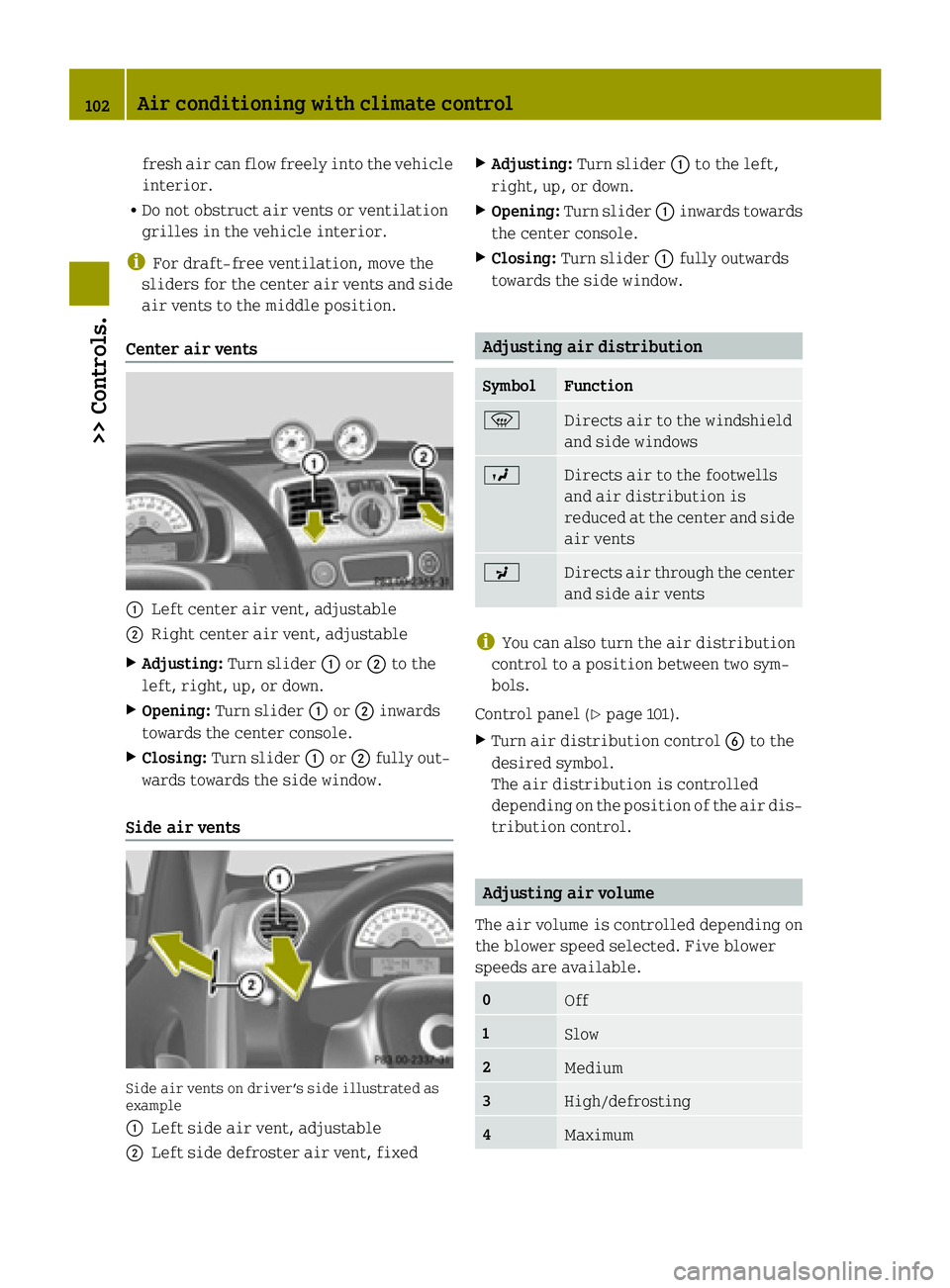
Center air vents :
Left center air vent, adjustable
; Right center air vent, adjustable
X Adjusting: Turn slider :or; to the
left, right, up, or down.
X Opening: Turn slider :or; inwards
towards the center console.
X Closing: Turn slider :or; fully out-
wards towards the side window.
Side air vents Side air vents on driver’s side illustrated as
example
: Left side air vent, adjustable
; Left side defroster air vent, fixed X
Adjusting: Turn slider :to the left,
right, up, or down.
X Opening: Turn slider :inwards towards
the center console.
X Closing: Turn slider :fully outwards
towards the side window. Adjusting air distribution
Symbol Function
z
Directs air to the windshield
and side windows
O
Directs air to the footwells
and air distribution is
reduced at the center and side
air vents P
Directs air through the center
and side air vents i
You can also turn the air distribution
control to a position between two sym-
bols.
Control panel (Y page 101).
X Turn air distribution control Bto the
desired symbol.
The air distribution is controlled
depending on the position of the air dis- tribution control. Adjusting air volume
The air volume is controlled depending on
the blower speed selected. Five blower
speeds are available. 0
Off
1
Slow
2
Medium
3
High/defrosting
4
Maximum102
Air conditioning with climate control>> Controls.
Page 105 of 222
X
Increasing or decreasing: Push air vol-
ume control :up or down. Defrosting
G
WARNING
Never drive with iced up or fogged win-
dows. Visibility will be significantly
impaired. Impaired visibility could
endanger yourself and others. This may
prevent you from observing the traffic con- ditions, thereby causing an accident.
The best defrosting of windows is achieved
if the ice is completely removed from the
windows manually with an ice scraper
before driving off.
Also use the "Air conditioning before
start" function (Y page 90).
Control panel (Y page 101).
X Switching on: Push air volume control :
to level 3.
X Turn air distribution control Bto posi-
tion z.
X Push temperature control Afully up. Rear window defroster
The rear window defroster serves to de-ice
the rear window quickly and clear the view if the rear window is fogged.
The rear window defroster uses a large
amount of power. To keep battery drain to a
minimum, switch off the rear window
defroster as soon as the rear window is
clear. The rear window defroster is auto-
matically deactivated after approximately 10 minutes of operation. X
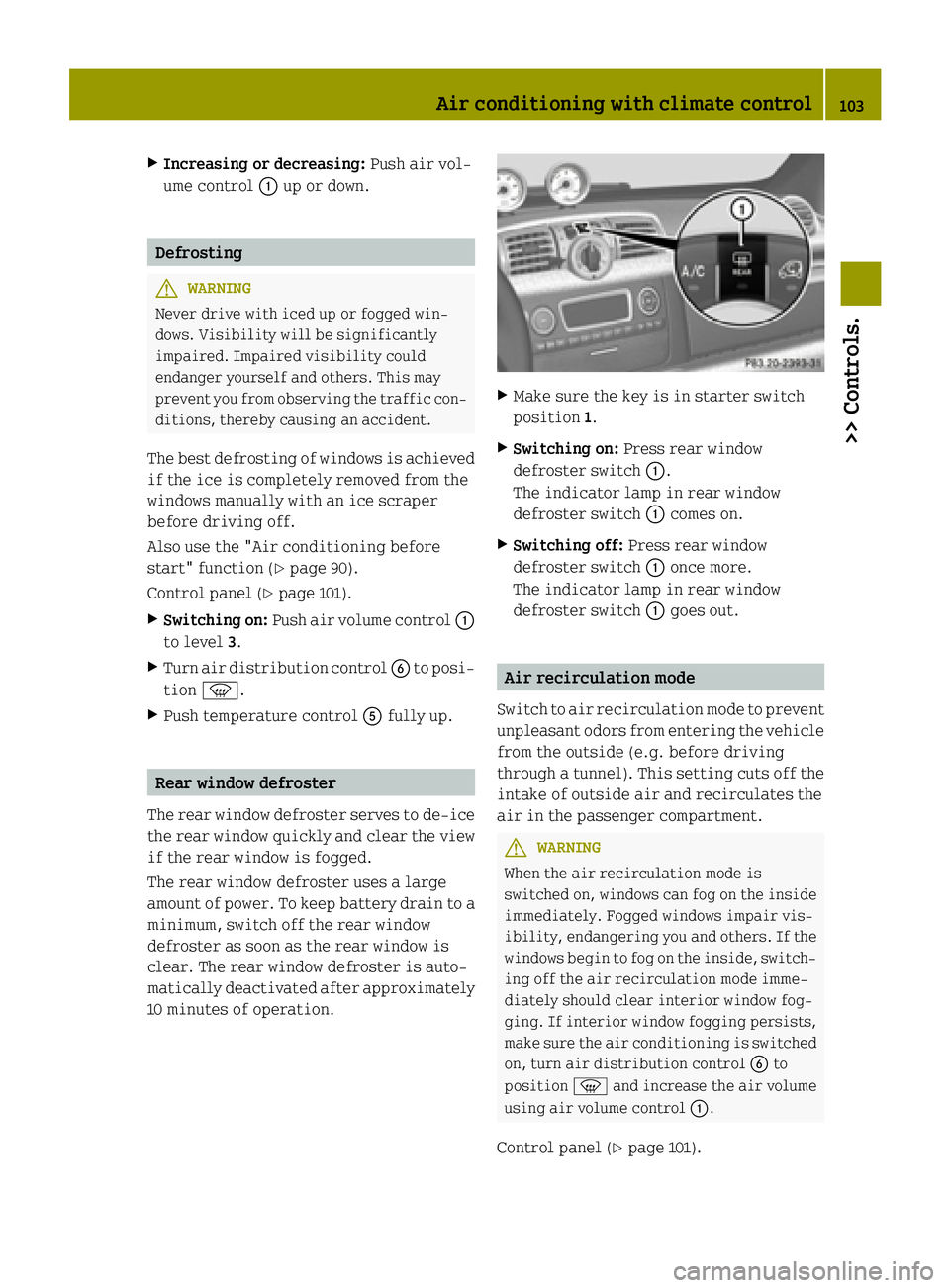
Make sure the key is in starter switch
position 1.
X Switching on: Press rear window
defroster switch :.
The indicator lamp in rear window
defroster switch :comes on.
X Switching off: Press rear window
defroster switch :once more.
The indicator lamp in rear window
defroster switch :goes out. Air recirculation mode
Switch to air recirculation mode to prevent unpleasant odors from entering the vehicle
from the outside (e.g. before driving
through a tunnel). This setting cuts off the
intake of outside air and recirculates the
air in the passenger compartment. G
WARNING
When the air recirculation mode is
switched on, windows can fog on the inside immediately. Fogged windows impair vis-
ibility, endangering you and others. If the
windows begin to fog on the inside, switch- ing off the air recirculation mode imme-
diately should clear interior window fog-
ging. If interior window fogging persists,
make sure the air conditioning is switched on, turn air distribution control Bto
position zand increase the air volume
using air volume control :.
Control panel (Y page 101). Air conditioning with climate control
103>> Controls. Z
Page 123 of 222

of charge service life you can continue to
use the "Vehicle Homepage" with costs.
Further information can be obtained at any
authorized electric drive smart center.
The "Vehicle Homepage" is available in the following languages:
R German
R English
R French
R Italian
R Spanish
R Portuguese
R Dutch
i Further information concerning sup-
ported end devices and available lan-
guages can be found under the following
address: http://vh.smart.com/info.
In order to call up the "Vehicle Homepage", the vehicle must be connected to the Inter-
net.
This is enabled:
R via a mobile service module (if your
vehicle is equipped with it)
(Y page 122)
R via powerline (Y page 122)
Further information can be found here
(Y page 114).
Personal area setup You must first set up your personal access
under http://vh.smart.com in order to
access the "Vehicle Homepage". For this,
you need a valid Email address.
Following registration, you then have
access to your personal area on the "Vehi-
cle Homepage". The vehicle must be regis-
tered in the personal area for you to access the settings of your vehicle. Call up the
corresponding input field within the
"Vehicle Homepage". Enter the vehicle
identification number (VIN) and the vehi-
cle verification code (VVC). This informa- tion can be obtained at your authorized electric drive smart center when you
receive the vehicle.
Notes on data protection Please note that the "Vehicle Homepage"
allows access to your personal data. For
this reason, keep your vehicle verification
code (VVC) and your user data in a secure
place and safe from unauthorized persons.
Each person who has access to the above
information can use the functions on the
"Vehicle Homepage". For this reason, make
sure than no unauthorized persons have
access to your personal area.
After selling the vehicle, you are required to delete the vehicle from your personal
area on the "Vehicle Homepage". You must
also destroy the vehicle verification code
(VVC) documents.
If you have bought a pre-owned vehicle, it
may be possible that the previous owner
still has access to the "Vehicle Homepage". For this reason, have a new vehicle veri-
fication code (VVC) reissued to you at an
authorized electric drive smart center
after purchase. With this new code you can
set up the access to your vehicle as descri- bed in the "Personal area setup" section.
Here you can also deactivate the previous
owner's access, should it still be active.
Calling up the functions of the "Vehicle
Homepage" If the vehicle is registered in your per-
sonal area of the "Vehicle Homepage", you
can, for example, access the following
functions:
R call up the current charge level
R program the departure time
R activate the "Air conditioning before
start" function
When the vehicle is being charged, you can call up the estimated charging time and the
attainable range. Both results are estima- High-voltage battery
121>> Operation. Z
Page 124 of 222

ted values because, for example, they are
influenced by the following factors:
R outside temperature
R active electrical consumers, e.g. air
conditioning, lights
R personal driving style
R traffic conditions
Plan for a sufficient reserve accordingly.
Connecting the vehicle to the Internet Via mobile service module
i This function is only available if the
vehicle is equipped with a mobile ser-
vice module.
You can use the “Vehicle Homepage” when
the vehicle has connected to the Internet
via the mobile service module. The mobile
service module uses GSM (Global System for Mobile Communications) and transfers the
required data via radio transmission. The
vehicle automatically detects if a connec- tion to the Internet via the mobile service module is available or not. No pre-settings
need to be done.
In order to use data transfer via the mobile
service module you do not need a SIM card
and no contract.
i There may be service limitations if the
vehicle is located for example in a
underground garage. Service limita-
tions may also appear in areas with poor
mobile service coverage. In theses cases
you can launch the Internet connection
via powerline (Y page 122).
Via powerline
You can also access the “Vehicle Homepage”
if you do not have GSM reception. This is
possible for example via your DSL router.
This connection is built by the plugged in charging cable with the aid of the power-
line technology.
The vehicle supports powerline communi-
cation according to the "HomePlug AV" standard. Data is transmitted via phase L1
and the neutral conductor of the power line.
In order for the vehicle to access the Inter-net, you require a commercially available
adapter of the "HomePlug AV" standard.
This adapter must also have an encryption
button so that it can be configured to com-
municate with the vehicle. Connect the
adapter to the power supply as well as your Internet connection. If the adapter is con-
nected to different phase than L1, a phase
coupler must be additionally installed.
Only in this way can stable communication
be guaranteed. For questions, consult a
qualified electrician.
i If you already have a powerline network
installed, the vehicle can be integrated
into it.
To establish a connection between the
vehicle and a powerline adapter, carry out
the following:
X Connect the vehicle to a power socket or a
wallbox.
The right #indicator lamp on the
vehicle socket must flash green.
X Insert the powerline adapter into a
neighboring power socket. Observe that
the vehicle and the adapter are connec-
ted via phase L1.
X Switch on the ignition.
X Call up the Charge current
Charge current menu on the
control system (Y page 92).
Carry out the following steps within
30 seconds: X If the value of the charge current is not
set to 8 A:set the value to 8 A and confirm.
X Set the value of the charge current to 12 A
and confirm.
X Set the value of the charge current to 8 A
and confirm. 122
High-voltage battery>> Operation.
Page 131 of 222

Your vehicle is equipped with the Tire and
Loading Information placard located on
the driver’s door B‑pillar (Y page 133).
The tire inflation pressure should be
checked regularly. Only adjust the tire
inflation pressure on cold tires. The tires can be considered cold if the vehicle has
been parked for at least 3 hours or driven
less than 1 mile (1.6 km). Depending on the
ambient temperature, the driving speed
and the tire load, the tire temperature
changes. When the tire temperature
changes by 18¦ (10¥), the tire inflation
pressure will change by approximately
10 kpa (0.1 bar, 1.5 psi). Keep this in mind
when checking tire inflation pressure on
warm tires and adjust the tire pressure
only if the tire inflation pressure is too
low for the current operating conditions.
If you check the tire inflation pressure
when the tires are warm, the reading will be
higher than the cold reading. This is nor-
mal. Do not let air out to match the speci-
fied cold tire inflation pressure. Other-
wise, the tire will be underinflated.
Follow recommended cold tire inflation
pressures listed on Tire and Loading
Information placard on the driver’s door
B‑pillar.
Keeping the tires properly inflated pro-
vides the best handling, tread life and rid-
ing comfort.
In addition to the Tire and Loading Infor-
mation placard on the driver’s door B‑pil- lar, also consult the tire inflation pres-
sure label (if available) on the inside of
the filler flap for any additional informa-
tion pertaining to special driving situa-
tions. For more information, see “Impor-
tant notes on tire inflation pressure”
(Y page 129).
i Data shown on Tire and Loading Infor-
mation placard example are for illus-
tration purposes only. Tire data are spe- cific to each vehicle and may vary from
data shown in the following illustration. Refer to Tire and Loading Information
placard on vehicle for actual data spe-
cific to your vehicle.
The Tire and Loading Information placard
lists the recommended cold tire inflation
pressures :for maximum loaded vehicle
weight. The tire inflation pressures listed apply to the tires installed as original
equipment.
Important notes on tire inflation pres-
sure G
WARNING
If the tire inflation pressure drops repeat- edly, check the tires for punctures from
foreign objects and/or whether air is leak-
ing from the valves or from around the rim.
Tire temperature and tire inflation pres-
sure are also increased while driving,
depending on the driving speed and the
tire load.
Potential problems associated with
underinflated and overinflated tires Underinflated tires
G
WARNING
Follow recommended tire inflation pres-
sures.
Do not underinflate tires. Underinflated
tires wear excessively and/or unevenly,
adversely affect handling and energy con-
sumption of the vehicle, and are more
likely to fail from being overheated. Tires and wheels
129>> Operation. Z
Page 146 of 222

and heater, to the extent that these items
are available as factory-installed equip-
ment (whether installed or not).
Air pressure The amount of air inside the tire pressing
outward on each square inch of the tire. Air pressure is expressed in pounds per square
inch (psi), or kilopascal (kPa) or bars.
Aspect ratio Dimensional relationship between tire
section height and section width expressed
in percentage.
Bar Another metric unit for air pressure. There
are 14.5038 pounds per square inch (psi) to
1 bar; there are 100 kilopascals (kPa) to
1 bar.
Bead The tire bead contains steel wires wrapped
by steel cords that hold the tire onto the
rim.
Cold tire inflation pressure Tire inflation pressure when your vehicle
has been sitting for at least 3 hours or
driven no more than 1 mile (1.6 km).
Curb weight The weight of a motor vehicle with standard
equipment including the maximum capa-
city of fuel, oil, and coolant, and, if so
equipped, air conditioning and additionaloptional equipment, but without passen-
gers and cargo.
DOT (Department of Transportation) A tire branding symbol which denotes the
tire meets requirements of the U.S. Depart- ment of Transportation. GAWR (Gross Axle Weight Rating) The GAWR is the maximum permissible axle
weight. The gross vehicle weight on each
axle must never exceed the GAWR for the
front and rear axle indicated on the cer-
tification label located on the driver’s
door B‑pillar.
GVW (Gross Vehicle Weight) The GVW comprises the weight of the vehi-
cle including fuel, tools, installed acces-
sories, passengers and cargo. The GVW must never exceed the GVWR indicated on the
certification label located on the driver’s
door B‑pillar.
GVWR (Gross Vehicle Weight Rating) This is the maximum permissible vehicle
weight of the fully loaded vehicle (weight
of the vehicle including all options, pas-
sengers, fuel, and cargo. It is indicated on
certification label located on the driver’s door B‑pillar.
Kilopascal (kPa) The metric unit for air pressure. There are
6.9 kPa to 1 psi; another metric unit for air
pressure is bars. There are 100 kilopas-
cals (kPa) to 1 bar.
Maximum load rating The maximum load in kilograms and pounds
that can be carried by the tire.
Maximum loaded vehicle weight The sum of curb weight, accessory weight,
total load limit and production options
weight.
Maximum permissible tire inflation
pressure This number is the greatest amount of air
pressure that should ever be put in the tire.144
Tires and wheels>> Operation.
Page 147 of 222

Normal occupant weight
The number of occupants the vehicle is
designed to seat, multiplied by 68 kilo-
grams (150 lbs).
Occupant distribution The distribution of occupants in a vehicle
at their designated seating positions.
Production options weight The combined weight of those installed
regular production options weighing over
5 lbs (2.3 kilograms) in excess of those
standard items which they replace, not
previously considered in curb weight or
accessory weight, including heavy duty
brakes, ride levelers, roof rack, heavy duty
battery, and special trim.
PSI (Pounds per square inch) A standard unit of measure for air pres-
sure.
Recommended tire inflation pressure The recommended tire inflation pressure
for normal driving conditions is listed on
the Tire and Loading Information placard
located on driver’s door B‑pillar and pro-
vides best handling, tread life and riding
comfort.
Rim A metal support for a tire or a tire and tube
assembly upon which the tire beads are
seated.
Sidewall The portion of a tire between the tread and
the bead. TIN (Tire Identification Number) Unique identifier which facilitates
efforts by tire manufacturers to notify
purchasers in recall situations or other
safety matters concerning tires and gives
purchasers the means to easily identify
such tires. The TIN is comprised of “Man-
ufacturer’s identification mark”, “Tire
size”, “Tire type code” and “Date of manu-
facture”.
Tire load rating Numerical code associated with the maxi-
mum load a tire can support.
Tire ply composition and material used This indicates the number of plies or the
number of layers of rubber-coated fabric
in the tire tread and sidewall. Tire manu-
facturers also must indicate the ply mate-
rials in the tire and sidewall, which
include steel, nylon, polyester, and others.
Tire speed rating Part of tire designation; indicates the
speed range for which a tire is approved.
Total load limit Rated cargo and luggage load plus 68 kilo-
grams (150 lbs) times the vehicle’s desig-
nated seating capacity.
Traction Force exerted by the vehicle on the road via
the tires. The amount of grip provided.
Tread The portion of a tire that comes into con-
tact with the road. Tires and wheels
145>> Operation. Z
Page 149 of 222

For safety reasons, smart recommends
that you only use snow chains that have
been approved by smart.
Information on this is available from any
smart center.
Please refer to the separate operating
instructions for detailed information on mounting the snow chains.
Snow chains should only be driven on
snow-covered roads at speeds not to
exceed 30 mph (50 km/h). Remove chains
as soon as possible when driving on roads
without snow.
Please observe the following guidelines
when using snow chains: R Using snow chains is not permissible
with all wheel/tire combinations
(Y page 216).
R Use snow chains in pairs and on rear
wheels only. Follow the manufacturer’s
mounting instructions.
R Use of snow chains may be prohibited
depending on location. Always check
local and state laws before mounting
snow chains. G
WARNING
When mounting or removing snow chains,
always park your vehicle on level ground,
engage the parking brake, and switch off
the drive system. The vehicle could other-
wise move and injure yourself or other road users. G
WARNING
When mounting and removing snow chains,
ensure that you and your vehicle are at a
safe distance from moving traffic. Not
doing so could endanger other road users or even lead to you being injured by the vehi-cles behind you. G
WARNING
The vehicle’s handling changes when driv-
ing with snow chains on any kind of road
surface. This means that you should always adapt your driving style to suit the current
road and weather conditions.
! If snow chains that do not meet require-
ments are mounted, they may scrape
against the body or axle components when the vehicle is in motion. This could
result in damage to the rim/tire or vehi-
cle. Driving instructions
Drinking and driving
G
WARNING
Do not drink alcohol or take drugs and drive or allow anyone to drive who has been
drinking alcohol or taking drugs. Even a
small amount of alcohol or drugs can affect
your reflexes, perceptions and judgment.
The possibility of a serious or even fatal
accident are greatly increased when you
drink or take drugs and drive. Pedals
G
WARNING
Make sure absolutely no objects are
obstructing the pedals’ range of motion.
Keep the driver’s footwell clear of all
obstacles. If there are any floormats* or
carpets in the footwell, make sure the ped- als still have sufficient clearance.
During sudden acceleration or braking
maneuvers, the objects could get caught
between or beneath the pedals and restrictyour ability to brake or accelerate. This
could lead to accidents and/or injury. Power assistance
G
WARNING
With the drive system inactive, there is no power assistance for the brake and steering
systems. In this case, it is important to Driving instructions
147>> Operation.
* optional Z