warning SMART FORTWO COUPE 2015 User Guide
[x] Cancel search | Manufacturer: SMART, Model Year: 2015, Model line: FORTWO COUPE, Model: SMART FORTWO COUPE 2015Pages: 222, PDF Size: 5.02 MB
Page 20 of 222

the vehicle. This prevents the high‑voltage
battery from exploding.
Stay away from this area of the vehicle. High-voltage disconnect device
Your vehicle is equipped with a high-volt-
age disconnect device :to disable the
vehicle’s high-voltage system.
! The high-voltage system must only be
switched off at vehicle standstill by
specially trained service engineers.
Otherwise the high-voltage system may
be damaged. Proper use of the vehicle
Proper use of the vehicle requires that you
are familiar with the following informa-
tion and rules:
R the safety precautions in this manual
R the “Technical data” section in this man-
ual
R traffic rules and regulations
R motor vehicle laws and safety standards G
WARNING
Various warning labels are attached to your vehicle. These warning labels are intended
to make you and others aware of various
risks. You should not remove any of these
warning labels unless explicitly instruc-
ted to do so by information on the label
itself. Removal of any of these labels may cause you and others to be unaware of cer-
tain risks which may result in an accident
and/or personal injury. Problems with your vehicle
If you should experience a problem with
your vehicle, particularly one that you
believe may affect its safe operation, we
urge you to immediately contact an author-
ized electric drive smart center to have the problem diagnosed and corrected if
required. Do not drive the vehicle if you
believe it may not be safely operated. If the
matter is not handled to your satisfaction, please discuss the problem with the smart
center management, or if necessary contact
us at one of the following addresses:
In the USA:
Mercedes-Benz USA LLC
One Mercedes Drive
Montvale, NJ 07645
In Canada:
Customer Relations Department
98 Vanderhoof Avenue
Mercedes-Benz Canada, Inc.
Toronto, Ontario, M4G 4C9 Reporting safety defects
For the USA only: The following text is pub- lished as required of manufacturers under
Title 49, Code of U.S. Federal Regulations, Part 575 pursuant to the National Traffic
and Motor Vehicle Safety Act of 1966.
If you believe that your vehicle has a defect
which could cause a crash or could cause
injury or death, you should immediately
inform the National Highway Traffic Safety
Administration (NHTSA) in addition to
notifying Mercedes-Benz USA LLC.
If NHTSA receives similar complaints, it
may open an investigation, and if it finds 18
>> Introduction.
Page 22 of 222

state or local government; in connection
with or arising out of litigation involving MBUSA or its subsidiaries and affiliates;
or, as required by law.
Warning: The EDR is a component of the
Restraint System Module. Tampering with,
altering, modifying or removing the EDR
component may result in a malfunction of
the Restraint System Module and other sys- tems.
State laws or regulations regarding EDRs
that conflict with federal regulation are
pre-empted. This means that in the event of
such conflict, the federal regulation gov-
erns. As of February 2013, 13 states have
enacted laws relating to EDRs. QR code for the rescue card
The QR codes are secured in the charge
socket flap and on the opposite side on the
B-pillar. In the event of an accident, res-
cue services can use the QR code to quickly find the appropriate rescue card for your
vehicle. The current rescue card contains
the most important information about your
vehicle in a compact form, e.g. the routing of the electric cables.
You can find more information under
https://portal.aftersales.i.daimler.com/
public/content/asportal/en/
communication/informationen_fuer/
QRCode.html. Information on copyright
General information
Information on license for free and open-
source software used in your vehicle and
its electronic components is available on
the following website:
http://www.mercedes-benz.com/
opensource 20
>> Introduction.
Page 25 of 222
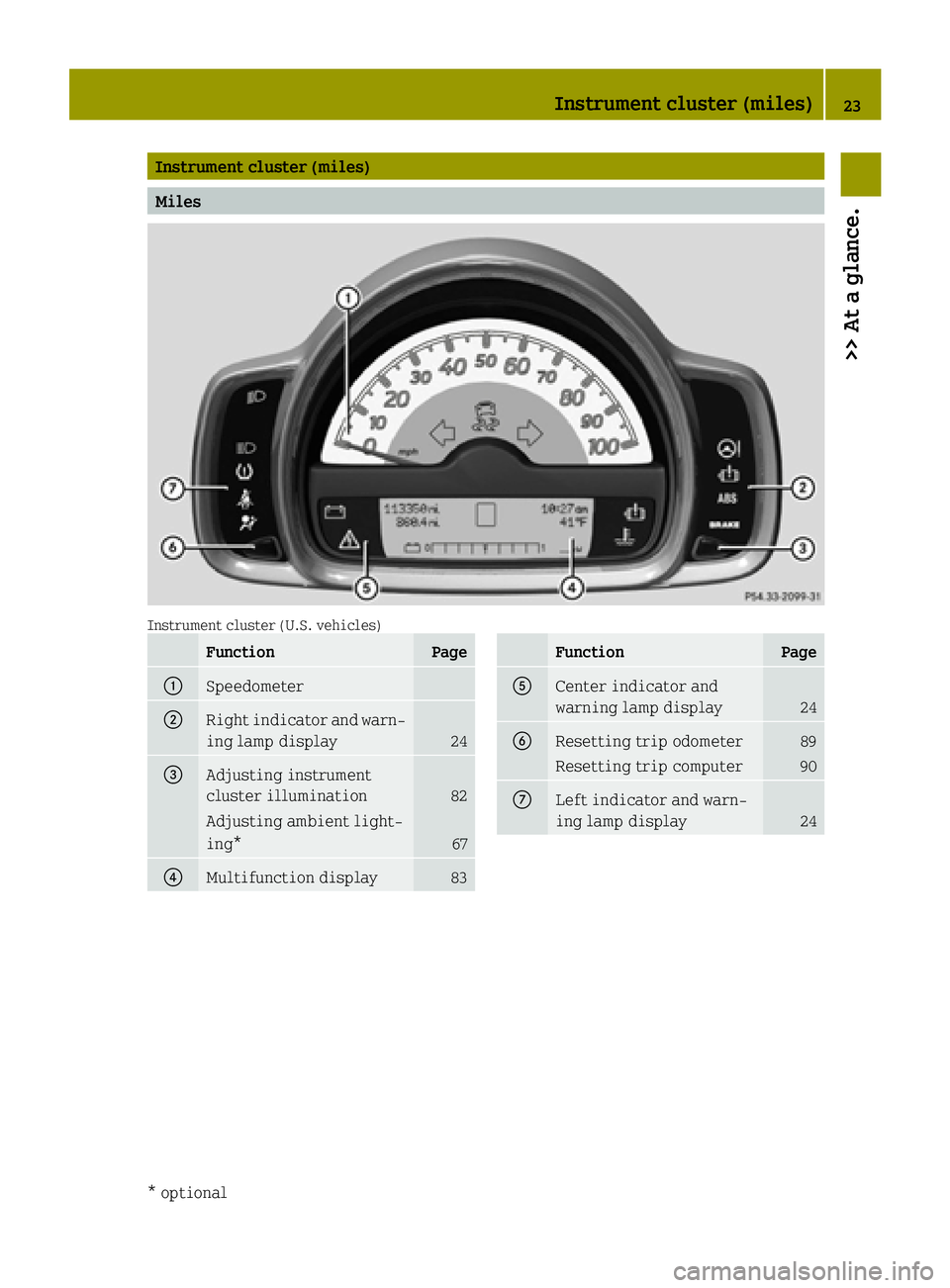
Instrument cluster (miles)
Miles
Instrument cluster (U.S. vehicles)
Function Page
:
Speedometer
;
Right indicator and warn-
ing lamp display 24
=
Adjusting instrument
cluster illumination
82
Adjusting ambient light-
ing*
67
?
Multifunction display 83 Function Page
A
Center indicator and
warning lamp display
24
B
Resetting trip odometer 89
Resetting trip computer 90
C
Left indicator and warn-
ing lamp display
24Instrument cluster (miles)
23>> At a glance.
* optional
Page 26 of 222
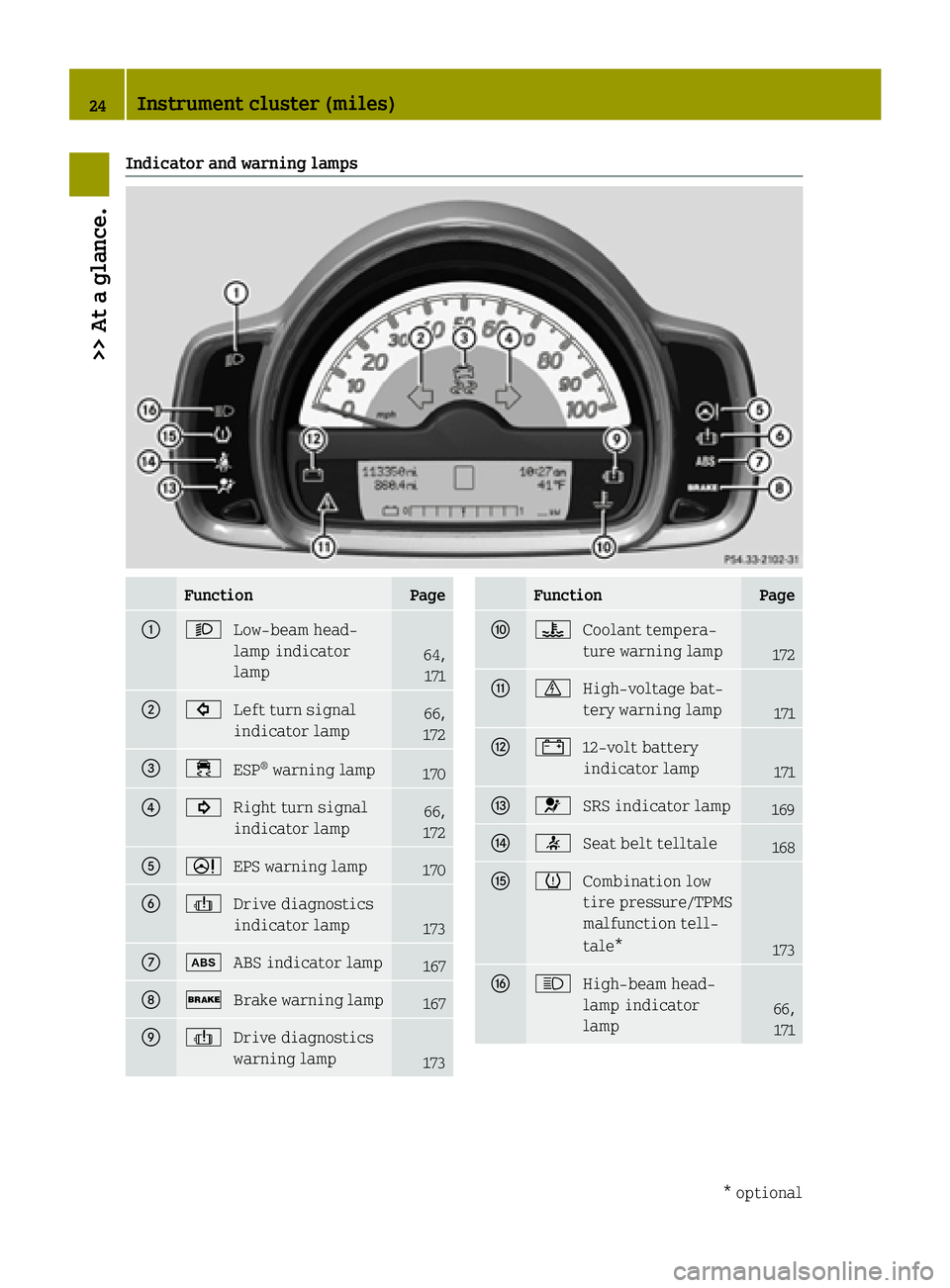
Indicator and warning lamps
Function Page
: M
Low‑beam head-
lamp indicator
lamp 64,
171 ; #
Left turn signal
indicator lamp 66,
172 = ÷
ESP®
warning lamp 170
? !
Right turn signal
indicator lamp 66,
172 A
D
EPS warning lamp 170
B þ
Drive diagnostics
indicator lamp 173
C ò
ABS indicator lamp 167
D $
Brake warning lamp 167
E þ
Drive diagnostics
warning lamp 173 Function Page
F ?
Coolant tempera-
ture warning lamp 172
G N
High-voltage bat-
tery warning lamp 171
H #
12-volt battery
indicator lamp 171
I 6
SRS indicator lamp 169
J 7
Seat belt telltale 168
K
h
Combination low
tire pressure/TPMS
malfunction tell-
tale* 173
L K
High‑beam head-
lamp indicator
lamp 66,
171 24
Instrument cluster (miles)>> At a glance.
* optional
Page 27 of 222
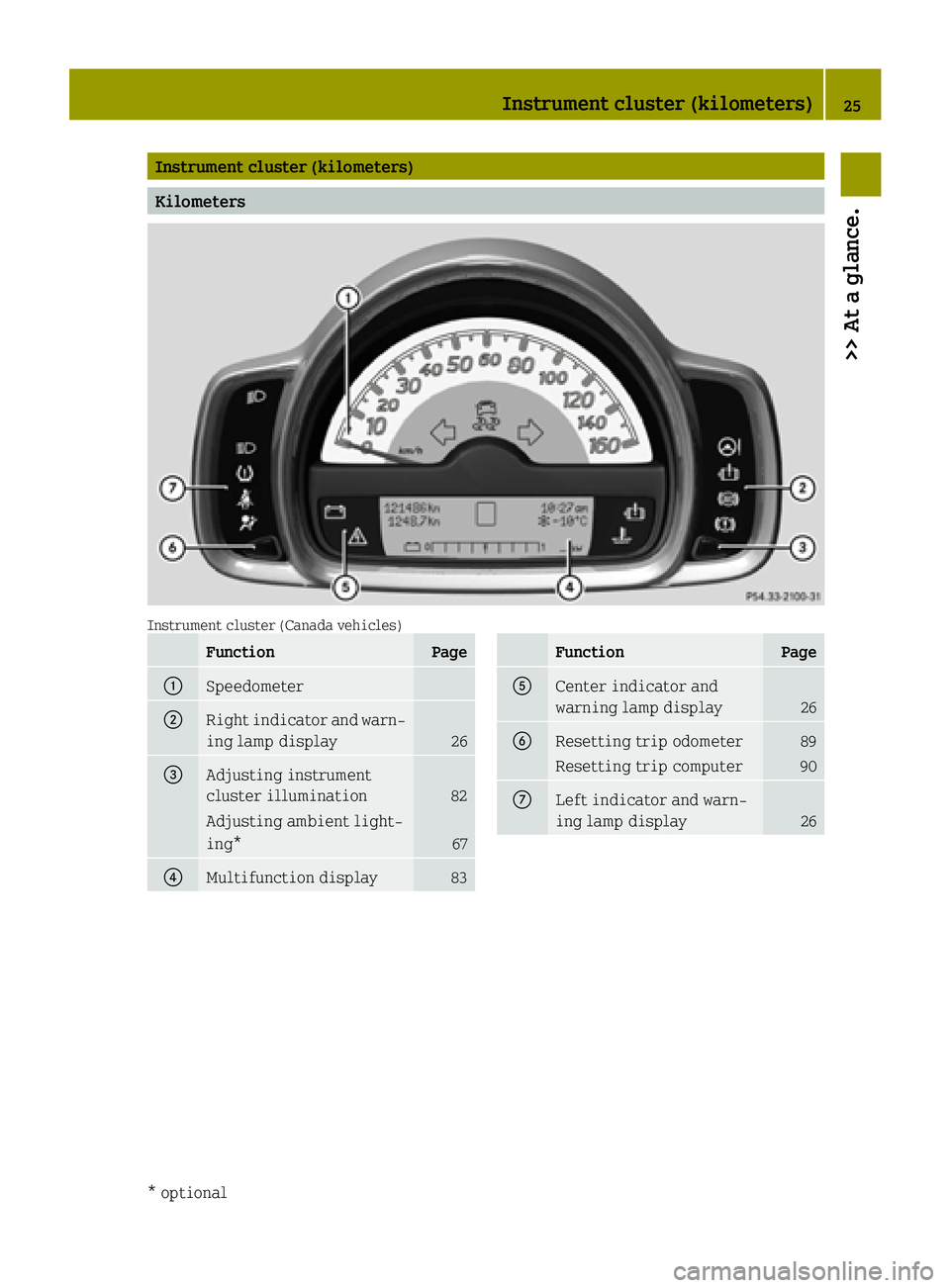
Instrument cluster (kilometers)
Kilometers
Instrument cluster (Canada vehicles)
Function Page
:
Speedometer
;
Right indicator and warn-
ing lamp display 26
=
Adjusting instrument
cluster illumination
82
Adjusting ambient light-
ing*
67
?
Multifunction display 83 Function Page
A
Center indicator and
warning lamp display
26
B
Resetting trip odometer 89
Resetting trip computer 90
C
Left indicator and warn-
ing lamp display
26Instrument cluster (kilometers)
25>> At a glance.
* optional
Page 28 of 222
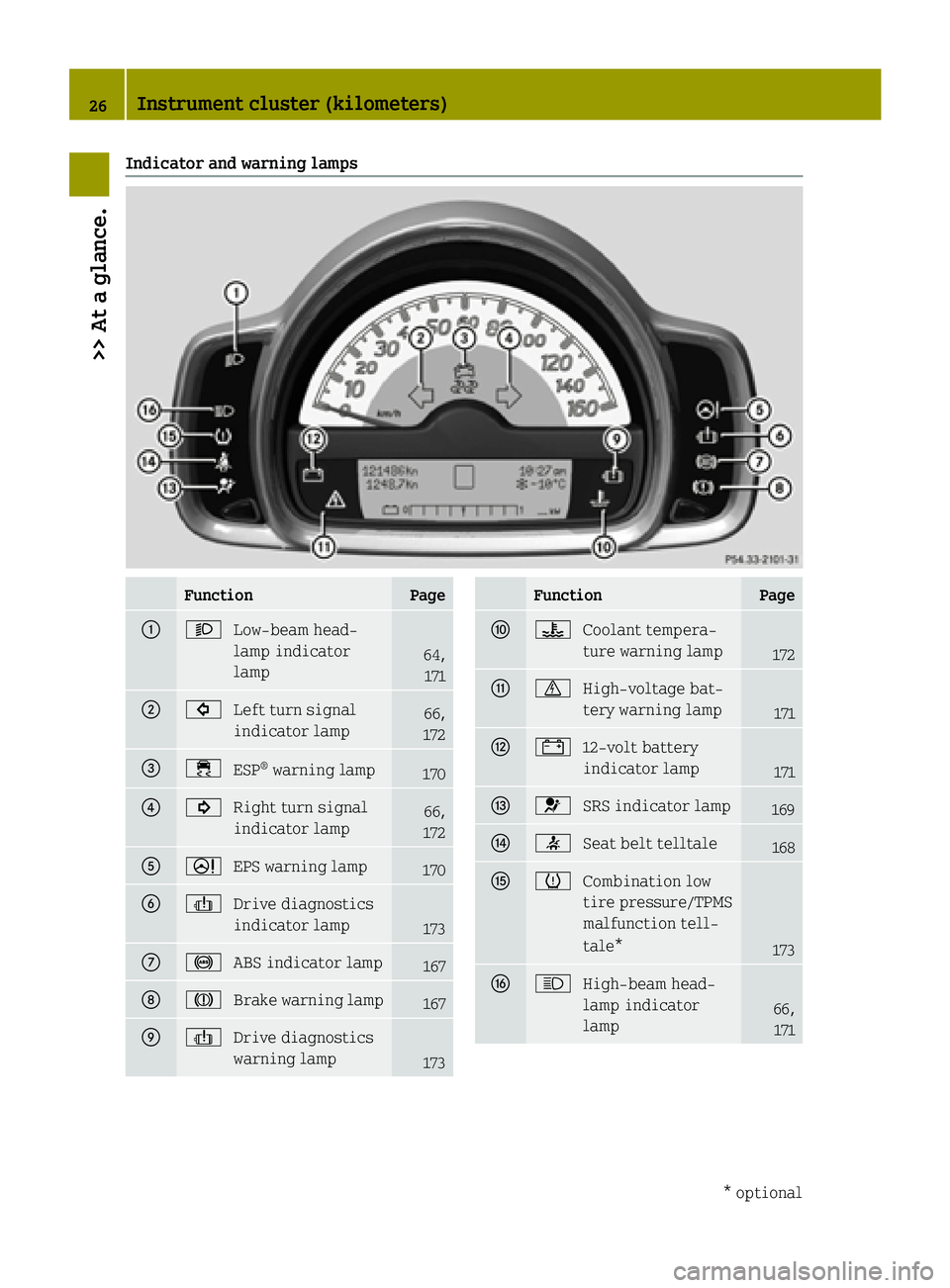
Indicator and warning lamps
Function Page
: M
Low‑beam head-
lamp indicator
lamp 64,
171 ; #
Left turn signal
indicator lamp 66,
172 = ÷
ESP®
warning lamp 170
? !
Right turn signal
indicator lamp 66,
172 A
D
EPS warning lamp 170
B þ
Drive diagnostics
indicator lamp 173
C !
ABS indicator lamp 167
D J
Brake warning lamp 167
E þ
Drive diagnostics
warning lamp 173 Function Page
F ?
Coolant tempera-
ture warning lamp 172
G N
High-voltage bat-
tery warning lamp 171
H #
12-volt battery
indicator lamp 171
I 6
SRS indicator lamp 169
J 7
Seat belt telltale 168
K
h
Combination low
tire pressure/TPMS
malfunction tell-
tale* 173
L K
High‑beam head-
lamp indicator
lamp 66,
171 26
Instrument cluster (kilometers)>> At a glance.
* optional
Page 29 of 222

Center console
Function Page
:
Charge level gauge 81
;
Power gauge 81
=
Air conditioning with
climate control 99
?
Radio 95
A
Drawer 107
B
Switching seat heating*
on/off
60
C
Restarting TPMS button 130
D
Switching tow-away pro-
tection*/interior motion
sensor* on/off
49
E
Central unlocking switch 53 Function Page
F
Hazard warning flasher
switch
68
G
Central locking switch 53
H
Switching front fog
lamps* on/off
67
I
Storage tray* 107
J
Gear selector lever 79
K
Starter switch 57
L
Parking brake lever 77
M
Coin holder 106
Retractable soft top
switch
2 72
2
cabriolet only. Center console
27>> At a glance.
* optional
Page 32 of 222
Occupant safety
Introduction
The smart vehicle is equipped with seat
belts and dual stage air bags to protect you
in a crash. However, children can be killed or seriously injured by an inflating air
bag. Indeed, there is a stronger risk of
serious death or bodily injury when an air
bag deploys on a child positioned in a
rear-facing child seat in the passenger
seat. Because this vehicle has only two
front seats and no backseat, it is limited as are other two-seat vehicles, in the extent
to which it may restrain children traveling
in the passenger front seat. Many states
have laws against placing children of cer- tain ages in the front seat of a vehicle that
has both front and back seats. Those laws
make exceptions to permit children to be
restrained in the front seat of two seat
vehicles. Special instructions and warn-
ings are provided below about when and if
you may restrain a child in the passenger
seat of the smart vehicle. Under certain
circumstances, it is appropriate for the
passenger air bag not to operate when a
child is restrained in a car seat in the
passenger seat, and this vehicle is equip- ped with technology to accomplish this.
Please pay very close attention to the
instructions and warnings below, particu-
larly as they relate to children.
In this section you will learn the most
important facts about the restraint system components of the vehicle.
The restraint systems are:
R Seat belts (Y page 31)
R Child restraints (Y page 42) Additional protection potential is provi-
ded by:
R Supplemental RestraintSystem (SRS)
with
- Air bags (Y page 33)
- Air bag control unit (with crash sen-
sors)
- Emergency Tensioning Devices and
seat belt force limiters (Y page 33)
R Air bag system components with
- Passenger front air bag off indicator
lamp (Y page 41)
- Passenger seat with OccupantClassi-
fication System (OCS) (Y page 39)
Although independent systems, their pro-
tective functions work in conjunction with each other.
i For information on infants and chil-
dren traveling with you in the vehicle
and restraint systems for infants and
children, see “Children in the vehicle”
(Y page 42).
The SRS system conducts a self-test when
the ignition is switched on and in regular intervals while the engine is running. This facilitates detection of malfunctions. The
SRS indicator lamp 6in the instrument
cluster comes on when the ignition is
switched on and goes out after approx-
imately four seconds.
The SRS components are in operational
readiness if the SRS indicator lamp 6
is not lit when the engine is running.
A malfunction in the system has been detec- ted if the SRS indicator lamp 6
R fails to go out after approximately 4 sec-
onds after the ignition was switched on
R does not come on at all
R comes on after the engine was started or
while driving G
WARNING
Modifications to or work improperly con-
ducted on restraint systems (such as seat 30
Occupant safety>> Safety.
Page 33 of 222

belts and anchors, Emergency Tensioning
Devices, seat belt force limiters or air
bags) or their wiring, as well as tampering with interconnected electronic systems,
can lead to the restraint systems no longer
functioning as intended. Air bags or Emer- gency Tensioning Devices, for example,
could deploy inadvertently or fail to
deploy in accidents in which they other-
wise should deploy (although the deceler-
ation threshold for air bag deployment is
exceeded). Therefore, never modify the
restraint systems. Do not tamper with elec-
tronic components or their software. G
WARNING
In the event that the SRS indicator lamp
6 comes on while driving or does not
come on at all, the SRS self-check has
detected a malfunction. For your safety, we strongly recommend that you immediately
but safely pull the vehicle off of the road-
way and stop driving. Contact an authorized
electric drive smart center immediately to have the system checked; otherwise the SRS
may not deploy when needed in an accident, which could result in serious or fatal
injury, or it might deploy unexpectedly andunnecessarily which could also result in
injury.
In addition, improper repair work on the
SRS creates a risk of rendering the SRS
inoperative or causing unintended air bag
deployment. Work on the SRS must therefore only be performed by qualified techni-
cians. Contact an authorized electric drive
smart center. If it is necessary to modify an air bag system to accommodate a person
with disabilities, contact your local
authorized electric drive smart center. Seat belts
The use of seat belts and infant and child
restraint systems is required by law in all 50 states, the District of Columbia, the U.S. territories and all Canadian provinces and
territories.
Even where this is not the case, all vehicle
occupants should have their seat belts fas- tened whenever the vehicle is being oper-
ated.
For more information, see “Fastening the
seat belts” (Y page 62).
i For information on infants and chil-
dren traveling with you in the vehicle
and restraint systems for infants and
children, see “Children in the vehicle”
(Y page 42). G
WARNING
Always fasten your seat belt before driving. Always make sure all of your passengers are properly restrained.
Failure to wear and properly fasten and
position your seat belt greatly increases
your risk of injuries and their likely
severity in an accident. You and your
passenger should always wear seat belts.
If you are ever in an accident, your injuries
can be considerably more severe without
your seat belt properly buckled.
Without your seat belt buckled, you are
much more likely to hit the interior of the
vehicle or be ejected from it. You can be
seriously injured or killed.
In the same crash, the possibility of injury
or death is lessened if you are properly
wearing your seat belt. Air bags can only
protect you if you are properly wearing
your seat belt. G
WARNING
Never ride in a moving vehicle with the seat backrest in an excessively reclined posi-
tion as this can be dangerous. You could
slide under the seat belt in a collision. If
you slide under it, the belt would apply
force at the abdomen or neck, causing seri-
ous or even fatal injuries. The seat back-
rest and seat belt provide the best
restraint when the wearer is in a position Occupant safety
31>> Safety.
Z
Page 34 of 222
that is as upright as possible and the belt
is properly positioned on the body. G
WARNING
Never let more people ride in the vehicle
than there are seat belts available. Make
sure everyone riding in the vehicle is cor- rectly restrained with a separate seat belt.Never use a seat belt for more than one per-
son at a time. G
WARNING
Seat belts of a vehicle involved in an acci- dent must be inspected by smart. Only then
is it possible to determine whether the seat belts were damaged or stressed in the acci-dent. Damaged or stressed seat belts may
not properly protect you in a subsequent
accident.
Only use seat belts which have been
approved by smart.
Do not make any modifications to the seat
belts. This can lead to unintended activa-
tion of the Emergency Tensioning Devices
(ETDs) or to their failure to activate when
necessary.
Do not bleach or dye seat belts as this may
severely weaken them. In a crash, they may
not be able to provide adequate protection.
Have all work carried out only by qualified
technicians. Contact an authorized elec-
tric drive smart center. G
WARNING
USE SEAT BELTS PROPERLY R Seat belts can only work when used prop-
erly. Never wear seat belts in any other
way than as described in this section, as
that could result in serious injuries in
case of an accident.
R Each occupant should wear their seat belt
at all times, because seat belts help
reduce the likelihood of and potential
severity of injuries in accidents,
including rollovers. The integrated
restraint system includes SRS (driver front air bag, passenger front air bag,
head-thorax air bags) and Emergency
Tensioning Devices (ETDs) with seat belt
force limiters.
The system is designed to enhance the
protection provided by secured seat
belts in certain frontal and side
impacts.
R Never wear the shoulder belt under your
arm, against your neck or off your shoul-
der. Doing so may cause your body to movetoo far forward in a frontal crash, which
would increase the chance of head and
neck injuries. The seat belt would also
apply too much force to the ribs or abdo-
men, which could severely injure inter-
nal organs such as your liver or spleen.
R Never wear seat belts over rigid or
breakable objects in or on your clothing,
such as eyeglasses, pens, keys, etc., as
these might cause injuries.
R Position the lap belt as low as possible
on your hips and not across the abdomen.
If the lap seat belt is positioned across
your abdomen, it could cause serious
injuries in a crash.
R Never use a seat belt for more than one
person at a time. Do not fasten a seat belt
around a person and another person or
other objects at the same time.
R Seat belts should not be worn twisted. In
a crash, you would not have the full width
of the seat belt to manage impact forces. The twisted seat belt against your body
could cause injuries.
R Pregnant women should also always use a
lap-shoulder belt. The lap belt portion
should be positioned as low as possible
on the hips to avoid any possible pres-
sure on the abdomen.
R Never place your feet on the instrument
panel, dashboard or on the seat. Always
keep both feet on the floor in front of the
seat.
R When using a seat belt to secure infant or
toddler restraints or children in booster 32
Occupant safety>> Safety.