weight SMART FORTWO COUPE 2015 User Guide
[x] Cancel search | Manufacturer: SMART, Model Year: 2015, Model line: FORTWO COUPE, Model: SMART FORTWO COUPE 2015Pages: 222, PDF Size: 5.02 MB
Page 41 of 222

The thorax-pelvis side air bags are inte-
grated into the driver and passenger seat
backrests. :
Thorax-pelvis side air bags Occupant Classification System
The Occupant Classification System (OCS)
automatically turns the passenger front air bag on or off based on the classified occu-pant weight category determined by weight
sensor readings from the passenger seat.
i Based on the classified occupant
weight category determined by weight
sensor readings from the passenger seat,
the system does also deactivate
R head-thorax air bag (cabriolet)
R the window curtain air bag (coupé)
R the thorax-pelvis side air bag (coupé)
R the seat Emergency Tensioning Devi-
ces
R the seat belt force limiter.
Occupants must sit properly belted in a
position that is as upright as possible with their back against the seat backrest and
feet on the floor to be correctly classified.
If the occupant’s weight is transferred to
another object in the vehicle (e.g. by lean-
ing on armrests), the OCS may not be able to properly approximate the occupant’s
weight category.
i If the seat, including the trim cover and
cushion, needs to be serviced in any way, take the vehicle to an authorized elec- tric drive smart center. Only seat acces-
sories approved by smart may be used.
Both driver and the passenger should
always use the 40indicator
lamp as an indication of whether or not
the passenger is properly positioned
(Y page 41). G
WARNING
If the 40indicator lamp illu-
minates when an adult or someone larger
than a small individual is in the passenger seat, have the passenger re-position him-
self or herself in the seat until the
40indicator lamp goes out.
In the event of a collision, the air bag con- trol unit will not allow passenger front air
bag deployment when the OCS has classified
the passenger seat occupant as being up to
or less than the weight of a typical
12‑month‑old child in a standard child
restraint, or if the passenger seat is
sensed as being empty.
When the OCS senses that the passenger seat occupant is classified as being up to or
less than the weight of a typical
12‑month‑old child in a standard child
restraint, the 40indicator
lamp will illuminate when the ignition is
switched on and remain illuminated, indi-
cating that the passenger front air bag is
deactivated.
When the OCS senses that the passenger seat is classified as being empty, the
40indicator lamp will illu-
minate and remains illuminated.
When the OCS senses that the passenger seat occupant is classified as being heavier
than the weight of a typical 12‑month‑old
child seated in a standard child restraint
or as being a small individual (such as a
young teenager or a small adult), the
40indicator lamp will illu-
minate for approximately 4 seconds when
the ignition is switched on and then,
depending on occupant weight sensor read- Occupant safety
39>> Safety.
Z
Page 42 of 222

ings from the seat, remains illuminated or
goes out.
When the 40indicator lamp is
illuminated, the passenger front air bag is
deactivated.
When the 40indicator lamp is
out and the passenger seat is occupied by an adult or someone larger than a small indi-
vidual, the passenger front air bag is acti-
vated.
When the OCS senses that the passenger seat occupant is classified as an adult or some- one larger than a small individual, the
40indicator lamp will illu-
minate for approximately 4 seconds when
the ignition is switched on and then goes
out, indicating that the passenger front air
bag is activated.
If the 40indicator lamp is
illuminated, the passenger front air bag is
deactivated and will not be deployed.
If the 40indicator lamp is not
illuminated, the passenger front air bag is
activated and will be deployed
R in the event of certain frontal impacts
R if impact exceeds a preset deployment
threshold
R independently of the head-thorax air
bags
If the passenger front air bag is deployed, the rate of inflation will be influenced by
R the rate of vehicle deceleration and a
fastened or unfastened seat belt as
assessed by the air bag control unit
R the passenger’s weight category as iden-
tified by the OCS G
WARNING
Children 12 years old and under must be
seated and properly secured in an appro-
priate infant or child restraint recommen- ded for the size and weight of the child.
The infant or child restraint must be prop-
erly secured with the vehicle’s seat belt, fully in accordance with the child seat
manufacturer’s instructions.
Children can be killed or seriously injured by an inflating air bag. Note the following
important information:
R Your vehicle is equipped with air bag
technology designed to turn off the
passenger front air bag in your vehicle
when the system senses the weight of a
typical 12‑month‑old child or less along
with the weight of a standard appropri-
ate child restraint on the passenger seat.
R A child in a rear-facing child restraint
on the passenger seat will be seriously
injured or even killed if the passenger
front air bag inflates in a collision
which could occur under some circum-
stances, even with the air bag technology
installed in your vehicle.
R If you install a rear-facing child
restraint on the passenger seat, make
sure the 40indicator lamp
is illuminated, indicating that the
passenger front air bag is deactivated.
Should the 40indicator
lamp not illuminate or go out while the
restraint is installed, please check
installation.
Periodically check the 40
indicator lamp while driving to make
sure the 40indicator lamp
is illuminated.
If the 40indicator lamp
goes out or remains out, do not transport a child on the passenger seat until the
system has been repaired.
A child in a rear-facing child restraint
on the passenger seat may be seriously
injured or even killed if the passenger
front air bag inflates.
R If you place a child in a forward-facing
child restraint on the passenger seat,
move the seat as far back as possible, use
the proper child restraint recommended
for the age, size and weight of the child 40
Occupant safety>> Safety.
Page 43 of 222

by the seat manufacturer, and secure
child restraint with the vehicle’s seat
belt according to the child seat manu-
facturer’s instructions. For children
larger than the typical 12‑month‑old
child, the passenger front air bag may or may not be activated.
i Deployment of the driver front air bag
does not mean that the passenger front
air bag also should have deployed.
The Occupant Classification System may
have determined R that the seat was empty or occupied by the
weight up to or less than that of a typical 12‑month‑old child seated in a standard
child restraint — both instances where
the system suppresses deployment of the
passenger front air bag even though the
impact met the criteria and was of suf-
ficient severity to deploy the driver
front air bag
R that the seat was occupied by a small
individual (such as a young teenager or a
small adult) or a child weighing more
than the weight of a typical 12‑month‑old
child in a standard child restraint —
instances where the system may suppress deployment of the passenger front air
bag even though the impact met the cri-
teria and was of sufficient severity to
deploy the driver front air bag
Passenger front air bag off indicator
lamp The indicator lamp is located on the over-
head control panel. Passenger front air bag off indicator
lamp
:illuminates when the passenger
front air bag is deactivated. G
WARNING
When the SRS indicator lamp 6and the
40indicator lamp are lit at
the same time, there is a malfunction in the Occupant Classification System.
In order to ensure proper operation of the
air bag system and OCS:
R Have the system checked as soon as pos-
sible by qualified technicians. Contact
an authorized electric drive smart cen-
ter.
R Sit properly belted in a position that is
as upright as possible with your back
against the seat backrest.
R Do not lean on the armrests or lift your-
self from the seat by using the handle
over the door as this may cause the OCS to
be unable to correctly approximate the
occupant weight category.
R Only have the seat repaired or replaced
by an authorized electric drive smart
center.
R Read and observe all warnings in this
chapter.
Self-test Occupant Classification Sys-
tem After turning the key in the starter switch
to position
1or 2, the 40
indicator lamp located in the center con-
sole illuminates. If an adult occupant is Occupant safety
41>> Safety. Z
Page 45 of 222

vated. The seat belt is now locked. Push
down on child restraint to take up any
slack.
To deactivate, release seat belt buckle and
let seat belt retract completely. To deac-
tivate the special seat belt retractor for
the passenger seat, the passenger seat must be in the most backward position. The seatbelt can again be used in the usual manner. G
WARNING
Never release the seat belt buckle while the vehicle is in motion, since the special seatbelt retractor will be deactivated.
The use of infant or child restraints is
required by law in all 50 states, the Dis-
trict of Columbia, the U.S. territories, and
all Canadian provinces and territories.
Infants and small children should be seated in an appropriate infant or child restraint
system properly secured in accordance
with the manufacturer’s instructions for
the child restraint, that complies with U.S. Federal Motor Vehicle Safety Standards 213and 225 and Canadian Motor Vehicle Safety
Standards 213, 213.1 and 213.2.
A statement by the child restraint manu-
facturer of compliance with these stand-
ards can be found on the instruction label
on the restraint and in the instruction
manual provided with the restraint.
When using any infant restraint, toddler
restraint, or booster seat be sure to care-
fully read and follow all manufacturer’s
instructions for installation and use.
Please read and observe warning labels
affixed to the inside of the vehicle and to
infant or child restraints. G
WARNING
Children 12 years old and under must be
seated and properly secured in an appro-
priately sized infant restraint, toddler
restraint, or booster seat recommended for the size and weight of the child. The infant or child restraint must be prop-
erly secured with the vehicle’s seat belt
fully in accordance with the child seat
manufacturer’s instructions.
Occupants, especially children, should
never place their bodies or lean their
heads in the area of the door where the
head-thorax air bags (cabriolet), window
curtain air bags (coupé) and thorax-pelvis
air bags (coupé) inflates. This could result in serious injuries or death should the
head-thorax air bags (cabriolet), window
curtain air bags (coupé) and thorax-pelvis
air bags (coupé) be triggered. Always sit as
upright as possible, properly use the seat
belt and use an appropriately sized infant
restraint, toddler restraint, or booster
seat recommended for the size and weight of
the child.
Children can be killed or seriously injured by an inflating air bag. Note the following
important information when circumstances
require you to place a child in the
passenger seat:
R Your vehicle is equipped with air bag
technology designed to turn off the
passenger front air bag in your vehicle
when the Occupant Classification System
senses the weight of a typical
12‑month‑old child or less along with the
weight of an appropriate child restraint
on the passenger seat.
R A child in a rear-facing child restraint
on the passenger seat may be seriously
injured or even killed if the passenger
front air bag inflates in a collision.
R If you install a rear-facing child
restraint on the passenger seat, make
sure the 40indicator lamp
is illuminated, indicating that the
passenger front air bag is deactivated.
Should the 40indicator
lamp not illuminate or go out while the
restraint is installed, please check
installation. Periodically check the
40indicator lamp while Occupant safety
43>> Safety.
Z
Page 46 of 222

driving to make sure the
40
indicator lamp is illuminated. If the
40indicator lamp goes out
or remains out, do not transport a child
on the passenger seat until the system has been repaired. A child in a rear-facing
child restraint on the passenger seat may
be seriously injured or even killed if the passenger front air bag inflates.
R If you place a child in a forward-facing
child restraint on the passenger seat,
move the seat as far back as possible, use a proper child restraint recommended
for the age, size and weight of the child,
and secure child restraint with the vehi- cle’s seat belt according to the child seat
manufacturer’s instructions. For chil-
dren larger than the typical
12‑month‑old child, the passenger front
air bag may or may not be activated. G
WARNING
Infants and small children should never
share a seat belt with another occupant.
During an accident, they could be crushed
between the occupant and seat belt.
A child’s risk of serious or fatal injuries is
significantly increased if the child
restraints are not properly secured in the
vehicle and/or the child is not properly
secured in the child restraint.
Children too big for a toddler restraint
must ride in a seat using regular seat belt.
Position shoulder belt across chest and
shoulder, not face or neck. A booster seat
may be necessary to achieve proper seat
belt positioning for children over 41 lbs
until they reach a height where a lap-
shoulder belt fits properly without a boos- ter.
When the child restraint is not in use,
remove it from the vehicle or secure it with
the seat belt to prevent the child restraint from becoming a projectile in the event of
an accident. Do not leave children unattended in the
vehicle, even if the children are secured in
a child restraint system. Unsupervised
children in a child restraint system may
use vehicle equipment and may cause an
accident and/or serious personal injury.
If you are using a rear-facing child
restraint system on the passenger seat, you
must verify that the passenger front air bag is deactivated. When the passenger front
air bag is deactivated, the 40
indicator lamp is illuminated (Y page 41).
Top tether
Top tether permits an additional connec-
tion between a child restraint system and
the passenger seat. Proper usage of the top
tether, in accordance with instructions
provided by the child restraint manufac-
turer, can further reduce the risk of inju-
ries.
The top tether anchorage is located on the
floor of the cargo compartment. The top
tether guide for the top tether strap is
located above, on the head restraint. 44
Occupant safety>> Safety.
Page 56 of 222

X
Locking: Press central locking
switch :.
The indicator lamp on central locking
switch :comes on, when the starter
switch is in position 1.
The indicator lamp on central locking
switch :flashes, when the starter
switch is in position 0.
With the doors and the tailgate closed,
the vehicle locks.
X Unlocking: Press central unlocking
switch ;.
The vehicle unlocks and the indicator
lamp on central locking switch :goes
out. Opening the doors from the inside
You can open a locked door from the inside.
Open door only when conditions are safe to do so. X
Pull on inside door handle :.
With the driver’s door open a warning
signal sounds if the exterior lamps are switched on and the ignition is switched
off. Opening the upper tailgate on the
coupé
X
Press button #on the key twice.
X Press and hold button $on the key for
approximately two seconds.
or
X Pull the release handle in handle
recess :of the lower tailgate.
The upper tailgate is unlocked.
X Swivel the upper tailgate upwards to
open.
Observe the information on loading the
vehicle (Y page 108).
For information on vehicle weights, see
“Vehicle specification” (Y page 215). Opening the lower tailgate on the
coupé
X Open the upper tailgate (Y page 54).54
Opening and closing>> Controls.
Page 57 of 222
X
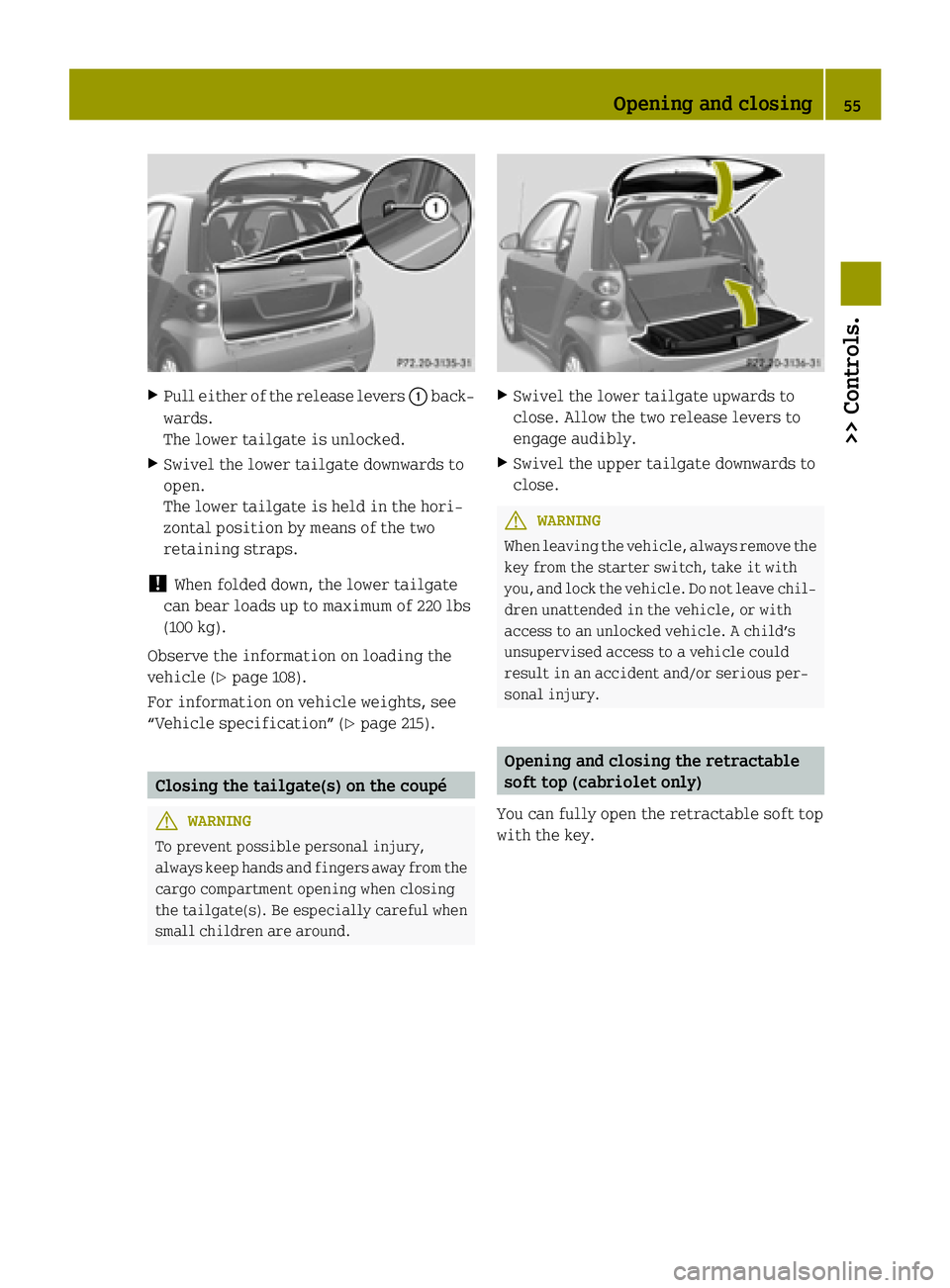
Pull either of the release levers :back-
wards.
The lower tailgate is unlocked.
X Swivel the lower tailgate downwards to
open.
The lower tailgate is held in the hori-
zontal position by means of the two
retaining straps.
! When folded down, the lower tailgate
can bear loads up to maximum of 220 lbs
(100 kg).
Observe the information on loading the
vehicle (Y page 108).
For information on vehicle weights, see
“Vehicle specification” (Y page 215).Closing the tailgate(s) on the coupé
G
WARNING
To prevent possible personal injury,
always keep hands and fingers away from the cargo compartment opening when closing
the tailgate(s). Be especially careful when
small children are around. X
Swivel the lower tailgate upwards to
close. Allow the two release levers to
engage audibly.
X Swivel the upper tailgate downwards to
close. G
WARNING
When leaving the vehicle, always remove the key from the starter switch, take it with
you, and lock the vehicle. Do not leave chil- dren unattended in the vehicle, or with
access to an unlocked vehicle. A child’s
unsupervised access to a vehicle could
result in an accident and/or serious per-
sonal injury. Opening and closing the retractable
soft top (cabriolet only)
You can fully open the retractable soft top
with the key. Opening and closing
55>> Controls. Z
Page 60 of 222

Seats
Safety notes
G
WARNING
All seat adjustments, as well as fastening of seat belts, must be done before the vehicle
is operated. G
WARNING
When adjusting the seat, make sure no one
becomes trapped.
Do not adjust the driver’s seat while driv-
ing. Adjusting the seat while driving could cause the driver to lose control of the vehi-
cle.
Never ride in a moving vehicle with the seat backrest in an excessively reclined posi-
tion as this can be dangerous. You could
slide under the seat belt in a collision. If
you slide under the seat belt, it could apply force at the abdomen or neck, potentially
causing serious or fatal injuries. The seat
backrest and seat belts provide the best
restraint when the wearer is in a position
that is as upright as possible and seat belts are properly positioned on the body.
Your seat must be adjusted so that you can
correctly fasten your seat belt.
Observe the following points:
R Adjust the seat backrest until your arms
are slightly angled when holding the
steering wheel.
R Adjust the seat to a comfortable seating
position that still allows you to reach the
accelerator/brake pedal safely. The
position should be as far back as possi-
ble with the driver still able to operate
the controls properly.
R Never place hands under the seat or near
any moving parts while a seat is being
adjusted.
Failure to do so could result in an accident
and/or serious personal injury.
Observe the notes on the air bag system. G
WARNING
Children 12 years old and under must be
seated and properly secured in an appro-
priately sized infant restraint, toddler
restraint, or booster seat recommended for the size and weight of the child. For addi-
tional information, see “Children in the
vehicle”.
A child’s risk of serious or fatal injuries is
significantly increased if the child
restraints are not properly secured in the
vehicle and/or the child is not properly
secured in the child restraint. G
WARNING
Contact an authorized electric drive smart center if the seats have become damaged.
The seat is an integral part of the vehicle’s
safety system in the same way as seat belts
and air bags. Damage to the seats may
reduce their ability to protect the occu-
pants in an accident. Seat adjustment
:
Seat backrest tilt
; Seat fore and aft adjustment
Seat backrest tilt X
Adjusting: Sit down on the front seat.
X Pull adjustment lever :upwards and
adjust the seat backrest until your arms
are slightly angled when holding the
steering wheel. 58
Seats>> Controls.
Page 64 of 222
Seat belts
Fastening the seat belts
G
WARNING
Always fasten your seat belt before driving. Always make sure all of your passengers are properly restrained.
Failure to wear and properly fasten and
position your seat belt greatly increases
your risk of injuries and their likely
severity in an accident. You and your
passenger should always wear seat belts.
If you are ever in an accident, your injuries
can be considerably more severe without
your seat belt properly buckled.
Without your seat belt buckled, you are
much more likely to hit the interior of the
vehicle or be ejected from it. You can be
seriously injured or killed.
In the same crash, the possibility of injury
or death is lessened if you are properly
wearing your seat belt. Air bags can only
protect you if you are properly wearing
your seat belt. G
WARNING
Children 12 years old and under must be
seated and properly secured in an appro-
priately sized infant restraint, toddler
restraint, or booster seat recommended for the size and weight of the child. For addi-
tional information, see “Children in the
vehicle”.
A child’s risk of serious or fatal injuries is
significantly increased if the child
restraints are not properly secured in the
vehicle and/or the child is not properly
secured in the child restraint. G
WARNING
Never let more people ride in the vehicle
than there are seat belts available. Make
sure everyone riding in the vehicle is cor- rectly restrained with a separate seat belt.Never use a seat belt for more than one per-
son at a time. G
WARNING
Never ride in a moving vehicle with the seat backrest in an excessively reclined posi-
tion as this can be dangerous. You could
slide under the seat belt in a collision. If
you slide under it, the belt would apply
force at the abdomen or neck, causing seri-
ous or even fatal injuries. The seat back-
rest and seat belt provide the best
restraint when the wearer is in a position
that is as upright as possible and the belt
is properly positioned on the body. G
WARNING
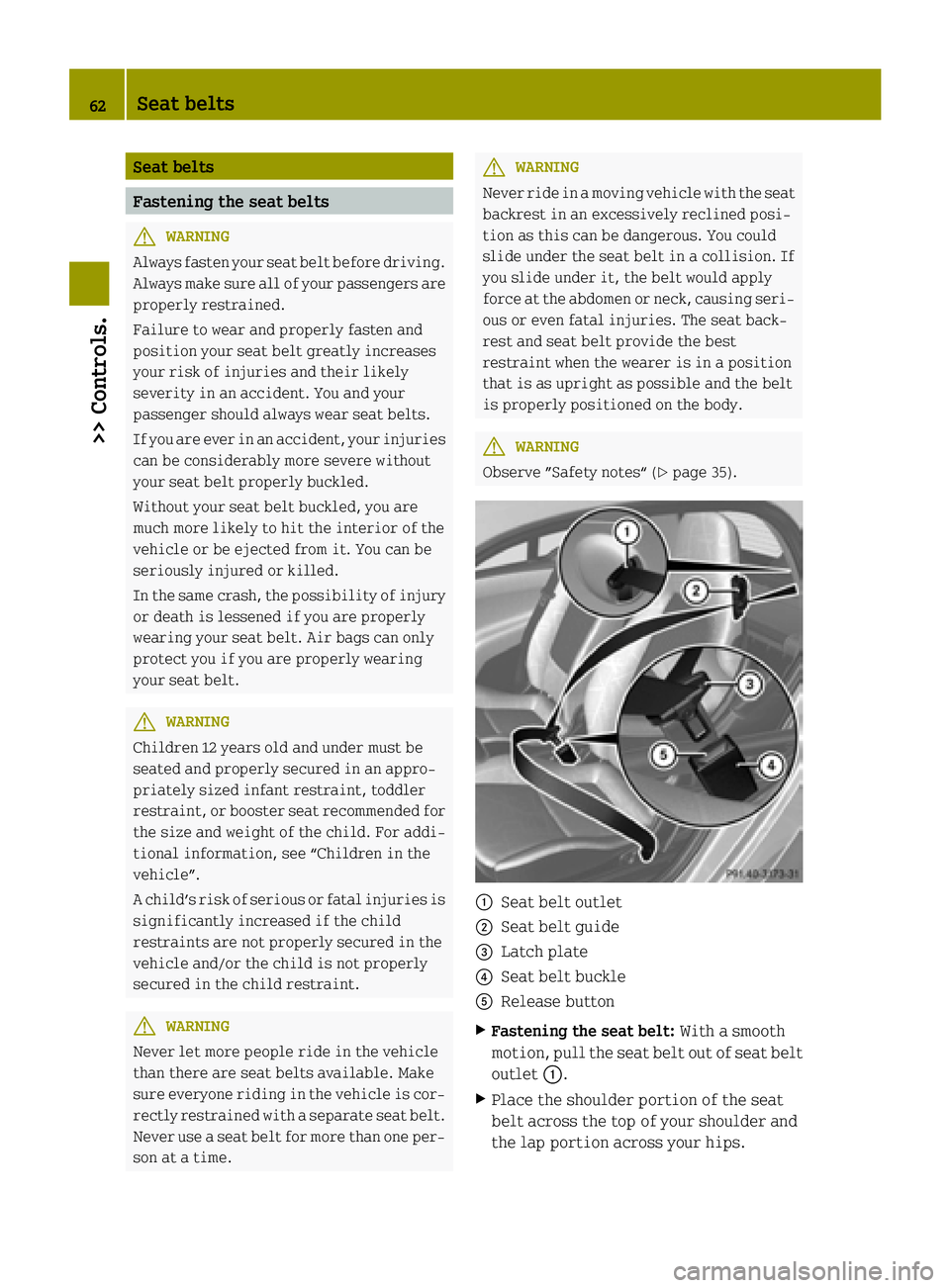
Observe ”Safety notes“ (Y page 35). :
Seat belt outlet
; Seat belt guide
= Latch plate
? Seat belt buckle
A Release button
X Fastening the seat belt: With a smooth
motion, pull the seat belt out of seat belt
outlet :.
X Place the shoulder portion of the seat
belt across the top of your shoulder and
the lap portion across your hips. 62
Seat belts>> Controls.
Page 73 of 222

When loading, make sure no sharp objects
come into contact with the soft top or the
rear window.
Do not place any evenly distributed loads with a weight of more than 165 lbs (75 kg)
on the rear soft top when folded down.
Make sure the high-mounted brake lamp
is not concealed.
! Do not block the soft top system’s lock-
ing apertures.
Only place the side rails in the desig-
nated storage space of the tailgate.
! Do not sit on the folded-down rear soft
top.
Do not fold down the rear soft top at tem-
peratures below 14¦ (-10¥).
Do not place any pointed, sharp-edged,
hot (above 176¦ [80¥]), incandescent or
burning objects on the soft top’s lining.
Do not apply wax to the soft top fabric and select only wax-free washing products
when using an automatic car wash.
Only drive with the retaining clips
closed, as exhaust fumes could otherwise
reach the vehicle’s interior.
! Please keep in mind that weather con-
ditions can sometimes change rapidly.
Make sure to close the retractable soft
top and the rear soft top when leaving the
vehicle. If water enters the vehicle inte- rior, vehicle electronics could be dam-
aged which is not covered by the smart
Limited Warranty. Opening and closing the retractable
soft top
You can open and close the retractable soft
top when the vehicle is either stationary or in motion. G
WARNING
Never operate the retractable soft top if
there is the possibility of anyone being harmed by the opening or closing proce-
dure.
G
WARNING
The retractable soft top is made out of fab- ric. In the event of an accident, the fabric
may tear. This may result in an opening in
the roof.
In a vehicle rollover, occupants not wear-
ing their seat belts or not wearing them
properly may be thrown out of the opening.
Such an opening also presents a potential
for injury for occupants wearing their seat
belts properly as entire body parts or por- tions of them may protrude from the
passenger compartment. G
WARNING
When leaving the vehicle, always remove the key from the starter switch, take it with
you, and lock the vehicle. Do not leave chil- dren unattended in the vehicle, or with
access to an unlocked vehicle. A child’s
unsupervised access to a vehicle could
result in an accident and/or serious per-
sonal injury.
! To avoid damaging the seals, do not
transport any objects with sharp edges
which can stick out of the retractable
soft top.
Do not open the retractable soft top if
there is snow or ice on the roof, as this
could result in malfunctions.
If you cannot open or close the retracta-
ble soft top due to a malfunction contact
Roadside Assistance or an authorized
electric drive smart center.
i To avoid draining the battery, leave the
drive system running when opening and
closing the retractable soft top.
Opening from outside You can open the retractable soft top com-
pletely with the key. Soft top system (cabriolet only)
71>> Controls. Z