ECU SMART FORTWO COUPE 2015 Owner's Manual
[x] Cancel search | Manufacturer: SMART, Model Year: 2015, Model line: FORTWO COUPE, Model: SMART FORTWO COUPE 2015Pages: 222, PDF Size: 5.02 MB
Page 107 of 222
X
Open the tailgate.
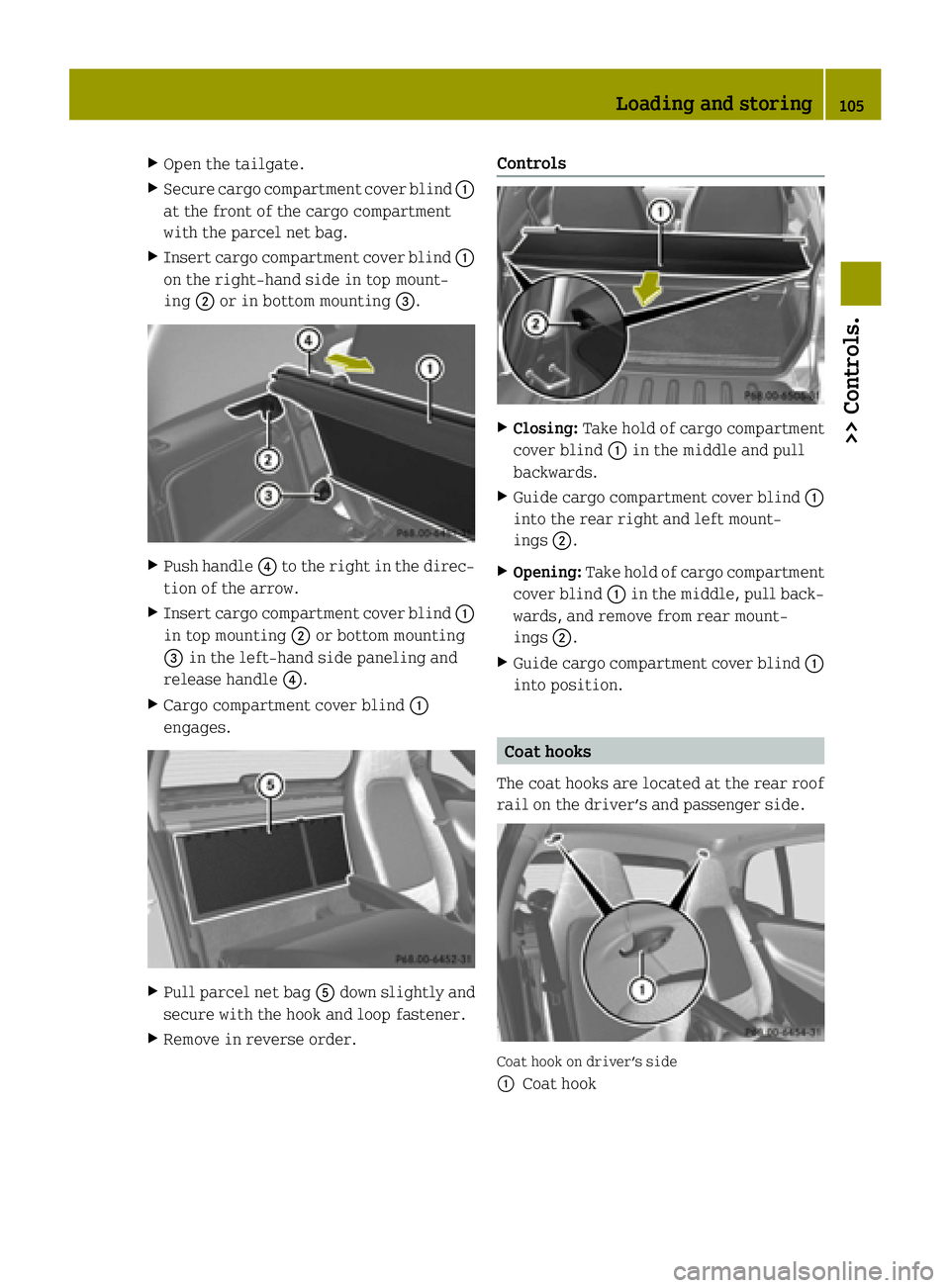
X Secure cargo compartment cover blind :
at the front of the cargo compartment
with the parcel net bag.
X Insert cargo compartment cover blind :
on the right-hand side in top mount-
ing ;or in bottom mounting =.X
Push handle ?to the right in the direc-
tion of the arrow.
X Insert cargo compartment cover blind :
in top mounting ;or bottom mounting
= in the left-hand side paneling and
release handle ?.
X Cargo compartment cover blind :
engages. X
Pull parcel net bag Adown slightly and
secure with the hook and loop fastener.
X Remove in reverse order. Controls
X
Closing: Take hold of cargo compartment
cover blind :in the middle and pull
backwards.
X Guide cargo compartment cover blind :
into the rear right and left mount-
ings ;.
X Opening: Take hold of cargo compartment
cover blind :in the middle, pull back-
wards, and remove from rear mount-
ings ;.
X Guide cargo compartment cover blind :
into position. Coat hooks
The coat hooks are located at the rear roof
rail on the driver’s and passenger side. Coat hook on driver’s side
:
Coat hook Loading and storing
105>> Controls. Z
Page 110 of 222
this reason, please make sure that the
charging cable is only stowed in the
intended location. X
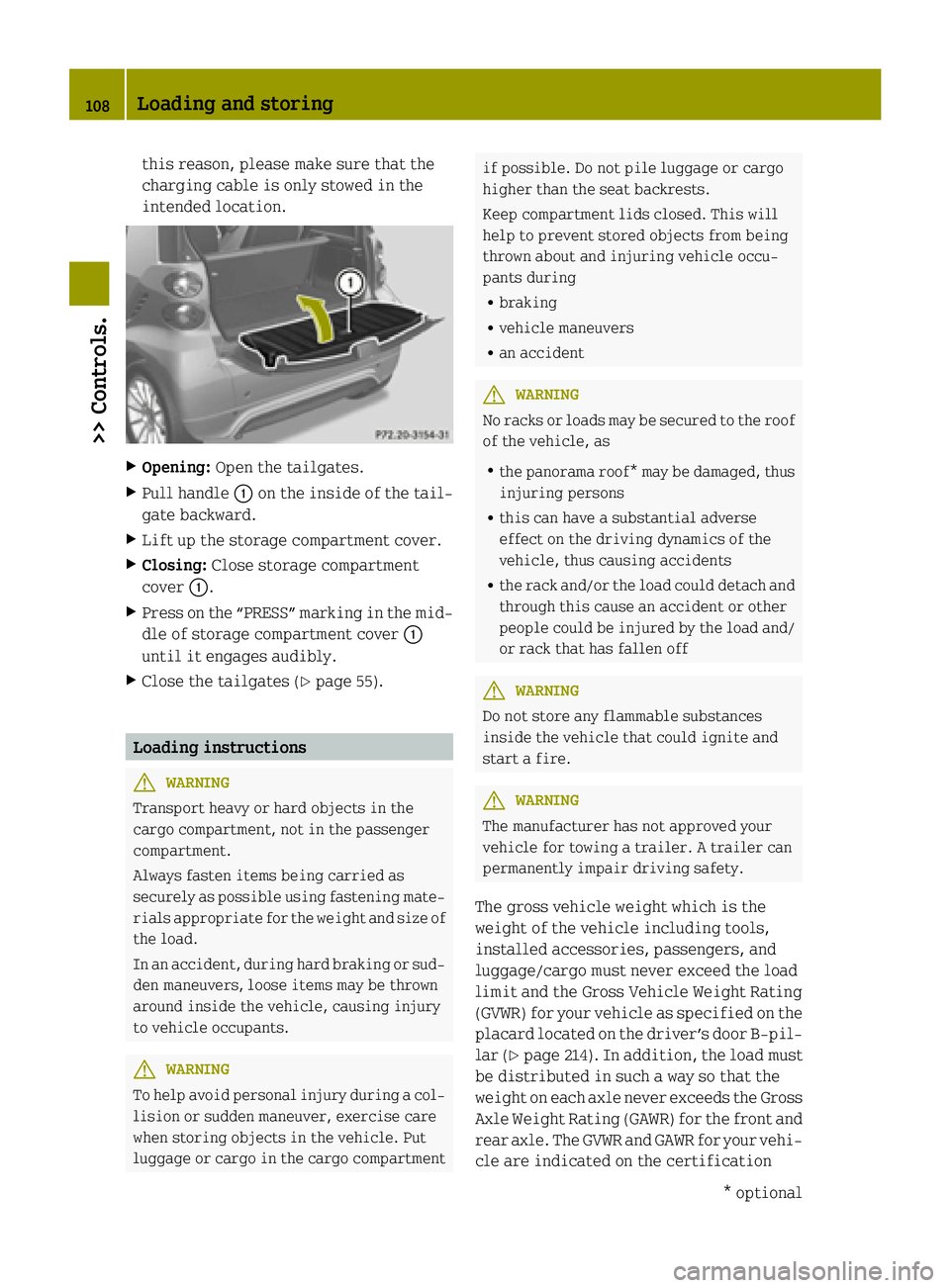
Opening: Open the tailgates.
X Pull handle :on the inside of the tail-
gate backward.
X Lift up the storage compartment cover.
X Closing: Close storage compartment
cover :.
X Press on the “PRESS” marking in the mid-
dle of storage compartment cover :
until it engages audibly.
X Close the tailgates (Y page 55).Loading instructions
G
WARNING
Transport heavy or hard objects in the
cargo compartment, not in the passenger
compartment.
Always fasten items being carried as
securely as possible using fastening mate- rials appropriate for the weight and size of
the load.
In an accident, during hard braking or sud-
den maneuvers, loose items may be thrown
around inside the vehicle, causing injury
to vehicle occupants. G
WARNING
To help avoid personal injury during a col- lision or sudden maneuver, exercise care
when storing objects in the vehicle. Put
luggage or cargo in the cargo compartment if possible. Do not pile luggage or cargo
higher than the seat backrests.
Keep compartment lids closed. This will
help to prevent stored objects from being
thrown about and injuring vehicle occu-
pants during
R braking
R vehicle maneuvers
R an accident G
WARNING
No racks or loads may be secured to the roof of the vehicle, as
R the panorama roof* may be damaged, thus
injuring persons
R this can have a substantial adverse
effect on the driving dynamics of the
vehicle, thus causing accidents
R the rack and/or the load could detach and
through this cause an accident or other
people could be injured by the load and/
or rack that has fallen off G
WARNING
Do not store any flammable substances
inside the vehicle that could ignite and
start a fire. G
WARNING
The manufacturer has not approved your
vehicle for towing a trailer. A trailer can
permanently impair driving safety.
The gross vehicle weight which is the
weight of the vehicle including tools,
installed accessories, passengers, and
luggage/cargo must never exceed the load
limit and the Gross Vehicle Weight Rating
(GVWR) for your vehicle as specified on the placard located on the driver’s door B‑pil-
lar (Y page 214). In addition, the load must
be distributed in such a way so that the
weight on each axle never exceeds the Gross Axle Weight Rating (GAWR) for the front and
rear axle. The GVWR and GAWR for your vehi-
cle are indicated on the certification 108
Loading and storing>> Controls.
* optional
Page 111 of 222

label which can be found on the driver’s
door B‑pillar.
For more information, see “Loading the
vehicle” (Y page 133).
The handling characteristics of a fully
loaded vehicle depend greatly on the load
distribution. It is therefore recommended
to load the vehicle with the heaviest items being placed towards the front of the vehi-cle.
Please pay attention to and comply with thefollowing instructions when loading the
vehicle and transporting cargo:
R Always place items being carried
against seat backrests, and fasten them
as securely as possible.
R The heaviest portion of the cargo should
always be kept as low as possible against
seat backrests.
R Do not stack loads higher than the top
edge of the head restraints.
R Make sure no luggage/cargo items can get
above or next to the driver’s and/or
passenger seat into the passenger com-
partment.
R Make sure luggage/cargo is properly
secured.
R Always use, if so equipped, cargo net*
when transporting cargo.
Do not carry any unnecessary weight in the
vehicle. This increases vehicle weight,
which results in increased energy con-
sumption. Useful features
Sun visors
The sun visors protect you from sun glare
while driving. Glare through the windshield
X
Swing sun visor :down.
Glare through a side window X
Swing sun visor :down.
X Disengage sun visor :from mount-
ing ;.
X Pivot sun visor :to the side. Sun screen*
The sun screen provides protection from
sun rays and from heat generated by the
panorama roof*.
The sun screen can be adjusted to any
desired position. X
Opening or closing: Move sun screen:
forward or backward using the handle. Useful features
109>> Controls.
* optional Z
Page 116 of 222

ture range from
Ò4‡(Ò20 ¥) to 104 ‡
(40 ¥) .
When the vehicle is exposed to tempera-
tures below Ò13‡(Ò25 ¥) for longer than
seven days, irreversible damage by frost
can occur.
Terms of use Observe the following notes:
R exclusions of the high-voltage battery
terms of use in the battery rental con-
tract
R exclusions and limitations in the war-
ranty and guarantee documents, as well as
in the Service Booklet
R maintenance notes for the high-voltage
battery in the Service Booklet
Overvoltage protection !
Overvoltage in the on-board powersup-
ply system can damage the vehicle.
The vehicle is therefore equipped with a
protective device against overvoltage in the power supply system. This protective
device can be activated in severe thun-
derstorms, for example, and lead to
security systems being triggered. This
function is used to protect the vehicle.
Once the security system has been reac-
tivated, the charging process continues
automatically.
Reactivate the security system after it has been triggered. Otherwise the charging
process will not continue. The high-volt-
age battery is not being charged, which may result in the vehicle not being ready to
start.
If you have secured other devices using the same security system, they will also be
deactivated after this is triggered. Make
sure that these devices do function after
reactivating the security system. Charging cable and ‑connecter warming Observe the safety notes on (Y
page 112).
Charging cable and ‑connecter can become warmed during charging process when con-
nected to a power source.
This warming is caused by
R high charge currents
R charging time
R transfer resistances at the plug contacts
R resistances of the charging cable
If the infrastructure of the power supply
system and charging cable are in good
order, the charging cable and ‑connecter
will only warm up within admissible
threshold.
Damaged charging cable plug or its con-
tacts may lead to warming above admissi-
ble threshold. In case of this, have the
cable, respectively power socket,
exchanged or disposed by a qualified elec-
trician. Charging at an AC power socket or a
private wallbox
Charging at an AC power socket G
WARNING
If you apply improperly installed power
sockets or adapters, extension cables or
similar to connect the charging cable to
power sockets, this may cause fire or lead
to electric shock. Risk of life!
In order to avoid the risk, please observe
the following:
R Connect the charging cable only to power
sockets which are
- properly installed
- approved by a qualified electrician
R For safety reasons only use charging
cables which have been supplied and
approved for the vehicle.
R Do not use a damaged charging cable. 114
High-voltage battery>> Operation.
Page 120 of 222

Observe the provider's instructions at the
charging station.
Charging station with charging commu-
nication („Plug&Charge“) You do not have to activate charging sta-
tions with charging communication before
the charging process. This is done by the
vehicle. This function is called "Plug &
Charge". Information is exchanged
between the vehicle and the charging sta-
tion via the charging cable for activation.
This is for:
R mutual authorization of the vehicle and
the charging station
R verification of contract data
R automatic billing of the energy costs
Electronic certificates are used here for
secure exchange of data.
If the verification of contract data is suc-
cessful, the charging process is initiated.
i A preliminary version of the
ISO/IEC 15118 standard is used for com-
munication between the vehicle and the
charging station. If it is necessary to
update your vehicle, consult an author-
ized electric drive smart center.
In order to use "Plug & Charge", you have to
configure the functions of your vehicle on
the "Vehicle Homepage" (Y page 120). For
this you require a "Plug & Charge" certif-
icate which you receive from your power
company after concluding a suitable con-
tract. Consult an authorized electric drive
smart center if you have problems with the
configuration or have no access to the
Internet.
The charging station offers information on the availability of electricity and costs.
This information is processed by the vehi-
cle and is used for an optimum charging of the high‑voltage battery (Y page 123). The
energy costs are automatically calculated
after the charging process is complete. With your existing electricity contract,
you and others who have access to your vehi-
cle can charge the costs to your electricity
bill. For this reason, cancel your existing electricity contract for this vehicle
before you sell it. Delete your "Plug &
Charge" certificate by all means.
i You can delete the certificate from the
vehicle's data on the "Vehicle Home-
page". Please consult an authorized
electric drive smart center if you do not have access to the Internet.
If the charging station allows the connec-
ted vehicle access to the Internet, you can
call up and change information pertaining to the vehicle on the "Vehicle Homepage"
(Y page 120).
Connecting the charging cable X
Engage the parking brake.
X Move the gear selector lever to park
position P.
X Switch off the ignition.
X Open the charge socket flap.
X Remove the cover from the charge socket.
X Insert plug of the charging cable into the
charge socket to the stop.
The high‑voltage battery is being
charged.
i The vehicle must not be moved during
charging.
The è indicator lamp in the multi-
function display comes on when the igni- tion is switched on and the charging
cable is connected.
i The drive system and battery cooling
systems may switch on audibly during the
charging process, depending on the tem- perature. 118
High-voltage battery>> Operation.
Page 123 of 222

of charge service life you can continue to
use the "Vehicle Homepage" with costs.
Further information can be obtained at any
authorized electric drive smart center.
The "Vehicle Homepage" is available in the following languages:
R German
R English
R French
R Italian
R Spanish
R Portuguese
R Dutch
i Further information concerning sup-
ported end devices and available lan-
guages can be found under the following
address: http://vh.smart.com/info.
In order to call up the "Vehicle Homepage", the vehicle must be connected to the Inter-
net.
This is enabled:
R via a mobile service module (if your
vehicle is equipped with it)
(Y page 122)
R via powerline (Y page 122)
Further information can be found here
(Y page 114).
Personal area setup You must first set up your personal access
under http://vh.smart.com in order to
access the "Vehicle Homepage". For this,
you need a valid Email address.
Following registration, you then have
access to your personal area on the "Vehi-
cle Homepage". The vehicle must be regis-
tered in the personal area for you to access the settings of your vehicle. Call up the
corresponding input field within the
"Vehicle Homepage". Enter the vehicle
identification number (VIN) and the vehi-
cle verification code (VVC). This informa- tion can be obtained at your authorized electric drive smart center when you
receive the vehicle.
Notes on data protection Please note that the "Vehicle Homepage"
allows access to your personal data. For
this reason, keep your vehicle verification
code (VVC) and your user data in a secure
place and safe from unauthorized persons.
Each person who has access to the above
information can use the functions on the
"Vehicle Homepage". For this reason, make
sure than no unauthorized persons have
access to your personal area.
After selling the vehicle, you are required to delete the vehicle from your personal
area on the "Vehicle Homepage". You must
also destroy the vehicle verification code
(VVC) documents.
If you have bought a pre-owned vehicle, it
may be possible that the previous owner
still has access to the "Vehicle Homepage". For this reason, have a new vehicle veri-
fication code (VVC) reissued to you at an
authorized electric drive smart center
after purchase. With this new code you can
set up the access to your vehicle as descri- bed in the "Personal area setup" section.
Here you can also deactivate the previous
owner's access, should it still be active.
Calling up the functions of the "Vehicle
Homepage" If the vehicle is registered in your per-
sonal area of the "Vehicle Homepage", you
can, for example, access the following
functions:
R call up the current charge level
R program the departure time
R activate the "Air conditioning before
start" function
When the vehicle is being charged, you can call up the estimated charging time and the
attainable range. Both results are estima- High-voltage battery
121>> Operation. Z
Page 150 of 222

keep in mind that a considerably higher
degree of effort is necessary to brake and
steer the vehicle. Adapt your driving
accordingly. Brakes
G
WARNING
Make sure not to endanger any other road
users when carrying out braking maneu-
vers.
Refer to the description of the hydraulic
brake assistant (Y page 47).
! Because the ESP ®
operates automati-
cally, the ignition must be switched off
when the parking brake is being tested
on a brake test dynamometer. Active
braking action through the ESP ®
may oth-
erwise seriously damage the brake sys-
tem which is not covered by the smart
Limited Warranty.
Brake pad wear or a leak in the brake system may be the reason for low brake fluid level
in the brake fluid reservoir.
The brake fluid level in the brake fluid
reservoir may be too low if the brake warn- ing lamp in the instrument cluster comes on
(Y page 23) although the parking brake is
released.
Have the brake system inspected immedi-
ately. Contact an authorized electric drive
smart center.
All checks and service work on the brake
system should be carried out by qualified
technicians only. Contact an authorized
electric drive smart center.
Only install brake pads and use brake fluid
recommended by smart. Inclines G
WARNING
Resting your foot on the brake pedal will
cause excessive and premature wear of the
brake pads.
It can also result in the brakes overheat-
ing, thereby significantly reducing their
effectiveness and your ability to stop the
vehicle in sufficient time to avoid an acci- dent.
Please observe the following guidelines to
avoid that the permitted maximum speed is
exceeded when driving on downhill grades:
R Do not move the gear selector lever to N.
R Recuperation is limited, if:
- the high-voltage battery is fully
charged or too cold
- the power electronics or the electric
motor is overheated.
When driving down long and steep grades, do not depress the brake pedal perma-
nently. Depress it in intervals instead to
reduce the vehicle speed.
High and low stresses After hard braking, it is advisable to drive
on for some time, rather than immediately
park, so that the air stream will cool down
the brakes faster.
If your brake system is normally only sub-
jected to moderate loads, you should occa- sionally test the effectiveness of the
brakes by applying above-normal braking
pressure at higher speeds. This will also
enhance the grip of the brake pads. G
WARNING
Make sure not to endanger any other road
users when carrying out these braking
maneuvers. 148
Driving instructions>> Operation.
Page 154 of 222

Standing water
Do not drive through flooded areas or water of unknown depth. Before driving through
water, determine its depth. Never acceler-
ate before driving into water.
If you must drive through standing water,
drive slowly to prevent water from entering
R the front compartment
R the engine compartment
R the passenger compartment
! Water in these areas could cause dam-
age to
R electrical components
R electrical wiring
R the drive system
R the high-voltage battery
Any such damage is not covered by the
smart Limited Warranty. Passenger compartment
G
WARNING
Always fasten items being carried as
securely as possible.
In an accident, during hard braking or sud- den maneuvers, loose items thrown around
inside the vehicle may injure vehicle
occupants.
The cargo compartment is the preferred
place to carry objects. Control and operation of radio trans-
mitters
Radio and telephone G
WARNING
Please do not forget that your primary
responsibility is to drive the vehicle
safely. Only operate the radio or tele- phone
8
if road, weather and traffic condi-
tions permit.
Bear in mind that at a speed of just 30 mph
(approximately 50 km/h), your vehicle is
covering a distance of 44 feet (approx-
imately 14 m) every second.
Telephones and two-way radios G
WARNING
Never operate radio transmitters equipped with a built-in or attached antenna (i.e.
without being connected to an external
antenna) from inside the vehicle while the
drive system is switched on. Doing so couldlead to a malfunction of the vehicle’s elec-
tronic system, possibly resulting in an
accident and/or serious personal injury.
Radio transmitters, such as a mobile phone
or a citizens band unit should only be used inside the vehicle if they are connected to an antenna that is installed on the outside
of the vehicle.
Refer to the radio transmitter operation
instructions regarding use of an external
antenna. Coolant temperature
During severe operating conditions and
stop-and-go city traffic, the coolant tem-
perature may rise. ! Excessive coolant temperature causes
the red coolant temperature warning
lamp ? in the instrument cluster to
come on.
The drive system should not be operated
with the red coolant temperature warn-
ing lamp ?illuminated. Doing so may
cause serious damage to the drive system
and the high-voltage battery, which is
not covered by the smart Limited War-
ranty.
8 Observe all legal requirements. 152
Driving instructions>> Operation.
Page 188 of 222
tensioning spring could crack the wind-
shield.
Do not allow the wiper arms to contact the windshield glass without a wiper blade
inserted.
We recommend that you have this work
carried out at an authorized electric
drive smart center.
To ensure proper visibility
R it is vital that you have wiper blades that
are in perfect shape
R clean the wiper blades regularly with a
cleaning agent
R remove any tough dirt stains with a
sponge or brush Windshield wiper blades
! Do not pull on the wiper blade inserts.
They could tear.
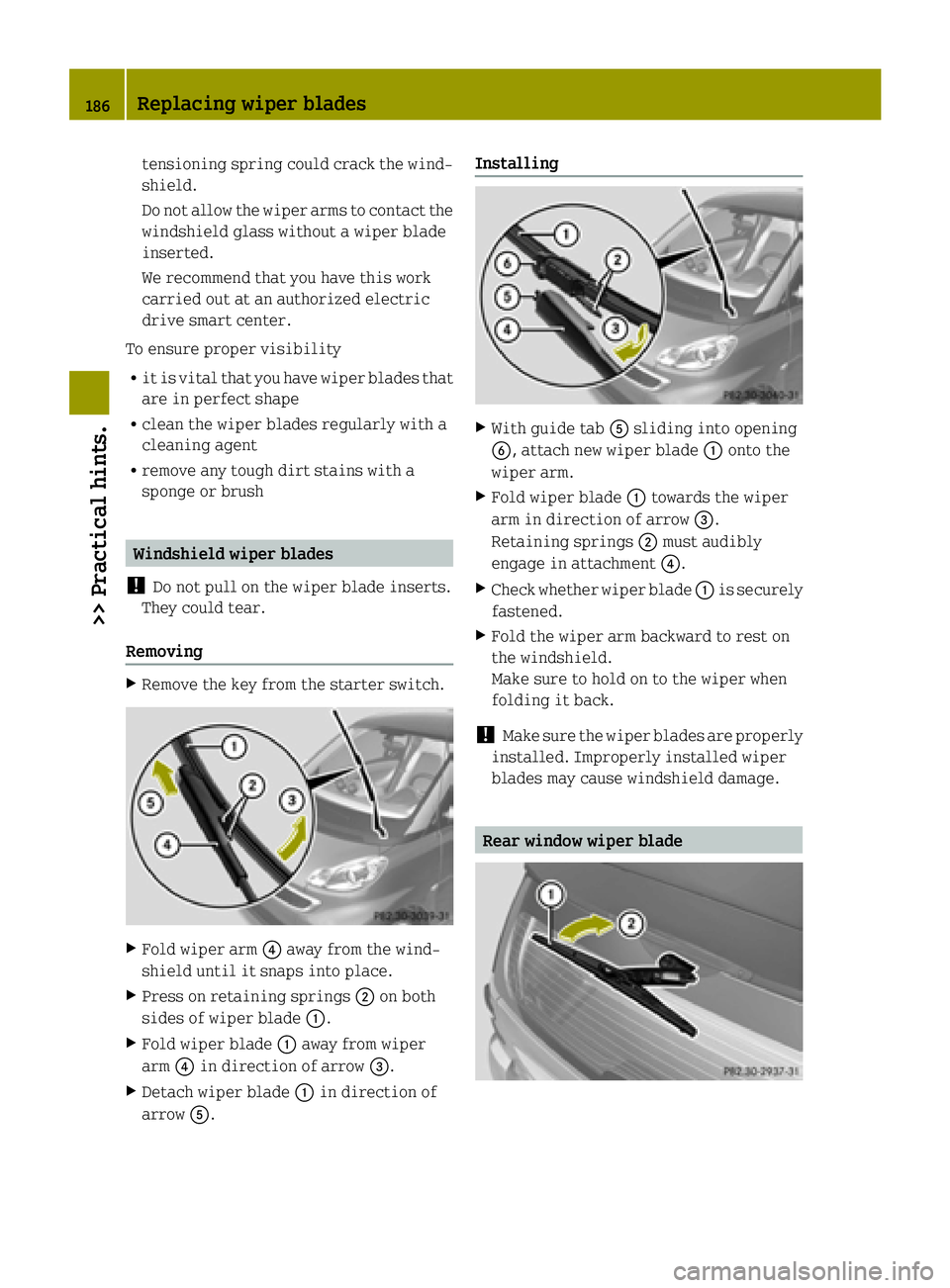
Removing X
Remove the key from the starter switch. X
Fold wiper arm ?away from the wind-
shield until it snaps into place.
X Press on retaining springs ;on both
sides of wiper blade :.
X Fold wiper blade :away from wiper
arm ?in direction of arrow =.
X Detach wiper blade :in direction of
arrow A. Installing
X
With guide tab Asliding into opening
B, attach new wiper blade :onto the
wiper arm.
X Fold wiper blade :towards the wiper
arm in direction of arrow =.
Retaining springs ;must audibly
engage in attachment ?.
X Check whether wiper blade :is securely
fastened.
X Fold the wiper arm backward to rest on
the windshield.
Make sure to hold on to the wiper when
folding it back.
! Make sure the wiper blades are properly
installed. Improperly installed wiper
blades may cause windshield damage. Rear window wiper blade186
Replacing wiper blades>> Practical hints.
Page 193 of 222

X
Place the tire repair kit securely in the
vehicle.
X Drive off immediately.
The tire sealant will distribute itself
evenly inside the tire. G
WARNING
Do not exceed vehicle speed of 50 mph
(80 km/h). A tire sealant repair is not
designed to operate at higher speeds.
The sticker must be attached on the instru- ment cluster where it will be easily seen by
the driver.
Vehicle handling characteristics of a tire
sealant repaired tire may change. Adapt
your driving accordingly.
X After driving for about 1.8 miles (3 km) or
ten minutes, stop and exit the vehicle
taking all of the appropriate safety pre- cautions.
X Take the tire repair kit from the vehicle.
X Screw the end of filler hose ?onto tire
valve G.
X Check the tire inflation pressure using
pressure gauge ;. G
WARNING
If tire inflation pressure has fallen below
130 kPa (1.3 bar, 19 psi) do not continue to
drive the vehicle.
Park your vehicle safely away from the
roadway and contact the nearest authorized electric drive smart center or call Road-
side Assistance.
Have the damaged tire replaced.
X If the tire inflation pressure is at least
130 kPa (1.3 bar, 19 psi), inflate or deflate
the tire to correct tire inflation pres-
sure (see Tire and Loading Information
placard located on the driver’s door
B‑pillar). R
To increase the tire inflation pres-
sure: Switch on the electric air pump.
R To decrease the tire inflation pres-
sure: Open vent screw =. Recheck the
tire inflation pressure with the elec-
tric air pump’s pressure gauge.
X After checking the tire inflation pres-
sure, unscrew the end of filler hose ?
from tire valve G.
X Screw the valve cap onto the tire valve.
X Plug filler hose with the stopper.
X Place the tire repair kit securely in the
vehicle.
! The manufacturer is unable to guaran-
tee that all tire punctures can be
repaired with the tire repair kit, in par-
ticular cuts or perforations larger than
approximately 0.16 in (4 mm) or away from
the tire’s tread. The manufacturer is not liable for damage sustained through
improper use of the tire repair kit. G
WARNING
Follow recommended tire inflation pres-
sures.
Do not underinflate tires. Underinflated
tires wear excessively and/or unevenly,
adversely affect handling and energy con-
sumption of the vehicle, and are more
likely to fail from being overheated.
Do not overinflate tires. Overinflated
tires can adversely affect handling and
ride comfort, wear unevenly, increase
stopping distance, and result in sudden
deflation (blowout) because they are more
likely to become punctured or damaged by
road debris, potholes etc.
Do not overload the tires by exceeding the
specified load limit as indicated on the
Tire and Loading Information placard on
the driver’s door B‑pillar. Overloading the tires can overheat them, possibly causing a
blowout. Overloading the tires can also
result in handling or steering problems, or brake failure. Flat tire
191>> Practical hints. Z