brake SMART FORTWO COUPE 2015 Owner's Manual
[x] Cancel search | Manufacturer: SMART, Model Year: 2015, Model line: FORTWO COUPE, Model: SMART FORTWO COUPE 2015Pages: 222, PDF Size: 5.02 MB
Page 80 of 222

G
WARNING
Engaging the parking brake while the vehi- cle is in motion can cause the rear wheels tolock up. You could lose control of the vehi- cle and cause an accident. In addition, the
vehicle’s brake lights do not light up when
the parking brake is engaged. X
Releasing: Depress the brake pedal.
X Pull up slightly on parking brake
lever ;and press release button :.
X Push parking brake lever ;down as far
as it will go.
When the ignition is switched on, the
brake warning lamp $(USA only) or
J (Canada only) in the instrument
cluster goes out.
X Engaging: Pull up parking brake lever ;
firmly.
When the ignition is switched on, the
brake warning lamp $(USA only) or
J (Canada only) in the instrument
cluster comes on. G
WARNING
Getting out of your vehicle with the trans-
mission not fully engaged in park position P is dangerous. When the drive system is
switched off and the brakes are released,
the vehicle can be moved freely with the
gear selector lever in all positions except
park position P. Also, when parked on an
incline, park position Palone may not pre-
vent your vehicle from moving, possibly
hitting people or objects. Always engage the parking brake in addi-
tion to shifting to park position P.
When parked on an incline, always turn the
front wheels towards the curb. G
WARNING
When leaving the vehicle, always remove the key from the starter switch, take it with
you, and lock the vehicle. Do not leave chil- dren unattended in the vehicle, or with
access to an unlocked vehicle. Children
could release the parking brake and/or
move the gear selector lever from park
position P, either of which could result in
an accident and/or serious personal
injury.
Brake pedal The brake pedal has two brake circuits
independent of each other. When the igni-
tion is switched on, a brake servo is used
during braking to increase pedal force. G
WARNING
Make sure absolutely no objects are
obstructing the pedals’ range of motion.
Keep the driver’s footwell clear of all
obstacles. If there are any floormats* or
carpets in the footwell, make sure the ped- als still have sufficient clearance.
During sudden acceleration or braking
maneuvers, the objects could get caught
between or beneath the pedals and restrictyour ability to brake or accelerate. This
could lead to accidents and/or injury. G
WARNING
Considerably more effort will be required
to apply the brakes if
R the brake servo has failed
R a brake circuit has failed
R the ignition is switched off, e.g. for tow-
ing the vehicle
The braking distance is likewise greater. 78
Driving and parking>> Controls.
* optional
Page 81 of 222

Make sure the drive system is active when-
ever the vehicle is rolling. Have the brake system repaired at an authorized electric
drive smart center, if there is a fault in the
brake system. If a brake circuit has failed (Y
page 167),
you must depress brake pedal :further
down to achieve the same effect and the
braking distance is increased.
i The brake servo will only function with
the ignition switched on. Switching off the drive system
G
WARNING
Do not turn off the drive system before the
vehicle has come to a complete stop. With
the drive system not running, there is no
power assistance for the brake and steering systems. In this case, it is important to
keep in mind that a considerably higher
degree of effort is necessary to brake and
steer the vehicle.
X Depress the brake pedal.
X Move the gear selector lever to park
position P.
The transmission position indicator
should be on P
P
! Always engage the parking brake in
addition to shifting to park position P.X
Release the brake pedal.
X Turn the key to starter switch position 0.
X Remove the key from the starter switch.
The electronic immobilizer is activa-
ted. Transmission
Shifting procedure
Gearshift pattern for transmission
j
Park position
k
Reverse gear
i
Neutral position
h
Drive position
Select a gear:
X
Switch on the ignition.
X Depress the brake pedal.
X Move the gear selector lever to the
desired position. Steering wheel paddle shifters* (for
recuperation)
G
WARNING
The operating condition of the high-volt-
age battery (e.g. not yet at normal operat-
ing temperature or fully charged) influen- ces the braking effect of the electric
motor. Transmission
79>> Controls.
* optional Z
Page 82 of 222

In overrun or braking mode, the motor's
braking effect may therefore be reduced or may not be present at all.
As a result of the reduced engine braking
effect, you may cause an accident and
injure yourself or others.
Compensate for the reduced engine braking
effect by pressing the brake pedal accord-
ingly, as required.
Using the steering wheel paddle shifters*, you can increase or decrease the recuper-
ation in overrun phases. Recuperation
takes place when you release the acceler-
ator pedal. The electric motor will then be
used as a generator and energy will be
regained while driving. The regained
energy is stored in the high-voltage bat-
tery. High recuperation decelerates your
vehicle stronger.
In overrun phases, there are three levels of recuperation:
R no recuperation (level 0, coasting)
R moderate recuperation (level 1)
R high-level recuperation (level 2)
The amount of recuperation in overrun
mode is displayed in the power gauge
(Y page 81).
The set mode for recuperation is shown in
the recuperation display (Y page 84).
When you switch on the ignition, level 1 is
automatically preset. :
Left steering wheel paddle shifter
(minus)
; Right steering wheel paddle shifter
(plus)
X Decrease recuperation: Pull left steer-
ing wheel paddle shifter :.
X Increase recuperation: Pull right steer-
ing wheel paddle shifter ;.
Use the different levels 0 to 2 for condi-
tions as described below: Level 0 Driving without frequent
breaking. No sharp bends on
the road ahead.
Maximum kinetic energy
remains for the vehicle.
Level 1 Normal driving, standard set-
ting. Level 2 Sporty driving.
The break pedal has to be
depressed less often, as the
deceleration due to recuper-
ation is higher than in level
1.
The energy efficiency is sub-
stantially higher than if the
vehicle is decelerated by
depressing the brake pedal. At levels 1 and 2 the vehicle can be step-
lessly decelerated by depressing the brake
pedal.
i Under certain circumstances, in over-
run phases recuperation does not work as
described above. This may be e. g the 80
Transmission>> Controls.
* optional
Page 83 of 222

case if the high-voltage battery is
already fully charged or has not reached
operating temperature. Driving tips
Driving on uphill grades G
WARNING
The hill-start assist system is not
designed to function as a parking brake and
does not prevent the vehicle from moving
when parked on an incline.
Always engage the parking brake in addi-
tion to shifting to park position P.
! When the hill‑start assist system stops
braking the vehicle, it can roll back-
wards.
If you open the driver’s door, the
hill‑start assist system is deactivated
and a warning signal sounds.
Your vehicle has a hill‑start assist system. On uphill grades the hill‑start assist sys-
tem maintains the pressure in the brake
system for approximately one second after
you have released the brake pedal. There-
fore, you can start off smoothly without the
vehicle moving immediately after releas-
ing the brake pedal.
X Release the brake pedal.
X Apply sufficient pressure to the accel-
erator pedal to drive off.
On uphill grades with higher inclination,
the hill-start assist system will release
the pressure in the brake system after
approximately two seconds. A warning sig-
nal sounds and the transmission position
indicator shows a flashing N
N in order to
warn you of the vehicle rolling backwards.
X Press the brake pedal.
X Release the brake pedal.
X Apply sufficient pressure to the accel-
erator pedal to drive off. i
The hill‑start assist system is inactive
if you start off with the parking brake
engaged.
Recuperation If the high-voltage battery is fully
charged or too cold, only limited recuper-
ation power will be available.
The vehicle can not be decelerated or limi-
ted in being decelerated by using the
accelerator pedal, if
R the gearshift selector lever is in posi-
tion Dand the vehicle is rolling back-
wards
R the gearshift selector lever is in posi-
tion Rand the vehicle is rolling for-
wards.
On uphill grades, the vehicle could possi- bly be not or only restricted being held
from the crawler function. Instrument cluster
Charge level and power gauges
:
Charge level gauge
; Power gauge
The gauges can be turned by approximately
90°.
The illumination for both gauges comes on when you switch on the ignition and the
exterior lighting. Instrument cluster
81>> Controls. Z
Page 84 of 222

Charge level gauge
!
Do not hang any objects on the charge
level gauge.
This could cause the charge level gauge
to be torn from its mountings and be dam-
aged.
The charge level gauge :displays charge
status of the high-voltage battery as a per-
centage.
When the High-voltage Battery at High-voltage Battery at
Reserve Level
Reserve Level message appears in the
multifunction display while the drive sys- tem is in operation, the high-voltage bat-
tery has reached the reserve level.
i If the charge level of the high-voltage
battery has dropped below 20 %, recharge it at:
R an AC power socket (Y page 114)
R a private wall box (Y page 115)
R a public charging station
(Y page 117)
Power gauge G
WARNING
The operating condition of the high-volt-
age battery (e.g. not yet at normal operat-
ing temperature or fully charged) influen- ces the braking effect of the electric
motor.
In overrun or braking mode, the motor's
braking effect may therefore be reduced or
may not be present at all.
As a result of the reduced engine braking
effect, you may cause an accident and
injure yourself or others.
Compensate for the reduced engine braking effect by pressing the brake pedal accord-
ingly, as required.
! Do not hang any objects on the power
gauge.
This could cause the power gauge to be
torn from its mountings and be damaged. Power gauge
;contains two segments:
R Section right of 0
Power gauge ;indicates the current
power that the drive system delivers to
the rear wheels. 100 % correspond to 55 kW peak power.
R Section left of 0
When you release the accelerator pedal
or when you depress the brake pedal, the
electric motor operates as a generator.
Electric current is produced and stored
in the high-voltage battery. As long as
the high-voltage battery is being
charged, the electric motor simulates an
engine brake.
When the pointer of power gauge ;is in
the "OFF“ position, the vehicle is not ready to drive, because:
R the drive system has not been started
R the gear selector lever has not been
moved to position Nor Pwhen starting
the drive system
R the charging cable is connected to the
vehicle
R there is not enough power from the high-
voltage battery
R a problem occured in the high-voltage
system
After the drive system has been started, the pointer of power gauge ;moves to posi-
tion 0.READY
READY appears in the multifunction
display (Y page 87). The vehicle is ready
to drive. Adjusting instrument cluster illumi-
nation
You can adjust the illumination of R the switches and dials in the instrument
cluster
R the radio
R the climate control panel
R the charge level and power gauges
Five illumination levels are available. 82
Instrument cluster>> Controls.
Page 86 of 222
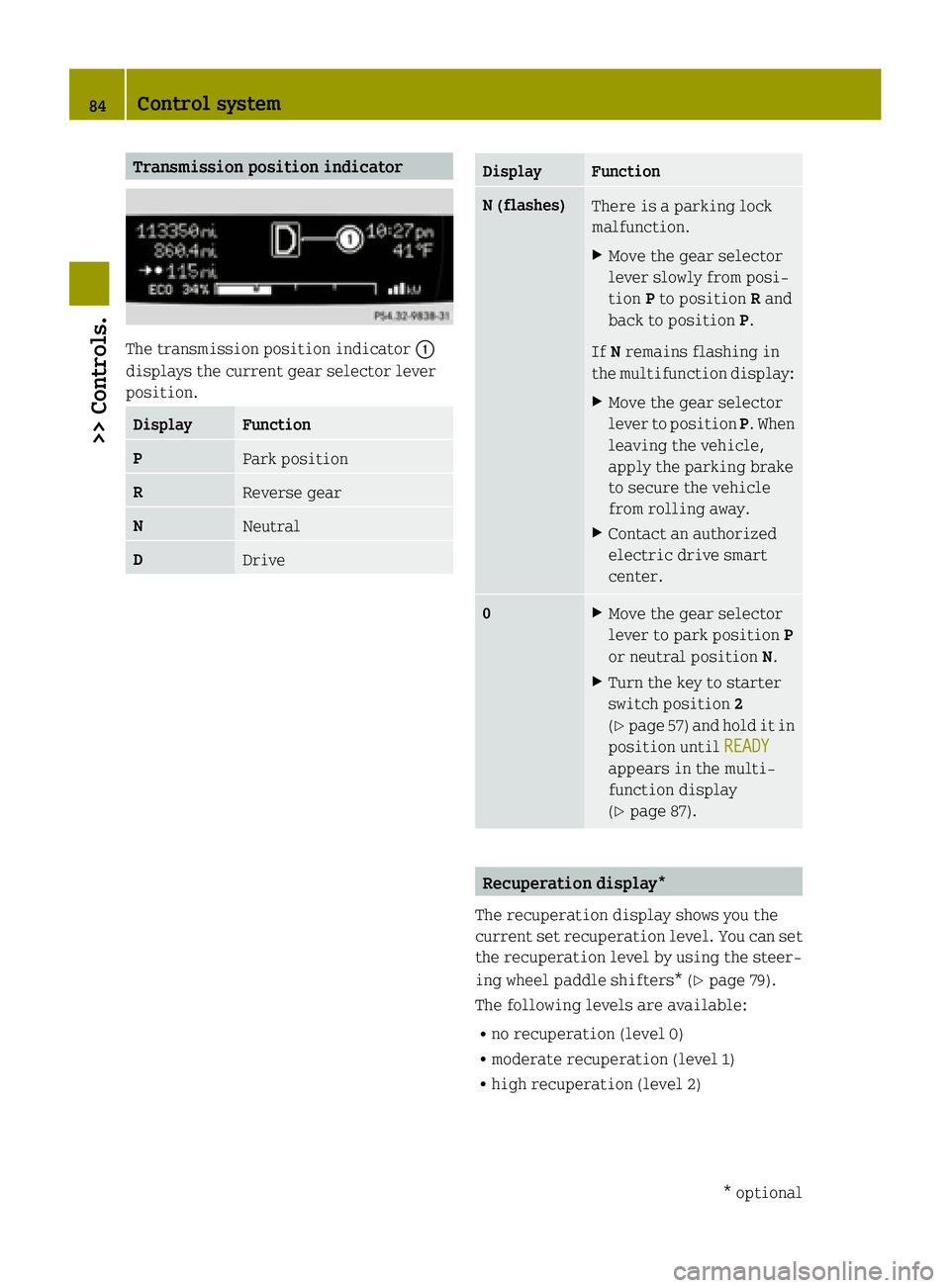
Transmission position indicator
The transmission position indicator
:
displays the current gear selector lever
position. Display Function
P
Park position
R
Reverse gear
N
Neutral
D
Drive Display Function
N (flashes)
There is a parking lock
malfunction.
X Move the gear selector
lever slowly from posi-
tion Pto position Rand
back to position P.
If Nremains flashing in
the multifunction display:
X Move the gear selector
lever to position P. When
leaving the vehicle,
apply the parking brake
to secure the vehicle
from rolling away.
X Contact an authorized
electric drive smart
center. 0 X
Move the gear selector
lever to park position P
or neutral position N.
X Turn the key to starter
switch position 2
(Y page 57) and hold it in
position until READY READY
appears in the multi-
function display
(Y page 87). Recuperation display*
The recuperation display shows you the
current set recuperation level. You can set the recuperation level by using the steer-
ing wheel paddle shifters* (Y page 79).
The following levels are available:
R no recuperation (level 0)
R moderate recuperation (level 1)
R high recuperation (level 2) 84
Control system>> Controls.
* optional
Page 87 of 222

No recuperation (level 0)
:
Symbol for no recuperation
When this mode is set, there is no recuper-
ation. When you release the accelerator
pedal, the vehicle rolls on unbraked.
Use this mode in situations when driving
without frequent braking, for example on
highways.
Moderate recuperation (level 1) Moderate recuperation occurs when this
mode is set. When you release the acceler-
ator pedal, the vehicle is slightly braked. Gained kinetic energy is converted into
electrical energy by the electric motor.
This energy is stored in the high-voltage
battery.
This mode is set as standard when starting
the drive system.
Use this mode in situations of well-bal-
anced relationship between accelerating
and braking, for example on cross-country
rides. High recuperation (level 2) :
Symbol for high recuperation
High recuperation occurs when this mode is
set. When you release the accelerator
pedal, the vehicle is deeply braked. Energy conversion of kinetic energy to electrical
energy is most effective in this mode.
Use this mode in situations in which you
need to brake frequently, for example while
driving stop-and-go in city traffic. Maximum available power
G
WARNING
When the indicator for the maximum avail- able power is not at its maximal range, the
power output is reduced noticeably. Adapt
your speed and driving accordingly. Oth-
erwise, you could cause an accident. Exer-
cise particular care when passing or accel-
erating. The indicator for the maximum available
power of the drive system contains three
segments
:. The number of dark segments
indicates power that is currently availa-
ble. Control system
85>> Controls. Z
Page 99 of 222

:
USB socket
; AUX socket smart surround sound system*
The smart surround sound system supple-
ments the existing speakers with more
powerful and additional speakers (includ- ing a digital amplifier in the passenger
footwell and a passive subwoofer). Driving systems
Cruise control*
The cruise control maintains the speed you set for your vehicle automatically. On
downhill grades, the cruise control does
not brake the vehicle via the brake system.
The cruise control can only use the braking power of the engine. You must apply the
brakes yourself in order to reduce the
vehicle speed. The cruise control will then
be canceled. G
WARNING
The cruise control is a convenience system designed to assist the driver during vehi-
cle operation. The cruise control cannot
take road, traffic, and weather conditions
into account. The driver is and must always
remain responsible for the vehicle’s speed and for safe brake operation. Do not use the cruise control
R if the road, traffic, and weather condi-
tions do not make it advisable to travel at
a constant speed
R on slippery roads
Rapid changes in tire traction can result
in wheel spin and loss of control.
R when driving in fog
The use of the cruise control is recommen-
ded for driving at a constant speed for
extended periods of time.
With the cruise control is activated and a
speed set, the following message appears
in the multifunction display: U.S. vehicles
:
Cruise control activated
; Set speed Canada vehicles
:
Cruise control activated
; Set speed
The cruise control is operated via buttons
on the steering wheel. Driving systems
97>> Controls.
* optional Z
Page 100 of 222

:
Activating or deactivating the cruise
control
; Resuming at last set speed or increas-
ing speed
= Setting current or lower speed, or
decreasing speed
? Canceling the cruise control
Activating/deactivating The cruise control must be activated before
you can set a speed. When you switch off the drive system, the cruise control is deac-
tivated automatically.
X Press ON/OFF button :briefly.
The cruise control is activated.
CRUISE CRUISE (USA only) or V(Canada only)
appears in the multifunction display.
Setting current speed You can set any speed above 20 mph
(30 km/h).
X Accelerate the vehicle to the desired
speed.
X With the cruise control activated, press
SET/− button =briefly.
X Remove your foot from the accelerator
pedal.
The current speed is set and the vehicle
maintains that speed.
USA only: set
set appears in the multifunc-
tion display to indicate that the speed
has been set. Canada only: The set speed appears in the
multifunction display next to cruise
control symbol V.
i On uphill grades, the cruise control
may not be able to maintain the set speed.
Once the grade eases, the set speed will
be resumed.
On downhill grades, the cruise control
can only maintain the set speed using the
drive systems braking power. You must
apply the brakes yourself when the vehi- cle does not slow down sufficiently. Thiswill cancel the cruise control.
Canceling cruise control When the cruise control is activated, you
can cancel it at any time and resume the set
speed later.
X Press CANCEL button ?briefly.
or
X Depress the brake pedal.
The cruise control is canceled.
The cruise control deactivates automati-
cally, when
R you engage the parking brake
R the vehicle speed is below 20 mphh
(30 km/h)
R ESP ®
is in operation.
Resuming last set speed G
WARNING
The “Resume” function should only be oper- ated if the driver is fully aware of the pre-viously set speed and wishes to resume this particular preset speed.
The set speed stored in memory should only
be set again if prevailing road conditions and legal speed limits permit. Possible
acceleration or deceleration differences
arising from returning to the preset speed
could cause an accident and/or serious
injury to you and others. 98
Driving systems>> Controls.
Page 108 of 222
Storage compartments
G
WARNING
To help avoid personal injury during a col- lision or sudden maneuver, exercise care
when storing objects in the vehicle. Put
luggage or cargo in the cargo compartment if possible. Do not pile luggage or cargo
higher than the seat backrests.
Keep compartment lids closed. This will
help to prevent stored objects from being
thrown about and injuring vehicle occu-
pants during
R hard braking
R a change of direction
R an accident
Do not store objects under the driver’s seat. Objects stored under the driver’s seat can
slide forward into driver’s foot well during
braking and get caught between or beneath
the pedals. This could restrict your ability
to brake or accelerate and could lead to
accidents and injury.
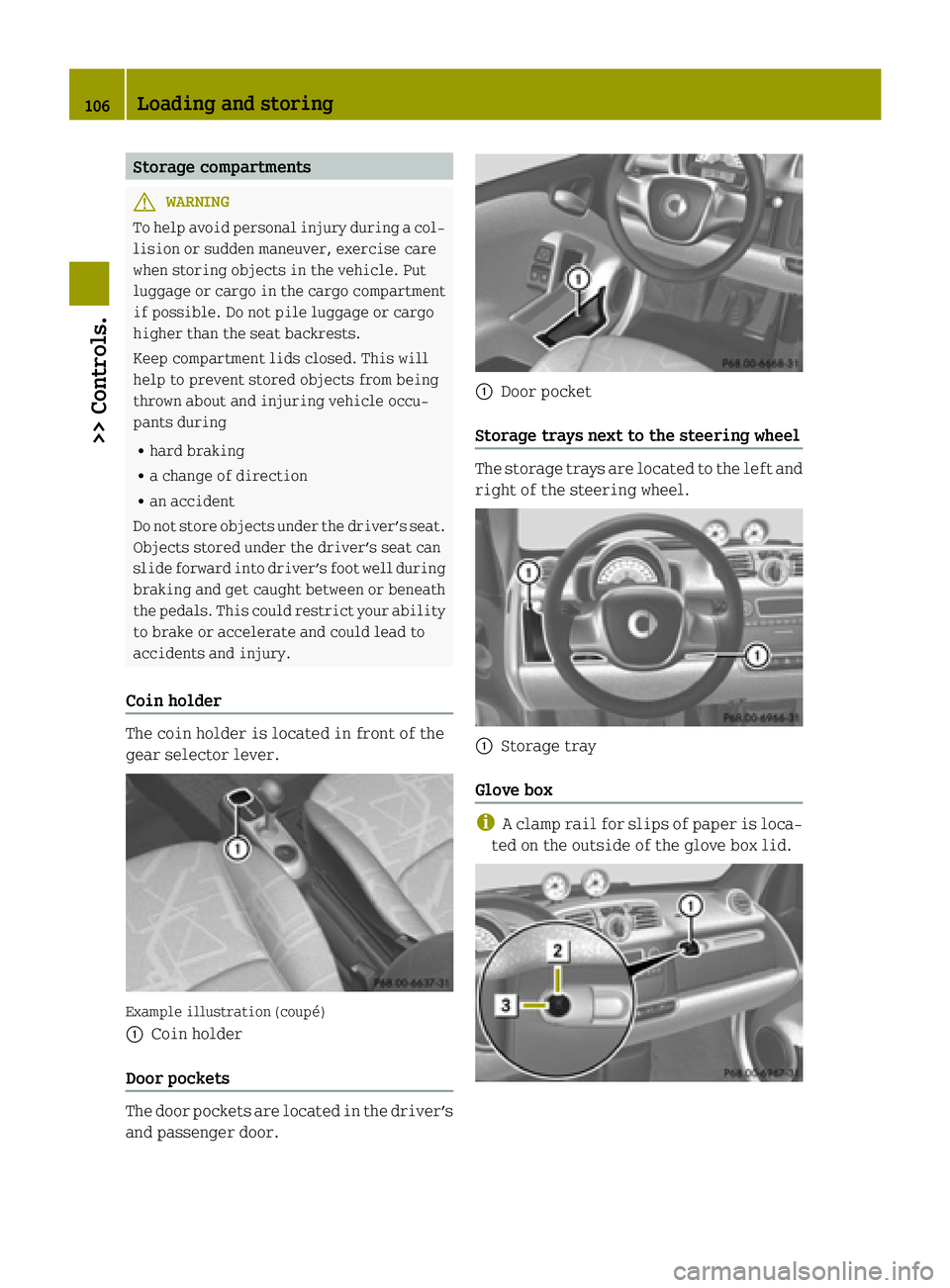
Coin holder The coin holder is located in front of the
gear selector lever. Example illustration (coupé)
: Coin holder
Door pockets The door pockets are located in the driver’s
and passenger door. :
Door pocket
Storage trays next to the steering wheel The storage trays are located to the left and
right of the steering wheel. :
Storage tray
Glove box i
A clamp rail for slips of paper is loca-
ted on the outside of the glove box lid. 106
Loading and storing>> Controls.