change wheel SMART FORTWO COUPE ELECTRIC DRIVE 2014 User Guide
[x] Cancel search | Manufacturer: SMART, Model Year: 2014, Model line: FORTWO COUPE ELECTRIC DRIVE, Model: SMART FORTWO COUPE ELECTRIC DRIVE 2014Pages: 222, PDF Size: 16.17 MB
Page 149 of 222
175/55 R15 on the rear axle.
For safety reasons, smart recommends
that you only use snow chains that have
been approved by smart.
Information on this is available from any
smart center.
Please refer to the separate operating
instructions for detailed information on
mounting the snow chains.
Snow chains should only be driven on
snow-covered roads at speeds not to
exceed 30 mph (50 km/h). Remove chains
as soon as possible when driving on roads
without snow.
Please observe the following guidelines
when using snow chains:
R Using snow chains is not permissible
with all wheel/tire combinations
(Y page 216).
R Use snow chains in pairs and on rear
wheels only. Follow the manufacturer’s
mounting instructions.
R Use of snow chains may be prohibited
depending on location. Always check
local and state laws before mounting
snow chains. G
WARNING
When mounting or removing snow chains,
always park your vehicle on level ground,
engage the parking brake, and switch off
the drive system. The vehicle could other-
wise move and injure yourself or other road
users. G
WARNING
When mounting and removing snow chains,
ensure that you and your vehicle are at a
safe distance from moving traffic. Not
doing so could endanger other road users or
even lead to you being injured by the vehi-
cles behind you. G
WARNING
The vehicle’s handling changes when driv-
ing with snow chains on any kind of road surface. This means that you should always
adapt your driving style to suit the current
road and weather conditions.
! If snow chains that do not meet require-
ments are mounted, they may scrape
against the body or axle components when
the vehicle is in motion. This could
result in damage to the rim/tire or vehi-
cle. Driving instructions
Drinking and driving
G
WARNING
Do not drink alcohol or take drugs and drive
or allow anyone to drive who has been
drinking alcohol or taking drugs. Even a
small amount of alcohol or drugs can affect
your reflexes, perceptions and judgment.
The possibility of a serious or even fatal
accident are greatly increased when you
drink or take drugs and drive. Pedals
G
WARNING
Make sure absolutely no objects are
obstructing the pedals’ range of motion.
Keep the driver’s footwell clear of all
obstacles. If there are any floormats* or
carpets in the footwell, make sure the ped-
als still have sufficient clearance.
During sudden acceleration or braking
maneuvers, the objects could get caught
between or beneath the pedals and restrict
your ability to brake or accelerate. This
could lead to accidents and/or injury. Power assistance
G
WARNING
With the drive system inactive, there is no
power assistance for the brake and steering Driving instructions
147>> Operation.
* optional Z
Page 161 of 222
>> Practical hints.Where will I find ...
.......................... 160
Display messages ............................. 161
What to do if ... ............................... 166
Unlocking/locking manually ...............177
Replacing transmitter battery ............178
Replacing bulbs .............................. .179
Replacing wiper blades .....................185
Flat tire ........................................ 187
Wheel change .................................. 195
Batteries ....................................... 197
Jump starting ................................. 200
Towing .......................................... 203
Fuses ............................................ 205
Page 166 of 222
Display messages Possible causes/consequences and
0050
0050Solutions 00E5
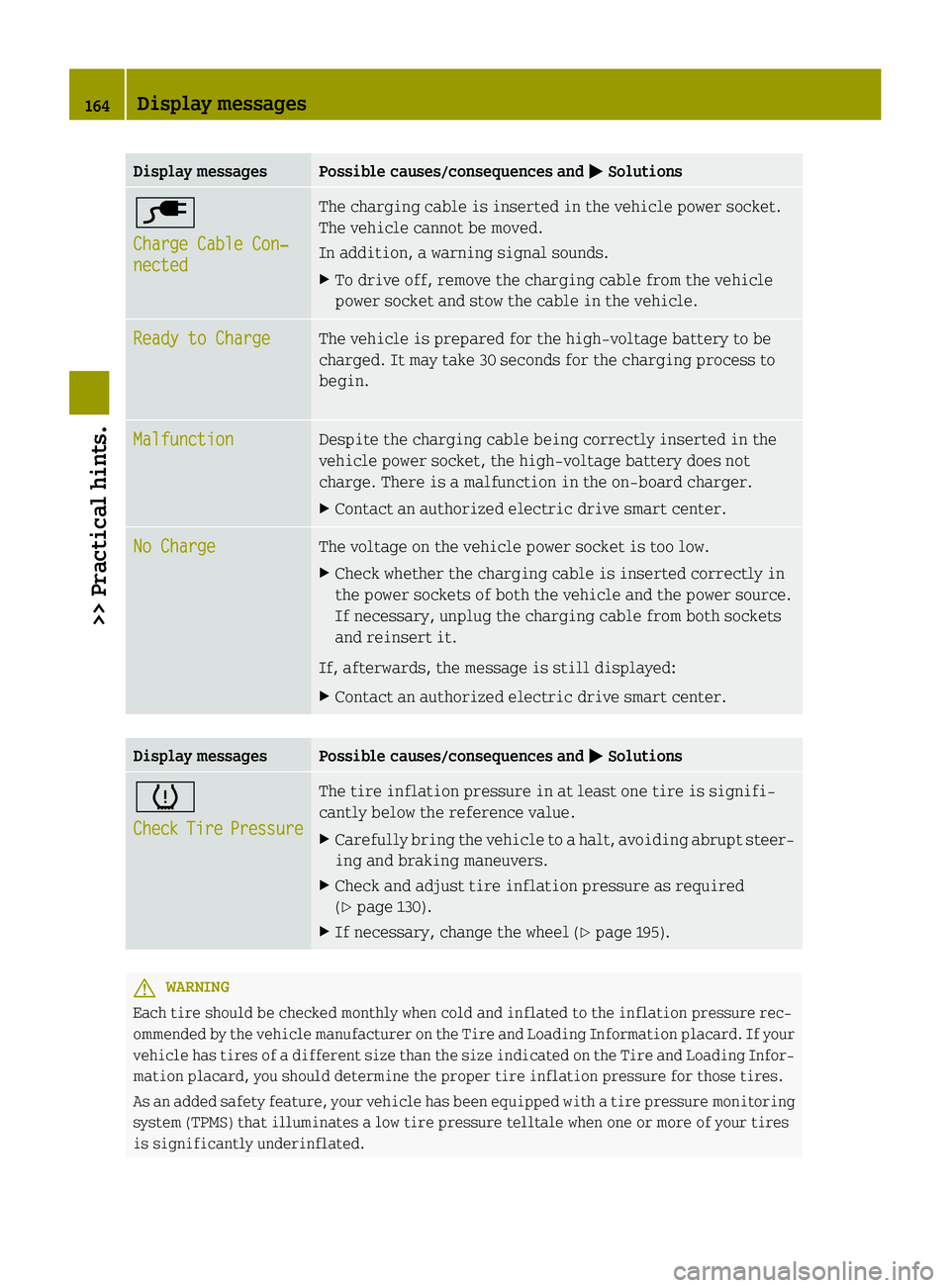
Charge Cable Con‐ Charge Cable Con‐
nected nected The charging cable is inserted in the vehicle power socket.
The vehicle cannot be moved.
In addition, a warning signal sounds.
X
To drive off, remove the charging cable from the vehicle
power socket and stow the cable in the vehicle. Ready to Charge Ready to Charge The vehicle is prepared for the high‑voltage battery to be
charged. It may take 30 seconds for the charging process to
begin.
Malfunction Malfunction Despite the charging cable being correctly inserted in the
vehicle power socket, the high‑voltage battery does not
charge. There is a malfunction in the on-board charger.
X
Contact an authorized electric drive smart center. No Charge No Charge The voltage on the vehicle power socket is too low.
X
Check whether the charging cable is inserted correctly in
the power sockets of both the vehicle and the power source.
If necessary, unplug the charging cable from both sockets
and reinsert it.
If, afterwards, the message is still displayed:
X Contact an authorized electric drive smart center. Display messages Possible causes/consequences and
0050 0050Solutions 0077
Check Check
Tire
TirePressure
Pressure The tire inflation pressure in at least one tire is signifi-
cantly below the reference value.
X
Carefully bring the vehicle to a halt, avoiding abrupt steer-
ing and braking maneuvers.
X Check and adjust tire inflation pressure as required
(Y page 130).
X If necessary, change the wheel (Y page 195).G
WARNING
Each tire should be checked monthly when cold and inflated to the inflation pressure rec-
ommended by the vehicle manufacturer on the Tire and Loading Information placard. If your
vehicle has tires of a different size than the size indicated on the Tire and Loading Infor-
mation placard, you should determine the proper tire inflation pressure for those tires.
As an added safety feature, your vehicle has been equipped with a tire pressure monitoring
system (TPMS) that illuminates a low tire pressure telltale when one or more of your tires
is significantly underinflated. 164
Display messages>> Practical hints.
Page 190 of 222
tion of the tire repair kit in your vehicle
before sealing a tire.
The tire repair kit can be used to seal
punctures of up to approximately 0.16 in
(4 mm) on the tire tread.
The tire repair kit enables you to drive on
the sealed tire to the nearest authorized
electric drive smart center.
X You should have the sealed tire replaced
at an authorized electric drive smart
center. G
WARNING
Take care not to allow the contents of the
tire sealant to come in contact with hair,
eyes or clothing. The tire sealant is harm-
ful if inhaled, swallowed or absorbed
through the skin - causes skin, eye and res-
piratory irritation. Wear gloves while
using this product if they are available.
Any contact with eyes or skin should be
flushed immediately with plenty of water.
If clothing comes in contact with the tire
sealant, change clothing as soon as possi-
ble.
In case of allergic reaction or rash, consult
a physician immediately. Notes
R Small tire punctures, particularly those
in the tread, can be sealed with the tire
sealant.
R The tire sealant can be used in ambient
temperatures from ‑4 ¦(‑20¥) to
104¦ (+40¥).
R Do not remove any foreign objects such as
nails or screws that have penetrated the
tire.
R Do not use the tire sealant if the tire has
been damaged by being driven when
insufficiently inflated (e.g. bumps,
cuts, cracks etc. on the tire).
R Allow escaped tire sealant to dry, then
peel it off. R
Immediately wash all painted surfaces
that came into contact with the tire seal-
ant using a damp cloth.
R Avoid skin and eye contact with the tire
sealant.
R Do not swallow the tire sealant.
R Allow the tire sealant that is inside the
damaged tire to dry and dispose of
together with the tire.
R Do not use the tire sealant after the expi-
ration date has elapsed (see top of con-
tainer).
Instead, have it replaced at an author-
ized electric drive smart center. G
WARNING
The tire sealant is a limited repair device.
The tire sealant cannot be used for cuts or
punctures larger than approximately
0.16 in (4 mm) and tire damage caused by
driving with extremely low tire inflation
pressure, or on a flat tire, or a damaged
wheel.
Do not drive the vehicle under such cir-
cumstances.
If you are unsure of the condition of the tire
or have any question whatsoever about its
suitability for driving contact the nearest
authorized electric drive smart center for
assistance or call Roadside Assistance. G
WARNING
Please review the instructions below for
using the tire repair kit. If you are not
confident that you can competently follow
the instructions for using this kit, do not
use the kit, but instead call for Roadside
Assistance. G
WARNING
Keep the tire sealant out of reach of chil-
dren. If swallowed, rinse mouth immedi-
ately with plenty of water and drink plenty
of water.
Do not induce vomiting!
Consult a physician immediately. 188
Flat tire>> Practical hints.
Page 197 of 222
Wheel change
Preparing the vehicle
X Park the vehicle on a hard, flat surface
when possible.
X Turn on the hazard warning flasher.
X Turn the steering wheel so that the front
wheels are in a straight-ahead position.
X Engage the parking brake.
X Move the gear selector lever to park
position P.
X Switch off the drive system.
X Have any passenger exit the vehicle at a
safe distance from the roadway. Removing the wheel
G
WARNING
When jacking up the vehicle, only use a
suitable jack. Observe the manufacturer’s
safety instructions.
The jack must be designed for jacking up
this vehicle at the jack take-up brackets
built into both sides of the vehicle.
The jack is intended only for lifting the
vehicle briefly for wheel changes. It is not
suited for performing maintenance work
under the vehicle. To help avoid personal
injury, use the jack only to lift the vehicle
during a wheel change.
Never get beneath the vehicle while it is
supported by the jack. Keep hands and feet
away from the area under the lifted vehicle.
Always lower the vehicle onto sufficient
capacity jackstands before working under
the vehicle.
Always firmly engage the parking brake and
block the wheels with wheel chocks or other
sizeable objects before raising the vehi-
cle with the jack. Do not release the parking
brake while the vehicle is raised.
Make sure the ground on which the vehicle
is standing and where you place the jack is solid, level and not slippery. If necessary,
use a large underlay. On slippery surfaces,
such as tiled floors, you should use a non-
slip underlay, for example a rubber mat.
Do not use wooden blocks or similar objects
to support the jack. Otherwise the jack may
not be able to achieve its load-bearing
capacity if it is not at its full height.
The jack must always be vertical when in
use. Always try to use the jack on level sur-
face. If you do not position the jack cor-
rectly, the vehicle can fall off the jack and
seriously or fatally injure you or others.
Never switch on the drive system when the
vehicle is raised.
Also observe the notes on the jack.
X Make sure to have a suitable jack 10
, wheel
wrench 10
and wheel chock 10
.
Contact an authorized electric drive
smart center for information on which
jack and wheel wrench are required.
X Prepare the vehicle as described
(Y page 195).
X Make sure the surface is level.
Prevent the vehicle from rolling away by
blocking wheels with wheel chocks or other
sizeable objects:
X Place one wheel chock or other sizeable
object in front of and another wheel
chock or other sizeable object behind
the wheel that is diagonally opposite to
the wheel being changed.
X On wheel to be changed, loosen but do not
yet remove the wheel bolts (approx-
imately one full turn with wheel wrench).
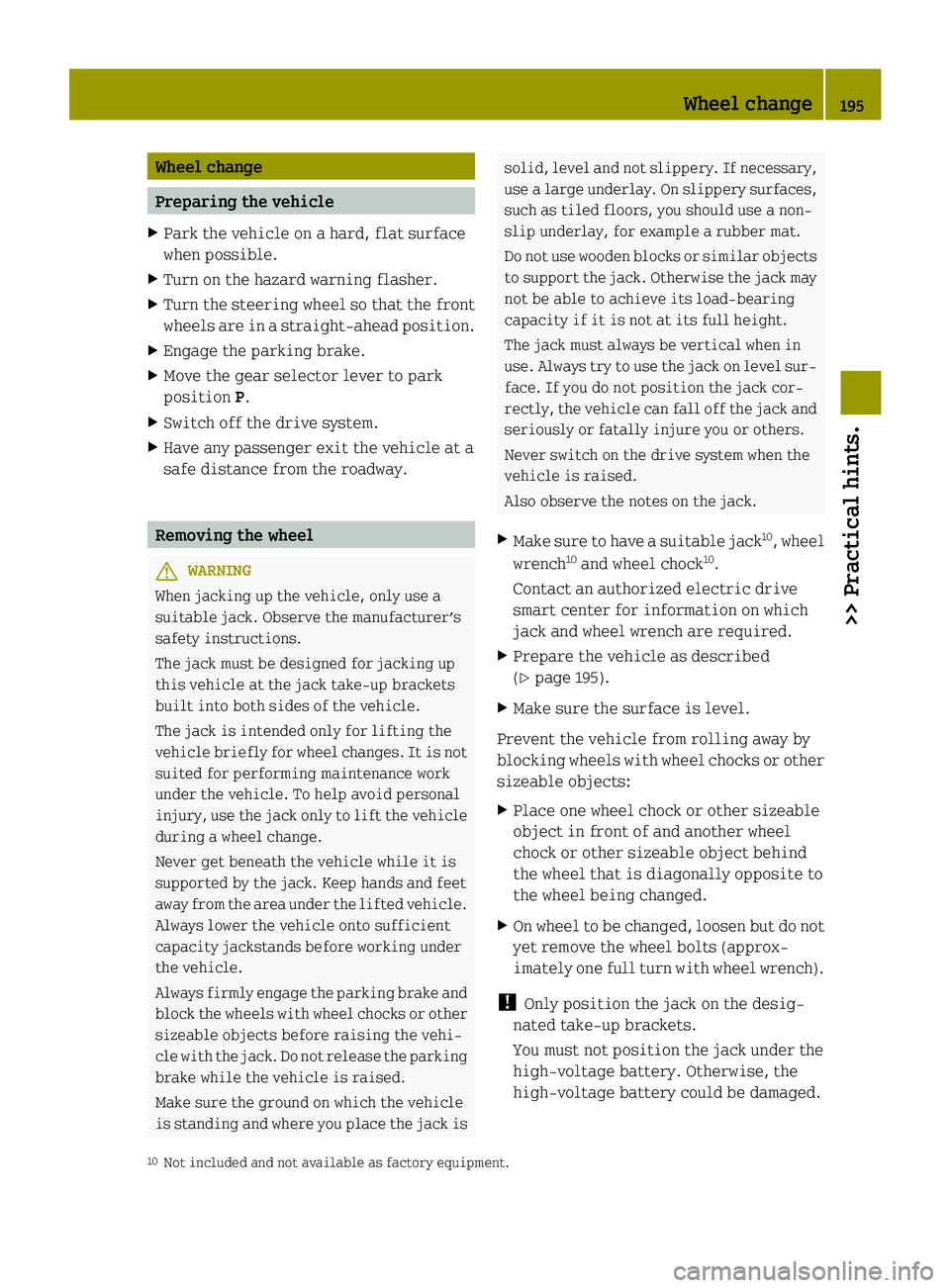
! Only position the jack on the desig-
nated take-up brackets.
You must not position the jack under the
high-voltage battery. Otherwise, the
high-voltage battery could be damaged.
10 Not included and not available as factory equipment. Wheel change
195>> Practical hints. Z
Page 198 of 222
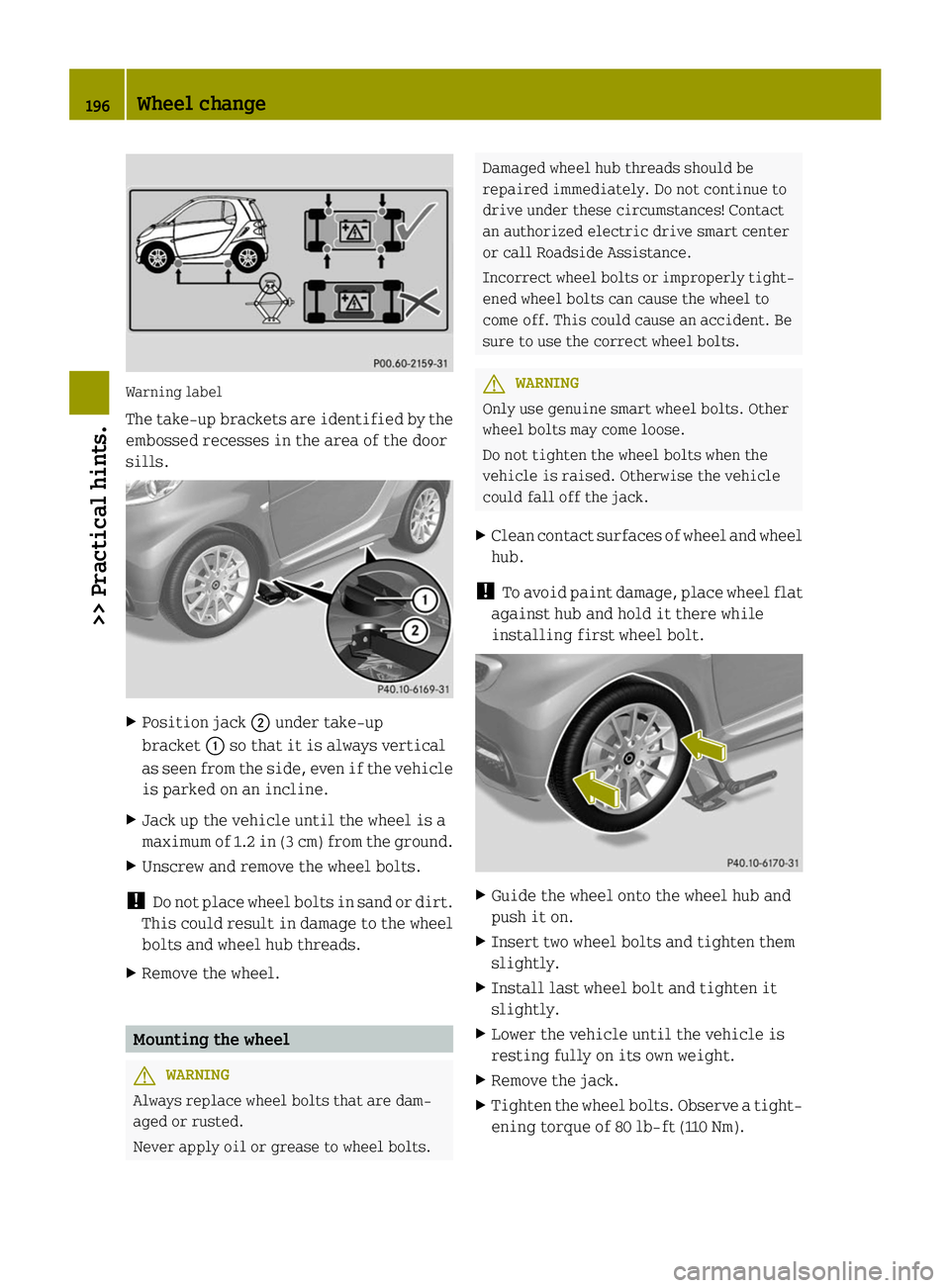
Warning label
The take-up brackets are identified by the
embossed recesses in the area of the door
sills. X
Position jack 0044under take-up
bracket 0043so that it is always vertical
as seen from the side, even if the vehicle
is parked on an incline.
X Jack up the vehicle until the wheel is a
maximum of 1.2 in (3 cm) from the ground.
X Unscrew and remove the wheel bolts.
! Do not place wheel bolts in sand or dirt.
This could result in damage to the wheel
bolts and wheel hub threads.
X Remove the wheel. Mounting the wheel
G
WARNING
Always replace wheel bolts that are dam-
aged or rusted.
Never apply oil or grease to wheel bolts. Damaged wheel hub threads should be
repaired immediately. Do not continue to
drive under these circumstances! Contact
an authorized electric drive smart center
or call Roadside Assistance.
Incorrect wheel bolts or improperly tight-
ened wheel bolts can cause the wheel to
come off. This could cause an accident. Be
sure to use the correct wheel bolts.
G
WARNING
Only use genuine smart wheel bolts. Other
wheel bolts may come loose.
Do not tighten the wheel bolts when the
vehicle is raised. Otherwise the vehicle
could fall off the jack.
X Clean contact surfaces of wheel and wheel
hub.
! To avoid paint damage, place wheel flat
against hub and hold it there while
installing first wheel bolt. X
Guide the wheel onto the wheel hub and
push it on.
X Insert two wheel bolts and tighten them
slightly.
X Install last wheel bolt and tighten it
slightly.
X Lower the vehicle until the vehicle is
resting fully on its own weight.
X Remove the jack.
X Tighten the wheel bolts. Observe a tight-
ening torque of 80 lb-ft (110 Nm). 196
Wheel change>> Practical hints.