belt SMART FORTWO COUPE ELECTRIC DRIVE 2014 Owner's Manual
[x] Cancel search | Manufacturer: SMART, Model Year: 2014, Model line: FORTWO COUPE ELECTRIC DRIVE, Model: SMART FORTWO COUPE ELECTRIC DRIVE 2014Pages: 222, PDF Size: 16.17 MB
Page 60 of 222
Seats
Safety notes
G
WARNING
All seat adjustments, as well as fastening
of seat belts, must be done before the vehi-
cle is operated. G
WARNING
When adjusting the seat, make sure no one
becomes trapped.
Do not adjust the driver’s seat while driv-
ing. Adjusting the seat while driving could
cause the driver to lose control of the vehi-
cle.
Never ride in a moving vehicle with the seat
backrest in an excessively reclined posi-
tion as this can be dangerous. You could
slide under the seat belt in a collision. If
you slide under the seat belt, it could apply
force at the abdomen or neck, potentially
causing serious or fatal injuries. The seat
backrest and seat belts provide the best
restraint when the wearer is in a position
that is as upright as possible and seat belts
are properly positioned on the body.
Your seat must be adjusted so that you can
correctly fasten your seat belt.
Observe the following points:
R Adjust the seat backrest until your arms
are slightly angled when holding the
steering wheel.
R Adjust the seat to a comfortable seating
position that still allows you to reach the
accelerator/brake pedal safely. The
position should be as far back as possi-
ble with the driver still able to operate
the controls properly.
R Never place hands under the seat or near
any moving parts while a seat is being
adjusted.
Failure to do so could result in an accident
and/or serious personal injury.
Observe the notes on the air bag system. G
WARNING
Children 12 years old and under must be
seated and properly secured in an appro-
priately sized infant restraint, toddler
restraint, or booster seat recommended for
the size and weight of the child. For addi-
tional information, see “Children in the
vehicle”.
A child’s risk of serious or fatal injuries
is significantly increased if the child
restraints are not properly secured in the
vehicle and/or the child is not properly
secured in the child restraint. G
WARNING
Contact an authorized electric drive smart
center if the seats have become damaged.
The seat is an integral part of the vehicle’s
safety system in the same way as seat belts
and air bags. Damage to the seats may
reduce their ability to protect the occu-
pants in an accident. Seat adjustment
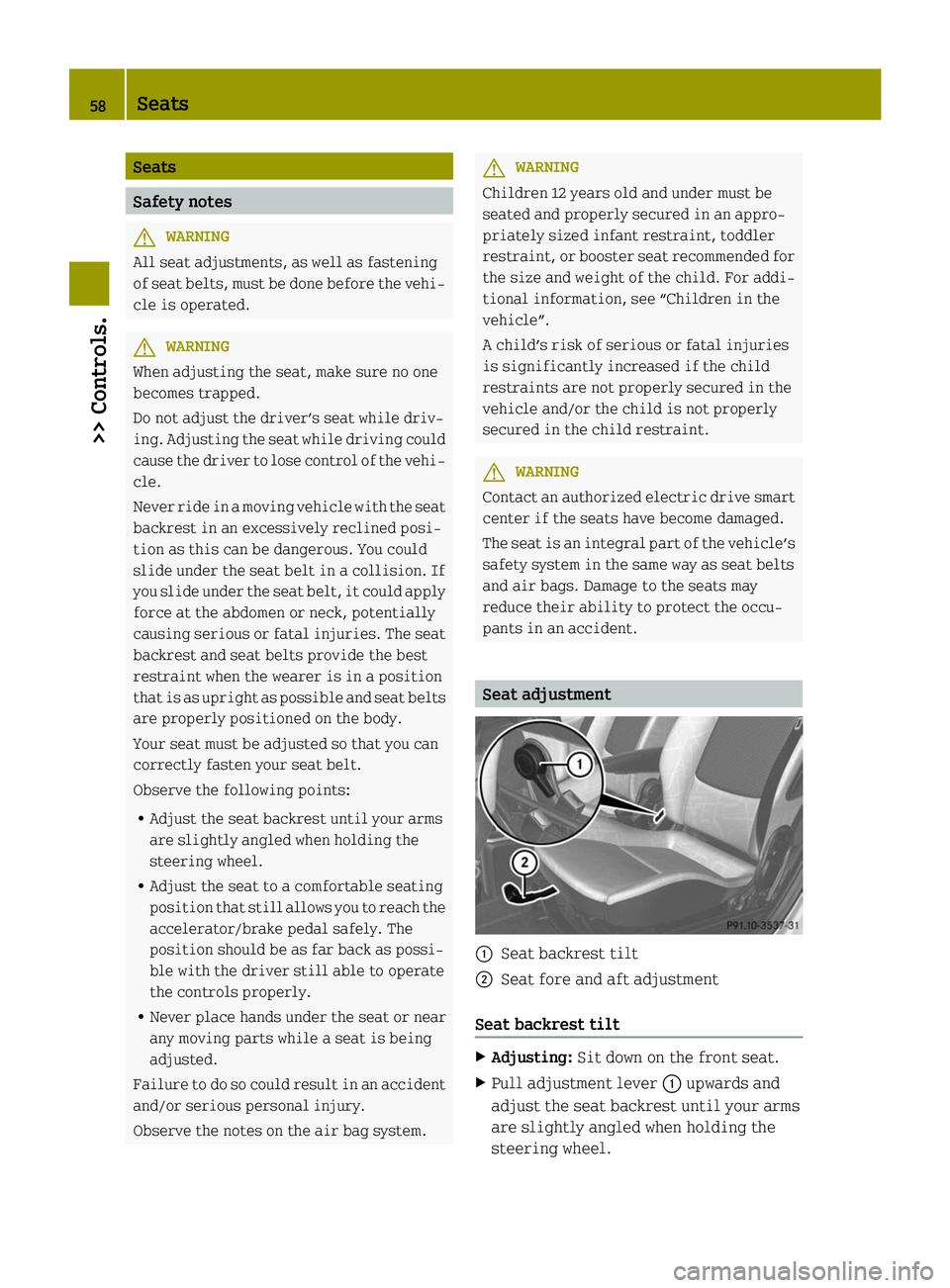
0043
Seat backrest tilt
0044 Seat fore and aft adjustment
Seat backrest tilt X
Adjusting: Sit down on the front seat.
X Pull adjustment lever 0043upwards and
adjust the seat backrest until your arms
are slightly angled when holding the
steering wheel. 58
Seats>> Controls.
Page 61 of 222
X
Release adjustment lever 0043when the
desired seat backrest tilt is reached.
When you hear an audible click, the seat
backrest is again fixed into place.
X Check for proper engagement before
driving.
i When adjusting the tilt of the backrest
without any load on the seat then hold on
to the backrest with one hand.
Seat fore and aft adjustment X
Pull adjustment handle 0044upwards and
slide the seat to a seating position that
still allows you to reach the accelerator/
brake pedal safely.
X Release adjustment handle 0044when the
desired seating position is reached.
When you hear an audible click, the seat
is again fixed into place.
X Check for proper engagement before
driving.
Seat height The seat guide is inclined in the horizon-
tal plane. Seat fore and aft adjustment also
alters the seat height.
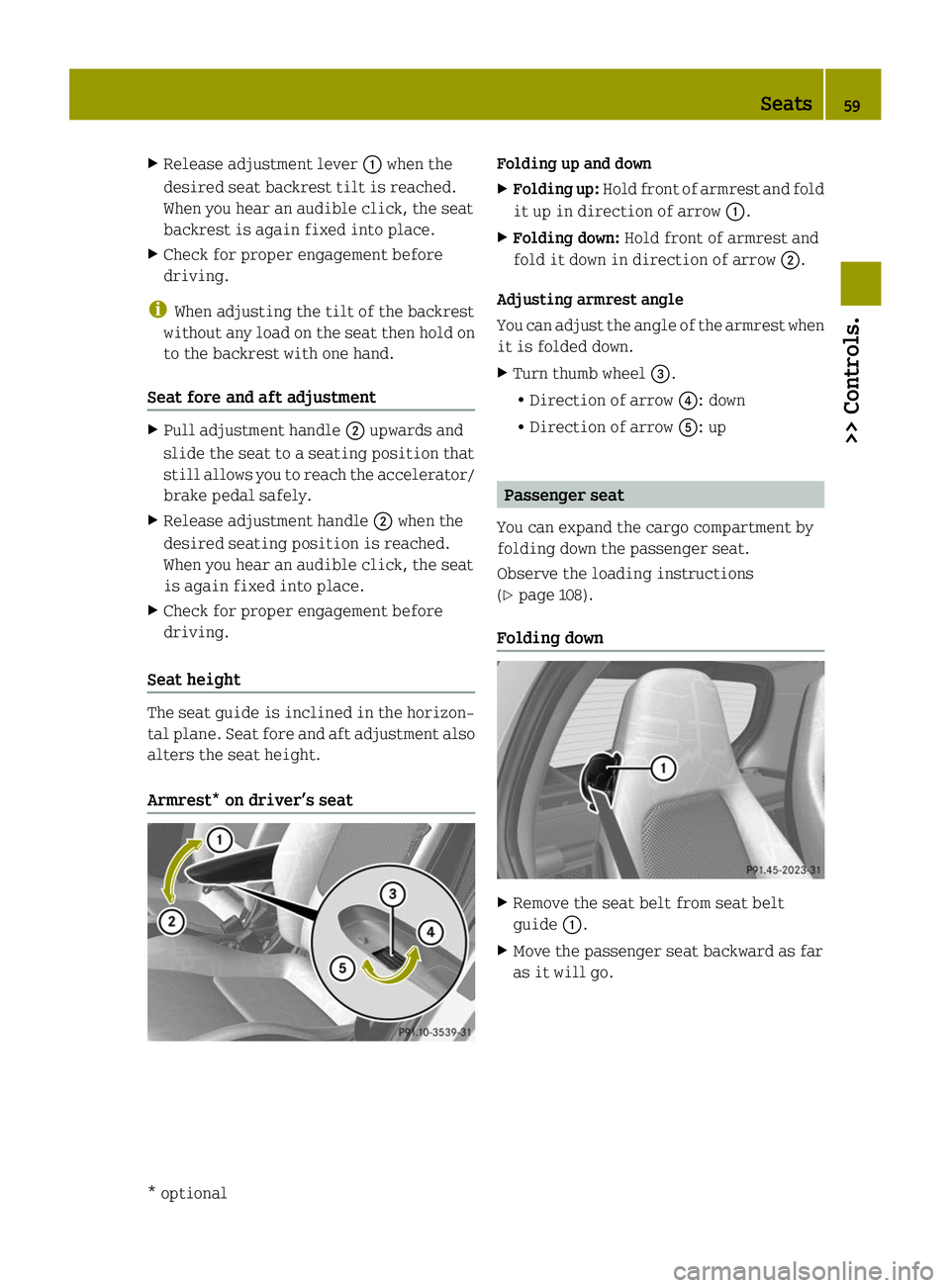
Armrest* on driver’s seat Folding up and down
X
Folding up: Hold front of armrest and fold
it up in direction of arrow 0043.
X Folding down: Hold front of armrest and
fold it down in direction of arrow 0044.
Adjusting armrest angle
You can adjust the angle of the armrest when
it is folded down.
X Turn thumb wheel 0087.
R Direction of arrow 0085: down
R Direction of arrow 0083: up Passenger seat
You can expand the cargo compartment by
folding down the passenger seat.
Observe the loading instructions
(Y page 108).
Folding down X
Remove the seat belt from seat belt
guide 0043.
X Move the passenger seat backward as far
as it will go. Seats
59>> Controls.
* optional Z
Page 62 of 222

X
Hold the backrest with one hand back.
X Pull adjustment lever 0044upwards and
unlock the seat backrest.
X Fold the seat backrest forward.
Folding back X
Pull adjustment lever 0044upwards and
unlock the seat backrest.
X Fold the seat backrest backward.
When you hear an audible click, the seat
backrest is again fixed into place.
X Check for proper engagement before
driving.
X Place the seat belt back in seat belt
guide 0043. G
WARNING
When folding the passenger seat backrest
back to its upright position, please make
sure
R nobody becomes trapped
R no obstacles are jammed in the lock
R the adjustment lever has audibly locked
into position
A properly engaged passenger seat back-
rest will help to prevent stored objects in
the cargo compartment from being thrown
about and injuring vehicle occupants dur-
ing
R braking
R vehicle maneuvers
R an accident Seat heating*
The seat heating allows you to heat the
driver’s and passenger seat electrically. The seat heating has two levels.
The indicator lamps on seat heating
switch
0043come on to show which heating
level you have selected. Level Indicator lamps on the switch
off
No indicator lamp on
1
One indicator lamp on
2
Two indicator lamps on
X
Make sure the key is in starter switch
position 1.
X Switching on: Press seat heating
switch 0043repeatedly until the desired
seat heating level is reached.
X Switching off: Press seat heating
switch 0043repeatedly until all indicator
lamps go out.
i Switch on the seat heating and, at the
same time, reduce the temperature in the
vehicle interior. The high‑voltage bat-
tery then consumes less energy.
! If the seat heating is malfunctioning,
the indicator lamp(s) on the switch
come(s) on briefly when you press the
switch and then go(es) out again. Contact
an authorized smart center. 60
Seats>> Controls.
* optional
Page 64 of 222
Seat belts
Fastening the seat belts
G
WARNING
Always fasten your seat belt before driving.
Always make sure all of your passengers are
properly restrained.
Failure to wear and properly fasten and
position your seat belt greatly increases
your risk of injuries and their likely
severity in an accident. You and your
passenger should always wear seat belts.
If you are ever in an accident, your injuries
can be considerably more severe without
your seat belt properly buckled.
Without your seat belt buckled, you are
much more likely to hit the interior of the
vehicle or be ejected from it. You can be
seriously injured or killed.
In the same crash, the possibility of injury
or death is lessened if you are properly
wearing your seat belt. Air bags can only
protect you if you are properly wearing
your seat belt. G
WARNING
Children 12 years old and under must be
seated and properly secured in an appro-
priately sized infant restraint, toddler
restraint, or booster seat recommended for
the size and weight of the child. For addi-
tional information, see “Children in the
vehicle”.
A child’s risk of serious or fatal injuries
is significantly increased if the child
restraints are not properly secured in the
vehicle and/or the child is not properly
secured in the child restraint. G
WARNING
Never let more people ride in the vehicle
than there are seat belts available. Make
sure everyone riding in the vehicle is cor-
rectly restrained with a separate seat belt.
Never use a seat belt for more than one per-
son at a time. G
WARNING
Never ride in a moving vehicle with the seat
backrest in an excessively reclined posi-
tion as this can be dangerous. You could
slide under the seat belt in a collision. If
you slide under it, the belt would apply
force at the abdomen or neck, causing ser-
ious or even fatal injuries. The seat back-
rest and seat belt provide the best
restraint when the wearer is in a position
that is as upright as possible and the belt
is properly positioned on the body. G
WARNING
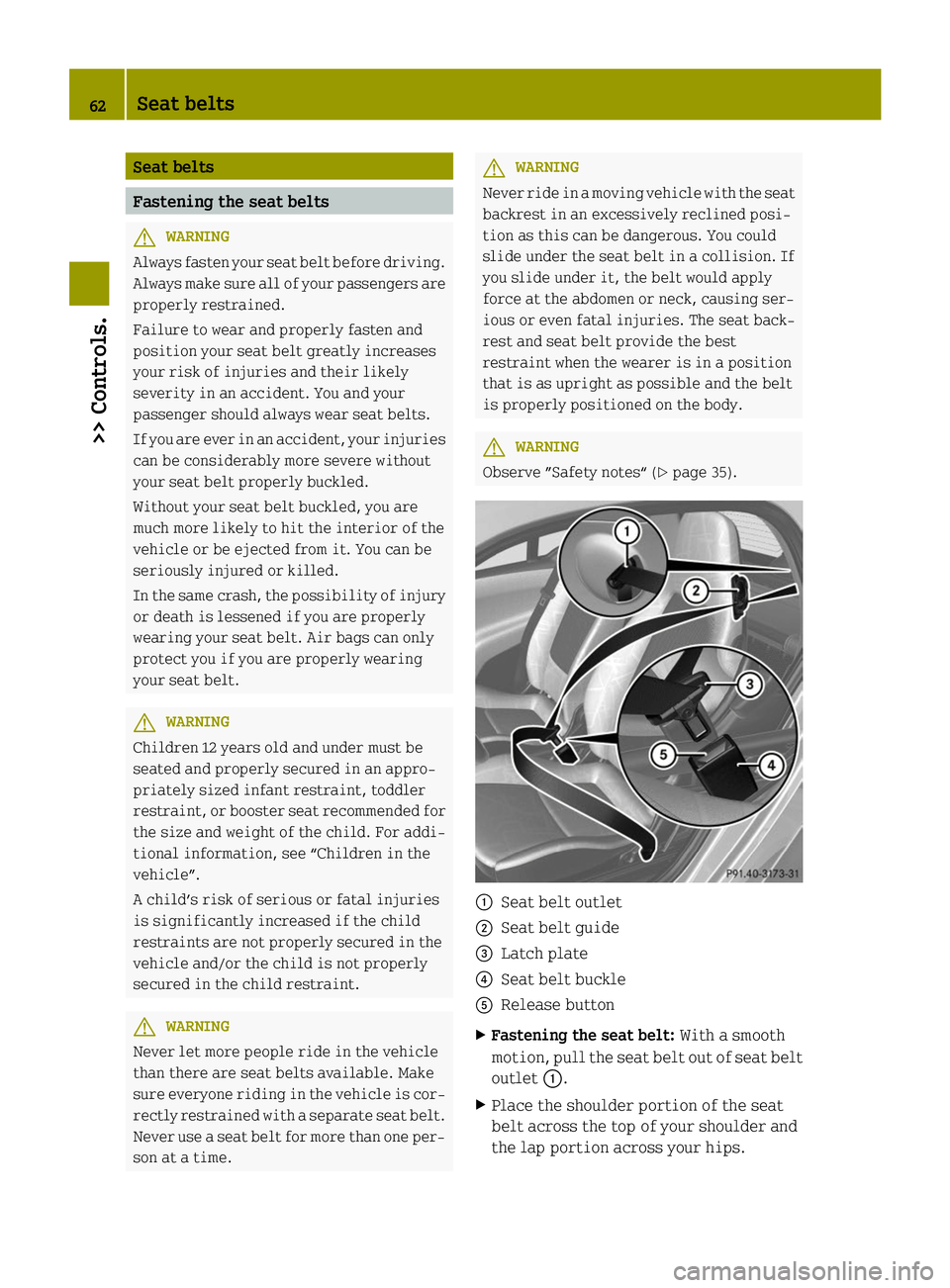
Observe ”Safety notes“ (Y page 35). 0043
Seat belt outlet
0044 Seat belt guide
0087 Latch plate
0085 Seat belt buckle
0083 Release button
X Fastening the seat belt: With a smooth
motion, pull the seat belt out of seat belt
outlet 0043.
X Place the shoulder portion of the seat
belt across the top of your shoulder and
the lap portion across your hips. 62
Seat belts>> Controls.
Page 65 of 222
X
Push latch plate 0087into seat belt
buckle 0085until it clicks.
X If necessary, tighten the lap portion of
the seat belt to a snug fit by pulling
shoulder portion up.
X Unfastening the seat belt: Press release
button 0083.
X Allow the retractor to completely rewind
the seat belt by guiding latch plate 0087.
Proper use of seat belts R
Do not twist the seat belt when fastening.
R Adjust the seat belt so that the shoulder
portion is located as close as possible
to the middle of the shoulder (it should
not touch the neck). Never pass the
shoulder portion of the seat belt under
your arm.
R Position the lap belt as low as possible
on your hips (over hip joint) and not
across the abdomen.
R Place the seat backrest in a position that
is as upright as possible.
R Never use a seat belt for more than one
person at a time.
R Do not fasten a seat belt around a person
and another object at the same time. When
using a seat belt to secure infant or tod-
dler restraints or children in booster
seats, always follow the child seat man-
ufacturer’s instructions.
R Check your seat belt during travel to
make sure it is properly positioned.
R Make sure the seat belt is always fitted
snugly. Take special care to maintain a
snug fit when wearing loose clothing. G
WARNING
Do not pass seat belts over sharp edges.
They could tear.
Do not allow the seat belt to get caught in
the door or in the seat adjustment mecha-
nism. This could damage the seat belt. Never attempt to make modifications to
seat belts. This could impair the effec-
tiveness of the seat belts.
Do not bleach or dye seat belts as this may
severely weaken them. In a crash they may
not be able to provide adequate protection.
Damaged seat belts or seat belts that were
highly stressed in an accident must be
replaced. Contact an authorized electric
drive smart center. Correct driver seat adjustment
G
WARNING
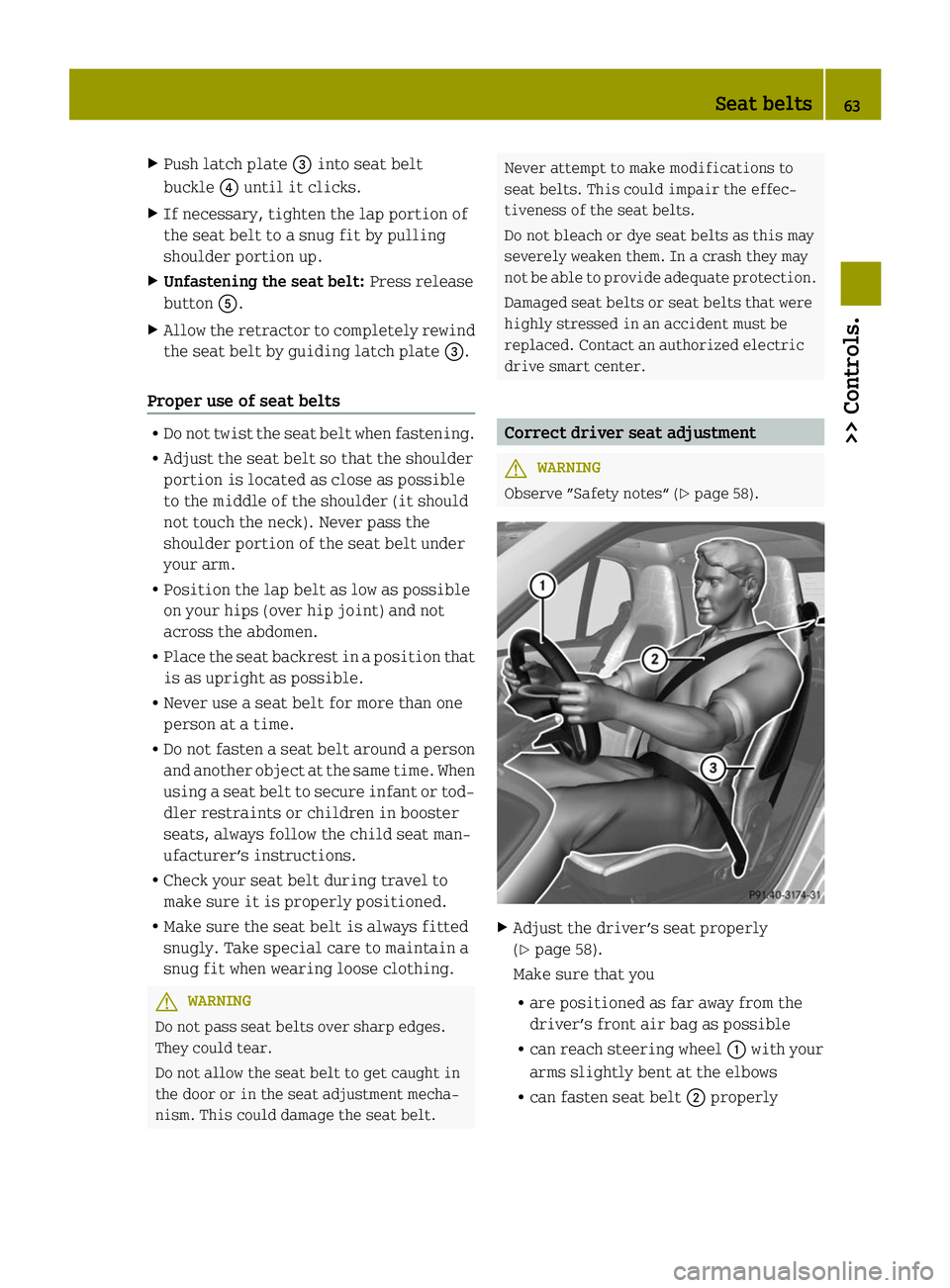
Observe ”Safety notes“ (Y page 58). X
Adjust the driver’s seat properly
(Y page 58).
Make sure that you
R are positioned as far away from the
driver’s front air bag as possible
R can reach steering wheel 0043with your
arms slightly bent at the elbows
R can fasten seat belt 0044properly Seat belts
63>> Controls. Z
Page 66 of 222
R
you have adjusted seat backrest 0087to
a position that is as upright as possi-
ble
R you can move your legs freely
R you can depress the brake and accel-
erator pedal safely.
X Make sure the seat belt is fastened prop-
erly (Y page 62). Lighting
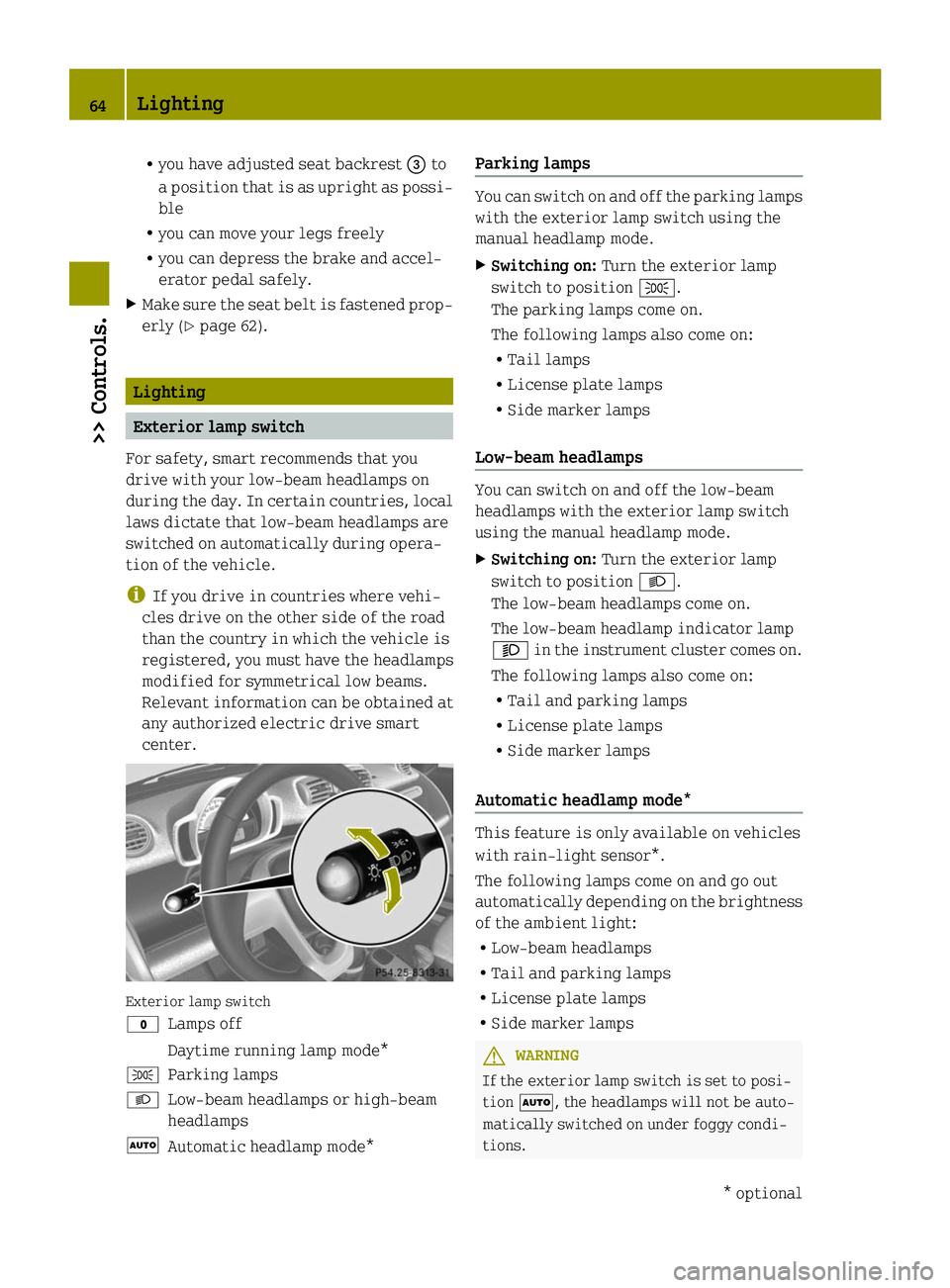
Exterior lamp switch
For safety, smart recommends that you
drive with your low‑beam headlamps on
during the day. In certain countries, local
laws dictate that low‑beam headlamps are
switched on automatically during opera-
tion of the vehicle.
i If you drive in countries where vehi-
cles drive on the other side of the road
than the country in which the vehicle is
registered, you must have the headlamps
modified for symmetrical low beams.
Relevant information can be obtained at
any authorized electric drive smart
center. Exterior lamp switch
003F
Lamps off
Daytime running lamp mode*
0060 Parking lamps
0058 Low‑beam headlamps or high‑beam
headlamps
0058 Automatic headlamp mode* Parking lamps You can switch on and off the parking lamps
with the exterior lamp switch using the
manual headlamp mode.
X
Switching on: Turn the exterior lamp
switch to position 0060.
The parking lamps come on.
The following lamps also come on:
R Tail lamps
R License plate lamps
R Side marker lamps
Low‑beam headlamps You can switch on and off the low‑beam
headlamps with the exterior lamp switch
using the manual headlamp mode.
X
Switching on: Turn the exterior lamp
switch to position 0058.
The low‑beam headlamps come on.
The low‑beam headlamp indicator lamp
0059 in the instrument cluster comes on.
The following lamps also come on:
R Tail and parking lamps
R License plate lamps
R Side marker lamps
Automatic headlamp mode* This feature is only available on vehicles
with rain-light sensor*.
The following lamps come on and go out
automatically depending on the brightness
of the ambient light:
R
Low‑beam headlamps
R Tail and parking lamps
R License plate lamps
R Side marker lamps G
WARNING
If the exterior lamp switch is set to posi-
tion 0058, the headlamps will not be auto-
matically switched on under foggy condi-
tions. 64
Lighting>> Controls.
* optional
Page 73 of 222
When loading, make sure no sharp objects
come into contact with the soft top or the
rear window.
Do not place any evenly distributed loads
with a weight of more than 165 lbs (75 kg)
on the rear soft top when folded down.
Make sure the high-mounted brake lamp
is not concealed.
! Do not block the soft top system’s lock-
ing apertures.
Only place the side rails in the desig-
nated storage space of the tailgate.
! Do not sit on the folded-down rear soft
top.
Do not fold down the rear soft top at tem-
peratures below 14¦ (-10¥).
Do not place any pointed, sharp-edged,
hot (above 176 ¦[80¥]), incandescent or
burning objects on the soft top’s lining.
Do not apply wax to the soft top fabric and
select only wax-free washing products
when using an automatic car wash.
Only drive with the retaining clips
closed, as exhaust fumes could otherwise
reach the vehicle’s interior.
! Please keep in mind that weather con-
ditions can sometimes change rapidly.
Make sure to close the retractable soft
top and the rear soft top when leaving the
vehicle. If water enters the vehicle
interior, vehicle electronics could be
damaged which is not covered by the
smart Limited Warranty. Opening and closing the retractable
soft top
You can open and close the retractable soft
top when the vehicle is either stationary
or in motion. G
WARNING
Never operate the retractable soft top if
there is the possibility of anyone being harmed by the opening or closing proce-
dure.
G
WARNING
The retractable soft top is made out of fab-
ric. In the event of an accident, the fabric
may tear. This may result in an opening in
the roof.
In a vehicle rollover, occupants not wear-
ing their seat belts or not wearing them
properly may be thrown out of the opening.
Such an opening also presents a potential
for injury for occupants wearing their seat
belts properly as entire body parts or por-
tions of them may protrude from the
passenger compartment. G
WARNING
When leaving the vehicle, always remove the
key from the starter switch, take it with
you, and lock the vehicle. Do not leave chil-
dren unattended in the vehicle, or with
access to an unlocked vehicle. A child’s
unsupervised access to a vehicle could
result in an accident and/or serious per-
sonal injury.
! To avoid damaging the seals, do not
transport any objects with sharp edges
which can stick out of the retractable
soft top.
Do not open the retractable soft top if
there is snow or ice on the roof, as this
could result in malfunctions.
If you cannot open or close the retracta-
ble soft top due to a malfunction contact
Roadside Assistance or an authorized
electric drive smart center.
i To avoid draining the battery, leave the
drive system running when opening and
closing the retractable soft top.
Opening from outside You can open the retractable soft top com-
pletely with the key. Soft top system (cabriolet only)
71>> Controls. Z
Page 78 of 222
result in an accident and/or serious per-
sonal injury.
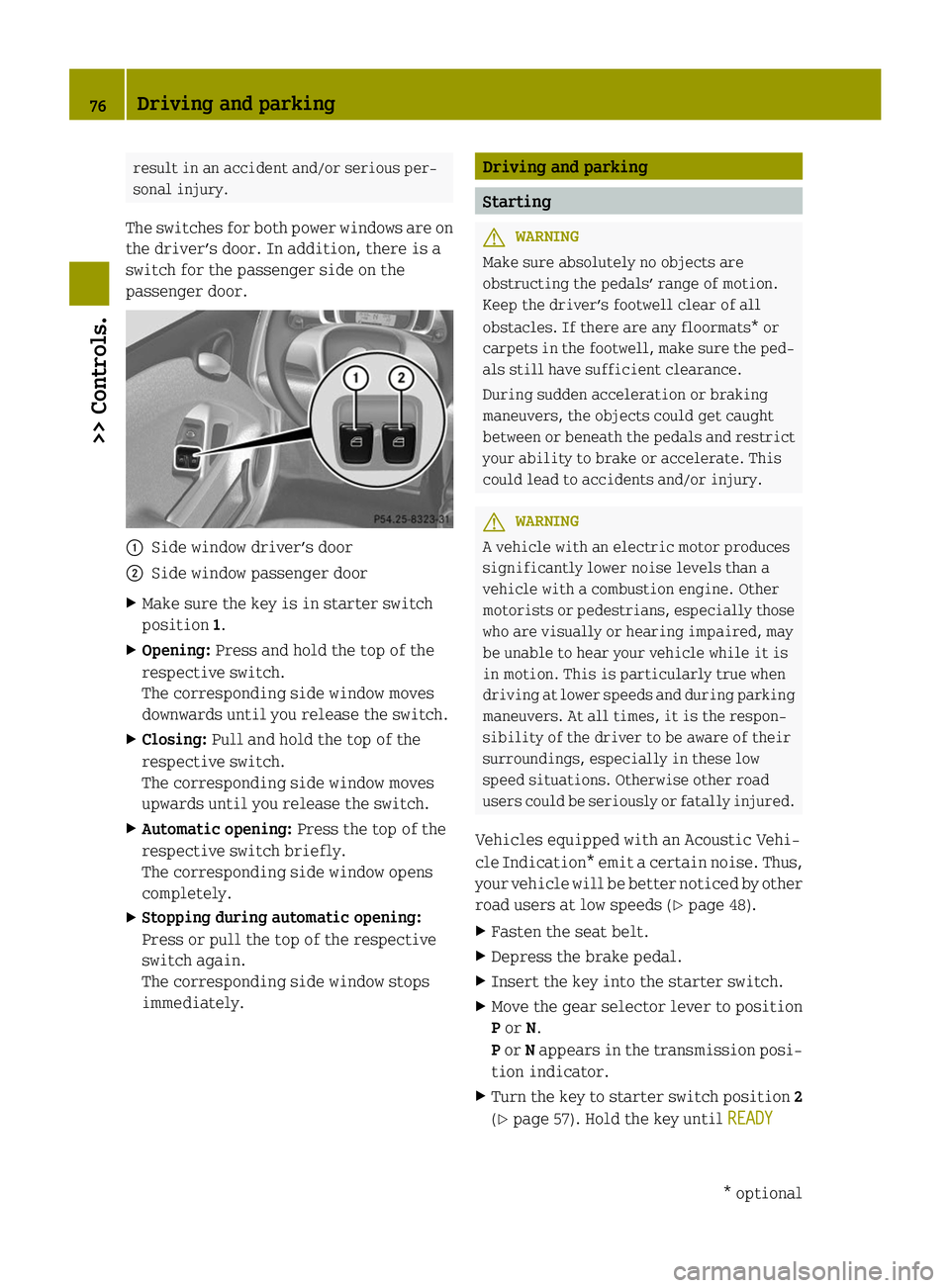
The switches for both power windows are on
the driver’s door. In addition, there is a
switch for the passenger side on the
passenger door. 0043
Side window driver’s door
0044 Side window passenger door
X Make sure the key is in starter switch
position 1.
X Opening: Press and hold the top of the
respective switch.
The corresponding side window moves
downwards until you release the switch.
X Closing: Pull and hold the top of the
respective switch.
The corresponding side window moves
upwards until you release the switch.
X Automatic opening: Press the top of the
respective switch briefly.
The corresponding side window opens
completely.
X Stopping during automatic opening:
Press or pull the top of the respective
switch again.
The corresponding side window stops
immediately. Driving and parking
Starting
G
WARNING
Make sure absolutely no objects are
obstructing the pedals’ range of motion.
Keep the driver’s footwell clear of all
obstacles. If there are any floormats* or
carpets in the footwell, make sure the ped-
als still have sufficient clearance.
During sudden acceleration or braking
maneuvers, the objects could get caught
between or beneath the pedals and restrict
your ability to brake or accelerate. This
could lead to accidents and/or injury. G
WARNING
A vehicle with an electric motor produces
significantly lower noise levels than a
vehicle with a combustion engine. Other
motorists or pedestrians, especially those
who are visually or hearing impaired, may
be unable to hear your vehicle while it is
in motion. This is particularly true when
driving at lower speeds and during parking
maneuvers. At all times, it is the respon-
sibility of the driver to be aware of their
surroundings, especially in these low
speed situations. Otherwise other road
users could be seriously or fatally injured.
Vehicles equipped with an Acoustic Vehi-
cle Indication* emit a certain noise. Thus,
your vehicle will be better noticed by other
road users at low speeds (Y page 48).
X Fasten the seat belt.
X Depress the brake pedal.
X Insert the key into the starter switch.
X Move the gear selector lever to position
Por N.
P or Nappears in the transmission posi-
tion indicator.
X Turn the key to starter switch position 2
(Y page 57). Hold the key until READY READY76
Driving and parking>> Controls.
* optional
Page 142 of 222
0083
Manufacturer
0084 Tire ply material (Y page 143)
006B Tire size designation, load and speed
rating (Y page 140)
006C Load identification (Y page 142)
006D Tire name
i For illustration purposes only. Actual
data on tires are specific to each vehicle
and may vary from data shown in above
illustration.
For more information, see “Rims and
tires” (Y page 216).
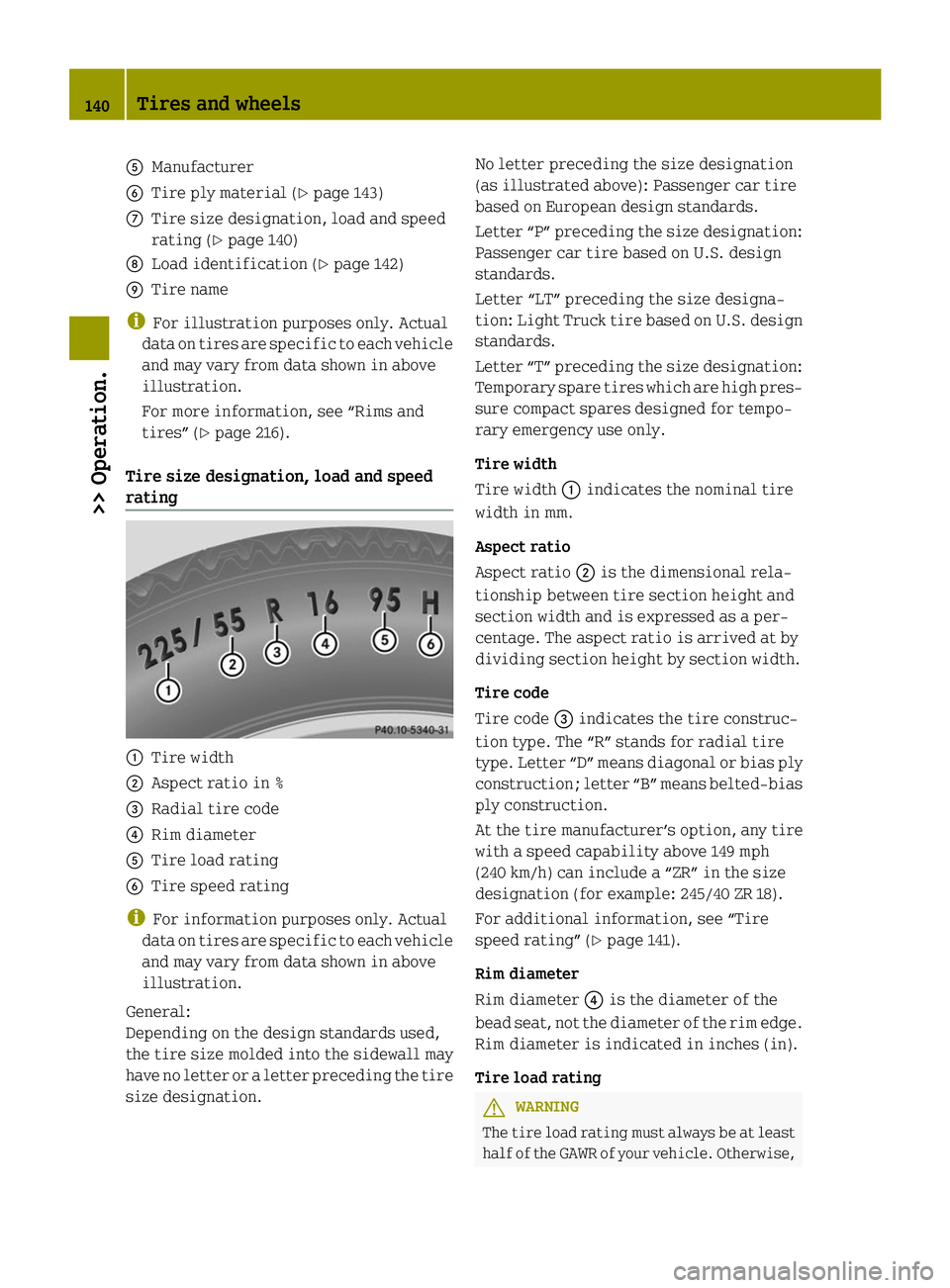
Tire size designation, load and speed
rating 0043
Tire width
0044 Aspect ratio in %
0087 Radial tire code
0085 Rim diameter
0083 Tire load rating
0084 Tire speed rating
i For information purposes only. Actual
data on tires are specific to each vehicle
and may vary from data shown in above
illustration.
General:
Depending on the design standards used,
the tire size molded into the sidewall may
have no letter or a letter preceding the tire
size designation. No letter preceding the size designation
(as illustrated above): Passenger car tire
based on European design standards.
Letter “P” preceding the size designation:
Passenger car tire based on U.S. design
standards.
Letter “LT” preceding the size designa-
tion: Light Truck tire based on U.S. design
standards.
Letter “T” preceding the size designation:
Temporary spare tires which are high pres-
sure compact spares designed for tempo-
rary emergency use only.
Tire width
Tire width 0043indicates the nominal tire
width in mm.
Aspect ratio
Aspect ratio 0044is the dimensional rela-
tionship between tire section height and
section width and is expressed as a per-
centage. The aspect ratio is arrived at by
dividing section height by section width.
Tire code
Tire code 0087indicates the tire construc-
tion type. The “R” stands for radial tire
type. Letter “D” means diagonal or bias ply
construction; letter “B” means belted-bias
ply construction.
At the tire manufacturer’s option, any tire
with a speed capability above 149 mph
(240 km/h) can include a “ZR” in the size
designation (for example: 245/40 ZR 18).
For additional information, see “Tire
speed rating” (Y page 141).
Rim diameter
Rim diameter 0085is the diameter of the
bead seat, not the diameter of the rim edge.
Rim diameter is indicated in inches (in).
Tire load rating G
WARNING
The tire load rating must always be at least
half of the GAWR of your vehicle. Otherwise, 140
Tires and wheels>> Operation.
Page 170 of 222
G
WARNING
Driving with the brake warning lamp illuminated can result in an accident. Have your brake
system checked immediately if the brake warning lamp stays on.
Do not add brake fluid before checking the brake system.
! If you find that the brake fluid in the brake fluid reservoir has fallen to the minimum
mark or below, have the brake system checked for brake pad thickness and leaks imme-
diately. Contact an authorized electric drive smart center immediately. Do not add
brake fluid as this will not solve the problem.
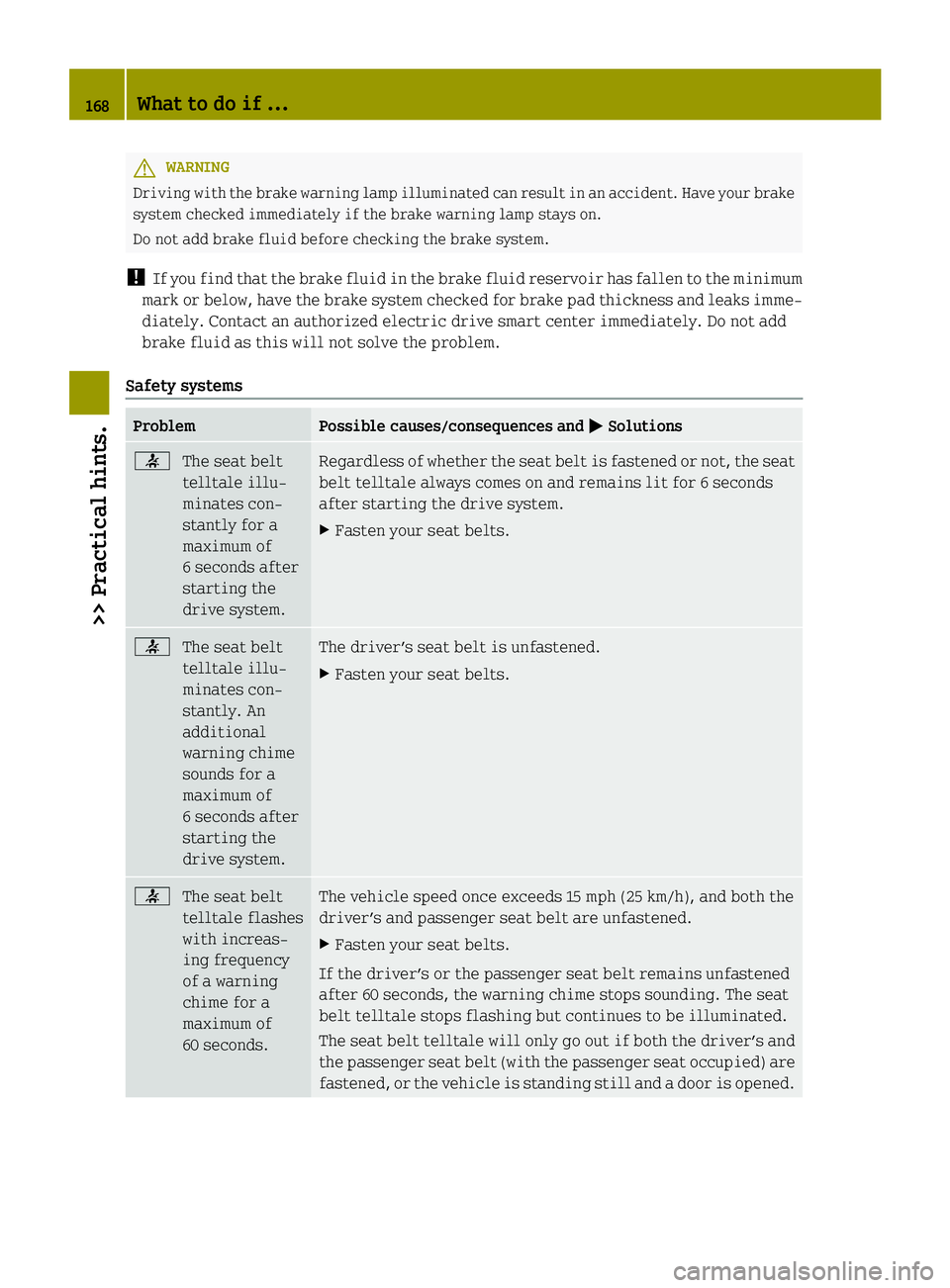
Safety systems Problem Possible causes/consequences and
0050 0050Solutions 0076
The seat belt
telltale illu-
minates con-
stantly for a
maximum of
6 seconds after
starting the
drive system. Regardless of whether the seat belt is fastened or not, the seat
belt telltale always comes on and remains lit for 6 seconds
after starting the drive system.
X
Fasten your seat belts. 0076
The seat belt
telltale illu-
minates con-
stantly. An
additional
warning chime
sounds for a
maximum of
6 seconds after
starting the
drive system. The driver’s seat belt is unfastened.
X
Fasten your seat belts. 0076
The seat belt
telltale flashes
with increas-
ing frequency
of a warning
chime for a
maximum of
60 seconds. The vehicle speed once exceeds 15 mph (25 km/h), and both the
driver’s and passenger seat belt are unfastened.
X
Fasten your seat belts.
If the driver’s or the passenger seat belt remains unfastened
after 60 seconds, the warning chime stops sounding. The seat
belt telltale stops flashing but continues to be illuminated.
The seat belt telltale will only go out if both the driver’s and
the passenger seat belt (with the passenger seat occupied) are
fastened, or the vehicle is standing still and a door is opened. 168
What to do if ...>> Practical hints.