weight SMART FORTWO COUPE ELECTRIC DRIVE 2014 Owner's Manual
[x] Cancel search | Manufacturer: SMART, Model Year: 2014, Model line: FORTWO COUPE ELECTRIC DRIVE, Model: SMART FORTWO COUPE ELECTRIC DRIVE 2014Pages: 222, PDF Size: 16.17 MB
Page 73 of 222
When loading, make sure no sharp objects
come into contact with the soft top or the
rear window.
Do not place any evenly distributed loads
with a weight of more than 165 lbs (75 kg)
on the rear soft top when folded down.
Make sure the high-mounted brake lamp
is not concealed.
! Do not block the soft top system’s lock-
ing apertures.
Only place the side rails in the desig-
nated storage space of the tailgate.
! Do not sit on the folded-down rear soft
top.
Do not fold down the rear soft top at tem-
peratures below 14¦ (-10¥).
Do not place any pointed, sharp-edged,
hot (above 176 ¦[80¥]), incandescent or
burning objects on the soft top’s lining.
Do not apply wax to the soft top fabric and
select only wax-free washing products
when using an automatic car wash.
Only drive with the retaining clips
closed, as exhaust fumes could otherwise
reach the vehicle’s interior.
! Please keep in mind that weather con-
ditions can sometimes change rapidly.
Make sure to close the retractable soft
top and the rear soft top when leaving the
vehicle. If water enters the vehicle
interior, vehicle electronics could be
damaged which is not covered by the
smart Limited Warranty. Opening and closing the retractable
soft top
You can open and close the retractable soft
top when the vehicle is either stationary
or in motion. G
WARNING
Never operate the retractable soft top if
there is the possibility of anyone being harmed by the opening or closing proce-
dure.
G
WARNING
The retractable soft top is made out of fab-
ric. In the event of an accident, the fabric
may tear. This may result in an opening in
the roof.
In a vehicle rollover, occupants not wear-
ing their seat belts or not wearing them
properly may be thrown out of the opening.
Such an opening also presents a potential
for injury for occupants wearing their seat
belts properly as entire body parts or por-
tions of them may protrude from the
passenger compartment. G
WARNING
When leaving the vehicle, always remove the
key from the starter switch, take it with
you, and lock the vehicle. Do not leave chil-
dren unattended in the vehicle, or with
access to an unlocked vehicle. A child’s
unsupervised access to a vehicle could
result in an accident and/or serious per-
sonal injury.
! To avoid damaging the seals, do not
transport any objects with sharp edges
which can stick out of the retractable
soft top.
Do not open the retractable soft top if
there is snow or ice on the roof, as this
could result in malfunctions.
If you cannot open or close the retracta-
ble soft top due to a malfunction contact
Roadside Assistance or an authorized
electric drive smart center.
i To avoid draining the battery, leave the
drive system running when opening and
closing the retractable soft top.
Opening from outside You can open the retractable soft top com-
pletely with the key. Soft top system (cabriolet only)
71>> Controls. Z
Page 106 of 222
X
Switching on: Press air recirculation
switch 0085.
The indicator lamp in air recirculation
switch 0085comes on.
X Switching off: Press air recirculation
switch 0085once more.
The indicator lamp in air recirculation
switch 0085goes out. Loading and storing
Cargo compartment cover blind with
parcel net bag G
WARNING
The cargo compartment cover blind is not
intended to secure heavy objects in the
event of an accident. For this reason, heavy
objects must be tied down.
Vehicle occupants could be injured by
objects being thrown around in the vehicle
in the event of
R hard braking
R a change of direction
R an accident G
WARNING
Do not place any objects on the mounted
cargo compartment cover blind.
Vehicle occupants could be injured by
objects being thrown around in the vehicle
in the event of
R hard braking
R a change of direction
R an accident G
WARNING
Only place light loads in the parcel net
bag. Do not transport heavy, sharp-edged or
fragile objects in the parcel net bag. The
parcel net bag cannot sufficiently secure
loads in an accident. Vehicle occupants could be injured by
objects being thrown around in the vehicle
in the event of
R hard braking
R a change of direction
R an accident
Observe the loading guidelines.
The cargo compartment cover blind
R serves to protect objects that are stored
in the vehicle’s cargo compartment from
prying eyes
R prevents smaller objects from penetrat-
ing into the passenger compartment from
the cargo compartment; however, it is not
intended to act as a load restraining
device
The parcel net bag
R is for storing small, lightweight objects
R prevents small objects from sliding
around inside the passenger compart-
ment
! If objects are placed on the cargo com-
partment cover blind when mounted, the
cover may be damaged.
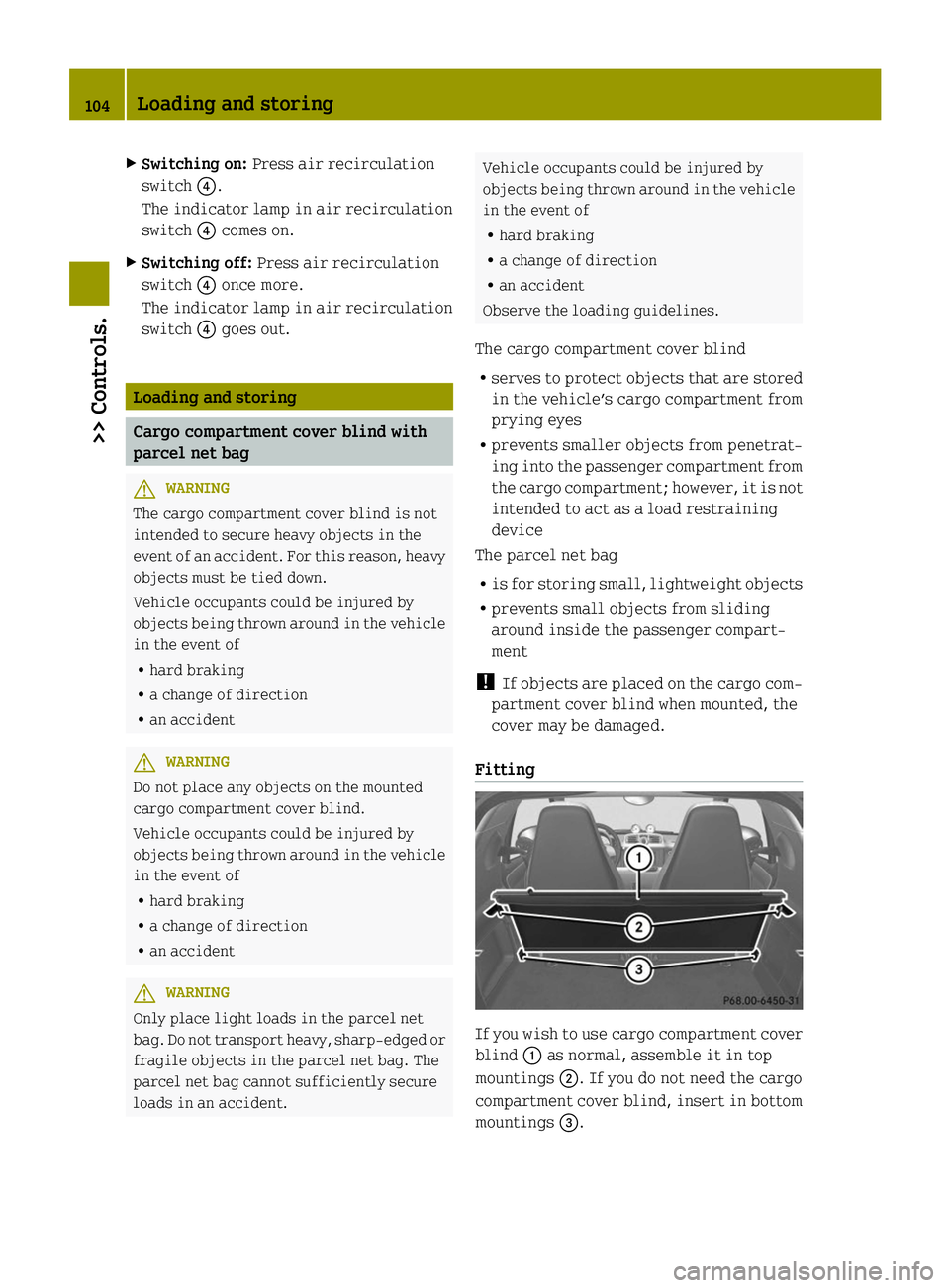
Fitting If you wish to use cargo compartment cover
blind
0043as normal, assemble it in top
mountings 0044. If you do not need the cargo
compartment cover blind, insert in bottom
mountings 0087. 104
Loading and storing>> Controls.
Page 109 of 222
X
Opening: Pull on glove box lid
release 0043and fold down the glove box
lid.
X Closing: Lift up the glove box lid with a
bit of force until it engages.
X Locking: Insert the key into the glove box
lock and turn it to position 0049.
X Unlocking: Insert the key into the glove
box lock and turn it to position 0048.
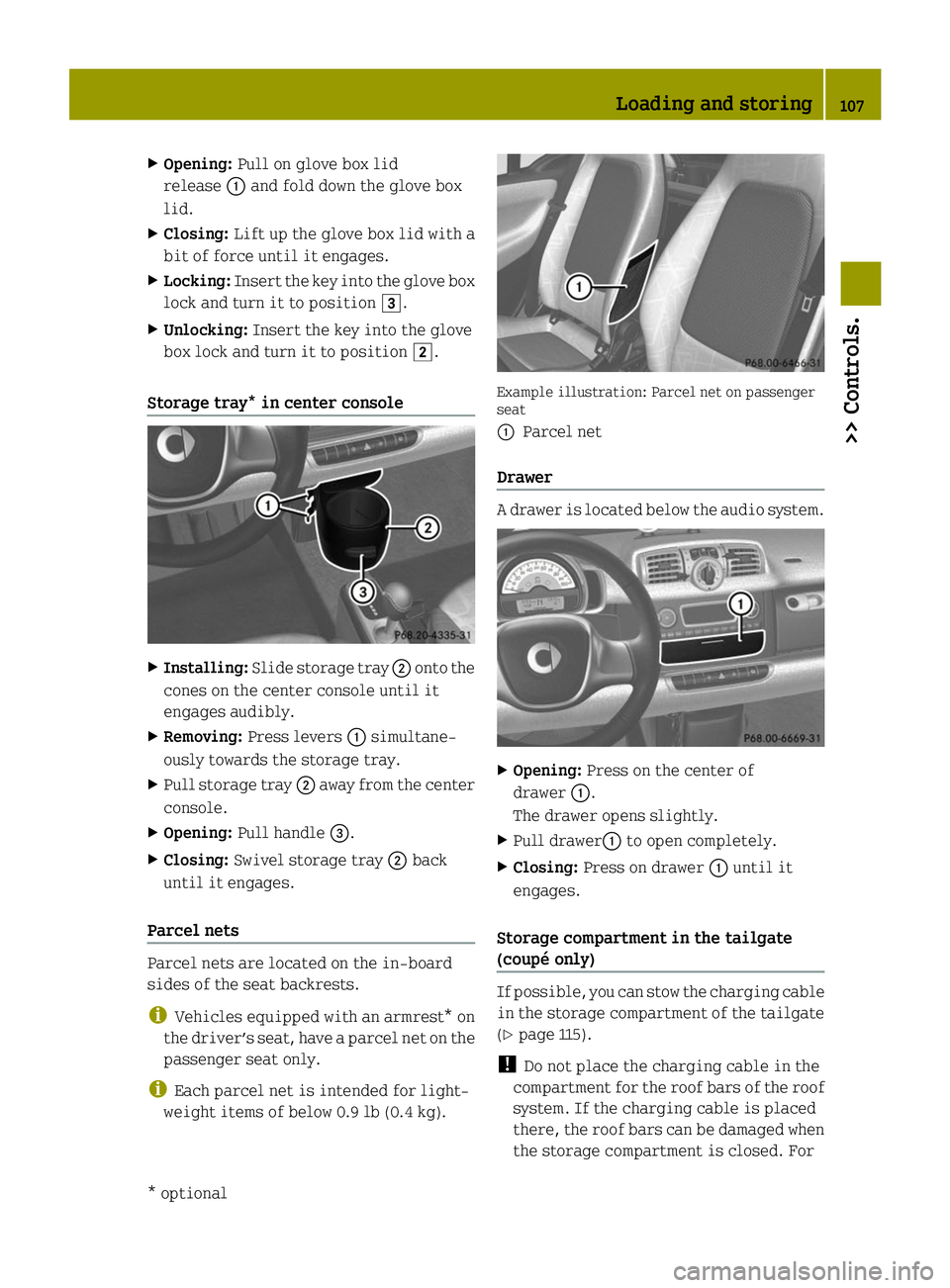
Storage tray* in center console X
Installing: Slide storage tray 0044onto the
cones on the center console until it
engages audibly.
X Removing: Press levers 0043simultane-
ously towards the storage tray.
X Pull storage tray 0044away from the center
console.
X Opening: Pull handle 0087.
X Closing: Swivel storage tray 0044back
until it engages.
Parcel nets Parcel nets are located on the in-board
sides of the seat backrests.
i
Vehicles equipped with an armrest* on
the driver’s seat, have a parcel net on the
passenger seat only.
i Each parcel net is intended for light-
weight items of below 0.9 lb (0.4 kg). Example illustration: Parcel net on passenger
seat
0043
Parcel net
Drawer A drawer is located below the audio system.
X
Opening: Press on the center of
drawer 0043.
The drawer opens slightly.
X Pull drawer0043 to open completely.
X Closing: Press on drawer 0043until it
engages.
Storage compartment in the tailgate
(coupé only) If possible, you can stow the charging cable
in the storage compartment of the tailgate
(Y
page 115).
! Do not place the charging cable in the
compartment for the roof bars of the roof
system. If the charging cable is placed
there, the roof bars can be damaged when
the storage compartment is closed. For Loading and storing
107>> Controls.
* optional Z
Page 110 of 222
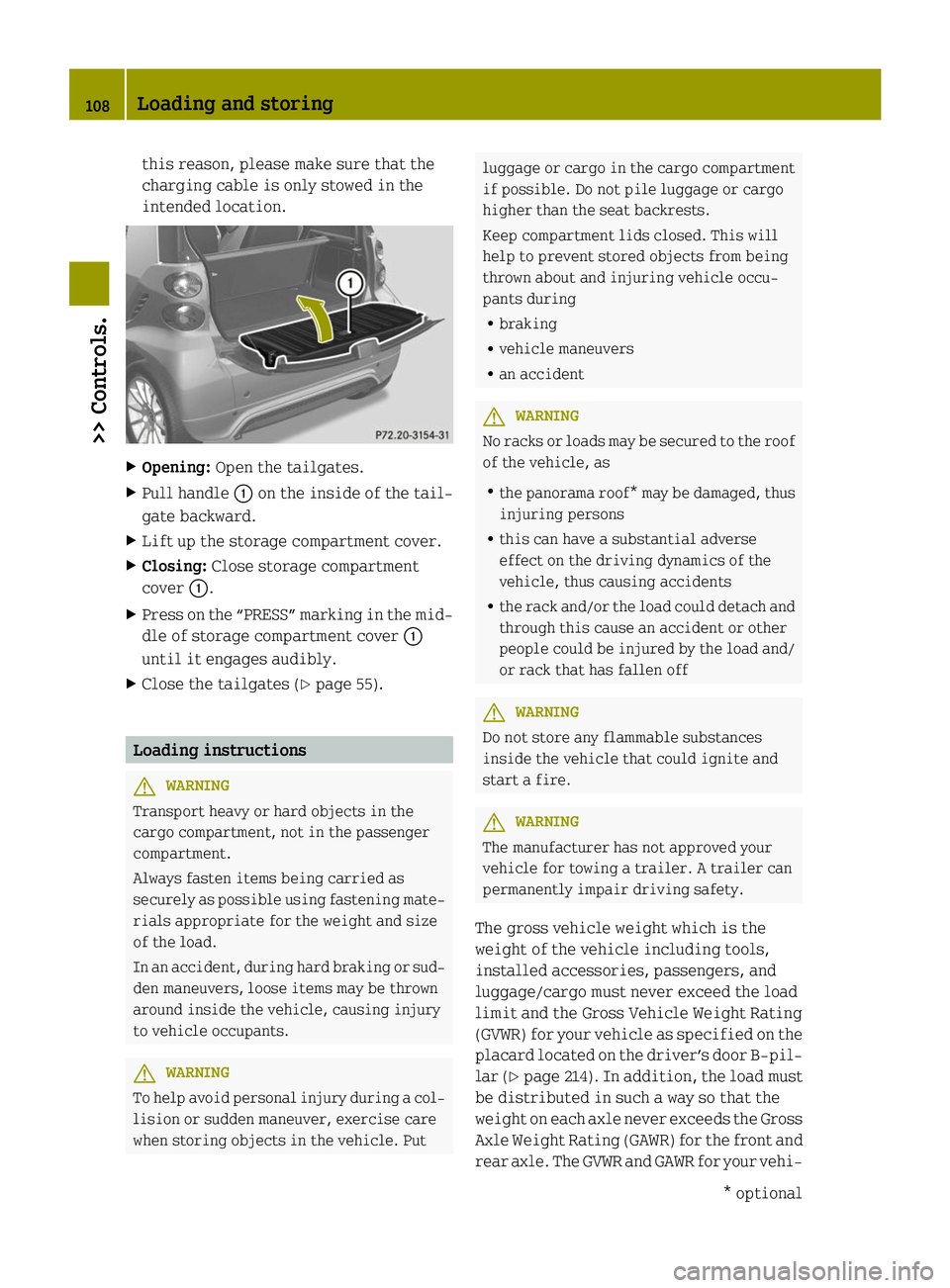
this reason, please make sure that the
charging cable is only stowed in the
intended location. X
Opening: Open the tailgates.
X Pull handle 0043on the inside of the tail-
gate backward.
X Lift up the storage compartment cover.
X Closing: Close storage compartment
cover 0043.
X Press on the “PRESS” marking in the mid-
dle of storage compartment cover 0043
until it engages audibly.
X Close the tailgates (Y page 55).Loading instructions
G
WARNING
Transport heavy or hard objects in the
cargo compartment, not in the passenger
compartment.
Always fasten items being carried as
securely as possible using fastening mate-
rials appropriate for the weight and size
of the load.
In an accident, during hard braking or sud-
den maneuvers, loose items may be thrown
around inside the vehicle, causing injury
to vehicle occupants. G
WARNING
To help avoid personal injury during a col-
lision or sudden maneuver, exercise care
when storing objects in the vehicle. Put luggage or cargo in the cargo compartment
if possible. Do not pile luggage or cargo
higher than the seat backrests.
Keep compartment lids closed. This will
help to prevent stored objects from being
thrown about and injuring vehicle occu-
pants during
R braking
R vehicle maneuvers
R an accident G
WARNING
No racks or loads may be secured to the roof
of the vehicle, as
R the panorama roof* may be damaged, thus
injuring persons
R this can have a substantial adverse
effect on the driving dynamics of the
vehicle, thus causing accidents
R the rack and/or the load could detach and
through this cause an accident or other
people could be injured by the load and/
or rack that has fallen off G
WARNING
Do not store any flammable substances
inside the vehicle that could ignite and
start a fire. G
WARNING
The manufacturer has not approved your
vehicle for towing a trailer. A trailer can
permanently impair driving safety.
The gross vehicle weight which is the
weight of the vehicle including tools,
installed accessories, passengers, and
luggage/cargo must never exceed the load
limit and the Gross Vehicle Weight Rating
(GVWR) for your vehicle as specified on the
placard located on the driver’s door B‑pil-
lar (Y page 214). In addition, the load must
be distributed in such a way so that the
weight on each axle never exceeds the Gross
Axle Weight Rating (GAWR) for the front and
rear axle. The GVWR and GAWR for your vehi- 108
Loading and storing>> Controls.
* optional
Page 111 of 222
cle are indicated on the certification
label which can be found on the driver’s
door B‑pillar.
For more information, see “Loading the
vehicle” (Y page 133).
The handling characteristics of a fully
loaded vehicle depend greatly on the load
distribution. It is therefore recommended
to load the vehicle with the heaviest items
being placed towards the front of the vehi-
cle.
Please pay attention to and comply with the
following instructions when loading the
vehicle and transporting cargo:
R Always place items being carried
against seat backrests, and fasten them
as securely as possible.
R The heaviest portion of the cargo should
always be kept as low as possible against
seat backrests.
R Do not stack loads higher than the top
edge of the head restraints.
R Make sure no luggage/cargo items can get
above or next to the driver’s and/or
passenger seat into the passenger com-
partment.
R Make sure luggage/cargo is properly
secured.
R Always use, if so equipped, cargo net*
when transporting cargo.
Do not carry any unnecessary weight in the
vehicle. This increases vehicle weight,
which results in increased energy con-
sumption. Useful features
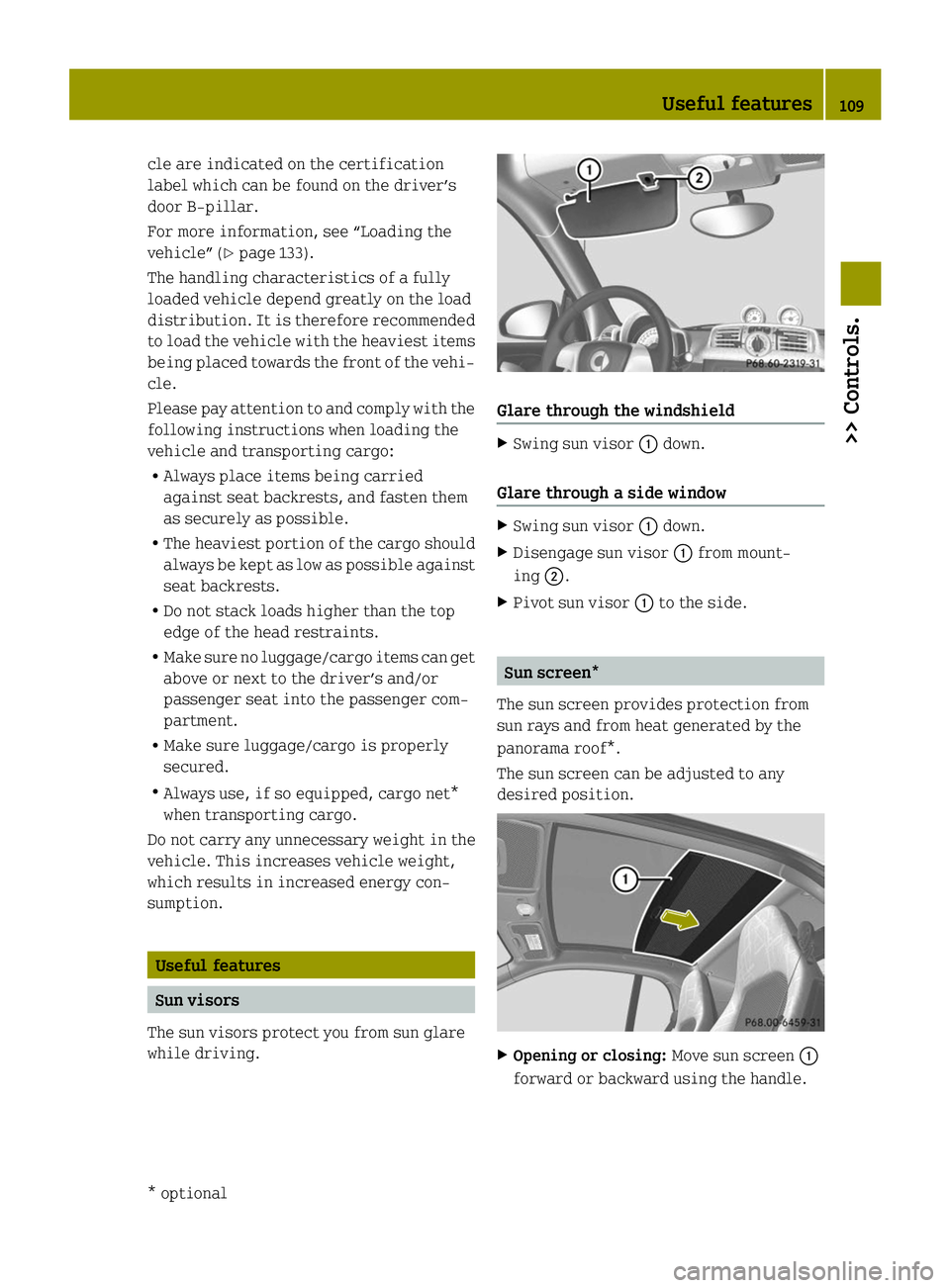
Sun visors
The sun visors protect you from sun glare
while driving. Glare through the windshield
X
Swing sun visor 0043down.
Glare through a side window X
Swing sun visor 0043down.
X Disengage sun visor 0043from mount-
ing 0044.
X Pivot sun visor 0043to the side. Sun screen*
The sun screen provides protection from
sun rays and from heat generated by the
panorama roof*.
The sun screen can be adjusted to any
desired position. X
Opening or closing: Move sun screen0043
forward or backward using the handle. Useful features
109>> Controls.
* optional Z
Page 131 of 222
ride comfort, wear unevenly, increase
stopping distance, and result in sudden
deflation (blowout) because they are more
likely to become punctured or damaged by
road debris, potholes etc.
Do not overload the tires by exceeding the
specified load limit as indicated on the
Tire and Loading Information placard on
the driver’s door B‑pillar. Overloading the
tires can overheat them, possibly causing
a blowout. Overloading the tires can also
result in handling or steering problems, or
brake failure.
Your vehicle is equipped with the Tire and
Loading Information placard located on
the driver’s door B‑pillar (Y page 134).
The tire inflation pressure should be
checked regularly. Only adjust the tire
inflation pressure on cold tires. The tires
can be considered cold if the vehicle has
been parked for at least 3 hours or driven
less than 1 mile (1.6 km). Depending on the
ambient temperature, the driving speed
and the tire load, the tire temperature
changes. When the tire temperature
changes by 18¦ (10¥), the tire inflation
pressure will change by approximately
10 kpa (0.1 bar, 1.5 psi). Keep this in mind
when checking tire inflation pressure on
warm tires and adjust the tire pressure
only if the tire inflation pressure is too
low for the current operating conditions.
If you check the tire inflation pressure
when the tires are warm, the reading will
be higher than the cold reading. This is
normal. Do not let air out to match the
specified cold tire inflation pressure.
Otherwise, the tire will be underinflated.
Follow recommended cold tire inflation
pressures listed on Tire and Loading
Information placard on the driver’s door
B‑pillar.
Keeping the tires properly inflated pro-
vides the best handling, tread life and rid-
ing comfort. In addition to the Tire and Loading Infor-
mation placard on the driver’s door B‑pil-
lar, also consult the tire inflation pres-
sure label (if available) on the inside of
the filler flap for any additional informa-
tion pertaining to special driving situa-
tions. For more information, see “Impor-
tant notes on tire inflation pressure”
(Y
page 129).
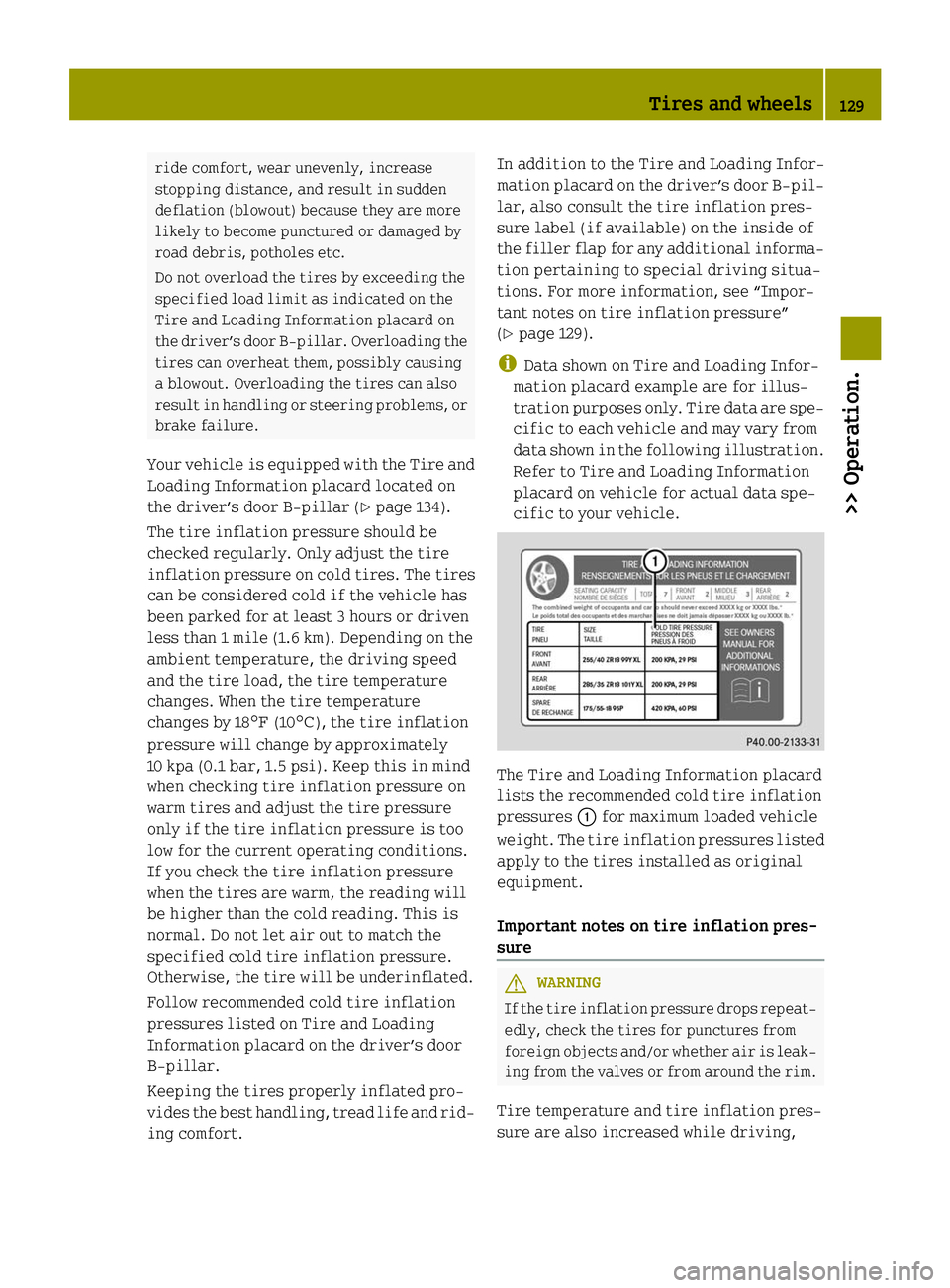
i Data shown on Tire and Loading Infor-
mation placard example are for illus-
tration purposes only. Tire data are spe-
cific to each vehicle and may vary from
data shown in the following illustration.
Refer to Tire and Loading Information
placard on vehicle for actual data spe-
cific to your vehicle. The Tire and Loading Information placard
lists the recommended cold tire inflation
pressures
0043for maximum loaded vehicle
weight. The tire inflation pressures listed
apply to the tires installed as original
equipment.
Important notes on tire inflation pres-
sure G
WARNING
If the tire inflation pressure drops repeat-
edly, check the tires for punctures from
foreign objects and/or whether air is leak-
ing from the valves or from around the rim.
Tire temperature and tire inflation pres-
sure are also increased while driving, Tires and wheels
129>> Operation. Z
Page 135 of 222
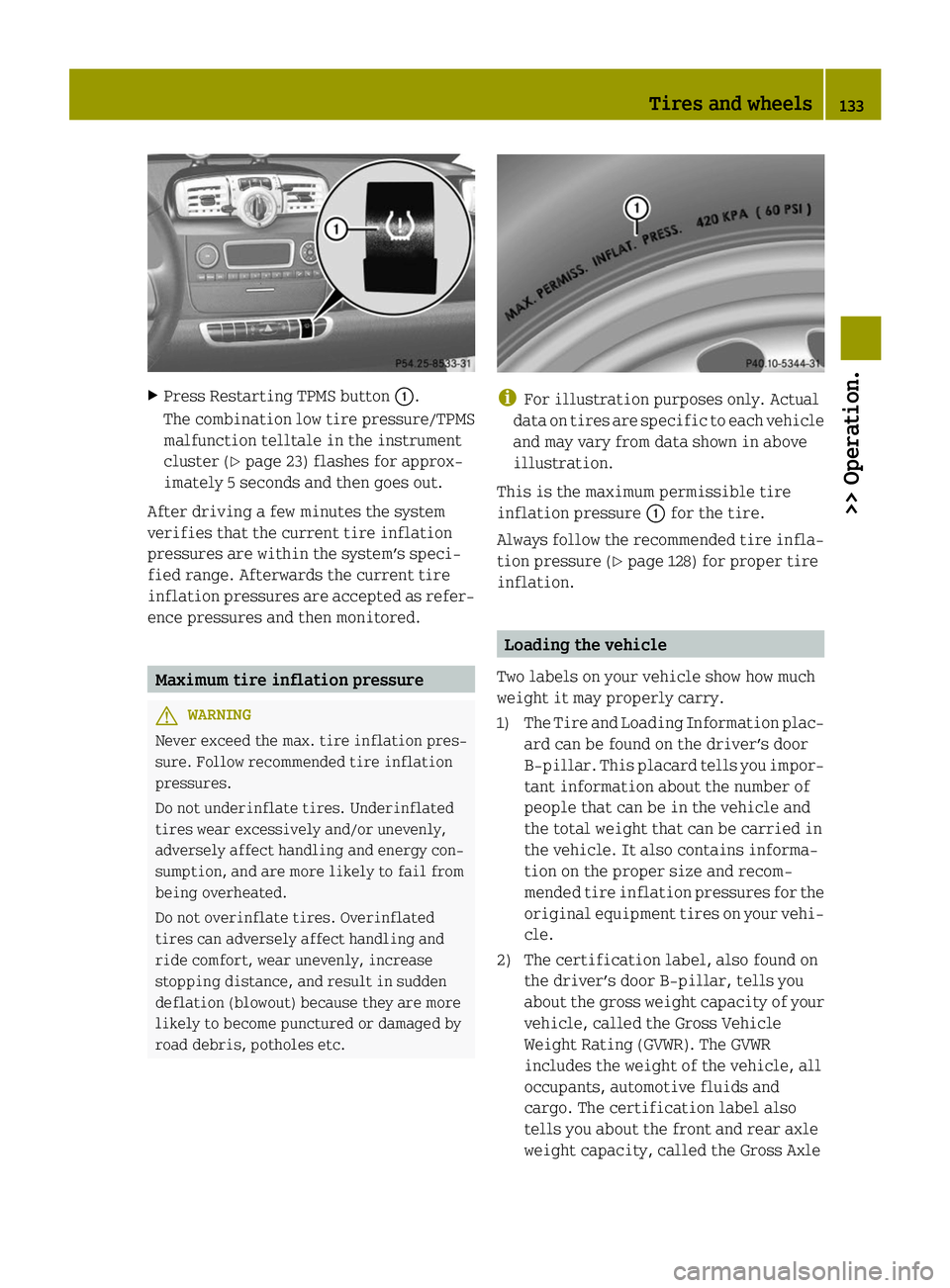
X
Press Restarting TPMS button 0043.
The combination low tire pressure/TPMS
malfunction telltale in the instrument
cluster (Y page 23) flashes for approx-
imately 5 seconds and then goes out.
After driving a few minutes the system
verifies that the current tire inflation
pressures are within the system’s speci-
fied range. Afterwards the current tire
inflation pressures are accepted as refer-
ence pressures and then monitored. Maximum tire inflation pressure
G
WARNING
Never exceed the max. tire inflation pres-
sure. Follow recommended tire inflation
pressures.
Do not underinflate tires. Underinflated
tires wear excessively and/or unevenly,
adversely affect handling and energy con-
sumption, and are more likely to fail from
being overheated.
Do not overinflate tires. Overinflated
tires can adversely affect handling and
ride comfort, wear unevenly, increase
stopping distance, and result in sudden
deflation (blowout) because they are more
likely to become punctured or damaged by
road debris, potholes etc. i
For illustration purposes only. Actual
data on tires are specific to each vehicle
and may vary from data shown in above
illustration.
This is the maximum permissible tire
inflation pressure 0043for the tire.
Always follow the recommended tire infla-
tion pressure (Y page 128) for proper tire
inflation. Loading the vehicle
Two labels on your vehicle show how much
weight it may properly carry.
1) The Tire and Loading Information plac- ard can be found on the driver’s door
B‑pillar. This placard tells you impor-
tant information about the number of
people that can be in the vehicle and
the total weight that can be carried in
the vehicle. It also contains informa-
tion on the proper size and recom-
mended tire inflation pressures for the
original equipment tires on your vehi-
cle.
2) The certification label, also found on the driver’s door B‑pillar, tells you
about the gross weight capacity of your
vehicle, called the Gross Vehicle
Weight Rating (GVWR). The GVWR
includes the weight of the vehicle, all
occupants, automotive fluids and
cargo. The certification label also
tells you about the front and rear axle
weight capacity, called the Gross Axle Tires and wheels
133>> Operation. Z
Page 136 of 222
Weight Rating (GAWR). The GAWR is the
total allowable weight that can be car-
ried by a single axle (front or rear).
Never exceed the GVWR or GAWR for
either the front axle or rear axle.
0043
Driver’s door B‑pillar
Following is a discussion on how to work
with the information contained on the Tire
and Loading Information placard with
regards to loading your vehicle.
Tire and Loading Information G
WARNING
Do not overload the tires by exceeding the
specified load limit as indicated on the
Tire and Loading Information placard on
the driver’s door B‑pillar. Overloading the
tires can overheat them, possibly causing
a blowout. Overloading the tires can also
result in handling or steering problems, or
brake failure.
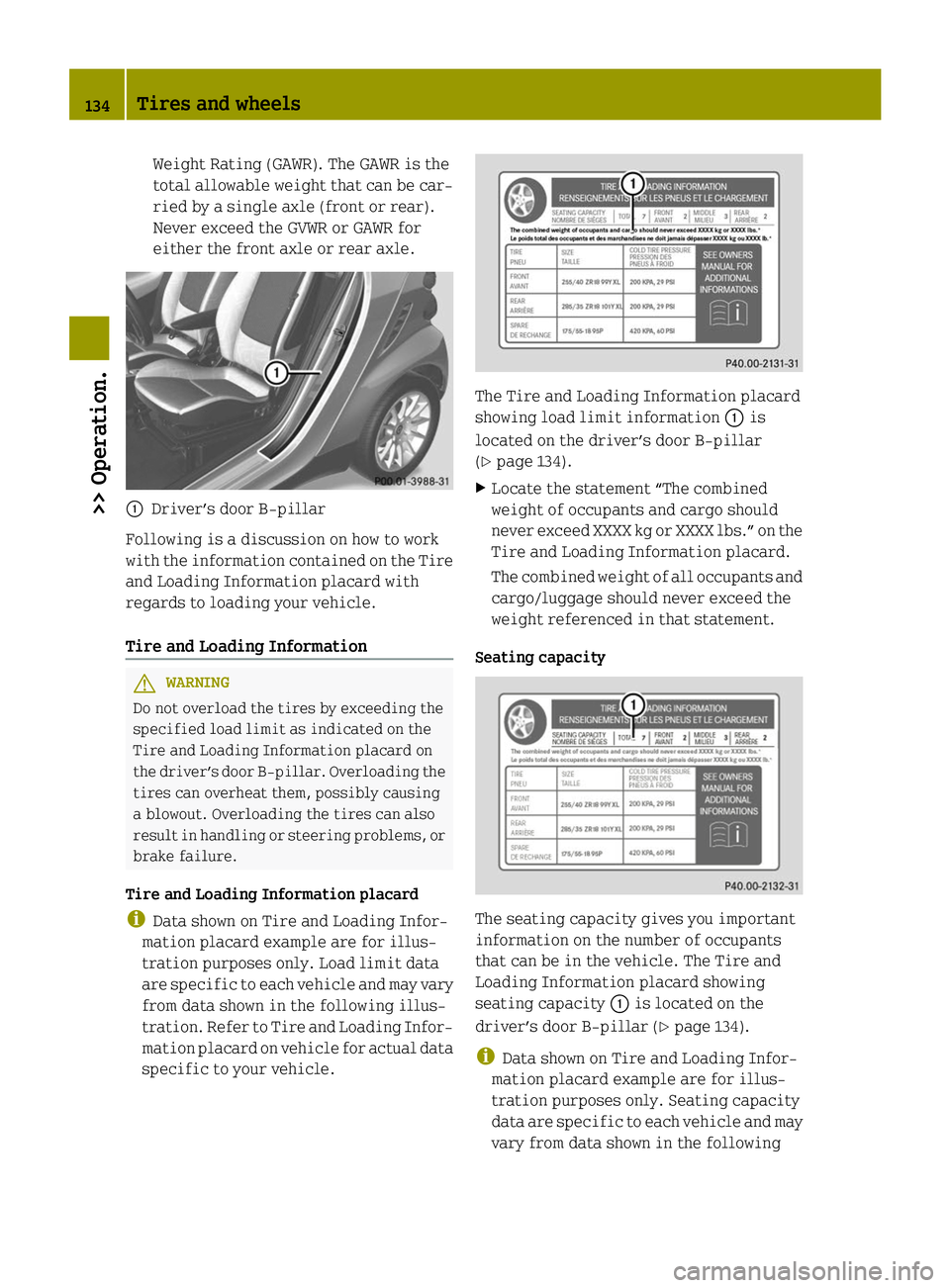
Tire and Loading Information placard
i Data shown on Tire and Loading Infor-
mation placard example are for illus-
tration purposes only. Load limit data
are specific to each vehicle and may vary
from data shown in the following illus-
tration. Refer to Tire and Loading Infor-
mation placard on vehicle for actual data
specific to your vehicle. The Tire and Loading Information placard
showing load limit information 0043is
located on the driver’s door B‑pillar
(Y page 134).
X Locate the statement “The combined
weight of occupants and cargo should
never exceed XXXX kg or XXXX lbs.” on the
Tire and Loading Information placard.
The combined weight of all occupants and
cargo/luggage should never exceed the
weight referenced in that statement.
Seating capacity The seating capacity gives you important
information on the number of occupants
that can be in the vehicle. The Tire and
Loading Information placard showing
seating capacity 0043is located on the
driver’s door B‑pillar (Y page 134).
i Data shown on Tire and Loading Infor-
mation placard example are for illus-
tration purposes only. Seating capacity
data are specific to each vehicle and may
vary from data shown in the following 134
Tires and wheels>> Operation.
Page 137 of 222
illustration. Refer to Tire and Loading
Information placard on vehicle for
actual data specific to your vehicle.
Steps for determining correct load limit
The following steps have been developed as
required of all manufacturers under
Title 49, Code of U.S. Federal Regulations,
Part 575 pursuant to the “National Traffic
and Motor Vehicle Safety Act of 1966”.
X Step 1: Locate the statement “The com-
bined weight of occupants and cargo
should never exceed XXXX kg or
XXXX lbs.” on your vehicle’s Tire and
Loading Information placard.
X Step 2: Determine the combined weight of
the driver and passenger that will be
riding in your vehicle.
X Step 3: Subtract the combined weight of
the driver and passenger from XXXX kilo-
grams or XXXX lbs.
X Step 4: The resulting figure equals the
available amount of cargo and luggage
load capacity. For example, if the “XXXX”
amount equals 540 lbs and there will be
one 150 lbs passenger in your vehicle, the
amount of available cargo and luggage
load capacity is 390 lbs
(540 lbs - 150 lbs = 390 lbs).
X Step 5: Determine the combined weight of
luggage and cargo being loaded on the
vehicle. That weight may not safely
exceed the available cargo and luggage
load capacity calculated in step 4.
i The maximum cargo compartment load
is 110 lbs (50 kg).
The following table shows examples on how
to calculate total and cargo load capaci-
ties with varying seating configurations
and number and size of occupants. The fol-
lowing examples use a load limit of 540 lbs.
This is for illustration purposes only .
Make sure you are using the actual load
limit for your vehicle stated on the vehi-
cle’s Tire and Loading Information placard
(Y page 134). The higher the weight of all occupants, the
less cargo and luggage load capacity is
available. Tires and wheels
135>> Operation. Z
Page 138 of 222
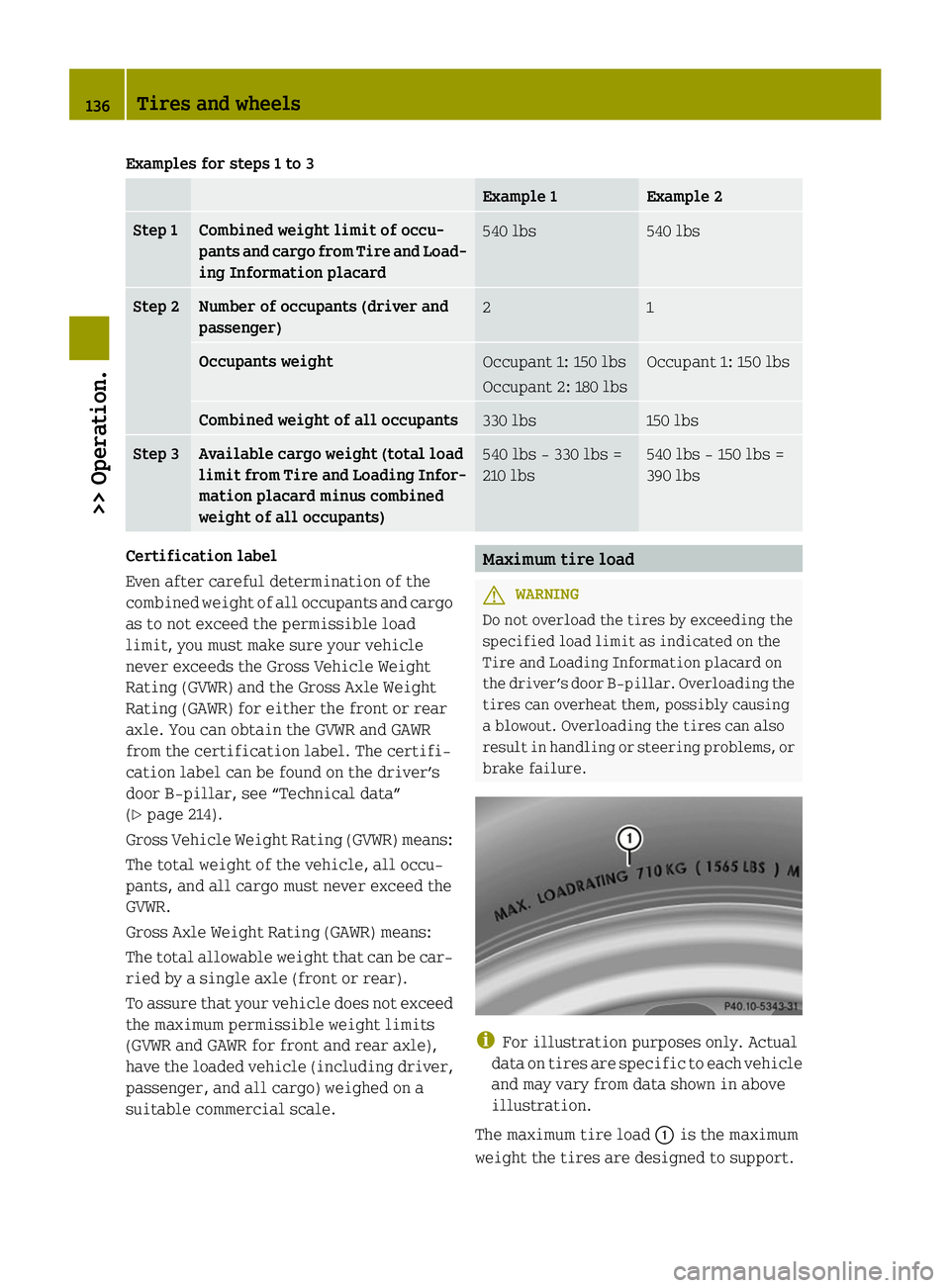
Examples for steps 1 to 3
Example 1 Example 2
Step 1 Combined weight limit of occu-
pants and cargo from Tire and Load-
ing Information placard
540 lbs 540 lbs
Step 2 Number of occupants (driver and
passenger)
2 1
Occupants weight
Occupant 1: 150 lbs
Occupant 2: 180 lbs Occupant 1: 150 lbs
Combined weight of all occupants
330 lbs 150 lbs
Step 3 Available cargo weight (total load
limit from Tire and Loading Infor-
mation placard minus combined
weight of all occupants)
540 lbs - 330 lbs =
210 lbs 540 lbs - 150 lbs =
390 lbs
Certification label
Even after careful determination of the
combined weight of all occupants and cargo
as to not exceed the permissible load
limit, you must make sure your vehicle
never exceeds the Gross Vehicle Weight
Rating (GVWR) and the Gross Axle Weight
Rating (GAWR) for either the front or rear
axle. You can obtain the GVWR and GAWR
from the certification label. The certifi-
cation label can be found on the driver’s
door B‑pillar, see “Technical data”
(Y
page 214).
Gross Vehicle Weight Rating (GVWR) means:
The total weight of the vehicle, all occu-
pants, and all cargo must never exceed the
GVWR.
Gross Axle Weight Rating (GAWR) means:
The total allowable weight that can be car-
ried by a single axle (front or rear).
To assure that your vehicle does not exceed
the maximum permissible weight limits
(GVWR and GAWR for front and rear axle),
have the loaded vehicle (including driver,
passenger, and all cargo) weighed on a
suitable commercial scale. Maximum tire load
G
WARNING
Do not overload the tires by exceeding the
specified load limit as indicated on the
Tire and Loading Information placard on
the driver’s door B‑pillar. Overloading the
tires can overheat them, possibly causing
a blowout. Overloading the tires can also
result in handling or steering problems, or
brake failure. i
For illustration purposes only. Actual
data on tires are specific to each vehicle
and may vary from data shown in above
illustration.
The maximum tire load 0043is the maximum
weight the tires are designed to support. 136
Tires and wheels>> Operation.