battery SSANGYONG NEW ACTYON SPORTS 2013 Service Manual
[x] Cancel search | Manufacturer: SSANGYONG, Model Year: 2013, Model line: NEW ACTYON SPORTS, Model: SSANGYONG NEW ACTYON SPORTS 2013Pages: 751, PDF Size: 72.63 MB
Page 25 of 751
01-8
4. CAUTION WHEN SERVICING THE ENGINE
1) Cleaness
Engine has a lot of precisely machined (grinding, polishing, lapping) surfaces. Thus, there should be great
cautions for cleaness when servicing the engine components. Apply the engine oil on the sliding surfaces
when assemblying the components. Every component should be disassembled and reassembled in
accordance with the correct sequences. Before servicing the engine, the negative cable should be
diconnected from the battery. Otherwise, some electric or electronic components could be damaged.
2) Servicing
(1) Lifting up the vehicle
Always keep the safety precautions.
To prevent the vehicle from rolling down, put the chocks under the tires (when using a 4-post lift).
Make sure to support the correct lifting points (when using a 2-post lift) -
-
-
(2) Exhaust system
Wear the safety glove when removing the exhaust pipe.
Make sure that the exhaust pipe is cooled before removing it. -
-Before service work, be sure to disconnect battery negative (-) terminal to prevent damages by bad
wire and short.
To prevent the foreign material from getting into engine cylinder, cover the inlet of air cleaner if the
air cleaner has been removed -
-
Page 42 of 751
02-110000-00
4. GUIDELINES ON ENGINE SERVICE
To prevent personal injuries and vehicle damages that can be caused by mistakes during engine and
unit inspection/repair and to secure optimum engine performance and safety after service works, basic
cautions and service work guidelines that can be easily forgotten during engine service works are
described in.
Cautions before service works
For safe and correct works, you must observe the working procedures and instructions in this
manual. And, use the designated tools as follow:
Engine stand / Heavy duty engine jack
To prevent the engine from starting abruptly, do not allow anybody to get in the vehicle while
servicing in engine compartment.
Before work on engine and each electrical equipment, be sure to disconnect battery negative (-)
terminal.
Before service works, be sure to prepare the works by cleaning and aligning work areas.
Do not allow the foreign material get into the fuel injection system.
When removing the engine, use only the safety hook on engine and engine hanger. Do not support
the bottom of oil pan with a jack.
Engine and accessories ▶
-
-
-
-
-
-
▶
Completely drain the engine oil, coolant and fuel from engine before removal.
Before disassembling/assembling the engine components, carefully read the working procedures in
this manual.
Make sure to keep the specified tightening torques during installation.
Clean and properly lubricate the parts before reassembly.
Carefully check that there are not any interference while servicing. -
-
-
-
-
Page 43 of 751
02-12
Electrical equipment ▶
Electric devices should be handled more carefully.
Currently, the engine has a lot of electric devices. there could be poor engine performance, incomplete
combustion and other abnormal symptoms due to short circuit or poor contact.
Before work on engine and each electrical equipment, be sure to disconnect battery negative (-)
terminal.
When replacing the electric device, use only genuine part and check the conditions of connections
and grounds. Loosened connection or ground make cause a fire and personal injury. -
-Fuel and lubrication system ▶
Do not allow the fluid and engine oil to make contact with the body paintwork and hoses.
If work on the fluid system such as fuel and oil, working area should be well ventilated and smoking
should be prohibited.
Gasket or seal on the fuel/lubrication system should be replaced with new ones and bolts and nuts
should be tightened as specified.
After removal/installation works, be sure to check whether there is leak on the connecting section. -
-
-
-
If fine dust or foreign material enters into DI engine's fuel system, there can be serious damages in HP
pump and injectors. Thus, be sure to plug the inlets of removed fuel line components with cap and
protect removed parts not to be contaminated with dirt. (Refer to cleanness in this manual while working
on DI engine fuel system)
Page 82 of 751
03-52210-01
Follow the job procedures. If you find a defective component, replace it with new one. 5.
Once disconnected, the fuel pipes between HP pump and fuel rail and between fuel rail and each
injector should be replaced with new ones. The pipes should be tightened tospecified tightening torques
during installation. Over or under torques out of specified range may cause damages and leaks at
connections. Once installed, the pipes have been deformed according to the force during installation,
therefore they are not reusable. The copper washer on injector should be replaced with new one. The
injector holder bolt should be tightened to specified tightening torque as well. If not, the injection point
may be deviated from correct position, and it may cause engine disorder.
Plug the removed components with clean and undamaged sealing caps and store it into the box to
keep the conditions when it was installed. 6.
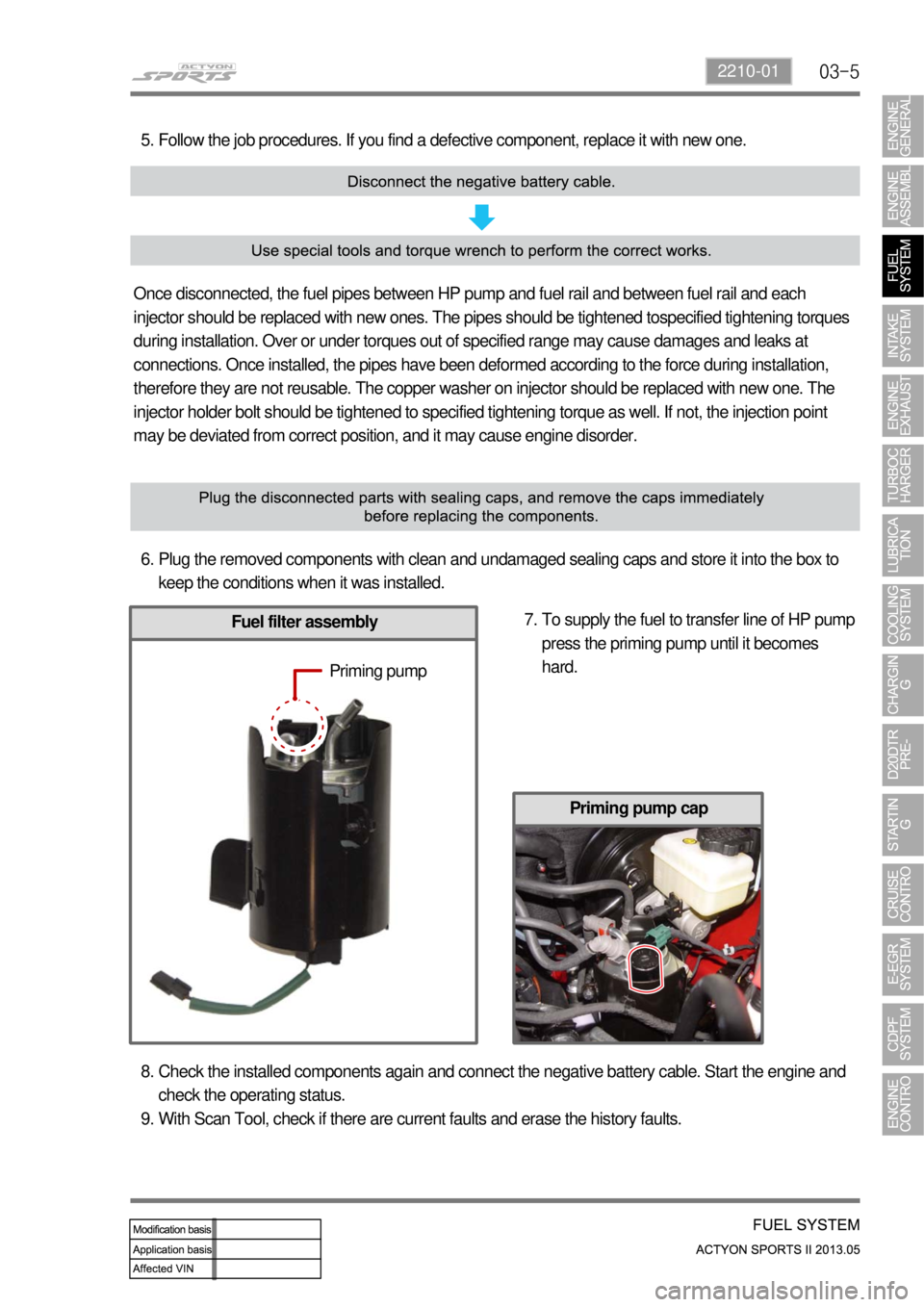
To supply the fuel to transfer line of HP pump
press the priming pump until it becomes
hard. 7.
Priming pump
Priming pump cap
Fuel filter assembly
Check the installed components again and connect the negative battery cable. Start the engine and
check the operating status.
With Scan Tool, check if there are current faults and erase the history faults. 8.
9.
Page 148 of 751
09-31451-01
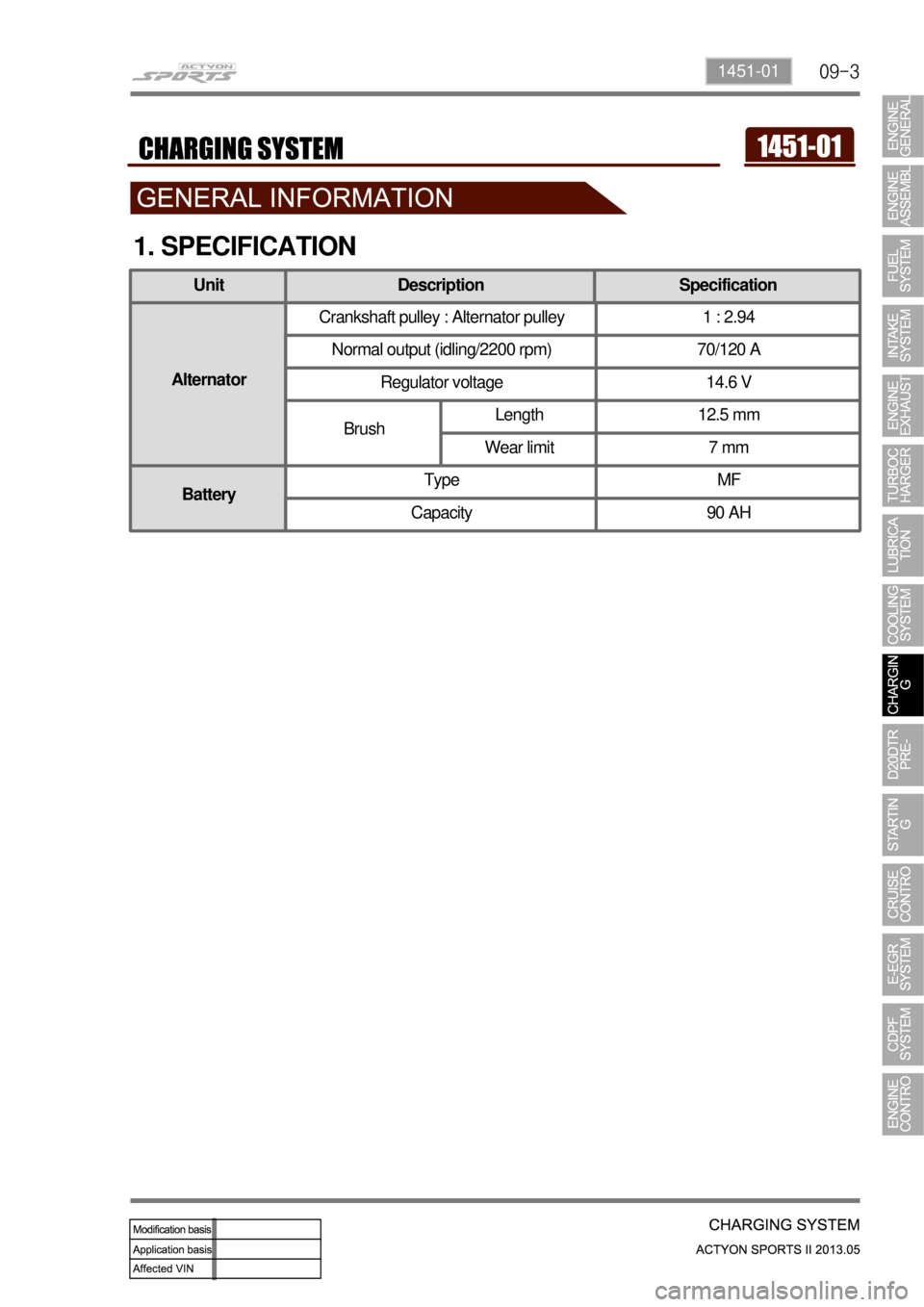
1. SPECIFICATION
AlternatorCrankshaft pulley : Alternator pulley 1 : 2.94
Normal output (idling/2200 rpm) 70/120 A
Regulator voltage 14.6 V
BrushLength 12.5 mm
Wear limit 7 mm
BatteryType MF
Capacity 90 AH
Unit Description Specification
Page 149 of 751
09-4
2. INSPECTION
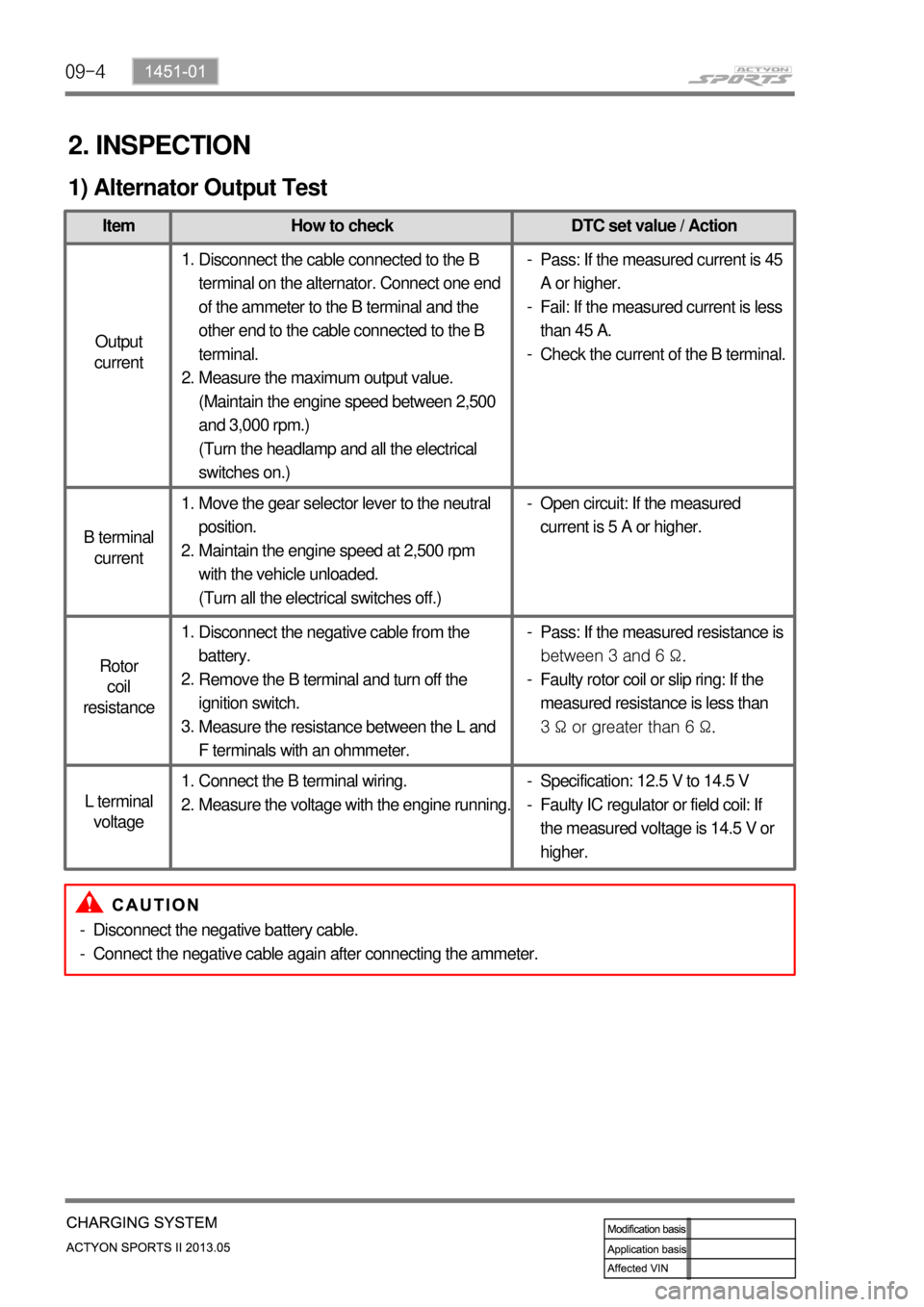
1) Alternator Output Test
Item How to check DTC set value / Action
Output
current
B terminal
current
Rotor
coil
resistance
L terminal
voltage
Disconnect the cable connected to the B
terminal on the alternator. Connect one end
of the ammeter to the B terminal and the
other end to the cable connected to the B
terminal.
Measure the maximum output value.
(Maintain the engine speed between 2,500
and 3,000 rpm.)
(Turn the headlamp and all the electrical
switches on.) 1.
2.Pass: If the measured current is 45
A or higher.
Fail: If the measured current is less
than 45 A.
Check the current of the B terminal. -
-
-
Move the gear selector lever to the neutral
position.
Maintain the engine speed at 2,500 rpm
with the vehicle unloaded.
(Turn all the electrical switches off.) 1.
2.Open circuit: If the measured
current is 5 A or higher. -
Disconnect the negative cable from the
battery.
Remove the B terminal and turn off the
ignition switch.
Measure the resistance between the L and
F terminals with an ohmmeter. 1.
2.
3.Pass: If the measured resistance is
between 3 and 6 Ω.
Faulty rotor coil or slip ring: If the
measured resistance is less than
3 Ω or greater than 6 Ω. -
-
Connect the B terminal wiring.
Measure the voltage with the engine running. 1.
2.Specification: 12.5 V to 14.5 V
Faulty IC regulator or field coil: If
the measured voltage is 14.5 V or
higher. -
-
Disconnect the negative battery cable.
Connect the negative cable again after connecting the ammeter. -
-
Page 150 of 751
09-51451-01
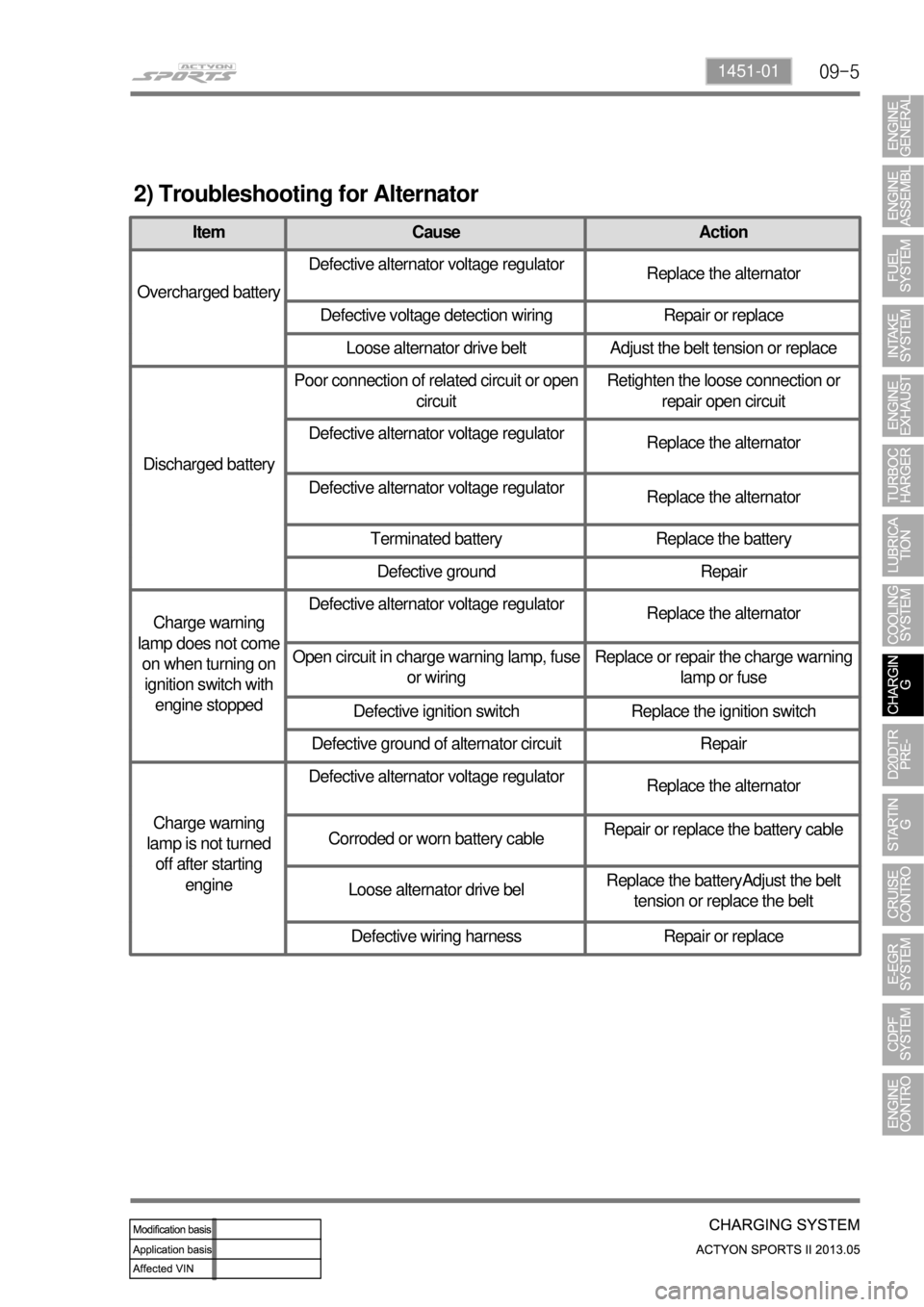
2) Troubleshooting for Alternator
Item Cause Action
Overcharged batteryDefective alternator voltage regulator
Replace the alternator
Defective voltage detection wiring Repair or replace
Loose alternator drive belt Adjust the belt tension or replace
Discharged batteryPoor connection of related circuit or open
circuitRetighten the loose connection or
repair open circuit
Defective alternator voltage regulator
Replace the alternator
Defective alternator voltage regulator
Replace the alternator
Terminated battery Replace the battery
Defective ground Repair
Charge warning
lamp does not come
on when turning on
ignition switch with
engine stoppedDefective alternator voltage regulator
Replace the alternator
Open circuit in charge warning lamp, fuse
or wiringReplace or repair the charge warning
lamp or fuse
Defective ignition switch Replace the ignition switch
Defective ground of alternator circuit Repair
Charge warning
lamp is not turned
off after starting
engineDefective alternator voltage regulator
Replace the alternator
Corroded or worn battery cableRepair or replace the battery cable
Loose alternator drive belReplace the batteryAdjust the belt
tension or replace the belt
Defective wiring harness Repair or replace
Page 151 of 751

09-6
3) Checking Battery
Page 152 of 751
09-71451-01
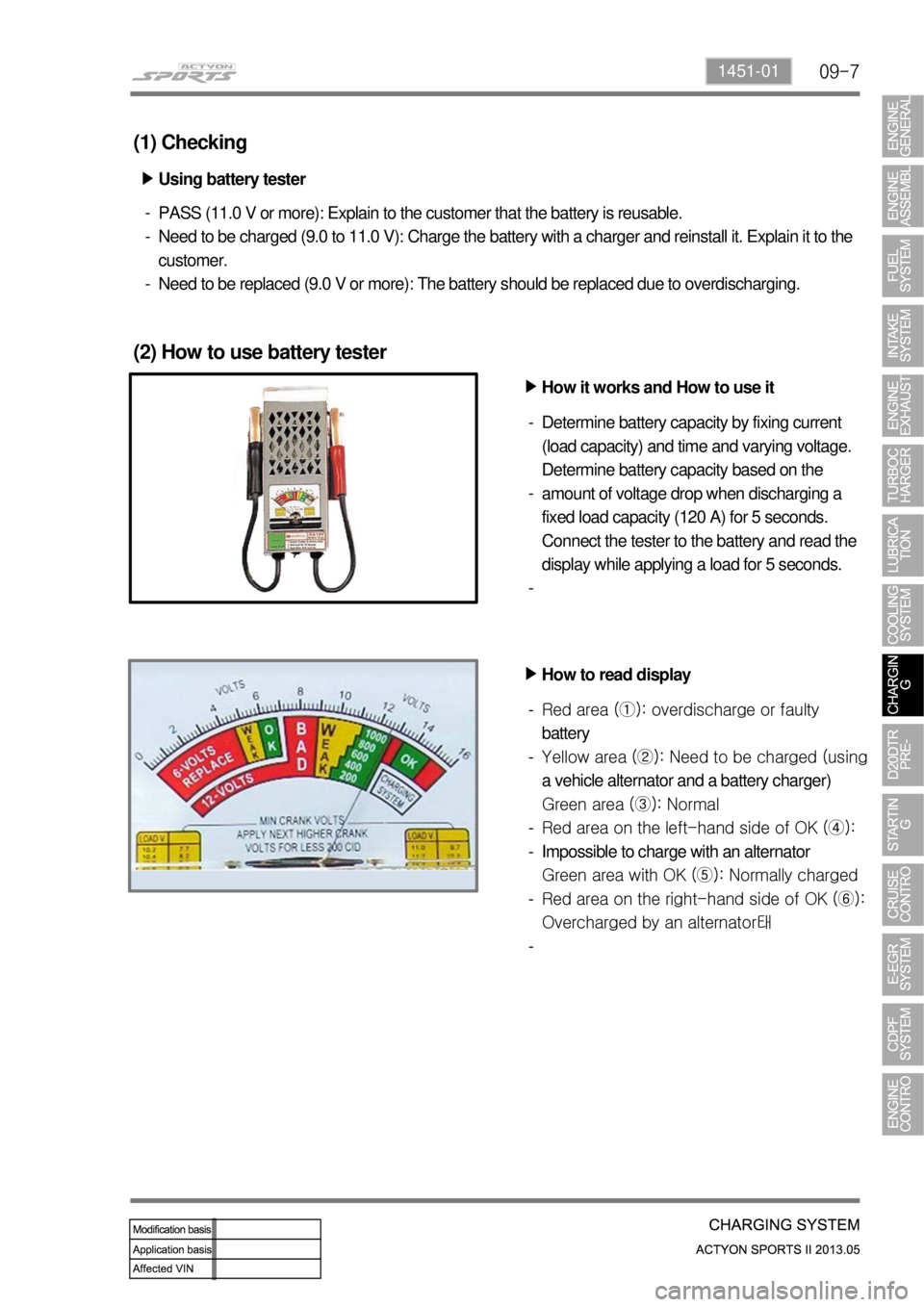
(1) Checking
Using battery tester ▶
PASS (11.0 V or more): Explain to the customer that the battery is reusable.
Need to be charged (9.0 to 11.0 V): Charge the battery with a charger and reinstall it. Explain it to the
customer.
Need to be replaced (9.0 V or more): The battery should be replaced due to overdischarging. -
-
-
(2) How to use battery tester
How it works and How to use it ▶
Determine battery capacity by fixing current
(load capacity) and time and varying voltage.
Determine battery capacity based on the
amount of voltage drop when discharging a
fixed load capacity (120 A) for 5 seconds.
Connect the tester to the battery and read the
display while applying a load for 5 seconds. -
-
-
How to read display ▶
Red area (①): overdischarge or faulty
battery
Yellow area (②): Need to be charged (using
a vehicle alternator and a battery charger)
Green area (③): Normal
Red area on the left-hand side of OK (④):
Impossible to charge with an alternator
Green area with OK (⑤): Normally charged
Red area on the right-hand side of OK (⑥):
Overcharged by an alternator태 -
-
-
-
-
-
Page 153 of 751
09-8
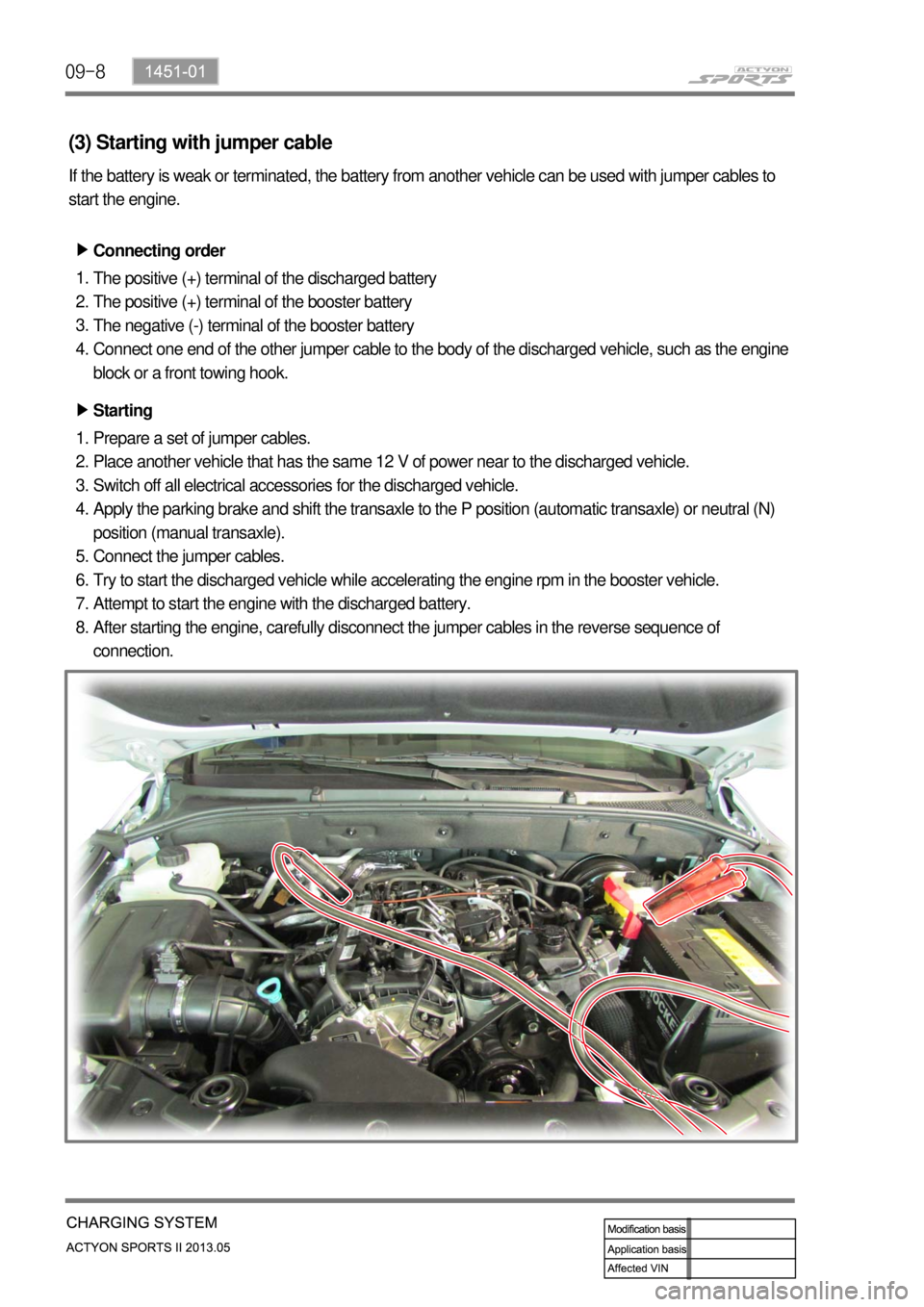
(3) Starting with jumper cable
If the battery is weak or terminated, the battery from another vehicle can be used with jumper cables to
start the engine.
Connecting order ▶
The positive (+) terminal of the discharged battery
The positive (+) terminal of the booster battery
The negative (-) terminal of the booster battery
Connect one end of the other jumper cable to the body of the discharged vehicle, such as the engine
block or a front towing hook. 1.
2.
3.
4.
Starting ▶
Prepare a set of jumper cables.
Place another vehicle that has the same 12 V of power near to the discharged vehicle.
Switch off all electrical accessories for the discharged vehicle.
Apply the parking brake and shift the transaxle to the P position (automatic transaxle) or neutral (N)
position (manual transaxle).
Connect the jumper cables.
Try to start the discharged vehicle while accelerating the engine rpm in the booster vehicle.
Attempt to start the engine with the discharged battery.
After starting the engine, carefully disconnect the jumper cables in the reverse sequence of
connection. 1.
2.
3.
4.
5.
6.
7.
8.