fuel pump SSANGYONG RODIUS 2012 User Guide
[x] Cancel search | Manufacturer: SSANGYONG, Model Year: 2012, Model line: RODIUS, Model: SSANGYONG RODIUS 2012Pages: 715, PDF Size: 79.36 MB
Page 219 of 715

03-152210-01
Static test for backleak of injector ▶
Disconnect the injector return hose and
cover the openings with caps shaped
screw (included in the special tool). 1.
Connect the hose of the container for
measuring backleak to the return nipple of
the injector.
(prevent air entry to the low pressure line) 2.
Disconnect the IMV connector of the
high pressure pump and then fuel
pressure sensor connector. 3.
The connector of the injector can be easily
contaminated. Always keep it clean.
Crank the engine 2 times for 5 seconds.
Check the time for flow if injector backleak
and confirm that it is within the specified
range. 4.
5.
If the value is out of the specified range,
replace the injector.
SpecificationBelow 20 sec.
Page 221 of 715
03-172210-01
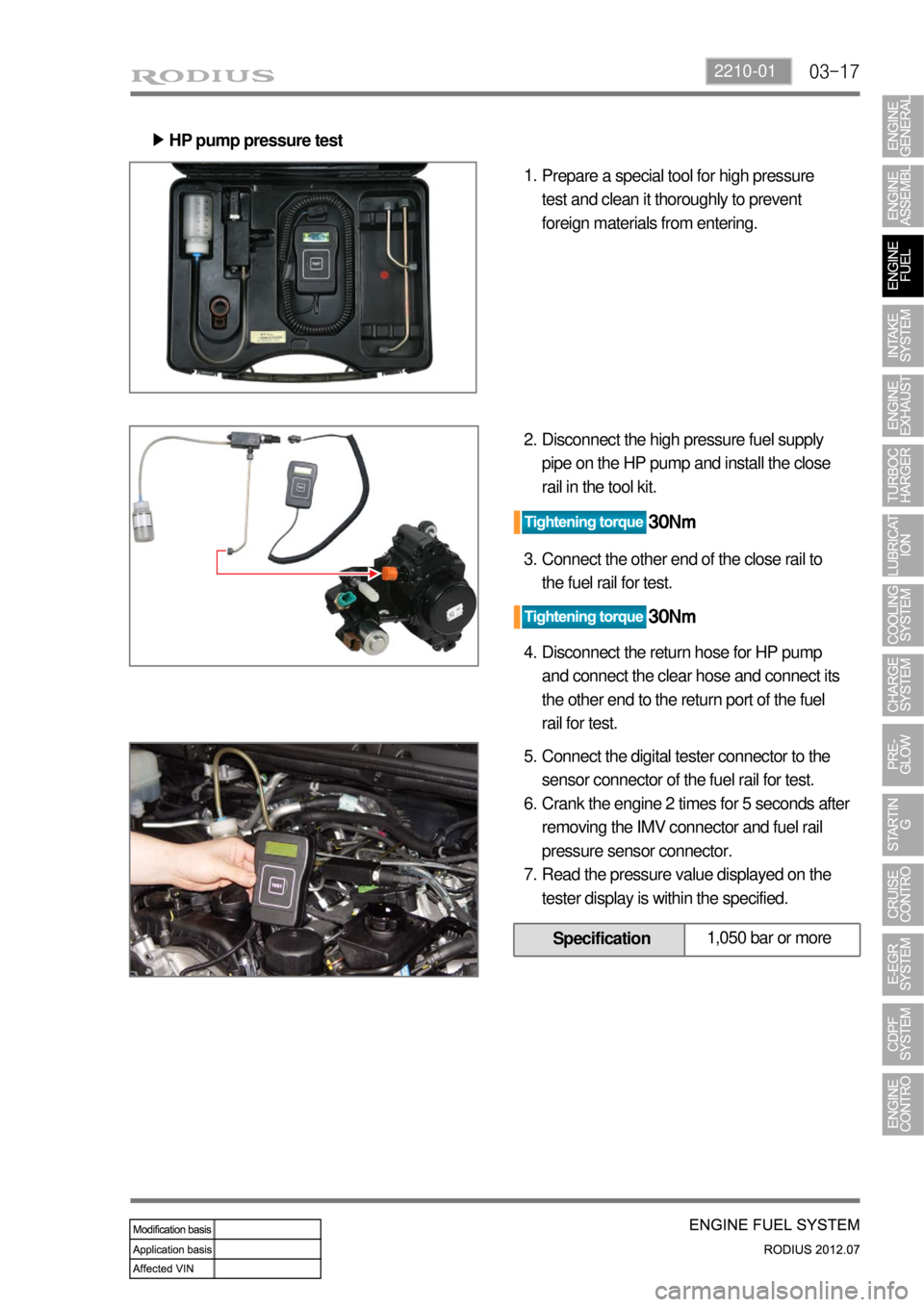
HP pump pressure test ▶
Prepare a special tool for high pressure
test and clean it thoroughly to prevent
foreign materials from entering. 1.
Disconnect the high pressure fuel supply
pipe on the HP pump and install the close
rail in the tool kit. 2.
Connect the other end of the close rail to
the fuel rail for test. 3.
Disconnect the return hose for HP pump
and connect the clear hose and connect its
the other end to the return port of the fuel
rail for test. 4.
Connect the digital tester connector to the
sensor connector of the fuel rail for test.
Crank the engine 2 times for 5 seconds after
removing the IMV connector and fuel rail
pressure sensor connector.
Read the pressure value displayed on the
tester display is within the specified. 5.
6.
7.
Specification1,050 bar or more
Page 223 of 715
03-192210-01
2) Cleanness
(1) Cleanness of DI engine fuel system
Cleanness of DI engine fuel system and service procedures ▶
The fuel system for DI engine consists of transfer (low pressure) line and high pressure line.
Its highest pressure reaches over 1,800 bar.
<007a00960094008c0047008a00960094009700960095008c0095009b009a0047009000950047009000950091008c008a009b00960099004700880095008b0047006f007700470097009c00940097004700880099008c004700940088008a008f0090009500
8c008b00470088009b0047009b008f008c004700940090008a>rometer 100 μm of
preciseness.
The pressure regulation and injector operation are done by electric source from engine ECU.
Accordingly, if the internal valve is stuck due to foreign materials, injector remains open.
Even in this case, the HP pump still operates to supply high pressurized fuel. This increases the
pressure to combustion chamber (over 250 bar) and may cause fatal damage to engine.
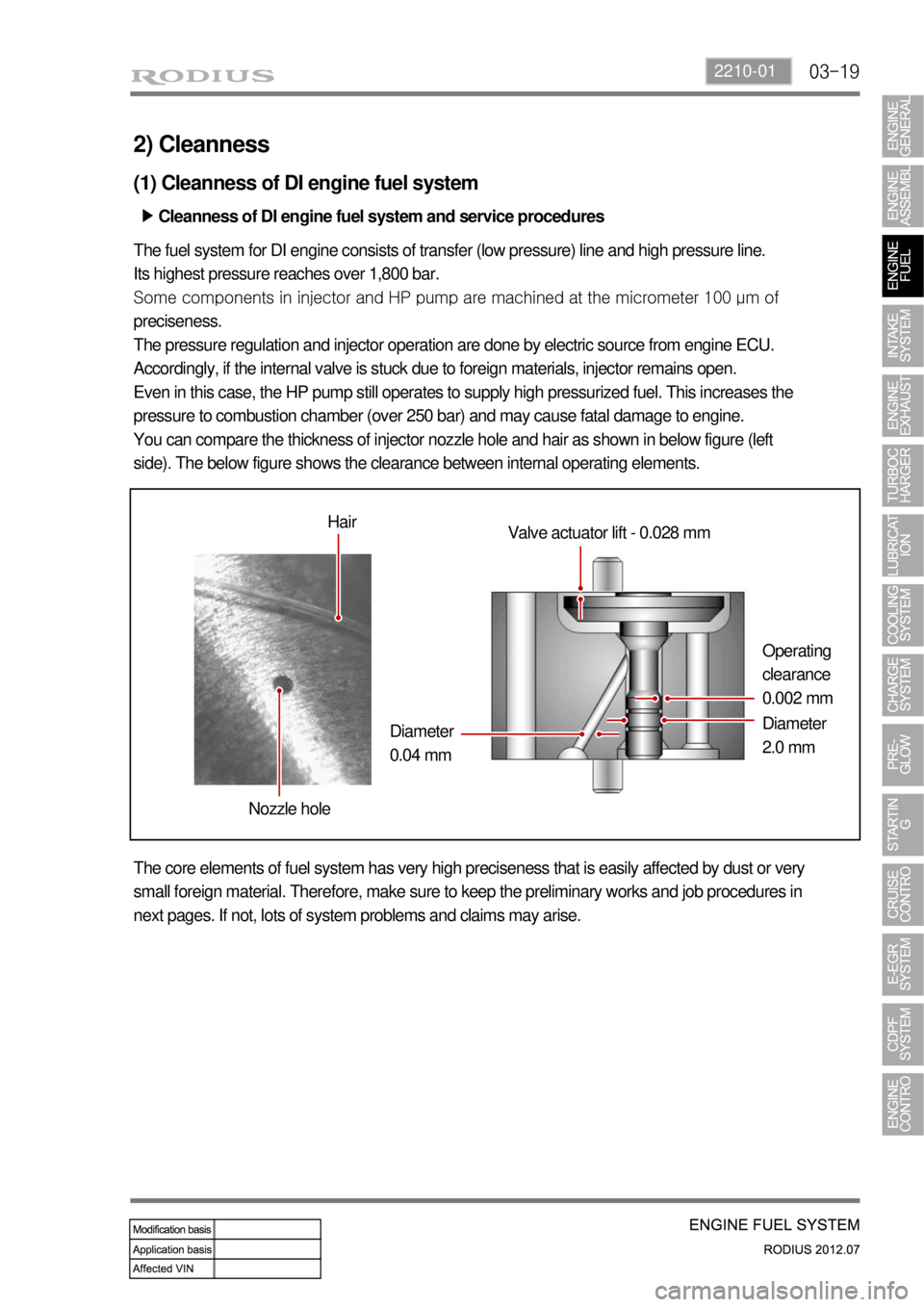
You can compare the thickness of injector nozzle hole and hair as shown in below figure (left
side). The below figure shows the clearance between internal operating elements.
The core elements of fuel system has very high preciseness that is easily affected by dust or very
small foreign material. Therefore, make sure to keep the preliminary works and job procedures in
next pages. If not, lots of system problems and claims may arise.
Hair
Nozzle holeValve actuator lift - 0.028 mm
Diameter
0.04 mm
Operating
clearance
0.002 mm
Diameter
2.0 mm
Page 224 of 715

03-20
Water
separator
(2) Di engine and its expected problems and remedies can be caused by
water in fuel
System supplement against paraffin separation ▶
In case of Diesel fuel, paraffin, one of the elements, can be separated from fuel during winter and
then can stick on the fuel filter blocking fuel flow and causing difficult starting finally. Oil
companies supply summer fuel and winter fuel by differentiating mixing ratio of kerosene and
other elements by region and season. However, above phenomenon can be happened if stations
have poor facilities or sell improper fuel for the season. In case of DI engine, purity of fuel is very
important factor to keep internal preciseness of HP pump and injector.
Accordingly, more dense mesh than conventional fuel filter is used. To prevent fuel filter internal
clogging due to paraffin separation, SYMC is using fuel line that high pressure and temperature
fuel injected by injector returns through fuel filter to have an effect of built-in heater (see fuel
system).
System supplement and remedy against water in fuel ▶
As mentioned above, some gas stations supply fuel with excessive than specified water. In the
conventional IDI engine, excessive water in the fuel only causes dropping engine power or engine
hunting. However, fuel system in the DI engine consists of precise components so water in the
fuel can cause malfunctions of HP pump due to poor lubrication of pump caused by poor coating
film during high speed pumping and bacterization (under long period parking). To prevent
problems can be caused by excessive water in fuel, water separator is installed inside of fuel
filter. When fuel is passing filter, water that has relatively bigger specific gravity is accumulated on
the bottom of the filter.
Water drain from water separator ▶
If water in the separator on the fuel filter exceeds a certain level, it will be supplied to HP pump
with fuel, so the engine ECU turns on warning lamp on the meter cluster and buzzer if water level
is higher than a certain level.
Due to engine layout, a customer cannot easily drain water from fuel filter directly, so if a
customer checks in to change engine oil, be sure to perform water drain from fuel filter.
To separate the water from the fuel filter,
remove the fuel filter assembly first.
Page 225 of 715

03-212210-01
1. OVERVIEW
The components in fuel system supply the fuel and generate the high pressure to inject the fuel to
each injector. They are controlled by the engine ECU.
The common rail fuel injection system consists of fuel tank, fuel line, low pressure line which
supplies low pressure fuel to the low pressure pump (including high pressure pump), common rail
which distributes and accumulates the high pressurized fuel from the fuel pump, high pressure
line which connected to the injector, and the engine control unit (ECU) which calculates the
accelerator pedal position and controls the overall performance of vehicle based on the input
signals from various sensors.
1) Fuel Flow Diagram
Page 227 of 715

03-232210-01
T-MAP sensor
Measuring booster pressure
and temperatureFuel rail assembly
Relieving the pulsation.
Measuring the fuel pressure.
Distributing the fuel to injectors.
High pressure pump
Generating high pressurized fuel
and supplying it according to
engine rpm, required volume,
required pressure
Plunger type HP pump (1,800 bar)
Vane type LP pump (6 bar)
Accelerator pedal position
sensor
Detecting driver's intention for
speed up/down
Fuel filter assembly
Supplying clean fuel/fuel
heating/water separation by
priming pump
Page 228 of 715

03-24
2) Fuel System Flow Diagram
The fuel from the fuel tank is supplied to the fuel heater of fuel filter/priming pump and then low
pressure generated by the low pressure pump (built into HP pump) is transmitted to the HP pump.
The fuel pressure at the HP pump is controlled by the IMV valve, and the maximum allowed
pressure is 1,800 bar. The compressed fuel at the fuel pump is delivered to the rail, and injected
by the injectors according to the injection signals. The injection method is the same with the
conventional method; Fuel return by backleak which operates the needle valve.
The major difference is that the fuel return line is connected to the fuel filter inlet port, not the HP
pump venturi.
The pressure from the high pressure pump is increased to 1,800 bar from 1,600 bar, and the
pump is now installed to the cylinder head (cylinder block for previous model). The fuel pressure
is generated by the operation of intake camshaft and gears. The specifications for the IMV valve
and the fuel temperature sensor are not changed.
Page 340 of 715
15-150000-00
(3) Fuel Pressure Control
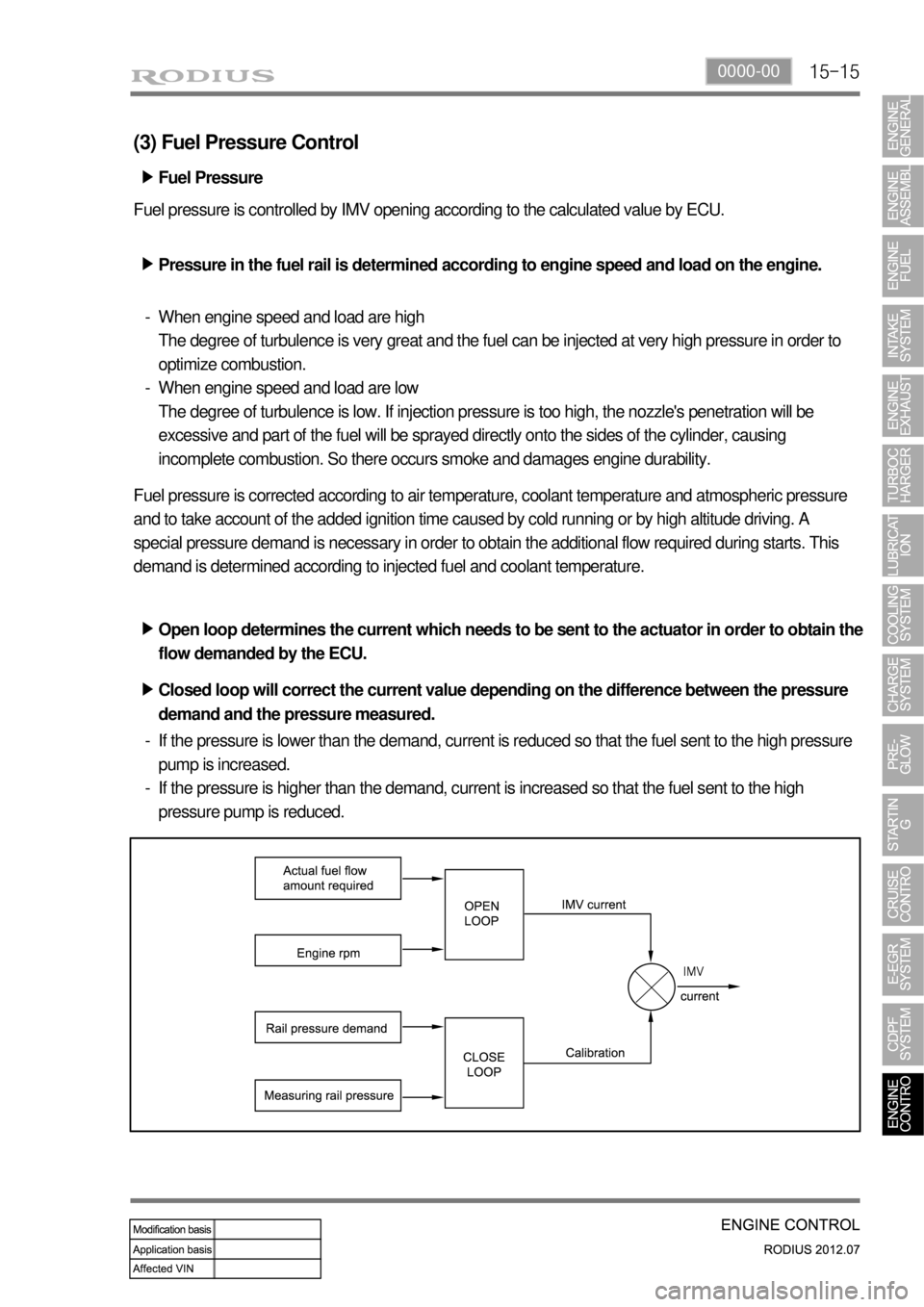
Fuel pressure is controlled by IMV opening according to the calculated value by ECU.
Pressure in the fuel rail is determined according to engine speed and load on the engine. ▶
When engine speed and load are high
The degree of turbulence is very great and the fuel can be injected at very high pressure in order to
optimize combustion.
When engine speed and load are low
The degree of turbulence is low. If injection pressure is too high, the nozzle's penetration will be
excessive and part of the fuel will be sprayed directly onto the sides of the cylinder, causing
incomplete combustion. So there occurs smoke and damages engine durability. -
-
Fuel pressure is corrected according to air temperature, coolant temperature and atmospheric pressure
and to take account of the added ignition time caused by cold running or by high altitude driving. A
special pressure demand is necessary in order to obtain the additional flow required during starts. This
demand is determined according to injected fuel and coolant temperature.
Open loop determines the current which needs to be sent to the actuator in order to obtain the
flow demanded by the ECU. ▶
Closed loop will correct the current value depending on the difference between the pressure
demand and the pressure measured. ▶
If the pressure is lower than the demand, current is reduced so that the fuel sent to the high pressure
pump is increased.
If the pressure is higher than the demand, current is increased so that the fuel sent to the high
pressure pump is reduced. -
-Fuel Pressure ▶
Page 387 of 715

03-32211-22
1. FUEL SYSTEM SPECIFICATION
Use Only Unleaded Fuel Rated at 89 Octane or Higher ▶
Fuel quality and additives contained in fuel have a significant effect on power output, drivability,
and life of theengine. Fuel with too low an octane number can cause engine knock.
Do Not Use Methanol ▶
Fuels containing methanol (wood alcohol) should not be used in vehicle.
This type of fuel can reduce vehicle performance and damage components of the fuel system.
Vehicle Fueling from Drums or Storage Containers ▶
For safety reasons (particularly when using noncommercial fueling systems) fuel containers,
pumps and hoses must be properly earthed. Static electricity build up can occur under certain
atmospheric and fuel flow conditions if unearthed hoses, particularly plastic, are fitted to the fuel-
dispensing pump.
It is therefore recommended that earthed pumps with integrally earthed hoses be used, and that
storage containers be properly earthed during all noncommercial fueling operations.
Page 427 of 715

01-138410-02
▶Ef17, Ef18, Ef22, Ef24~Ef26, FUEL PUMP RELAY