brake SSANGYONG TURISMO 2013 Service Manual
[x] Cancel search | Manufacturer: SSANGYONG, Model Year: 2013, Model line: TURISMO, Model: SSANGYONG TURISMO 2013Pages: 796, PDF Size: 78.99 MB
Page 150 of 796
01-6
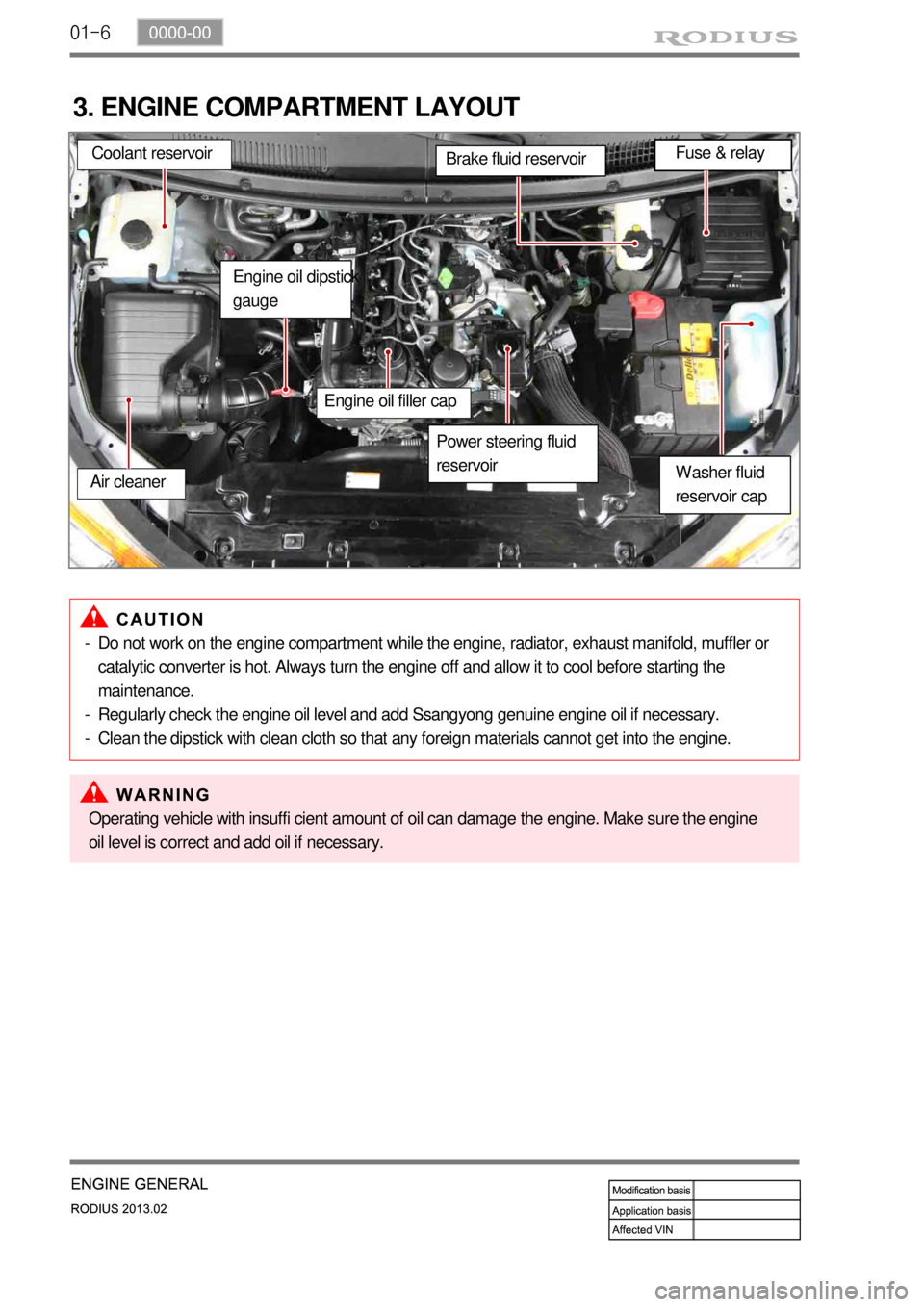
3. ENGINE COMPARTMENT LAYOUT
Do not work on the engine compartment while the engine, radiator, exhaust manifold, muffler or
catalytic converter is hot. Always turn the engine off and allow it to cool before starting the
maintenance.
Regularly check the engine oil level and add Ssangyong genuine engine oil if necessary.
Clean the dipstick with clean cloth so that any foreign materials cannot get into the engine. -
-
-
Power steering fluid
reservoirBrake fluid reservoir
Engine oil dipstick
gauge
Washer fluid
reservoir cap Engine oil filler cap
Air cleaner
Operating vehicle with insuffi cient amount of oil can damage the engine. Make sure the engine
oil level is correct and add oil if necessary.
Coolant reservoirFuse & relay
Page 160 of 796
01-16
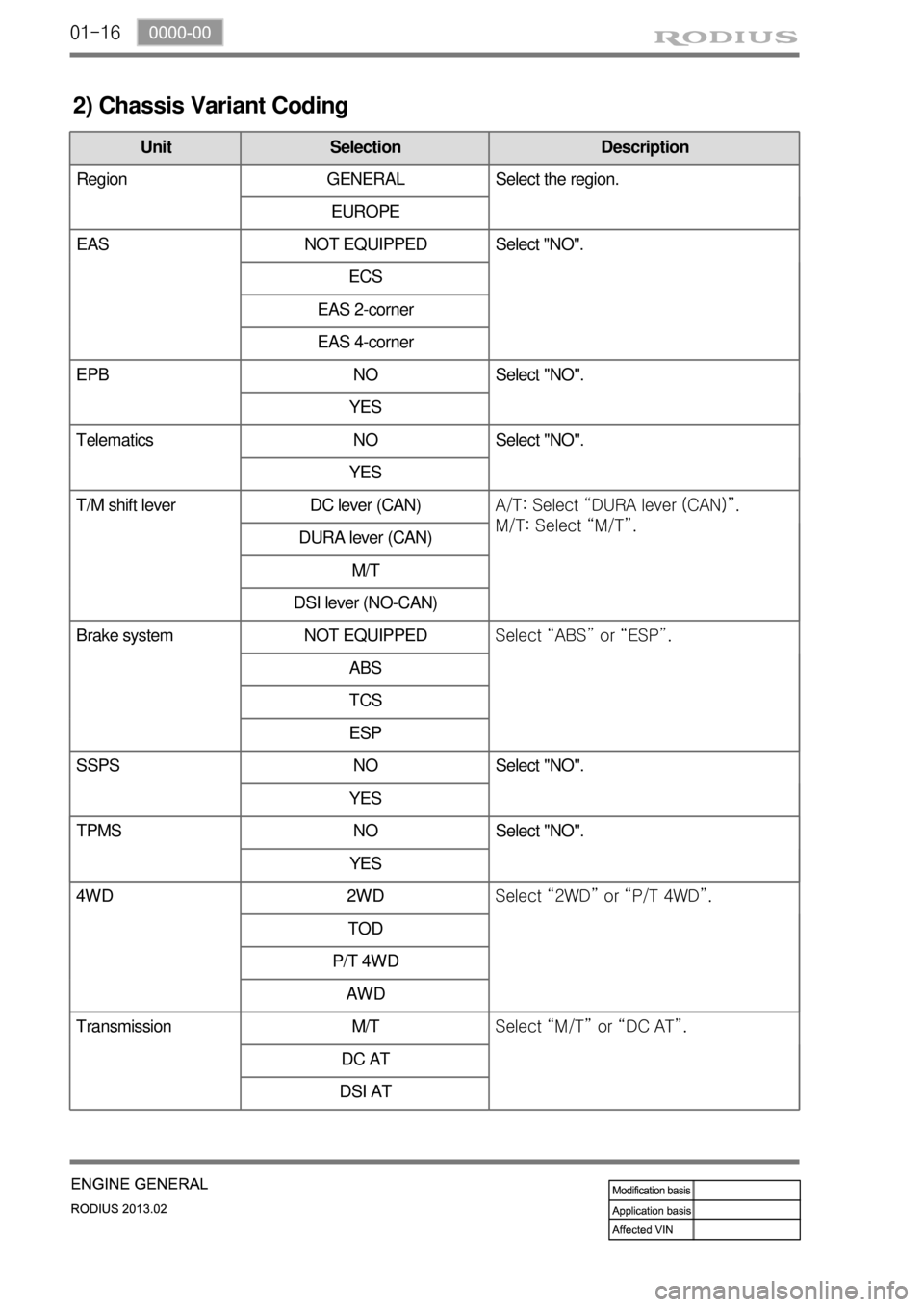
2) Chassis Variant Coding
Unit Selection Description
Region GENERAL Select the region.
EUROPE
EAS NOT EQUIPPED Select "NO".
ECS
EAS 2-corner
EAS 4-corner
EPB NO Select "NO".
YES
Telematics NO Select "NO".
YES
T/M shift lever DC lever (CAN)A/T: Select “DURA lever (CAN)”.
M/T: Select “M/T”.
DURA lever (CAN)
M/T
DSI lever (NO-CAN)
Brake system NOT EQUIPPEDSelect “ABS” or “ESP”.
ABS
TCS
ESP
SSPS NO Select "NO".
YES
4WD 2WDSelect “2WD” or “P/T 4WD”.
TOD
P/T 4WD
AWD
Transmission M/TSelect “M/T” or “DC AT”.
DC AT
DSI AT
TPMS NO Select "NO".
YES
Page 167 of 796
02-8
4. CHECK AND INSPECTION
1) Cylinder
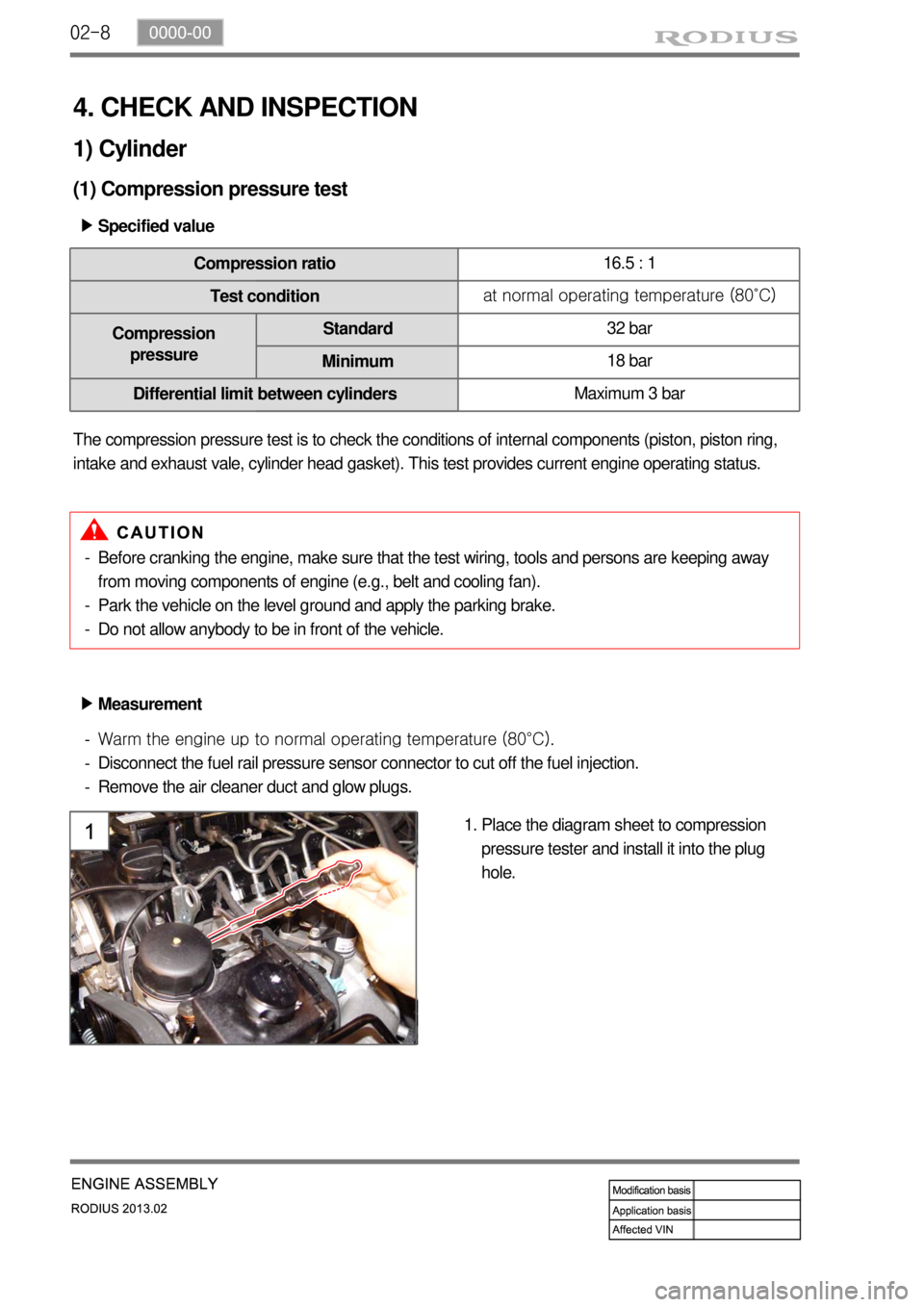
(1) Compression pressure test
Specified value ▶
Compression ratio16.5 : 1
Test conditionat normal operating temperature (80˚C)
Compression
pressureStandard32 bar
Minimum18 bar
Differential limit between cylindersMaximum 3 bar
The compression pressure test is to check the conditions of internal components (piston, piston ring,
intake and exhaust vale, cylinder head gasket). This test provides current engine operating status.
Measurement ▶
Warm the engine up to normal operating temperature (80°C).
Disconnect the fuel rail pressure sensor connector to cut off the fuel injection.
Remove the air cleaner duct and glow plugs. -
-
-
Place the diagram sheet to compression
pressure tester and install it into the plug
hole. 1. Before cranking the engine, make sure that the test wiring, tools and persons are keeping away
from moving components of engine (e.g., belt and cooling fan).
Park the vehicle on the level ground and apply the parking brake.
Do not allow anybody to be in front of the vehicle. -
-
-
Page 177 of 796
02-18
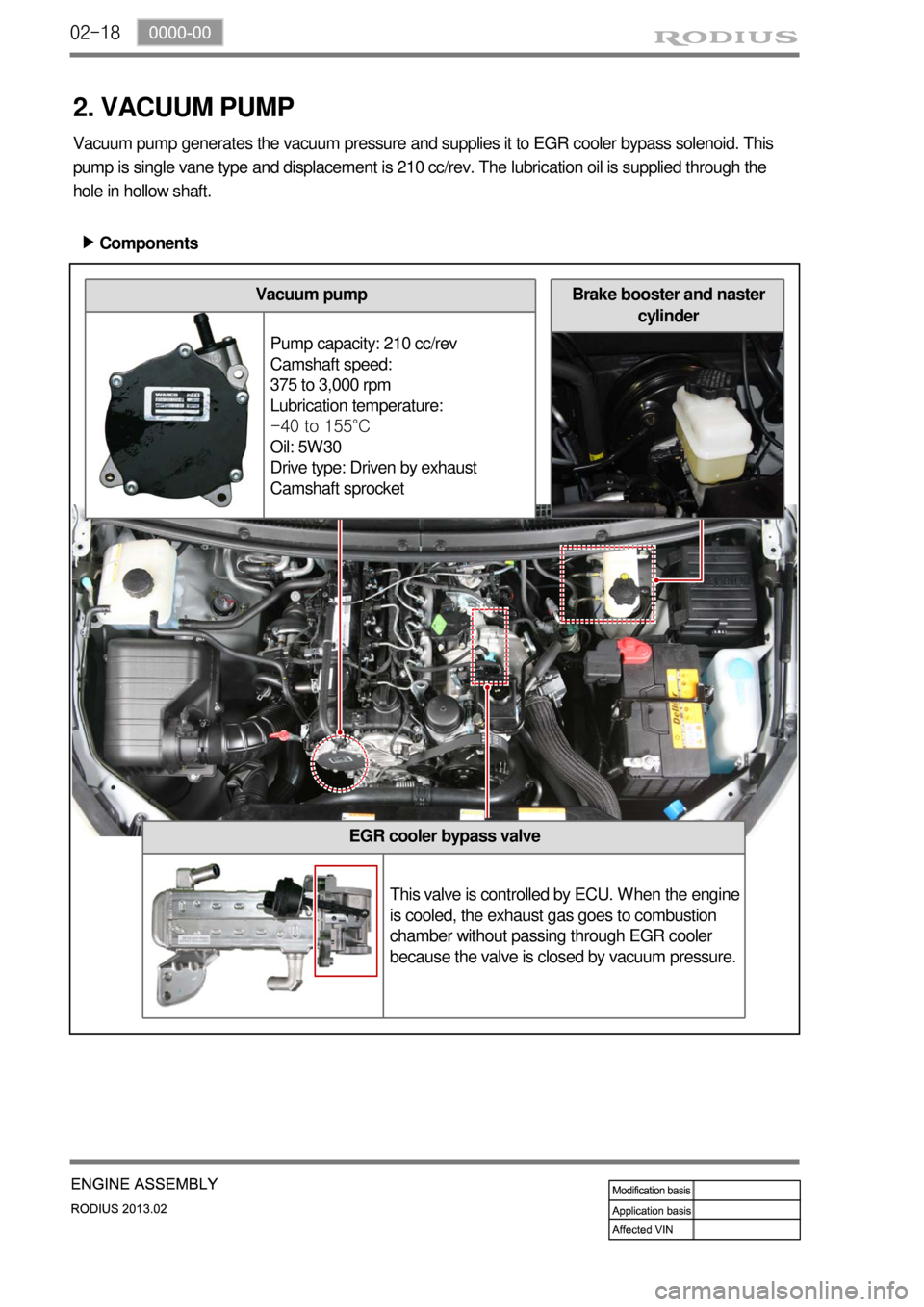
Vacuum pump
Pump capacity: 210 cc/rev
Camshaft speed:
375 to 3,000 rpm
Lubrication temperature:
-40 to 155°C
Oil: 5W30
Drive type: Driven by exhaust
Camshaft sprocket
EGR cooler bypass valve
This valve is controlled by ECU. When the engine
is cooled, the exhaust gas goes to combustion
chamber without passing through EGR cooler
because the valve is closed by vacuum pressure.
2. VACUUM PUMP
Vacuum pump generates the vacuum pressure and supplies it to EGR cooler bypass solenoid. This
pump is single vane type and displacement is 210 cc/rev. The lubrication oil is supplied through the
hole in hollow shaft.
Components ▶
Brake booster and naster
cylinder
Page 269 of 796
07-4
2. MAINTENANCE
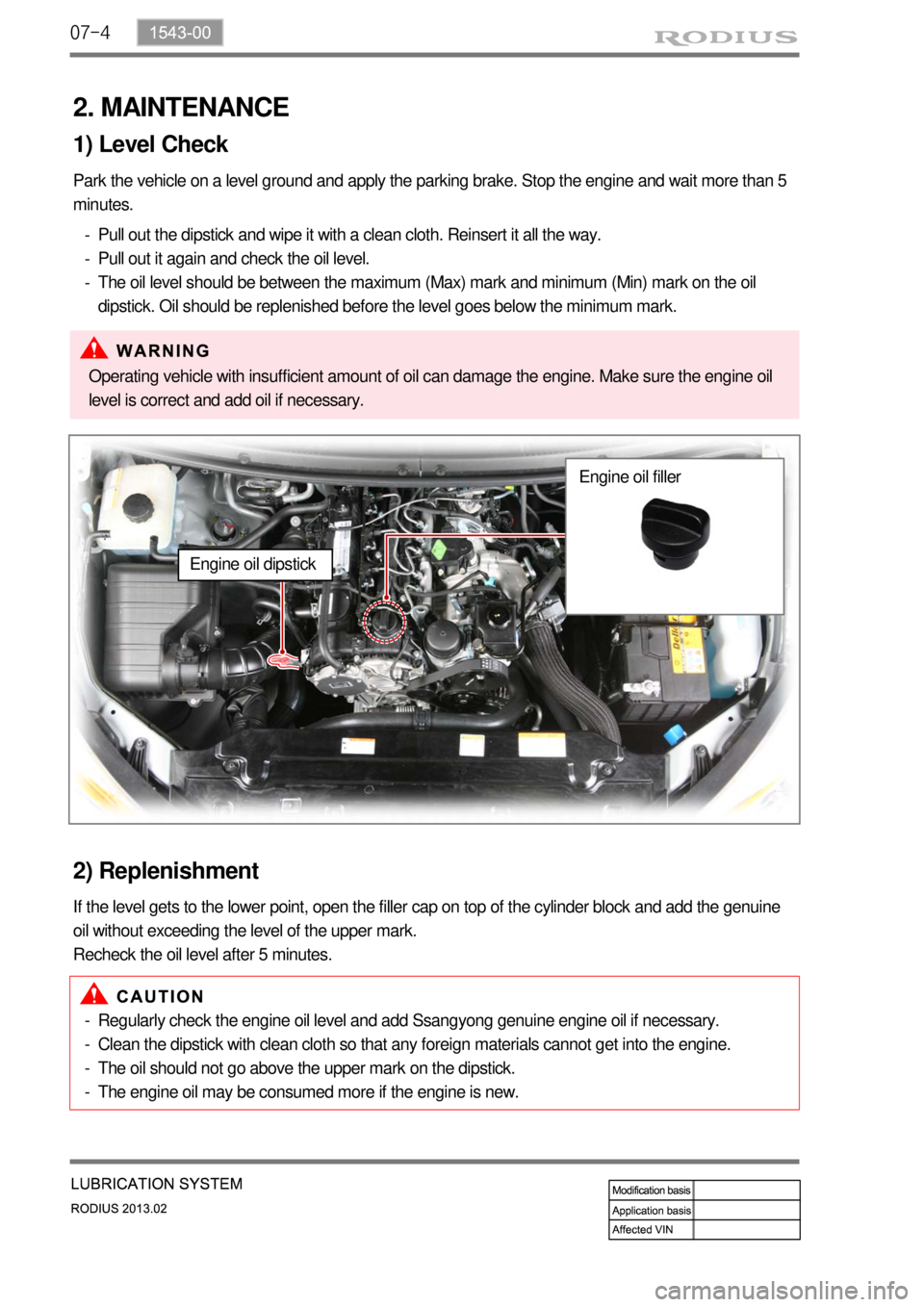
1) Level Check
Park the vehicle on a level ground and apply the parking brake. Stop the engine and wait more than 5
minutes.
Pull out the dipstick and wipe it with a clean cloth. Reinsert it all the way.
Pull out it again and check the oil level.
The oil level should be between the maximum (Max) mark and minimum (Min) mark on the oil
dipstick. Oil should be replenished before the level goes below the minimum mark. -
-
-
Operating vehicle with insufficient amount of oil can damage the engine. Make sure the engine oil
level is correct and add oil if necessary.
2) Replenishment
If the level gets to the lower point, open the filler cap on top of the cylinder block and add the genuine
oil without exceeding the level of the upper mark.
Recheck the oil level after 5 minutes.
Regularly check the engine oil level and add Ssangyong genuine engine oil if necessary.
Clean the dipstick with clean cloth so that any foreign materials cannot get into the engine.
The oil should not go above the upper mark on the dipstick.
The engine oil may be consumed more if the engine is new. -
-
-
-
Engine oil dipstick
Engine oil filler
Page 274 of 796
08-51520-00
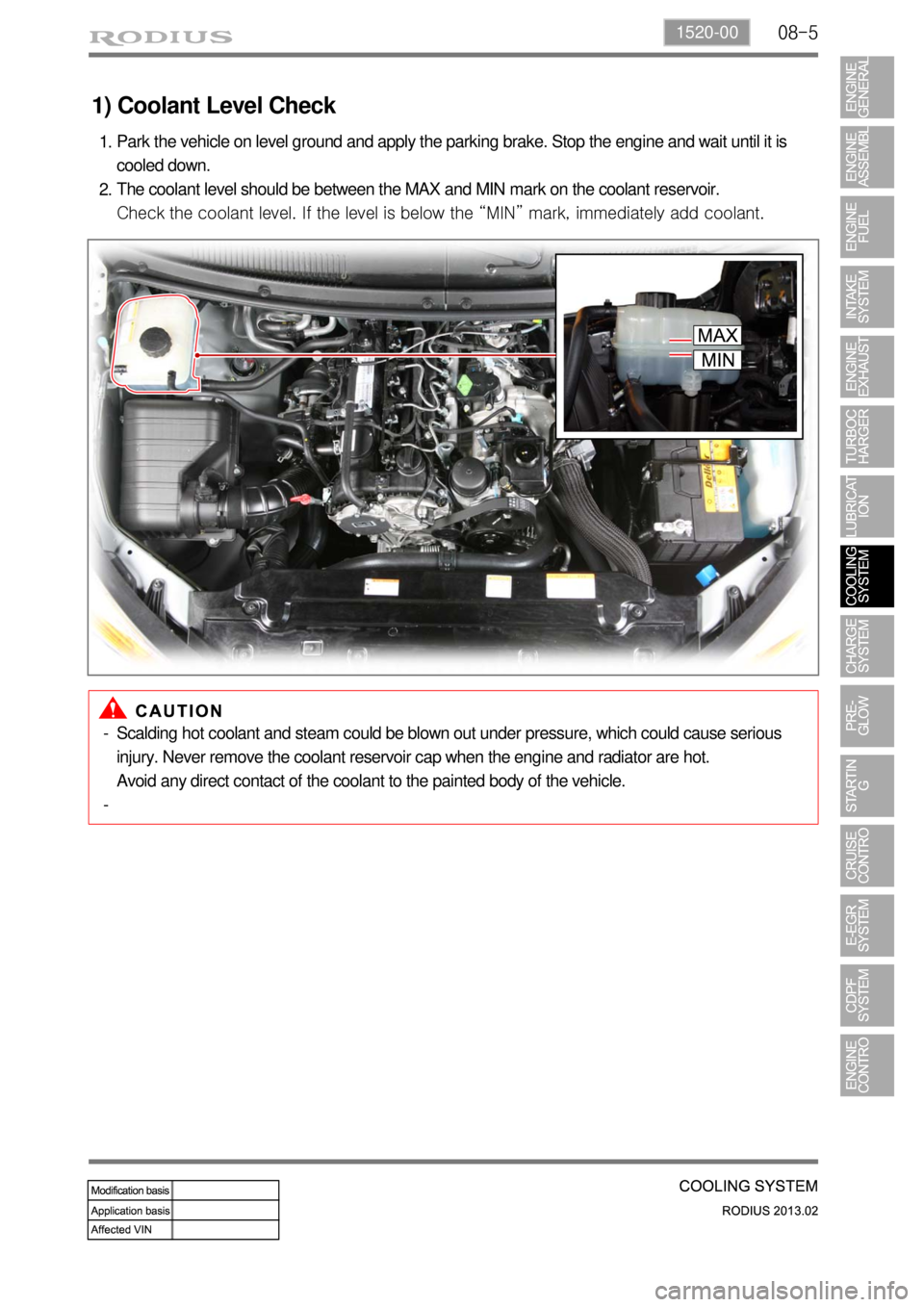
1) Coolant Level Check
Park the vehicle on level ground and apply the parking brake. Stop the engine and wait until it is
cooled down.
The coolant level should be between the MAX and MIN mark on the coolant reservoir.
Check the coolant level. If the level is below the “MIN” mark, immediately add coolant. 1.
2.
Scalding hot coolant and steam could be blown out under pressure, which could cause serious
injury. Never remove the coolant reservoir cap when the engine and radiator are hot.
Avoid any direct contact of the coolant to the painted body of the vehicle. -
-
Page 284 of 796
09-8
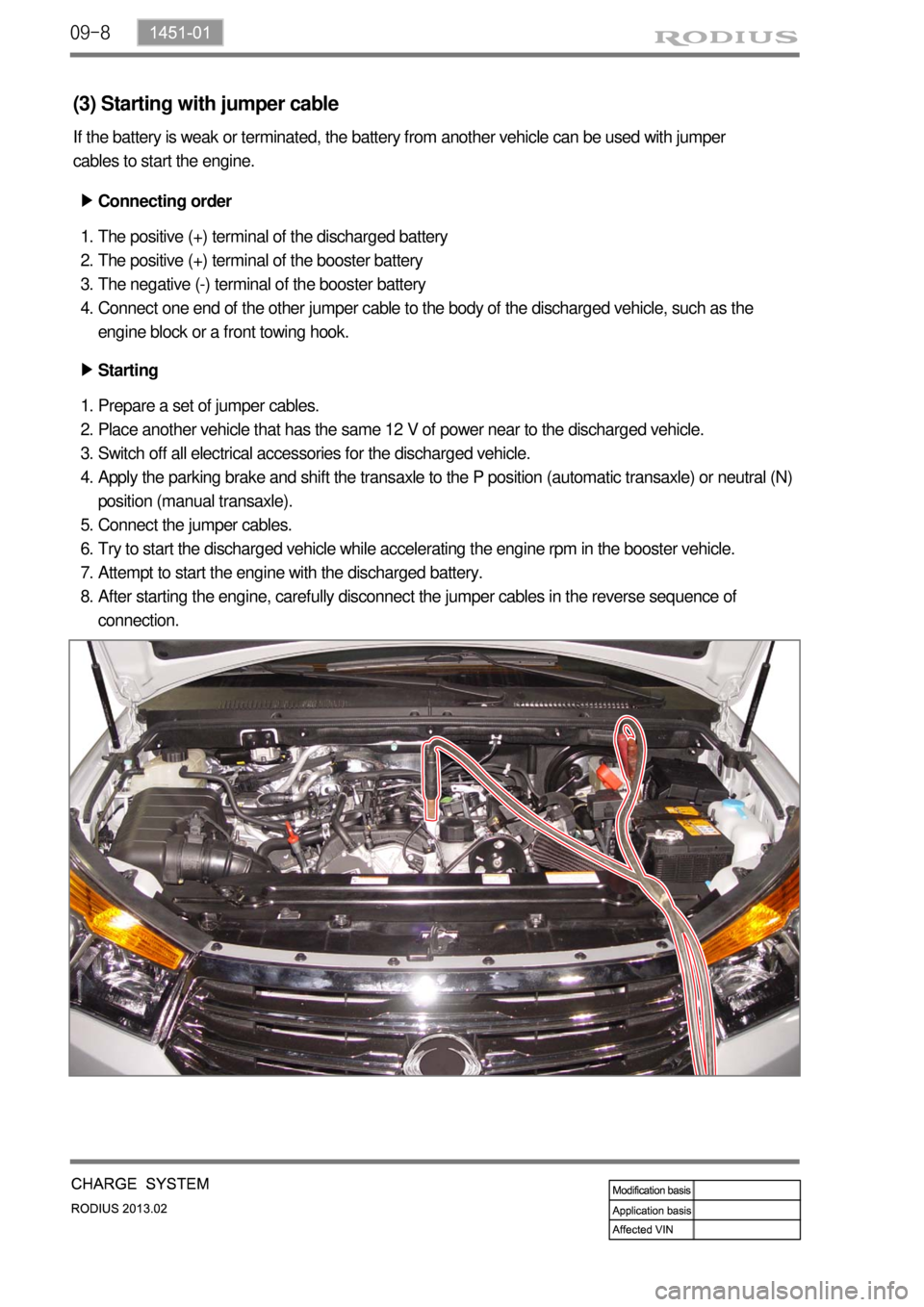
(3) Starting with jumper cable
If the battery is weak or terminated, the battery from another vehicle can be used with jumper
cables to start the engine.
Connecting order ▶
The positive (+) terminal of the discharged battery
The positive (+) terminal of the booster battery
The negative (-) terminal of the booster battery
Connect one end of the other jumper cable to the body of the discharged vehicle, such as the
engine block or a front towing hook. 1.
2.
3.
4.
Starting ▶
Prepare a set of jumper cables.
Place another vehicle that has the same 12 V of power near to the discharged vehicle.
Switch off all electrical accessories for the discharged vehicle.
Apply the parking brake and shift the transaxle to the P position (automatic transaxle) or neutral (N)
position (manual transaxle).
Connect the jumper cables.
Try to start the discharged vehicle while accelerating the engine rpm in the booster vehicle.
Attempt to start the engine with the discharged battery.
After starting the engine, carefully disconnect the jumper cables in the reverse sequence of
connection. 1.
2.
3.
4.
5.
6.
7.
8.
Page 306 of 796

12-78510-23
3) Decelerating with the Cruise Control System
(1) While the cruise control system is running
Push down the DECEL switch of the cruise control lever and hold it until the desired speed is
reached without a brake pedal intervention. But the cruise control system cannot maintain the
cruise function at less than 34 km/h.
When the desired speed is reached, release the lever. 1.
2.
(2) When the cruise control system is not running
Push down the DECEL switch of the cruise control lever and hold it.
And then release the accelerator pedal slowly.
When the desired speed is reached, release the lever. But the cruise control system cannot
maintain the cruise function at less than 34 km/h. 1.
2.
3.
(3) Tap-down while the cruise control system is running
Push down the DECEL switch of the cruise control lever less than 0.5 second per one switching
while the cruise control system is running. This is a tap-down switching.
When you operate a tap-down switching, the vehicle is decelerated by 1.0 km/h below the previous
set speed.
If you want to decelerate to 10 km/h, operate the tap-down switching ten times without the brake
pedal intervention. 1.
2.
3.
Page 308 of 796

12-98510-23
5) Normal Cancellation of the Cruise Control
The cruise control system will be canceled when one or more items of the following conditions are
applied;
Keep the main cruise control switch in the neutral position when not using the cruise control.When the brake pedal is depressed.
When the cruising speed is downed less than 38 km/h.
When the OFF switch is operated by pulling the cruise control lever (Type A) or by pushing the ON-
OFF switch of the cruise control lever (Type B).
When ESP is activated.
When applying the parking brake when driving.
When using the clutch in order to shift (M/T only).
And the cruise control system can be operated again in driving state. 1.
2.
3.
4.
5.
6.
Page 309 of 796
12-10
(2) Using the Cruise Control on Hills
How well the cruise control works on hills depends on the speed, load, and the steepness of the hill.
When going up steep hills, you may have to depress the accelerator pedal to maintain your speed.
When going downhill, you may have to brake or shift to a lower gear to keep your speed down.
Applying the brake takes you out of the cruise control.
And the cruise control system cannot be operated again in driving state. In this case, you should stop
the vehicle, and turn off the ignition switch and then turn it on again. After you do that, you can use the
cruise control s
ystem again. But if the cruise control system isn’t recovered, you should contact
a Ssangyong Dealer for diagnosis of the cruise control system.
Abnormal changes of the gear selector lever can damage the engine. Do not move the gear shift
lever to Neutral while driving at the set speed. Automatic transmission damage may result.
The speed that has been set may not be maintained on uphill or downhill slopes.
The speed may drop to less than the set speed on a steep uphill grade. The accelerator must be
used if you want to maintain that speed.
The speed may increase to more than the set speed on a steep downhill grade. When the speed
increases too much, turn off the cruise control. -
-
-
-
(1) Abnormal Cancellation of the Cruise Control
When the rapid deceleration is applied without braking.
When the rapid acceleration is applied without acceleration pedal intervention.
When the cruise control lever is failed.
When the brake switch and the brake light switch input signal are implausible. 1.
2.
3.
4.