coolant temperature SSANGYONG TURISMO 2013 Service Manual
[x] Cancel search | Manufacturer: SSANGYONG, Model Year: 2013, Model line: TURISMO, Model: SSANGYONG TURISMO 2013Pages: 796, PDF Size: 78.99 MB
Page 148 of 796
01-4
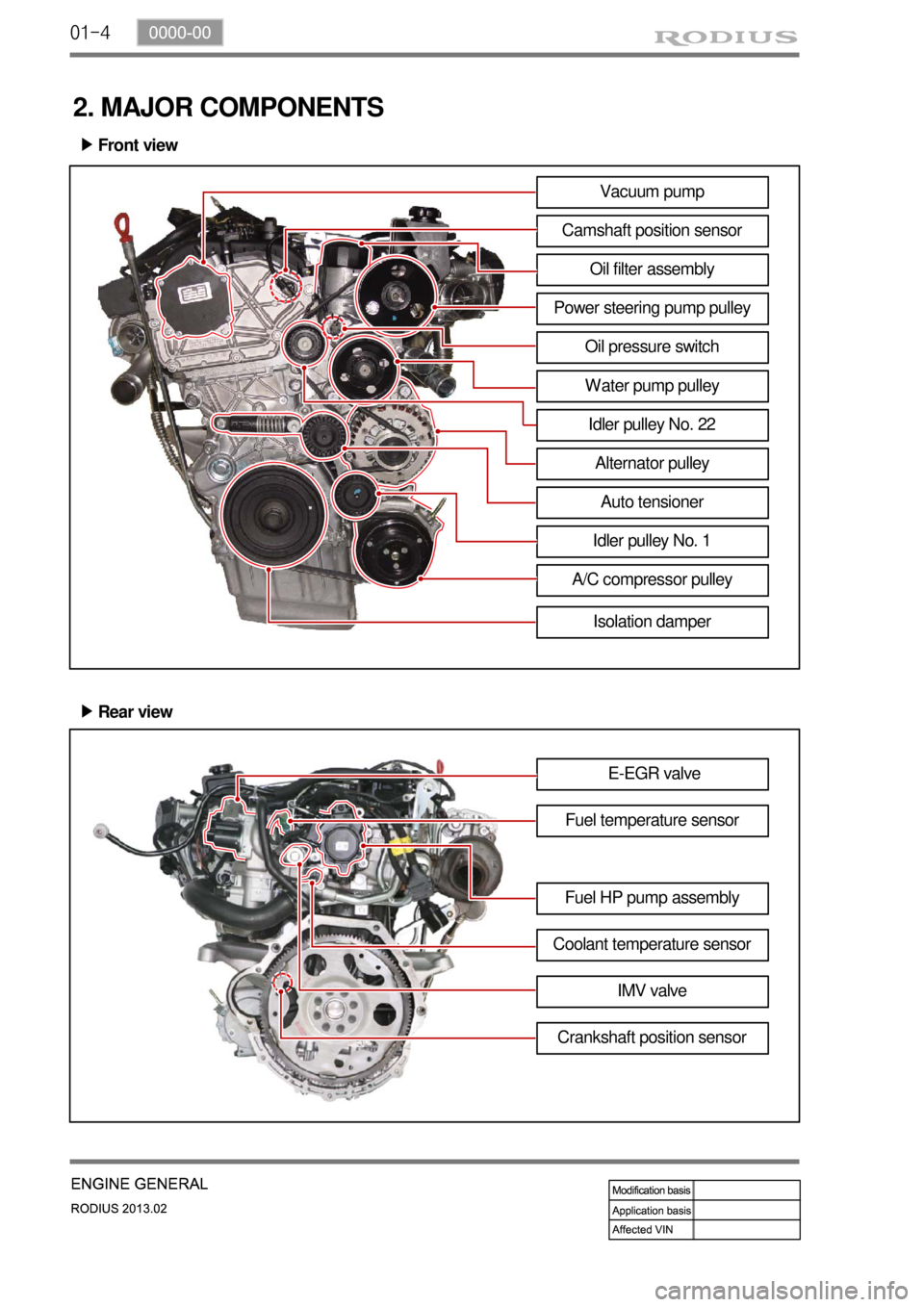
2. MAJOR COMPONENTS
Front view ▶
Vacuum pump
Camshaft position sensor
Oil filter assembly
Power steering pump pulley
Oil pressure switch
Water pump pulley
Idler pulley No. 22
Alternator pulley
Auto tensioner
Idler pulley No. 1
A/C compressor pulley
Rear view ▶
E-EGR valve
Fuel temperature sensor
Fuel HP pump assembly
Coolant temperature sensor
Crankshaft position sensorIMV valve
Isolation damper
Page 149 of 796
01-50000-00
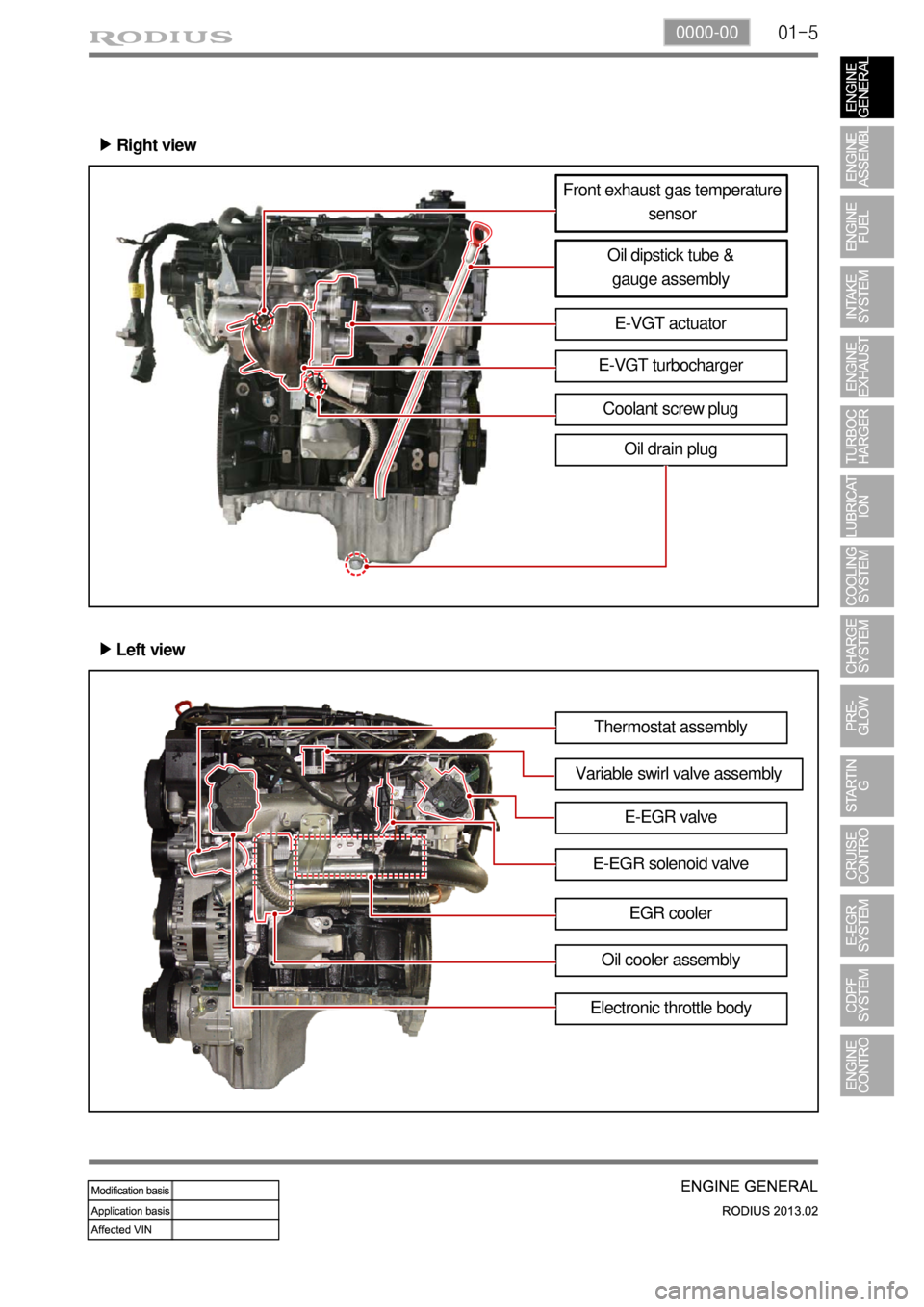
Right view ▶
Front exhaust gas temperature
sensor
Oil dipstick tube &
gauge assembly
E-VGT actuator
E-VGT turbocharger
Coolant screw plug
Oil drain plug
Left view ▶
Thermostat assembly
Variable swirl valve assembly
EGR cooler E-EGR valve
E-EGR solenoid valve
Oil cooler assembly
Electronic throttle body
Page 152 of 796
01-8
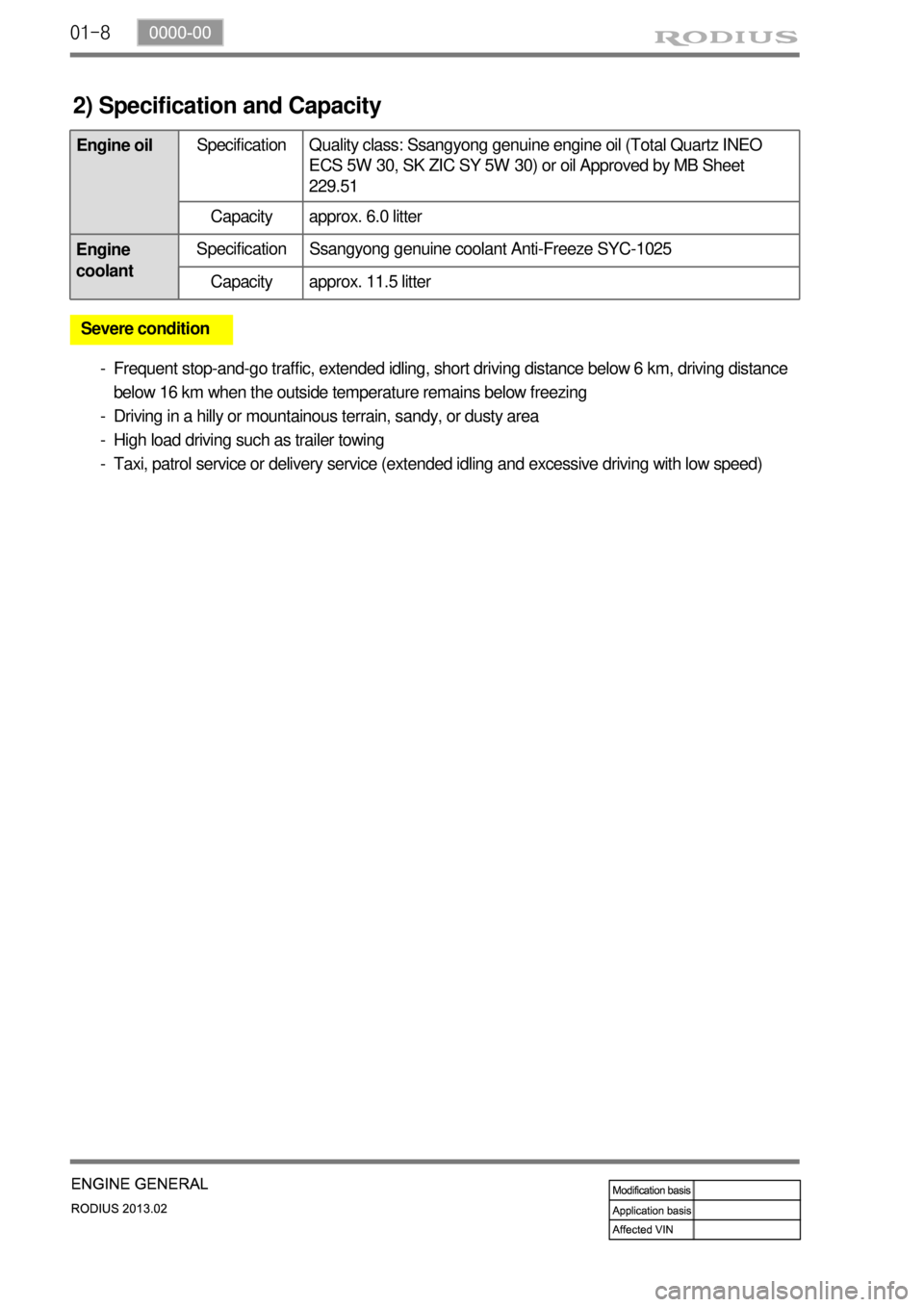
2) Specification and Capacity
Engine oilSpecification Quality class: Ssangyong genuine engine oil (Total Quartz INEO
ECS 5W 30, SK ZIC SY 5W 30) or oil Approved by MB Sheet
229.51
Capacity approx. 6.0 litter
Engine
coolantSpecification Ssangyong genuine coolant Anti-Freeze SYC-1025
Capacity approx. 11.5 litter
Severe condition
Frequent stop-and-go traffic, extended idling, short driving distance below 6 km, driving distance
below 16 km when the outside temperature remains below freezing
Driving in a hilly or mountainous terrain, sandy, or dusty area
High load driving such as trailer towing
Taxi, patrol service or delivery service (extended idling and excessive driving with low speed) -
-
-
-
Page 156 of 796

01-12
6. TIGHTENING TORQUE
Name SizeNumbers of
fastenerTightening
torque (Nm)Note (total
tightening
torque)
Main bearing capM12×82 10 55±5Nm,
180˚ Not-reusable
Connecting rod capM9×52 8 40±5Nm,
90˚+10˚ 50 ~80Nm
Crankshaft rear sealM6×20 6 10±1Nm -
Oil pumpM8×35 3 25±2.5Nm -
Drive plateM10×22 8 45±5Nm,
90˚+10˚ Not-reusable
Isolation damper center
boltM18×50 1 200±20Nm,
180˚+20˚660 ~ 720Nm
Not-reusable
Oil panM6×20 18 10±1Nm -
M6×35 2 10±1Nm -
M6×85 2 10±1Nm -
M6×120 2 10±1Nm -
M8×40 2 25±2.5Nm -
Mounting nut for high
pressure pumpM14×1.5-8-1 1 65±5Nm -
Mounting bolt for high
pressure pumpM8×30 3 25±2.5Nm -
Cylinder headM13×150 12 85Nm
270°±10° -
Camshaft capM6×30 16 10±1Nm -
M8×60 4 25±2.5Nm -
Exhaust stud bolt 10 15±1.5Nm -
Exhaust sprocketM11×40 1 30±3Nm -
Chain tensioner screw
plug
M38×1.5 1 25±2.5Nm -
Coolant temperature
sensor1 20±2.0Nm -
Belt auto tensionerM8×30(LOW) 1 25±2.5Nm -
M10×75(U
pper) 1 55±5.5Nm -
Water pumpM6×50 7 10±1.0Nm -
Page 164 of 796

02-50000-00
3. TIGHTENING TORQUE
Component SizeBolt
QuantitySpecified torque
(Nm)Remark
(Total torque)
Main bearing capM12×82 10 55±5Nm,
180˚ Not re-usable
Connecting rod capM9×52 8 40±5Nm,
90˚+10˚ 50 to 80 Nm
Crankshaft rear sealM6×20 6 10±1Nm -
Oil pump M8x35 3 25±2.5Nm -
Drive plateM10×22 8 45±5Nm,
90˚+10˚ Not re-usable
Isolation damper center
boltM18x50 1 200±20Nm,
180˚+20˚660 to 720 Nm
Not re-usable
Oil panM6×20 18 10±1Nm -
M6×35 2 10±1Nm -
M6×85 2 10±1Nm -
M6×120 2 10±1Nm -
M8×40 2 25±2.5Nm -
HP pump main nutM14×1.5-8-1 1 65±5Nm -
HP pump bolt M8x30 3 25±2.5Nm -
Cylinder headM13×150 12 85Nm
270°±10° -
Camshaft capM6×30 16 10±1Nm -
M8×60 4 25±2.5Nm -
Exhaust stud bolt 10 15±1.5Nm -
Exhaust sprocket boltM11×40 1 30±3Nm -
Chain tensioner screw
plugM38×1.5 1 25±2.5Nm -
Coolant temperature
sensor1 20±2.0Nm
-
Auto tensionerM8×30(LOW) 1 25±2.5Nm -
M10×75(Upper)1 55±5.5Nm -
Coolant pumpM6×50 7 10±1.0Nm -
Page 233 of 796
03-26
The engine ECU calculates the accelerator pedal based on the input signals from various sensors, and
controls the overall operation of the vehicle.
The ECU receives the signals from various sensor through data line, and performs effective air-fuel ratio
control based on these signals.
The crankshaft speed (position) sensor measures the engine speed, and the camshaft speed (position)
sensor determines the order of injections, and the ECU detects the amount of the accelerator pedal
depressed (driver's will) by receiving the electrical signals from the accelerator pedal sensor.
The mass air flow sensor detects the volume of intake air and sends the value to the ECU.
The major function of the ECU is controlling air-fuel ratio to reduce the emission level (EGR valve
control) by detecting instantaneous air flow change with the signals from the mass air flow sensor.
Also, the ECU uses the signals from the coolant temperature & air temperature sensors, booster
pressure sensor, atmospheric pressure sensor to: a) determine injection starting point and set value for
pilot injection, and b) deal with various operations and variable conditions.
Page 264 of 796
06-191914-01
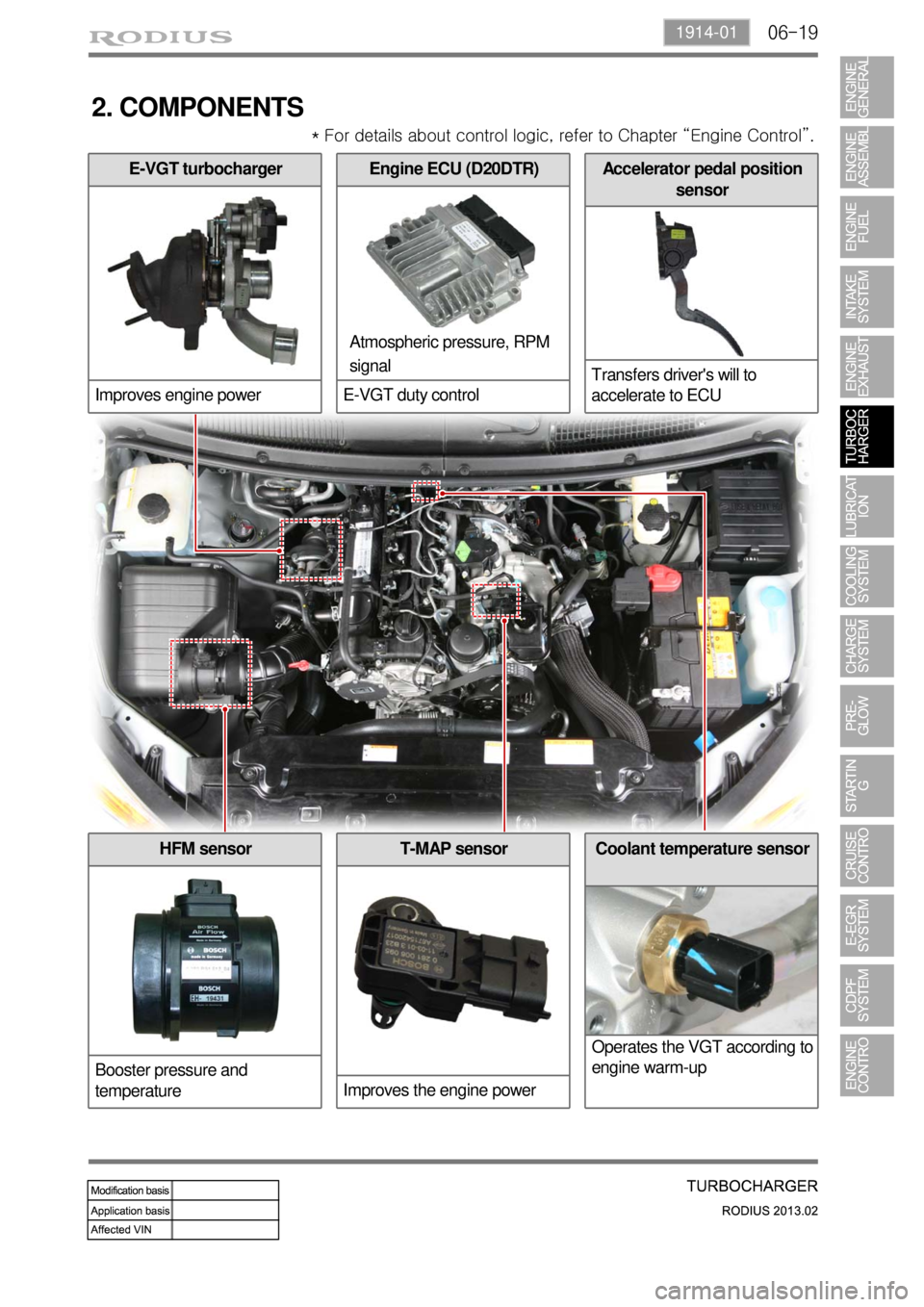
2. COMPONENTS
Atmospheric pressure, RPM
signal * For details about control logic, refer to Chapter “Engine Control”.
E-VGT turbocharger
Improves engine powerAccelerator pedal position
sensor
Transfers driver's will to
accelerate to ECUEngine ECU (D20DTR)
E-VGT duty control
Coolant temperature sensor
Operates the VGT according to
engine warm-upT-MAP sensor
Improves the engine powerHFM sensor
Booster pressure and
temperature
Page 272 of 796
08-31520-00
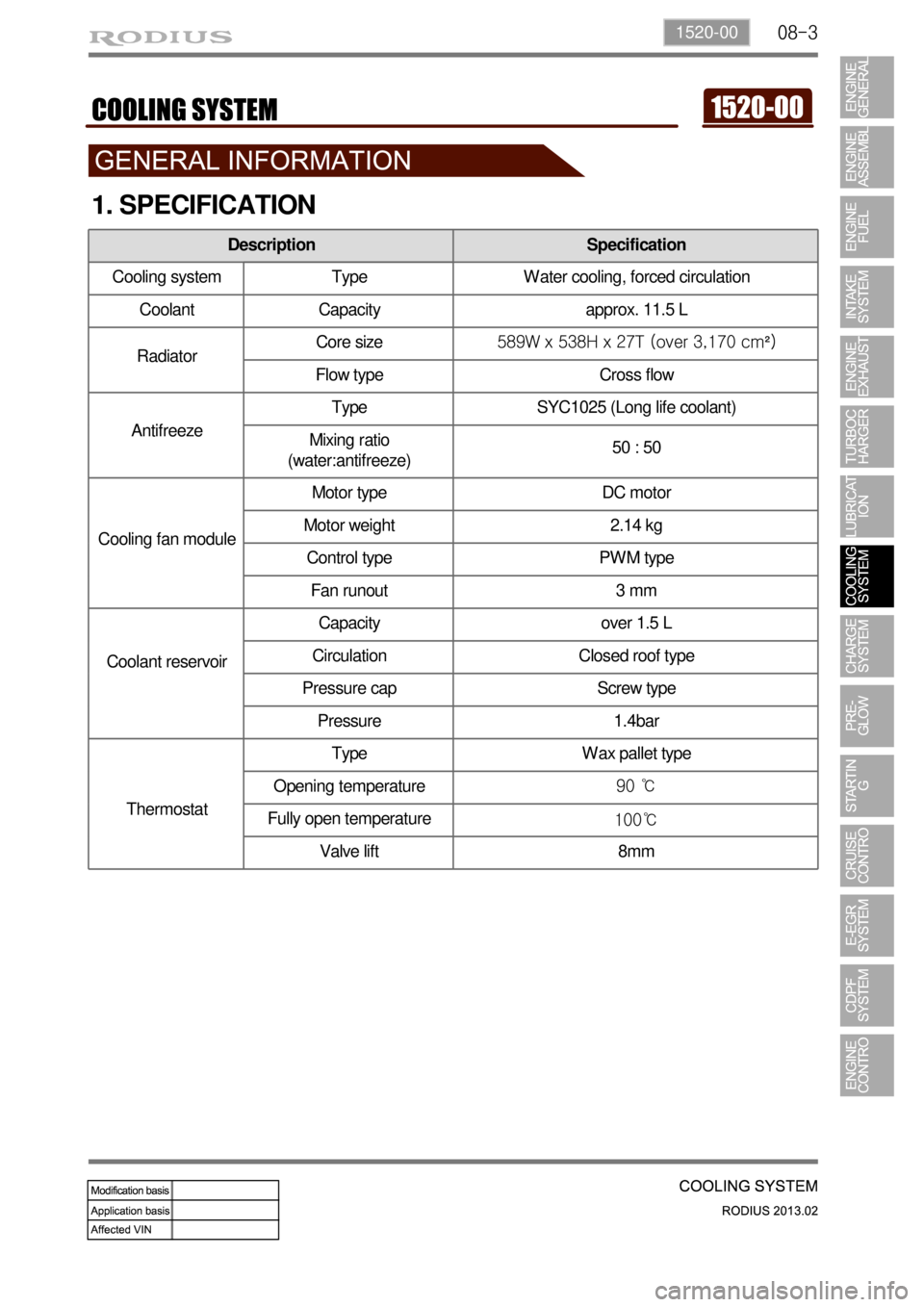
1. SPECIFICATION
Description Specification
Cooling system Type Water cooling, forced circulation
Coolant Capacity approx. 11.5 L
RadiatorCore size589W x 538H x 27T (over 3,170 cm²)
Flow type Cross flow
AntifreezeType SYC1025 (Long life coolant)
Mixing ratio
(water:antifreeze)50 : 50
Cooling fan moduleMotor type DC motor
Motor weight 2.14 kg
Control type PWM type
Fan runout 3 mm
Coolant reservoirCapacity over 1.5 L
Circulation Closed roof type
Pressure cap Screw type
Pressure 1.4bar
ThermostatType Wax pallet type
Opening temperature90 ℃
Fully open temperature
100℃
Valve lift 8mm
Page 273 of 796

08-4
2. INSPECTION
Possible Cause Action
Coolant level
is
too low- Leak from the radiator
- Leak from the coolant auxiliary tank
- Leak from the heater core- Change the radiator
- Change the coolant auxiliary tank
- Change the heater
- Leak from the coolant hose
connections
- Damaged coolant hose - Reconnect the hose or replace
the clamp
- Change the hose
- Leak from the water pump gasket
- Leak from the water pump internal
seal- Change the gasket
- Change the water pump
- Leak from the water inlet cap
- Leak from the thermostat housing- Change the water inlet cap
gasket
- Change the thermostat sealing
- Incorrect tightening torque of the
cylinder head bolts
- Damaged cylinder head gasket- Tighten the bolts to the specified
torque
- Change the cylinder head gasket
Coolant
temperature is
too high- Coolant leakage (Coolant level is low)
- Improper coolant mixture ratio
- Kinked coolant hose- Add coolant
- Check the coolant concentration
(Anti-freeze)
- Repair or replace the hose
- Defective thermostat
- Defective water pump
- Defective radiator
- Defective coolant auxiliary tank or tank
cap- Change the thermostat
- Change the water pump
- Change the radiator
- Change the coolant auxiliary tank
or tank cap
- Cracks on the cylinder block or
cylinder head
- Clogged coolant passages in the
cylinder block or cylinder head- Change cylinder block or cylinder
head
- Clean the coolant passage
- Clogged radiator core - Clean the radiator core
- Improper operation of cooling fan - Replace the cooling fan or repair
the related circuit
- Defective temperature sensor or
faulty wiring- Replace the sensor or repair the
related wiring
Coolant
temperature is
too low- Thermostat is stuck open - Change the thermostat
- Improper operation of cooling fan - Replace the cooling fan or repair
the related circuit
- Defective temperature sensor or faulty
wiring- Replace the sensor or repair the
related wiring
Page 275 of 796
08-6
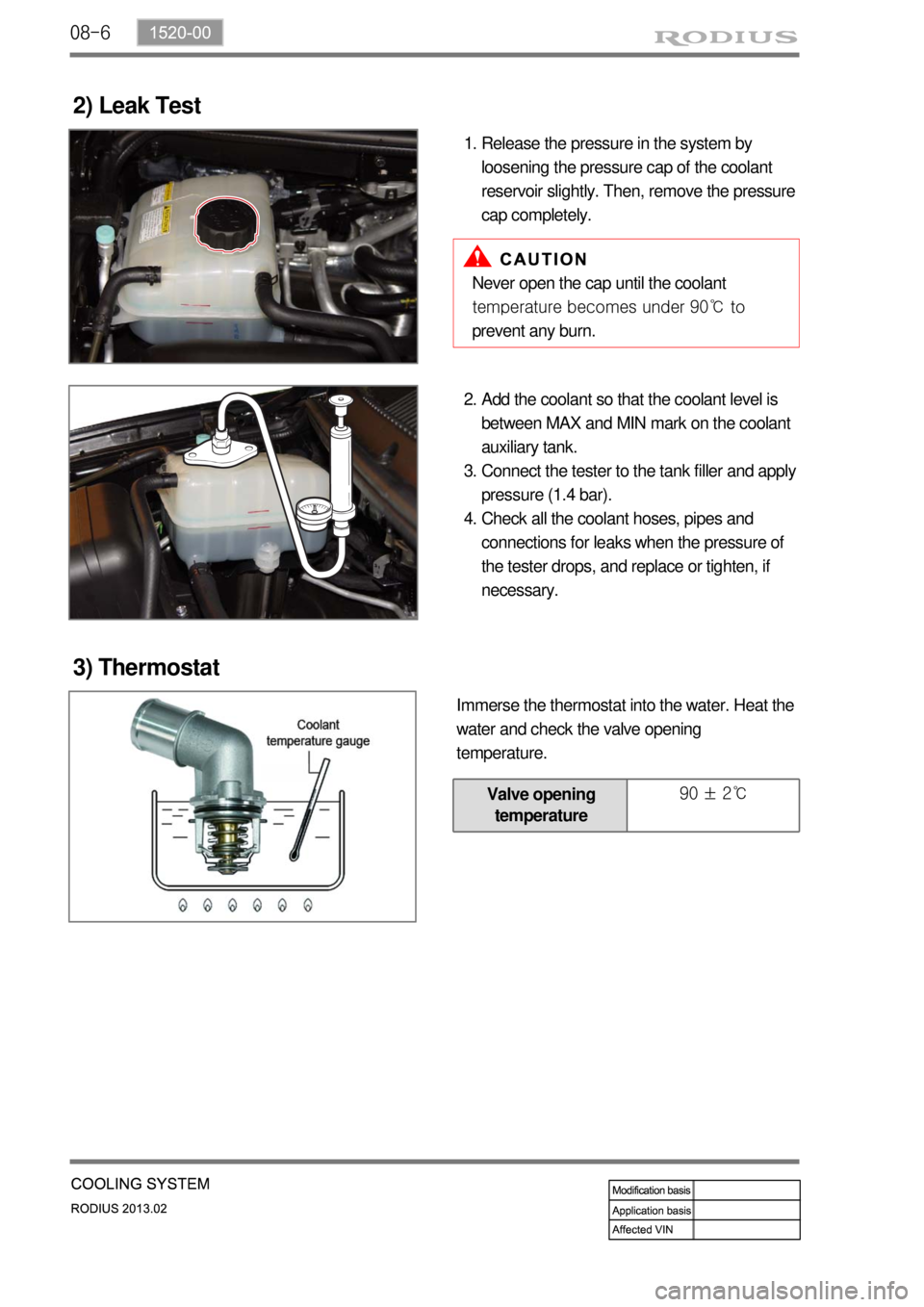
2) Leak Test
Release the pressure in the system by
loosening the pressure cap of the coolant
reservoir slightly. Then, remove the pressure
cap completely. 1.
Never open the cap until the coolant
temperature becomes under 90℃ to
prevent any burn.
Add the coolant so that the coolant level is
between MAX and MIN mark on the coolant
auxiliary tank.
Connect the tester to the tank filler and apply
pressure (1.4 bar).
Check all the coolant hoses, pipes and
connections for leaks when the pressure of
the tester drops, and replace or tighten, if
necessary. 2.
3.
4.
3) Thermostat
Immerse the thermostat into the water. Heat the
water and check the valve opening
temperature.
Valve opening
temperature 90 ± 2℃