maintenance SSANGYONG TURISMO 2013 Service Manual
[x] Cancel search | Manufacturer: SSANGYONG, Model Year: 2013, Model line: TURISMO, Model: SSANGYONG TURISMO 2013Pages: 796, PDF Size: 78.99 MB
Page 122 of 796
01-70000-00
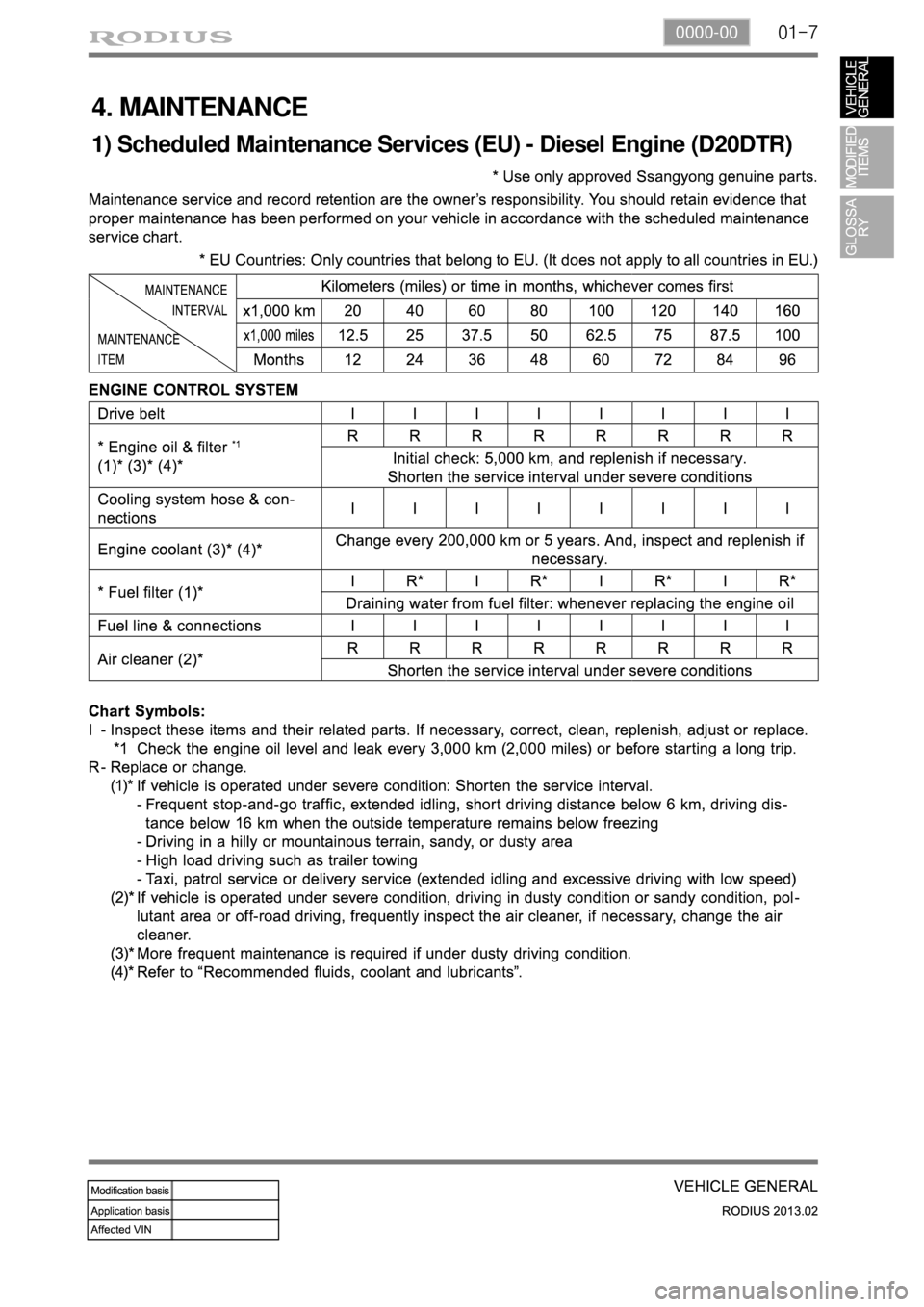
4. MAINTENANCE
1) Scheduled Maintenance Services (EU) - Diesel Engine (D20DTR)
Page 125 of 796
01-10
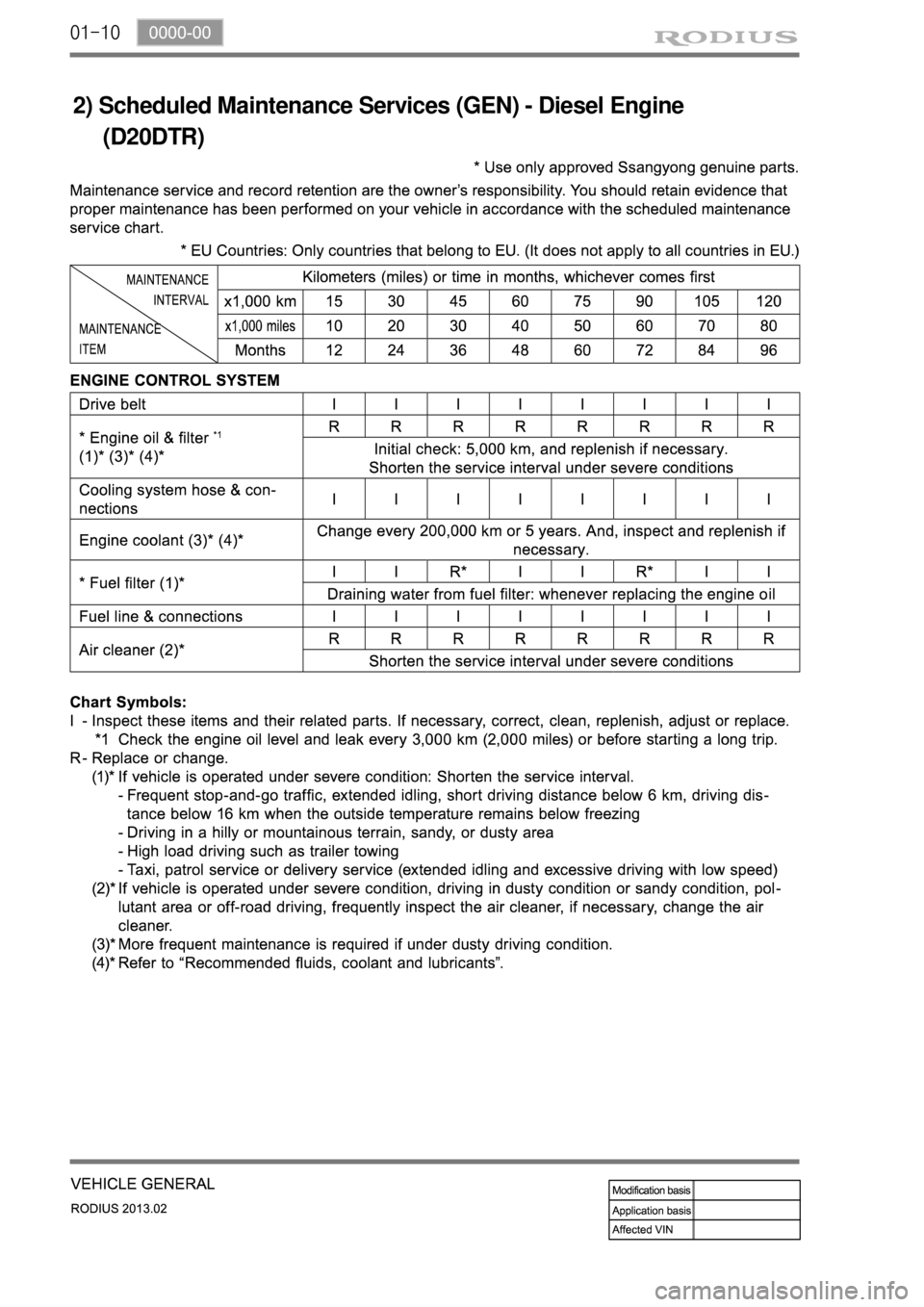
2) Scheduled Maintenance Services (GEN) - Diesel Engine
(D20DTR)
Page 128 of 796
01-130000-00
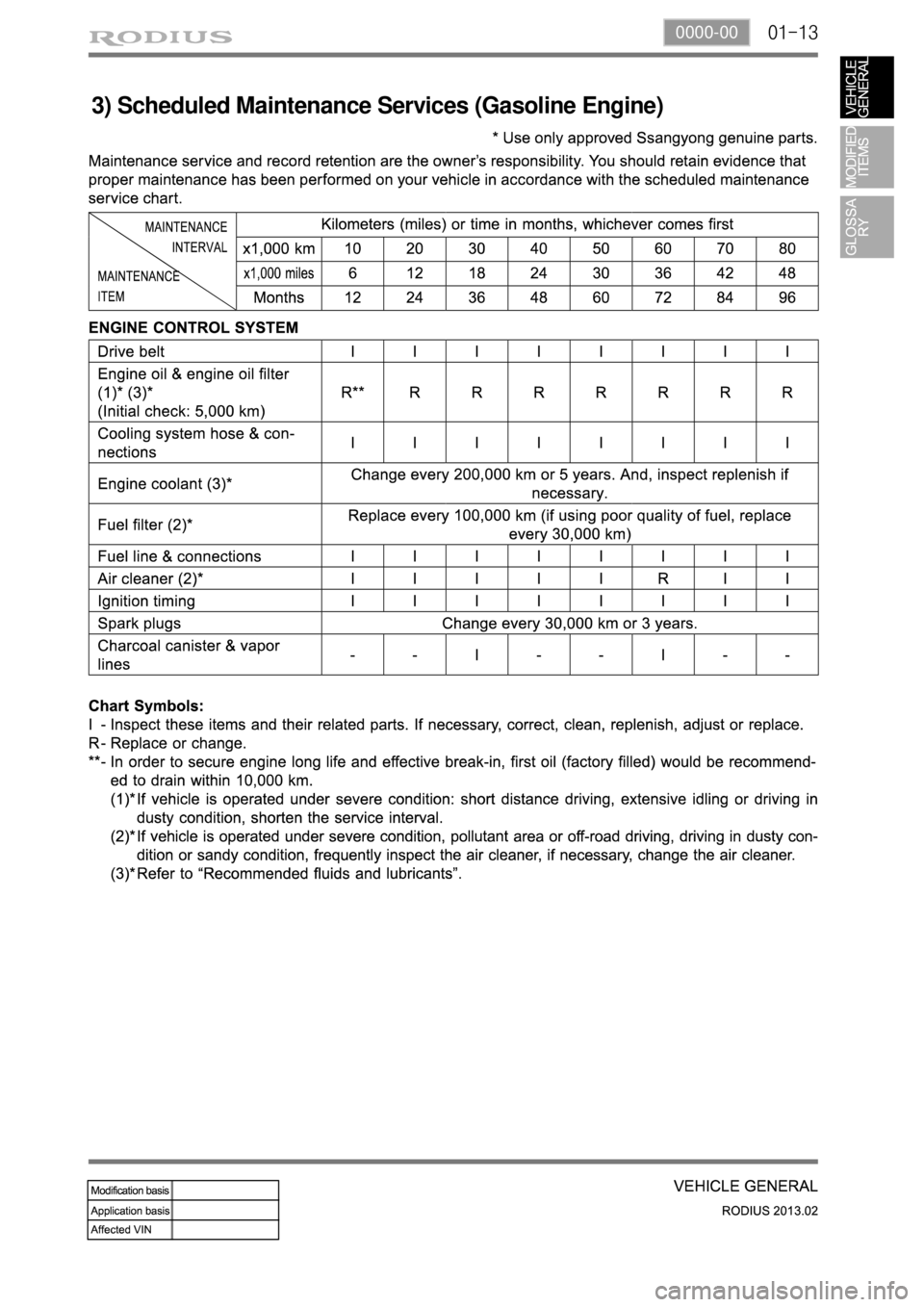
3) Scheduled Maintenance Services (Gasoline Engine)
Page 150 of 796
01-6
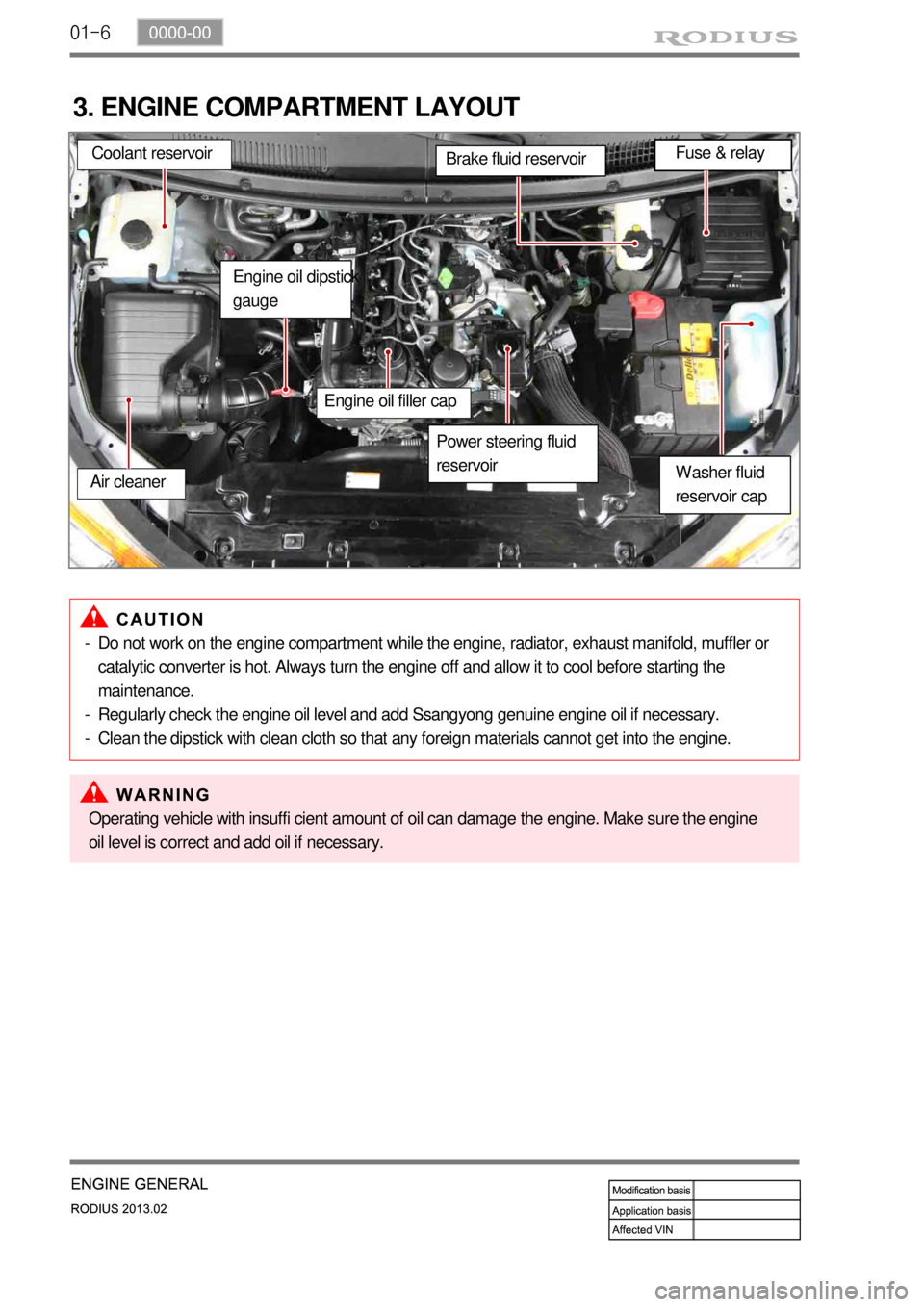
3. ENGINE COMPARTMENT LAYOUT
Do not work on the engine compartment while the engine, radiator, exhaust manifold, muffler or
catalytic converter is hot. Always turn the engine off and allow it to cool before starting the
maintenance.
Regularly check the engine oil level and add Ssangyong genuine engine oil if necessary.
Clean the dipstick with clean cloth so that any foreign materials cannot get into the engine. -
-
-
Power steering fluid
reservoirBrake fluid reservoir
Engine oil dipstick
gauge
Washer fluid
reservoir cap Engine oil filler cap
Air cleaner
Operating vehicle with insuffi cient amount of oil can damage the engine. Make sure the engine
oil level is correct and add oil if necessary.
Coolant reservoirFuse & relay
Page 187 of 796
02-28
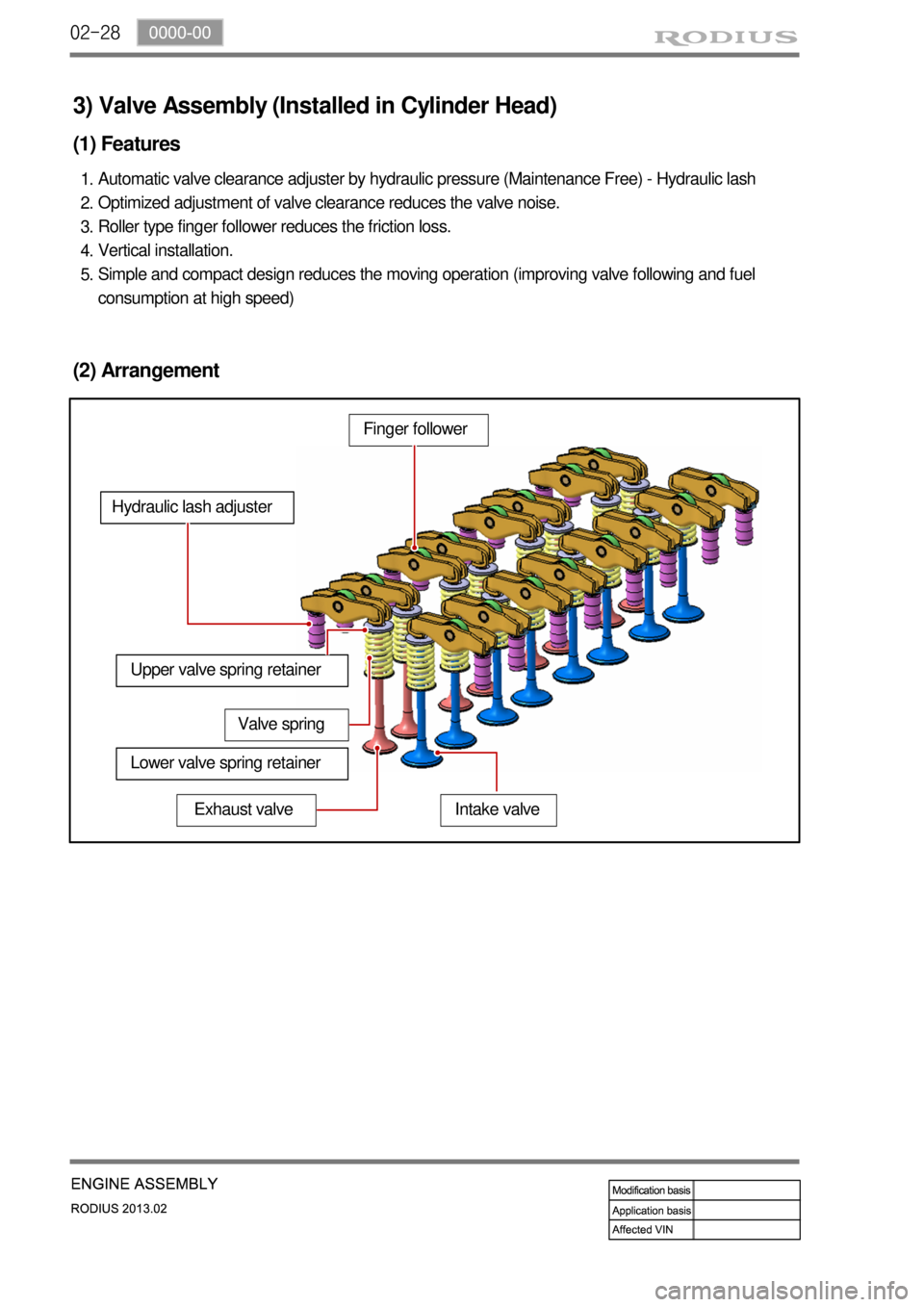
3) Valve Assembly (Installed in Cylinder Head)
(1) Features
Automatic valve clearance adjuster by hydraulic pressure (Maintenance Free) - Hydraulic lash
Optimized adjustment of valve clearance reduces the valve noise.
Roller type finger follower reduces the friction loss.
Vertical installation.
Simple and compact design reduces the moving operation (improving valve following and fuel
consumption at high speed) 1.
2.
3.
4.
5.
(2) Arrangement
Hydraulic lash adjuster
Upper valve spring retainer
Lower valve spring retainer
Valve spring
Exhaust valveIntake valve
Finger follower
Page 211 of 796
03-4
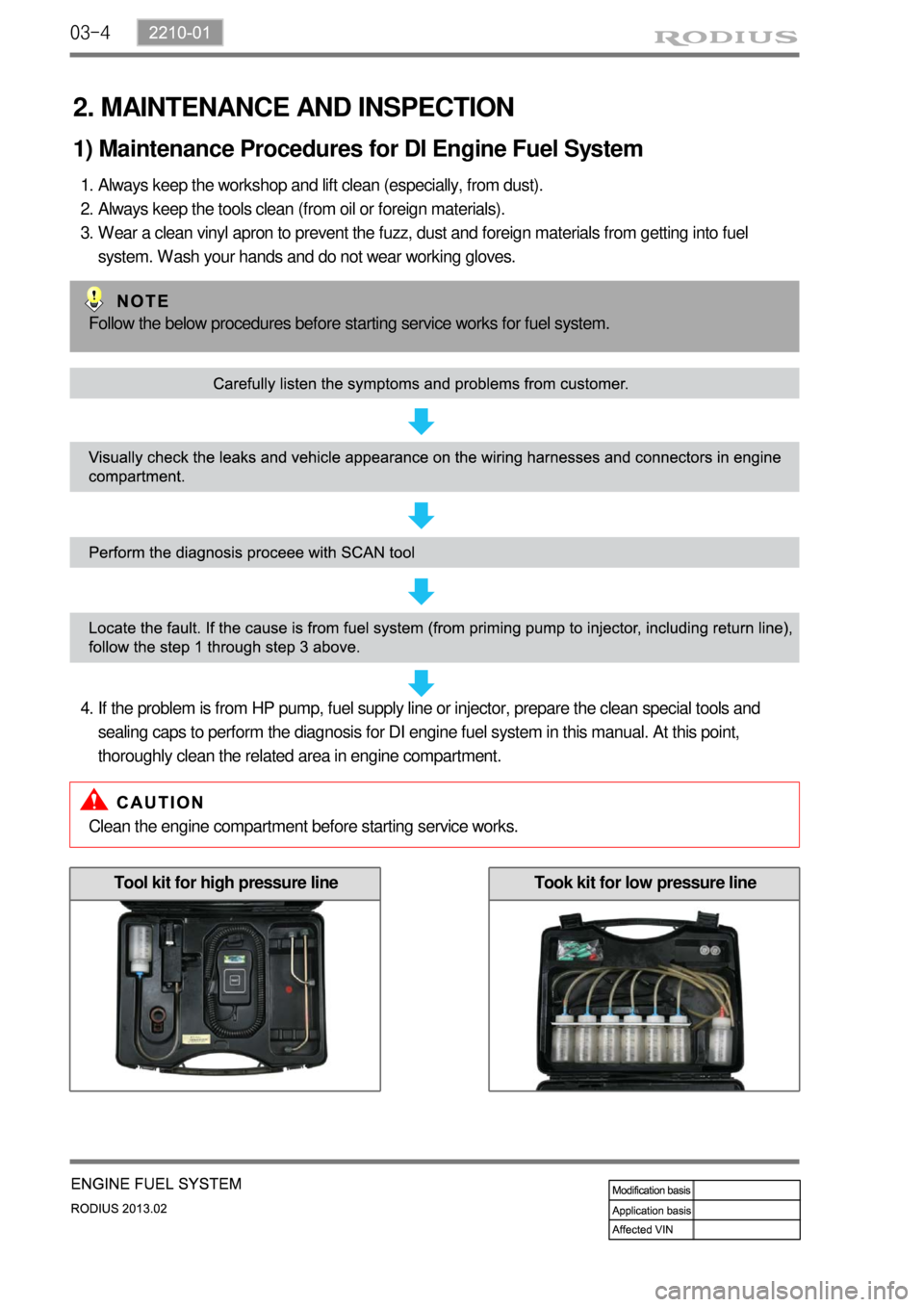
Took kit for low pressure lineTool kit for high pressure line
2. MAINTENANCE AND INSPECTION
1) Maintenance Procedures for DI Engine Fuel System
Always keep the workshop and lift clean (especially, from dust).
Always keep the tools clean (from oil or foreign materials).
Wear a clean vinyl apron to prevent the fuzz, dust and foreign materials from getting into fuel
system. Wash your hands and do not wear working gloves. 1.
2.
3.
Follow the below procedures before starting service works for fuel system.
If the problem is from HP pump, fuel supply line or injector, prepare the clean special tools and
sealing caps to perform the diagnosis for DI engine fuel system in this manual. At this point,
thoroughly clean the related area in engine compartment. 4.
Clean the engine compartment before starting service works.
Page 269 of 796
07-4
2. MAINTENANCE
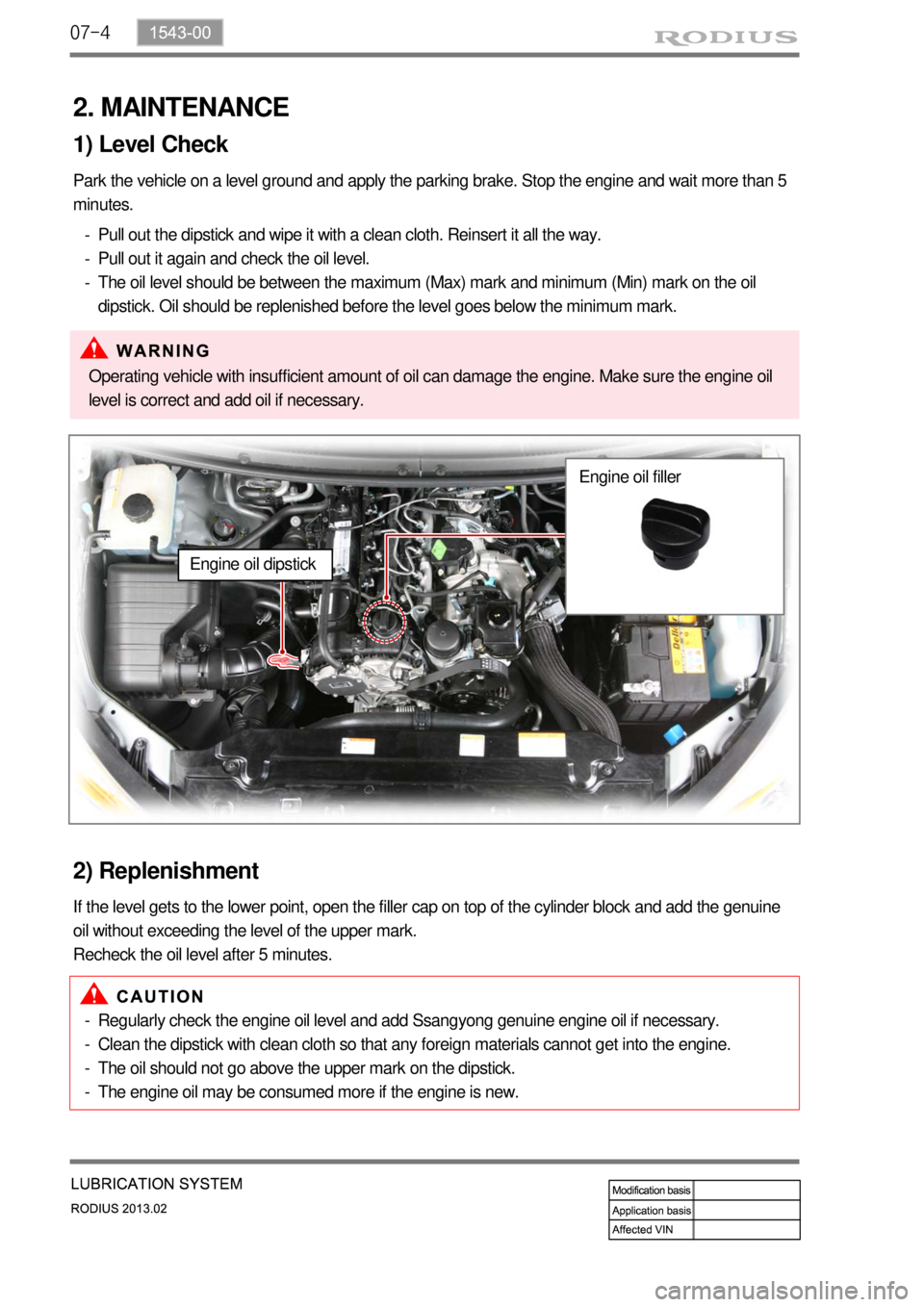
1) Level Check
Park the vehicle on a level ground and apply the parking brake. Stop the engine and wait more than 5
minutes.
Pull out the dipstick and wipe it with a clean cloth. Reinsert it all the way.
Pull out it again and check the oil level.
The oil level should be between the maximum (Max) mark and minimum (Min) mark on the oil
dipstick. Oil should be replenished before the level goes below the minimum mark. -
-
-
Operating vehicle with insufficient amount of oil can damage the engine. Make sure the engine oil
level is correct and add oil if necessary.
2) Replenishment
If the level gets to the lower point, open the filler cap on top of the cylinder block and add the genuine
oil without exceeding the level of the upper mark.
Recheck the oil level after 5 minutes.
Regularly check the engine oil level and add Ssangyong genuine engine oil if necessary.
Clean the dipstick with clean cloth so that any foreign materials cannot get into the engine.
The oil should not go above the upper mark on the dipstick.
The engine oil may be consumed more if the engine is new. -
-
-
-
Engine oil dipstick
Engine oil filler
Page 285 of 796
09-91451-01
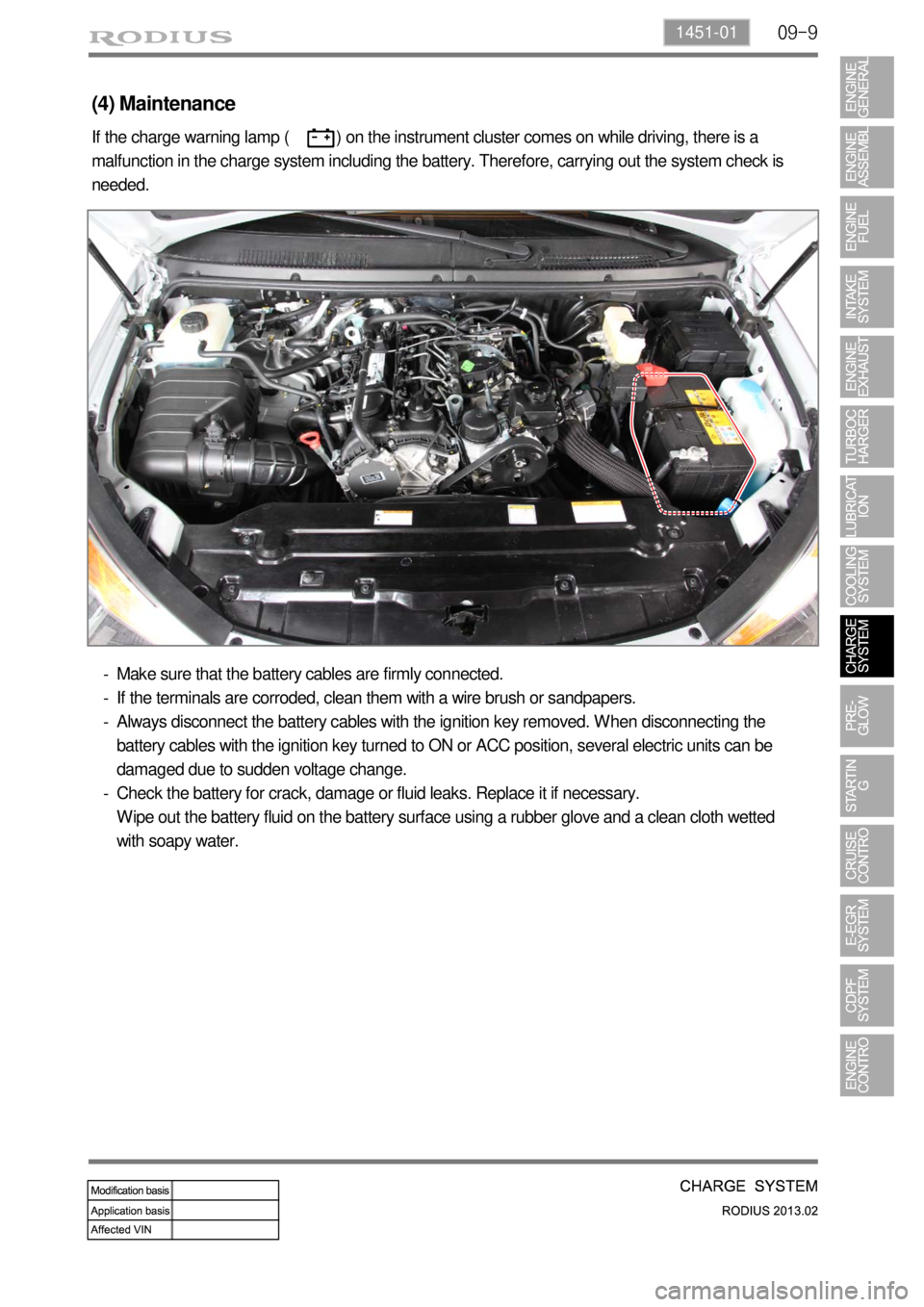
If the charge warning lamp ( ) on the instrument cluster comes on while driving, there is a
malfunction in the charge system including the battery. Therefore, carrying out the system check is
needed.
(4) Maintenance
Make sure that the battery cables are firmly connected.
If the terminals are corroded, clean them with a wire brush or sandpapers.
Always disconnect the battery cables with the ignition key removed. When disconnecting the
battery cables with the ignition key turned to ON or ACC position, several electric units can be
damaged due to sudden voltage change.
Check the battery for crack, damage or fluid leaks. Replace it if necessary.
Wipe out the battery fluid on the battery surface using a rubber glove and a clean cloth wetted
with soapy water. -
-
-
-
Page 627 of 796

07-12
3. WHEEL ALIGNMENT
Wheel alignment (adjustment of Camber, Caster and Toe) is part of standard automobile maintenance
that consists of adjusting the angles of the wheels so that they are set to the specification. The purpose
of these adjustments is to reduce tire wear, and to ensure that vehicle travel is straight and true (without
"pulling" to one side). Alignment angles can also be altered beyond the specifications to obtain a specific
handling characteristic.
When viewed from the top, the distance between the tire centers is smaller in the front than in
the rear. ▶
Side slip protection
Parallel front wheels rotation (straight ahead driving is ensured by toe-in to prevent the wheels from tilting
outwards by the camber while driving)
Prevention of uneven (outward) tire wear Prevention of toe-out from wearing of steering linkage -
-
-
1) Toe-in
The difference of measured distances between the front ends of the tires (A) and the rear ends of the
tires (B) along the same axle when viewed the wheels from the top.
Toe-inFront0.˚±0.10˚
Rear0.48˚±0.15˚
Necessity for Wheel Alignment ▶
Wheel alignment consists of adjusting the angles of the wheels so that they are perpendicular to the
ground and parallel to each other. The purpose of these adjustments is maximum tire life and a vehicle
that tracks straight and true when driving along a straight and level road.
The symptoms of a vehicle that is out of alignment are:
Uneven or rapid tire wear
Pulling or drifting away from a straight line
Wandering on a straight level road
Spokes of the steering wheel off to one side while driving on a straight and level road.