lights SUBARU BAJA 2005 1.G Owner's Guide
[x] Cancel search | Manufacturer: SUBARU, Model Year: 2005, Model line: BAJA, Model: SUBARU BAJA 2005 1.GPages: 469, PDF Size: 5.24 MB
Page 245 of 469
7-10
Starting and operating
If the engine does not start, try the following:
1) Turn the ignition switch to the “OFF” position and
wait for at least 10 seconds. After checking that the
parking brake is firmly set, turn the ignition switch to
the “START” position while depressing the acceler-
ator pedal slightly (about a quarter of the full stroke).
Release the accelerator pedal as soon as the en-
gine starts.
2) If this fails to start the engine, turn the ignition
switch back to the “OFF” position and wait for at
least 10 seconds. Then fully depress the accelerator
pedal and turn the ignition switch to the “START”
position. If the engine starts, quickly release the ac-
celerator pedal.
3) If this fails to start the engine, turn the ignition
switch again to the “OFF” position. After waiting for
10 seconds or longer, turn the ignition switch to the
“START” position without depressing the accelera-
tor pedal.
4) If the engine still refuses to start, contact your
nearest SUBARU dealer for assistance.
6. Confirm that all warning and indicator lights have
gone off after the engine has started. The fuel injection
system automatically lowers the idle speed as the en-
gine warms up.
NOTE (Turbo models)
The engine may be difficult to start when the bat- tery has been disconnected and reconnected (for
maintenance or other purposes). This difficulty is
caused by the electronically controlled throttle’s
self-diagnosis function. To overcome it, keep the
ignition switch in the “ON” position for approxi-
mately 10 seconds before starting the engine. „
Automatic transmission vehicle
If you restart the engine while the vehicle is
moving, shift the selector lever into the “N” po-
sition. Do not attempt to place the selector lever
of a moving vehicle into the “P” position.
1. Apply the parking brake.
2. Turn off unnecessary lights and accessories.
3. Shift the selector lever to the “P” or “N” position
(preferably “P” position). The starter will only operate
when the select lever is at the “P” or “N” position.
4. Turn the ignition switch to the “ON” position and
check the operation of the warning and indicator lights.
Refer to the “Warning and indicator lights” section
(chapter 3).
5. Turn the ignition switch to the “START” position
Page 246 of 469
7-11
Starting and operating
– CONTINUED –
without depressing the accelerator pedal. Release
the key immediately after the engine has started.
If the engine does not start, try the following: 1) Turn the ignition switch to the “OFF” position and
wait for at least 10 seconds. After checking that the
parking brake is firmly set, turn the ignition switch to
the “START” position while depressing the acceler-
ator pedal slightly (about a quarter of the full stroke).
Release the accelerator pedal as soon as the en-
gine starts.
2) If this fails to start the engine, turn the ignition
switch back to the “OFF” position and wait for at
least 10 seconds. Then fully depress the accelerator
pedal and turn the ignition switch to the “START”
position. If the engine starts, quickly release the ac-
celerator pedal.
3) If this fails to start the engine, turn the ignition
switch again to the “OFF” position. After waiting for
10 seconds or longer, turn the ignition switch to the
“START” position without depressing the accelera-
tor pedal.
4) If the engine still refuses to start, contact your
nearest SUBARU dealer for assistance.
6. Confirm that all warning and indicator lights have
gone out after the engine has started. The fuel injec-
tion system automatically lowers the idle speed as the
engine warms up. While the engine is warming up, make sure that the
selector lever is at the “P” or “N” position and that the
parking brake is applied.
NOTE (Turbo models)
The engine may be difficult to start when the bat-
tery has been disconnected and reconnected (for
maintenance or other purposes). This difficulty is
caused by the electronically controlled throttle’s
self-diagnosis function. To overcome it, keep the
ignition switch in the “ON” position for approxi-
mately 10 seconds before starting the engine.
Page 272 of 469
7-37
Starting and operating
– CONTINUED –
“Warning and indicator lights” section (chapter 3).
When parking your vehicle, always set the parking
brake firmly and put the shift lever in the “1” (1st) for an
upgrade or “R” (Reverse) for a downgrade for manual
transmission vehicles, or in the “P” (Park) position for
automatic transmission vehicles. Always set the park-
ing brake firmly when parking your vehicle. Never rely
on the transmission alone to hold the vehicle.
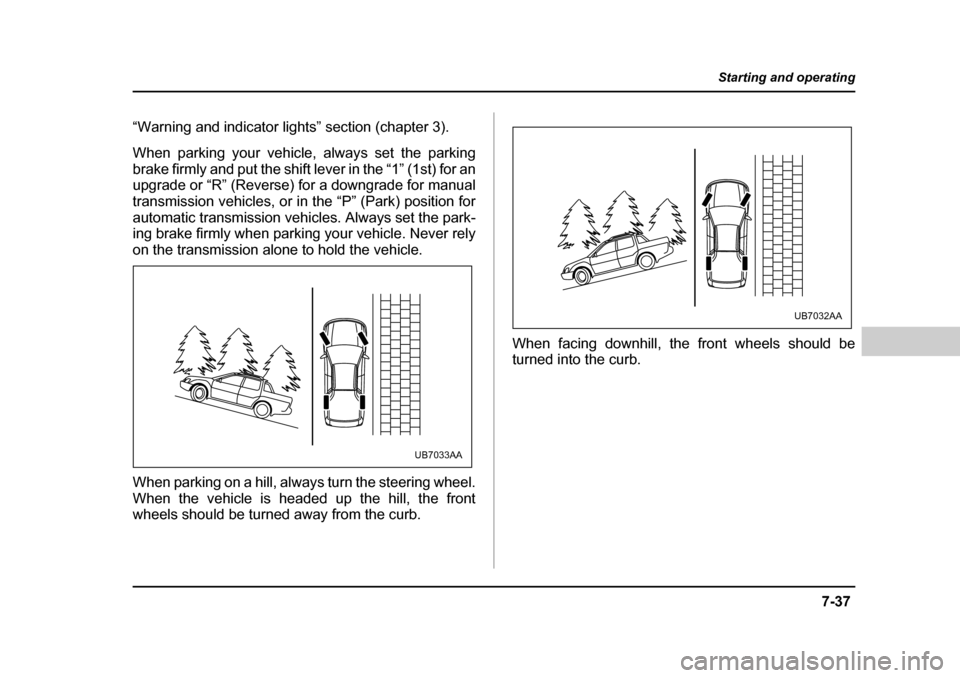
When parking on a hill, always turn the steering wheel.
When the vehicle is headed up the hill, the front
wheels should be turned away from the curb. When facing downhill, the front wheels should be
turned into the curb.
UB7033AA
UB7032AA
Page 300 of 469
8-23
Driving tips
– CONTINUED –
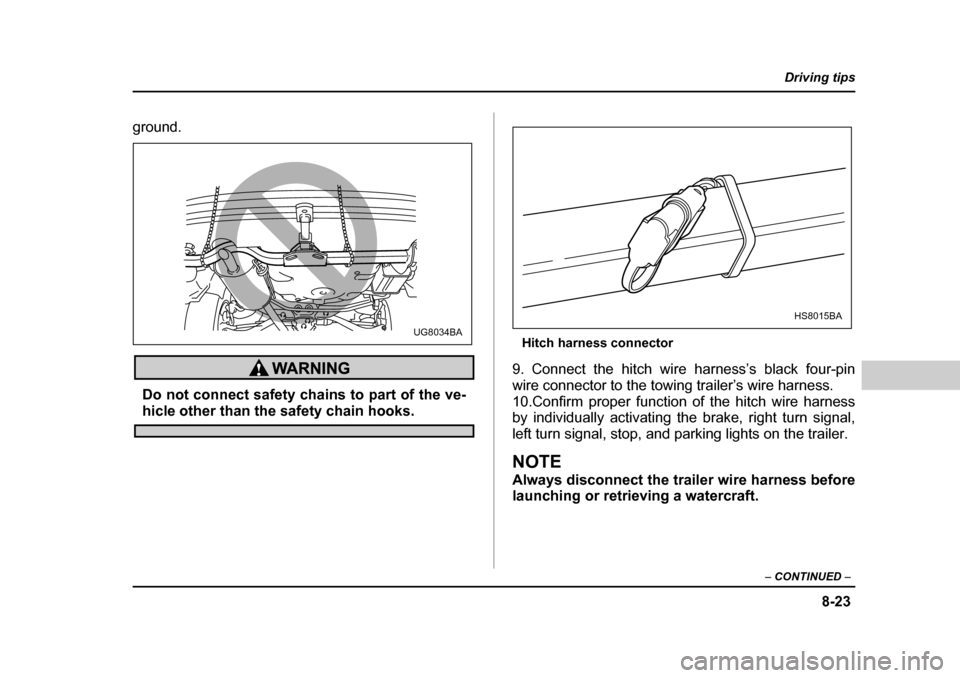
ground.
Do not connect safety chains to part of the ve-
hicle other than the safety chain hooks. Hitch harness connector
9. Connect the hitch wire harness’s black four-pin
wire connector to the towing trailer’s wire harness.
10.Confirm proper function of the hitch wire harness
by individually activating the brake, right turn signal,
left turn signal, stop, and parking lights on the trailer.
NOTE
Always disconnect the trailer wire harness before
launching or retrieving a watercraft.
UG8034BA
HS8015BA
Page 309 of 469
8-32
Driving tips
standard side mirrors provide a good rearward field of
view without significant blind spots. If significant blind
spots occur with the vehicle’s standard side mirrors,
use towing mirrors that conform with Federal, state/
province and/or other applicable regulations. T
Trailer lights
Direct splicing or other improper connection of
trailer lights may damage your vehicle’s electri-
cal system and cause a malfunction of your ve-
hicle’s lighting system.
Connection of trailer lights to your vehicle’s electrical
system requires modifications to the vehicle’s lighting
circuit to increase its capacity and accommodate wir-
ing changes. To ensure the trailer lights are connected
properly, please consult your SUBARU dealer. Check
for proper operation of the turn signals, the brake
lights and parking lights each time you hitch up. T Tires
Never tow a trailer when the temporary spare tire is used. The temporary spare tire is not de-
signed to sustain the towing load. Use of the
temporary spare tire when towing can result in
failure of the spare tire and/or less stability of
the vehicle.
Make sure that all the tires on your vehicle are properly
inflated.
The recommended cold tire pressure is shown on the
vehicle placard attached to the driver’s side door jamb.
Trailer tire condition, size, load rating and proper infla-
tion pressure should be in accordance with the trailer
manufacturer’s specifications.
In the event your vehicle gets a flat tire when towing a
trailer, ask a commercial road service to repair the flat tire.
If you carry a regular size spare tire in your vehicle or
trailer as a precaution against getting a flat tire, be
sure that the spare tire is firmly secured.
Page 310 of 469
8-33
Driving tips
– CONTINUED –
„Trailer towing tips
yNever exceed 45 mph (72 km/h) when towing
a trailer in hilly country on hot days. y When towing a trailer, steering, stability,
stopping distance and braking performance
will be different from normal operation. For
safety’s sake, you should employ extra caution
when towing a trailer and you should never
speed. You should also keep the following tips
in mind:
T Before starting out on a trip
y Check that the vehicle and vehicle-to-hitch mount-
ing are in good condition. If any problems are appar-
ent, do not tow the trailer. y Check that the vehicle sits horizontally with the trail-
er attached. If the vehicle is tipped sharply up at the
front and down at the rear, check the total trailer
weight, GVW, GAWs and tongue load again, then con-
firm that the load and its distribution are acceptable.y Check that the tire pressures are correct.
y Check that the vehicle and trailer are connected
properly. Confirm that. – the trailer tongue is connected properly to the
hitch ball.
– the trailer lights connector is connected properly
and trailer’s brake lights illuminate when the vehi-
cle’s brake pedal is pressed, and that the trailer’s
turn signal lights flash when the vehicle’s turn signal
lever is operated.
– the safety chains are connected properly.
– all cargo in the trailer is secured safety in position.
– the side mirrors provide a good rearward field of
view without a significant blind spot.
y Sufficient time should be taken to learn the “feel” of
the vehicle/trailer combination before starting out on a
trip. In an area free of traffic, practice turning, stopping
and backing up. T Driving with a trailer
y You should allow for considerably more stopping
distance when towing a trailer. Avoid sudden braking
because it may result in skidding or jackknifing and
loss of control. y Avoid abrupt starts and sudden accelerations. If
your vehicle has a manual transmission, always start
out in first gear and release the clutch at moderate en-
gine revolution.y Avoid uneven steering, sharp turns and rapid lane
changes.y Slow down before turning. Make a longer than nor-
Page 312 of 469
8-35
Driving tips
– CONTINUED –
overheating” section in chapter 9, and “Warning and
indicator lights” section in chapter 3.
NOTE (Turbo models only)
In a vehicle that has an automatic transmission,
the engine is less likely to overheat with the “D”
range selected than it is with the manual mode se-
lected. yIf your vehicle has an automatic transmission, avoid
using the accelerator pedal to stay stationary on an
uphill slope instead of using the parking brake or foot
brake. That may cause the transmission fluid to over-
heat. y Non-turbo models only: If your vehicle is equipped
with an automatic transmission, avoid driving with the
gear selector lever in “D” when towing a heavy trailer
to prevent fluid overheating. A lower gear should be
used. T Parking on a grade
Always block the wheels under both vehicle and trailer
when parking. Apply the parking brake firmly. You
should not park on a hill or slope. But if parking on a
hill or slope cannot be avoided, you should take the
following steps:
1. Apply the brakes and hold the pedal down.
2. Have someone place wheel blocks under both the vehicle and trailer wheels.
3. When the wheel blocks are in place, release the
regular brakes slowly until the blocks absorb the load.
4. Apply the regular brakes and then apply the park-
ing brake; slowly release the regular brakes.
5. Shift into 1st or reverse gear (manual transmission)
or “P” (automatic transmission) and shut off the en-
gine.
Page 332 of 469

9-19
In case of emergency
– CONTINUED –
Do not jump start unless cables in suitable con-
dition are available.yA running engine can be dangerous. Keep
your fingers, hands, clothing, hair and tools
away from the cooling fan, belts and any other
moving engine parts. Removing rings, watches
and ties is advisable.
When your vehicle does not start due to a run down
(discharged) battery, the vehicle may be jump started
by connecting your battery to another battery (called
the booster battery) with jumper cables.
Jump starting is dangerous if it done incorrectly. If you
are unsure about the proper procedure for jump start-
ing, consult a competent mechanic. „ How to jump start
1. Make sure the booster battery is 12 volts and the
negative terminal is grounded.
2. If the booster battery is in another vehicle, do not let
the two vehicles touch.
3. Turn off all unnecessary lights and accessories.
4. Connect the jumper cables exactly in the sequence
illustrated.
Page 347 of 469
10-4
Appearance care
sion components. „
Cleaning aluminum wheels
y Promptly wipe the aluminum wheels clean of any
kind of grime or agent. If dirt is left on too long, it may
be difficult to clean off. y Do not use soap containing grit to clean the wheels.
Be sure to use a neutral cleaning agent, and later rinse
thoroughly with water. Do not clean the wheels with a
stiff brush or expose them to a high-speed washing
device.y Clean the vehicle (including the aluminum wheels)
with water as soon as possible when it has been
splashed with sea water, exposed to sea breezes, or
driven on roads treated with salt or other agents. „ Cleaning fog light lens
1. Stop the vehicle in a safe place.
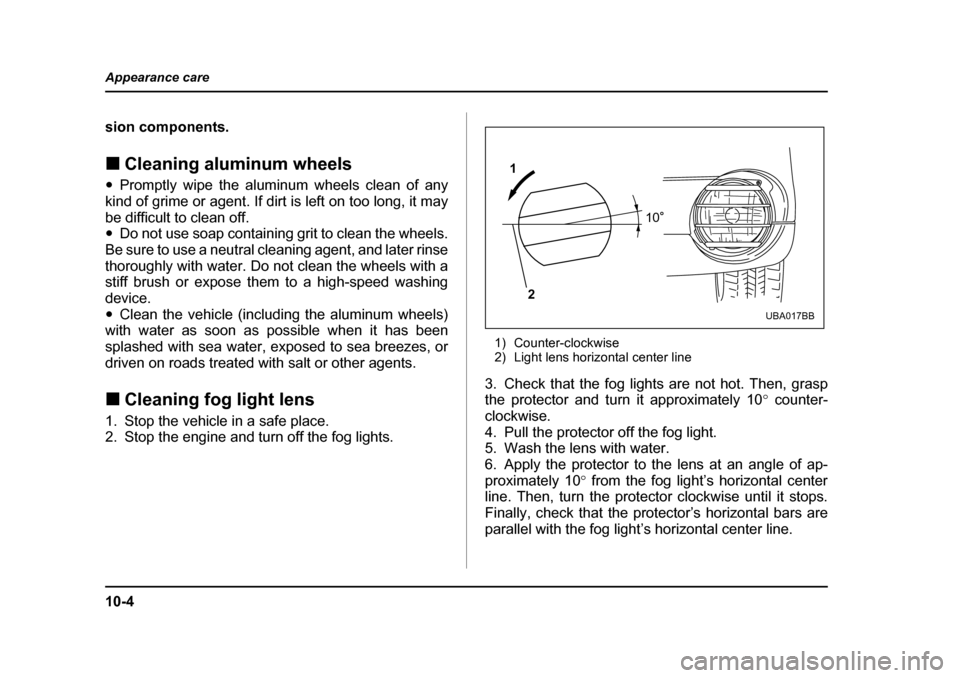
2. Stop the engine and turn off the fog lights. 1) Counter-clockwise
2) Light lens horizontal center line
3. Check that the fog lights are not hot. Then, grasp
the protector and turn it approximately 10 ° counter-
clockwise.
4. Pull the protector off the fog light.
5. Wash the lens with water.
6. Apply the protector to the lens at an angle of ap-
proximately 10 ° from the fog light’s horizontal center
line. Then, turn the protector clockwise until it stops.
Finally, check that the protector’s horizontal bars are
parallel with the fog light’s horizontal center line.
1
2 10
UBA017BB
Page 353 of 469

11 - 2
Maintenance and service
Types of tires .................................................... 11-45
Tire inspection .................................................. 11-46
Tire pressures and wear .................................. 11-46
Wheel balance ................................................... 11-49
Wear indicators ................................................. 11-49
Tire rotation ....................................................... 11-50
Tire replacement ............................................... 11-50
Wheel replacement ........................................... 11-51
Aluminum wheels ......................................... 11-52
Windshield washer fluid .............................. 11-52
Replacement of windshield wiper blades .. 11-53
Battery ........................................................... 11-56
Fuses ............................................................. 11-57
Main fuse ....................................................... 11-60
Installation of accessories .......................... 11-60
Replacing bulbs ............................................ 11-61 Headlight ........................................................... 11-64
Front fog light ................................................... 11-68
Front turn signal light, parking light and side marker light .................................................... 11-69
Rear combination lights ................................... 11-70
Tail light (on the tailgate) ................................. 11-72
License plate light ............................................ 11-74
Map light, dome light and door step light ...... 11-76
High mount stop and cargo light assembly ... 11-77
Sport activity lights (if equipped) .................... 11-79