ignition SUBARU BAJA 2005 1.G Workshop Manual
[x] Cancel search | Manufacturer: SUBARU, Model Year: 2005, Model line: BAJA, Model: SUBARU BAJA 2005 1.GPages: 469, PDF Size: 5.24 MB
Page 247 of 469
7-12
Starting and operating
Stopping the engine
Do not stop the engine when the vehicle is mov-
ing. This will cause loss of power to the power
steering and the brake booster, making steer-
ing and braking more difficult. It could also re-
sult in accidental activation of the “LOCK” po-
sition on the ignition switch, causing the steer-
ing wheel to lock.
The ignition switch should be turned off only when the
engine is idling.
Manual transmission
Do not drive the vehicle with the clutch disen-
gaged (i.e., when the clutch pedal is depressed)
or with the shift lever in the neutral position.
Engine braking has no effect in either of these
conditions and the risk of an accident is conse-
quently increased.
Shift into reverse ONLY when the vehicle has
completely stopped. It may cause damage to the transmission to try shifting into reverse
when the vehicle is moving.
The manual transmission is a fully synchromeshed, 5-
forward-speeds and 1-reverse-speed transmission.
Page 252 of 469
7-17
Starting and operating
– CONTINUED –
A shift interlock function is employed in the automatic
transmission system to ensure safe starting of the ve-
hicle.
To shift the selector lever from the “P” to the any other
position, you have to depress the brake pedal fully
when the ignition switch is in the “ON” position. This
prevents the vehicle from lurching when it is started.
If the shift lever does not move from the “P” position
with the brake pedal depressed, refer to the “Shift lock
release” section in this chapter. TR (Reverse)
This position is for backing the vehicle.
To shift from “N” to “R” position, first stop the vehicle
completely then move the lever to “R” position. T N (Neutral)
Do not drive the vehicle with the selector lever
in the “N” (neutral) position. Engine braking
has no effect in this condition and the risk of an
accident is consequently increased.
This position is for restarting a stalled engine. In this position the wheels and transmission are not
locked. In this position, the transmission is neutral; the
vehicle will roll freely, even on the slightest incline un-
less the parking brake or foot brake is on.
Avoid coasting with the transmission neutral.
During coasting, the engine braking does not act. T
D (Drive)
This position is for normal driving.
The transmission automatically shifts into a suitable
gear from 1st to 4th according to the vehicle speed
and the acceleration you require.
When more acceleration is required in this position,
press the accelerator pedal fully to the floor and hold
that position. The transmission will automatically
downshift to 3rd, 2nd or 1st gear. When you release
the pedal, the transmission will return to the original
gear position. V While climbing a grade
When driving up a hill, undesired upshift to 4th gear is
prevented from taking place when the accelerator is
released. This minimizes the chance of subsequent
downshifting to a lower gear when accelerating again.
This prevents repeated upshifting and downshifting re-
sulting in a smoother operation of the vehicle.
Page 255 of 469
7-20
Starting and operating
The engine may, on rare occasions, knock when the
vehicle rapidly accelerates or rapidly pulls away from
a standstill. This phenomenon does not indicate a fault. „
Shift lock release
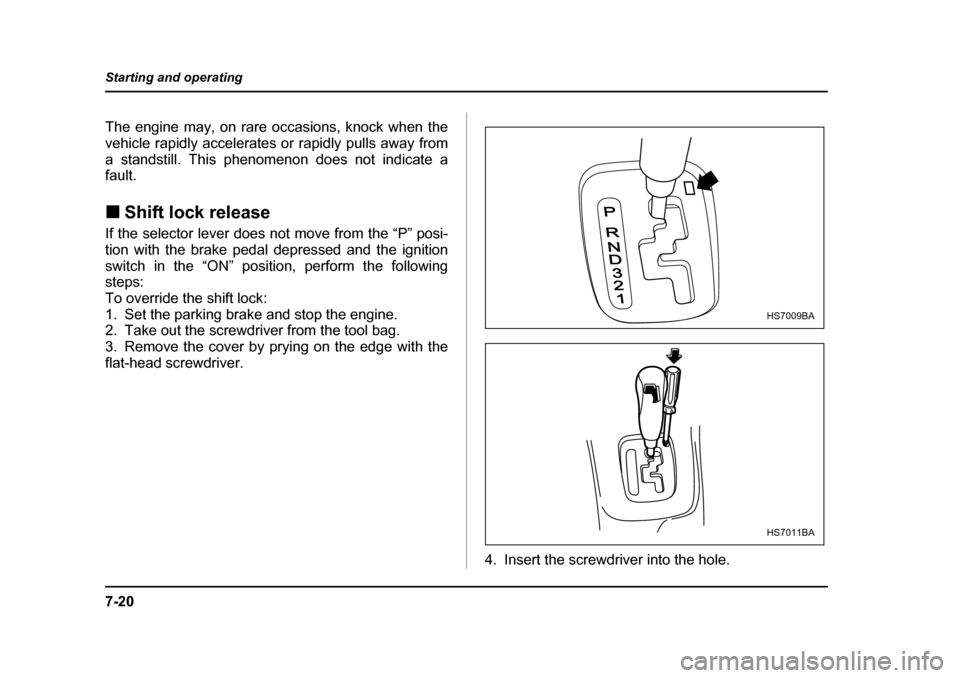
If the selector lever does not move from the “P” posi-
tion with the brake pedal depressed and the ignition
switch in the “ON” position, perform the following steps:
To override the shift lock:
1. Set the parking brake and stop the engine.
2. Take out the screwdriver from the tool bag.
3. Remove the cover by prying on the edge with the
flat-head screwdriver.
4. Insert the screwdriver into the hole.
P
RND321
HS7009BA
HS7011BA
Page 258 of 469
7-23
Starting and operating
– CONTINUED –
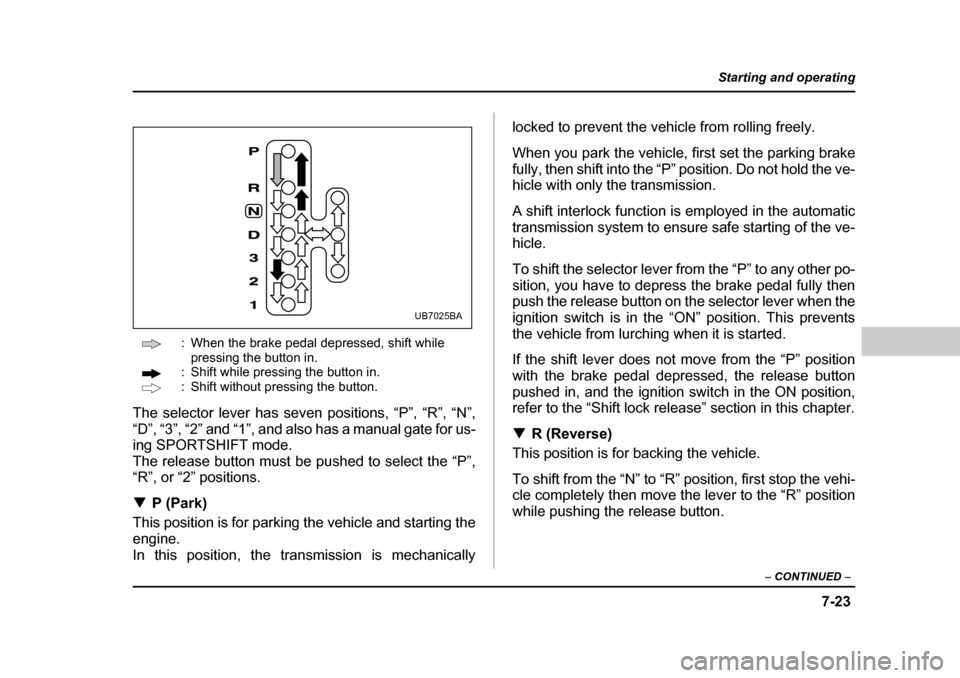
: When the brake pedal depressed, shift while
pressing the button in.
: Shift while pressing the button in.
: Shift without pressing the button.
The selector lever has seven positions, “P”, “R”, “N”,
“D”, “3”, “2” and “1”, and also has a manual gate for us-
ing SPORTSHIFT mode.
The release button must be pushed to select the “P”,
“R”, or “2” positions. T P (Park)
This position is for parking the vehicle and starting the
engine.
In this position, the transmission is mechanically locked to prevent the vehicle from rolling freely.
When you park the vehicle, first set the parking brake
fully, then shift into the “P” position. Do not hold the ve-
hicle with only the transmission.
A shift interlock function is employed in the automatic
transmission system to ensure safe starting of the ve-
hicle.
To shift the selector lever from the “P” to any other po-
sition, you have to depress the brake pedal fully then
push the release button on the selector lever when the
ignition switch is in the “ON” position. This prevents
the vehicle from lurching when it is started.
If the shift lever does not move from the “P” position
with the brake pedal depressed, the release button
pushed in, and the ignition switch in the ON position,
refer to the “Shift lock release” section in this chapter. T
R (Reverse)
This position is for backing the vehicle.
To shift from the “N” to “R” position, first stop the vehi-
cle completely then move the lever to the “R” position
while pushing the release button.
UB7025BA
Page 259 of 469
7-24
Starting and operating
T
N (Neutral)
Do not drive the vehicle with the selector lever
in the “N” (neutral) position. Engine braking
has no effect in this condition and the risk of an
accident is consequently increased.
This position is for restarting a stalled engine.
In this position the wheels and transmission are not
locked. In this position, the transmission is neutral; the
vehicle will roll freely, even on the slightest incline un-
less the parking brake or foot brake is on.
Avoid coasting with the transmission neutral.
During coasting, there is no engine braking effect.
NOTE
If the selector lever is in the “N” position when you
stop the engine for parking, you may not subse-
quently be able to move it to the “R” and “P” posi- tions. If this happens, turn the ignition switch to
the “ON” position. You will then be able to move
the selector lever to the “P” position. T D (Drive)
This position is for normal driving. The transmission automatically shifts into a suitable
gear from 1st to 4th according to the vehicle speed
and the acceleration you require.
When more acceleration is required in this position,
press the accelerator pedal fully to the floor and hold
that position. The transmission will automatically
downshift to 3rd, 2nd or 1st gear. When you release
the pedal, the transmission will return to the original
gear position.
To use the SPORTSHIFT mode, move the lever from
this position into the manual gate. V
While climbing a grade
When driving up a hill, undesired upshift to 4th gear is
prevented from taking place when the accelerator is
released. This minimizes the chance of subsequent
downshifting to a lower gear when accelerating again.
This prevents repeated upshifting and downshifting re-
sulting in a smoother operation of the vehicle.
NOTE
The transmission may downshift to 2nd or 1st
gear, depending on the way the accelerator pedal
is pressed to accelerate the vehicle again. V While going down a hill
When descending a steep hill, depressing the brake
pedal will cause the transmission to downshift to 3rd
Page 261 of 469
7-26
Starting and operating
The function becomes operational when the vehicle
reaches a speed of approximately 6 mph (10 km/h).
Once operational, it prevents the selector lever from
being moved from the “N” position to the “R” position.
When the vehicle speed drops below 6 mph (10 km/h),
the function is canceled. The selector lever can then
be moved to the “R” and “P” positions.
When the ignition switch has been turned to the “OFF”
position, movement of the selector lever from the “N”
position to the “R” position is possible for a limited time
period and then becomes impossible. Also, the selec-
tor lever cannot be moved to the “R” position when it
has been placed in the “P” position and then placed
again in the “N” position. When movement of the se-
lector lever from the “N” position to the “R” position has
become impossible, turn the ignition switch back to the
“ON” position then move the selector lever to the “P”
position. Pressing the selector lever release button
also makes it possible to move the selector lever to the
“P” position at this time.
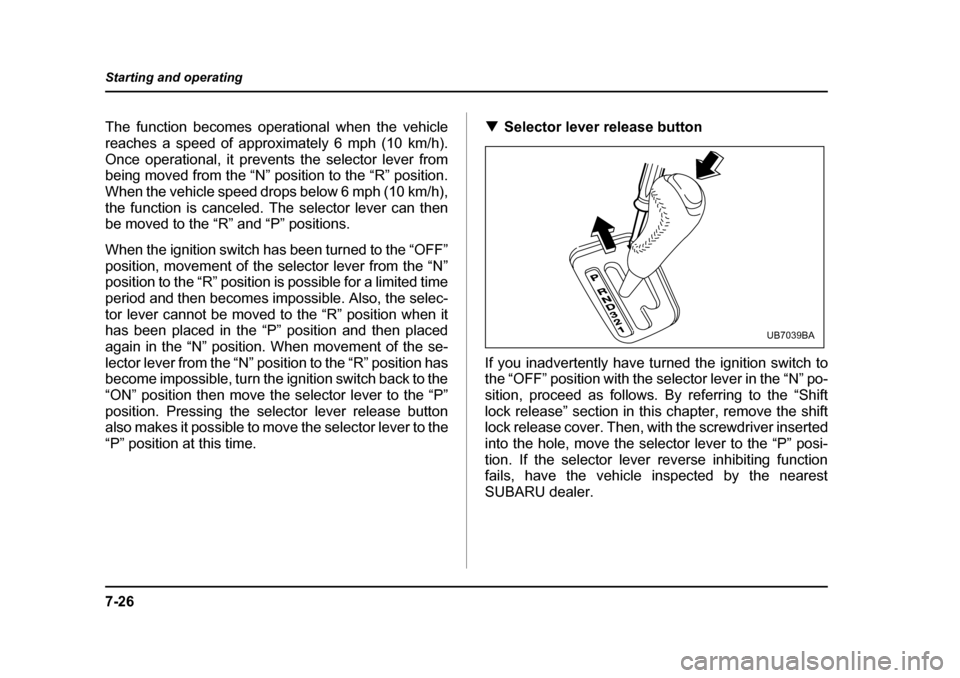
T
Selector lever release button
If you inadvertently have turned the ignition switch to
the “OFF” position with the selector lever in the “N” po-
sition, proceed as follows. By referring to the “Shift
lock release” section in this chapter, remove the shift
lock release cover. Then, with the screwdriver inserted
into the hole, move the selector lever to the “P” posi-
tion. If the selector lever reverse inhibiting function
fails, have the vehicle inspected by the nearest SUBARU dealer.
UB7039BA
Page 265 of 469
7-30
Starting and operating
„
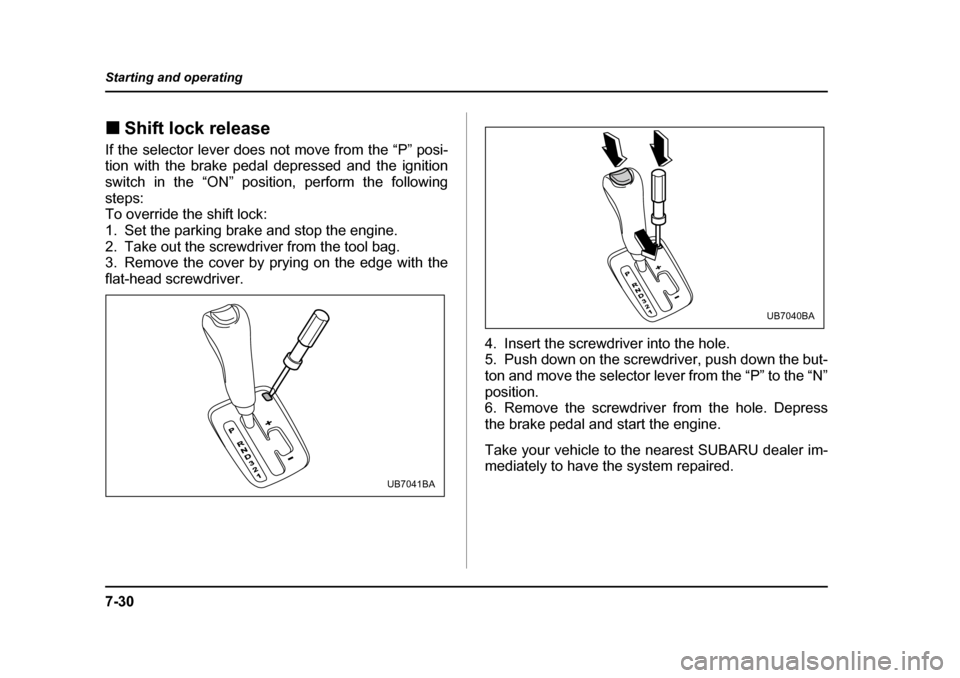
Shift lock release
If the selector lever does not move from the “P” posi-
tion with the brake pedal depressed and the ignition
switch in the “ON” position, perform the followingsteps:
To override the shift lock:
1. Set the parking brake and stop the engine.
2. Take out the screwdriver from the tool bag.
3. Remove the cover by prying on the edge with the
flat-head screwdriver.
4. Insert the screwdriver into the hole.
5. Push down on the screwdriver, push down the but-
ton and move the selector lever from the “P” to the “N”position.
6. Remove the screwdriver from the hole. Depress
the brake pedal and start the engine.
Take your vehicle to the nearest SUBARU dealer im- mediately to have the system repaired.
UB7041BA
UB7040BA
Page 269 of 469
7-34
Starting and operating
The ABS system prevents the lock-up of wheels which
may occur during sudden braking or braking on slip-
pery road surfaces. This helps prevent the loss of
steering control and directional stability caused by
wheel lock-up.
When the ABS system is operating, you may hear a
chattering noise or feel a slight vibration in the brake
pedal. This is normal when the ABS operates.
The ABS system will not operate when the vehicle
speed is below approximately 6 mph (10 km/h). „
ABS system self-check
You may feel a slight shock in the brake pedal and
hear the operating sound of ABS from the engine com-
partment just after the vehicle is started. This is
caused by an automatic functional test of the ABS sys-
tem being carried out and does not indicate any abnor-
mal condition. „
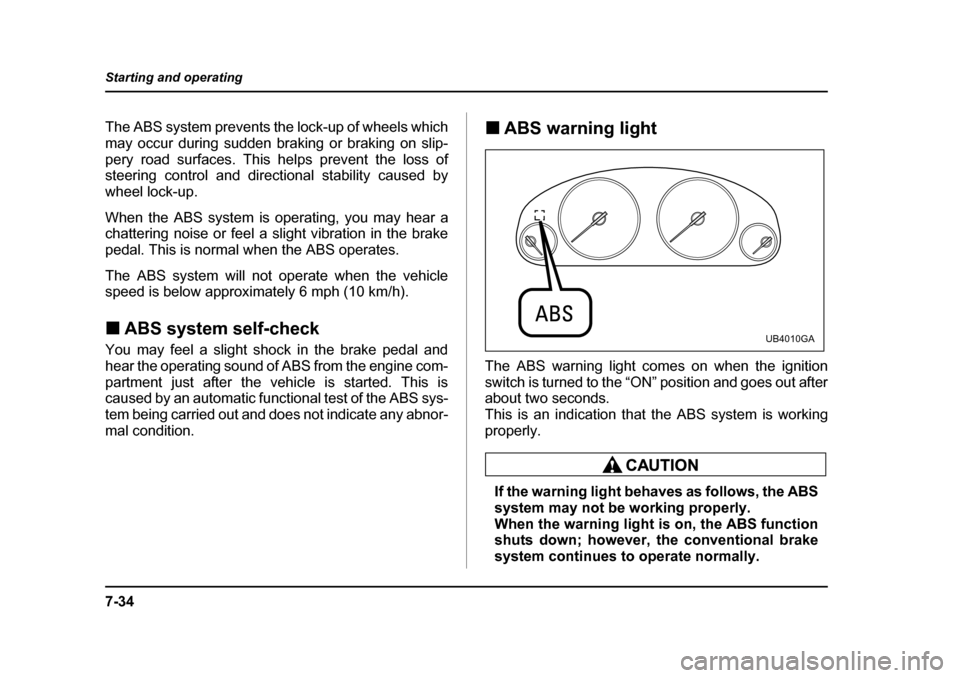
ABS warning light
The ABS warning light comes on when the ignition
switch is turned to the “ON” position and goes out after
about two seconds.
This is an indication that the ABS system is working
properly.
If the warning light behaves as follows, the ABS
system may not be working properly.
When the warning light is on, the ABS function
shuts down; however, the conventional brake
system continues to operate normally.
UB4010GA
Page 270 of 469
7-35
Starting and operating
– CONTINUED –
yThe warning light does not come on when the
ignition switch is turned to the “ON” position. y The warning light comes on when the ignition
switch is turned to the “ON” position, but it
does not go out even when the vehicle speed
exceeds approximately 8 mph (12 km/h). y The warning light comes on during driving.
If these occur, have the ABS system repaired at
the first available opportunity by your SUBARU
dealer.
NOTE
If the warning light behavior is as described be-
low, the ABS system may be considered normal. y The warning light comes on right after the en-
gine is started but goes out immediately, remain-
ing off. y The warning light remains on after the engine
has been started, but it goes out when the vehicle
speed reaches about 8 mph (12 km/h). y The warning light comes on during driving, but
it goes out immediately and remains off.
When driving with an insufficient battery voltage such
as when the engine is jump started, the ABS warning
light may come on. This is due to the low battery volt-
age and does not indicate a malfunction. When the battery becomes fully charged, the light will go out.
Page 275 of 469

7-40
Starting and operating
„
To turn off the cruise control
There are two ways to turn off the cruise control: y Push the main switch again.
y Turn the ignition switch to the “ACC” position (but
only when the vehicle is completely stopped). „ To change the cruising speed
T To increase the speed (by control lever)
Push the control lever upward in the “ACCEL, RE-
SUME” direction and hold it until the vehicle reaches
the desired speed. Then, release the control lever.
The vehicle speed at that moment will be memorized
and treated as the new set speed.
When the difference between the actual vehicle speed
and the set speed is less than 4 mph (6.8 km/h), the
set speed can be increased 1 mph (1.6 km/h) each
time by pressing the control lever upward in the “AC-
CEL, RESUME” direction quickly. T To increase the speed (by accelerator pedal)
1. Depress the accelerator pedal to accelerate the ve-
hicle to the desired speed.
2. Push the control lever downward in the “SET,
COAST” direction once. Now the desired speed is set
and the vehicle will keep running at that speed without depressing the accelerator pedal.
NOTE
If the difference between the actual vehicle speed
when the control lever is pushed downward and
the speed last time you set it is less than 4 mph
(6.8 km/h), the vehicle speed will be lowered by 1
mph (1.6 km/h). This occurs because the cruise
control system unit regards this lever operation as
that intended to decrease the vehicle speed. T
To decrease the speed (by control lever)
Push the control lever downward in the “SET, COAST”
direction and hold it until the vehicle reaches the de-
sired speed. Then, release the control lever. The vehi-
cle speed at that moment will be memorized and treat-
ed as the new set speed.
When the difference between the actual vehicle speed
and the set speed is less than 4 mph (6.8 km/h), the
set speed can be lowered 1 mph (1.6 km/h) each time
by pressing the control lever downward in the “SET,
COAST” direction quickly. T To decrease the speed (by brake pedal)
1. Depress the brake pedal to release cruise control
temporarily.
2. When the speed decreases to the desired speed,