ECU SUBARU BAJA 2005 1.G Repair Manual
[x] Cancel search | Manufacturer: SUBARU, Model Year: 2005, Model line: BAJA, Model: SUBARU BAJA 2005 1.GPages: 469, PDF Size: 5.24 MB
Page 322 of 469
9-9
In case of emergency
– CONTINUED –
underside of the vehicle. Driving with the cable
not retracted fully could result in damage to the
adjacent under floor parts and lead to a serious
accident. yThe spare tire holder is designed to carry
only the smaller temporary spare tire. Never store a full size tire (flat or otherwise) in the
spare tire holder. Doing so can result in dam-
age to adjacent under floor parts and can lead
to a serious accident.
When using the spare tire hoist:
Do not use air tools or power tools to turn the
spare tire hoist shaft end. If you do, it could re-
sult in severe mechanical damage to the spare
tire hoist.
„ Re-storage of spare tire
1. Turn the spare tire hoist shaft end counterclock-
wise with the wheel nut wrench to loosen the cable
sufficiently enough to allow the cable end retainer go
through center hole of the temporary spare tire.
2. Insert the retainer through the center hole of the temporary tire (with the outside of the tire facing up).
3. Turn the hoist shaft end clockwise with the wheel
nut wrench to wind the cable up completely until you
hear a few clicking sounds. Confirm that the temporary
spare tire holding cable has been wound up complete-
ly by shaking the temporary tire.
If the temporary spare tire is not stored secure-
ly, it could damage adjacent areas of the vehi-
cle and make an abnormal noise.
4. Put the rubber cap on the hoist shaft end hole.
5. Place the wheel nut wrench back into the tool bag
and store the jack and tool bag in their storage loca-
tions.
Page 325 of 469
9-12
In case of emergency
Flat tires
If you get a flat tire while driving, never brake sudden-
ly; keep driving straight ahead while gradually reduc-
ing speed. Then slowly pull off the road to a safe place. „
Changing a flat tire
yDo not jack up the vehicle on an incline or a
loose road surface. The jack can come out of
the jacking point or sink into the ground and
this can result in a serious accident. y Use only the jack provided with your vehicle.
The jack supplied with the vehicle is designed
only for changing a tire. Never get under the ve-
hicle while supporting the vehicle with thisjack. y Always turn the engine off before raising the
flat tire off the ground using the jack. Never
swing or push the vehicle supported with the
jack. The jack can come out of the jacking point
due to a jolt and this can result in a serious ac-
cident. y Never place a tire or tire changing tools in the
passenger compartment after changing wheels. In a sudden stop or collision, loose
equipment could strike occupants and cause
injury. Store the tire and all tools in the proper
place.
1. Park on a hard, level surface, whenever possible,
then stop the engine.
2. Set the parking brake securely and shift a manual
transmission vehicle into reverse or an automatic
transmission vehicle into the “P” (Park) position.
3. Turn on the hazard warning flasher and have ev-
eryone get out of the vehicle.
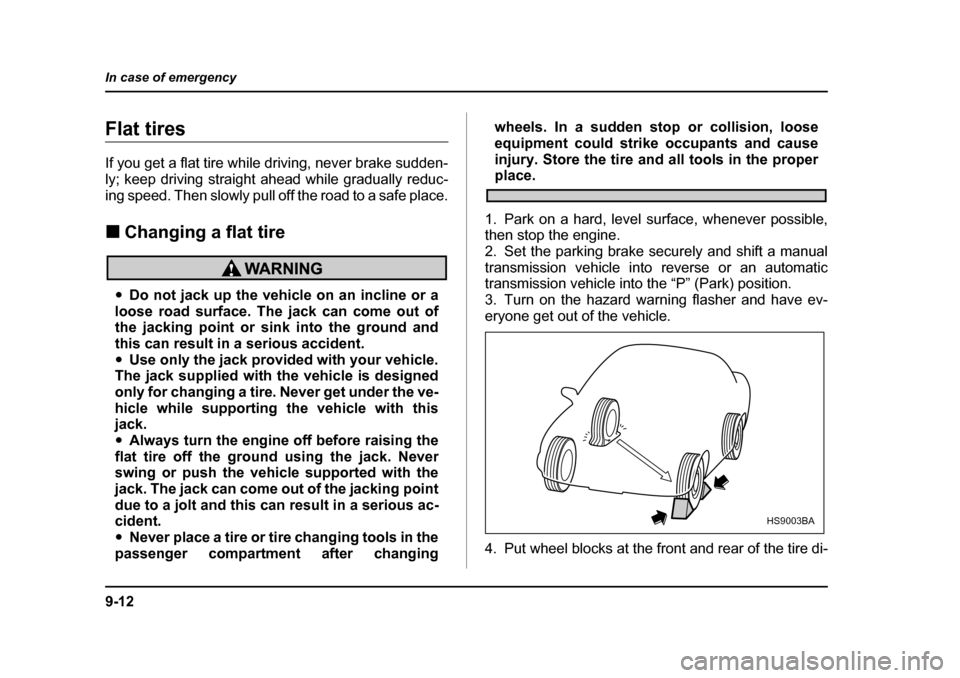
4. Put wheel blocks at the front and rear of the tire di-
HS9003BA
Page 329 of 469
9-16
In case of emergency
9. Use the wheel nut wrench to securely tighten the
wheel nuts to the specified torque, following the tight-
ening order in the illustration. The torque for tightening
the nuts is 74 to 89 lbf·ft (100 to 120 N·m, 10 to 12
kgf·m). This torque is equivalent to applying about 88
to 110 lbs (40 to 50 kg) at the top of the wheel nut
wrench provided to your vehicle. Never use your foot
on the wheel nut wrench or a pipe extension on the
wrench because you may exceed the specified torque.
Have the wheel nut torque checked at the nearest au-
tomotive service facility. T
Storage of the flat tire
ySecure the flat tire in the cargo bed (with the
outer side of the wheel facing up) by using the
designated tire holding rod and retainer. If the
flat tire is not properly secured, it may fall out
and create a dangerous road hazard that could
lead to a serious accident. y Do not store the flat tire under the floor. Do-
ing so could damage the underside of the vehi-
cle.
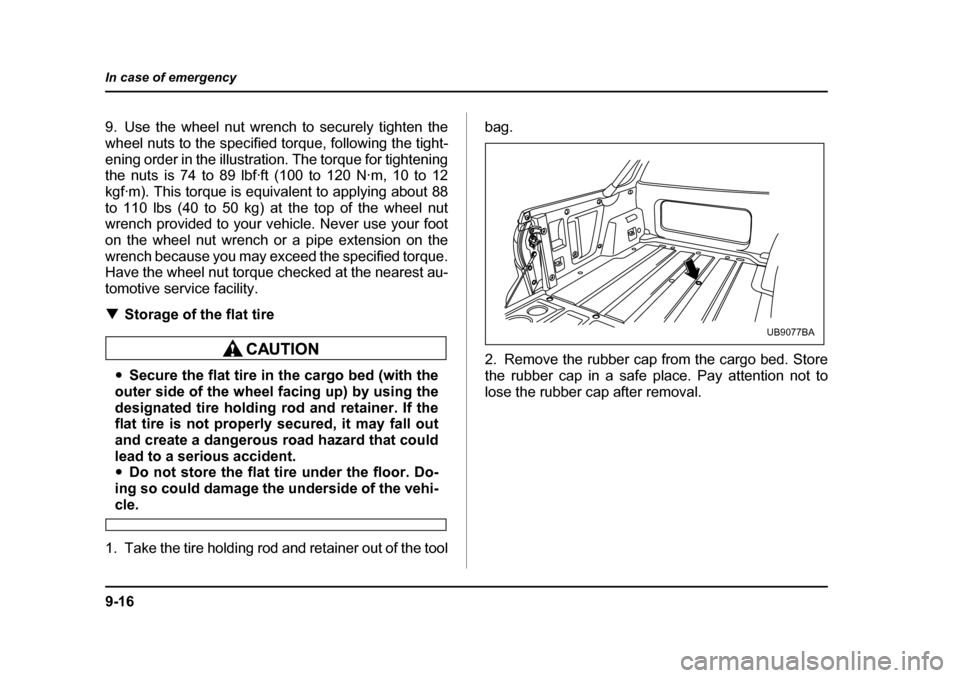
1. Take the tire holding rod and retainer out of the tool bag.
2. Remove the rubber cap from the cargo bed. Store
the rubber cap in a safe place. Pay attention not to
lose the rubber cap after removal.
UB9077BA
Page 330 of 469
9-17
In case of emergency
– CONTINUED –
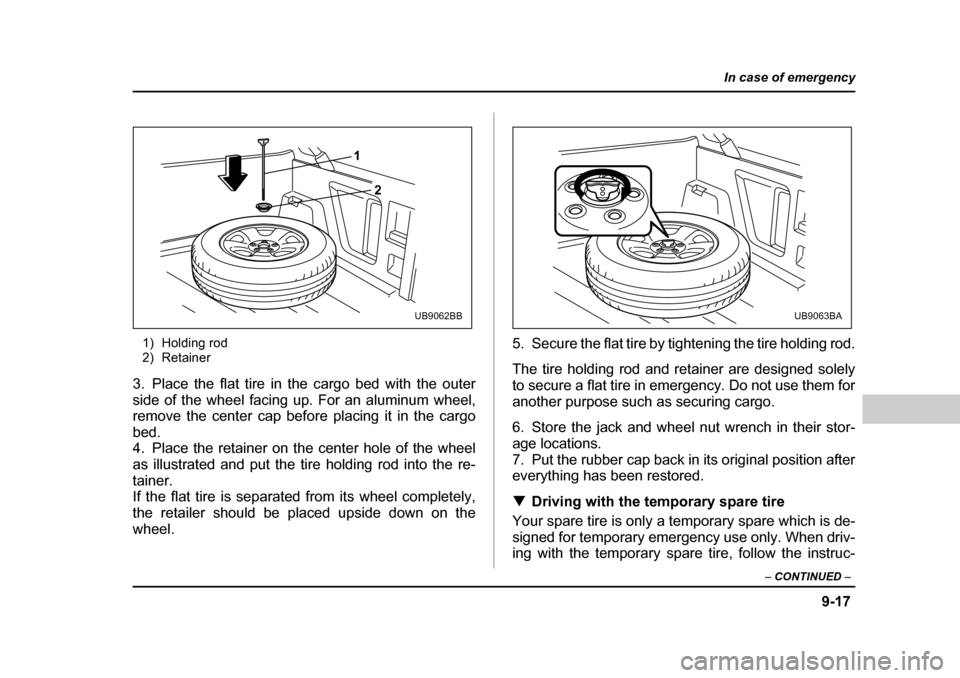
1) Holding rod
2) Retainer
3. Place the flat tire in the cargo bed with the outer
side of the wheel facing up. For an aluminum wheel,
remove the center cap before placing it in the cargo
bed.
4. Place the retainer on the center hole of the wheel
as illustrated and put the tire holding rod into the re-
tainer.
If the flat tire is separated from its wheel completely,
the retailer should be placed upside down on the
wheel. 5. Secure the flat tire by tightening the tire holding rod.
The tire holding rod and retainer are designed solely
to secure a flat tire in emergency. Do not use them for
another purpose such as securing cargo.
6. Store the jack and wheel nut wrench in their stor-
age locations.
7. Put the rubber cap back in its original position after
everything has been restored. T
Driving with the temporary spare tire
Your spare tire is only a temporary spare which is de-
signed for temporary emergency use only. When driv-
ing with the temporary spare tire, follow the instruc-
1
2
UB9062BBUB9063BA
Page 338 of 469
9-25
In case of emergency
– CONTINUED –
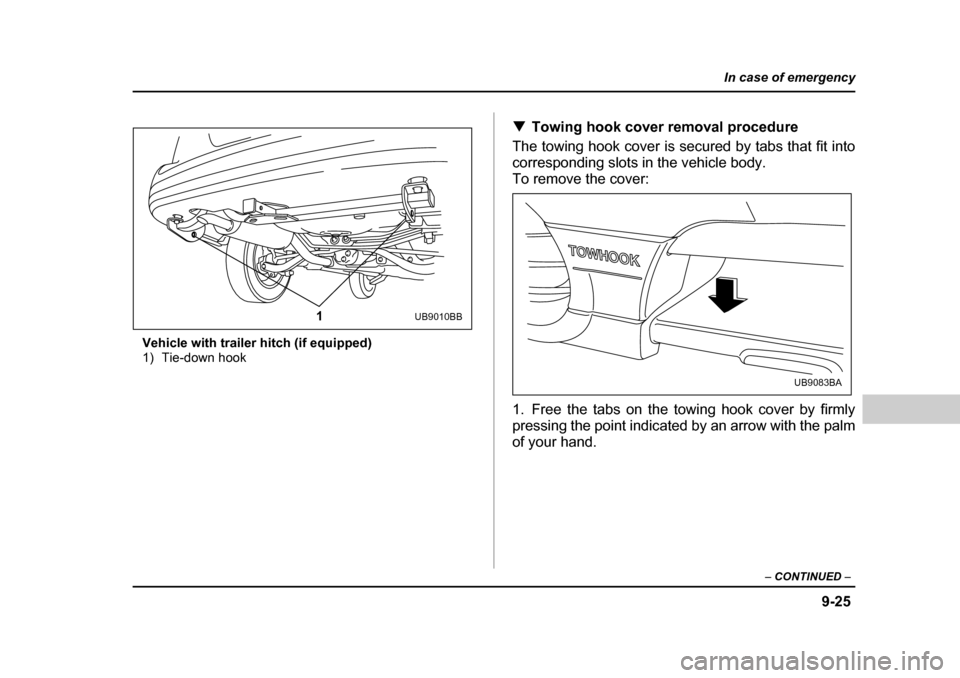
Vehicle with trailer hitch (if equipped)
1) Tie-down hook T
Towing hook cover removal procedure
The towing hook cover is secured by tabs that fit into
corresponding slots in the vehicle body.
To remove the cover:
1. Free the tabs on the towing hook cover by firmly
pressing the point indicated by an arrow with the palm
of your hand.
1UB9010BB
UB9083BA
Page 339 of 469
9-26
In case of emergency
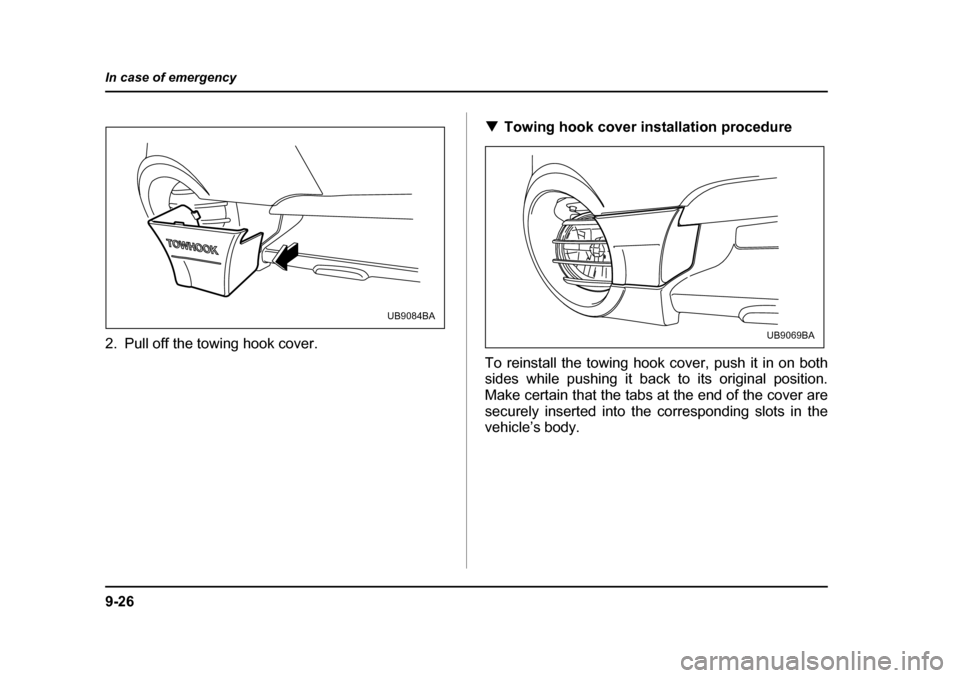
2. Pull off the towing hook cover.
T
Towing hook cover installation procedure
To reinstall the towing hook cover, push it in on both
sides while pushing it back to its original position.
Make certain that the tabs at the end of the cover are
securely inserted into the corresponding slots in the vehicle’s body.
UB9084BA
UB9069BA
Page 340 of 469
9-27
In case of emergency
– CONTINUED –
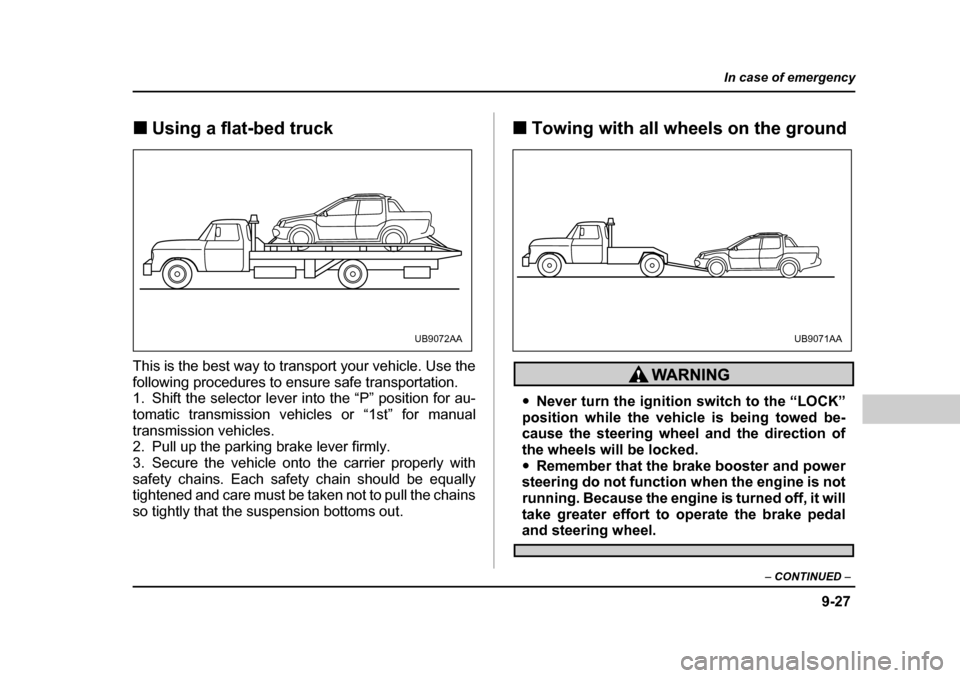
„Using a flat-bed truck
This is the best way to transport your vehicle. Use the
following procedures to ensure safe transportation.
1. Shift the selector lever into the “P” position for au-
tomatic transmission vehicles or “1st” for manual
transmission vehicles.
2. Pull up the parking brake lever firmly.
3. Secure the vehicle onto the carrier properly with
safety chains. Each safety chain should be equally
tightened and care must be taken not to pull the chains
so tightly that the suspension bottoms out. „
Towing with all wheels on the ground
yNever turn the ignition switch to the “LOCK”
position while the vehicle is being towed be-
cause the steering wheel and the direction of
the wheels will be locked.y Remember that the brake booster and power
steering do not function when the engine is not
running. Because the engine is turned off, it will
take greater effort to operate the brake pedal
and steering wheel.
UB9072AAUB9071AA
Page 357 of 469
11 - 6
Maintenance and service
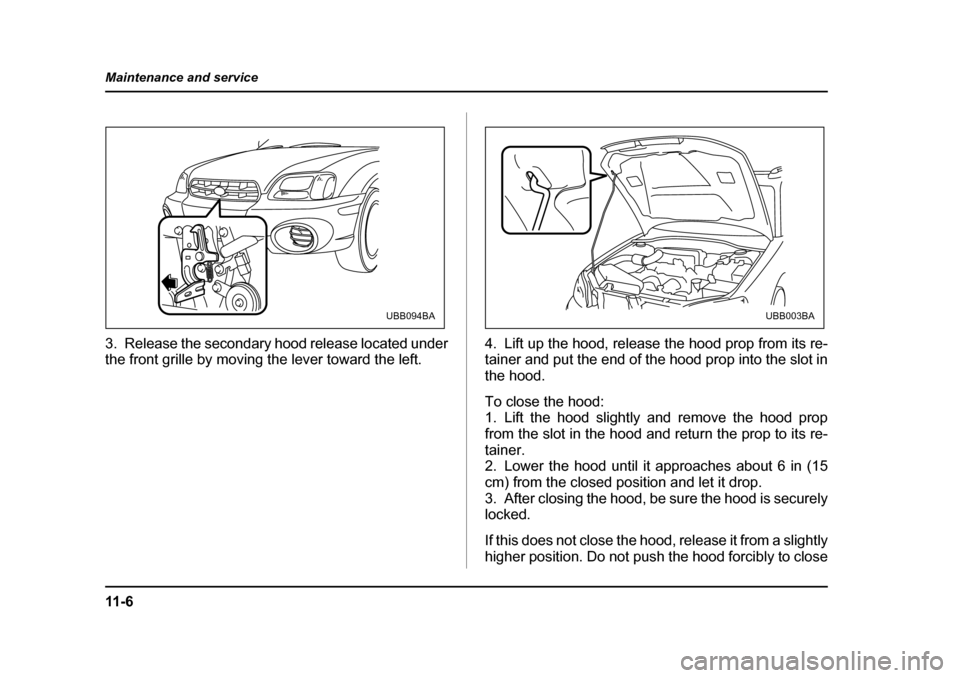
3. Release the secondary hood release located under
the front grille by moving the lever toward the left.
4. Lift up the hood, release the hood prop from its re-
tainer and put the end of the hood prop into the slot in
the hood.
To close the hood:
1. Lift the hood slightly and remove the hood prop
from the slot in the hood and return the prop to its re-
tainer.
2. Lower the hood until it approaches about 6 in (15
cm) from the closed position and let it drop.
3. After closing the hood, be sure the hood is securely
locked.
If this does not close the hood, release it from a slightly
higher position. Do not push the hood forcibly to close
UBB094BAUBB003BA
Page 364 of 469
11 -1 3
Maintenance and service
– CONTINUED –
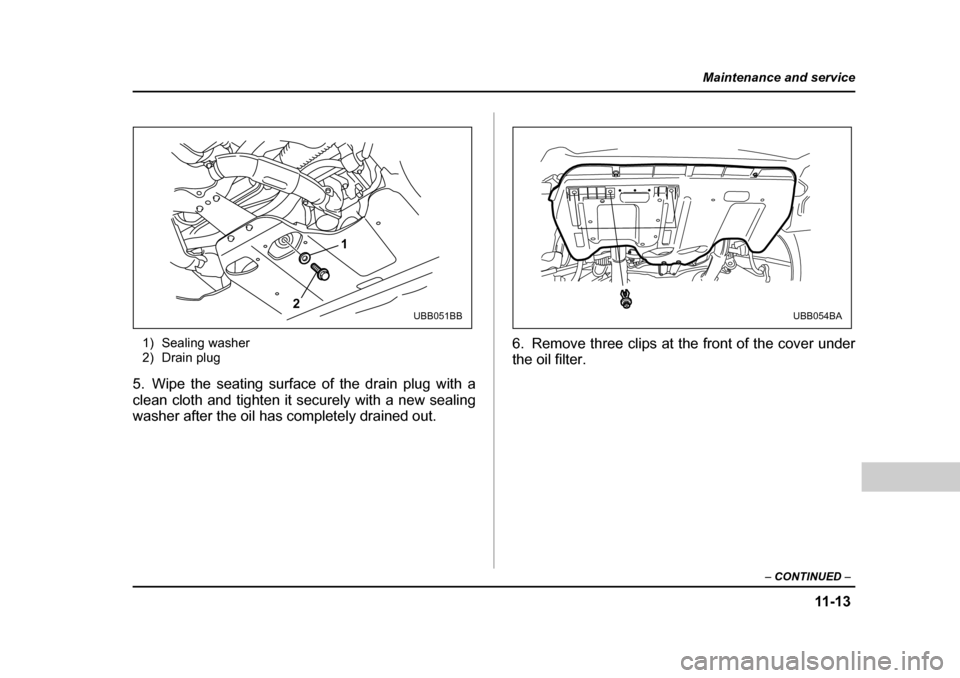
1) Sealing washer
2) Drain plug
5. Wipe the seating surface of the drain plug with a
clean cloth and tighten it securely with a new sealing
washer after the oil has completely drained out. 6. Remove three clips at the front of the cover under
the oil filter.
1
2UBB051BBUBB054BA
Page 371 of 469
11 - 2 0
Maintenance and service
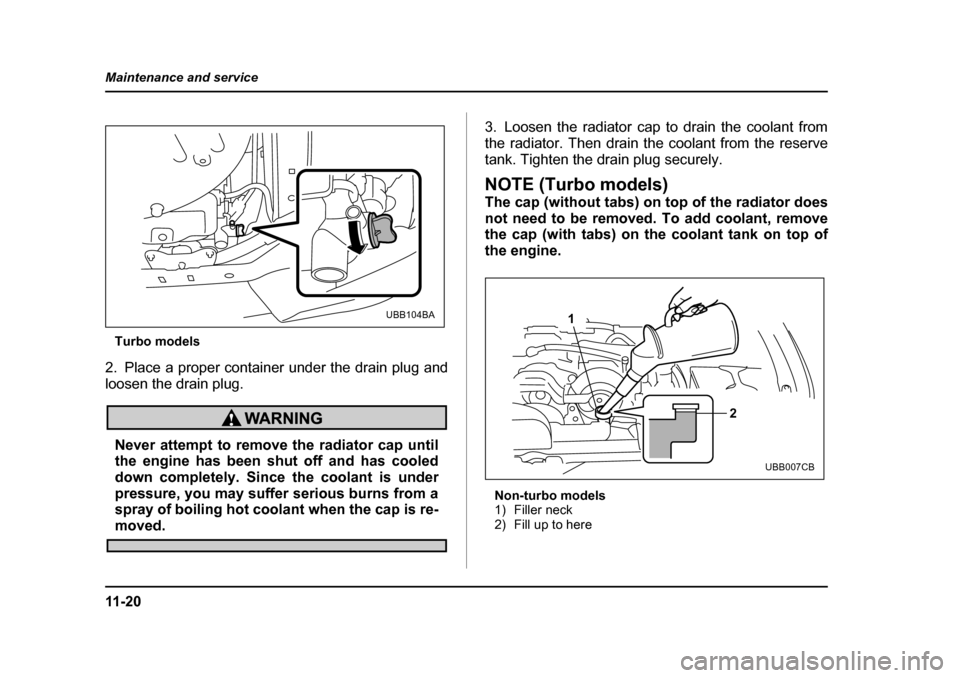
Turbo models
2. Place a proper container under the drain plug and
loosen the drain plug.
Never attempt to remove the radiator cap until
the engine has been shut off and has cooled
down completely. Since the coolant is under
pressure, you may suffer serious burns from a
spray of boiling hot coolant when the cap is re-
moved. 3. Loosen the radiator cap to drain the coolant from
the radiator. Then drain the coolant from the reserve
tank. Tighten the drain plug securely.
NOTE (Turbo models)
The cap (without tabs) on top of the radiator does
not need to be removed. To add coolant, remove
the cap (with tabs) on the coolant tank on top of
the engine.
Non-turbo models
1) Filler neck
2) Fill up to here
UBB104BA1 2
UBB007CB