tires SUBARU BAJA 2006 1.G Owner's Manual
[x] Cancel search | Manufacturer: SUBARU, Model Year: 2006, Model line: BAJA, Model: SUBARU BAJA 2006 1.GPages: 487, PDF Size: 5.55 MB
Page 341 of 487
9-12
In case of emergency
Flat tires
If you get a flat tire while driving, never brake sudden-
ly; keep driving straight ahead while gradually reduc-
ing speed. Then slowly pull off the road to a safe place. „
Changing a flat tire
yDo not jack up the vehicle on an incline or a
loose road surface. The jack can come out of
the jacking point or sink into the ground and
this can result in a serious accident. y Use only the jack provided with your vehicle.
The jack supplied with the vehicle is designed
only for changing a tire. Never get under the ve-
hicle while supporting the vehicle with thisjack. y Always turn off the engi ne before raising the
flat tire off the grou nd using the jack. Never
swing or push the vehicle supported with the
jack. The jack can come out of the jacking point
due to a jolt and this can result in a serious ac-
cident. y Never place a tire or tire changing tools in the
passenger compartment after changing wheels. In a sudden stop or collision, loose
equipment could strike occupants and cause
injury. Store the tire and all tools in the proper
place.
1. Park on a hard, level surface, whenever possible,
then stop the engine.
2. Set the parking brake securely and shift a manual
transmission vehicle into reverse or an automatic
transmission vehicle into the “P” (Park) position.
3. Turn on the hazard warning flasher and have ev-
eryone get out of the vehicle.
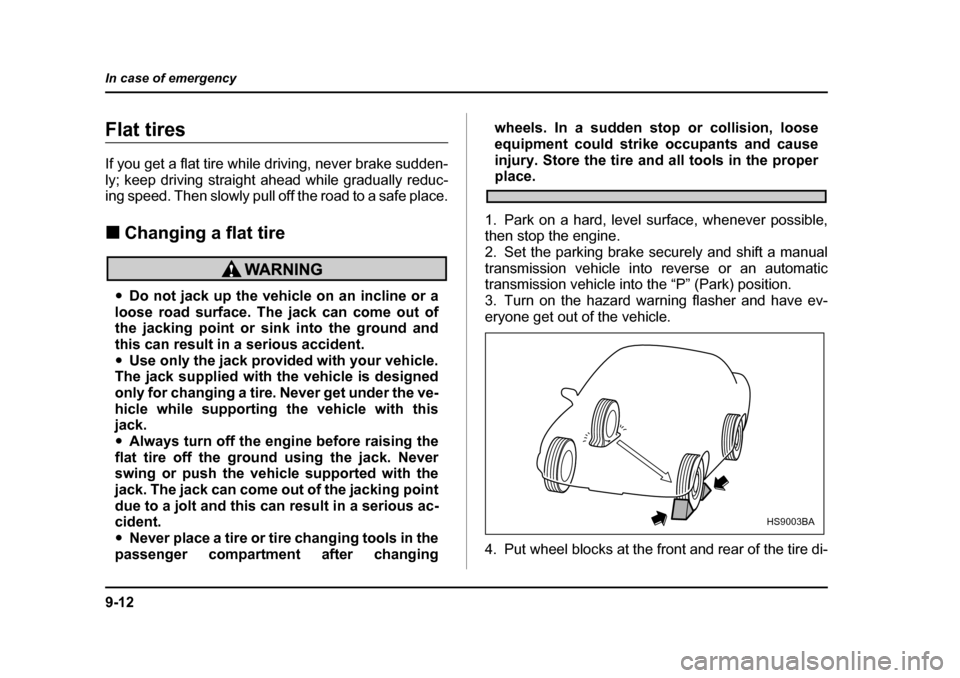
4. Put wheel blocks at the fron t and rear of the tire di-
HS9003BA
Page 366 of 487

11 - 1
11
Maintenance and service
Maintenance schedule ................................. 11-3
Maintenance precautions ............................ 11-3 Before checking or servicing in the engine compartment .................................................. 11-4
When you do checking or servicing in the engine compartment while the engine is
running ............................................................ 11-5
Engine hood .................................................. 11-5
Engine compartment overview ................... 11-8 Non-turbo models ............................................. 11-8
Turbo models .................................................... 11-9
Engine oil ...................................................... 11-10 Checking the oil level ....................................... 11-10
Changing the oil and oil filter .......................... 11-12
Recommended grade and viscosity ................ 11-15
Recommended grade and viscosity under severe driving conditions .............................. 11-16
Cooling system .... ....................................... .. 11-17
Hose and connections ...................................... 11-18
Engine coolant .................................................. 11-18
Air cleaner element ...................................... 11-23 Replacing the air cleaner element ................... 11-23
Spark plugs ................................................... 11-25 Recommended spark plugs ............................. 11-26
Drive belts ..................................................... 11-26
Manual transmission oil ............................... 11-27 Checking the oil level ....................................... 11-27
Recommended grade and viscosity ................ 11-29
Automatic transmission fluid ...................... 11-29 Checking the fluid level .................................... 11-29
Recommended fluid ......................................... 11-31
Front differential gear oil (AT vehicles) ...... 11-32
Checking the oil level ....................................... 11-32
Recommended grade and viscosity ............... 11-33
Rear differential gear oil . .............................. 11-33
Checking the gear oil level .............................. 11-33
Recommended grade and viscosity ............... 11-35
Power steering fluid ...................................... 11-36 Checking the fluid level .................................... 11-36
Recommended fluid ......................................... 11-38
Brake fluid ..................................................... 11-38 Checking the fluid level .................................... 11-38
Recommended brake fluid ............................... 11-39
Clutch fluid (MT vehicles) ............................ 11-40 Checking the fluid level .................................... 11-40
Recommended clutch fluid .............................. 11-41
Brake booster ................................................ 11-42
Brake pedal .................................................... 11-42 Checking the brake pedal free play ................ 11-42
Checking the brake pedal reserve distance ... 11-43
Clutch pedal (Manual transmission vehicles) ..................................................... 11-43Checking the clutch function .......................... 11-43
Checking the clutch pedal free play ............... 11-44
Replacement of brake pad and lining ......... 11-44 Breaking-in of new brake pads and linings .... 11-45
Parking brake stroke ......... ........................... 11-46
Tires and wheels ............. .............................. 11-46
Page 367 of 487

11 - 2
Maintenance and service
Types of tires .................................................... 11-46
Tire inspection .................................................. 11-47
Tire pressures and wear .................................. 11-47
Wheel balance ................................................... 11-50
Wear indicators ................................................. 11-50
Tire rotation ....................................................... 11-51
Tire replacement ............................................... 11-51
Wheel replacement ........................................... 11-52
Aluminum wheels ......................................... 11-53
Windshield washer fluid .............................. 11-53
Replacement of windshield wiper blades .. 11-55
Battery ........................................................... 11-58
Fuses ............................................................. 11-59
Main fuse ....................................................... 11-61
Installation of accessories .......................... 11-62
Replacing bulbs ............................................ 11-63 Headlight ........................................................... 11-66
Front fog light ................................................... 11-70
Front turn signal light, parking light and side marker light .................................................... 11-71
Rear combination lights ................................... 11-72
Tail light (on the tailgate) ................................. 11-74
License plate light ............................................ 11-76
Map light, dome light and door step light ...... 11-78
High mount stop and cargo light assembly ... 11-79
Sport activity lights (if equipped) .................... 11-81
Page 411 of 487
11 - 4 6
Maintenance and service
Parking brake strokeParking
Brake stroke
Check the parking brake stroke according to the main-
tenance schedule in the “Warranty and Maintenance
Booklet”. When the parking brake is properly adjusted,
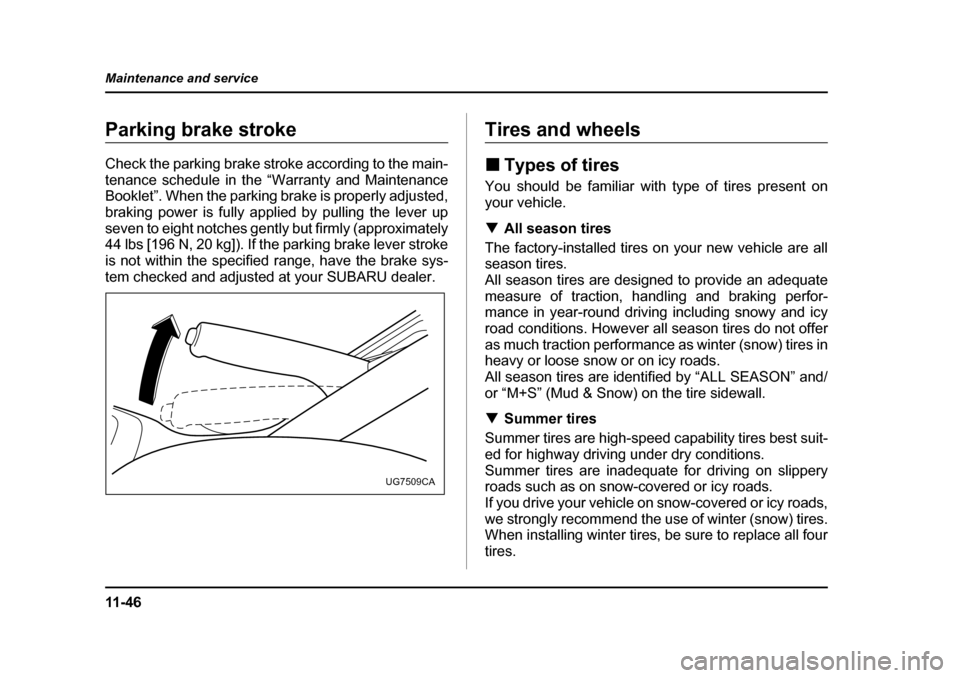
braking power is fully applied by pulling the lever up
seven to eight notches gently but firmly (approximately
44 lbs [196 N, 20 kg]). If the parking brake lever stroke
is not within the specified range, have the brake sys-
tem checked and adjusted at your SUBARU dealer.
Tires and wheelsTires and wheels
„ Types of tires„Tires
„ TypesYou should be familiar with type of tires present on your vehicle. TAll season tires
The factory-installed tires on your new vehicle are all
season tires.
All season tires are designed to provide an adequate
measure of traction, handling and braking perfor-
mance in year-round driving including snowy and icy
road conditions. However all season tires do not offer
as much traction performance as winter (snow) tires in
heavy or loose snow or on icy roads.
All season tires are identified by “ALL SEASON” and/
or “M+S” (Mud & Snow) on the tire sidewall. T Summer tires
Summer tires are high-speed capability tires best suit-
ed for highway driving under dry conditions.
Summer tires are inadequate for driving on slippery
roads such as on snow-covered or icy roads.
If you drive your vehicle on snow-covered or icy roads,
we strongly recommend the use of winter (snow) tires.
When installing winter tires, be sure to replace all fourtires.
UG7509CA
Page 412 of 487
11 -4 7
Maintenance and service
– CONTINUED –
TWinter (snow) tires
Winter tires are best suited for driving on snow-cov-
ered and icy roads. However winter tires do not per-
form as well as summer tire s and all season tires on
roads other than snow-covered and icy roads. „ Tire inspection
„Tire
„ InspectionCheck on a daily basis that the tires are free from se-
rious damage, nails, and stones. At the same time,
check the tires for abnormal wear.
Contact your SUBARU dealer immediately if you find
any problem.
NOTE yWhen the wheels and tires strike curbs or are
subjected to harsh treatment as when the vehicle
is driven on a rough surface, they can suffer dam-
age that cannot be seen with the naked eye. This
type of damage does not become evident until
time has passed. Try not to drive over curbs, pot-
holes or on other rough surfaces. If doing so is un-
avoidable, keep the vehicle’s speed down to a
walking pace or less, a nd approach the curbs as
squarely as possible. Also, make sure the tires are
not pressed against the curb when you park the
vehicle. y If you feel unusual vibration while driving or find it difficult to steer the vehi
cle in a straight line, one
of the tires and/or wheels may be damaged. Drive
slowly to the nearest authorized SUBARU dealer
and have the vehicle inspected. „ Tire pressures and wear
„Tire
„ Pressures and wearMaintaining the correct tire pressures helps to maxi-
mize the tires’ service lives and is essential for good
running performance. Check and, if necessary, adjust
the pressure of each tire (including the spare) at least
once a month and before any long journey.
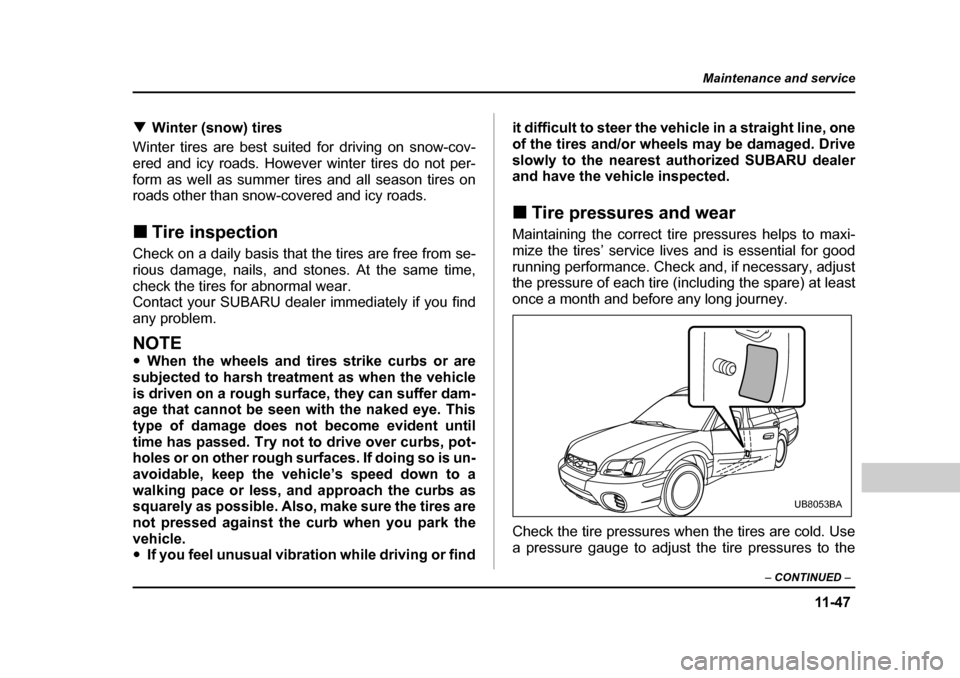
Check the tire pressures when the tires are cold. Use
a pressure gauge to adjust the tire pressures to the
UB8053BA
Page 413 of 487
11 - 4 8
Maintenance and service
values shown on the tire placard. The tire placard is lo-
cated on the door pillar on the driver’s side.
Driving even a short distance warms up the tires and
increases the tire pressures.
Also, the tire pressures
are affected by the outside temperature. It is best to
check tire pressure outdoors before driving the vehi- cle.
When a tire becomes warm, the air inside it expands,
causing the tire pressure to increase. Be careful not to
mistakenly release air from a warm tire to reduce its
pressure.
NOTE y The air pressure in a tire increases by approxi-
mately 4.3 psi (30 kPa, 0.3 kgf/cm 2
) when the tire
becomes warm. y The tires are considered cold when the vehicle
has been parked for at least three hours or has
been driven less than one mile (1.6 km).
Do not let air out of warm tires to adjust pres-
sure. Doing so will result in low tire pressure.
Incorrect tire pressures detract from controllability and
ride comfort, and they cause the tires to wear abnor- mally. y
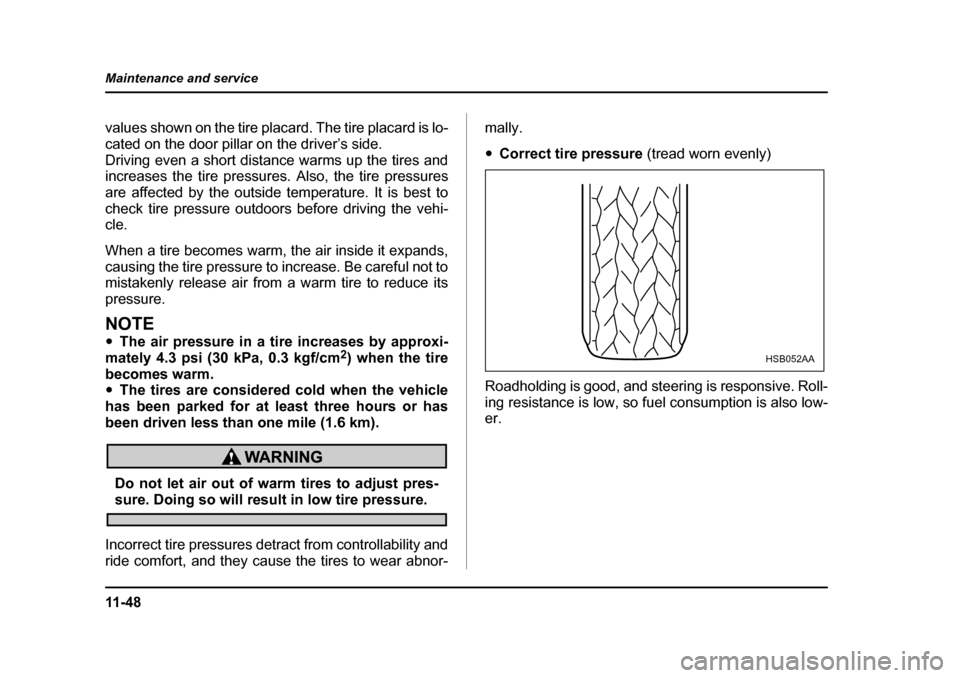
Correct tire pressure (tread worn evenly)
Roadholding is good, and steering is responsive. Roll-
ing resistance is low, so fu el consumption is also low-
er.
HSB052AA
Page 414 of 487
11 -4 9
Maintenance and service
– CONTINUED –
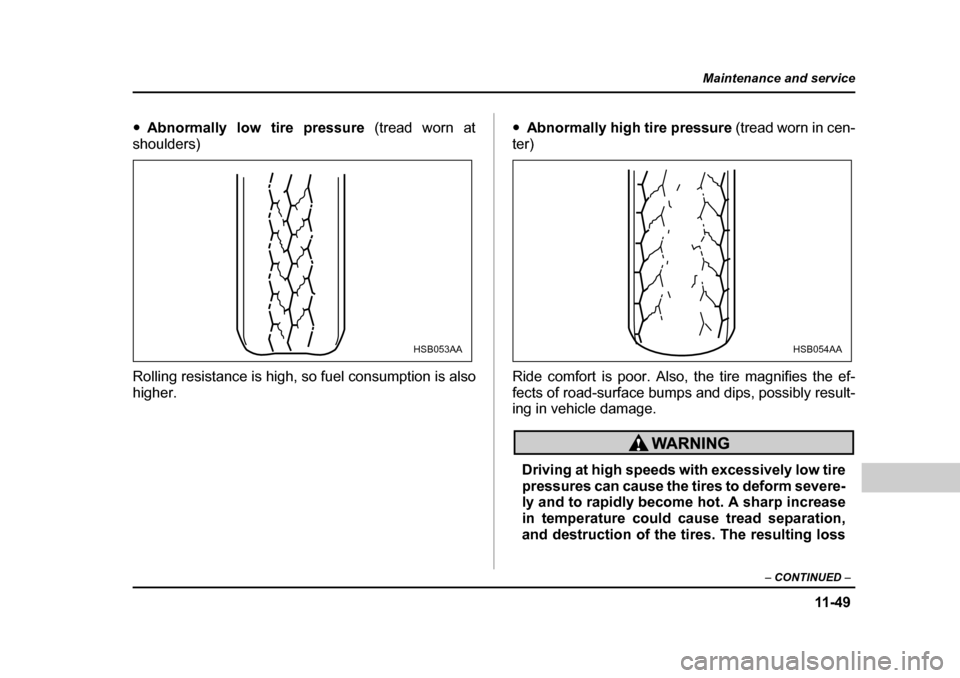
yAbnormally low tire pressure (tread worn at
shoulders)
Rolling resistance is high, so fuel consumption is also
higher. y
Abnormally high tire pressure (tread worn in cen-
ter)
Ride comfort is poor. Also, the tire magnifies the ef-
fects of road-surface bumps and dips, possibly result-
ing in vehicle damage.
Driving at high speeds with excessively low tire
pressures can cause the tires to deform severe-
ly and to rapidly become hot. A sharp increase
in temperature could cause tread separation,
and destruction of the tires. The resulting loss
HSB053AAHSB054AA
Page 415 of 487
11 - 5 0
Maintenance and service
of vehicle control could lead to an accident.
„ Wheel balance
„
Wheel
„ BalanceEach wheel was correctly bal anced when your vehicle
was new, but the wheels will become unbalanced as
the tires become worn during use. Wheel imbalance
causes the steering wheel to vibrate slightly at certain
vehicle speeds and detracts from the vehicle’s
straight-line stability. It can also cause steering and
suspension system problems and abnormal tire wear.
If you suspect that the wh eels are not correctly bal-
anced, have them checked and adjusted by your
SUBARU dealer. Also have them adjusted after tire re-
pairs and after tire rotation.
NOTE
Loss of correct wheel alignment* causes the tires
to wear on one side and reduces the vehicle’s run-
ning stability. Contact yo ur SUBARU dealer if you
notice abnormal tire wear.
*: The suspension system is designed to hold each wheel at
a certain alignment (relative to the other wheels and to the
road) for optimum straight-li ne stability and cornering perfor-
mance. „
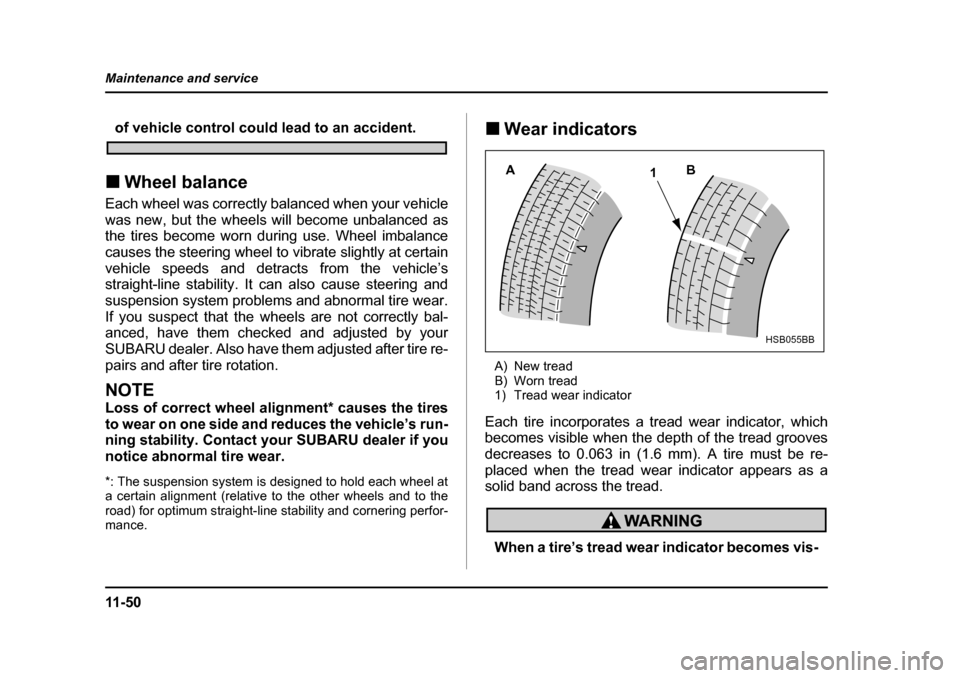
Wear indicators
„
Wear indicators
A) New tread
B) Worn tread
1) Tread wear indicator
Each tire incorporates a tread wear indicator, which
becomes visible when the depth of the tread grooves
decreases to 0.063 in (1.6 mm). A tire must be re-
placed when the tread wear indicator appears as a
solid band across the tread.
When a tire’s tread wear indicator becomes vis-
A 1B
HSB055BB
Page 416 of 487
11 -5 1
Maintenance and service
– CONTINUED –
ible, the tire is worn beyond the acceptable limit
and must be replaced immediately. With a tire
in this condition, driving at high speeds in wet
weather can cause the vehicle to hydroplane.
The resulting loss of vehicle control can lead to
an accident.
NOTE For safety, in spect the tire tread regularly and re-
place the tires before their tread wear indicators
become visible. „ Tire rotation
„Tire
„ Rotation
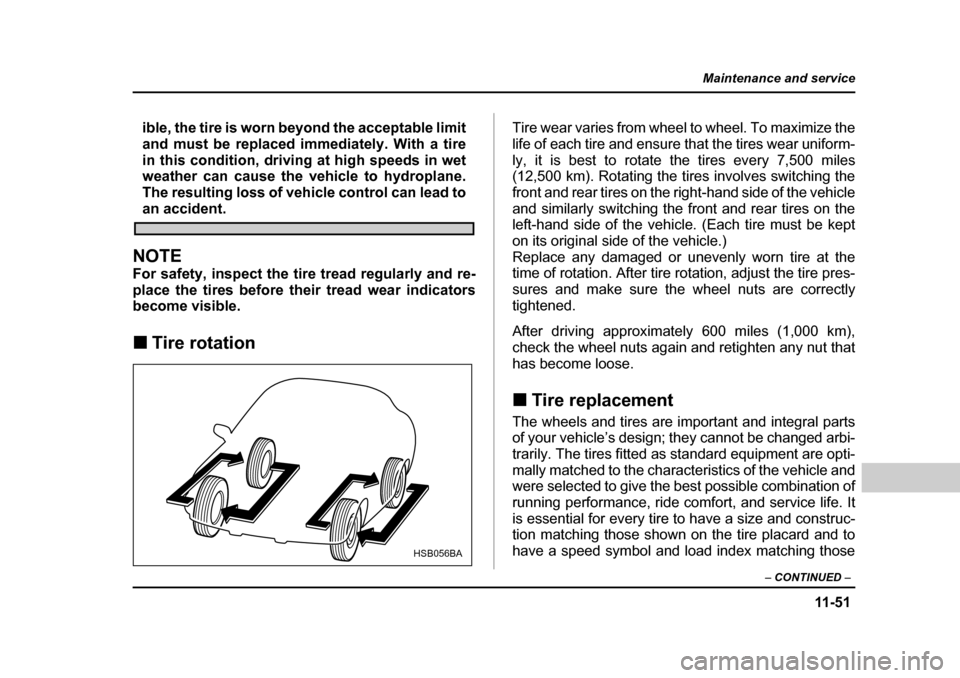
Tire wear varies from wheel to wheel. To maximize the
life of each tire and ensure that the tires wear uniform-
ly, it is best to rotate the tires every 7,500 miles
(12,500 km). Rotating the tires involves switching the
front and rear tires on the right-hand side of the vehicle
and similarly switching the front and rear tires on the
left-hand side of the vehicle. (Each tire must be kept
on its original side of the vehicle.)
Replace any damaged or unevenly worn tire at the
time of rotation. After tire ro tation, adjust the tire pres-
sures and make sure the wheel nuts are correctly
tightened.
After driving approximately 600 miles (1,000 km),
check the wheel nuts again and retighten any nut that
has become loose. „ Tire replacement
„Tire
„ ReplacementThe wheels and tires are important and integral parts
of your vehicle’s design; they cannot be changed arbi-
trarily. The tires fitted as standard equipment are opti-
mally matched to the characteristics of the vehicle and
were selected to give the best possible combination of
running performance, ride co mfort, and service life. It
is essential for every tire to have a size and construc-
tion matching those shown on the tire placard and to
have a speed symbol and load index matching those
HSB056BA
Page 417 of 487
11 - 5 2
Maintenance and service
shown on the tire placard.
Using tires of a non-specified size detracts from con-
trollability, ride comfort, braking performance, speed-
ometer accuracy and odometer accuracy. It also cre-
ates incorrect body-to-tire
clearances and inappropri-
ately changes the vehicle’s ground clearance.
All four tires must be the same in terms of manufactur-
er, brand (tread pattern), construction, and size. You
are advised to replace the ti res with new ones that are
identical to those fitted as standard equipment.
For safe vehicle operation, SUBARU recommends re-
placing all four tires at the same time.
y All four tires must be the same in terms of
manufacturer, brand (trea d pattern), construc-
tion, degree of wear, speed symbol, load index
and size. Mixing tires of different types, sizes or
degrees of wear can result in damage to the ve-
hicle’s power train. Use of different types or siz-
es of tires can also dangerously reduce control-
lability and braking performance and can lead
to an accident. y Use only radial tires. Do not use radial tires
together with belted bias tires and/or bias-ply tires. Doing so can dangerously reduce control-
lability, resulting in an accident.
„ Wheel replacement
„Wheel
„ ReplacementWhen replacing wheels due, for example, to damage,
make sure the replacement wheels match the specifi-
cations of the wheels that are fitted as standard equip-
ment. Replacement wheels are available from
SUBARU dealers.
Use only those wheels that are specified for
your vehicle. Wheels not meeting specifica-
tions could interfere with brake caliper opera-
tion and may cause the tires to rub against the
wheel well housing during turns. The resulting
loss of vehicle control could lead to an acci-
dent.