11 - 4 8
Maintenance and service
values shown on the tire placard. The tire placard is lo-
cated on the door pillar on the driver’s side.
Driving even a short distance warms up the tires and
increases the tire pressures.
Also, the tire pressures
are affected by the outside temperature. It is best to
check tire pressure outdoors before driving the vehi- cle.
When a tire becomes warm, the air inside it expands,
causing the tire pressure to increase. Be careful not to
mistakenly release air from a warm tire to reduce its
pressure.
NOTE y The air pressure in a tire increases by approxi-
mately 4.3 psi (30 kPa, 0.3 kgf/cm 2
) when the tire
becomes warm. y The tires are considered cold when the vehicle
has been parked for at least three hours or has
been driven less than one mile (1.6 km).
Do not let air out of warm tires to adjust pres-
sure. Doing so will result in low tire pressure.
Incorrect tire pressures detract from controllability and
ride comfort, and they cause the tires to wear abnor- mally. y
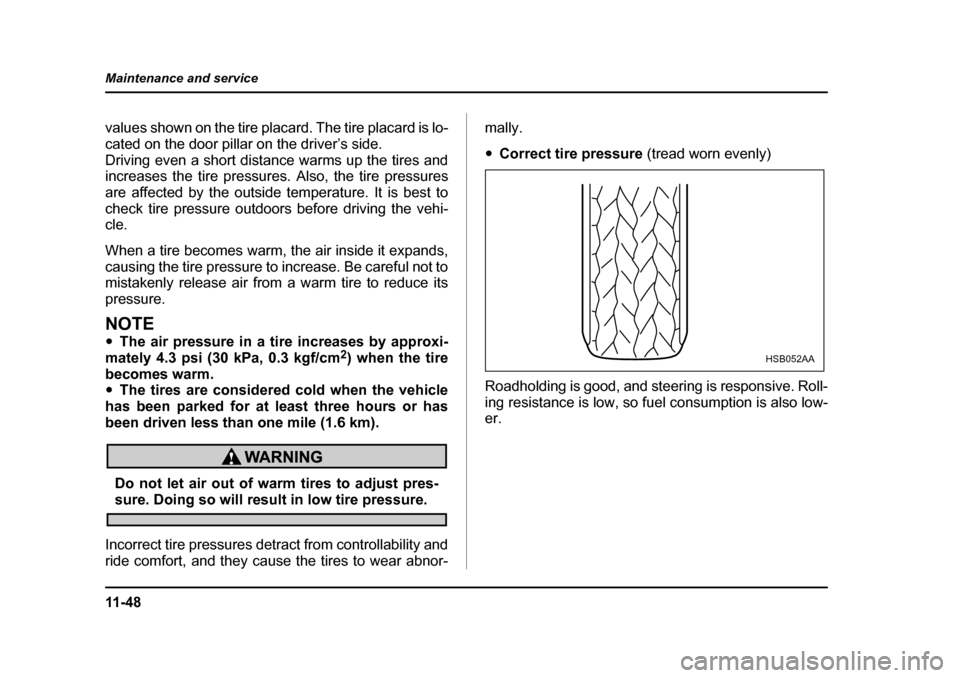
Correct tire pressure (tread worn evenly)
Roadholding is good, and steering is responsive. Roll-
ing resistance is low, so fu el consumption is also low-
er.
HSB052AA
11 - 6 0
Maintenance and service
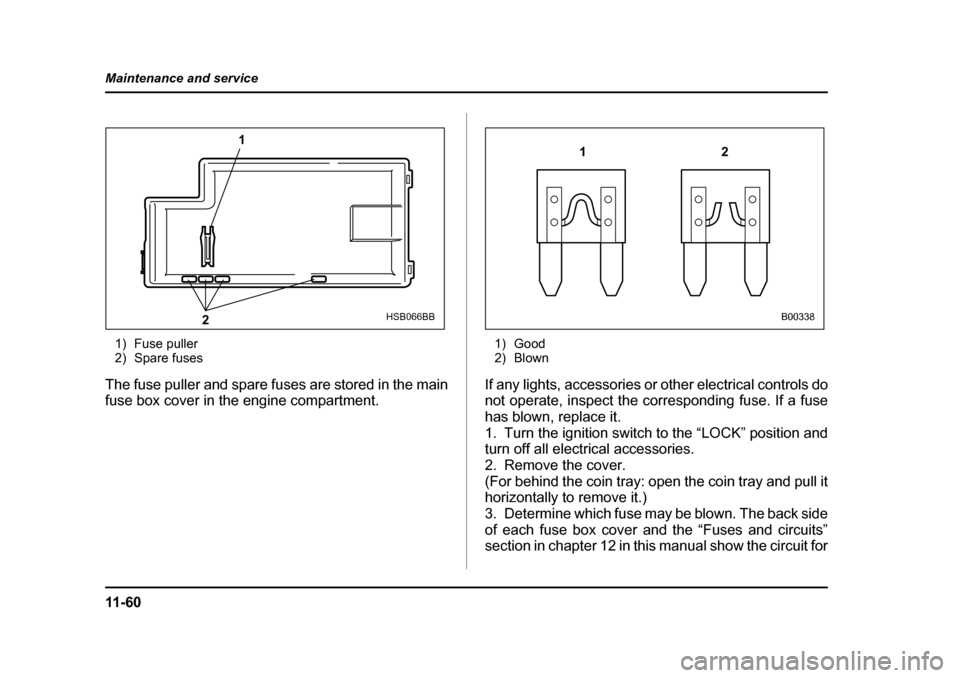
1) Fuse puller
2) Spare fuses
The fuse puller and spare fuses are stored in the main
fuse box cover in the engine compartment. 1) Good
2) Blown
If any lights, accessories or other electrical controls do
not operate, inspect the corresponding fuse. If a fuse
has blown, replace it.
1. Turn the ignition switch to the “LOCK” position and
turn off all electrical accessories.
2. Remove the cover.
(For behind the coin tray: open the coin tray and pull it
horizontally to remove it.)
3. Determine which fuse may be blown. The back side
of each fuse box cover and the “Fuses and circuits”
section in chapter 12 in this manual show the circuit for
1
2
HSB066BB
12
B00338
13-16
Consumer information and Reporting safety defects
tests, and does not include acceleration,
cornering, hydroplaning, or peak traction
characteristics.
„ Temperature A, B, C
The temperature grades are A (the highest), B,
and C, representing the tire’s resistance to the generation of heat and it s ability to dissipate heat
when tested under controlled conditions on a
specified indoor laboratory test wheel. Sustained
high temperature can cause the material of the
tire to degenerate and reduce tire life, and exces-
sive temperature can lead to sudden tire failure.
The grade C corresponds to a level of perfor-
mance which all passenger car tires must meet
under the Federal Motor Vehicle Safety Stan-
dards No. 109. Grades B and A represent higher
levels of performance on the laboratory test
wheel than the minimum required by law.
The temperature grade for this tire is es-
tablished for a tire that is properly inflated and not overloaded. Excessive speed, un-
derinflation, or exces
sive loading, either
separately or in combination, can cause
heat buildup and possible tire failure.