engine SUBARU BAJA 2006 1.G Manual PDF
[x] Cancel search | Manufacturer: SUBARU, Model Year: 2006, Model line: BAJA, Model: SUBARU BAJA 2006 1.GPages: 487, PDF Size: 5.55 MB
Page 309 of 487
8-16
Driving tips
stall four winter tires that
are of the same size, con-
struction, brand and load range and you should never
mix radial, belted bias or bias tires since this may re-
sult in dangerous handling characteristics. When you
choose a tire, make sure that there is enough clear-
ance between the tire and vehicle body.
Remember to drive with care at all times regardless of
the type of tires on your vehicle.
Your vehicle comes with P225/60R16 “all season
tires” as original equipment. You should be aware
that some winter tires with that same size designa-
tion may actually be too large for the vehicle and
may cause rubbing on sharp turns. Listed in the
following is the winter ti re size that we recom-
mend.
Recommended winter (snow) tire size
P215/60R16 Studless
„ Tire chains
Tire chains cannot be used on tires listed in the
following because of lack of clearance between the tires and vehicle body.y
P225/60R16 tires
yP215/60R16 winter (snow) tires
Driving on snowy grades or icy roads may require the
use of tire chains, in which case put the chains on the
front wheels only. Use only SAE class S type chains
that are of the correct size for your tires so as not to
damage the vehicle body or suspension.
When driving with tire chains, drive at speeds below
19 mph (30 km/h). When a temporary spare tire is on
a front wheel, replace the temporary spare tire with the
rear tire on the same side of the vehicle, and then fit
chains on the front tires.
Always use the utmost care when driving with tire
chains – overconfidence because you are driving with
tire chains could easily lead to a serious accident.
„ Rocking the vehicle
If you must rock the vehicle to free it from snow, sand,
or mud, depress the accelerator pedal slightly and
move the selector lever back and forth between “D”
and “R” repeatedly. Do not race the engine. For the
best possible traction, avoid spinning the wheels when
trying to free the vehicle.
Page 318 of 487
8-25
Driving tips
– CONTINUED –
Trailer towing
Your vehicle is designed and intended to be used pri-
marily to carry passengers and cargo. Towing a trailer
puts additional loads on your vehicle’s engine, driv-
etrain, brakes, tires and suspension and has an ad-
verse effect on fuel economy.
If you do decide to tow a trailer, your safety and satis-
faction depend upon proper use of correct equipment
and cautious operation of yo ur vehicle. Seek the ad-
vice of your SUBARU dealer to assist you in purchas-
ing a hitch and other necessary towing equipment ap-
propriate for your vehicle. In addition, be sure to follow
the instructions on correct installation and use provid-
ed by the trailer and other towing equipment manufac-
turers.
SUBARU assumes no responsibi lity for injuries or ve-
hicle damage that result from trailer towing equipment,
or from any errors or omissions in the instructions ac-
companying such equipment or for your failure to fol-
low the proper instructions. „ Warranties and maintenance
SUBARU warranties do not apply to vehicle damage
or malfunction caused by trailer towing. If you use your
vehicle to tow a trailer, more frequent maintenance will
be required due to the additional load. (Refer to “Main- tenance schedule under severe driving conditions” in
the “Warranty and Maintenance Booklet”.)
Under no circumstances should a trailer be towed with
a new vehicle or a vehicle with any new powertrain
component (engine, transmis
sion, differential, wheel
bearings, etc.) for the first 1,000 miles (1,600 km) of
driving. „ Maximum load limits
Never exceed the maximum load limits ex-
plained in the following. Exceeding the maxi-
mum load limits could cause personal injury
and/or vehicle damage.
yAdequate size trailer brakes are required
when the trailer and its cargo exceed 1,000 lbs
(453 kg) total weight. y Before towing a tr ailer, check the trailer total
weight, GVW, GAWs and tongue load. Make
sure the load and its dist ribution in your vehicle
Page 328 of 487
8-35
Driving tips
– CONTINUED –
yBacking up with a trailer is difficult and takes prac-
tice. When backing up with a trailer, never accelerate
or steer rapidly. When turning back, grip the bottom of
the steering wheel with one hand and turn it to the left
for a left turn, and turn it to the right for a right turn.
y If the ABS warning li ght illuminates while the vehicle
is in motion, stop towing the trailer and have repairs
performed immediately by the nearest SUBARU deal-er. T Driving on grades
y Before going down a steep hill, slow down and shift
into lower gear (if necessary, use 1st gear) in order to
utilize the engine braking ef fect and prevent overheat-
ing of your vehicle’s brakes. Do not make sudden
downshifts.y When driving uphill in hot weather, the air condition-
er may turn off automatically to protect the engine from
overheating.y When driving uphill in hot weather, pay attention to
the water temperature gauge pointer (for all vehicles)
and AT OIL TEMP warning light (for AT vehicles) since
the engine and transmission are relatively prone to
overheating under these conditions. If the water tem-
perature gauge pointer approaches the OVERHEAT
zone or the AT OIL TEMP warning light illuminates,
immediately switch off the ai r conditioner and stop the
vehicle at the nearest safe place. Refer to the “Engine overheating” section in chapter 9, and “Warning and indicator lights” se
ction in chapter 3.
NOTE (Turbo models only)
In a vehicle that has an automatic transmission,
the engine is less likely to overheat with the “D”
range selected than it is with the manual mode se-
lected. y If your vehicle has an autom atic transmission, avoid
using the accelerator pedal to stay stationary on an
uphill slope instead of using the parking brake or foot
brake. That may cause the transmission fluid to over-
heat. y Non-turbo models only: If your vehicle has an auto-
matic transmission, place the selector lever as follows:
Uphill slopes: “D” position
Downhill slopes: A low-speed gear position to use en-
gine braking T Parking on a grade
Always block the wheels under both vehicle and trailer
when parking. Apply the parking brake firmly. You
should not park on a hill or slope. But if parking on a
hill or slope cannot be avoided, you should take the
following steps:
1. Apply the brakes and hold the pedal down.
2. Have someone place wheel blocks under both the
Page 330 of 487

9-1
9
In case of emergency
If you park your vehicle in an emergency .. 9-2
Jack and tools ............................................... 9-3 Location of jack and tools ............................... 9-3
Removing jack and tool bag ............................ 9-3
Restoring jack and tools .................................. 9-5
Spare tire ....................................................... 9-7 Removing the spare tire ................................... 9-7
Re-storage of spare tire ................................... 9-9
Temporary spare tire .................................... 9-10 Using the temporary spare tire ........................ 9-10
Flat tires ......................................................... 9-12 Changing a flat tire ........................................... 9-12
Jump starting ................................................ 9-18 How to jump start ............................................. 9-19
Engine overheating ....................................... 9-21 If steam is coming from the engine compartment .................................................. 9-21
If no steam is coming from the engine compartment .................................................. 9-21
Towing ........................................................... 9-22 Towing and tie-down hooks ............................ 9-23
Using a flat-bed truck ....................................... 9-27
Towing with all wheels on the ground ............ 9-27
Page 340 of 487
9-11
In case of emergency
– CONTINUED –
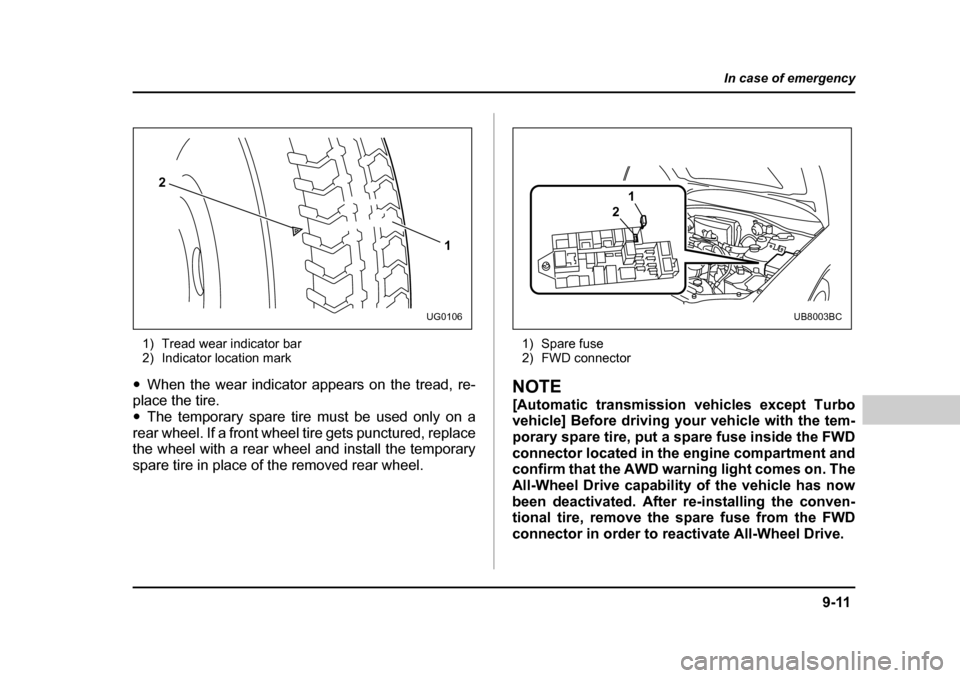
1) Tread wear indicator bar
2) Indicator location mark
y When the wear indicator appears on the tread, re-
place the tire. y The temporary spare tire must be used only on a
rear wheel. If a front wheel tire gets punctured, replace
the wheel with a rear wheel and install the temporary
spare tire in place of the removed rear wheel. 1) Spare fuse
2) FWD connector
NOTE
[Automatic transmission vehicles except Turbo
vehicle] Before driving your vehicle with the tem-
porary spare tire, put a spare fuse inside the FWD
connector located in the engine compartment and
confirm that the AWD warning light comes on. The
All-Wheel Drive capability of the vehicle has now
been deactivated. After
re-installing the conven-
tional tire, remove the spare fuse from the FWD
connector in order to reactivate All-Wheel Drive.
1
2
UG0106
1
2
UB8003BC
Page 341 of 487
9-12
In case of emergency
Flat tires
If you get a flat tire while driving, never brake sudden-
ly; keep driving straight ahead while gradually reduc-
ing speed. Then slowly pull off the road to a safe place. „
Changing a flat tire
yDo not jack up the vehicle on an incline or a
loose road surface. The jack can come out of
the jacking point or sink into the ground and
this can result in a serious accident. y Use only the jack provided with your vehicle.
The jack supplied with the vehicle is designed
only for changing a tire. Never get under the ve-
hicle while supporting the vehicle with thisjack. y Always turn off the engi ne before raising the
flat tire off the grou nd using the jack. Never
swing or push the vehicle supported with the
jack. The jack can come out of the jacking point
due to a jolt and this can result in a serious ac-
cident. y Never place a tire or tire changing tools in the
passenger compartment after changing wheels. In a sudden stop or collision, loose
equipment could strike occupants and cause
injury. Store the tire and all tools in the proper
place.
1. Park on a hard, level surface, whenever possible,
then stop the engine.
2. Set the parking brake securely and shift a manual
transmission vehicle into reverse or an automatic
transmission vehicle into the “P” (Park) position.
3. Turn on the hazard warning flasher and have ev-
eryone get out of the vehicle.
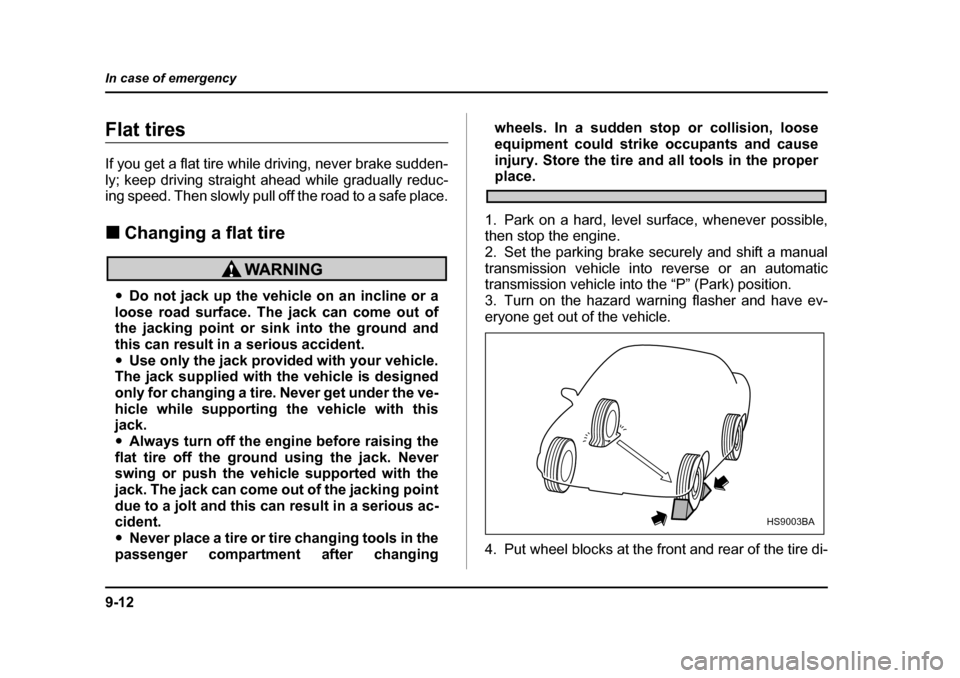
4. Put wheel blocks at the fron t and rear of the tire di-
HS9003BA
Page 348 of 487

9-19
In case of emergency
– CONTINUED –
Do not jump start unless cables in suitable con-
dition are available.yA running engine can be dangerous. Keep
your fingers, hands, clothing, hair and tools
away from the cooling fan, belts and any other
moving engine parts. Removing rings, watches
and ties is advisable. y Jump starting is dangerous if it done incor-
rectly. If you are unsure about the proper proce-
dure for jump starting, consult a competent me-
chanic.
When your vehicle does not start due to a run down
(discharged) battery, the vehicle may be jump started
by connecting your battery to another battery (called
the booster battery) with jumper cables. „ How to jump start
1. Make sure the booster battery is 12 volts and the
negative terminal is grounded.
2. If the booster battery is in another vehicle, do not let
the two vehicles touch.
3. Turn off all unnecessary lights and accessories.
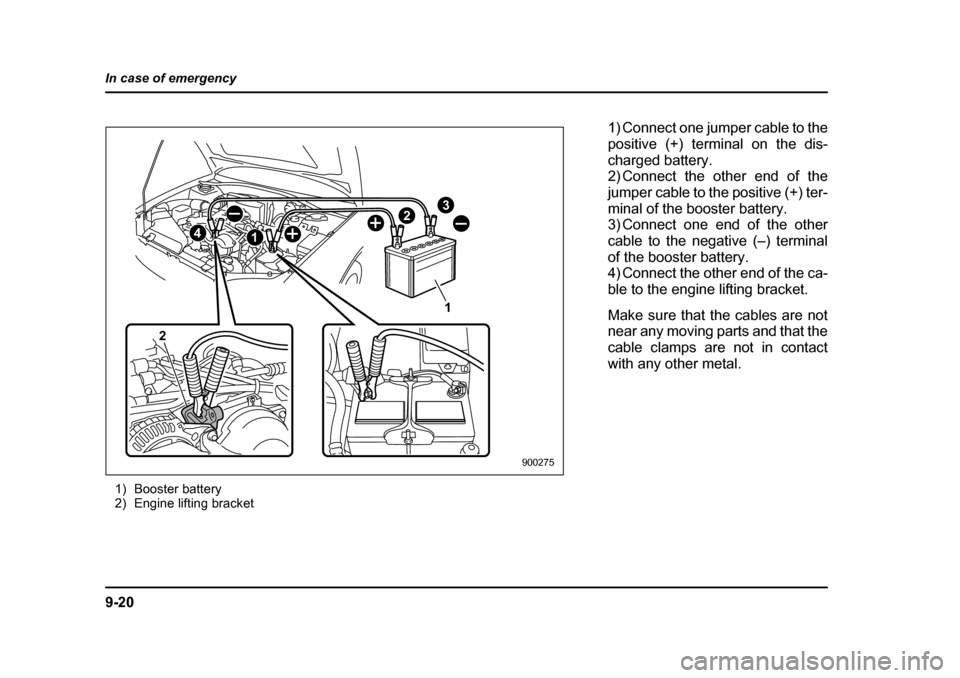
4. Connect the jumper cables exactly in the sequence
illustrated.
Page 349 of 487
9-20
In case of emergency
1) Booster battery
2) Engine lifting bracket
_ _
+ +
4 1 2
3
1
2
900275
1) Connect one jumper cable to the
positive (+) terminal on the dis-
charged battery.
2) Connect the other end of the
jumper cable to the positive (+) ter-
minal of the booster battery.
3) Connect one end of the other
cable to the negative (–) terminal
of the booster battery.
4) Connect the other end of the ca-
ble to the engine lifting bracket.
Make sure that the cables are not
near any moving parts and that the
cable clamps are not in contact
with any other metal.
Page 350 of 487
9-21
In case of emergency
– CONTINUED –
5. Start the engine of the vehicle with the booster bat-
tery and run it at moderate speed. Then start the en-
gine of the vehicle that has the discharged battery.
6. When finished, carefully disconnect the cables in
exactly the reverse order.Engine overheating
Never attempt to remove the radiator cap until
the engine has been shut off and has fully
cooled down. When the engine is hot, the cool-
ant is under pressure. Removing the cap while
the engine is still hot could release a spray of
boiling hot coolant, which could burn you very
seriously.
If the engine overheats, pull off the road safely and
stop the vehicle in a safe place. „ If steam is coming from the engine
compartment
Turn off the engine and get everyone away from the
vehicle until it cools down. „ If no steam is coming from the engine
compartment
1. Keep the engine running at idling speed.
2. Open the hood to ventilate the engine compart- ment.
Page 351 of 487
9-22
In case of emergency
Confirm that the cooling fan is turning. If the fan is not
turning, immediately turn off the engine and contact
your authorized dealer for repair.
3. After the engine coolant temperature has dropped,
turn off the engine.
If the temperature gauge
stays at the overheated
zone, turn off the engine.
4. After the engine has fully cooled down, check the
coolant level in the reserve tank.
If the coolant level is below the “MIN” mark, add cool-
ant up to the “MAX” mark.
5. If there is no coolant in the reserve tank, add cool-
ant to the reserve tank. Then remove the radiator cap
and fill the radiator with coolant.
If you remove the radiator cap from a hot radiator, first
wrap a thick cloth around the radiator cap, then turn
the cap counterclockwise slowly without pressing
down until it stops. Releas e the pressure from the ra-
diator. After the pressure has been fully released, re-
move the cap by pressing down and turning it.Towing
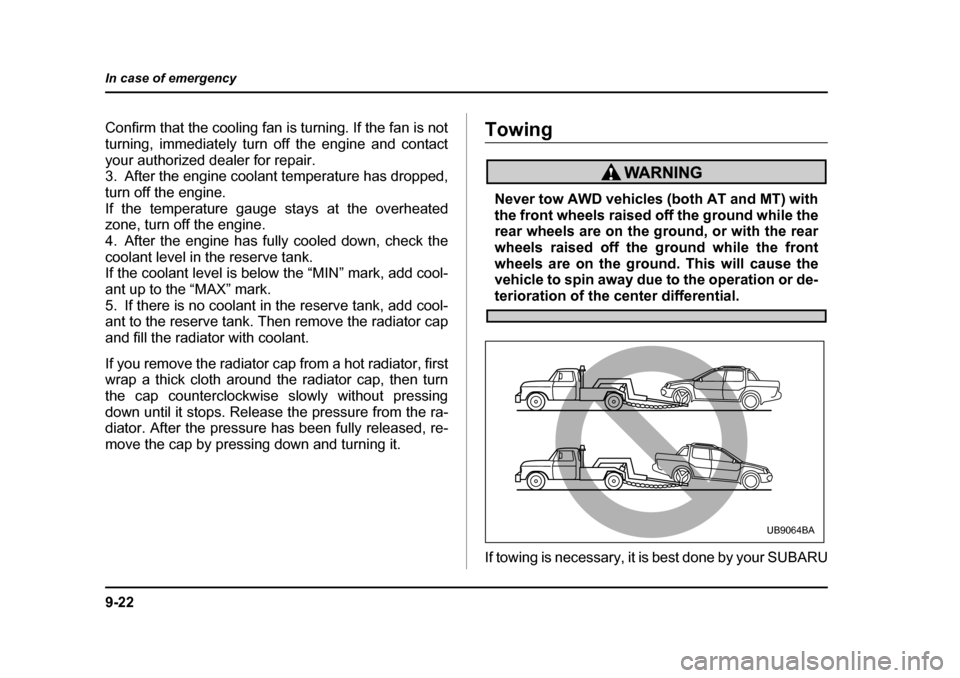
Never tow AWD vehicles (both AT and MT) with
the front wheels raised o ff the ground while the
rear wheels are on the ground, or with the rear
wheels raised off the ground while the front
wheels are on the ground. This will cause the
vehicle to spin away due to the operation or de-
terioration of the center differential.
If towing is necessary, it is best done by your SUBARU
UB9064BA