lights SUBARU BRZ 2013 1.G Service Manual
[x] Cancel search | Manufacturer: SUBARU, Model Year: 2013, Model line: BRZ, Model: SUBARU BRZ 2013 1.GPages: 484, PDF Size: 6.46 MB
Page 344 of 484
344
4-3. Do-it-yourself maintenance
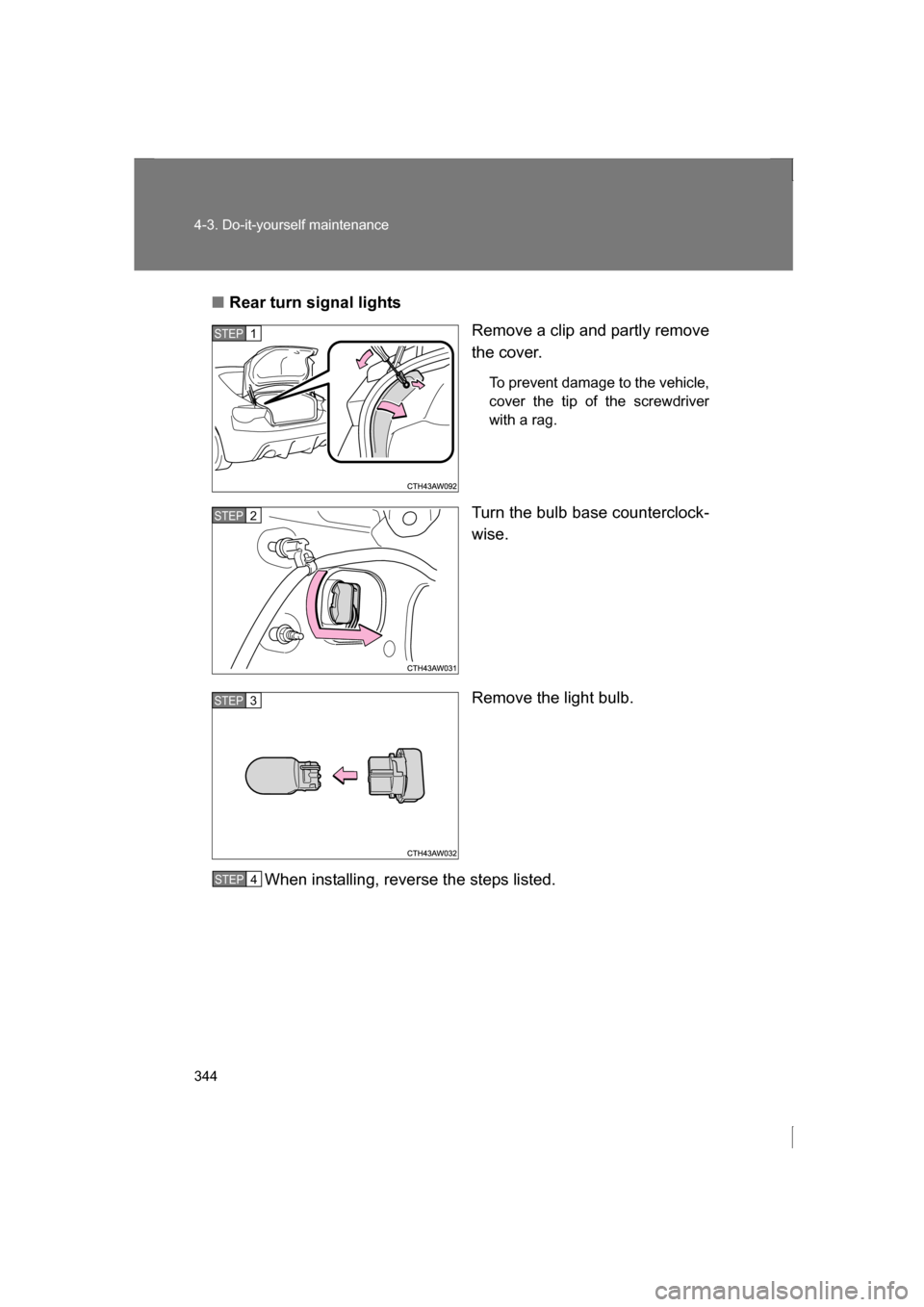
■Rear turn signal lightsRemove a clip and partly remove
the cover.
To prevent damage to the vehicle,
cover the tip of the screwdriverwith a rag.
Turn the bulb base counterclock-
wise.
Remove the light bulb.
When installing, reverse the steps listed.
STEP 1
STEP 2
STEP 3
STEP 4
Page 345 of 484
345
4-3. Do-it-yourself maintenance
4
Maintenance and care
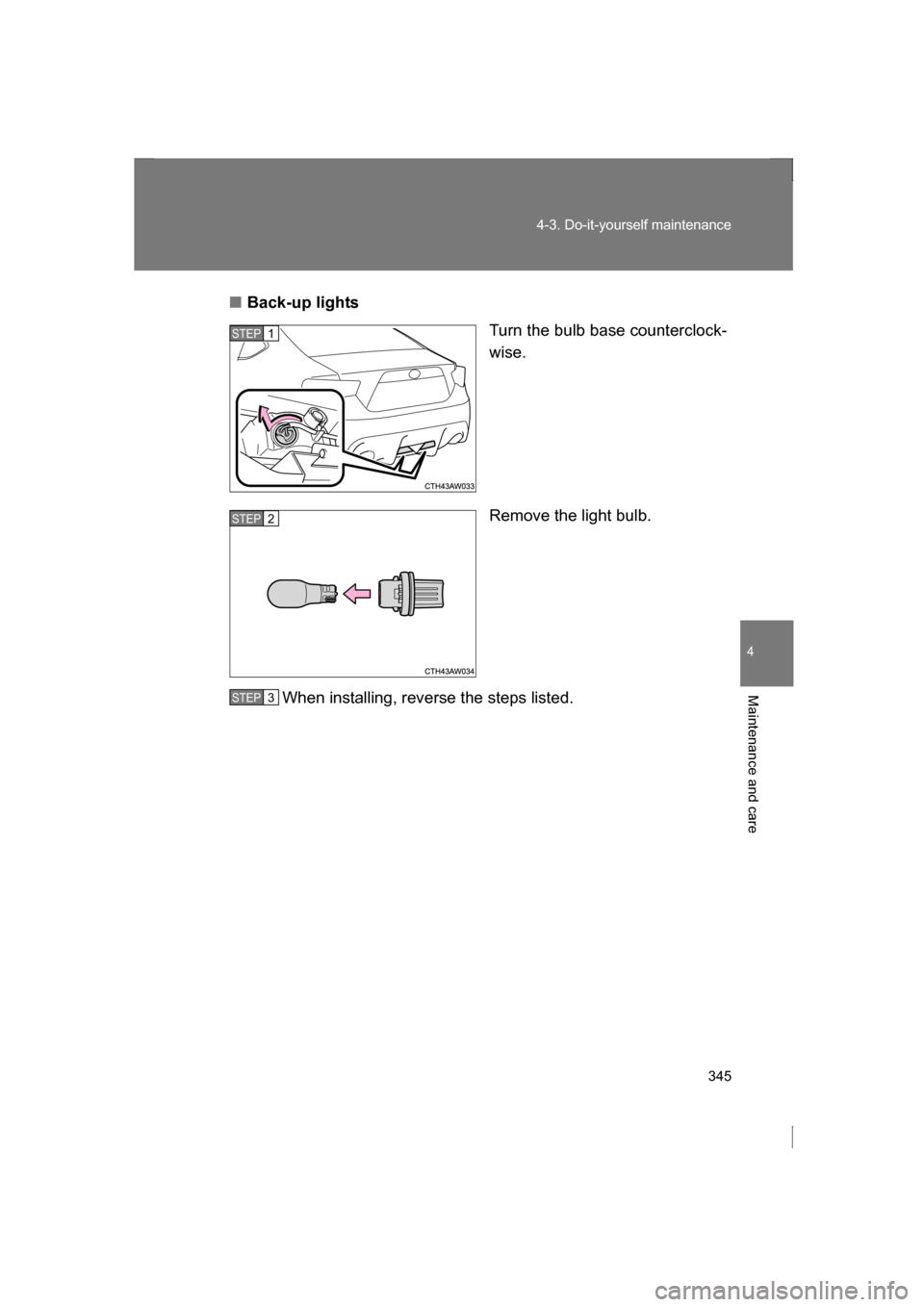
■Back-up lightsTurn the bulb base counterclock-
wise.
Remove the light bulb.
When installing, reverse the steps listed.
STEP 1
STEP 3 STEP 2
STEP 3
Page 346 of 484
346
4-3. Do-it-yourself maintenance
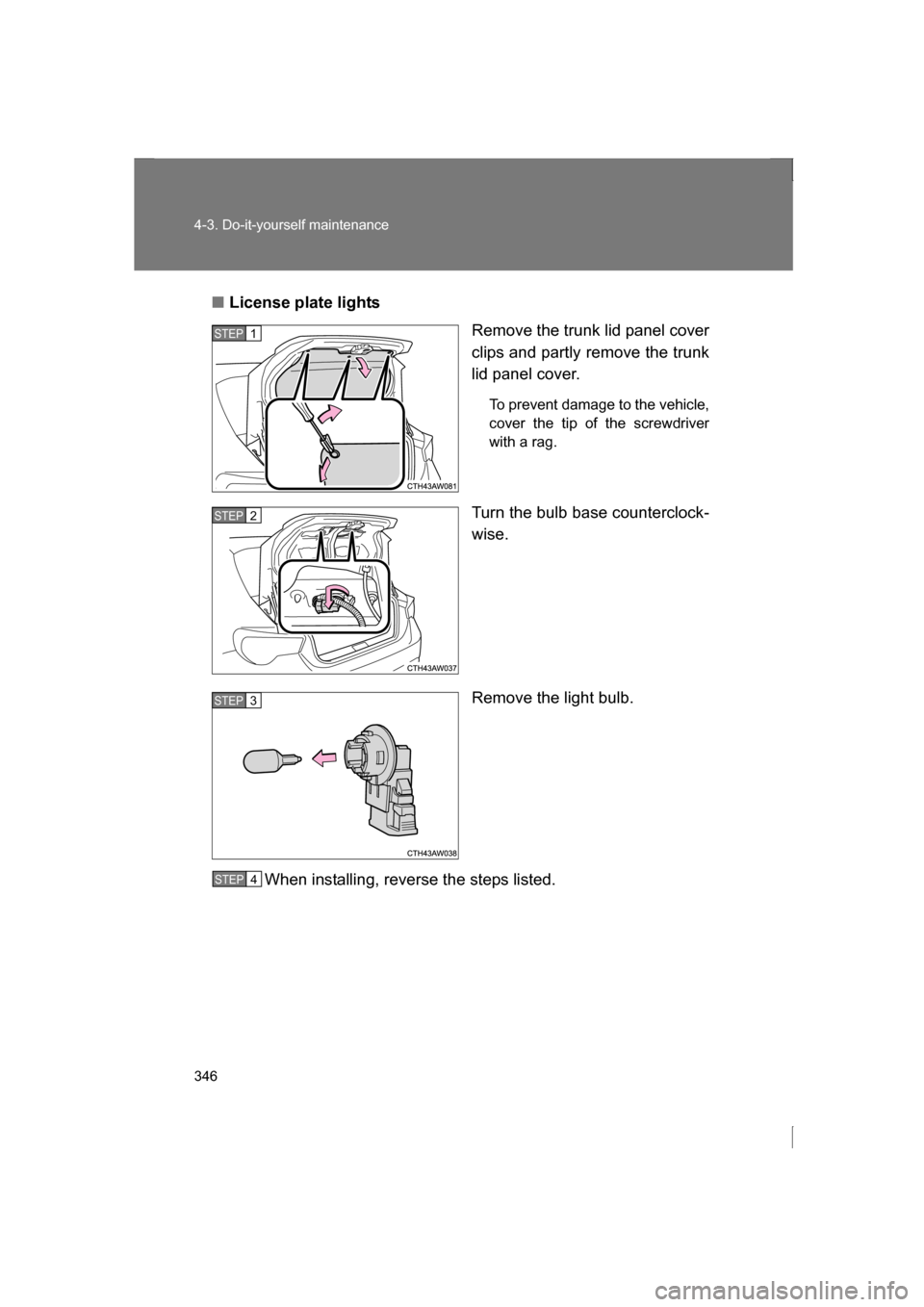
■License plate lightsRemove the trunk lid panel cover
clips and partly remove the trunk
lid panel cover.
To prevent damage to the vehicle,
cover the tip of the screwdriverwith a rag.
Turn the bulb base counterclock-
wise.
Remove the light bulb.
When installing, reverse the steps listed.
STEP 1
STEP 2
STEP 3
STEP 4
Page 348 of 484
348
4-3. Do-it-yourself maintenance
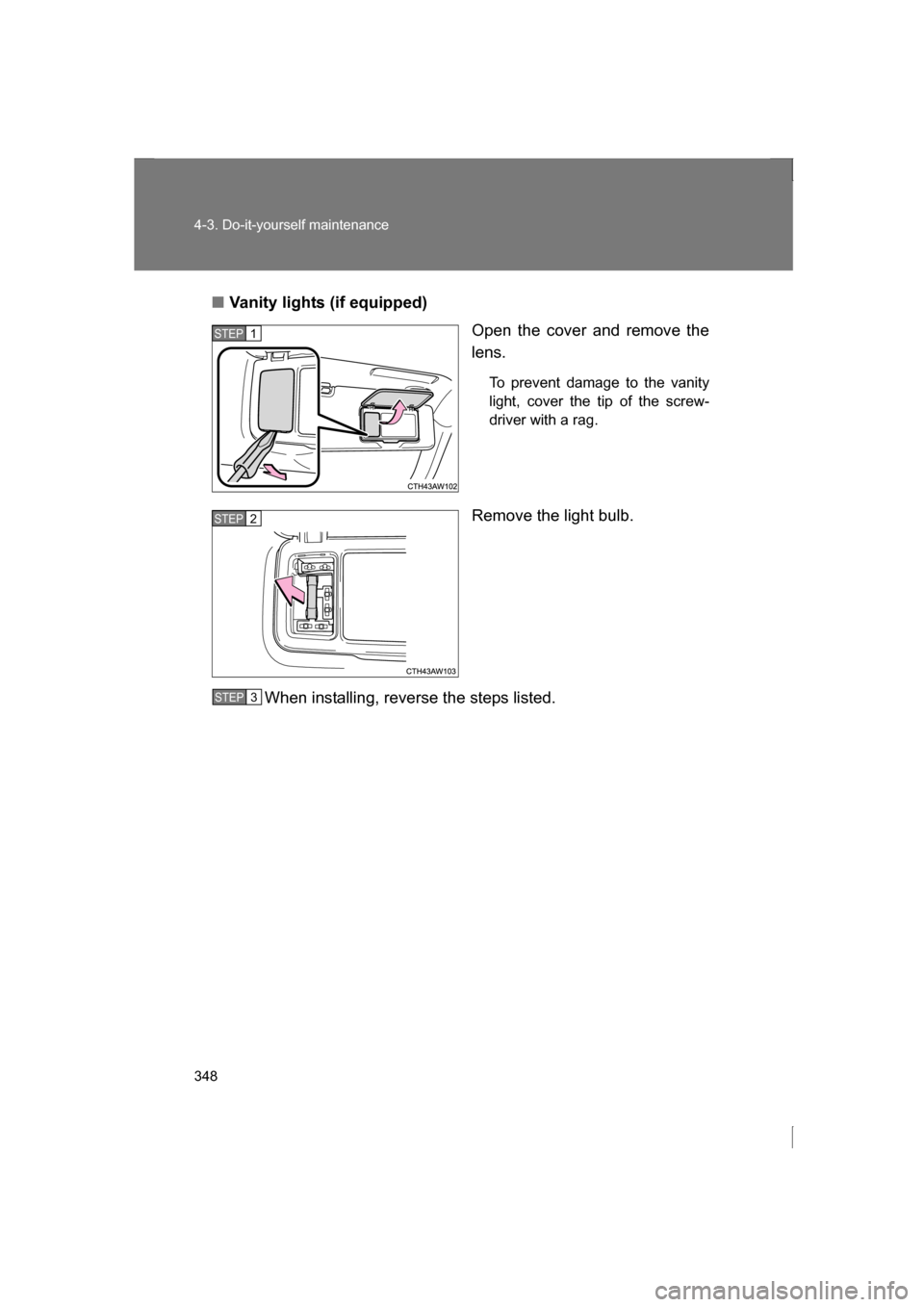
■Vanity lights (if equipped)Open the cover and remove the
lens.
To prevent damage to the vanity
light, cover the tip of the screw-
driver with a rag.
Remove the light bulb.
When installing, reverse the steps listed.
STEP 1
STEP 2
STEP 3
Page 349 of 484
349
4-3. Do-it-yourself maintenance
4
Maintenance and care
■Replacing the following bulbs
If any of the lights listed below has burnt out, have it replaced by
your SUBARU dealer. ●Headlight high and low beams
● Parking lights
● Daytime running lights
● Stop/tail lights
● High mounted stoplight
■Condensation build-up on the inside of the lens
Contact your SUBARU dealer for more information in the following situa-
tions. Temporary condensation build-up on the inside of the headlight lens
does not indicate a malfunction.
●Large drops of water are built up on the inside of the lens.
●Water has built up inside the headlight.
■Discharge headlights
If voltage to the discharge bulbs is insufficient, the bulbs may not come on,
or may go out temporarily. The discharge bulbs will come on when normal
power is restored.
■LED light bulbs
The parking lights, daytime running lights, stop/tail lights and high mounted
stoplight consist of a number of LEDs. If any of the LEDs burn out, take your
vehicle to your SUBARU dealer to have the light replaced.
Page 350 of 484
350
4-3. Do-it-yourself maintenance
■When replacing light bulbs
SUBARU recommends that you use genuine SUBARU products designed
for this vehicle.
Because certain bulbs are connected to circuits designed to prevent over-
load, non-genuine parts or parts not designed for this vehicle may be unus-
able.
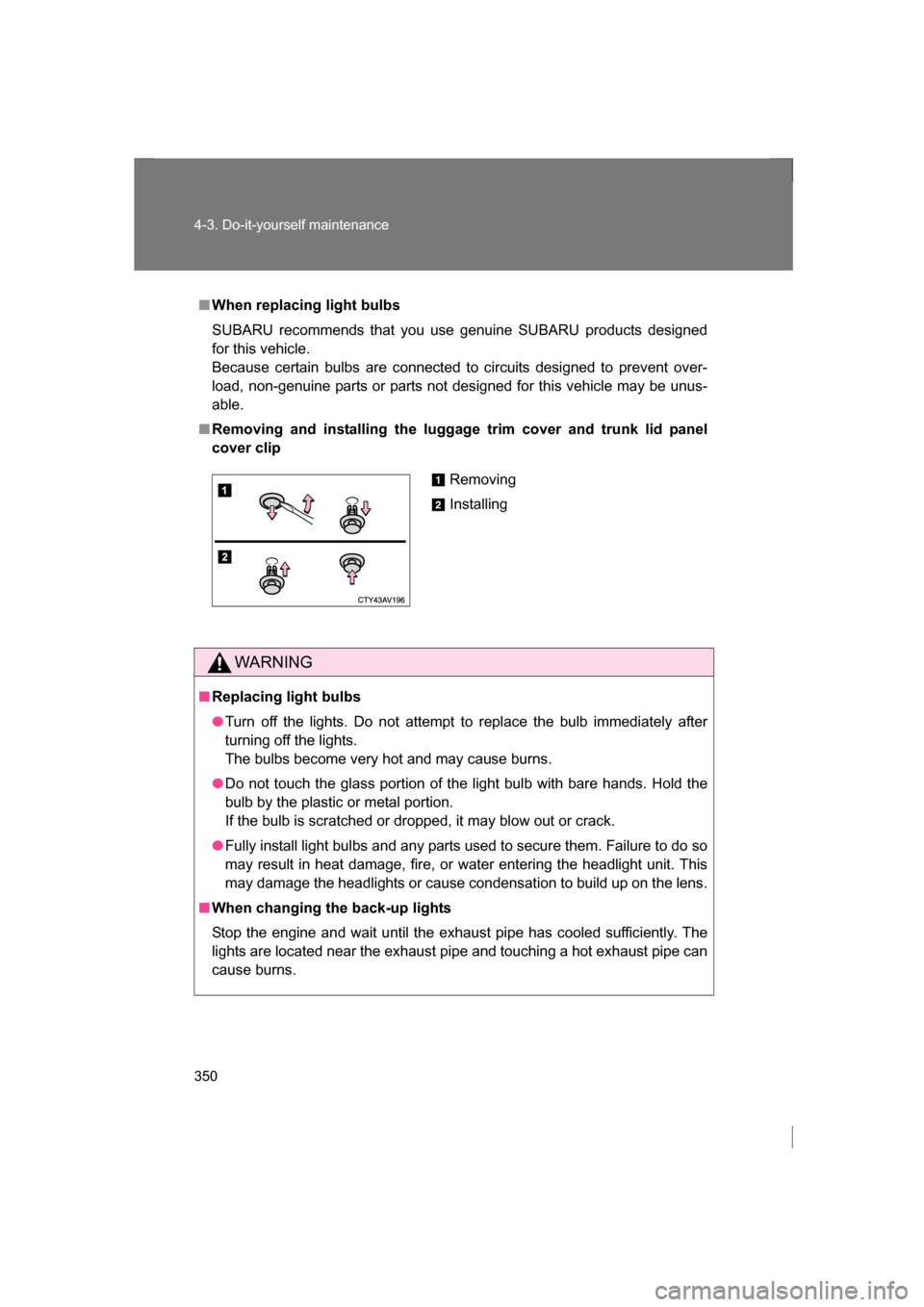
■Removing and installing the luggage trim cover and trunk lid panel cover clip
WARNING
■Replacing light bulbs
●Turn off the lights. Do not attempt to replace the bulb immediately after
turning off the lights.
The bulbs become very hot and may cause burns.
●Do not touch the glass portion of the light bulb with bare hands. Hold the
bulb by the plastic or metal portion.
If the bulb is scratched or dropped, it may blow out or crack.
●Fully install light bulbs and any parts used to secure them. Failure to do so
may result in heat damage, fire, or water entering the headlight unit. This
may damage the headlights or cause condensation to build up on the lens.
■When changing the back-up lights
Stop the engine and wait until the exhaust pipe has cooled sufficiently. The
lights are located near the exhaust pipe and touching a hot exhaust pipe can
cause burns.
Removing
Installing
Page 351 of 484
351
4-3. Do-it-yourself maintenance
4
Maintenance and care
WARNING
■Discharge headlights
●Contact your SUBARU dealer before replacing the discharge headlights
(including light bulbs).
●Do not touch the discharge headlight’s high voltage socket when the head-
lights are turned on.
An extremely high voltage of 25000 V will be discharged and could result
in serious injury or death by electric shock.
●Do not attempt to take apart or repair the low beam discharge headlight
bulbs, connectors, power supply circuits, or related components.
Doing so could result in electric shock and serious injury or death.
■To prevent damage or fire
Make sure bulbs are fully seated and locked.
Page 354 of 484
354
5-1. Essential information
Hazard war ning flashers
■Hazard warning flashers
If the hazard warning flashers are used for a long time while the engine is
not operating, the battery may discharge.
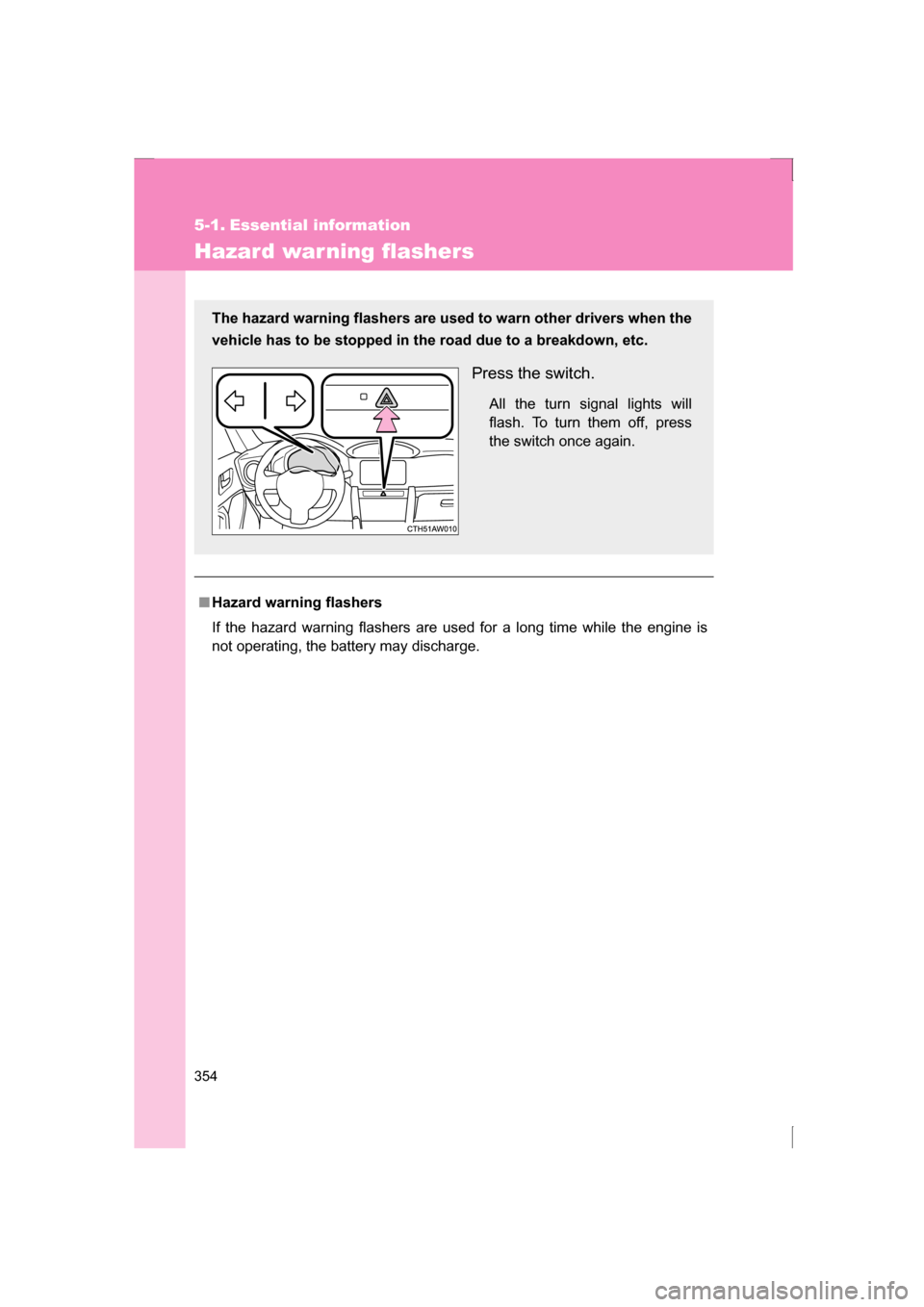
The hazard warning flashers are used to warn other drivers when the
vehicle has to be stopped in the road due to a breakdown, etc.
Press the switch.All the turn signal lights will
flash. To turn them off, press
the switch once again.
Page 389 of 484
5
When trouble arises
389
5-2. Steps to take in an emergency
If the engine will not start
If the engine will not start even though correct starting procedures
are being followed ( →P. 160, 169), consider each of the following
points.
■The engine will not start even when the starter motor oper-
ates normally.
One of the following may be the cause of the problem. ● There may not be sufficient fuel in the vehicle’s tank.
Refuel the vehicle.
● The engine may be flooded.
Try to restart the engine once more following correct starting
procedures. ( →P. 160, 169)
● There may be a malfunction in the engine immobilizer system. (→ P. 77)
■The starter motor turns over slowly, the interior lights and
headlights are dim, or the horn does not sound or sounds at
a low volume.
One of the following may be the cause of the problem. ● The battery may be discharged. ( →P. 398)
● The battery terminal connections may be loose or corroded.
■The starter motor does not turn over. (vehicles with a key-
less access with push button start system)
The engine starting system may be malfunctioning due to an
electrical problem such as an open circuit or a blown fuse. How-
ever, an interim measure is available to start the engine. (→ P. 390)
Page 390 of 484
390
5-2. Steps to take in an emergency
Emergency start function (vehicles with a keyless access with
push button start system)When the engine does not start, the following steps can be used as
an interim measure to start the engine if the push-button ignition
switch is functioning normally:
Vehicles with an automatic transmission Set the parking brake.
Put the select lever in P.
Set the push-button ignition switch to “ACC” mode.
Press and hold the push-button ignition switch about 15 sec-
onds while depressing the brake pedal firmly.
Even if the engine can be started using the above steps, the system
may be malfunctioning. Have the vehicle checked by your SUBARU
dealer.
■The starter motor does not turn over, the interior lights and
headlights do not turn on, or the horn does not sound.
One of the following may be the cause of the problem. ● One or both of the battery terminals may be disconnected.
● The battery may be discharged. ( →P. 398)
● There may be a malfunction in the steering lock system. (vehi-
cles with a keyless access with push button start system)
Contact your SUBARU dealer if the problem cannot be repaired, or if
repair procedures are unknown.
STEP 1
STEP 2
STEP 3
STEP 4