warning SUBARU BRZ 2013 1.G Workshop Manual
[x] Cancel search | Manufacturer: SUBARU, Model Year: 2013, Model line: BRZ, Model: SUBARU BRZ 2013 1.GPages: 484, PDF Size: 6.46 MB
Page 135 of 484
135
1-7. Safety information
1
Before driving
WARNING
■Child restraint precautions
●Do not allow the child to lean his/her head or any part of his/her body
against the door or the area of the seat, front and rear pillars or roof side
rails from which the SRS side airbags or SRS curtain airbags deploy even
if the child is seated in the child restraint system. It is dangerous if the SRS
side airbags and curtain airbags inflate, and the impact could cause death
or serious injury to the child.
●Make sure you have complied with all installation instructions provided by
the child restraint manufacturer and that the system is properly secured. If
it is not secured properly, it may cause death or serious injury to the child
in the event of a sudden stop, sudden swerve or an accident.
■When children are in the vehicle
Do not allow children to play with the seatbelt. If the seatbelt becomes
twisted around a child’s neck, it may lead to choking or other serious injuries
that could result in death.
If this occurs and the buckle cannot be unfastened, scissors should be used
to cut the belt.
■When the child restraint system is not in use
●Keep the child restraint system properly secured on the seat even if it is
not in use. Do not store the restraint unsecured in the passenger compart-ment.
●If it is necessary to detach the child restraint system, remove it from the
vehicle or store it securely in the trunk. This will prevent it from injuring
passengers in the event of a sudden stop, sudden swerve or accident.
Page 143 of 484
143
1-7. Safety information
1
Before driving
■When installing a child restraint system with LATCH anchors and a top
tether strap
Depending on the child restraint system's size and shape, if the child
restraint system is installed to the LATCH anchors first, it may not be possi-
ble to attach the top tether strap to the anchor bracket.
In that case, first temporarily attach the top tether strap to the anchor
bracket, install the child restraint system using the lower anchors and then
tighten the top tether strap.
■Laws and regulations pertaining to anchorages
The LATCH system conforms to FMVSS225 or CMVSS210.2.
Child restraint systems conforming to FMVSS213 or CMVSS213 specifica-
tions can be used.
This vehicle is designed to conform to the SAE J1819.
WARNING
■When installing a booster seat
To prevent the belt from going into ALR lock mode, do not fully extend the
shoulder belt. ALR mode causes the belt to tighten only. This could cause
injury or discomfort to the child. ( →P. 60)
■When installing a child restraint system
Follow the directions given in the child restraint system installation manual
and fix the child restraint system securely in place.
If the child restraint system is not correctly fixed in place, the child or other
passengers may be injured or even killed in the event of sudden braking,
sudden swerving or an accident.
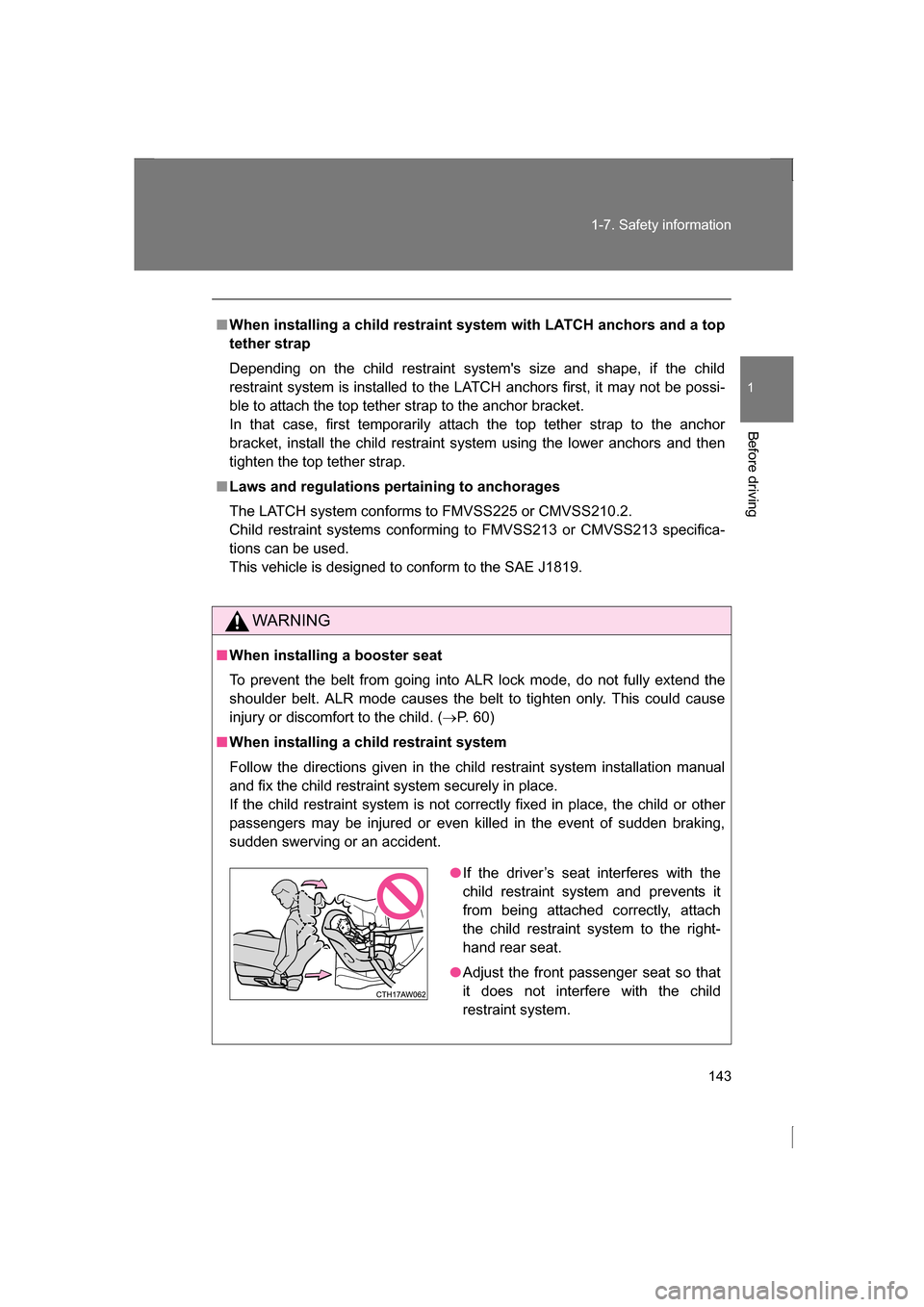
●If the driver’s seat interferes with the
child restraint system and prevents it
from being attached correctly, attach
the child restraint system to the right-
hand rear seat.
●Adjust the front passenger seat so that
it does not interfere with the child
restraint system.
Page 144 of 484
144
1-7. Safety information
WARNING
■When installing a child restraint system
●Ensure that the belt and plate are securely locked and the seatbelt is not
twisted.
●Shake the child restraint system left and right, and forward and backward
to ensure that it has been securely installed.
●When adjusting the front passenger seat position after installing a child
restraint system, do so slowly.
●Follow all installation instructions provided by the child restraint system
manufacturer.
■To correctly attach a child restraint system to the anchors
When using the LATCH anchors, be sure that there are no foreign objects
around the anchors and that the seatbelt is not caught behind the child
restraint. Make sure the child restraint system is securely attached, or it may
cause death or serious injury to the child or other passengers in the event of
sudden braking, sudden swerve or an accident.
Page 145 of 484
When driving2
145
2-1. Driving proceduresDriving the vehicle............ 146
Push-button ignition switch ............................. 160
Engine (ignition) switch .... 169
Automatic transmission .... 172
Manual Transmission ....... 179
Turn signal lever .............. 182
Parking brake ................... 183
Horn ................................. 184
2-2. Instrument cluster Gauges and meters ......... 185
Indicators and warning lights .............................. 190
Multi-information display............................ 195 2-3. Operating the lights and
windshield wipers
Headlight switch ............... 200
Fog light switch ................ 206
Windshield wipers and washer ........................... 207
2-4. Using other driving systems
Cruise control ................... 210
Driving assist systems ..... 215
2-5. Driving information Cargo and luggage .......... 221
Vehicle load limits ............ 225
Winter driving tips ............ 226
Trailer towing ................... 230
Dinghy towing .................. 231
Page 151 of 484
151
2-1. Driving procedures
2
When driving
WARNING
■When starting the vehicle (vehicles with an automatic transmission)
●Always keep your foot on the brake pedal while stopped with the engine
running. This prevents the vehicle from creeping.
●Firmly depress the brake pedal because engine speed may increase
immediately after starting the engine, when the air conditioning system is
operating, when turning the steering wheel, etc., thereby causing creeping
to become stronger. Apply the parking brake as necessary.
■When driving the vehicle
●Do not drive if you are unfamiliar with the location of the brake and accel-
erator pedals to avoid depressing the wrong pedal.
Page 152 of 484
152
2-1. Driving procedures
WARNING
●On vehicles with a manual transmission, do not shift the shift lever to R
while the vehicle is moving forward.
Doing so can damage the transmission and may result in a loss of vehicle
control.
●Do not shift the select lever to D (vehicles with an automatic transmission)
or shift lever to 1 (vehicles with a manual transmission) while the vehicle is
moving backward.
Doing so can damage the transmission and may result in a loss of vehicle
control.
●On vehicles with a manual transmission, do not release the clutch pedal
too quickly. Doing so may propel the vehicle forward, possibly causing an
accident.
●Moving the select lever to N (vehicles with an automatic transmission) or
shift lever to neutral (vehicles with a manual transmission) while the vehi-
cle is moving will disengage the engine from the transmission. Engine
braking is not available when N or neutral is selected.
●During normal driving, do not turn off the engine. Turning the engine off
while driving will not cause loss of steering or braking control, but the
power assist to these systems will be lost. This will make it more difficult to
steer and brake, so you should pull over and stop the vehicle as soon as it
is safe to do so.
●Use engine braking (downshift) to maintain a safe speed when driving
down a steep hill.
Using the brakes continuously may cause the brakes to overheat and lose
effectiveness. ( →P. 173, 179)
●Do not adjust the position of the steering wheel, the seat, or the inside or
outside rear view mirrors while driving.
Doing so may result in a loss of vehicle control that can cause accidents,
resulting in death or serious injury.
Page 153 of 484
153
2-1. Driving procedures
2
When driving
WARNING
●Always check that all passengers' arms, heads or other parts of their body
are not outside the vehicle, as this may result in death or serious injury.
●Do not drive in excess of the speed limit. Even if the legal speed limit per-
mits it, do not drive over 85 mph (140 km/h) unless your vehicle has high-
speed capability tires. Driving over 85 mph (140 km/h) may result in tire
failure, loss of control and possible injury. Be sure to consult a tire dealer
to determine whether the tires on your vehicle are high-speed capability
tires or not before driving at such speeds.
■When driving on slippery road surfaces
●Sudden braking, acceleration and steering may cause tire slippage and
reduce your ability to control the vehicle, resulting in an accident.
●Sudden acceleration, engine braking due to shift changing, or changes in
engine speed could cause the vehicle to skid, resulting in an accident.
●After driving through a puddle, lightly depress the brake pedal to make
sure that the brakes are functioning properly. Wet brake pads may prevent
the brakes from functioning properly. If the brakes on only one side are wet
and not functioning properly, steering control may be affected, resulting in
an accident.
■When shifting the select lever or shift lever
●On vehicles with an automatic transmission, be careful not to shift the
select lever with the accelerator pedal depressed. Shifting the select lever
to a gear other than P or N may lead to unexpected rapid acceleration of
the vehicle that may cause an accident and result in death or serious
injury.
●Do not place items in the select lever’s or shift lever’s surrounding area. It
may cause incorrect operation.
●If the select lever’s or shift lever’s boot is pulled out during cleaning, return
it to its previous position. If the select lever’s or shift lever’s boot is left
pulled out, the select lever or shift lever may become difficult to operate.
Page 154 of 484
154
2-1. Driving procedures
WARNING
■If you hear a squealing or scraping noise (brake pad wear limit indica-
tors)
Have your SUBARU dealer check and replace the brake pads as soon as
possible.
Rotor damage may result if the pads are not replaced when needed.
It is dangerous to drive the vehicle when the wear limits of the brake pads
and/or those of the brake discs are exceeded. ( →P. 149)
■Breaking-in of new brake pads and linings
A safe location and situation should be selected for break-in driving.
■When the vehicle is stopped
●Do not race the engine.
If the vehicle is in any gear other than P or N (vehicles with an automatic
transmission only) or neutral (vehicles with a manual transmission), the
vehicle may accelerate suddenly and unexpectedly, causing an accident.
●Do not leave the vehicle with the engine running for a long time.
If such a situation cannot be avoided, park the vehicle in an open space
and check that exhaust fumes do not enter the vehicle interior.
●On vehicles with an automatic transmission, in order to prevent accidents
due to the vehicle rolling away, always keep depressing the brake pedal
while the engine is running, and apply the parking brake as necessary.
●If the vehicle is stopped on an incline, in order to prevent accidents caused
by the vehicle rolling forward or backward, always depress the brake pedal
and securely apply the parking brake as needed.
●Avoid revving or racing the engine.
Running the engine at high speed while the vehicle is stopped may cause
the exhaust system to overheat, which could result in a fire if combustible
material is nearby.
Page 155 of 484
155
2-1. Driving procedures
2
When driving
WARNING
■When the vehicle is parked
●Do not leave glasses, cigarette lighters, spray cans, or soft drink cans in
the vehicle when it is in the sun.
Doing so may result in the following:
Page 156 of 484
156
2-1. Driving procedures
WARNING
■Exhaust gases
Exhaust gases include harmful carbon monoxide (CO), which is colorless
and odorless. Inhaling exhaust gases may lead to death or a serious health
hazard.
●If the vehicle is in a poorly ventilated area, stop the engine. In a closed
area, such as a garage, exhaust gases may collect and enter the vehicle.
This may lead to death or a serious health hazard.
●The exhaust system should be checked occasionally. If there is a hole or
crack caused by corrosion, damage to a joint or abnormal exhaust noise,
be sure to have the vehicle inspected and repaired by your SUBARU
dealer. Failure to do so may allow exhaust gases to enter the vehicle,
resulting in death or a serious health hazard.
■When taking a nap in the vehicle
Always turn the engine off. Otherwise, you may accidentally move the select
lever or shift lever, or depress the accelerator pedal, this could cause an
accident or fire due to engine overheating. Additionally, if the vehicle is
parked in a poorly ventilated area, exhaust gases may collect and enter the
vehicle, leading to death or a serious health hazard.