belt SUBARU BRZ 2013 1.G Owners Manual
[x] Cancel search | Manufacturer: SUBARU, Model Year: 2013, Model line: BRZ, Model: SUBARU BRZ 2013 1.GPages: 484, PDF Size: 6.46 MB
Page 1 of 484
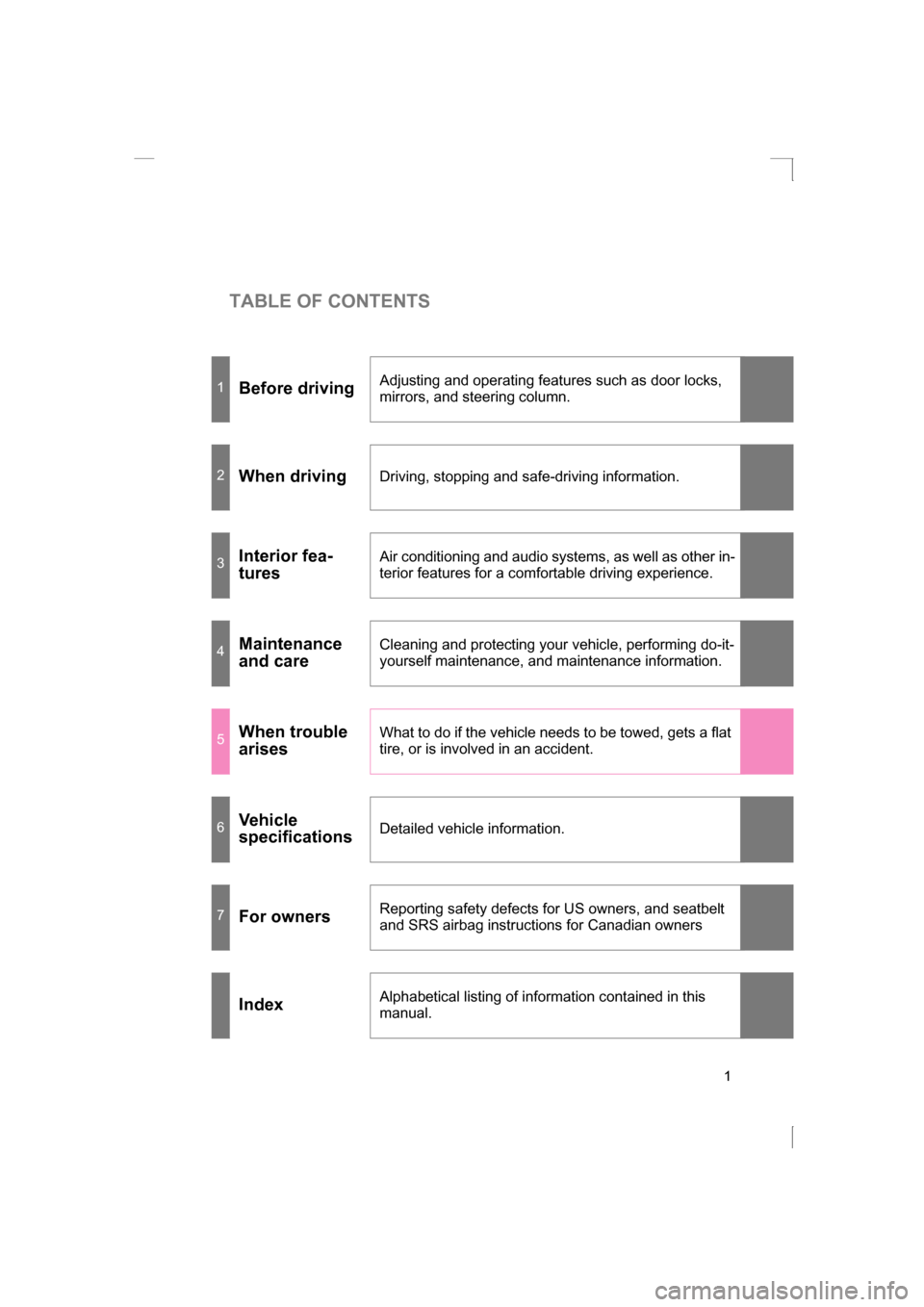
TABLE OF CONTENTS
1
1Before drivingAdjusting and operating features such as door locks,
mirrors, and steering column.
2When driving
Driving, stopping and safe-driving information.
3Interior fea-
turesAir conditioning and audio systems, as well as other in-
terior features for a comf
ortable driving experience.
4Maintenance
and careCleaning and protecting your vehicle, performing do-it-
yourself maintenance, and maintenance information.
5When trouble
arisesWhat to do if the vehicle needs to be towed, gets a flat
tire, or is involved in an accident.
6Vehicle
specifications
Detailed vehicle information.
7For owners
Reporting safety defects for US owners, and seatbelt
and SRS airbag instructions for Canadian owners
Index
Alphabetical listing of information contained in this manual.
Page 2 of 484
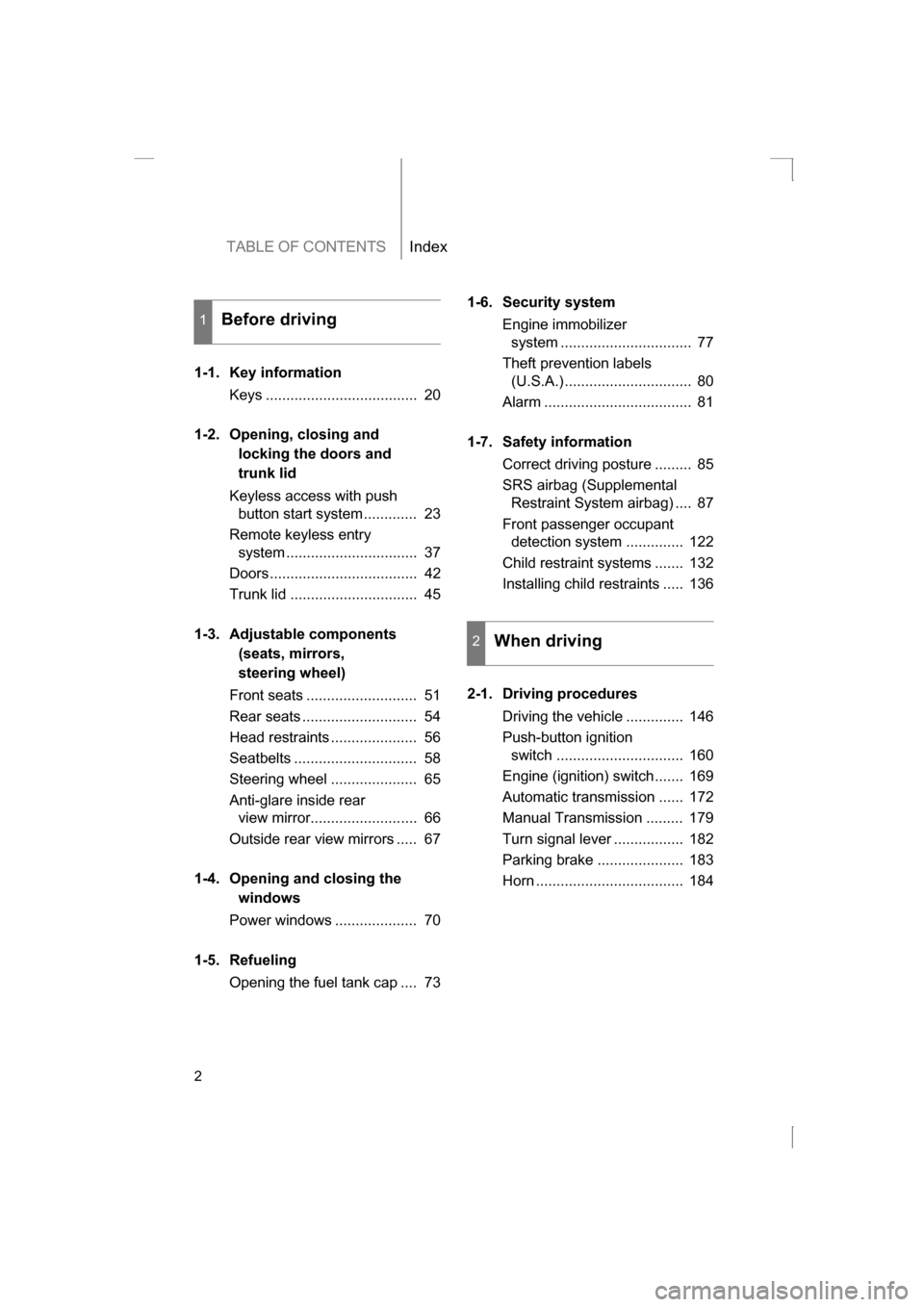
TABLE OF CONTENTSIndex
2
1-1. Key information
Keys ..................................... 20
1-2. Opening, closing and locking the doors and
trunk lid
Keyless access with push button start system ............. 23
Remote keyless entry system ................................ 37
Doors.................................... 42
Trunk lid ............................... 45
1-3. Adjustable components (seats, mirrors,
steering wheel)
Front seats ........................... 51
Rear seats ............................ 54
Head restraints ..................... 56
Seatbelts .............................. 58
Steering wheel ..................... 65
Anti-glare inside rear view mirror.......................... 66
Outside rear view mirrors ..... 67
1-4. Opening and closing the windows
Power windows .................... 70
1-5. Refueling Opening the fuel tank cap .... 73 1-6. Security system
Engine immobilizer system ................................ 77
Theft prevention labels (U.S.A.) ............................... 80
Alarm .................................... 81
1-7. Safety information Correct driving posture ......... 85
SRS airbag (Supplemental Restraint System airbag) .... 87
Front passenger occupant detection system .............. 122
Child restraint systems ....... 132
Installing child restraints ..... 136
2-1. Driving procedures Driving the vehicle .............. 146
Push-button ignition switch ............................... 160
Engine (ignition) switch....... 169
Automatic transmission ...... 172
Manual Transmission ......... 179
Turn signal lever ................. 182
Parking brake ..................... 183
Horn .................................... 184
1Before driving
2When driving
Page 5 of 484
1
2
3
4
5
6
7
5
6-1. Specifications
Maintenance data (fuel, oil level, etc.) ............ 410
Fuel information .................. 422
Tire information ................... 426
6-2. Customization Customizable features ........ 439
Reporting safety defects for U.S. owners ................. 444
Seatbelt instructions for Canadian owners
(in French) ........................ 445
SRS airbag instructions for Canadian owners
(in French) ........................ 448
Abbreviation list .........................470
Alphabetical index ......................471
What to do if... ............................481
6Vehicle specifications
7For owners
Index
Page 8 of 484
8
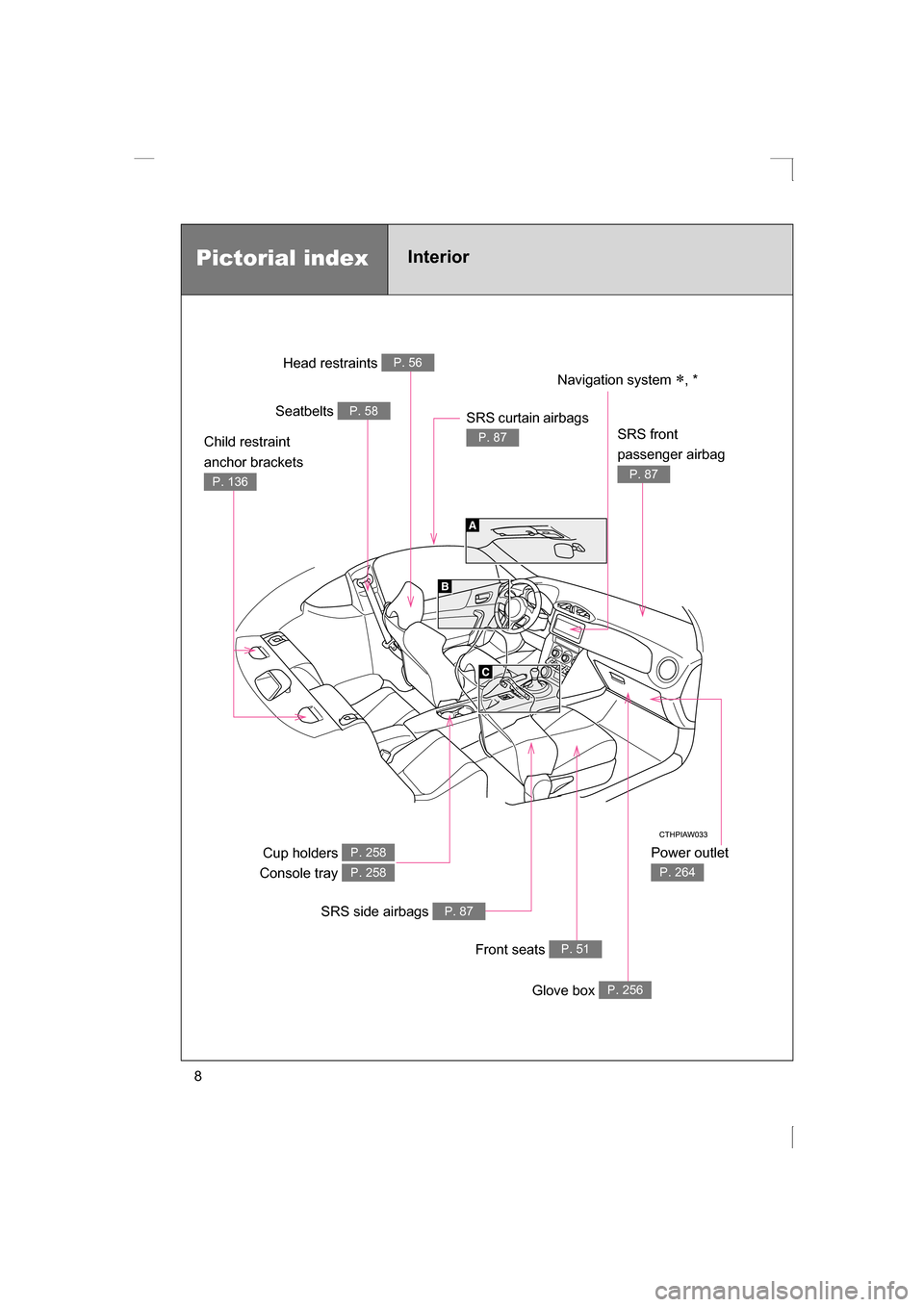
Pictorial indexInterior Power outlet
P. 264
Head restraints P. 56
Seatbelts P. 58
Cup holders
Console tray P. 258
P. 258
SRS side airbags P. 87
Front seats P. 51
Glove box P. 256
SRS curtain airbags
P. 87Child restraint
anchor brackets
P. 136
Navigation system ∗, *
SRS front
passenger airbag
P. 87
Page 15 of 484
15
Installation of a mobile two-way radio systemThe installation of a mobile two-way radio system in your vehicle could affect
electronic systems such as: ● Multiport fuel injection system/sequential multiport fuel injection system
● Cruise control system
● Anti-lock brake system
● SRS airbag system
● Seatbelt pretensioner system
Be sure to check with your SUBARU dealer for precautionary measures or
special instructions regarding installation of a mobile two-way radio system.
Page 17 of 484
17
Scrapping of your SUBARUThe SRS airbag and seatbelt pretensioner devices in your SUBARU contain
explosive chemicals. If the vehicle is scrapped with the airbags and seatbelt
pretensioners left as they are, this may cause an accident such as fire. Be
sure to have the systems of the SRS airbag and seatbelt pretensioner
removed and disposed of by a qualified service shop or by your SUBARU
dealer before you scrap your vehicle.
Perchlorate Material
Special handling may apply, See www.dtsc.ca.gov/hazardouswaste/perchlorate.
Your vehicle has components that may contain perchlorate. These
components may include airbag, seatbelt pretensioners, and transmitter
batteries.
WARNING
■General precautions while driving
Driving under the influence: Never drive your vehicle when under the influ-
ence of alcohol or drugs that have impaired your ability to operate your vehi-
cle. Alcohol and certain drugs delay reaction time, impair judgment and
reduce coordination, which could lead to an accident that could result in
death or serious injury.
Defensive driving: Always drive defensively. Anticipate mistakes that other
drivers or pedestrians might make and be ready to avoid accidents.
Driver distraction: Always give your full attention to driving. Anything that dis-
tracts the driver, such as adjusting controls, talking on a cellular phone or
reading can result in a collision with resulting death or serious injury to you,
your occupants or others.
■General precaution regarding children’s safety
Never leave children unattended in the vehicle, and never allow children to
have or use the key.
Children may be able to start the vehicle or shift the vehicle into neutral.
There is also a danger that children may injure themselves by playing with
the windows or other features of the vehicle. In addition, heat build-up or
extremely cold temperatures inside the vehicle can be fatal to children.
Page 19 of 484
Before driving1
19
1-1. Key informationKeys ................................... 20
1-2. Opening, closing and locking the doors and
trunk lid
Keyless access with push button start
system ............................. 23
Remote keyless entry system ............................. 37
Doors ................................. 42
Trunk lid ............................. 45
1-3. Adjustable components (seats, mirrors, steering
wheel)
Front seats ......................... 51
Rear seats.......................... 54
Head restraints................... 56
Seatbelts ............................ 58
Steering wheel ................... 65
Anti-glare inside rear view mirror ....................... 66
Outside rear view mirrors.............................. 67 1-4. Opening and closing the
windows
Power windows .................. 70
1-5. Refueling Opening the fuel tank cap ................................... 73
1-6. Security system Engine immobilizer system ............................. 77
Theft prevention labels (U.S.A.) ............................ 80
Alarm.................................. 81
1-7. Safety information Correct driving posture....... 85 SRS airbag (Supplemental Restraint
System airbag) ................. 87
Front passenger occupant detection system ............ 122
Child restraint systems..... 132
Installing child restraints ........................ 136
Page 44 of 484
44
1-2. Opening, closing and locking the doors and trunk lid
Locking the doors from the outside without a keyMove the lock lever to the lock position.
Close the door.
Vehicles with a keyless access with push button start system The door cannot be locked if the access key is left inside the vehi-
cle.
The key may not be detected correctly and the door may be locked.
■Window open/close function linked to door operation
In order to make opening and closing the doors easier, completely closed
windows are linked to door operations. Therefore, when a door is opened, its
window opens slightly. When a door is closed, its window closes completely.
However, if the battery has discharged or is disconnected, this function will not operate. ( →P. 402)
■If the keyless access with push button start system has been deacti-
vated in a customized setting (vehicles with a keyless access with
push button start system)
Use the remote keyless entry system or mechanical key. ( →P. 37, 394)
WARNING
■To prevent an accident
Observe the following precautions while driving the vehicle.
Failure to do so may result in a door opening and an occupant falling out,
resulting in death or serious injury.
●Always use a seatbelt.
●Always lock both side doors.
●Ensure that both side doors are properly closed.
●Do not pull the inside handle of the doors while driving.
The doors may be opened and the passengers are thrown out of the vehi-
cle and it may result in serious injury or death.
STEP 1
STEP 2
Page 51 of 484
51
1
Before driving
1-3. Adjustable components (seats, mirrors, steering wheel)
Front seats
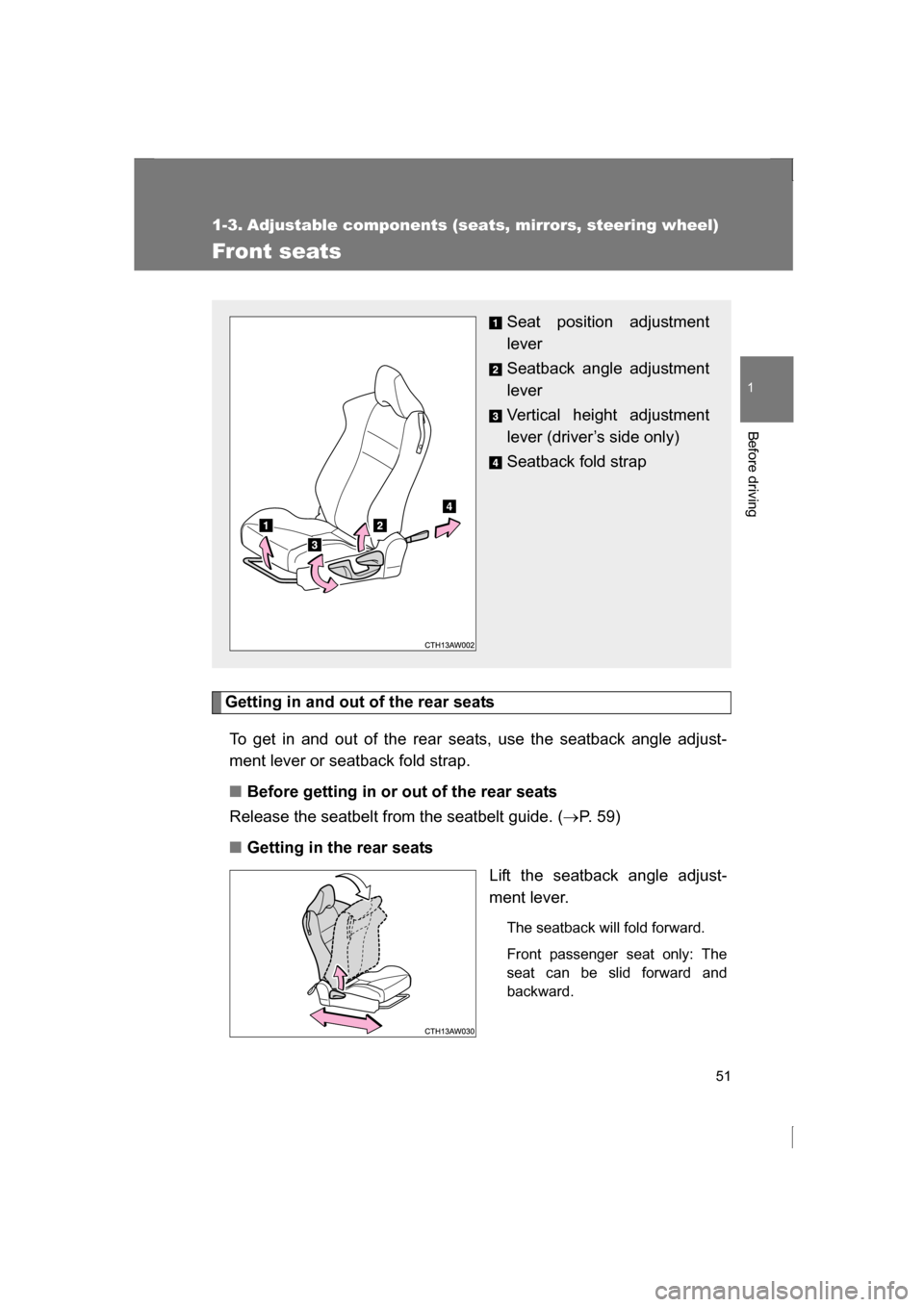
Getting in and out of the rear seatsTo get in and out of the rear seats, use the seatback angle adjust-
ment lever or seatback fold strap.
■Before getting in or out of the rear seats
Release the seatbelt from the seatbelt guide. ( →P. 5 9 )
■Getting in the rear seats
Lift the seatback angle adjust-
ment lever.
The seatback will fold forward.
Front passenger seat only: The
seat can be slid forward and
backward.
Seat position adjustment
lever
Seatback angle adjustment
lever
Vertical height adjustment
lever (driver’s side only)
Seatback fold strap
Page 52 of 484
52
1-3. Adjustable components (seats, mirrors, steering wheel)
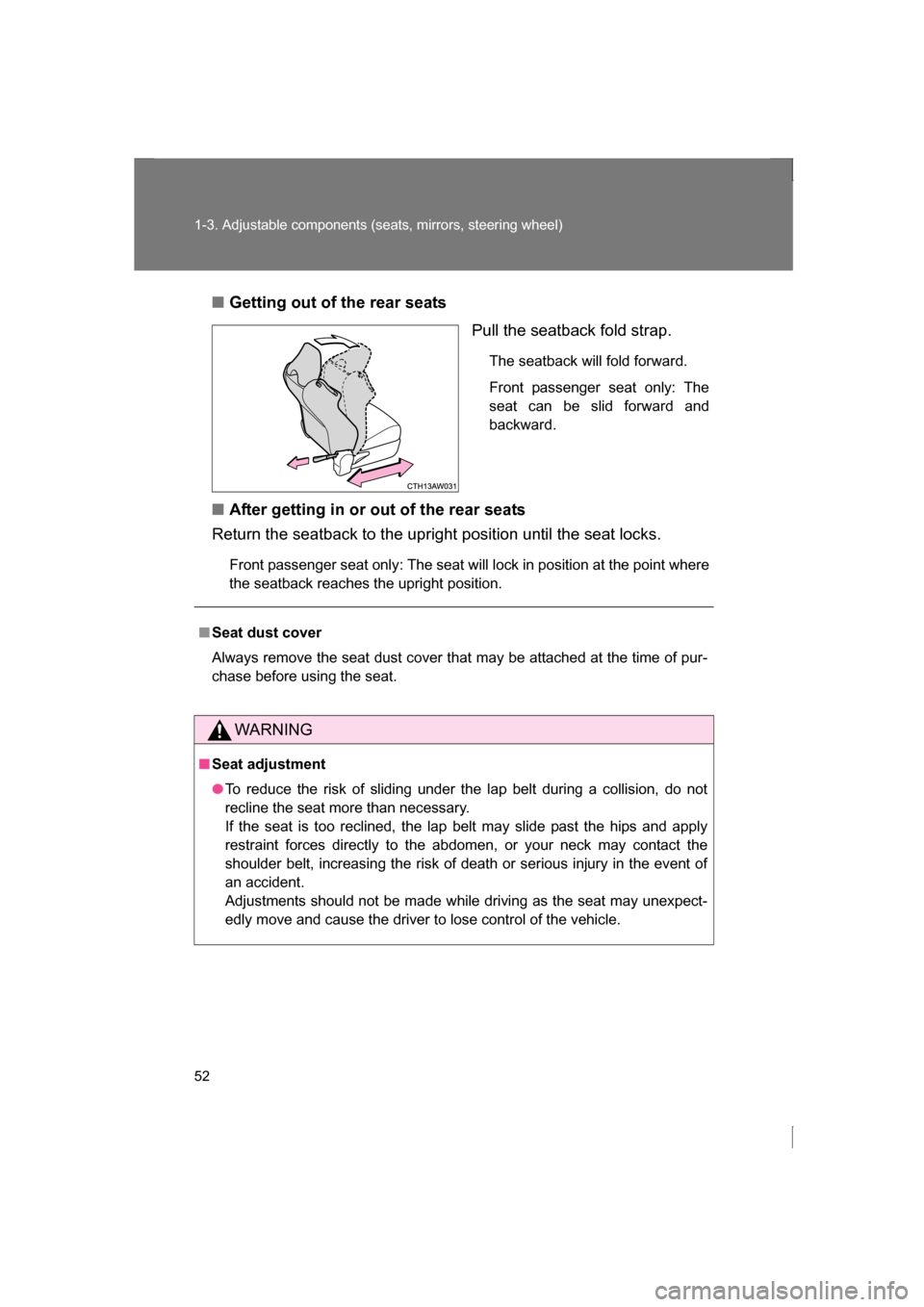
■Getting out of the rear seatsPull the seatback fold strap.
The seatback will fold forward.
Front passenger seat only: The
seat can be slid forward and
backward.
■After getting in or out of the rear seats
Return the seatback to the upright position until the seat locks.
Front passenger seat only: The seat will lock in position at the point where
the seatback reaches the upright position.
■Seat dust cover
Always remove the seat dust cover that may be attached at the time of pur-
chase before using the seat.
WARNING
■Seat adjustment
●To reduce the risk of sliding under the lap belt during a collision, do not
recline the seat more than necessary.
If the seat is too reclined, the lap belt may slide past the hips and apply
restraint forces directly to the abdomen, or your neck may contact the
shoulder belt, increasing the risk of death or serious injury in the event of
an accident.
Adjustments should not be made while driving as the seat may unexpect-
edly move and cause the driver to lose control of the vehicle.