ESP SUBARU BRZ 2014 1.G User Guide
[x] Cancel search | Manufacturer: SUBARU, Model Year: 2014, Model line: BRZ, Model: SUBARU BRZ 2014 1.GPages: 488, PDF Size: 6.41 MB
Page 127 of 488
127
1-7. Safety information
1
Before driving
*1
: The occupant detection system does not operate during self-
checking.
* 2
: The system judges a person of adult size as an adult. When a
smaller adult sits in the front passenger seat, the system may not
recognize him/her as an adult depending on his/her physique and
posture.
* 3
: In the event the front passenger does not wear a seatbelt.
* 4
: The front passenger’s SRS side airbag, SRS curtain airbag and
seatbelt pretensioner are not controlled by the occupant detection
system.
* 5
: For some children, child in seat, child in booster seat or child in
convertible seat, the system may not recognize him/her as a
child. Factors which may affect this can be the physique or pos-
ture.
Children who have outgrown a child restraint system should
always wear the seatbelt when sitting in the seat irrespective of
whether the airbag is deactivated or activated.
* 6
: When a child restraint system is installed on the front passenger
seat, do not place any article on the seat other than the child
occupant and a child restraint system.
Failure to do so may prevent the front passenger occupant detec-
tion system from functioning correctly or cause the system to fail.
* 7
: Do not place more than one child on the front passenger seat.
Failure to do so may prevent the front passenger occupant detec-
tion system from functioning correctly.
* 8
: Never install a child restraint system on the front passenger seat.
See the caution that follows regarding installation of a child
restraint system. ( →P. 137)
* 9
: In case the indicator is not illuminated, consult this manual on
how to installing the child restraint system properly. ( →P. 137)
Page 150 of 488
150
2-1. Driving procedures
Starting off on a steep uphillVehicles with an automatic transmission Make sure that the parking brake is set and shift the select
lever to D.
Gently depress the accelerator pedal.
Release the parking brake.
Vehicles with a manual transmission With the parking brake firmly set and the clutch pedal fully
depressed, shift the shift lever to 1.
Lightly depress the accelerator pedal at the same time as
gradually releasing the clutch pedal.
Release the parking brake.
■Driving in the rain
●Drive carefully when it is raining, because visibility will be reduced, the
windows may become fogged-up, and the road will be slippery.
●Drive carefully when it starts to rain, because the road surface will be
especially slippery.
●Refrain from high speeds when driving on an expressway in the rain,
because there may be a layer of water between the tires and the road
surface, preventing the steering and brakes from operating properly.
■Engine speed while driving (vehicl es with an automatic transmission)
In the following conditions, the engine speed may become high while driving.
This is due to automatic up-shifting c ontrol or down-shifting implementation
to meet driving conditions. It does not indicate sudden acceleration.
●The vehicle is judged to be driving uphill or downhill
●When the accelerator pedal is released
●When driving on curves
●When the brake pedal is firmly depressed
STEP 1
STEP 2
STEP 3
STEP 1
STEP 2
STEP 3
Page 161 of 488
161
2-1. Driving procedures
2
When driving
CAUTION
■Replacement of brake pad and lining
If you continue to drive despite the scraping noise from the audible brake
pad wear indicator, it will result in the need for costly brake rotor repair or
replacement.
■Breaking-in of new brake pads and linings
Pulling the parking brake lever too forcefully may cause the rear wheels to
lock. To avoid this, be certain to pull the lever up slowly and gently.
■If you get a flat tire while driving
A flat or damaged tire may cause the following situations. Hold the steering
wheel firmly and gradually depress the brake pedal to slow down the vehicle.
●It may be difficult to control your vehicle.
●The vehicle will make abnormal sounds or vibrations.
●The vehicle will lean abnormally.
Information on what to do in case of a flat tire ( →P. 380)
■When encountering flooded roads
Do not drive on a road that has flooded after heavy rain etc. Doing so may
cause the following serious damage to the vehicle:
●Engine stalling
●Short in electrical components
●Engine damage caused by water immersion
In the event that you drive on a flooded road and the vehicle is flooded, be
sure to have your SUBARU dealer check the following:
●Brake function
●Changes in quantity and quality of oil and fluid used for the engine, trans-
mission, differential, etc.
●Lubricant condition for the propeller shaft, bearings and suspension joints
(where possible) and the function of all joints, bearings, etc.
Page 201 of 488
201
2-2. Instrument cluster
2
When driving
■The multi-information display operate when
Vehicles without a keyless access with push button start system
The engine switch is in the “ON” position.
Vehicles with a keyless access with push button start system
The push-button ignition switch is in “ON” mode.
WARNING
■The information display at low temperatures
Allow the interior of the vehicle to warm up before using the liquid crystal
information display. At extremely low temperatures, the information display
monitor may respond slowly, and display changes may be delayed.
For example, there is a lag between the driver's shifting and the new shift
position number appearing on the display. In this case, wait until the display
changes and take care not to downshift again, causing rapid and excessive
engine braking and possibly an accident resulting in death or serious injury.
Page 217 of 488
217
2-4. Using other driving systems
2
When driving
Driving assist systems
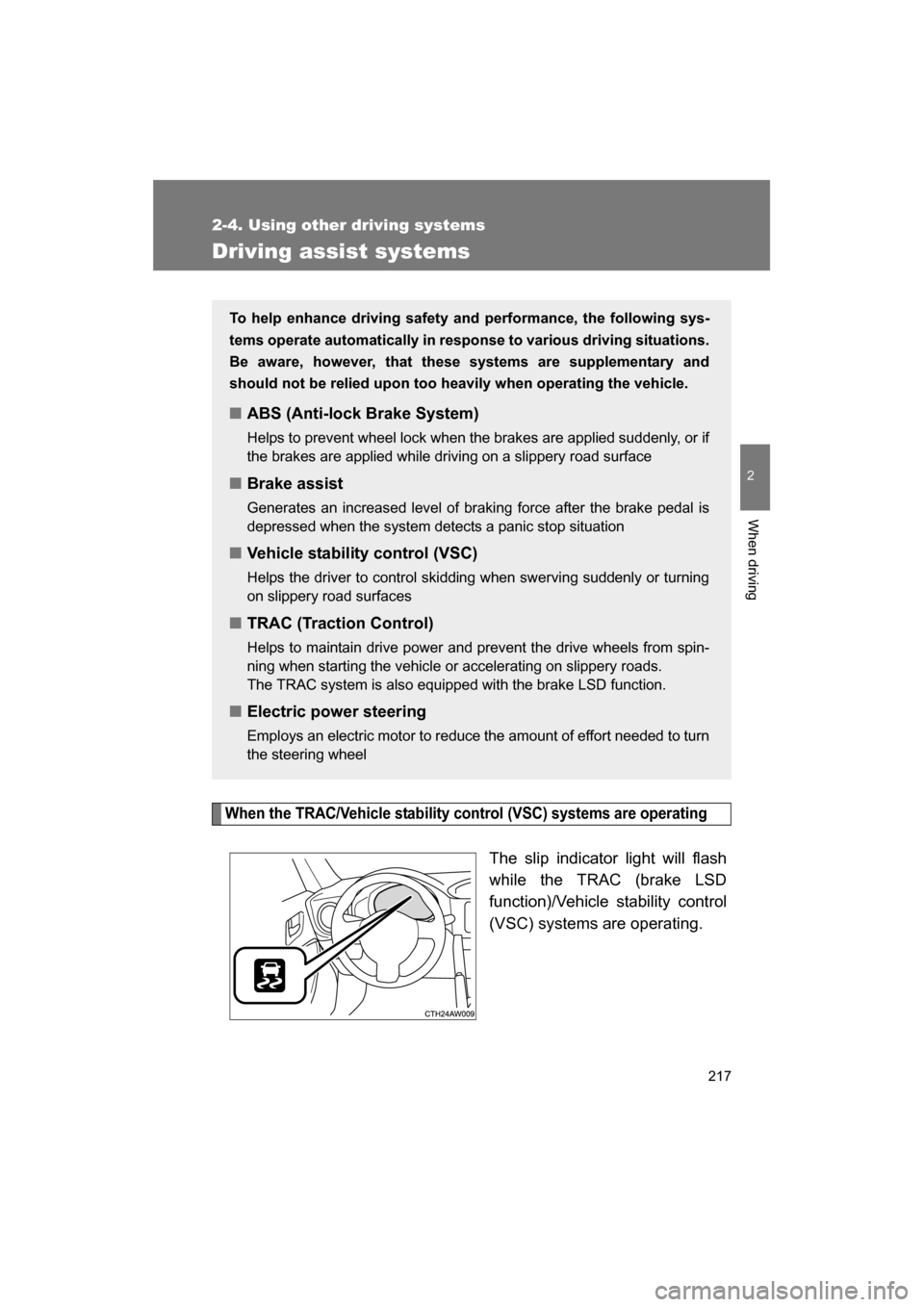
When the TRAC/Vehicle stability control (VSC) systems are operating
The slip indicator light will flash
while the TRAC (brake LSD
function)/Vehicle stability control
(VSC) systems are operating.
To help enhance driving safety and performance, the following sys-
tems operate automatically in response to various driving situations.
Be aware, however, that these systems are supplementary and
should not be relied upon too heavily when operating the vehicle.
■ABS (Anti-lock Brake System)
Helps to prevent wheel lock when the brakes are applied suddenly, or if
the brakes are applied while driving on a slippery road surface
■Brake assist
Generates an increased level of braking force after the brake pedal is
depressed when the system detects a panic stop situation
■Vehicle stability control (VSC)
Helps the driver to control skidding when swerving suddenly or turning
on slippery road surfaces
■TRAC (Traction Control)
Helps to maintain drive power and pr event the drive wheels from spin-
ning when starting the vehicle or accelerating on slippery roads.
The TRAC system is also equipped with the brake LSD function.
■Electric power steering
Employs an electric motor to reduce the amount of effort needed to turn
the steering wheel
Page 223 of 488
223
2-4. Using other driving systems
2
When driving
WARNING
■TRAC may not operate effectively when
Directional control and power may not be achievable while driving on slip-
pery road surfaces, even if the TRAC system is operating.
Do not drive the vehicle in conditions where stability and power may be lost.
■When the Vehicle stability control (VSC) and/or brake LSD function is
activated
The slip indicator light flashes. Always drive carefully. Reckless driving may
cause an accident. Exercise particular care when the indicator light flashes.
■When the TRAC/Vehicle stability control (VSC) systems are turned off
Be especially careful and drive at a speed appropriate to the road condi-
tions. As these are the systems to ensure vehicle stability and driving force,
do not turn the TRAC/Vehicle stability control (VSC) systems off unless nec-
essary.
■Replacing tires
Make sure that all tires are of the specified size, brand, tread pattern and
total load capacity. In addition, make sure that the tires are inflated to the
recommended tire inflation pressure level.
The ABS, TRAC and Vehicle stability cont rol (VSC) systems will not function
correctly if different tires are installed on the vehicle.
Contact your SUBARU dealer for further information when replacing tires or
wheels.
■Handling of tires and suspension
Using tires with any kind of problem or modifying the suspension will affect
the driving assist systems, and may cause a system to malfunction.
Page 231 of 488
231
2-5. Driving information
2
When driving
Tire chainsTire chains cannot be used on your vehicle because of the lack of
clearance between the tires and vehicle body.
When tire chains cannot be used, use of another type of traction
device (such as spring chains) may be acceptable if use on your vehi-
cle is recommended by the device manufacturer, taking into account
tire size and road conditions.
Follow the device manufacturer's instructions, especially regarding
maximum vehicle speed.
To help avoid damage to your vehicle, drive slowly, readjust or
remove the device if it is contacting your vehicle, and do not spin your
wheels. Damage caused to your vehicle by use of a traction device is
not covered under warranty.
Make certain that any traction device you use is an SAE class “S”
device, and use it on the rear wheels only.
Always use the utmost care when driving with a traction device. Over-
confidence because you are using a traction device could easily lead
to a serious accident.
Page 233 of 488
233
2-5. Driving information
2
When driving
Trailer towing
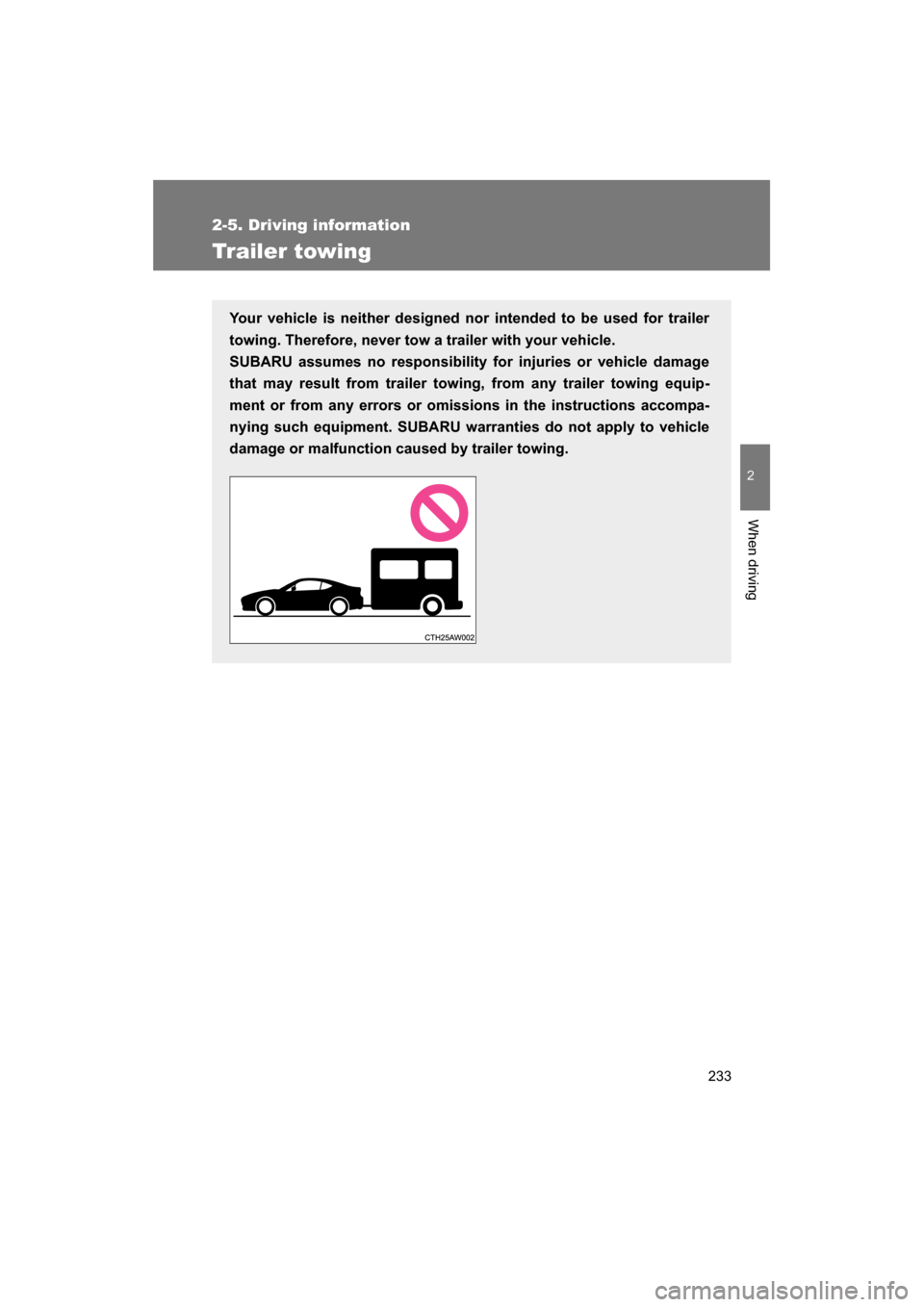
Your vehicle is neither designed nor intended to be used for trailer
towing. Therefore, never tow a trailer with your vehicle.
SUBARU assumes no responsibility for injuries or vehicle damage
that may result from trailer towing, from any trailer towing equip-
ment or from any errors or omissions in the instructions accompa-
nying such equipment. SUBARU warranties do not apply to vehicle
damage or malfunction caused by trailer towing.
Page 239 of 488
239
3-1. Using the air conditioning system and defogger
3
Interior features
Switching between outside air and recirculated air modesPress .
The mode switches between outside air mode (introduces air from out-
side the vehicle) (indicator off) and recirculated air mode (recycles air
inside the vehicle) (indicator on) each time the button is pressed.
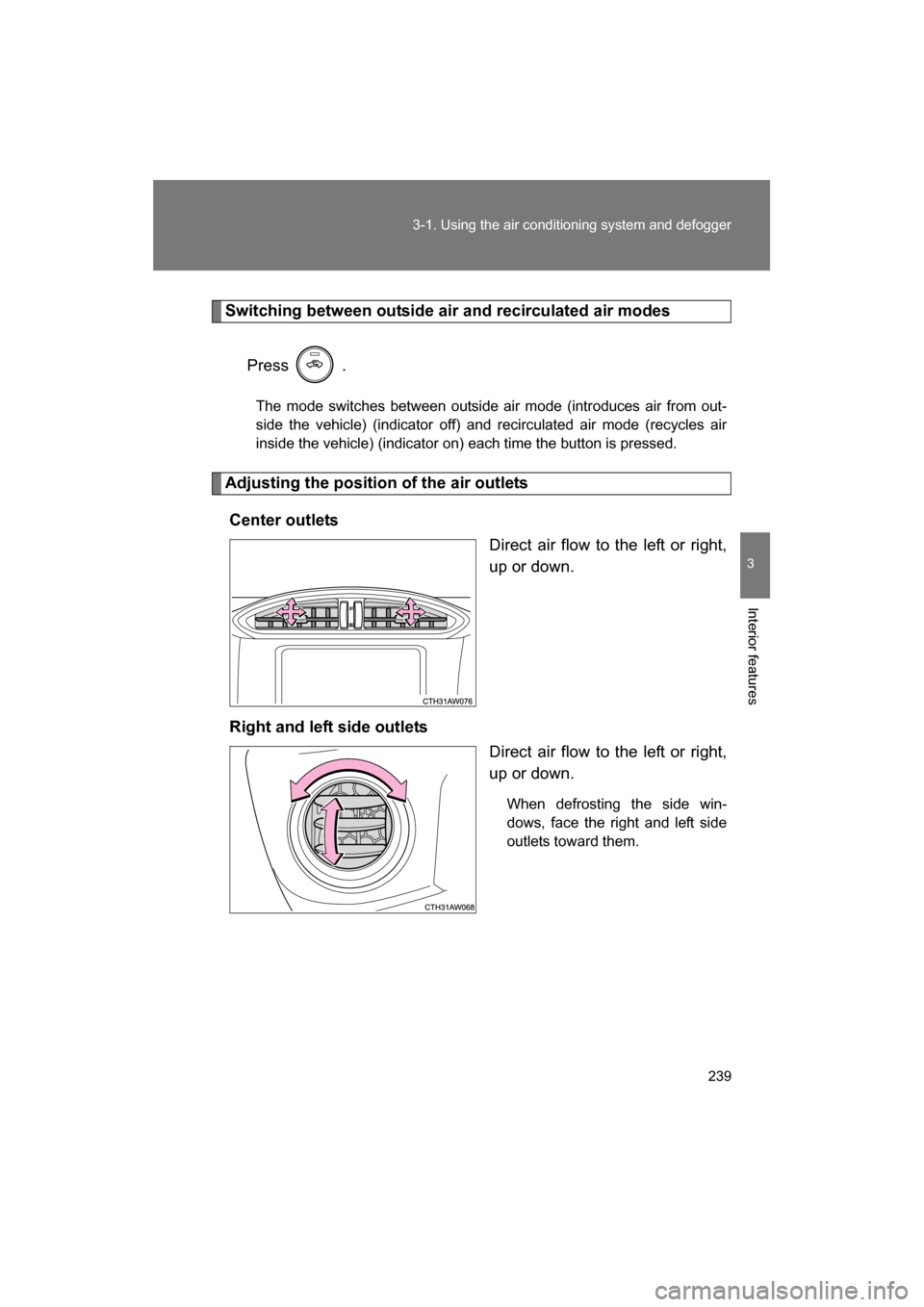
Adjusting the position of the air outlets Center outlets Direct air flow to the left or right,
up or down.
Right and left side outlets Direct air flow to the left or right,
up or down.
When defrosting the side win-
dows, face the right and left side
outlets toward them.
Page 271 of 488
271
3-5. Other interior features
3
Interior features
WARNING
Observe the following precautions.
Failure to do so may cause the driver's floor mat to slip, possibly interfering
with the pedals while driving. An unexpectedly high speed may result or it may
become difficult to stop the vehicle, leading to a serious accident.
■When installing the driver's floor mat
●Do not use floor mats designed for ot her models or different model year
vehicles, even if they are SUBARU Genuine floor mats.
●Only use floor mats designed for the driver's seat.
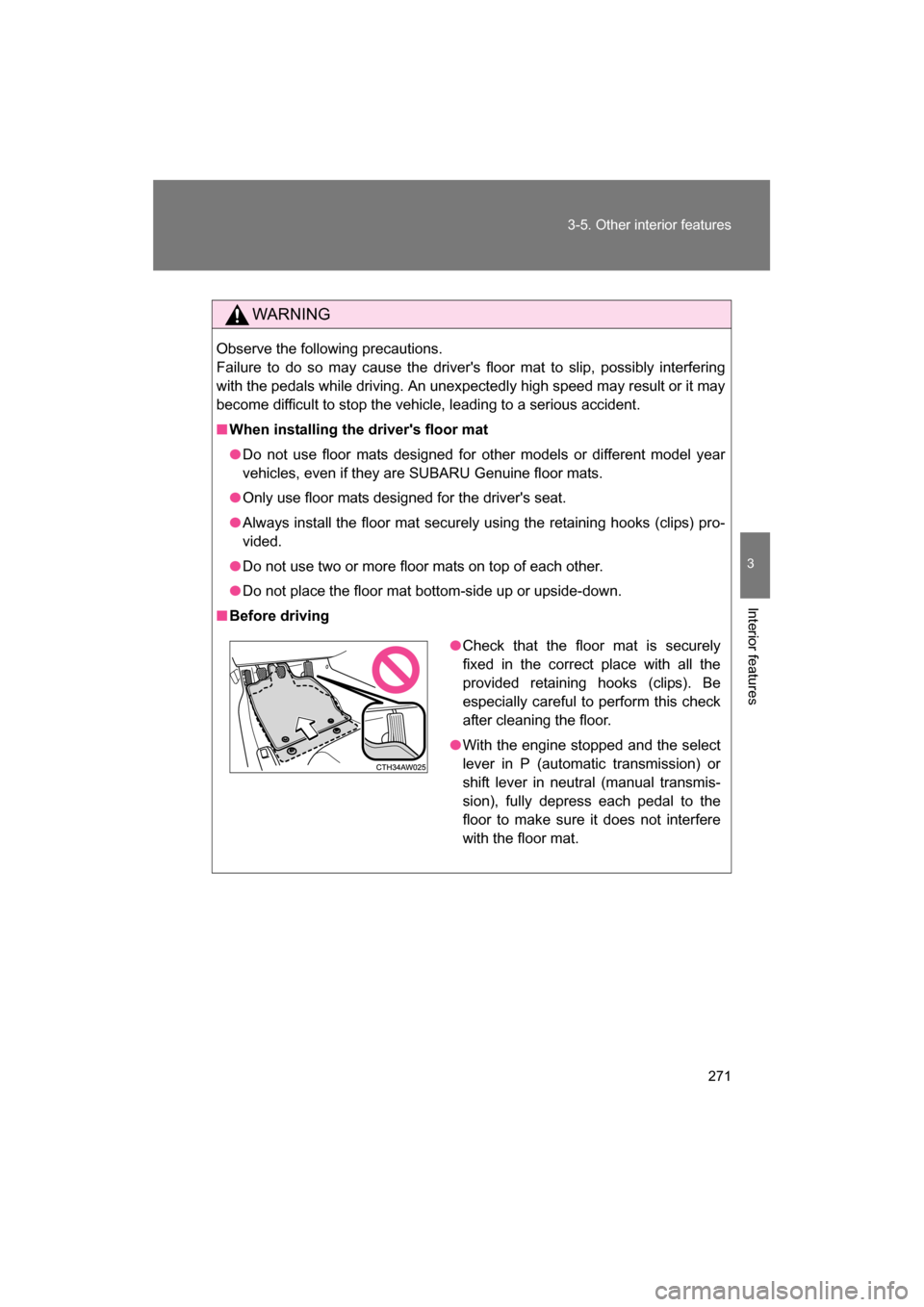
●Always install the floor mat securely using the retaining hooks (clips) pro-
vided.
●Do not use two or more floor mats on top of each other.
●Do not place the floor mat bottom-side up or upside-down.
■Before driving
●Check that the floor mat is securely
fixed in the correct place with all the
provided retaining hooks (clips). Be
especially careful to perform this check
after cleaning the floor.
●With the engine stopped and the select
lever in P (automatic transmission) or
shift lever in neutral (manual transmis-
sion), fully depress each pedal to the
floor to make sure it does not interfere
with the floor mat.