headlights SUBARU BRZ 2015 1.G User Guide
[x] Cancel search | Manufacturer: SUBARU, Model Year: 2015, Model line: BRZ, Model: SUBARU BRZ 2015 1.GPages: 492, PDF Size: 6.53 MB
Page 355 of 492
355
4-3. Do-it-yourself maintenance
4
Maintenance and care
■Replacing the following bulbs
If any of the lights listed below has burnt out, have it replaced by
your SUBARU dealer. ●Headlight high and low beams
● Parking lights
● Daytime running lights
● Stop/tail lights
● High mounted stoplight
● Door courtesy lights (if equipped)
■Condensation build-up on the inside of the lens
Contact your SUBARU dealer for more information in the following situa-
tions. Temporary condensation build-up on the inside of the headlight lens
does not indicate a malfunction.
●Large drops of water are built up on the inside of the lens.
●Water has built up inside the headlight.
■Discharge headlights
If voltage to the discharge bulbs is insufficient, the bulbs may not come on,
or may go out temporarily. The discharge bulbs will come on when normal
power is restored.
■LED light bulbs
The parking lights, daytime running lights, stop/tail lights and high mounted
stoplight consist of a number of LEDs. If any of the LEDs burn out, take your
vehicle to your SUBARU dealer to have the light replaced.
Page 356 of 492
356
4-3. Do-it-yourself maintenance
■When replacing light bulbs
SUBARU recommends that you use genuine SUBARU products designed
for this vehicle.
Because certain bulbs are connected to circuits designed to prevent over-
load, non-genuine parts or parts not designed for this vehicle may be unus-
able.
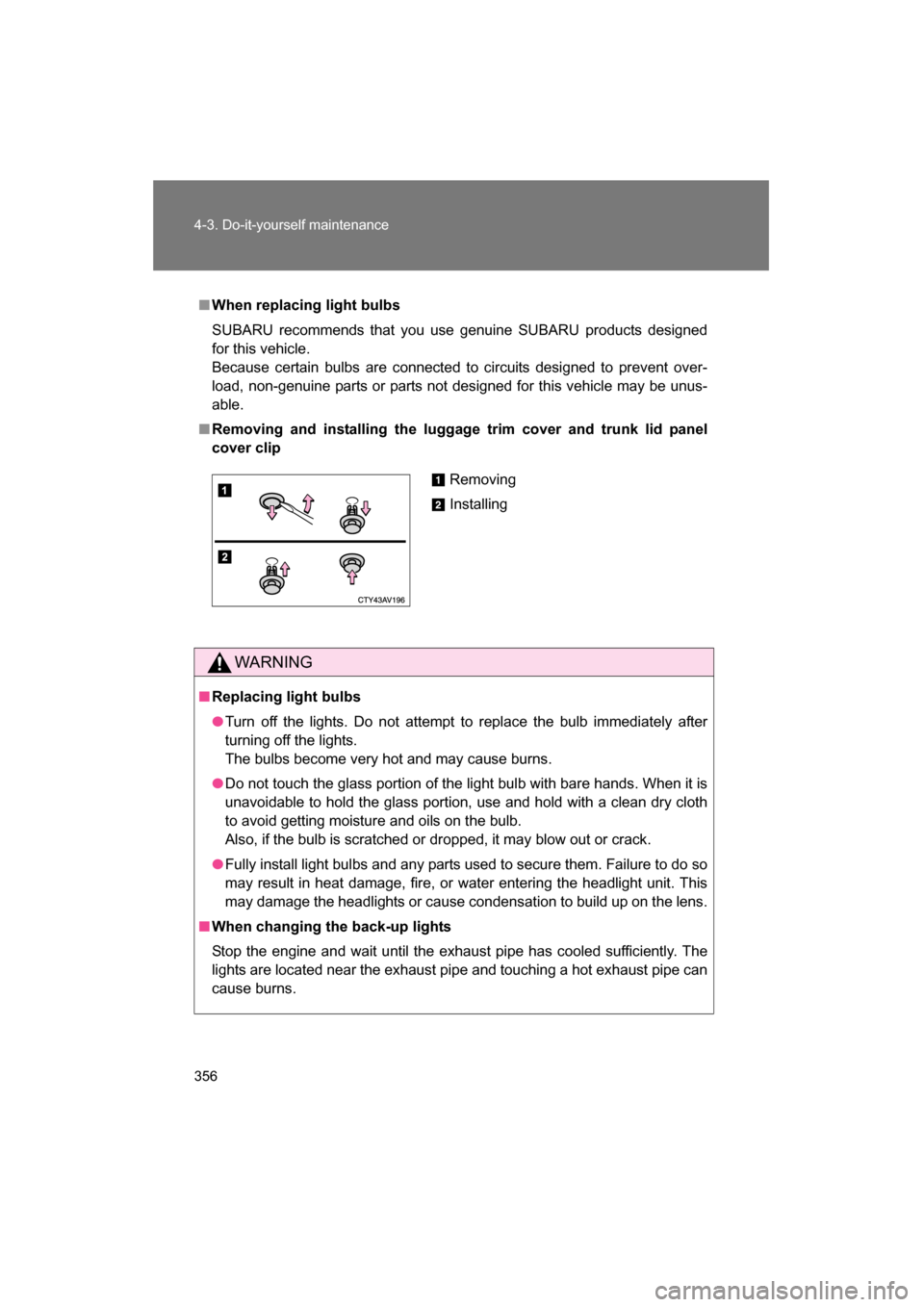
■Removing and installing the luggage trim cover and trunk lid panel cover clip
WARNING
■Replacing light bulbs
●Turn off the lights. Do not attempt to replace the bulb immediately after
turning off the lights.
The bulbs become very hot and may cause burns.
●Do not touch the glass portion of the light bulb with bare hands. When it is
unavoidable to hold the glass portion, use and hold with a clean dry cloth
to avoid getting moisture and oils on the bulb.
Also, if the bulb is scratched or dropped, it may blow out or crack.
●Fully install light bulbs and any parts used to secure them. Failure to do so
may result in heat damage, fire, or water entering the headlight unit. This
may damage the headlights or cause condensation to build up on the lens.
■When changing the back-up lights
Stop the engine and wait until the exhaust pipe has cooled sufficiently. The
lights are located near the exhaust pipe and touching a hot exhaust pipe can
cause burns.
Removing
Installing
Page 357 of 492
357
4-3. Do-it-yourself maintenance
4
Maintenance and care
WARNING
■Discharge headlights
●Contact your SUBARU dealer before replacing the discharge headlights
(including light bulbs).
●Do not touch the discharge headlight’s high voltage socket when the head-
lights are turned on.
An extremely high voltage of 25000 V will be discharged and could result
in serious injury or death by electric shock.
●Do not attempt to take apart or repair the low beam discharge headlight
bulbs, connectors, power supply circuits, or related components.
Doing so could result in electric shock and serious injury or death.
■To prevent damage or fire
Make sure bulbs are fully seated and locked.
Page 395 of 492
5
When trouble arises
395
5-2. Steps to take in an emergency
If the engine will not start
If the engine will not start even though correct starting procedures
are being followed ( →P. 162, 171), consider each of the following
points.
■The engine will not start even when the starter motor oper-
ates normally.
One of the following may be the cause of the problem. ● There may not be sufficient fuel in the vehicle’s tank.
Refuel the vehicle.
● The engine may be flooded.
Try to restart the engine once more following correct starting
procedures. ( →P. 162, 171)
● There may be a malfunction in the engine immobilizer system. (→ P. 78)
■The starter motor turns over slowly, the interior lights and
headlights are dim, or the horn does not sound or sounds at
a low volume.
One of the following may be the cause of the problem. ● The battery may be discharged. ( →P. 404)
● The battery terminal connections may be loose or corroded.
■The starter motor does not turn over. (vehicles with a key-
less access with push button start system)
The engine starting system may be malfunctioning due to an
electrical problem such as an open circuit or a blown fuse. How-
ever, an interim measure is available to start the engine. (→ P. 396)
Page 396 of 492
396
5-2. Steps to take in an emergency
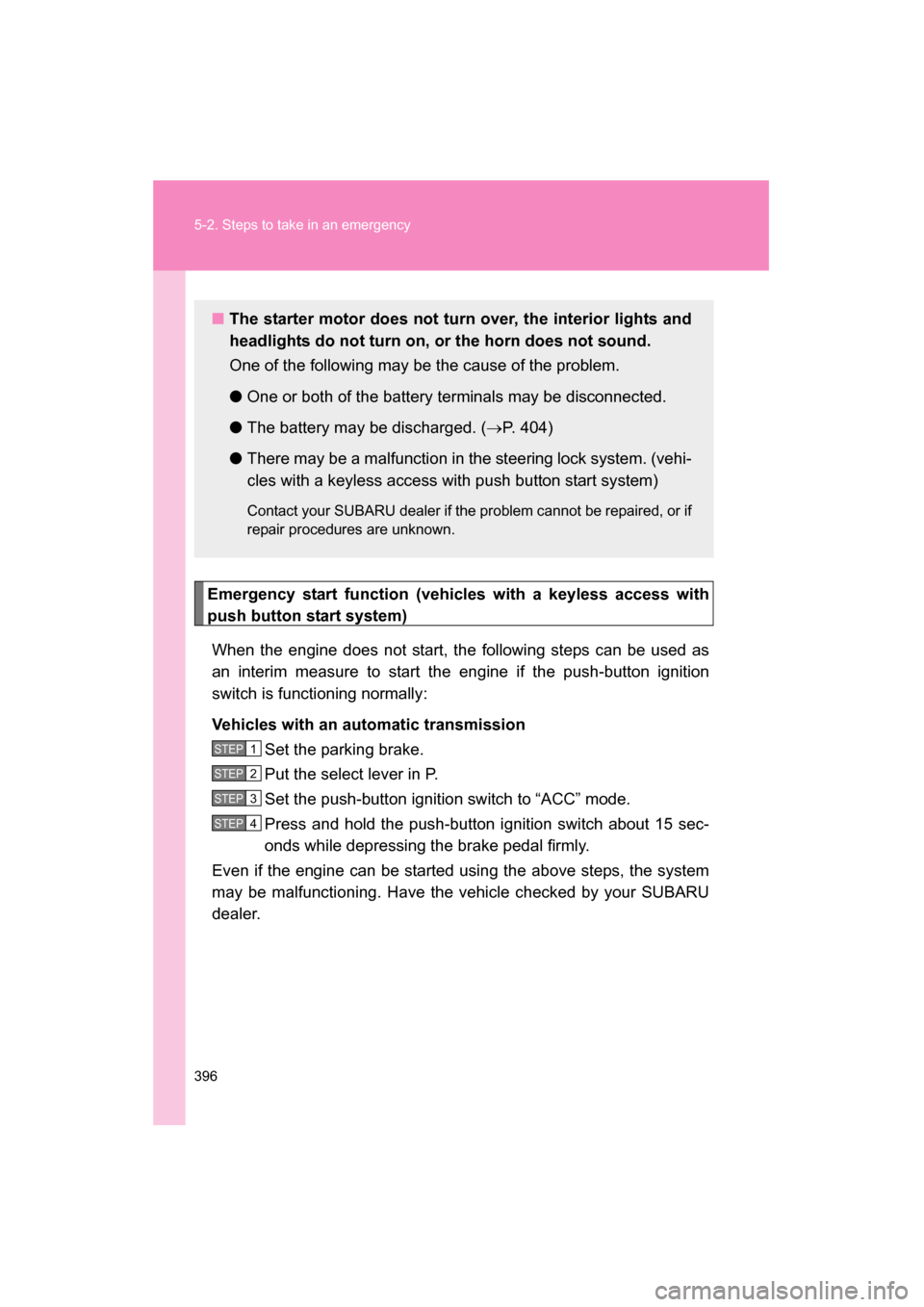
Emergency start function (vehicles with a keyless access with
push button start system)When the engine does not start, the following steps can be used as
an interim measure to start the engine if the push-button ignition
switch is functioning normally:
Vehicles with an automatic transmission Set the parking brake.
Put the select lever in P.
Set the push-button ignition switch to “ACC” mode.
Press and hold the push-button ignition switch about 15 sec-
onds while depressing the brake pedal firmly.
Even if the engine can be started using the above steps, the system
may be malfunctioning. Have the vehicle checked by your SUBARU
dealer.
■The starter motor does not turn over, the interior lights and
headlights do not turn on, or the horn does not sound.
One of the following may be the cause of the problem. ● One or both of the battery terminals may be disconnected.
● The battery may be discharged. ( →P. 404)
● There may be a malfunction in the steering lock system. (vehi-
cles with a keyless access with push button start system)
Contact your SUBARU dealer if the problem cannot be repaired, or if
repair procedures are unknown.
STEP 1
STEP 2
STEP 3
STEP 4
Page 406 of 492
406
5-2. Steps to take in an emergency
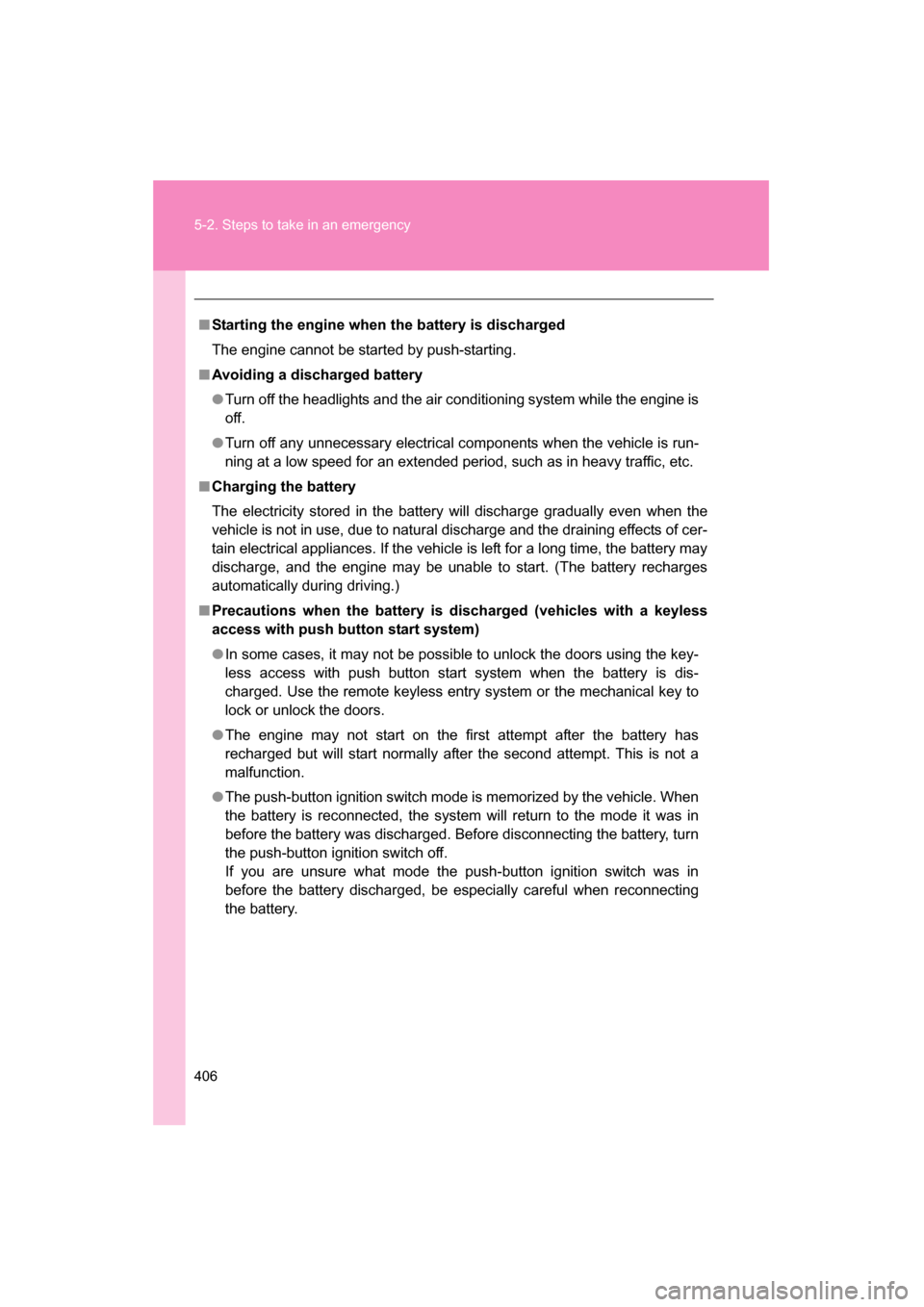
■Starting the engine when the battery is discharged
The engine cannot be started by push-starting.
■Avoiding a discharged battery
●Turn off the headlights and the air conditioning system while the engine is
off.
●Turn off any unnecessary electrical components when the vehicle is run-
ning at a low speed for an extended period, such as in heavy traffic, etc.
■Charging the battery
The electricity stored in the battery will discharge gradually even when the
vehicle is not in use, due to natural discharge and the draining effects of cer-
tain electrical appliances. If the vehicle is left for a long time, the battery may
discharge, and the engine may be unable to start. (The battery recharges
automatically during driving.)
■Precautions when the battery is discharged (vehicles with a keyless
access with push button start system)
●In some cases, it may not be possible to unlock the doors using the key-
less access with push button start system when the battery is dis-
charged. Use the remote keyless entry system or the mechanical key to
lock or unlock the doors.
●The engine may not start on the first attempt after the battery has
recharged but will start normally after the second attempt. This is not a
malfunction.
●The push-button ignition switch mode is memorized by the vehicle. When
the battery is reconnected, the system will return to the mode it was in
before the battery was discharged. Before disconnecting the battery, turn
the push-button ignition switch off.
If you are unsure what mode the push-button ignition switch was in
before the battery discharged, be especially careful when reconnecting
the battery.
Page 427 of 492
427
6-1. Specifications
6
Vehicle specifications
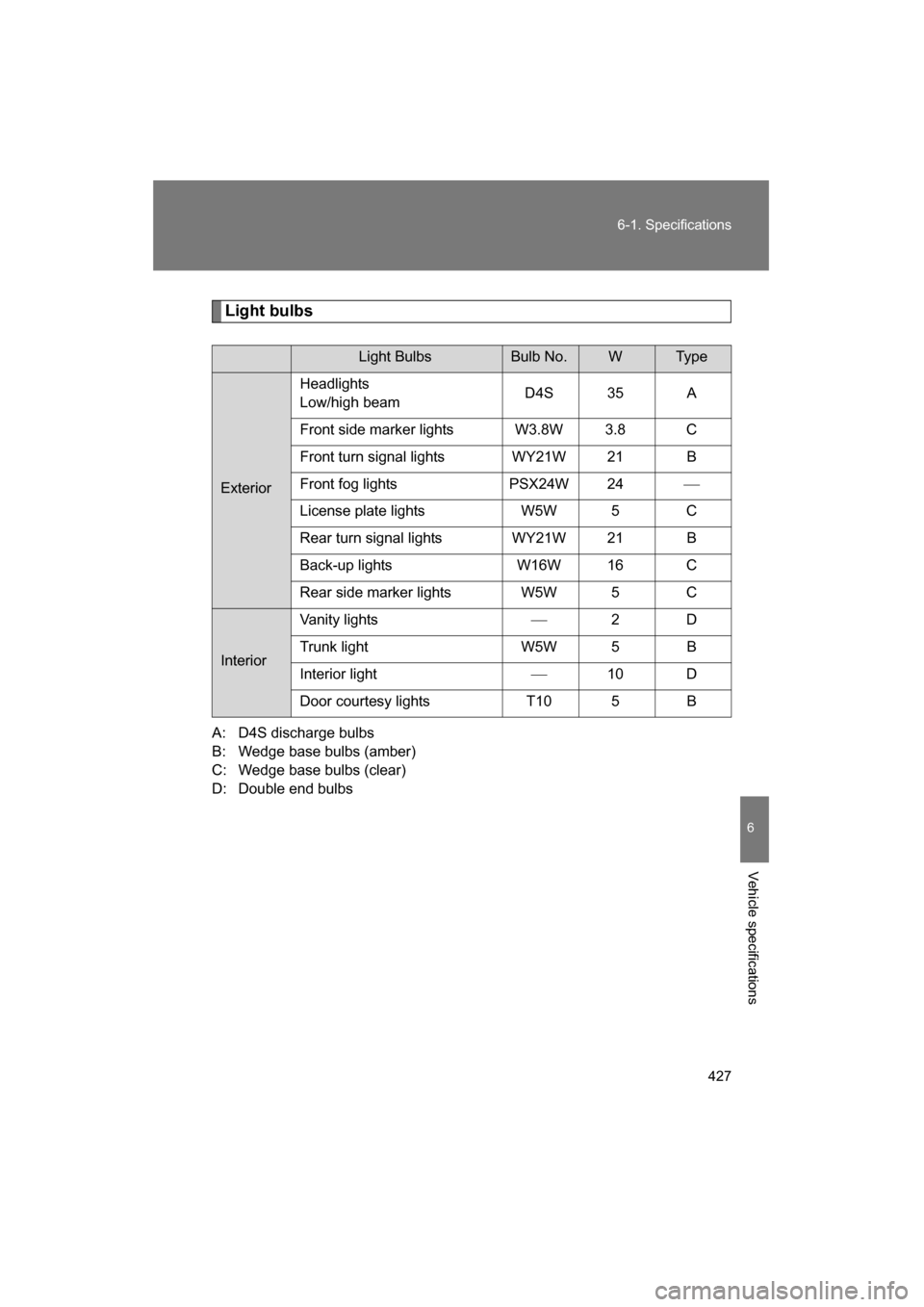
Light bulbs
A: D4S discharge bulbs
B: Wedge base bulbs (amber)
C: Wedge base bulbs (clear)
D: Double end bulbs
Light BulbsBulb No.WTyp e
Exterior Headlights Low/high beam
D4S 35 A
Front side marker lights W3.8W 3.8 C
Front turn signal lights WY21W 21 B
Front fog lights PSX24W 24
License plate lights W5W 5 C
Rear turn signal lights WY21W 21 B
Back-up lights W16W 16 C
Rear side marker lights W5W 5 C
Interior Vanity lights
2D
Trunk light W5W 5 B
Interior light 10 D
Door courtesy lights T10 5 B
Page 447 of 492
447
6-2. Customization
6
Vehicle specifications
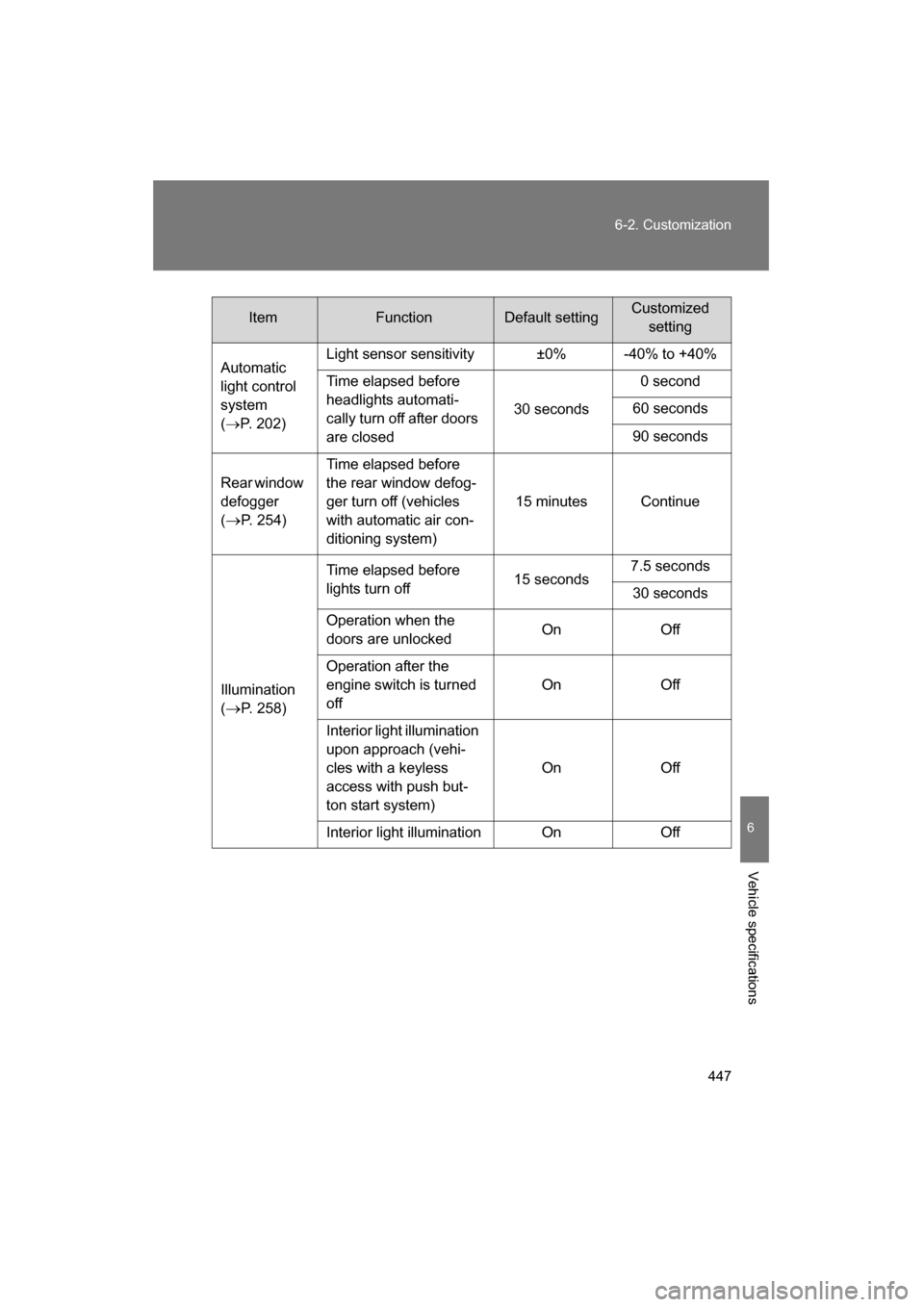
Automatic
light control
system (→ P. 202) Light sensor sensitivity ±0% -40% to +40%
Time elapsed before
headlights automati-
cally turn off after doors
are closed
30 seconds0 second
60 seconds
90 seconds
Rear window defogger ( → P. 254) Time elapsed before
the rear window defog-
ger turn off (vehicles
with automatic air con-
ditioning system)
15 minutes Continue
Illumination( → P. 258) Time elapsed before
lights turn off
15 seconds7.5 seconds
30 seconds
Operation when the
doors are unlocked On Off
Operation after the
engine switch is turned
off On Off
Interior light illumination
upon approach (vehi-
cles with a keyless
access with push but-
ton start system) On Off
Interior light illumination On Off
ItemFunctionDefault settingCustomized setting
Page 482 of 492
482
Alphabetical index
Hazard lightsSwitch.................................... 360
Hazard warning flashers Switch.................................... 360
Head restraints Adjusting ................................56
Headlights Discharge headlight
precautions ......................... 357
Replacing light bulbs ............. 343
Switch.................................... 202
Wattage.................................427
Heaters Seat heaters.......................... 271
Side mirror............................. 254
Horn...........................................186 I/M test ...................................... 292
Identification
Engine................................... 417
Vehicle .................................. 417
Ignition switch.................. 162, 171
Ignition switch light Ignition switch light ................ 258
Illuminated entry system......... 258
Immobilizer system ................... 78
Indicator lights ......................... 192
Inside rear view mirror .............. 66
Interior light Interior light ........................... 259
Switch ................................... 259
Wattage................................. 427
Jack Vehicle-equipped
jack ..................................... 384
Jack handle .............................. 384HI
J
Page 483 of 492
483
Alphabetical index
Keyless access with push button start systemAntenna location..................... 25
“Keyless access” entry function ................................ 23
Starting the engine ............... 162
Keyless entry............................. 37
Keys Access key ............................. 20
Engine switch ............... 162, 171
If you lose your keys............. 399
If your access key battery is discharged .......... 400
Key number ............................ 20
Keyless entry.......................... 37
Keys ....................................... 20
Mechanical key....................... 21
Transmitter ............................. 37
License plate lights Replacing light bulbs ............ 343
Wattage ................................ 427
Light bulbs Replacing ............................. 343
Wattage ................................ 427
Lights
Door courtesy lights.............. 258
Engine switch light................ 258
Fog light switch..................... 208
Hazard light switch ............... 360
Hazard warning flasher switch ................................. 360
Headlights switch ................. 202
Interior light switch................ 259
Replacing light bulbs ............ 343
Turn signal lever ................... 184
Vanity lights .......................... 266
Wattage ................................ 427
Load capacity .......................... 228 Maintenance
Do-it-yourself
maintenance .......................293
General maintenance ............289
Maintenance data..................416
Maintenance requirements.... 286
Manual air conditioning system ....................................238
Manual transmission ...............181
Meter Instrument panel light control .........................191
Meters ...................................187
Mirrors Inside rear view mirror.............66
Side mirror heater .................254
Side mirrors .............................67
Vanity mirrors ........................266
Multi-information display ........197
Noise from under vehicle ..........15K
L
M
N