belt SUBARU BRZ 2015 1.G Repair Manual
[x] Cancel search | Manufacturer: SUBARU, Model Year: 2015, Model line: BRZ, Model: SUBARU BRZ 2015 1.GPages: 492, PDF Size: 6.53 MB
Page 295 of 492
295
4-3. Do-it-yourself maintenance
4
Maintenance and care
WARNING
The engine compartment contains many mechanisms and fluids that may
move suddenly, become hot, or become electrically energized. To avoid death
or serious injury, observe the following precautions.
■When working in the engine compartment
●Keep hands, clothing, and tools away from the moving fan and engine
drive belt.
●Be careful not to touch the engine, radiator, exhaust manifold, etc. right
after driving as they may be hot. Oil and other fluids may also be hot.
●Do not leave anything that may burn easily, such as paper or rags, in the
engine compartment.
●Do not smoke, cause sparks or expose an open flame to fuel or the bat-
tery. Fuel and battery fumes are flammable.
●Be extremely cautious when working on the battery. It contains poisonous
and corrosive sulfuric acid.
■When working near the electric cooling fans or radiator grille
Vehicles without a keyless access with push button start system: Be sure the
engine switch is off. With the engine switch in the “ON” position, the electric
cooling fans may automatically start to run if the air conditioning is on and/or
the coolant temperature is high. ( →P. 304)
Vehicles with a keyless access with push button start system: Be sure the
push-button ignition switch is off. With the push-button ignition switch in
“ON” mode, the electric cooling fans may automatically start to run if the air
conditioning is on and/or the coolant temperature is high. ( →P. 304)
■Safety glasses
Wear safety glasses to prevent flying or falling material, fluid spray, etc. from
getting in the eyes.
CAUTION
■If you remove the air cleaner filter
Driving with the air cleaner filter removed may cause excessive engine wear
due to dirt in the air. Also a backfire could cause a fire in the engine compart-ment.
Page 373 of 492
5
When trouble arises
373
5-2. Steps to take in an emergency
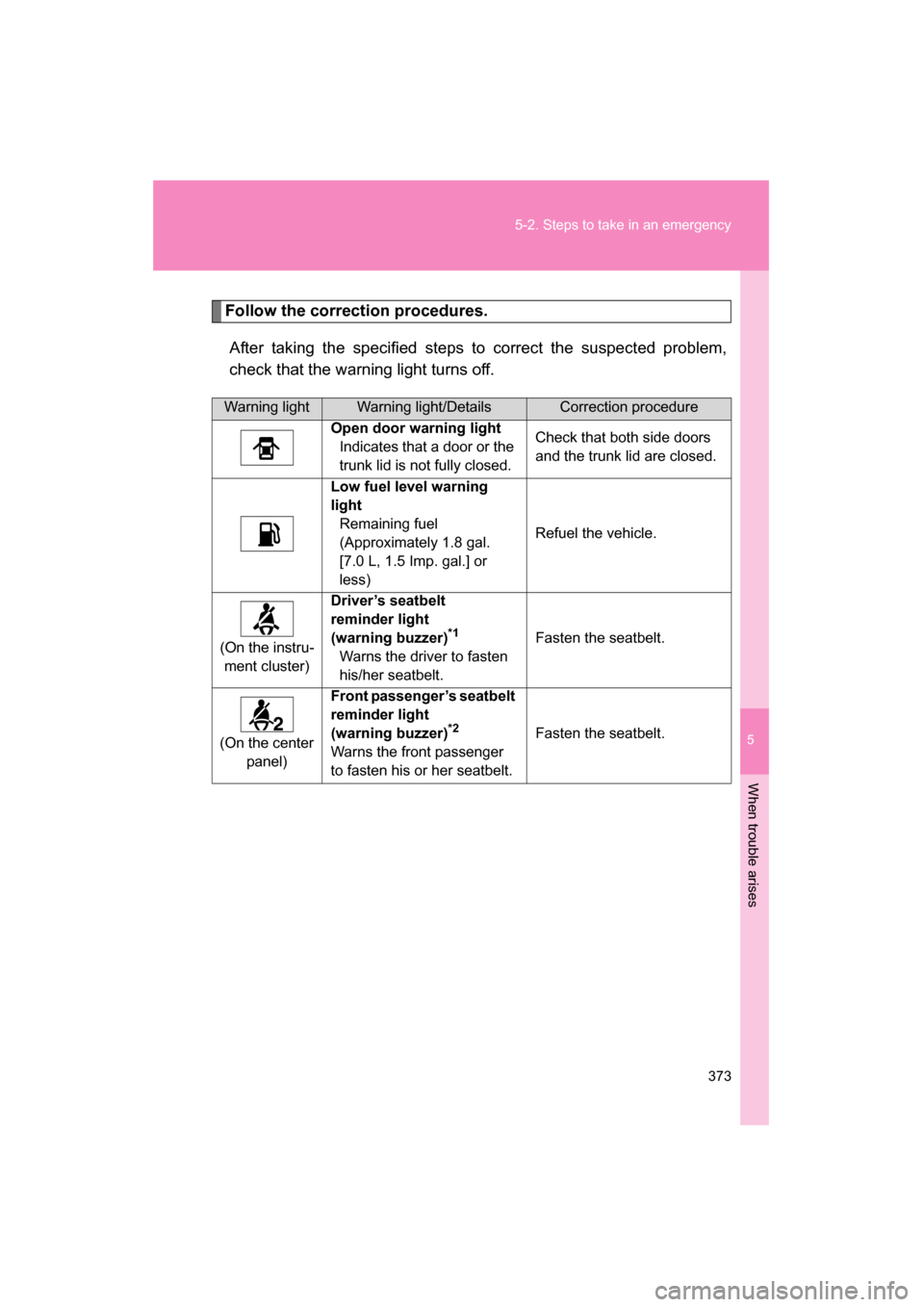
Follow the correction procedures.After taking the specified steps to correct the suspected problem,
check that the warning light turns off.
Warning lightWarning light/DetailsCorrection procedure
Open door warning light Indicates that a door or the
trunk lid is not fully closed. Check that both side doors
and the trunk lid are closed.
Low fuel level warning light Remaining fuel
(Approximately 1.8 gal.
[7.0 L, 1.5 Imp. gal.] or
less) Refuel the vehicle.
(On the instru- ment cluster) Driver’s seatbelt
reminder light
(warning buzzer)
*1
Warns the driver to fasten
his/her seatbelt. Fasten the seatbelt.
(On the center panel) Front passenger’s seatbelt
reminder light
(warning buzzer)
*2
Warns the front passenger
to fasten his or her seatbelt. Fasten the seatbelt.
Page 374 of 492
374
5-2. Steps to take in an emergency
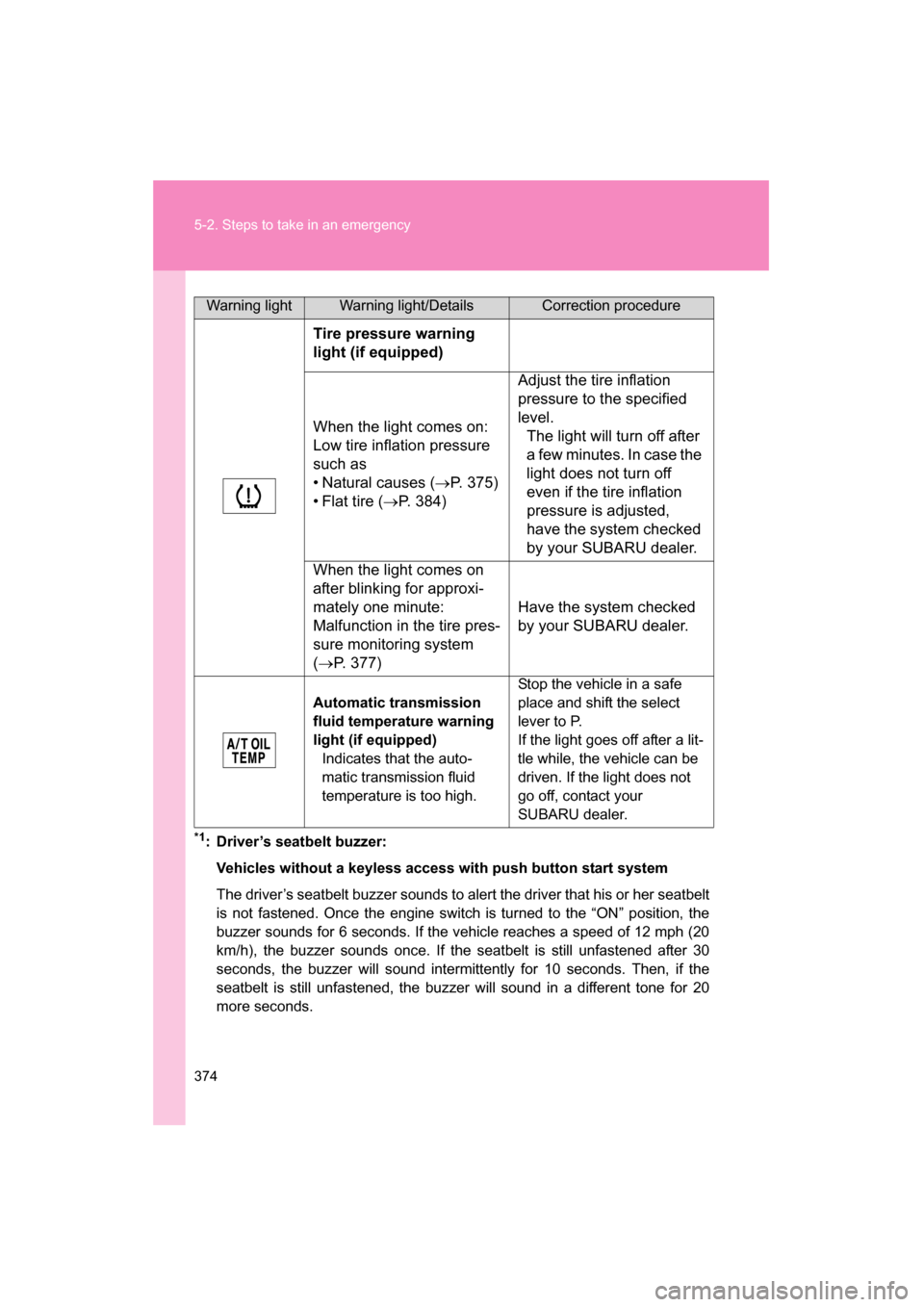
*1: Driver’s seatbelt buzzer:
Vehicles without a keyless access with push button start system
The driver’s seatbelt buzzer sounds to alert the driver that his or her seatbelt
is not fastened. Once the engine switch is turned to the “ON” position, the
buzzer sounds for 6 seconds. If the vehicle reaches a speed of 12 mph (20
km/h), the buzzer sounds once. If the seatbelt is still unfastened after 30
seconds, the buzzer will sound intermittently for 10 seconds. Then, if the
seatbelt is still unfastened, the buzzer will sound in a different tone for 20
more seconds. Tire pressure warning
light (if equipped)
When the light comes on:
Low tire inflation pressure
such as
Page 375 of 492
5
When trouble arises
375
5-2. Steps to take in an emergency
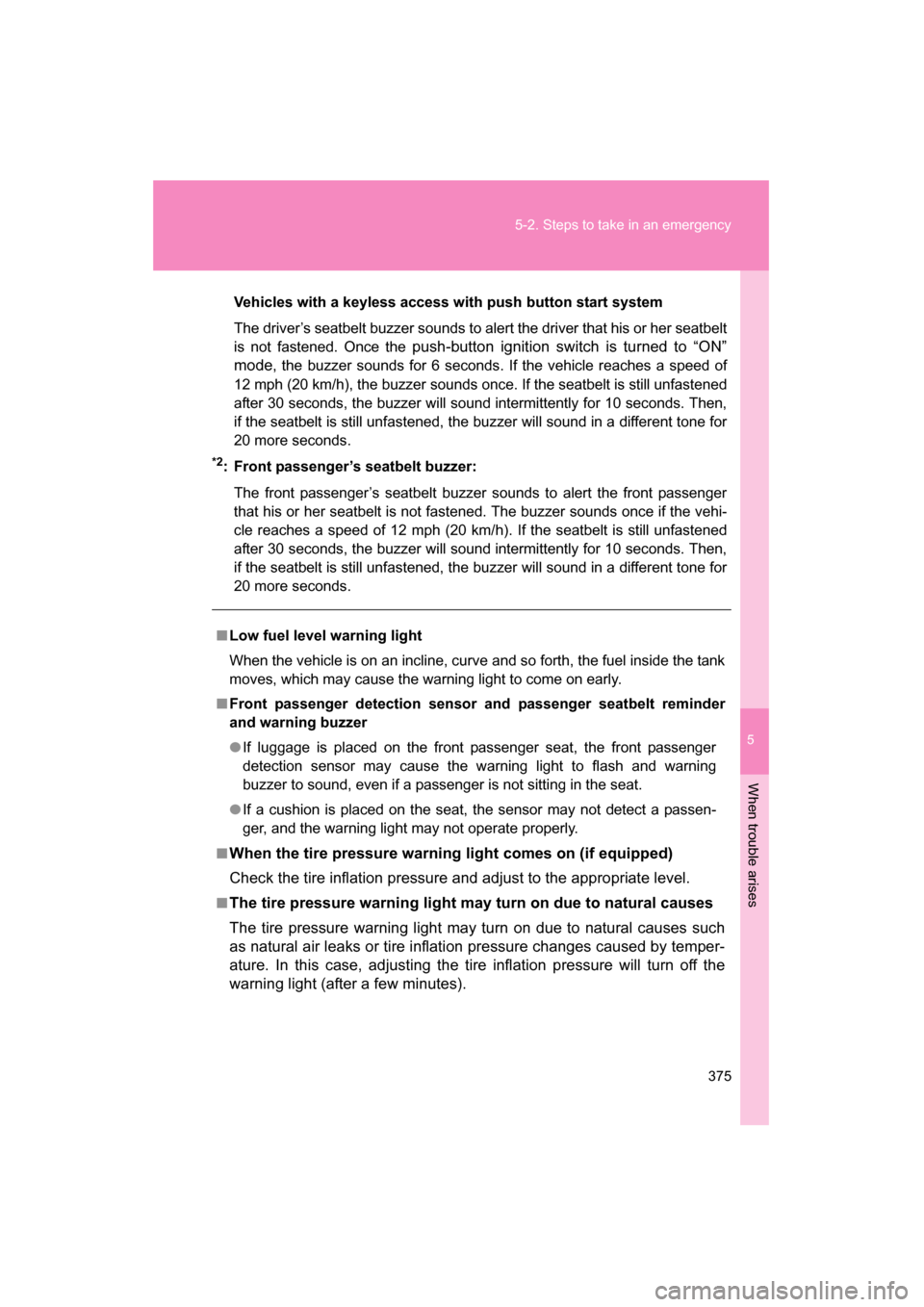
Vehicles with a keyless access with push button start system
The driver’s seatbelt buzzer sounds to alert the driver that his or her seatbelt
is not fastened. Once the push-button ignition switch is turned to “ON”
mode , the buzzer sounds for 6 seconds. If the vehicle reaches a speed of
12 mph (20 km/h), the buzzer sounds once. If the seatbelt is still unfastened
after 30 seconds, the buzzer will sound intermittently for 10 seconds. Then,
if the seatbelt is still unfastened, the buzzer will sound in a different tone for
20 more seconds.
*2 : Front passenger’s seatbelt buzzer:
The front passenger’s seatbelt buzzer sounds to alert the front passenger
that his or her seatbelt is not fastened. The buzzer sounds once if the vehi-
cle reaches a speed of 12 mph (20 km/h). If the seatbelt is still unfastened
after 30 seconds, the buzzer will sound intermittently for 10 seconds. Then,
if the seatbelt is still unfastened, the buzzer will sound in a different tone for
20 more seconds.
■Low fuel level warning light
When the vehicle is on an incline, curve and so forth, the fuel inside the tank
moves, which may cause the warning light to come on early.
■Front passenger detection sensor and passenger seatbelt reminder
and warning buzzer
●If luggage is placed on the front passenger seat, the front passenger
detection sensor may cause the warning light to flash and warning
buzzer to sound, even if a passenger is not sitting in the seat.
●If a cushion is placed on the seat, the sensor may not detect a passen-
ger, and the warning light may not operate properly.
■When the tire pressure warning light comes on (if equipped)
Check the tire inflation pressure and adjust to the appropriate level.
■The tire pressure warning light may turn on due to natural causes
The tire pressure warning light may turn on due to natural causes such
as natural air leaks or tire inflation pressure changes caused by temper-
ature. In this case, adjusting the tire inflation pressure will turn off the
warning light (after a few minutes).
Page 408 of 492
408
5-2. Steps to take in an emergency
CAUTION
■When handling jumper cables
Be careful that the jumper cables do not become tangled in the cooling fans
or any of the belts when connecting or disconnecting them.
■When closing the doors
While pushing the door glass towards the inside of the vehicle, slowly close
the door.
Because the side window open/close function linked to door operation will
not operate, the window may interfere with the vehicle body, possibly
scratching both the vehicle body and window, or even shattering the window.
Page 410 of 492
410
5-2. Steps to take in an emergency
■Overheating
If you observe the following, your vehicle may be overheating.
●The engine coolant temperature gauge enters the red zone or a loss of
power is experienced.
●Steam is coming from under the engine hood.
WARNING
■To prevent an accident or injury when inspecting under the engine
hood of your vehicle
●If steam is seen coming from under the engine hood, do not open the
engine hood until the steam has subsided. The engine compartment may
be very hot, causing serious injury such as burns.
●Keep hands and clothing away from the fan and other belts while the
engine is running.
●Do not loosen the radiator cap while the engine and radiator are hot.
Serious injury, such as burns, may result from hot coolant and steam
released under pressure.
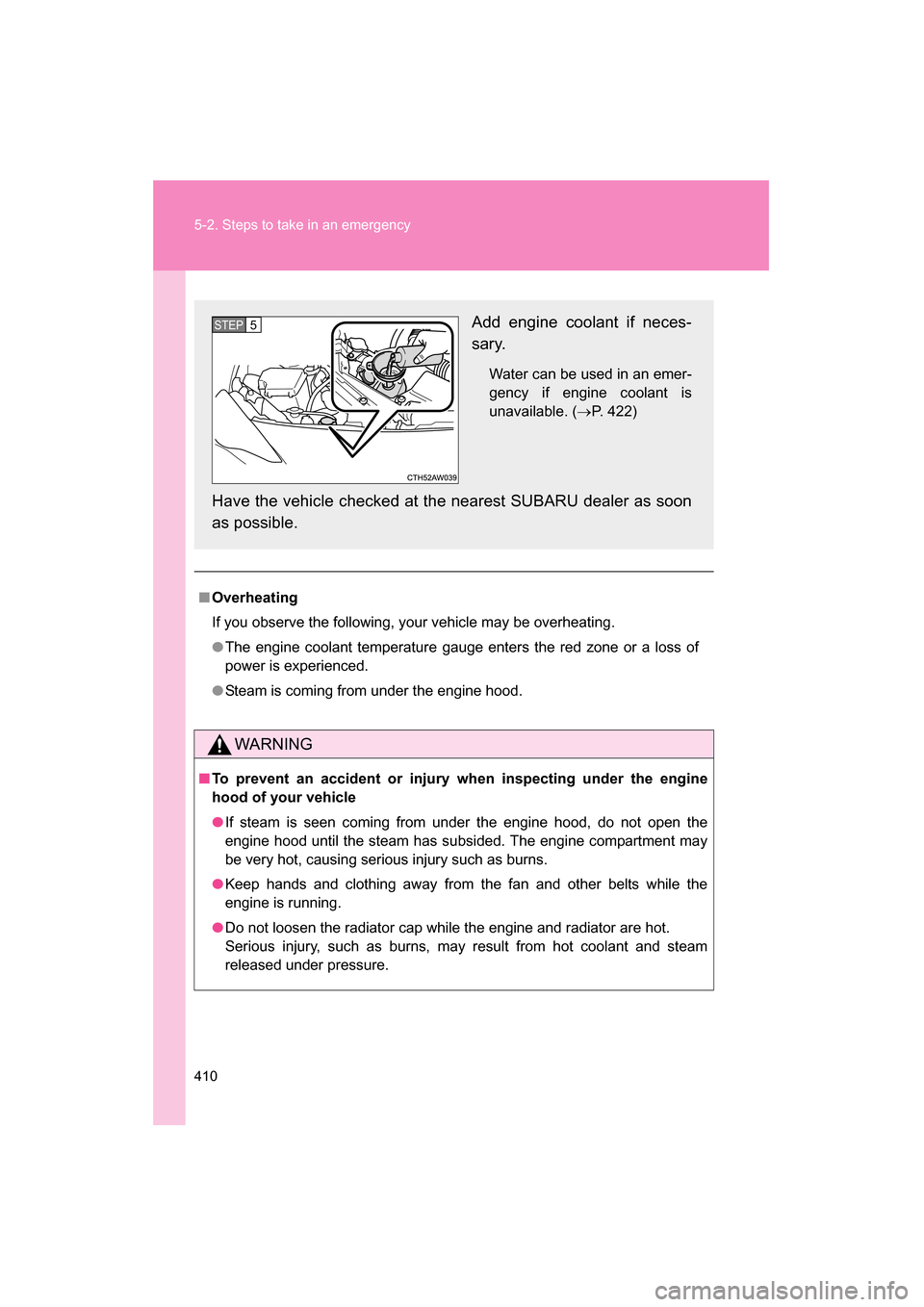
Add engine coolant if neces-
sary.
Water can be used in an emer-
gency if engine coolant is
unavailable. ( →P. 422)
Have the vehicle checked at the nearest SUBARU dealer as soon
as possible.STEP 5
Page 419 of 492
419
6-1. Specifications
6
Vehicle specifications
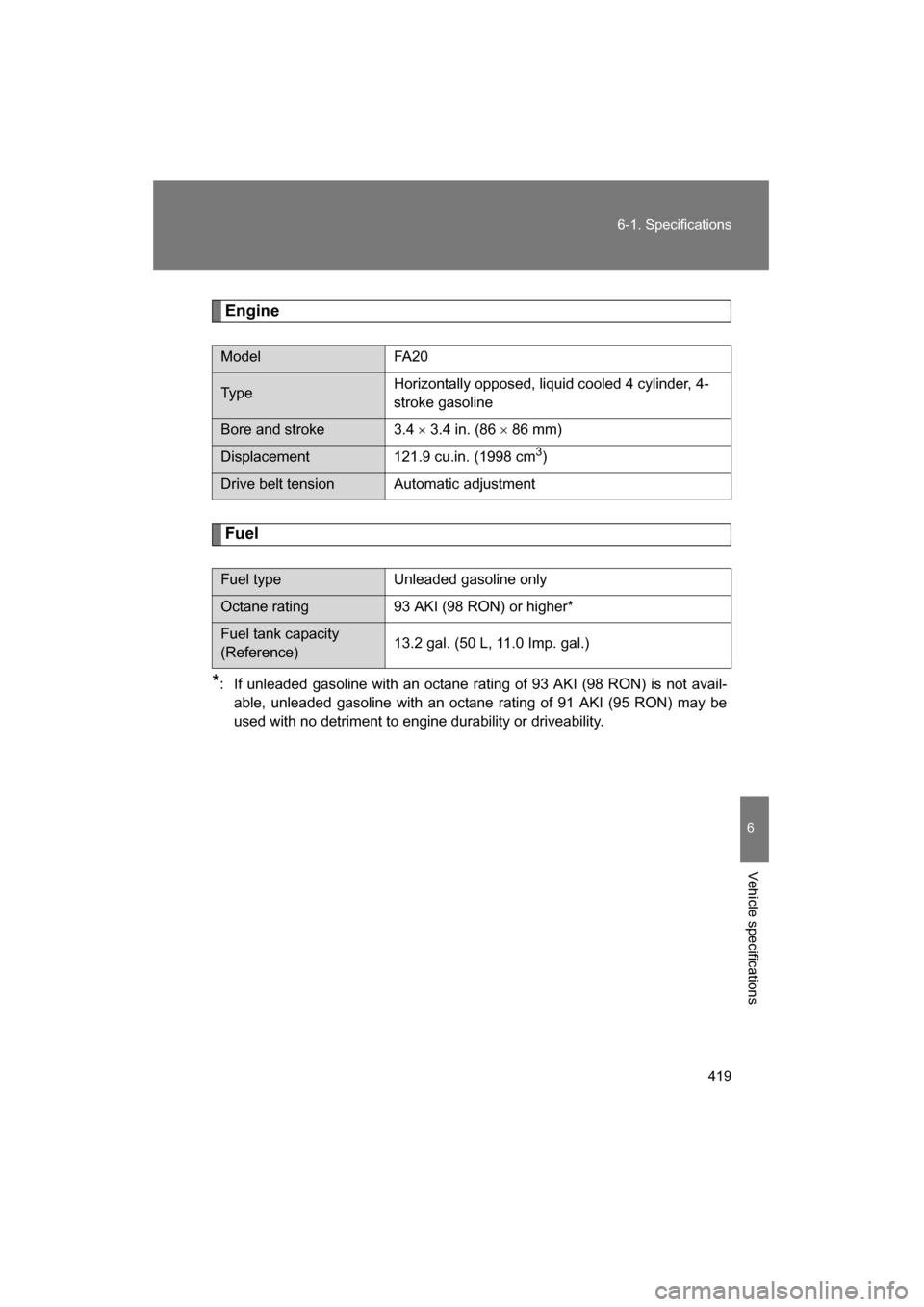
Engine
Fuel
* : If unleaded gasoline with an octane rating of 93 AKI (98 RON) is not avail-
able, unleaded gasoline with an octane rating of 91 AKI (95 RON) may be
used with no detriment to engine durability or driveability.
Model FA20
Ty p e Horizontally opposed, liquid cooled 4 cylinder, 4-
stroke gasoline
Bore and stroke 3.4
× 3.4 in. (86 × 86 mm)
Displacement 121.9 cu.in. (1998 cm 3
)
Drive belt tension Automatic adjustment
Fuel type Unleaded gasoline only
Octane rating 93 AKI (98 RON) or higher*
Fuel tank capacity
(Reference) 13.2 gal. (50 L, 11.0 Imp. gal.)
Page 436 of 492
436
6-1. Specifications
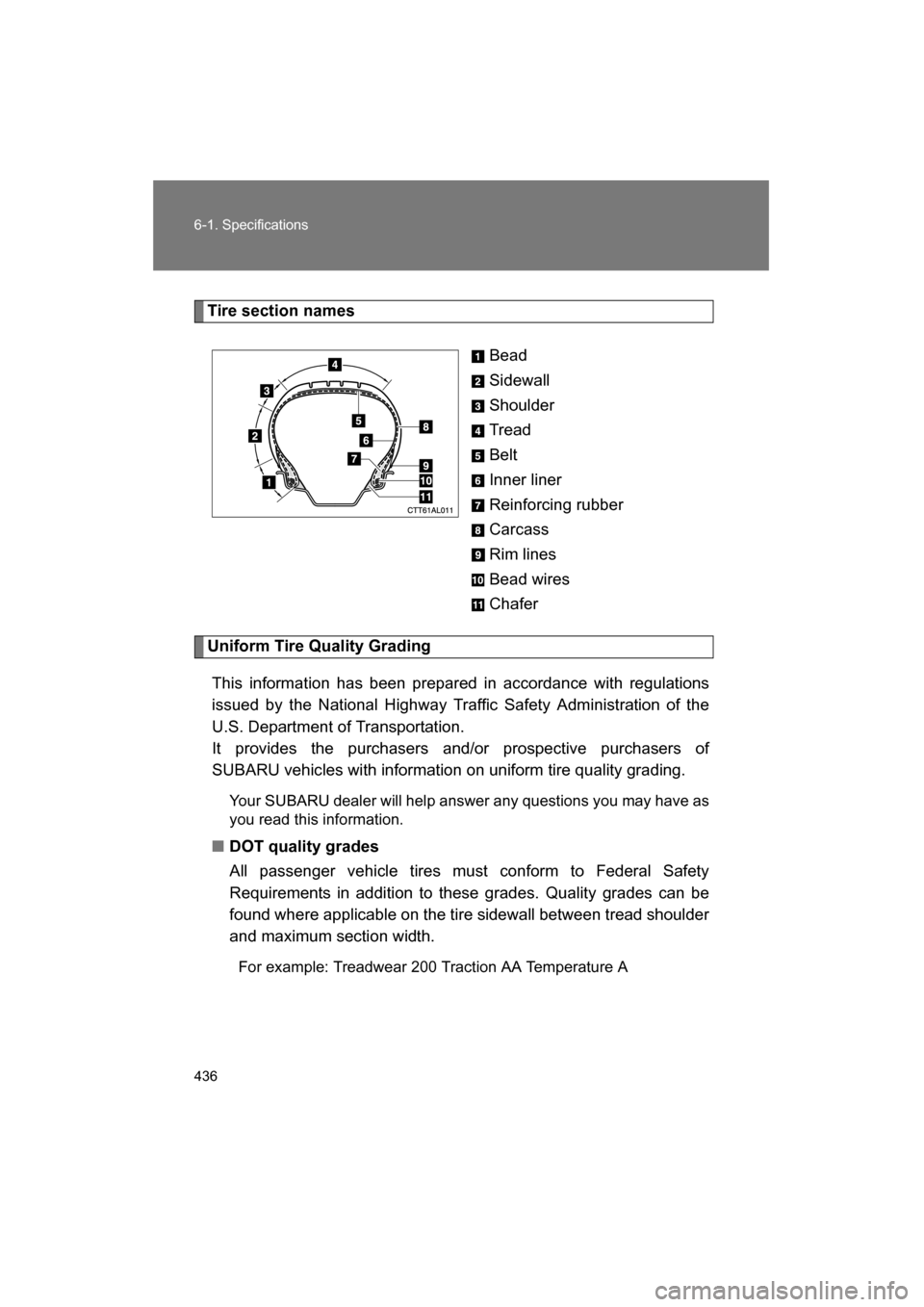
Tire section namesBead
Sidewall
Shoulder
Tread
Belt
Inner liner
Reinforcing rubber
Carcass
Rim lines
Bead wires
Chafer
Uniform Tire Quality GradingThis information has been prepared in accordance with regulations
issued by the National Highway Traffic Safety Administration of the
U.S. Department of Transportation.
It provides the purchasers and/or prospective purchasers of
SUBARU vehicles with information on uniform tire quality grading. Your SUBARU dealer will help answer any questions you may have as
you read this information.
■DOT quality grades
All passenger vehicle tires must conform to Federal Safety
Requirements in addition to these grades. Quality grades can be
found where applicable on the tire sidewall between tread shoulder
and maximum section width.
For example: Treadwear 200 Traction AA Temperature A
Page 449 of 492
For owners7
449
Reporting safety defects for U.S. owners .............. 450
Seatbelt instructions for Canadian owners
(in French) ..................... 451
SRS airbag instructions for Canadian owners
(in French) ..................... 454
Page 451 of 492
451
7
For owners
Seatbelt instructions for Canadian owners (in French)
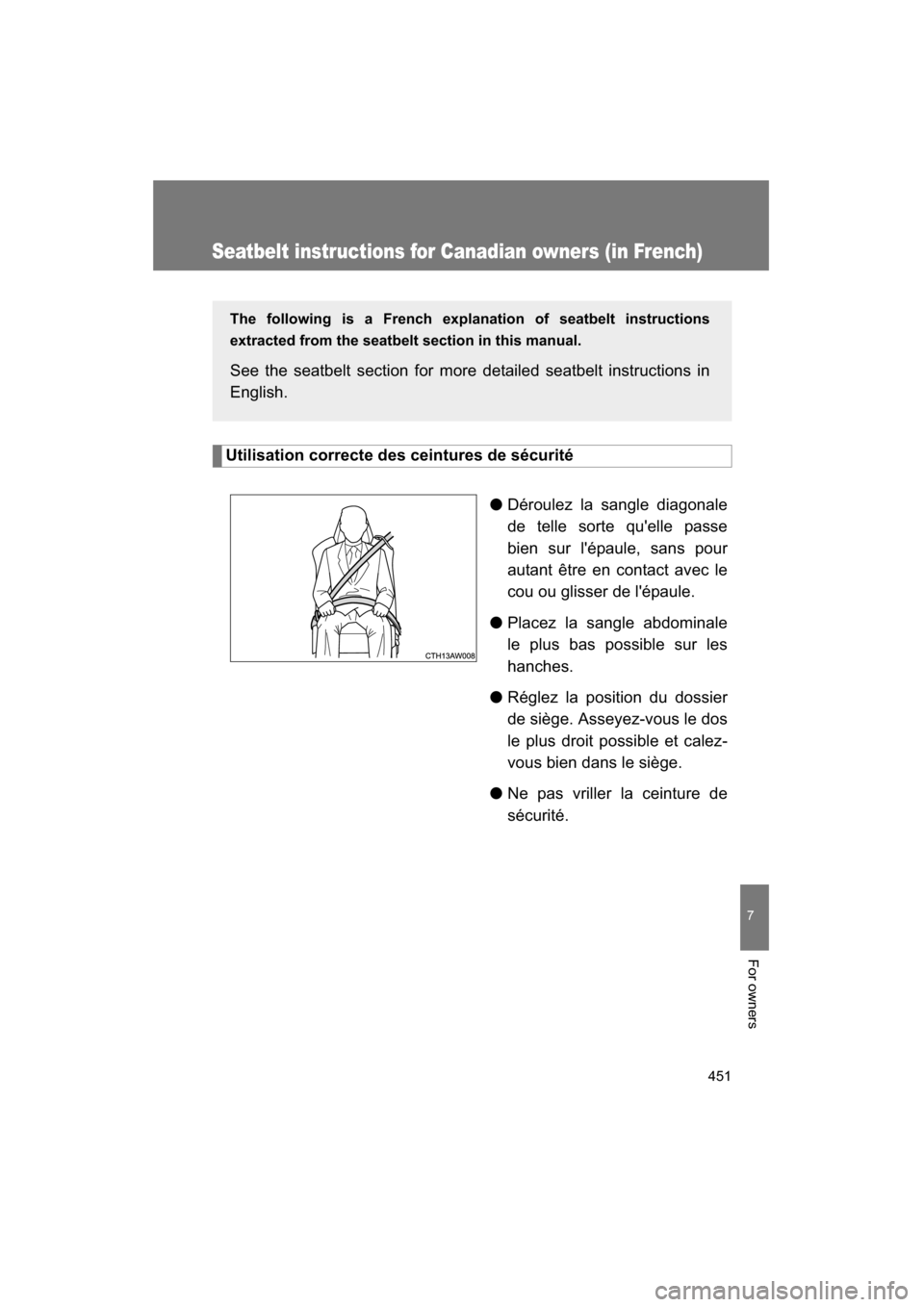
Utilisation correcte des ceintures de sécurité●Déroulez la sangle diagonale
de telle sorte qu'elle passe
bien sur l'épaule, sans pour
autant être en contact avec le
cou ou glisser de l'épaule.
● Placez la sangle abdominale
le plus bas possible sur les
hanches.
● Réglez la position du dossier
de siège. Asseyez-vous le dos
le plus droit possible et calez-
vous bien dans le siège.
● Ne pas vriller la ceinture de
sécurité.
The following is a French explanation of seatbelt instructions
extracted from the seatbelt section in this manual.
See the seatbelt section for more detailed seatbelt instructions in
English.