light SUBARU BRZ 2017 1.G Owners Manual
[x] Cancel search | Manufacturer: SUBARU, Model Year: 2017, Model line: BRZ, Model: SUBARU BRZ 2017 1.GPages: 540, PDF Size: 6.88 MB
Page 452 of 540
450 5-2. Steps to take in an emergency
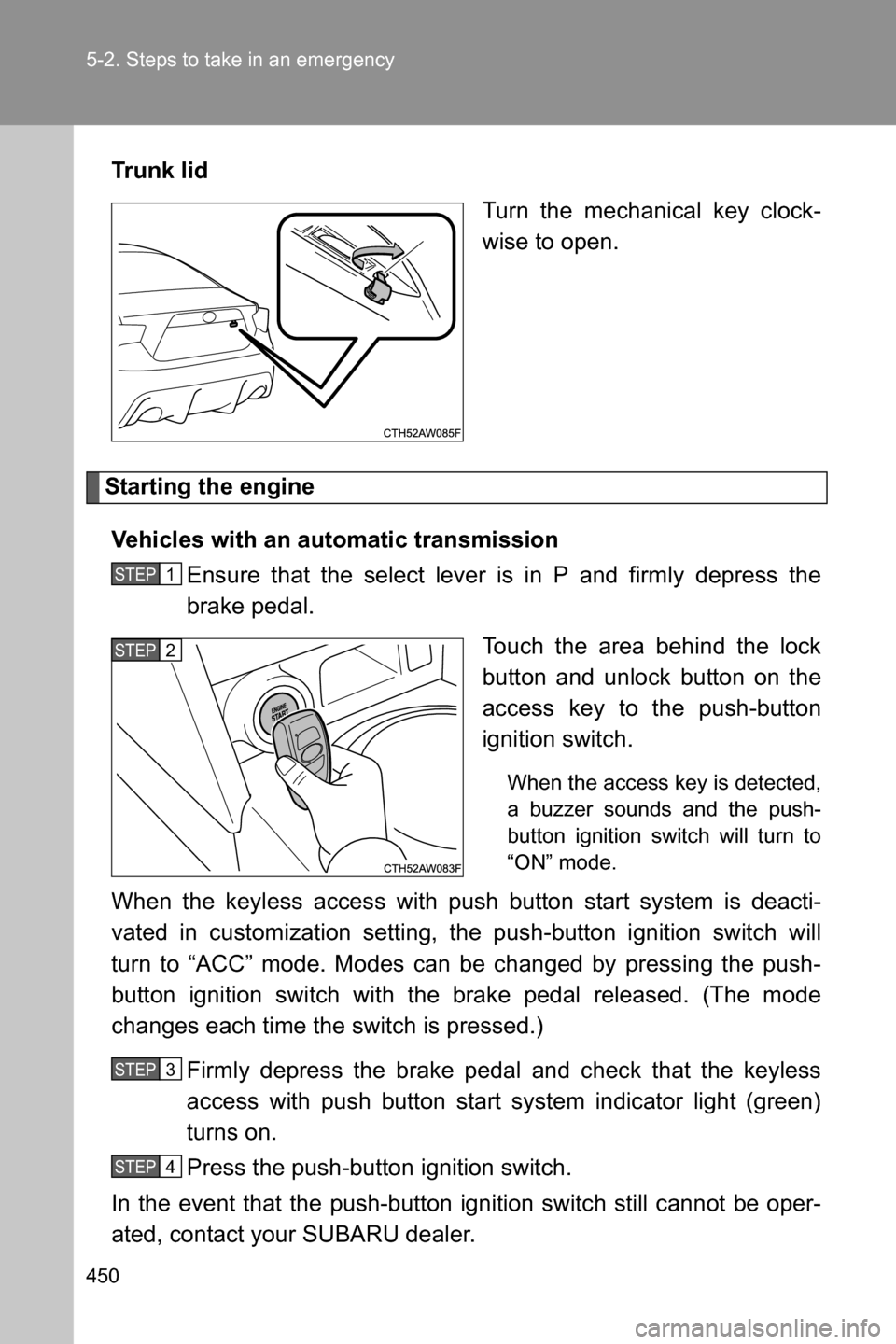
Trunk lid
Turn the mechanical key clock-
wise to open.
Starting the engine
Vehicles with an automatic transmission
Ensure that the select lever is in P and firmly depress the
brake pedal.
Touch the area behind the lock
button and unlock button on the
access key to the push-button
ignition switch.
When the access key is detected,
a buzzer sounds and the push-
button ignition switch will turn to
“ON” mode.
When the keyless access with push button start system is deacti-
vated in customization setting, the push-button ignition switch will
turn to “ACC” mode. Modes can be changed by pressing the push-
button ignition switch with the brake pedal released. (The mode
changes each time the switch is pressed.)
Firmly depress the brake pedal and check that the keyless
access with push button start system indicator light (green)
turns on.
Press the push-button ignition switch.
In the event that the push-button ignition switch still cannot be oper-
ated, contact your SUBARU dealer.
STEP 1
STEP 2
STEP 3
STEP 4
Page 453 of 540
5
When trouble arises
451 5-2. Steps to take in an emergency
Vehicles with a manual transmission
Ensure that the shift lever is in neutral and depress the clutch
pedal.
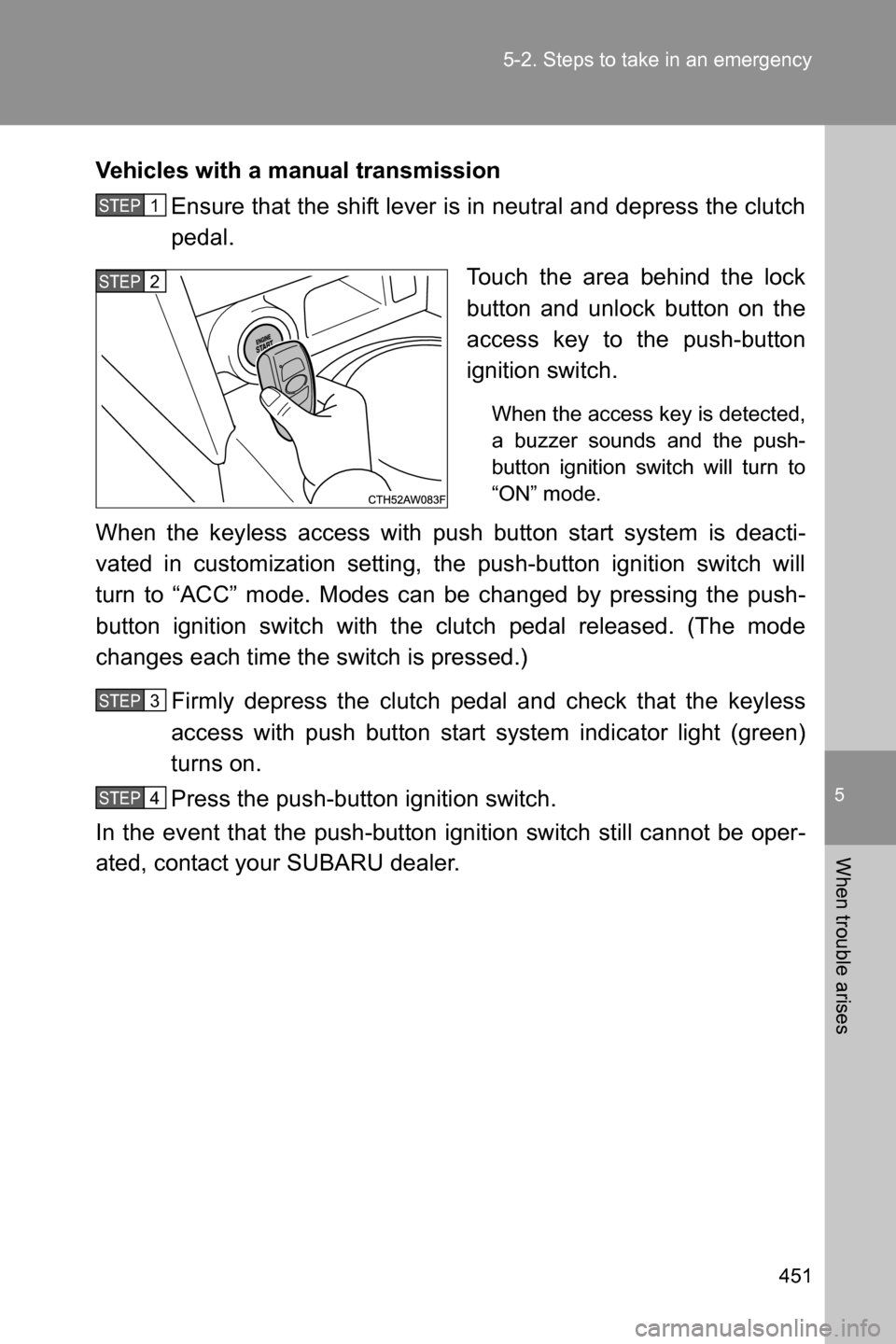
Touch the area behind the lock
button and unlock button on the
access key to the push-button
ignition switch.
When the access key is detected,
a buzzer sounds and the push-
button ignition switch will turn to
“ON” mode.
When the keyless access with push button start system is deacti-
vated in customization setting, the push-button ignition switch will
turn to “ACC” mode. Modes can be changed by pressing the push-
button ignition switch with the clutch pedal released. (The mode
changes each time the switch is pressed.)
Firmly depress the clutch pedal and check that the keyless
access with push button start system indicator light (green)
turns on.
Press the push-button ignition switch.
In the event that the push-button ignition switch still cannot be oper-
ated, contact your SUBARU dealer.
STEP 1
STEP 2
STEP 3
STEP 4
Page 456 of 540
454 5-2. Steps to take in an emergency
Start the engine of the second vehicle. Increase the engine
speed slightly and maintain at that level for approximately 5
minutes to recharge the battery of your vehicle.
Vehicles with a keyless access with push button start sys-
tem only: Open and close any of the doors of your vehicle
with the push-button ignition switch off.
Vehicles without a keyless access with push button start
system: Maintain the engine speed of the second vehicle
and turn the engine switch to the “ON” position, then start
the vehicle's engine.
Vehicles with a keyless access with push button start sys-
tem: Maintain the engine speed of the second vehicle and
turn the push-button ignition switch to “ON” mode, then
start the vehicle's engine.
Once the vehicle’s engine has started, remove the jumper
cables in the exact reverse order in which they were con-
nected.
Once the engine starts, have the vehicle checked at your SUBARU
dealer as soon as possible.STEP 2
STEP 3
STEP 4
STEP 5
Page 457 of 540
5
When trouble arises
455 5-2. Steps to take in an emergency
■Starting the engine when the battery is discharged
The engine cannot be started by push-starting.
■Avoiding a discharged battery
●Turn off the headlights and the air conditioning system while the engine is
off.
●Turn off any unnecessary electrical components when the vehicle is run-
ning at a low speed for an extended period, such as in heavy traffic, etc.
■Charging the battery
The electricity stored in the battery will discharge gradually even when the
vehicle is not in use, due to natural discharge and the draining effects of cer-
tain electrical appliances. If the vehicle is left for a long time, the battery may
discharge, and the engine may be unable to start. (The battery recharges
automatically during driving.)
■Precautions when the battery is discharged (vehicles with a keyless
access with push button start system)
●In some cases, it may not be possible to unlock the doors using the key-
less access with push button start system when the battery is dis-
charged. Use the remote keyless entry system or the mechanical key to
lock or unlock the doors.
●The engine may not start on the first attempt after the battery has
recharged but will start normally after the second attempt. This is not a
malfunction.
●The push-button ignition switch mode is memorized by the vehicle. When
the battery is reconnected, the system will return to the mode it was in
before the battery was discharged. Before disconnecting the battery, turn
the push-button ignition switch off.
If you are unsure what mode the push-button ignition switch was in
before the battery discharged, be especially careful when reconnecting
the battery.
Page 458 of 540
456 5-2. Steps to take in an emergency
WARNING
■Avoiding battery fires or explosions
Observe the following precautions to prevent accidentally igniting the flam-
mable gas that may be emitted from the battery.
●Make sure the jumper cable is connected to the correct terminal and that it
is not unintentionally in contact with any part other than the intended termi-
nal.
●Do not allow the jumper cables to come into contact with the “+” and “-” ter-
minals.
●Do not allow open flame or use matches, cigarette lighters or smoke near
the battery.
■Battery precautions
The battery contains poisonous and corrosive acidic electrolyte, while
related parts contain lead and lead compounds. Observe the following pre-
cautions when handling the battery.
●When working with the battery, always wear safety glasses and take care
not to allow any battery fluids (acid) to come into contact with skin, clothing
or the vehicle body.
●Do not lean over the battery.
●In the event that battery fluid comes into contact with the skin or eyes,
immediately wash the affected area with water and seek medical attention.
Place a wet sponge or cloth over the affected area until medical attention
can be received.
●Always wash your hands after handling the battery support, terminals, and
other battery-related parts.
●Do not allow children near the battery.
■To prevent damage to the vehicle
Do not pull- or push-start the vehicle as the three-way catalytic converter
may overheat and become a fire hazard.
Page 460 of 540
458
5-2. Steps to take in an emergency
If your vehicle overheats
Correction procedures
Stop the vehicle in a safe place and turn off the air condition-
ing system, and then stop the engine.
If you see steam:
Carefully lift the hood after the steam subsides.
If you do not see steam:
Carefully lift the hood.
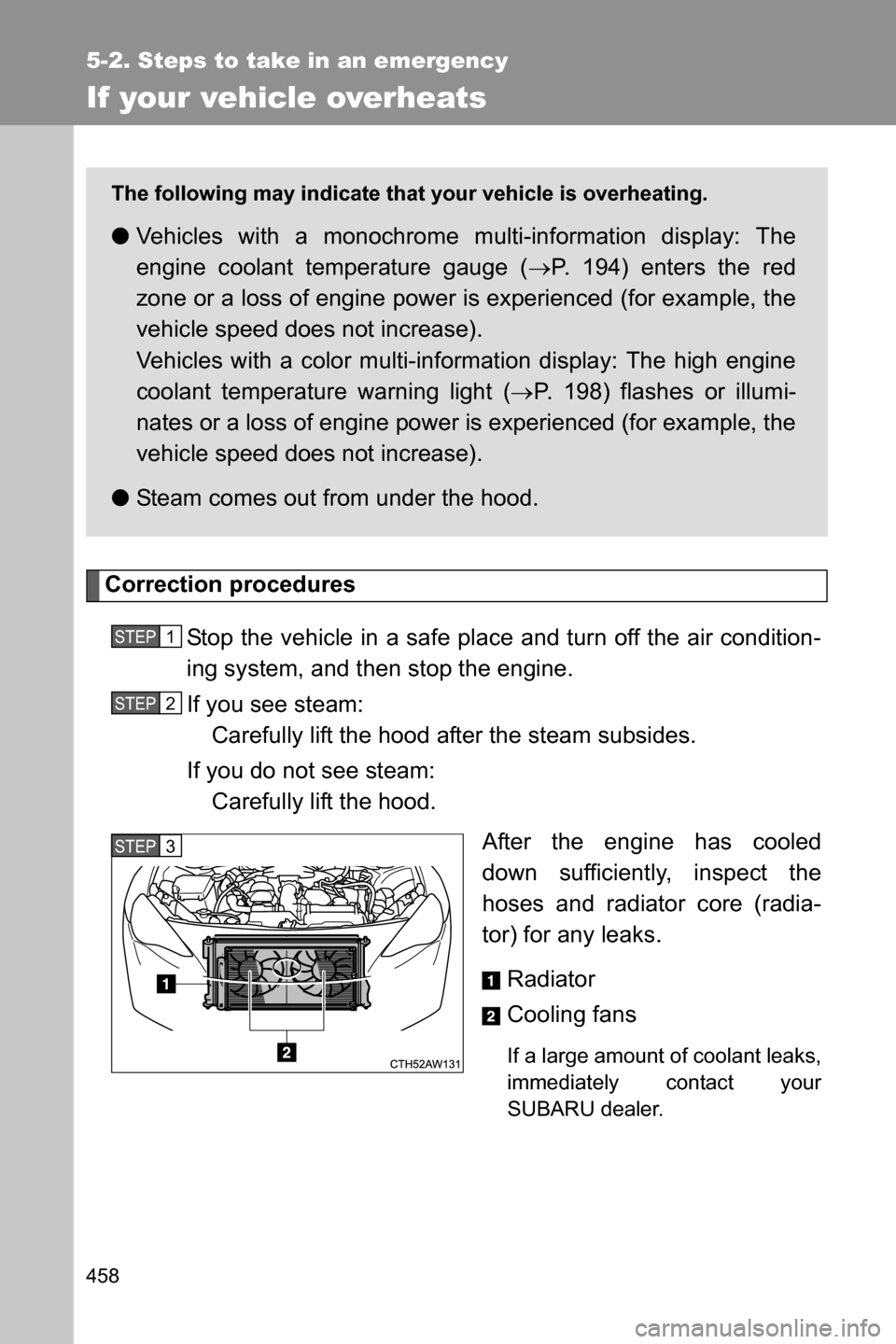
After the engine has cooled
down sufficiently, inspect the
hoses and radiator core (radia-
tor) for any leaks.
Radiator
Cooling fans
If a large amount of coolant leaks,
immediately contact your
SUBARU dealer.
The following may indicate that your vehicle is overheating.
●Vehicles with a monochrome multi-information display: The
engine coolant temperature gauge (oP. 194) enters the red
zone or a loss of engine power is experienced (for example, the
vehicle speed does not increase).
Vehicles with a color multi-information display: The high engine
coolant temperature warning light (oP. 198) flashes or illumi-
nates or a loss of engine power is experienced (for example, the
vehicle speed does not increase).
●Steam comes out from under the hood.
STEP 1
STEP 2
STEP 3
Page 477 of 540
475 6-1. Specifications
6
Vehicle specifications
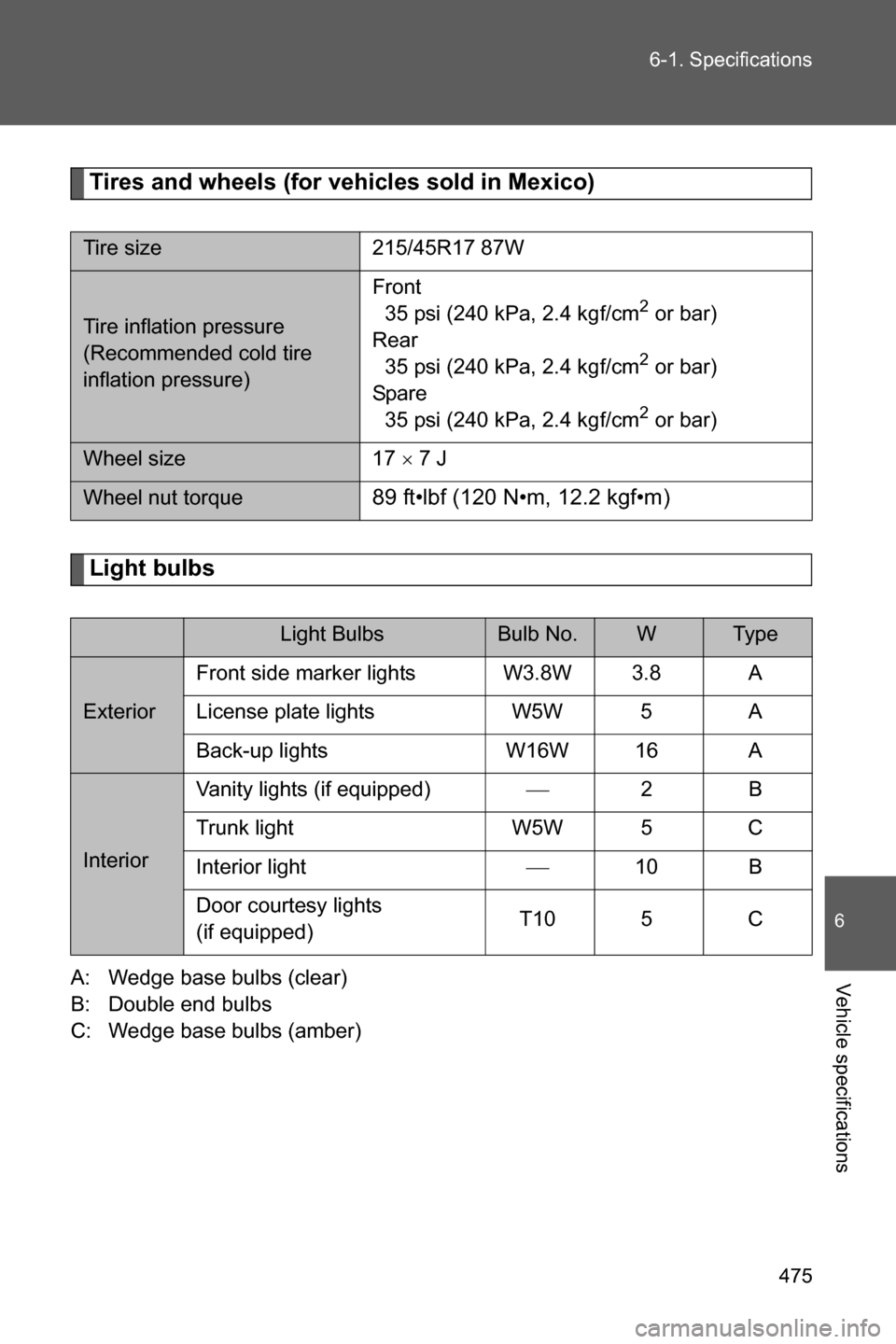
Tires and wheels (for vehicles sold in Mexico)
Light bulbs
A: Wedge base bulbs (clear)
B: Double end bulbs
C: Wedge base bulbs (amber)
Tire size 215/45R17 87W
Tire inflation pressure
(Recommended cold tire
inflation pressure)Front
35 psi (240 kPa, 2.4 kgf/cm2 or bar)
Rear
35 psi (240 kPa, 2.4 kgf/cm
2 or bar)
Spare
35 psi (240 kPa, 2.4 kgf/cm
2 or bar)
Wheel size 17 u 7 J
Wheel nut torque89 ft•lbf (120 N•m, 12.2 kgf•m)
Light BulbsBulb No.WTyp e
ExteriorFront side marker lights W3.8W 3.8 A
License plate lights W5W 5 A
Back-up lights W16W 16 A
InteriorVanity lights (if equipped)2B
Trunk light W5W 5 C
Interior light10 B
Door courtesy lights
(if equipped)T10 5 C
Page 478 of 540
476
6-1. Specifications
Fuel infor mation
■Fuel tank opening for unleaded gasoline
To help prevent incorrect fueling, your SUBARU has a fuel tank opening that
only accommodates the special nozzle on unleaded fuel pumps.
■If your engine knocks
●Consult your SUBARU dealer.
●You may occasionally notice light knocking for a short time while acceler-
ating or driving uphill. This is normal and there is no need for concern.
■Gasoline quality
In very few cases, driveability problems may be caused by the brand of gas-
oline you are using. If driveability problems persist, try changing the brand of
gasoline. If this does not correct the problem, consult your SUBARU dealer.
■Fuel octane rating
Using a gasoline with a lower octane rating can cause persistent and heavy
knocking, which can damage the engine. Do not be concerned if your vehi-
cle sometimes knocks lightly when you drive up a hill or when you acceler-
ate. Contact your SUBARU dealer if you use a fuel with the specified octane
rating and your vehicle knocks heavily or persistently.
RON
This octane rating is the Research Octane Number.
AKI
This octane rating is the average of the Research Octane and Motor Octane
numbers and is commonly referred to as the Anti Knock Index (AKI). The engine is designed to operate at maximum performance using
unleaded gasoline with an octane rating of 93 AKI (98 RON) or
higher. If 93 AKI (98 RON) fuel is not readily available in your area,
unleaded gasoline with an octane rating of 91 AKI (95 RON) may be
used with no detriment to engine durability or driveability. However,
you may notice a slight decrease in maximum engine performance
and you may hear some knocking (pinging) from the engine while
using 91 AKI (95 RON) fuel. Use of 91 AKI (95 RON) fuel will not affect
your warranty coverage.
Page 491 of 540
489 6-1. Specifications
6
Vehicle specifications
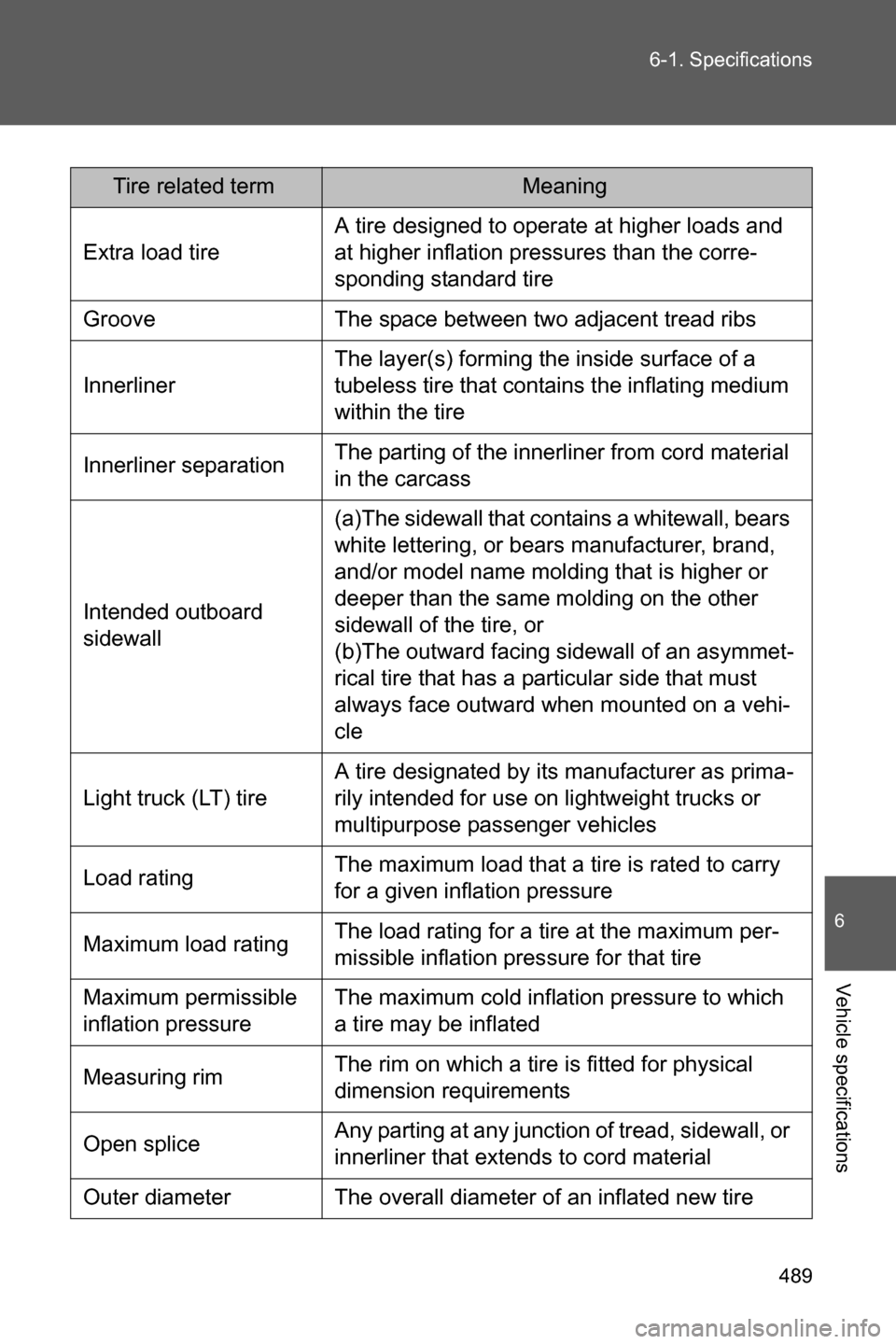
Tire related termMeaning
Extra load tireA tire designed to operate at higher loads and
at higher inflation pressures than the corre-
sponding standard tire
Groove The space between two adjacent tread ribs
InnerlinerThe layer(s) forming the inside surface of a
tubeless tire that contains the inflating medium
within the tire
Innerliner separationThe parting of the innerliner from cord material
in the carcass
Intended outboard
sidewall(a)The sidewall that contains a whitewall, bears
white lettering, or bears manufacturer, brand,
and/or model name molding that is higher or
deeper than the same molding on the other
sidewall of the tire, or
(b)The outward facing sidewall of an asymmet-
rical tire that has a particular side that must
always face outward when mounted on a vehi-
cle
Light truck (LT) tireA tire designated by its manufacturer as prima-
rily intended for use on lightweight trucks or
multipurpose passenger vehicles
Load ratingThe maximum load that a tire is rated to carry
for a given inflation pressure
Maximum load ratingThe load rating for a tire at the maximum per-
missible inflation pressure for that tire
Maximum permissible
inflation pressureThe maximum cold inflation pressure to which
a tire may be inflated
Measuring rimThe rim on which a tire is fitted for physical
dimension requirements
Open spliceAny parting at any junction of tread, sidewall, or
innerliner that extends to cord material
Outer diameter The overall diameter of an inflated new tire
Page 497 of 540
495 6-2. Customization
6
Vehicle specifications
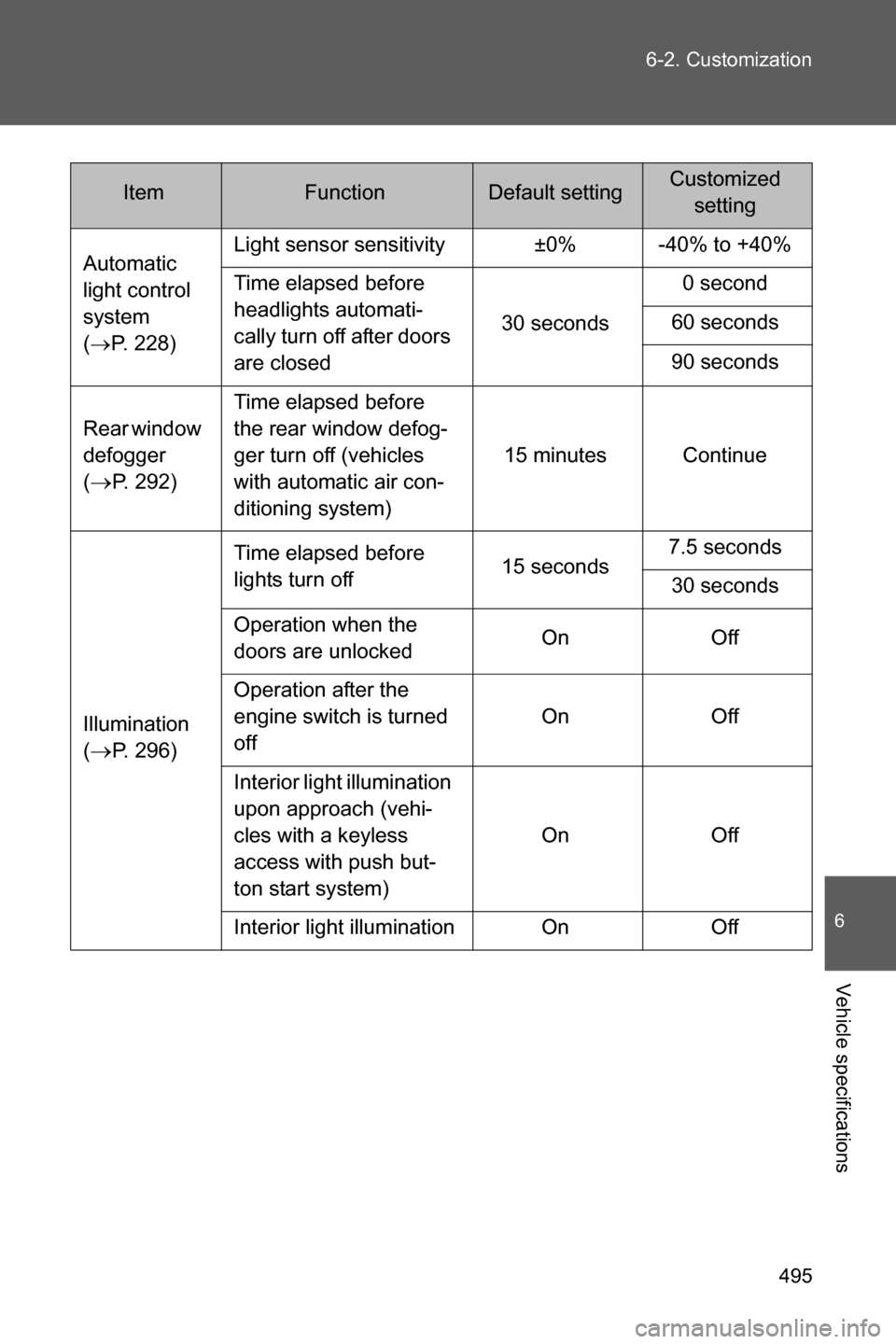
Automatic
light control
system
(oP. 228)Light sensor sensitivity ±0% -40% to +40%
Time elapsed before
headlights automati-
cally turn off after doors
are closed30 seconds0 second
60 seconds
90 seconds
Rear window
defogger
(
oP. 292)Time elapsed before
the rear window defog-
ger turn off (vehicles
with automatic air con-
ditioning system)15 minutes Continue
Illumination
(
oP. 296)Time elapsed before
lights turn off15 seconds7.5 seconds
30 seconds
Operation when the
doors are unlockedOn Off
Operation after the
engine switch is turned
offOn Off
Interior light illumination
upon approach (vehi-
cles with a keyless
access with push but-
ton start system)On Off
Interior light illumination On Off
ItemFunctionDefault settingCustomized
setting