check engine SUBARU BRZ 2017 1.G User Guide
[x] Cancel search | Manufacturer: SUBARU, Model Year: 2017, Model line: BRZ, Model: SUBARU BRZ 2017 1.GPages: 540, PDF Size: 6.88 MB
Page 165 of 540
163 2-1. Driving procedures
2
When driving
WARNING
■When the vehicle is stopped
●Do not race the engine.
If the vehicle is in any gear other than P or N (vehicles with an automatic
transmission only) or neutral (vehicles with a manual transmission), the
vehicle may accelerate suddenly and unexpectedly, causing an accident.
●Do not leave the vehicle with the engine running for a long time.
If such a situation cannot be avoided, park the vehicle in an open space
and check that exhaust fumes do not enter the vehicle interior.
●On vehicles with an automatic transmission, in order to prevent accidents
due to the vehicle rolling away, always keep depressing the brake pedal
while the engine is running, and apply the parking brake as necessary.
●If the vehicle is stopped on an incline, in order to prevent accidents caused
by the vehicle rolling forward or backward, always depress the brake pedal
and securely apply the parking brake as needed.
●Avoid revving or racing the engine.
Running the engine at high speed while the vehicle is stopped may cause
the exhaust system to overheat, which could result in a fire if combustible
material is nearby.
Page 167 of 540
165 2-1. Driving procedures
2
When driving
WARNING
■Exhaust gases
Exhaust gases include harmful carbon monoxide (CO), which is colorless
and odorless. Inhaling exhaust gases may lead to death or a serious health
hazard.
●If the vehicle is in a poorly ventilated area, stop the engine. In a closed
area, such as a garage, exhaust gases may collect and enter the vehicle.
This may lead to death or a serious health hazard.
●The exhaust system should be checked occasionally. If there is a hole or
crack caused by corrosion, damage to a joint or abnormal exhaust noise,
be sure to have the vehicle inspected and repaired by your SUBARU
dealer. Failure to do so may allow exhaust gases to enter the vehicle,
resulting in death or a serious health hazard.
■When taking a nap in the vehicle
Always turn the engine off. Otherwise, you may accidentally move the select
lever or shift lever, or depress the accelerator pedal, this could cause an
accident or fire due to engine overheating. Additionally, if the vehicle is
parked in a poorly ventilated area, exhaust gases may collect and enter the
vehicle, leading to death or a serious health hazard.
Page 168 of 540
166 2-1. Driving procedures
WARNING
■When braking
●When the brakes are wet, drive more cautiously.
Braking distance increases when the brakes are wet, and this may cause
one side of the vehicle to brake differently than the other side. Also, the
parking brake may not securely hold the vehicle.
●If the power brake assist function does not operate, do not follow other
vehicles closely and avoid hills or sharp turns that require braking.
In this case, braking is still possible, but the brake pedal should be
depressed more firmly than usual. Also, the braking distance will increase.
Have your brakes fixed immediately.
●Do not pump the brake pedal if the engine stalls.
Each push on the brake pedal uses up the reserve for the power-assisted
brakes.
●The brake system consists of 2 individual hydraulic systems; if one of the
systems fails, the other will still operate. In this case, the brake pedal
should be depressed more firmly than usual and the braking distance will
increase.
Have your brakes fixed immediately.
CAUTION
■Pre-driving check
Trapping small animals in the cooling fan and belts of the engine may result
in a malfunction. Check that no small animal enters the engine compartment
and under the vehicle before starting the engine.
■When driving the vehicle
Vehicles with an automatic transmission
●If the accelerator and brake pedals are depressed at the same time, driv-
ing torque may be restrained. This is not a malfunction.
●Do not use the accelerator pedal or depress the accelerator and brake
pedals at the same time to hold the vehicle on a hill.
Page 170 of 540

168 2-1. Driving procedures
CAUTION
■Replacement of brake pad and lining
If you continue to drive despite the scraping noise from the audible brake
pad wear indicator, it will result in the need for costly brake rotor repair or
replacement.
■Breaking-in of new brake pads and linings
Pulling the parking brake lever too forcefully may cause the rear wheels to
lock. To avoid this, be certain to pull the lever up slowly and gently.
■If you get a flat tire while driving
A flat or damaged tire may cause the following situations. Hold the steering
wheel firmly and gradually depress the brake pedal to slow down the vehicle.
●It may be difficult to control your vehicle.
●The vehicle will make abnormal sounds or vibrations.
●The vehicle will lean abnormally.
Information on what to do in case of a flat tire (oP. 431)
■When encountering flooded roads
Do not drive on a road that has flooded after heavy rain etc. Doing so may
cause the following serious damage to the vehicle:
●Engine stalling
●Short in electrical components
●Engine damage caused by water immersion
In the event that you drive on a flooded road and the vehicle is flooded, be
sure to have your SUBARU dealer check the following:
●Brake function
●Changes in quantity and quality of oil and fluid used for the engine, trans-
mission, differential, etc.
●Lubricant condition for the propeller shaft, bearings and suspension joints
(where possible) and the function of all joints, bearings, etc.
Page 171 of 540
169
2-1. Driving procedures
2
When driving
Push-button ignition switch (vehicles with a keyless access with push button star t system)
Performing the following operations when carrying the access key
on your person starts the engine or changes push-button ignition
switch modes.
■Starting the engine
Vehicles with an automatic transmission
Check that the parking brake is set.
Check that the select lever is set in P.
If the select lever is not set in P, the engine may not be started.
(oP. 181)
Firmly depress the brake pedal.
The keyless access with push button start system indicator light
(green) will turn on. If the indicator light does not turn on, the
engine cannot be started.
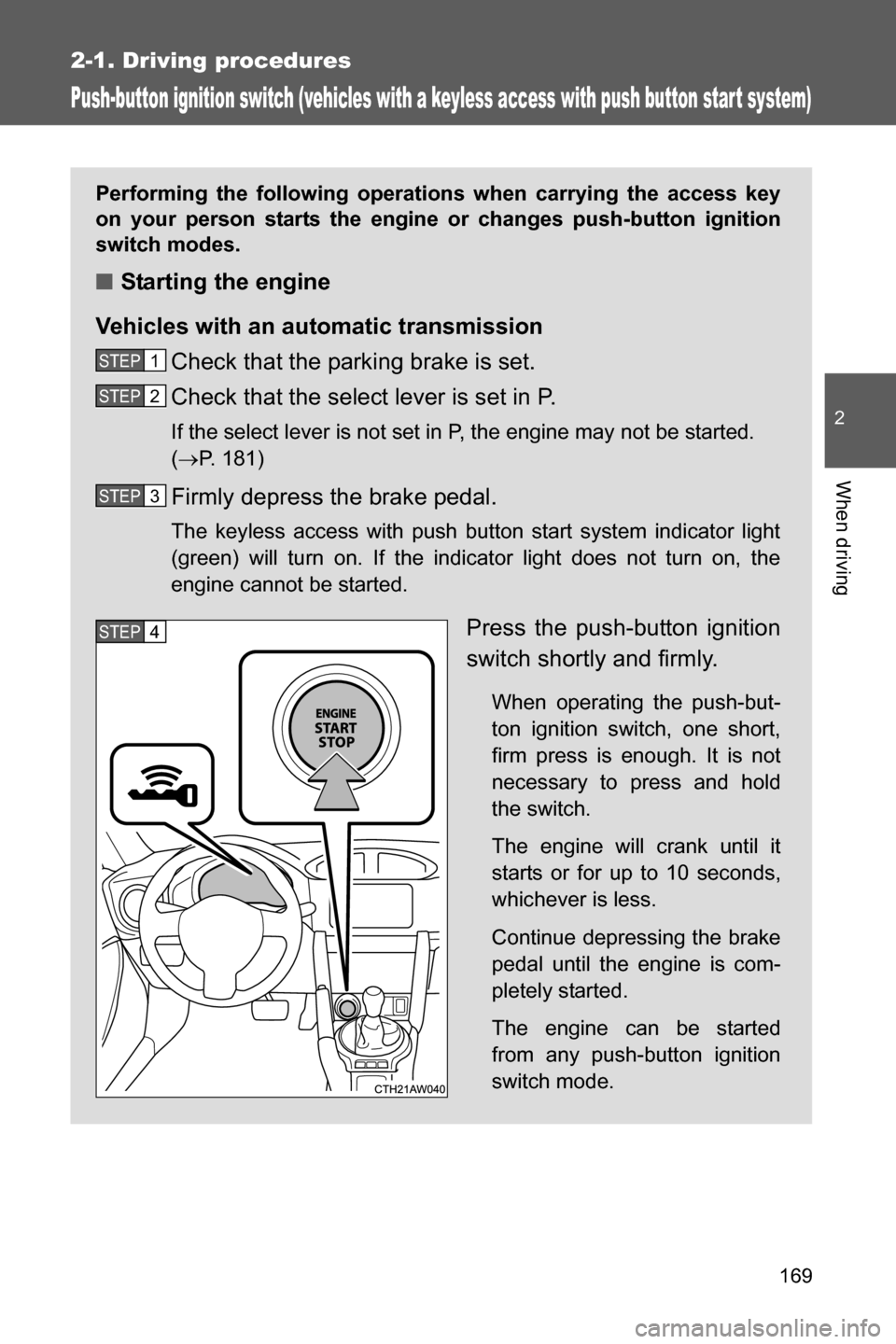
Press the push-button ignition
switch shortly and firmly.
When operating the push-but-
ton ignition switch, one short,
firm press is enough. It is not
necessary to press and hold
the switch.
The engine will crank until it
starts or for up to 10 seconds,
whichever is less.
Continue depressing the brake
pedal until the engine is com-
pletely started.
The engine can be started
from any push-button ignition
switch mode.
STEP 1
STEP 2
STEP 3
STEP 4
Page 172 of 540
170 2-1. Driving procedures
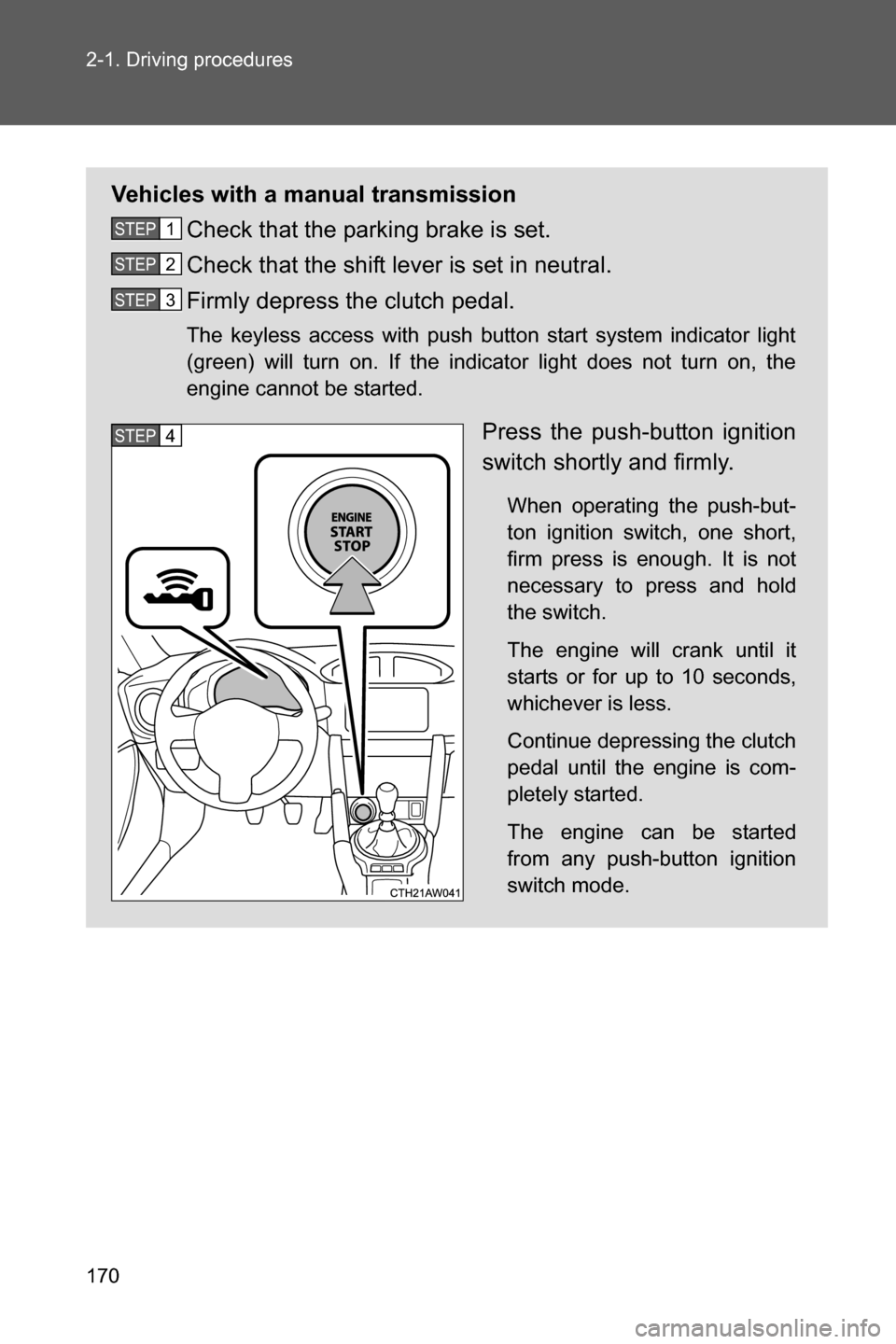
Vehicles with a manual transmission
Check that the parking brake is set.
Check that the shift lever is set in neutral.
Firmly depress the clutch pedal.
The keyless access with push button start system indicator light
(green) will turn on. If the indicator light does not turn on, the
engine cannot be started.
Press the push-button ignition
switch shortly and firmly.
When operating the push-but-
ton ignition switch, one short,
firm press is enough. It is not
necessary to press and hold
the switch.
The engine will crank until it
starts or for up to 10 seconds,
whichever is less.
Continue depressing the clutch
pedal until the engine is com-
pletely started.
The engine can be started
from any push-button ignition
switch mode.
STEP 1
STEP 2
STEP 3
STEP 4
Page 173 of 540
171 2-1. Driving procedures
2
When driving
■Stopping the engine
Vehicles with an automatic transmission
Stop the vehicle.
Shift the select lever to P.
Set the parking brake. (oP. 192)
Release the brake pedal.
Press the push-button ignition switch.
Check that the keyless access with push button start sys-
tem indicator light (green) is off.
Vehicles with a manual transmission
While depressing the clutch pedal, stop the vehicle.
Shift the shift lever to neutral.
Set the parking brake. (oP. 192)
Release the clutch pedal.
Press the push-button ignition switch.
Check that the keyless access with push button start sys-
tem indicator light (green) is off.
STEP 1
STEP 2
STEP 3
STEP 4
STEP 5
STEP 6
STEP 1
STEP 2
STEP 3
STEP 4
STEP 5
STEP 6
Page 175 of 540
173 2-1. Driving procedures
2
When driving
When stopping the engine with the select lever in a position
other than P (vehicles with an automatic transmission)
If the engine is stopped with the select lever in a position other than P,
the push-button ignition switch will not be turned off but instead be
turned to “ACC” mode. Perform the following procedure to turn the
switch off:
Check that the parking brake is set.
Shift the select lever to P.
Check that the keyless access with push button start system
indicator light (green) flashes slowly and then press the push-
button ignition switch once.
Check that the keyless access with push button start system
indicator light (green) is off.
■Auto power off function
Vehicles with an automatic transmission
If the vehicle is left in “ACC” mode for more than 20 minutes or “ON” mode
(the engine is not running) for more than an hour with the select lever in P,
the push-button ignition switch will automatically turn off. However, this func-
tion cannot entirely prevent battery discharge. Do not leave the vehicle with
the push-button ignition switch in “ACC” or “ON” mode for long periods of
time when the engine is not running.
Vehicles with a manual transmission
If the vehicle is left in “ACC” mode for more than 20 minutes or “ON” mode
(the engine is not running) for more than an hour, the push-button ignition
switch will automatically turn off. However, this function cannot entirely pre-
vent battery discharge. Do not leave the vehicle with the push-button ignition
switch in “ACC” or “ON” mode for long periods of time when the engine is not
running.
STEP 1
STEP 2
STEP 3
STEP 4
Page 176 of 540
174 2-1. Driving procedures
■Operation of the push-button ignition switch
If the switch is not pressed shortly and firmly, the push-button ignition switch
mode may not change or the engine may not start.
■Access key battery depletion
oP. 3 5
■Conditions affecting operation
oP. 3 1
■Note for the “keyless access” entry function
oP. 3 2
■If the engine does not start
The engine immobilizer system may not have been deactivated. (oP. 8 0 )
Contact your SUBARU dealer.
■Steering lock
After turning the push-button ignition switch off and opening and closing the
doors, the steering wheel will be locked due to the steering lock function.
Operating the push-button ignition switch again automatically cancels the
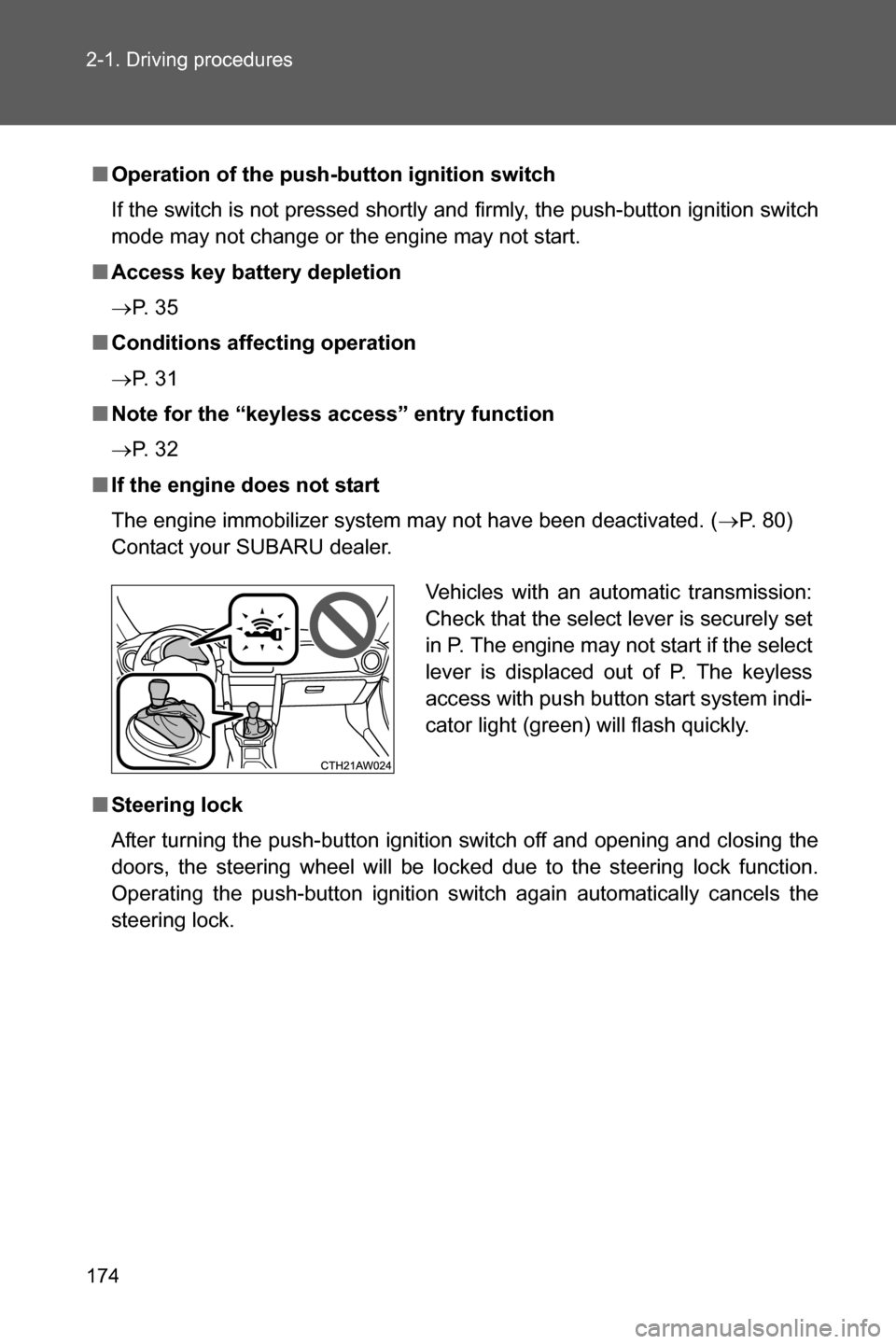
steering lock.Vehicles with an automatic transmission:
Check that the select lever is securely set
in P. The engine may not start if the select
lever is displaced out of P. The keyless
access with push button start system indi-
cator light (green) will flash quickly.
Page 177 of 540
175 2-1. Driving procedures
2
When driving
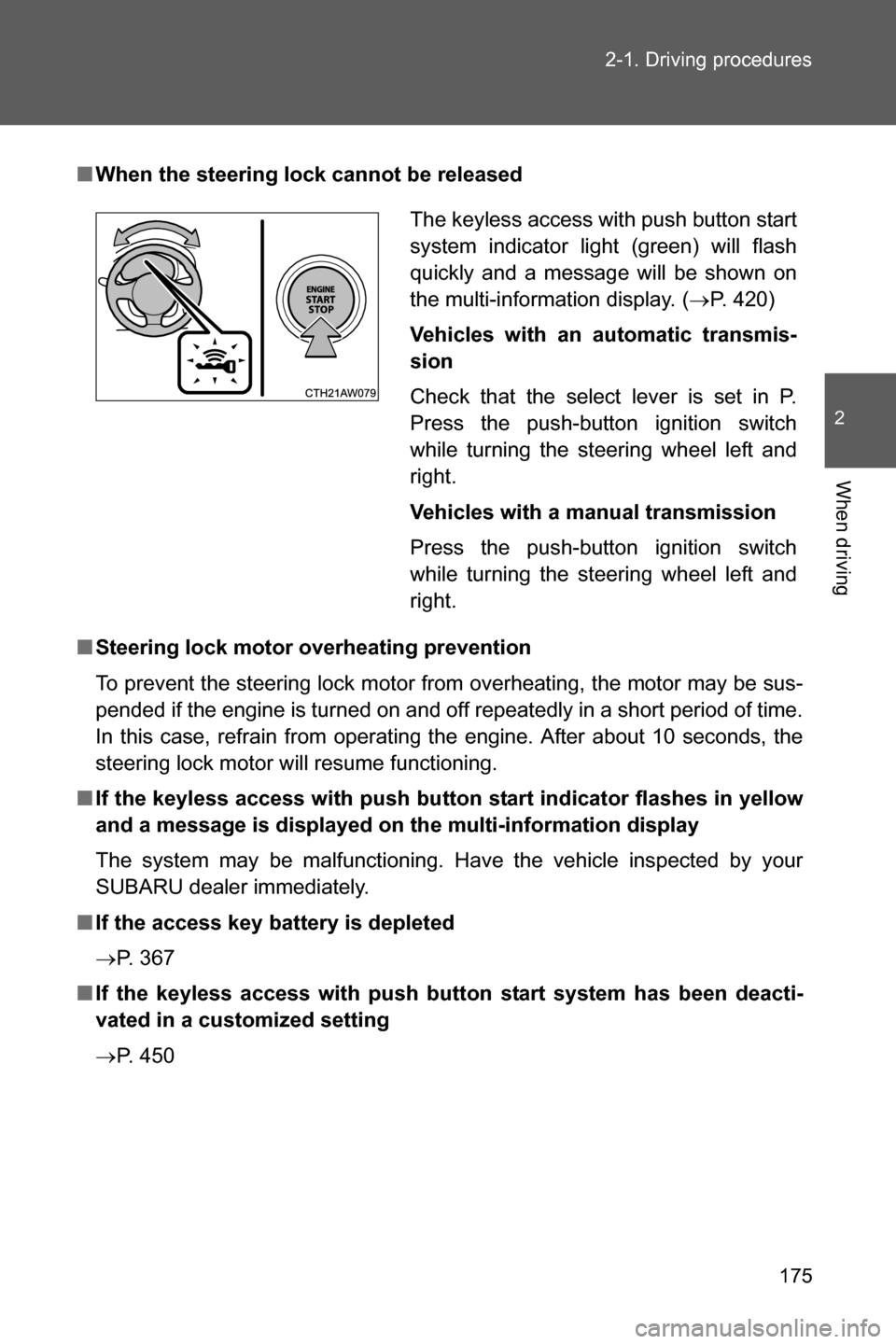
■When the steering lock cannot be released
■Steering lock motor overheating prevention
To prevent the steering lock motor from overheating, the motor may be sus-
pended if the engine is turned on and off repeatedly in a short period of time.
In this case, refrain from operating the engine. After about 10 seconds, the
steering lock motor will resume functioning.
■If the keyless access with push button start indicator flashes in yellow
and a message is displayed on the multi-information display
The system may be malfunctioning. Have the vehicle inspected by your
SUBARU dealer immediately.
■If the access key battery is depleted
oP. 367
■If the keyless access with push button start system has been deacti-
vated in a customized setting
oP. 450The keyless access with push button start
system indicator light (green) will flash
quickly and a message will be shown on
the multi-information display. (oP. 420)
Vehicles with an automatic transmis-
sion
Check that the select lever is set in P.
Press the push-button ignition switch
while turning the steering wheel left and
right.
Vehicles with a manual transmission
Press the push-button ignition switch
while turning the steering wheel left and
right.