ESP SUBARU BRZ 2017 1.G Owner's Manual
[x] Cancel search | Manufacturer: SUBARU, Model Year: 2017, Model line: BRZ, Model: SUBARU BRZ 2017 1.GPages: 540, PDF Size: 6.88 MB
Page 253 of 540
251
2-4. Using other driving systems
2
When driving
Driving assist systems
To help enhance driving safety and performance, the following sys-
tems operate automatically in response to various driving situations.
Be aware, however, that these systems are supplementary and
should not be relied upon too heavily when operating the vehicle.
■ABS (Anti-lock Brake System)
Helps to prevent wheel lock when the brakes are applied suddenly, or if
the brakes are applied while driving on a slippery road surface
■Brake assist
Generates an increased level of braking force after the brake pedal is
depressed when the system detects a panic stop situation
■Vehicle stability control (VSC)
Helps the driver to control skidding when swerving suddenly or turning
on slippery road surfaces
■TRAC (Traction Control)
Helps to maintain drive power and prevent the drive wheels from spin-
ning when starting the vehicle or accelerating on slippery roads.
The TRAC system is also equipped with the brake LSD function.
■Hill start assist
oP. 258
■Electric power steering
Employs an electric motor to reduce the amount of effort needed to turn
the steering wheel
Page 259 of 540
257 2-4. Using other driving systems
2
When driving
WARNING
■TRAC may not operate effectively when
Directional control and power may not be achievable while driving on slip-
pery road surfaces, even if the TRAC system is operating.
Do not drive the vehicle in conditions where stability and power may be lost.
■When the Vehicle stability control (VSC) and/or brake LSD function is
activated
The slip indicator light flashes. Always drive carefully. Reckless driving may
cause an accident. Exercise particular care when the indicator light flashes.
■When the TRAC/Vehicle stability control (VSC) systems are turned off
Be especially careful and drive at a speed appropriate to the road condi-
tions. As these are the systems to help ensure vehicle stability and driving
force, do not turn the TRAC/Vehicle stability control (VSC) systems off
unless necessary.
■Replacing tires
Make sure that all tires are of the specified size, brand, tread pattern and
total load capacity. In addition, make sure that the tires are inflated to the
recommended tire inflation pressure level.
The ABS, TRAC and Vehicle stability control (VSC) systems will not function
correctly if different tires are installed on the vehicle.
Contact your SUBARU dealer for further information when replacing tires or
wheels.
■Handling of tires and suspension
Using tires with any kind of problem or modifying the suspension will affect
the driving assist systems, and may cause a system to malfunction.
Page 272 of 540

270 2-5. Driving information
Tire chains
Tire chains cannot be used on your vehicle because of the lack of
clearance between the tires and vehicle body.
When tire chains cannot be used, use of another type of traction
device (such as spring chains) may be acceptable if use on your vehi-
cle is recommended by the device manufacturer, taking into account
tire size and road conditions.
Follow the device manufacturer's instructions, especially regarding
maximum vehicle speed.
To help avoid damage to your vehicle, drive slowly, readjust or
remove the device if it is contacting your vehicle, and do not spin your
wheels. Damage caused to your vehicle by use of a traction device is
not covered under warranty.
Make certain that any traction device you use is an SAE class “S”
device, and use it on the rear wheels only.
Always use the utmost care when driving with a traction device. Over-
confidence because you are using a traction device could easily lead
to a serious accident.
Selecting tire chains
We recommend that you consult your SUBARU dealer for information
about the chains that you can use.
Page 275 of 540
273
2-5. Driving information
2
When driving
Trailer towing
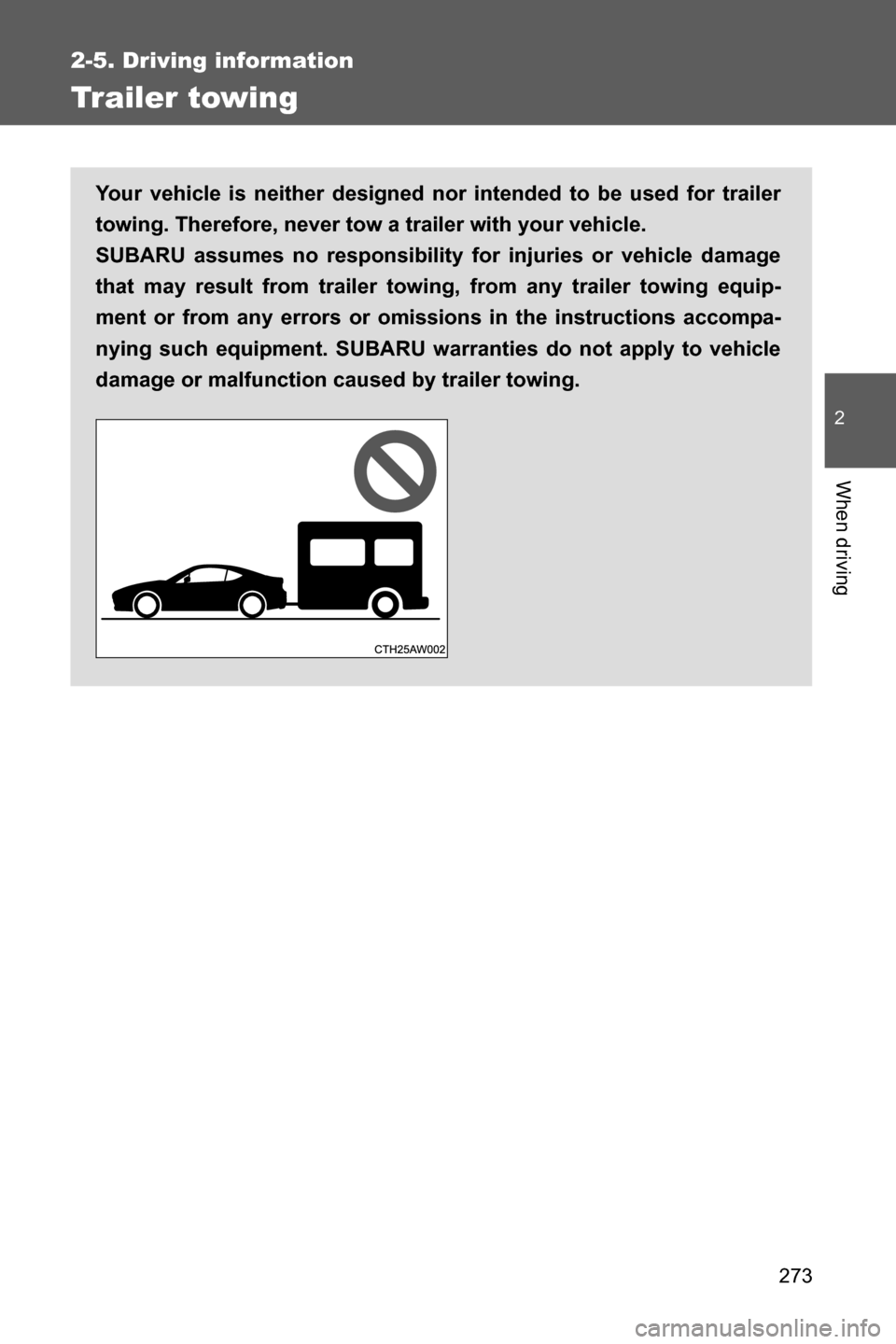
Your vehicle is neither designed nor intended to be used for trailer
towing. Therefore, never tow a trailer with your vehicle.
SUBARU assumes no responsibility for injuries or vehicle damage
that may result from trailer towing, from any trailer towing equip-
ment or from any errors or omissions in the instructions accompa-
nying such equipment. SUBARU warranties do not apply to vehicle
damage or malfunction caused by trailer towing.
Page 313 of 540
311 3-5. Other interior features
3
Interior features
WARNING
Observe the following precautions.
Failure to do so may cause the driver's floor mat to slip, possibly interfering
with the pedals while driving. An unexpectedly high speed may result or it may
become difficult to stop the vehicle. This could lead to an accident, resulting in
death or serious injury.
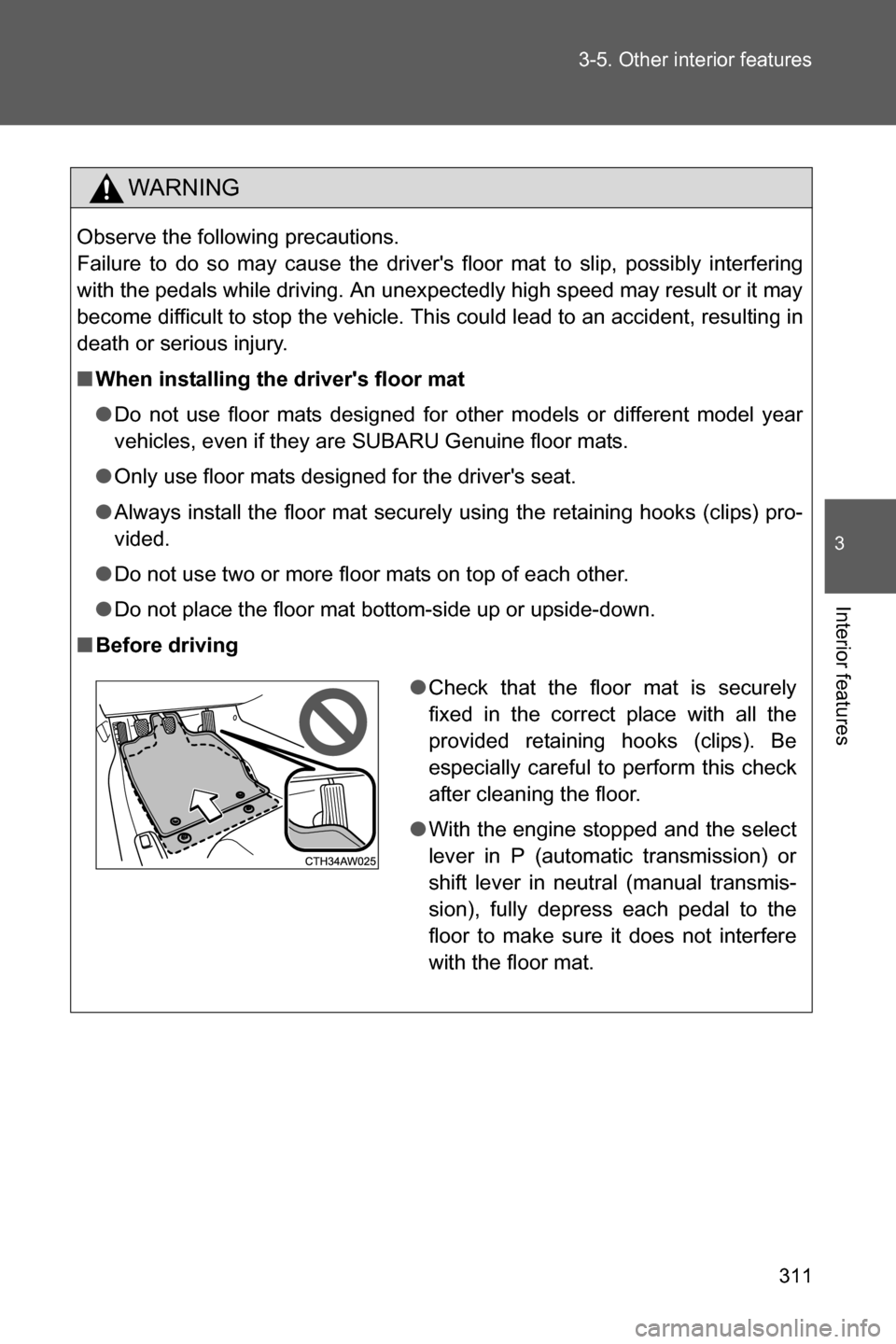
■When installing the driver's floor mat
●Do not use floor mats designed for other models or different model year
vehicles, even if they are SUBARU Genuine floor mats.
●Only use floor mats designed for the driver's seat.
●Always install the floor mat securely using the retaining hooks (clips) pro-
vided.
●Do not use two or more floor mats on top of each other.
●Do not place the floor mat bottom-side up or upside-down.
■Before driving
●Check that the floor mat is securely
fixed in the correct place with all the
provided retaining hooks (clips). Be
especially careful to perform this check
after cleaning the floor.
●With the engine stopped and the select
lever in P (automatic transmission) or
shift lever in neutral (manual transmis-
sion), fully depress each pedal to the
floor to make sure it does not interfere
with the floor mat.
Page 321 of 540
319 4-1. Maintenance and care
4
Maintenance and care
■Caring for leather areas
SUBARU recommends cleaning the interior of the vehicle at least twice a
year to maintain the quality of the vehicle’s interior.
■Shampooing the carpets
There are several commercial foaming-type cleaners available. Use a
sponge or brush to apply the foam. Rub in overlapping circles. Do not apply
water. Excellent results are obtained by keeping the carpet as dry as possi-
ble.
■Seatbelts
Clean with mild soap and lukewarm water using a cloth or sponge. Also
check the belts periodically for excessive wear, fraying or cuts.
WARNING
■Water in the vehicle
●Do not splash or spill liquid in the vehicle.
Doing so may cause electrical components etc. to malfunction or catch
fire.
●Do not get any of the SRS components or wiring in the vehicle interior wet.
(oP. 96)
Electrical malfunction may cause the airbags to deploy or not function
properly, resulting in death or severe injury.
■Cleaning the interior (especially instrument panel)
Do not use polish wax or polish cleaner. The instrument panel may reflect off
the windshield, obstructing the driver's view and leading to an accident,
resulting in death or serious injury.
Page 322 of 540

320 4-1. Maintenance and care
CAUTION
■Cleaning detergents
●Do not use organic substances such as benzene or gasoline, acidic or
alkaline solutions, dye, bleach or other detergent. Doing so may discolor
the vehicle interior or cause streaks or damage to painted surfaces.
●Do not use polish wax or polish cleaner. The instrument panel's or other
interior part’s painted surface may be damaged.
●Do not use a chemical agent containing silicone (highly-polymerized sili-
con compound) when cleaning any of the electrical appliances such as the
air conditioning, all switches and their surrounding areas.
If silicon (highly-polymerized silicon compound) contacts these compo-
nents, it may cause the electrical appliances to malfunction.
■Preventing damage to leather surfaces
Observe the following precautions to avoid damage to and deterioration of
leather surfaces.
●Remove any dust, dirt, sand, oil spots etc. on leather surfaces immedi-
ately.
●Do not expose the vehicle to direct sunlight for extended periods of time.
Park the vehicle in the shade, especially during summer.
●Do not place items made of vinyl, plastic, or that contain wax on the uphol-
stery, as they may stick to the leather surface if the vehicle interior heats
up significantly.
■Water on the floor
Do not wash the vehicle floor with water.
Vehicle systems such as the audio system may be damaged if water comes
into contact with electrical components under the floor of the vehicle, and
may also cause the body to rust.
Page 326 of 540
324
4-2. Maintenance
Maintenance requirements
■Repair and replacement
It is recommended that genuine SUBARU parts be used for repair to ensure
performance of each system. If non-SUBARU parts are used in replacement
or if a repair shop other than a SUBARU dealer performs repairs, warranty
coverage may be affected. To ensure safe and economical driving, day-to-day care and regular
maintenance is essential. It is the owner’s responsibility to perform
regular checks. SUBARU recommends the following maintenance.
■General maintenance
Should be performed on a daily basis. This can be done by your-
self or by a SUBARU dealer.
■Scheduled maintenance
Should be performed at specified intervals according to the
maintenance schedule.
For details about maintenance items and schedules, refer to the “War-
ranty and Maintenance Booklet” (except for Canada) or “Warranty and
Service Booklet” (for Canada).
■Do-it-yourself maintenance
You can perform some maintenance procedures yourself.
Please be aware that do-it-yourself maintenance may affect war-
ranty coverage.
The use of SUBARU Service Manuals is recommended.
For details about warranty coverage, see the separate “Warranty and
Maintenance Booklet” (except for Canada) or “Warranty and Service
Booklet” (for Canada).
Page 356 of 540

354 4-3. Do-it-yourself maintenance
■Initializing the tire pressure monitoring system (if equipped)
Initialize the system with the tire inflation pressure adjusted to the speci-
fied level.
■Routine tire inflation pressure checks (vehicles with a tire pressure
monitoring system)
The tire pressure monitoring system does not replace routine tire infla-
tion pressure checks. Make sure to check tire inflation pressure as part
of your routine of daily vehicle checks.
■Tire pressure monitoring system certification (if equipped)
MODEL/FCC IDs:
Transmitter: PAXPMVC010
Receiver: HYQ23AAA (vehicles without a keyless access with push
button start system)
HYQ23AAE (vehicles with a keyless access with push but-
ton start system)
NOTE:
This device complies with part 15 of the FCC Rules. Operation is subject
to the following two conditions: (1) This device may not cause harmful
interference, and (2) this device must accept any interference received,
including interference that may cause undesired operation.
FCC WARNING:
Changes or modifications not expressly approved by the party responsi-
ble for compliance could void the user's authority to operate the equip-
ment.
Page 414 of 540
412 5-2. Steps to take in an emergency
WARNING
■Maintenance of the tires (vehicles with a tire pressure monitoring
system)
Each tire, including the spare (if provided), should be checked monthly
when cold and inflated to the inflation pressure recommended by the
vehicle manufacturer on the vehicle placard or tire inflation pressure
label (tire and load information label). (If your vehicle has tires of a differ-
ent size than the size indicated on the vehicle placard or tire inflation
pressure label [tire and load information label], you should determine the
proper tire inflation pressure for those tires.)
As an added safety feature, your vehicle has been equipped with a tire
pressure monitoring system (TPMS) that illuminates a low tire pressure
telltale (tire pressure warning light) when one or more of your tires is sig-
nificantly under-inflated. Accordingly, when the low tire pressure telltale
(tire pressure warning light) illuminates, you should stop and check your
tires as soon as possible, and inflate them to the proper pressure. Driv-
ing on a significantly under-inflated tire causes the tire to overheat and
can lead to tire failure. Under-inflation also reduces fuel efficiency and
tire tread life, and may affect the vehicle's handling and stopping ability.
Please note that the TPMS is not a substitute for proper tire mainte-
nance, and it is the driver's responsibility to maintain correct tire pres-
sure, even if under-inflation has not reached the level to trigger
illumination of the TPMS low tire pressure telltale (tire pressure warning
light).
Your vehicle has also been equipped with a TPMS malfunction indicator
to indicate when the system is not operating properly. The TPMS mal-
function indicator is combined with the low tire pressure telltale (tire pres-
sure warning light). When the system detects a malfunction, the telltale
will flash for approximately one minute and then remain continuously illu-
minated. This sequence will continue upon subsequent vehicle start-ups
as long as the malfunction exists. When the malfunction indicator is illu-
minated, the system may not be able to detect or signal low tire pressure
as intended.