oil SUBARU BRZ 2017 1.G Owners Manual
[x] Cancel search | Manufacturer: SUBARU, Model Year: 2017, Model line: BRZ, Model: SUBARU BRZ 2017 1.GPages: 540, PDF Size: 6.88 MB
Page 7 of 540

1
2
3
4
5
6
7
5
6-1. Specifications
Maintenance data
(fuel, oil level, etc.) ............ 464
Fuel information .................. 476
Tire information ................... 480
6-2. Customization
Customizable features ........ 493
Reporting safety defects
for U.S. owners ................. 498
Seatbelt instructions
for Canadian owners
(in French) ........................ 499
SRS airbag instructions
for Canadian owners
(in French) ........................ 502
Abbreviation list ........................ 524
Alphabetical index ..................... 525
What to do if... ........................... 533
6Vehicle specifications
7For owners
Index
Page 33 of 540

31 1-2. Opening, closing and locking the doors and trunk lid
1
Before driving
■Conditions affecting operation
The keyless access with push button start system uses weak radio waves. In
the following situations, the communication between the access key and the
vehicle may be affected, preventing the keyless access with push button
start system, remote keyless entry system and engine immobilizer system
from operating properly. (Way of coping oP. 449)
●When the access key battery is depleted
●Near a TV tower, electric power plant, gas station, radio station, large dis-
play, airport or other facility that generates strong radio waves or electri-
cal noise
●When the access key is in contact with, or is covered by the following
metallic objects
• Cards to which aluminum foil is attached
• Cigarette boxes that have aluminum foil inside
• Metallic wallets or bags
• Coins
• Hand warmers made of metal
• Media such as CDs and DVDs
●When another transmitters (that emit radio waves) are being used nearby
●When carrying the access key together with the following devices that
emit radio waves
• A portable radio, cellular phone, cordless phone or other wireless com-
munication device
• Another vehicle's access key or a transmitter that emits radio waves
• Personal computers or personal digital assistants (PDAs)
• Digital audio players
• Portable game systems
●If window tint with a metallic content or metallic objects are attached to
the rear window
●When the access key is placed near a battery charger or electronic
devices
Page 53 of 540
51 1-2. Opening, closing and locking the doors and trunk lid
1
Before driving
WARNING
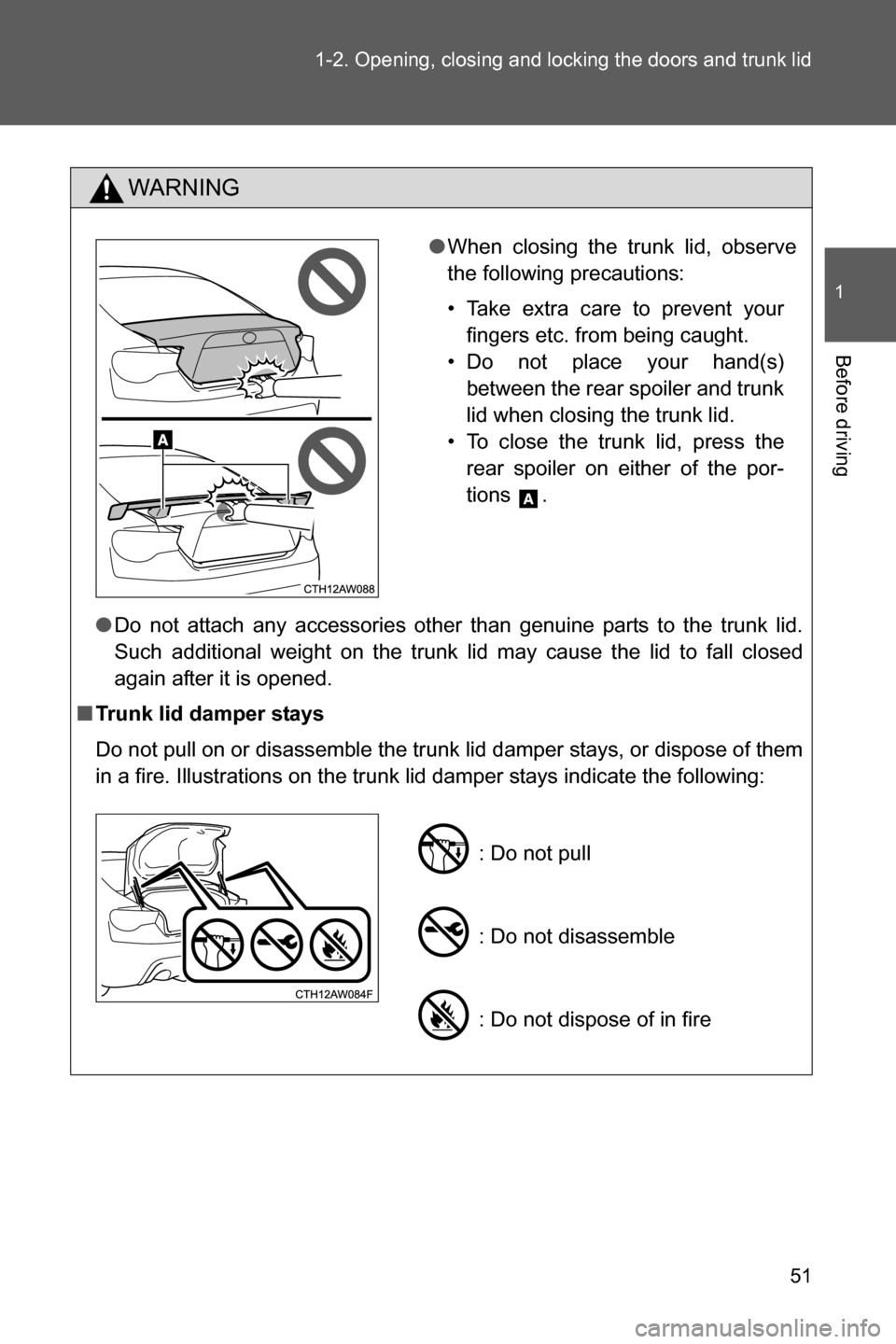
●Do not attach any accessories other than genuine parts to the trunk lid.
Such additional weight on the trunk lid may cause the lid to fall closed
again after it is opened.
■Trunk lid damper stays
Do not pull on or disassemble the trunk lid damper stays, or dispose of them
in a fire. Illustrations on the trunk lid damper stays indicate the following:
●When closing the trunk lid, observe
the following precautions:
• Take extra care to prevent your
fingers etc. from being caught.
• Do not place your hand(s)
between the rear spoiler and trunk
lid when closing the trunk lid.
• To close the trunk lid, press the
rear spoiler on either of the por-
tions .
: Do not pull
: Do not disassemble
: Do not dispose of in fire
Page 170 of 540

168 2-1. Driving procedures
CAUTION
■Replacement of brake pad and lining
If you continue to drive despite the scraping noise from the audible brake
pad wear indicator, it will result in the need for costly brake rotor repair or
replacement.
■Breaking-in of new brake pads and linings
Pulling the parking brake lever too forcefully may cause the rear wheels to
lock. To avoid this, be certain to pull the lever up slowly and gently.
■If you get a flat tire while driving
A flat or damaged tire may cause the following situations. Hold the steering
wheel firmly and gradually depress the brake pedal to slow down the vehicle.
●It may be difficult to control your vehicle.
●The vehicle will make abnormal sounds or vibrations.
●The vehicle will lean abnormally.
Information on what to do in case of a flat tire (oP. 431)
■When encountering flooded roads
Do not drive on a road that has flooded after heavy rain etc. Doing so may
cause the following serious damage to the vehicle:
●Engine stalling
●Short in electrical components
●Engine damage caused by water immersion
In the event that you drive on a flooded road and the vehicle is flooded, be
sure to have your SUBARU dealer check the following:
●Brake function
●Changes in quantity and quality of oil and fluid used for the engine, trans-
mission, differential, etc.
●Lubricant condition for the propeller shaft, bearings and suspension joints
(where possible) and the function of all joints, bearings, etc.
Page 187 of 540

185 2-1. Driving procedures
2
When driving
However, even when in manual mode, the gears will be automatically
changed in the following situations:
●When vehicle speed drops (downshift only).
●When engine oil temperature is high and engine speed rises close
to the red zone.
■When moving the select lever out of P
If the select lever is pushed sideways before the brake pedal is depressed,
select lever operation may not be possible. Depress the brake pedal before
shifting the select lever out of P.
■Downshifting restrictions warning buzzer
If downshifting operations are performed at a vehicle speed by which down-
shifting is not possible (when downshifting will cause the engine speed to
enter the red zone), a buzzer will sound to warn the driver that downshifting
cannot be performed.
■When driving with cruise control activated
Downshifting can be performed even when using cruise control. After down-
shifting, the set speed continues. (oP. 184, 186)
■Sport mode
●In sport mode, lower gears are used and gears change at a higher
engine speed.
●If sport mode is changed to while the select lever is in the M position, the
“SPORT” indicator will come on but sport mode controls will not be car-
ried out. Shift the select lever to the D position.
●Sport mode cannot be changed to when driving with cruise control acti-
vated.
■Snow mode
To prevent slipping, 1
st gear cannot be selected when in snow mode.
■Sport mode and snow mode automatic deactivation
In the following situations, the driving mode is automatically deactivated:
●When the engine is turned off after driving in sport mode or snow mode.
●When cruise control is activated while driving in sport mode.
Page 220 of 540
218 2-2. Instrument cluster
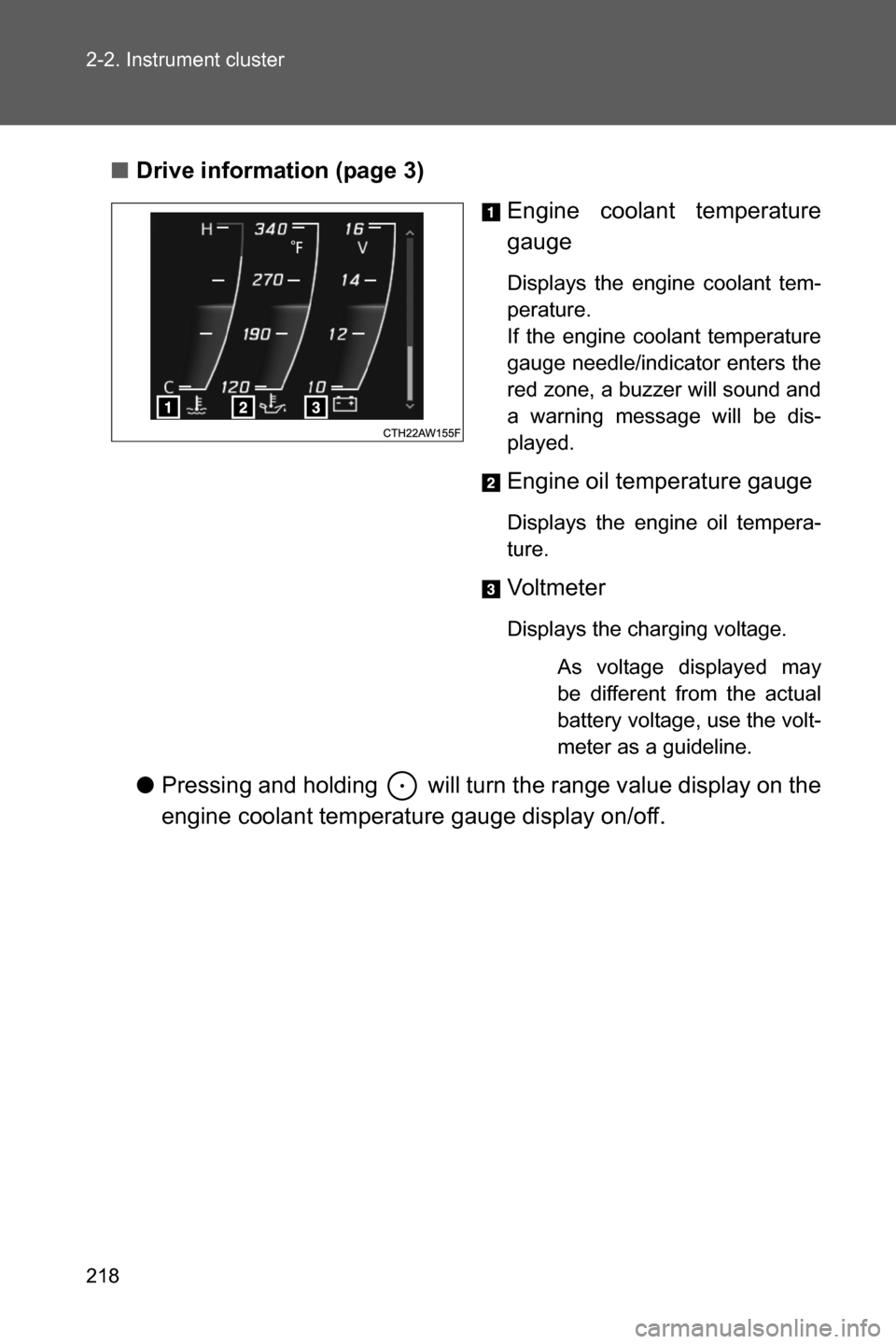
■Drive information (page 3)
Engine coolant temperature
gauge
Displays the engine coolant tem-
perature.
If the engine coolant temperature
gauge needle/indicator enters the
red zone, a buzzer will sound and
a warning message will be dis-
played.
Engine oil temperature gauge
Displays the engine oil tempera-
ture.
Vol tm e te r
Displays the charging voltage.
As voltage displayed may
be different from the actual
battery voltage, use the volt-
meter as a guideline.
●Pressing and holding will turn the range value display on the
engine coolant temperature gauge display on/off.
Page 270 of 540
268
2-5. Driving information
Winter driving tips
Carry out the necessary preparations and inspections before driving
the vehicle in winter. Always drive the vehicle in a manner appropri-
ate to the prevailing weather conditions.
■Pre-winter preparations
●Use fluids that are appropriate to the prevailing outside tem-
peratures.
• Engine oil
• Washer fluid
●Have a service technician inspect the condition of the battery.
●Have the vehicle fitted with four snow tires.
Make sure to install 4 tires that are of the specified size, and that
all 4 tires are the same for the following items:
•Size
• Circumference
• Speed symbol
• Load index
• Construction
• Manufacturer
• Brand (tread pattern)
• Degrees of wear
Also, make sure to use tire chains that match the size of the tires.
■Before driving the vehicle
Perform the following according to the driving conditions.
●Do not try to forcibly open a window or move a wiper that is
frozen. Pour warm water over the frozen area to melt the ice.
Wipe away the water immediately to prevent it from freezing.
●To ensure proper operation of the climate control system fan,
remove any snow that has accumulated on the air inlet vents
in front of the windshield.
Page 317 of 540

315 4-1. Maintenance and care
4
Maintenance and care
■Automatic car washes
●Fold the mirrors before washing the vehicle. Start washing from the front
of the vehicle. Make sure to and extend the mirrors before driving.
●When having your vehicle washed in an automatic car wash, make sure
beforehand that the car wash is of suitable type to avoid scratches to the
vehicle surface and harm to your vehicle’s paint.
●Vehicles with a rear spoiler: In certain automatic car washes, the rear
spoiler may interfere with machine operation. This may prevent the vehi-
cle from being cleaned properly or result in damage to the rear spoiler.
■High pressure car washes
●Do not allow the nozzles of the car wash to come within close proximity
of the windows and door frames as water may enter the cabin.
●Before using the car wash, check that the fuel filler lid on your vehicle is
closed properly.
■Aluminum wheels
●Remove any dirt immediately by using a neutral detergent. Do not use
hard brushes or abrasive cleaners. Do not use strong or harsh chemical
cleaners. Use the same mild detergent and wax as used on the paint.
●Do not use detergent on the wheels when they are hot, for example after
driving for long distance in the hot weather.
●Wash detergent from the wheels immediately after use.
■Parts containing resin such as the bumper
Do not scrub with abrasive cleaners.
■When washing the vehicle
Wear rubber gloves and use a hand brush when washing down underbody,
inner fenders and suspension to effectively remove mud and dirt off.
Page 318 of 540

316 4-1. Maintenance and care
WARNING
■When washing the vehicle
●Do not wash the engine compartment and area adjacent to it. If water
enters the engine air intake or electrical parts it will cause engine trouble or
a malfunction of the power steering.
●When washing the vehicle, the brakes may get wet. As a result, the brake
stopping distance will be longer. To dry the brakes, drive the vehicle at a
safe speed while lightly depressing the brake pedal to heat up the brakes.
●When washing inner fenders, underbody, bumpers and protruding objects
such as exhaust pipes and exhaust finishers, be careful to prevent injuries
from contacting sharp ends.
■Precautions regarding the exhaust pipes
Exhaust gasses cause the exhaust pipes and rear bumper diffusers to
become quite hot.
When washing the vehicle, be careful not to touch the pipes and diffusers
until they have cooled sufficiently, as touching hot exhaust pipes and rear
bumper diffusers can cause burns.
CAUTION
■To prevent paint deterioration and corrosion on the body and compo-
nents (aluminum wheels etc.)
●Wash the vehicle immediately in the following cases:
• After driving near the sea coast
• After driving on salted roads
• If you see coal tar or tree sap on the paint surface
• If you see dead insects, insect droppings or bird droppings on the paint
• After driving in an area contaminated with soot, oily smoke, mine dust,
iron powder or chemical substances
• If the vehicle becomes heavily soiled in dust or mud
• If liquids such as benzene and gasoline are spilled on the paint surface
●If the paint is chipped or scratched, have it repaired immediately.
●To prevent the wheels from corroding, remove any dirt and store in a place
with low humidity when storing the wheels.
Page 322 of 540

320 4-1. Maintenance and care
CAUTION
■Cleaning detergents
●Do not use organic substances such as benzene or gasoline, acidic or
alkaline solutions, dye, bleach or other detergent. Doing so may discolor
the vehicle interior or cause streaks or damage to painted surfaces.
●Do not use polish wax or polish cleaner. The instrument panel's or other
interior part’s painted surface may be damaged.
●Do not use a chemical agent containing silicone (highly-polymerized sili-
con compound) when cleaning any of the electrical appliances such as the
air conditioning, all switches and their surrounding areas.
If silicon (highly-polymerized silicon compound) contacts these compo-
nents, it may cause the electrical appliances to malfunction.
■Preventing damage to leather surfaces
Observe the following precautions to avoid damage to and deterioration of
leather surfaces.
●Remove any dust, dirt, sand, oil spots etc. on leather surfaces immedi-
ately.
●Do not expose the vehicle to direct sunlight for extended periods of time.
Park the vehicle in the shade, especially during summer.
●Do not place items made of vinyl, plastic, or that contain wax on the uphol-
stery, as they may stick to the leather surface if the vehicle interior heats
up significantly.
■Water on the floor
Do not wash the vehicle floor with water.
Vehicle systems such as the audio system may be damaged if water comes
into contact with electrical components under the floor of the vehicle, and
may also cause the body to rust.