warning SUBARU BRZ 2019 Owners Manual
[x] Cancel search | Manufacturer: SUBARU, Model Year: 2019, Model line: BRZ, Model: SUBARU BRZ 2019Pages: 560, PDF Size: 8.9 MB
Page 352 of 560
352 4-3. Do-it-yourself maintenance
BRZ_U
WARNING
The engine compartment contains many mechanisms and fluids that may
move suddenly, become hot, or become electrically energized. To avoid death
or serious injury, observe the following precautions.
■When working in the engine compartment
●Keep hands, clothing, and tools away from the moving fan and engine
drive belt.
● Be careful not to touch the engine, radiator, exhaust manifold, etc. right
after driving as they may be hot. Oil and other fluids may also be hot.
● Do not leave anything that may burn easily, such as paper or rags, in the
engine compartment.
● Do not smoke, cause sparks or expose an open flame to fuel or the bat-
tery. Fuel and battery fumes are flammable.
● Be extremely cautious when working on the battery. It contains poisonous
and corrosive sulfuric acid.
■ When working near the electric cooling fans or radiator grille
Vehicles without a keyless access with push button start system: Be sure the
engine switch is off. With the engine switch in the “ON” position, the electric
cooling fans may automatically start to run if the air conditioning is on and/or
the coolant temperature is high. ( →P. 361)
Vehicles with a keyless access with push button start system: Be sure the
push-button ignition switch is off. With the push-button ignition switch in
“ON” mode, the electric cooling fans may automatically start to run if the air
conditioning is on and/or the coolant temperature is high. ( →P. 361)
■ Safety glasses
Wear safety glasses to prevent flying or falling material, fluid spray, etc. from
getting in the eyes.
CAUTION
■If you remove the air cleaner element
Driving with the air cleaner element removed may cause excessive engine
wear due to dirt in the air. Also a backfire could cause a fire in the engine
compartment.
Page 354 of 560
354 4-3. Do-it-yourself maintenance
BRZ_U
WARNING
■Pre-driving check
Check that the engine hood is fully closed and locked.
If the engine hood is not locked properly it may open while the vehicle is in
motion and cause an accident, which may result in death or serious injury.
CAUTION
■When opening the engine hood
●Do not lift up or operate the wipers. Doing so may cause the engine hood
and wipers to contact, scratching the engine hood.
● Use caution when opening the engine hood in windy weather as it may
close suddenly in strong wind.
● Do not attach any accessories other than genuine SUBARU products to
the engine hood. Such additional weight on the engine hood may cause it
to be too heavy to be supported by the supporting rod when opened.
■ When closing the engine hood
Do not apply excessive weight or force when closing the engine hood as
doing so may result in damage.
Page 358 of 560
358 4-3. Do-it-yourself maintenance
BRZ_U
●When the engine is operated at high engine speeds (for extended peri-
ods of time)
● When the engine is operated under heavy loads (for extended periods of
time)
● When the engine idles for extended periods of time
● When the vehicle is operated in stop and go and/or heavy traffic situa-
tions
● When the vehicle is used under severe thermal conditions
● When the vehicle accelerates and decelerates frequently
Under these or similar conditions, you should check your oil at least every
2nd fuel fill-up and change your engine oil more frequently. Different drivers
in the same car may experience different results. If your oil consumption rate
is greater than expected, contact your authorized SUBARU retailer who may
perform a test under controlled conditions.
WARNING
■ Used engine oil
●Used engine oil contains potentially harmful contaminants which may
cause skin disorders such as inflammation or skin cancer, so care should
be taken to avoid prolonged and repeated contact. To remove used engine
oil from your skin, wash thoroughly with soap and water.
● Dispose of used oil and filters only in a safe and acceptable manner. Do
not dispose of used oil and filters in household trash, in sewers or onto the
ground.
Call your SUBARU dealer, service station or auto parts store for informa-
tion concerning recycling or disposal.
● Do not leave used engine oil within the reach of children.
Page 360 of 560
360 4-3. Do-it-yourself maintenance
BRZ_U
■Coolant selection
Only use SUBARU Super Coolant or similar high-quality ethylene glycol-
based non-silicate, non-amine, non-nitrite, and non-borate coolant with long-
life hybrid organic acid technology.
SUBARU Super Coolant is a mixture of 50% coolant and 50% deionized
water. (Enabled: -31 °F [-35 °C])
For more details about engine coolant, contact your SUBARU dealer.
WARNING
■ When the engine is hot
Do not remove the radiator cap.
The cooling system may be under pressure and may spray hot coolant if the
cap is removed, causing serious injuries, such as burns.
CAUTION
■When adding engine coolant
Coolant is neither plain water nor straight antifreeze. The correct mixture of
water and antifreeze must be used to provide proper lubrication, corrosion
protection and cooling. Be sure to read the antifreeze or coolant label.
■ If you spill coolant
Be sure to wash it off with water to prevent it damaging parts or paint.
Page 361 of 560
361
4-3. Do-it-yourself maintenance
4
Maintenance and care
BRZ_U
Radiator and condenser
Check the radiator and condenser and clear away any foreign
objects.
If either of the above parts are extremely dirty or you are not sure of
their condition, have your vehicle checked by your SUBARU dealer.
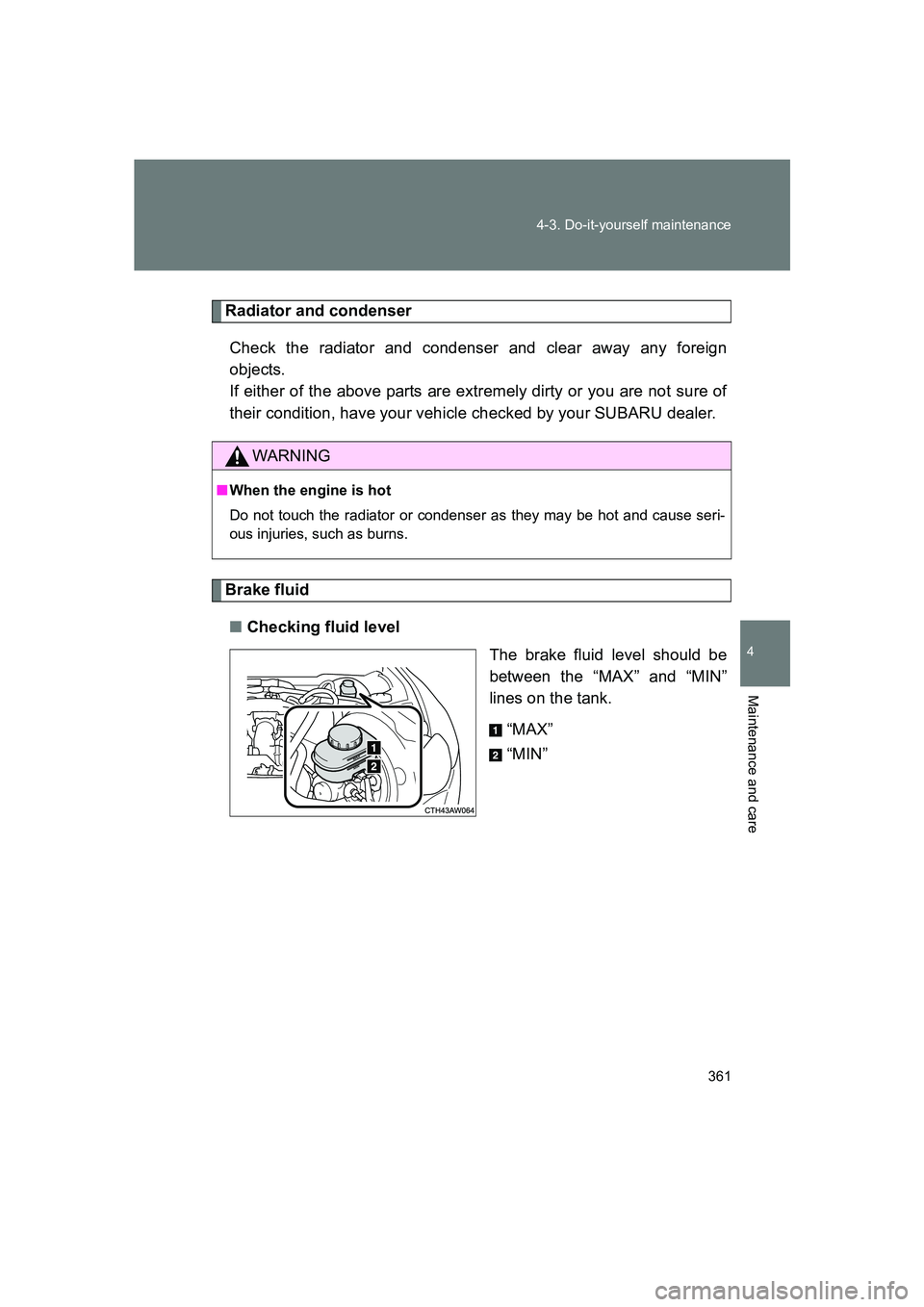
Brake fluid■ Checking fluid level
The brake fluid level should be
between the “MAX” and “MIN”
lines on the tank.
“MAX”
“MIN”
WARNING
■When the engine is hot
Do not touch the radiator or condenser as they may be hot and cause seri-
ous injuries, such as burns.
Page 362 of 560
362 4-3. Do-it-yourself maintenance
BRZ_U■
Adding fluid
Make sure to check the fluid type and prepare the necessary items.
Fluid type
FMVSS No.116 DOT 3 or DOT 4 brake fluid
ItemsClean funnel
■ Brake fluid can absorb moisture from the air
Excess moisture in the fluid can cause a dangerous loss of braking effi-
ciency. Use only newly opened brake fluid.
WARNING
■When filling the reservoir
Take care because brake fluid can harm your hands or eyes and damage
painted surfaces.
If fluid gets in your eyes, flush your eyes with clean water immediately.
If you still experience discomfort, see a doctor.
CAUTION
■If the fluid level is low or high
It is normal for the brake fluid level to go down slightly as the brake pads
wear or when the fluid level in the accumulator is high.
If the reservoir needs frequent refilling, it may indicate a serious problem.
Page 366 of 560
366 4-3. Do-it-yourself maintenance
BRZ_U
WARNING
■Chemicals in the battery
A battery contains poisonous and corrosive sulfuric acid and may produce
hydrogen gas which is flammable and explosive. To reduce the risk of death
or serious injury, take the following precautions while working on or near the
battery:
●Do not cause sparks by touching the battery terminals with tools.
● Do not smoke or light a match near the battery.
● Avoid contact with eyes, skin and clothes.
● Never inhale or swallow electrolyte.
● Wear protective safety glasses when working near the battery.
● Keep children away from the battery.
■ Where to safely charge the battery
Always charge the battery in an open area. Do not charge the battery in a
garage or closed room where there is not sufficient ventilation.
■ Emergency measures regarding electrolyte
●If electrolyte gets in your eyes
Flush your eyes with clean water for at least 15 minutes and get immedi-
ate medical attention. If possible, continue to apply water with a sponge or
cloth while traveling to the nearest medical facility.
● If electrolyte gets on your skin
Wash the affected area thoroughly. If you feel pain or burning, get medical
attention immediately.
● If electrolyte gets on your clothes
It can soak through clothing on to your skin. Immediately take off the cloth-
ing and follow the procedure above if necessary.
● If you accidentally swallow electrolyte
Drink a large quantity of water or milk. Get emergency medical attention
immediately.
Page 368 of 560
368 4-3. Do-it-yourself maintenance
BRZ_U
WARNING
■When adding washer fluid
Do not add washer fluid when the engine is hot or running, as washer fluid
contains alcohol and may catch fi re if spilled on the engine etc.
CAUTION
■Washer fluid
Do not use soapy water or engine antifreeze instead of washer fluid.
Doing so may cause streaking on the vehicle’s painted surfaces, as well as
damaging the pump leading to problems of the washer fluid not spraying.
■ Diluting washer fluid
Dilute washer fluid with water as necessary.
Refer to the freezing temperatures listed on the label of the washer fluid bot-
tle.
Page 370 of 560
370 4-3. Do-it-yourself maintenance
BRZ_U
Installing tire pressure warning valves and transmitters (vehicles
with a tire pressure monitoring system)When replacing tires or wheels, tire pressure warning valves and
transmitters must also be installed.
When new tire pressure warning valves and transmitters are
installed, new tire pressure warning valve and transmitter ID codes
must be registered in the tire pressure warning computer and tire
pressure monitoring system must be initialized. Have tire pressure
warning valve and transmitter ID codes registered by your SUBARU
dealer. ( →P. 371)
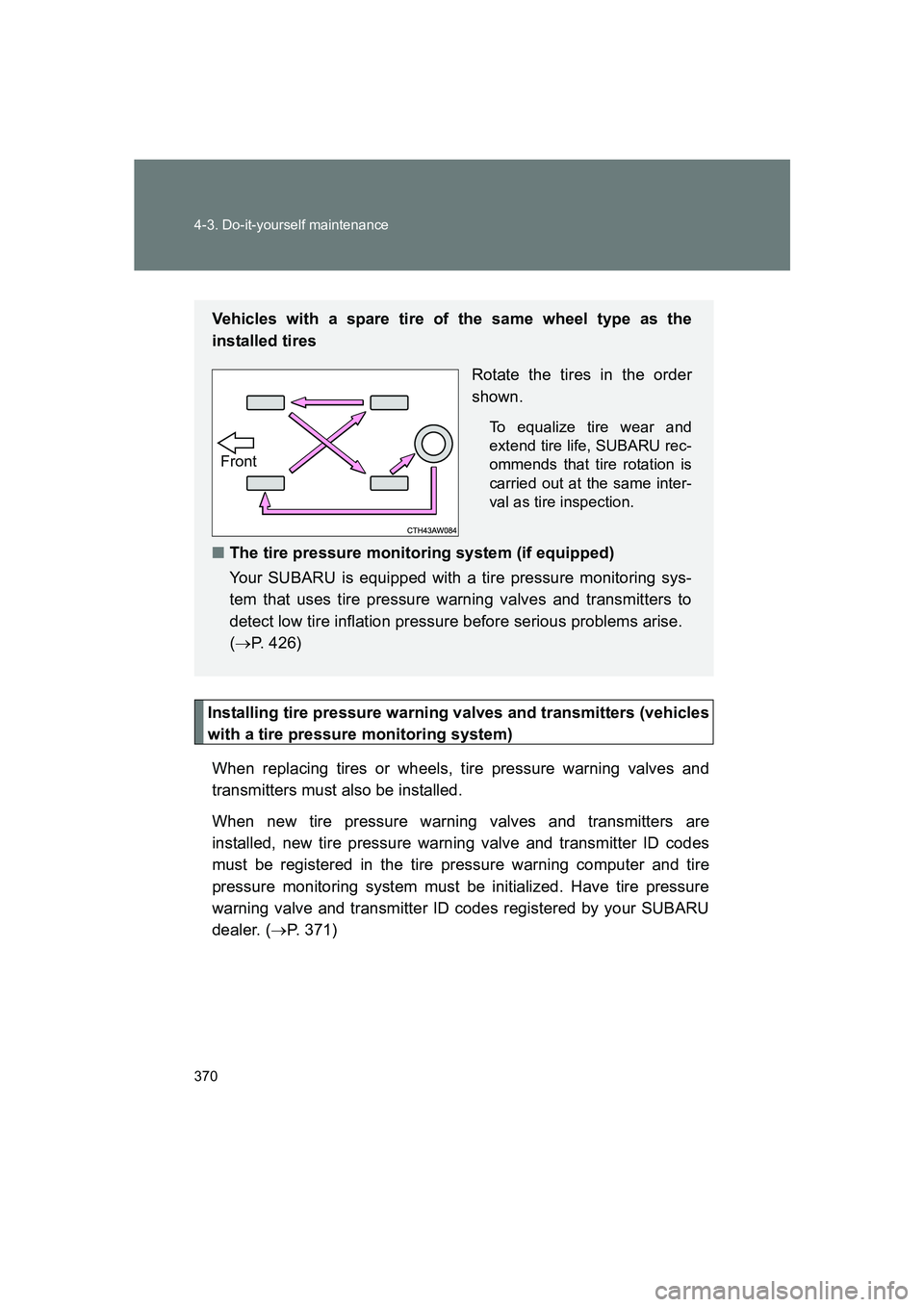
Vehicles with a spare tire of the same wheel type as the
installed tires
Rotate the tires in the order
shown.
To equalize tire wear and
extend tire life, SUBARU rec-
ommends that tire rotation is
carried out at the same inter-
val as tire inspection.
■The tire pressure monitoring system (if equipped)
Your SUBARU is equipped with a tire pressure monitoring sys-
tem that uses tire pressure warning valves and transmitters to
detect low tire inflation pressure before serious problems arise.
(→ P. 426)
Front
Page 371 of 560
371
4-3. Do-it-yourself maintenance
4
Maintenance and care
BRZ_U
Registering ID codes (vehicles with a tire pressure monitoring
system)
The tire pressure warning valve and transmitter is equipped with a
unique ID code. When replacing a tire pressure warning valve and
transmitter, it is necessary to register the ID code. Have the ID code
registered by your SUBARU dealer.
■When to replace your vehicle’s tires
Tires should be replaced if:
●You have tire damage such as cuts, splits, cracks deep enough to
expose the fabric or bulges indicating internal damage
●A tire goes flat repeatedly or cannot be properly repaired due to the
size or location of a cut or other damage
If you are not sure, consult with your SUBARU dealer.
■Replacing tires and wheels (vehicles with a tire pressure monitor-
ing system)
If the ID code of the tire pressure warning valve and transmitter is not
registered, the tire pressure monitoring system will not work properly.
After driving for about 20 minutes, the tire pressure warning light comes
on after blinking for 1 minute to indicate a system malfunction.
■Tire life
Any tire over 6 years old must be checked by a qualified technician even
if they have seldom or never been used or damage is not obvious.
■If the tread wears down below 0.16 in. (4 mm) on snow tires
The effectiveness of snow tires is lost.
■Low profile tires
Generally, low profile tires will wear more rapidly and tire grip perfor-
mance will be reduced on snowy and/or icy roads when compared to
standard tires. Be sure to use snow tires or tire chains on snowy and/or
icy roads and drive carefully at a speed appropriate for road and weather
conditions.