automatic transmission SUBARU BRZ 2019 User Guide
[x] Cancel search | Manufacturer: SUBARU, Model Year: 2019, Model line: BRZ, Model: SUBARU BRZ 2019Pages: 560, PDF Size: 8.9 MB
Page 163 of 560
163
2-1. Driving procedures
2
When driving
BRZ_U
WARNING
●
On vehicles with a manual transmission, do not release the clutch pedal
too quickly. Doing so may propel the vehicle forward, possibly causing an
accident.
● Moving the select lever to N (vehicles with an automatic transmission) or
shift lever to neutral (vehicles with a manual transmission) while the vehi-
cle is moving will disengage the engine from the transmission. Engine
braking is not available when N or neutral is selected.
● During normal driving, do not turn off the engine. Turning the engine off
while driving will not cause loss of steering or braking control, but the
power assist to these systems will be lost. This will make it more difficult to
steer and brake, so you should pull over and stop the vehicle as soon as it
is safe to do so.
● Use engine braking (downshift) to maintain a safe speed when driving
down a steep hill.
Using the brakes continuously may cause the brakes to overheat and lose
effectiveness. ( →P. 186, 192)
● Do not adjust the position of the steering wheel, the seat, or the inside or
outside rear view mirrors while driving.
Doing so may result in a loss of vehicle control that can cause accidents,
resulting in death or serious injury.
● Always check that all passengers' arms, heads or other parts of their body
are not outside the vehicle, as this may result in death or serious injury.
● Do not drive in excess of the speed limit. Even if the legal speed limit per-
mits it, do not drive over 85 mph (140 km/h) unless your vehicle has high-
speed capability tires. Driving over 85 mph (140 km/h) may result in tire
failure, loss of control and possible injury. Be sure to consult a tire dealer
to determine whether the tires on y our vehicle are high-speed capability
tires or not before driving at such speeds.
Page 164 of 560
164 2-1. Driving procedures
BRZ_U
WARNING
■When driving on slippery road surfaces
●Sudden braking, acceleration and steering may cause tire slippage and
reduce your ability to control the vehicle, resulting in an accident.
● Sudden acceleration, engine braking due to shifting, or changes in engine
speed could cause the vehicle to skid, resulting in an accident.
● After driving through a puddle, lightly depress the brake pedal to make
sure that the brakes are functioni ng properly. Wet brake pads may prevent
the brakes from functioning properly. If the brakes on only one side are wet
and not functioning properly, steering control may be affected, resulting in
an accident.
■ When shifting the select lever or shift lever
●On vehicles with an automatic transmission, be careful not to shift the
select lever with the accelerator pedal depressed. Shifting the select lever
to a gear other than P or N may lead to unexpected rapid acceleration of
the vehicle that may cause an accident and result in death or serious
injury.
● Do not place items in the select lever’s or shift lever’s surrounding area. It
may cause incorrect operation.
● If the select lever’s or shift lever’s boot is pulled out during cleaning, return
it to its previous position. If the select lever’s or shift lever’s boot is left
pulled out, the select lever or shift lever may become difficult to operate.
■ If you hear a squealing or scrapin g noise (brake pad wear limit indica-
tors)
Have your SUBARU dealer check and replace the brake pads as soon as
possible.
Rotor damage may result if the pads are not replaced when needed.
It is dangerous to drive the vehicle when the wear limits of the brake pads
and/or those of the brake discs are exceeded. ( →P. 159)
■ Breaking-in of new brake pads and linings
A safe location and situation should be selected for break-in driving.
Page 165 of 560
165
2-1. Driving procedures
2
When driving
BRZ_U
WARNING
■
When the vehicle is stopped
● Do not race the engine.
If the vehicle is in any gear other than P or N (vehicles with an automatic
transmission only) or neutral (vehicles with a manual transmission), the
vehicle may accelerate suddenly and unexpectedly, causing an accident.
● Do not leave the vehicle with the engine running for a long time.
If such a situation cannot be avoided, park the vehicle in an open space
and check that exhaust fumes do not enter the vehicle interior.
● On vehicles with an automatic transmission, in order to prevent accidents
due to the vehicle rolling away, always keep depressing the brake pedal
while the engine is running, and apply the parking brake as necessary.
● If the vehicle is stopped on an incline, in order to prevent accidents caused
by the vehicle rolling forward or backward, always depress the brake pedal
and securely apply the parking brake as needed.
● Avoid revving or racing the engine.
Running the engine at high speed while the vehicle is stopped may cause
the exhaust system to overheat, which could result in a fire if combustible
material is nearby.
Page 166 of 560
166 2-1. Driving procedures
BRZ_U
WARNING
■When the vehicle is parked
●Do not leave glasses, cigarette lighters, spray cans, or soft drink cans in
the vehicle when it is in the sun.
Doing so may result in the following:
• Gas may leak from a cigarette lighter or spray can, and may lead to a
fire.
• The temperature inside the vehicle may cause the plastic lenses and plastic material of glasses to deform or crack.
• Soft drink cans may fracture, causing the contents to spray over the interior of the vehicle, and may also cause a short circuit in the vehi-
cle's electrical components.
● Do not leave cigarette lighters in the vehicle. If a cigarette lighter is in a
place such as the glove box or on the floor, it may be lit accidentally when
luggage is loaded or the seat is adjusted, causing a fire.
● Do not attach suction cups to the windshield or windows. Do not place
containers such as air fresheners on the instrument panel or dashboard.
Suction cups or containers may act as lenses, causing a fire in the vehicle.
● Do not leave a door or window open if the curved glass is coated with a
metallized film such as a silver-colored one. Reflected sunlight may cause
the glass to act as a lens, causing a fire.
● Always apply the parking brake, shift the select lever to P (vehicles with an
automatic transmission only), stop the engine and lock the vehicle.
Do not leave the vehicle unattended while the engine is running.
● Do not touch the exhaust pipe while the engine is running or immediately
after turning the engine off.
Doing so may cause burns.
● Do not leave the engine running in an ar ea with snow build-up, or where it
is snowing. If snowbanks build up around the vehicle while the engine is
running, exhaust gases may collect and enter the vehicle. This may lead
to death or a serious health hazard.
Page 168 of 560
168 2-1. Driving procedures
BRZ_U
WARNING
■When braking
●When the brakes are wet, drive more cautiously.
Braking distance increases when the brakes are wet, and this may cause
one side of the vehicle to brake differently than the other side. Also, the
parking brake may not securely hold the vehicle.
● If the brake booster device does not operate, do not follow other vehicles
closely and avoid hills or sharp turns that require braking.
In this case, braking is still possible, but the brake pedal should be
depressed more firmly than usual. Also, the braking distance will increase.
Have your brakes fixed immediately.
● Do not pump the brake pedal if the engine stalls.
Each push on the brake pedal uses up the reserve for the power-assisted
brakes.
● The brake system consists of 2 individual hydraulic systems; if one of the
systems fails, the other will still operate. In this case, the brake pedal
should be depressed more firmly than usual and the braking distance will
increase.
Have your brakes fixed immediately.
CAUTION
■Pre-driving check
Trapping small animals in the cooling fan and belts of the engine may result
in a malfunction. Check that no small animal enters the engine compartment
and under the vehicle before starting the engine.
■ When driving the vehicle
Vehicles with an automatic transmission
●If the accelerator and brake pedals are depressed at the same time, driv-
ing torque may be restrained. This is not a malfunction.
● Do not use the accelerator pedal or depress the accelerator and brake
pedals at the same time to hold the vehicle on a hill.
Page 169 of 560
169
2-1. Driving procedures
2
When driving
BRZ_U
CAUTION
Vehicles with a manual transmission
●
If the accelerator and brake pedals are depressed at the same time, driv-
ing torque may be restrained. This is not a malfunction.
● Do not shift gears unless the clutch pedal is fully depressed. After shifting,
do not release the clutch pedal abruptly. Doing so may damage the clutch,
transmission and gears.
● Observe the following to prevent the clutch from being damaged.
• Do not rest your foot on the clutch pedal while driving.
Doing so may cause clutch trouble.
• Do not use any gear other than the 1st gear when starting off and mov- ing forward.
Doing so may damage the clutch.
• Do not use the clutch to hold the vehicle when stopping on an uphill grade.
Doing so may damage the clutch.
● Do not shift the shift lever to R when the vehicle is still moving. Doing so
may damage the clutch, transmission and gears.
● Do not release the clutch pedal too quickly. Doing so may damage the
transmission.
■ When parking the vehicle
● Vehicles with an automatic transmission: Always shift the select lever to P.
Failure to do so may cause the vehicle to move or the vehicle may accel-
erate suddenly if the accelerator pedal is accidentally depressed. Also set
the parking brake.
● When parking the vehicle, be careful not to contact a wheel stop, etc. as
doing so may damage the bumpers, underside of the vehicle, etc.
Page 170 of 560
170 2-1. Driving procedures
BRZ_U
CAUTION
■Avoiding damage to vehicle parts
●Do not turn the steering wheel fully in either direction and hold it there for
an extended period of time.
Doing so may damage the power steering motor.
● When driving over bumps in the road, drive as slowly as possible to avoid
damaging the wheels, underside of the vehicle, etc.
● On vehicles with an automatic transmission, do not race the engine for
more than 5 seconds in any position except the N or P position when the
brake is applied or when chocks are used in the wheels. This may cause
the transmission fluid to overheat.
■ Replacement of brake pad and lining
If you continue to drive despite the scraping noise from the audible brake
pad wear indicator, it will result in the need for costly brake rotor repair or
replacement.
■ Breaking-in of new brake pads and linings
Pulling the parking brake lever too forcefully may cause the rear wheels to
lock. To avoid this, be certain to pull the lever up slowly and gently.
■ If you get a flat tire while driving
A flat or damaged tire may cause the following situations. Hold the steering
wheel firmly and gradually depress the brake pedal to slow down the vehicle.
●It may be difficult to control your vehicle.
● The vehicle will make abnormal sounds or vibrations.
● The vehicle will lean abnormally.
Information on what to do in case of a flat tire ( →P. 451)
Page 172 of 560
172
2-1. Driving procedures
BRZ_U
Push-button ignition switch (vehicles with a keyless access with push button star t system)
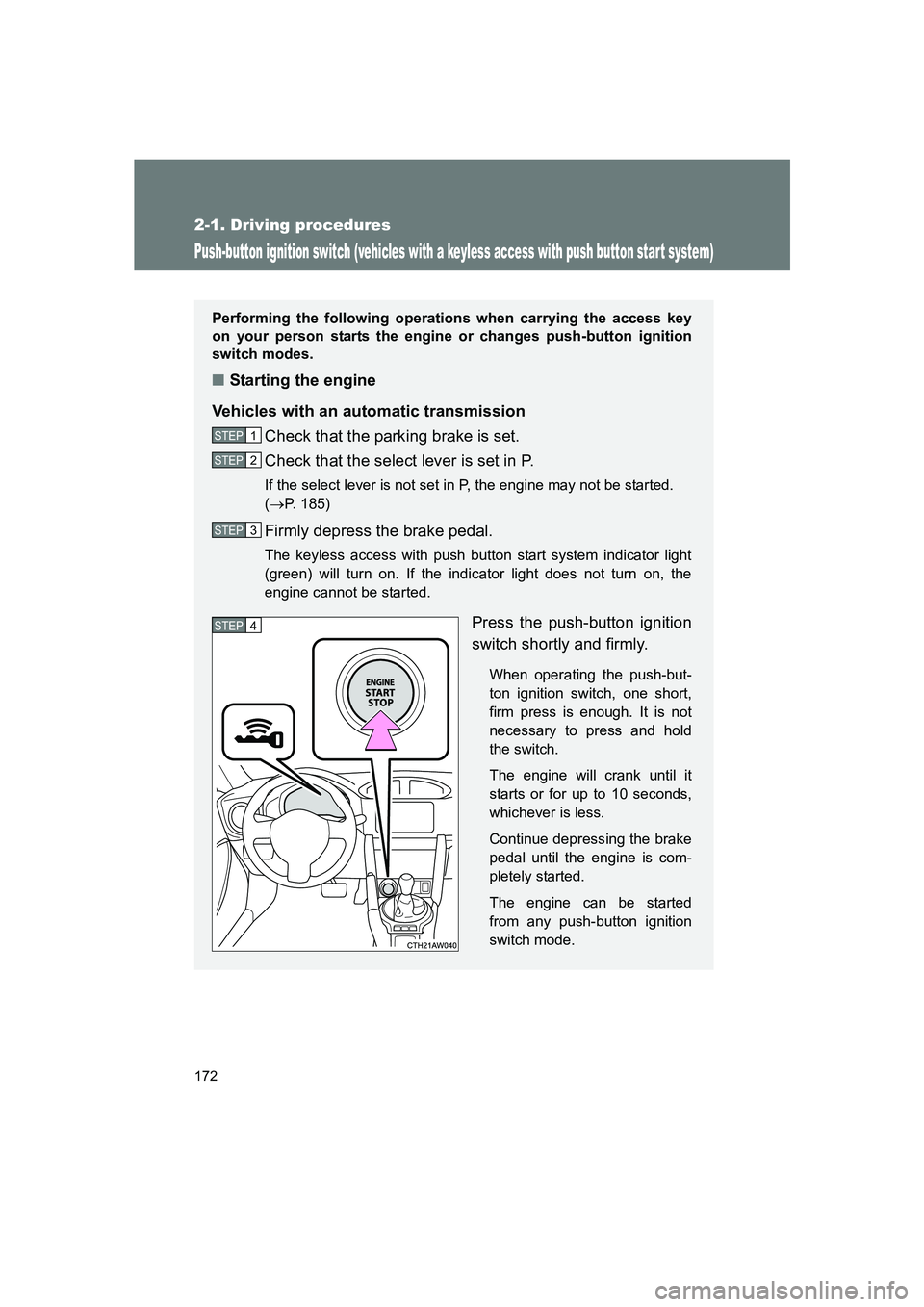
Performing the following operations when carrying the access key
on your person starts the engine or changes push-button ignition
switch modes.
■Starting the engine
Vehicles with an automatic transmission Check that the parking brake is set.
Check that the select lever is set in P.
If the select lever is not set in P, the engine may not be started.
(→ P. 185)
Firmly depress the brake pedal.
The keyless access with push button start system indicator light
(green) will turn on. If the indicator light does not turn on, the
engine cannot be started.
Press the push-button ignition
switch shortly and firmly.
When operating the push-but-
ton ignition switch, one short,
firm press is enough. It is not
necessary to press and hold
the switch.
The engine will crank until it
starts or for up to 10 seconds,
whichever is less.
Continue depressing the brake
pedal until the engine is com-
pletely started.
The engine can be started
from any push-button ignition
switch mode.
STEP 1
STEP 2
STEP 3
STEP 4
Page 174 of 560
174 2-1. Driving procedures
BRZ_U
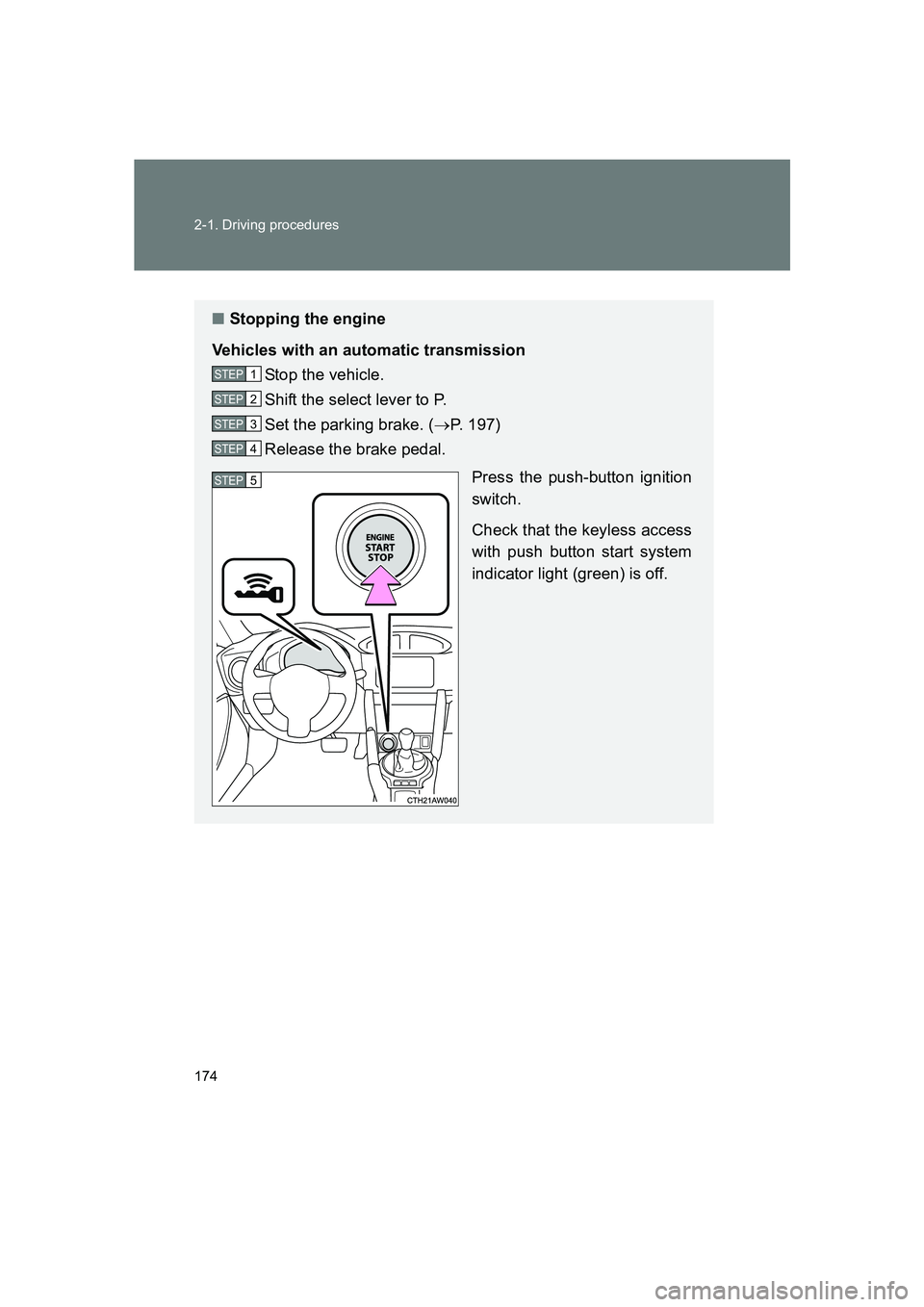
■Stopping the engine
Vehicles with an automatic transmission Stop the vehicle.
Shift the select lever to P.
Set the parking brake. ( →P. 197)
Release the brake pedal.
Press the push-button ignition
switch.
Check that the keyless access
with push button start system
indicator light (green) is off.
STEP 1
STEP 2
STEP 3
STEP 4
STEP 5
Page 176 of 560
176 2-1. Driving procedures
BRZ_U
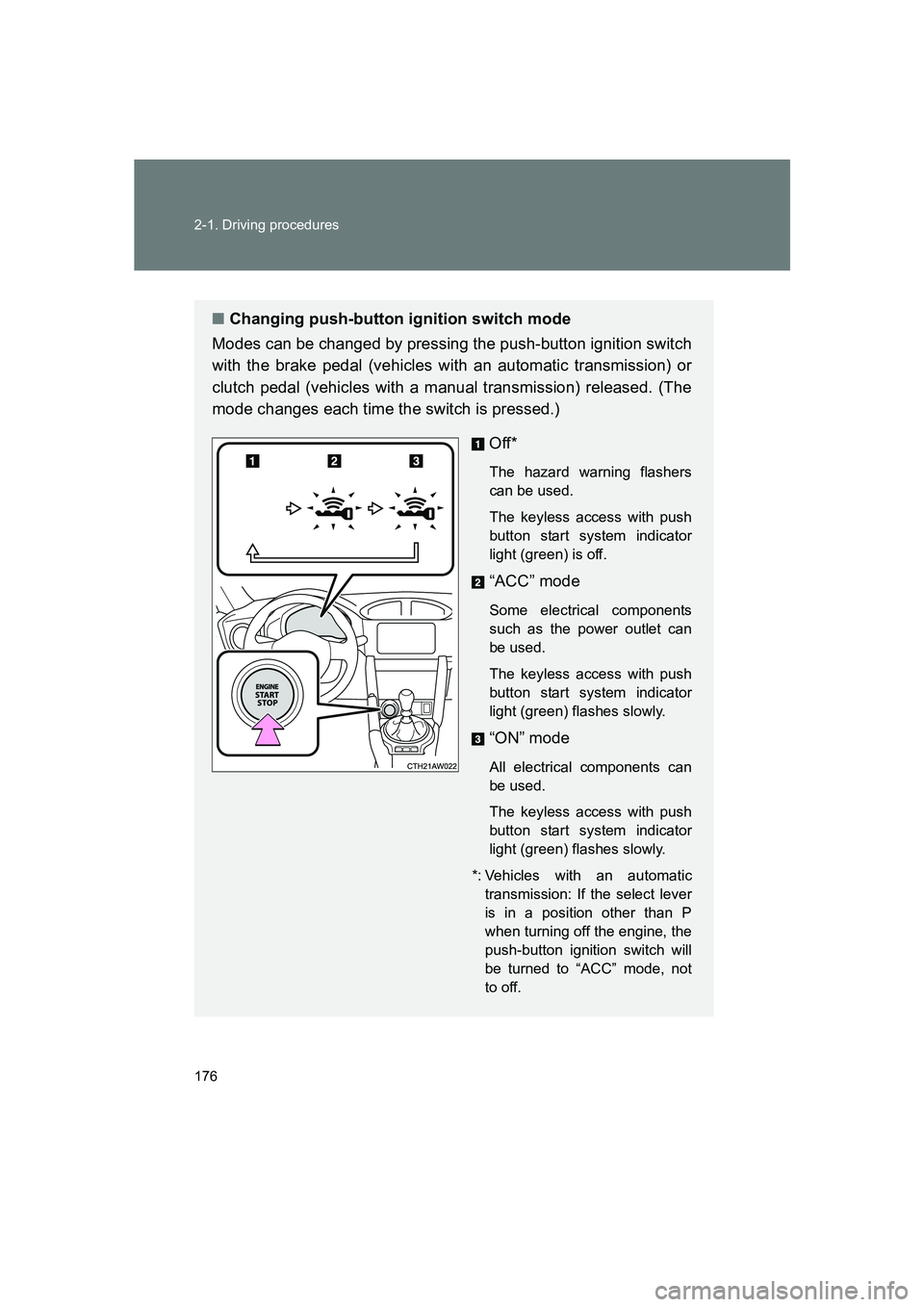
■Changing push-button ignition switch mode
Modes can be changed by pressing the push-button ignition switch
with the brake pedal (vehicles with an automatic transmission) or
clutch pedal (vehicles with a manual transmission) released. (The
mode changes each time the switch is pressed.)
Off*
The hazard warning flashers
can be used.
The keyless access with push
button start system indicator
light (green) is off.
“ACC” mode
Some electrical components
such as the power outlet can
be used.
The keyless access with push
button start system indicator
light (green) flashes slowly.
“ON” mode
All electrical components can
be used.
The keyless access with push
button start system indicator
light (green) flashes slowly.
*: Vehicles with an automatic transmission: If the select lever
is in a position other than P
when turning off the engine, the
push-button ignition switch will
be turned to “ACC” mode, not
to off.