warning SUBARU BRZ 2019 Workshop Manual
[x] Cancel search | Manufacturer: SUBARU, Model Year: 2019, Model line: BRZ, Model: SUBARU BRZ 2019Pages: 560, PDF Size: 8.9 MB
Page 139 of 560
139
1-7. Safety information
1
Before driving
BRZ_U
WARNING
■
Front passenger occupant detection system precautions
Observe the following precautions regarding front passenger occupant
detection system.
Failure to do so may cause the occupant detection system to not function
correctly, resulting in death or serious injury.
● Wear the seatbelt properly.
● Do not apply excessive force to the seat.
● Do not put sharp object(s) on the seat or pierce the seat upholstery.
● Do not put objects under the front passenger seat.
● Do not use a seat accessory, such as a cushion or seat cover, that covers
the seat cushion surface.
● Do not spill liquid on the front passenger seat. If liquid is spilled, wipe it off
immediately and dry the seat. If the airbag warning light illuminates, dry
the seat until the warning light turns off. If the airbag warning light stays on
even when the seat has dried, do not allow anyone to sit on the front pas-
senger seat and have the system checked by your SUBARU dealer. If the
airbag warning light does not illuminate, check that the airbag ON/OFF
indicator light works properly. If the indicator light does not work properly,
do not allow anyone to sit in the front passenger’s seat and have the sys-
tem inspected by your SUBARU dealer.
● Do not remove or disassemble the front passenger seat. Also, do not
replace or modify the seat upholstery or foam inside the seat.
● Do not install any accessory (such as an audio amplifier) other than a gen-
uine SUBARU accessory under the front passenger’s seat.
● Do not place a magnetized items near the seatbelt buckle.
Page 140 of 560
140 1-7. Safety information
BRZ_U
WARNING
■Front passenger occupant detection system precautions
●Never install a rearward facing child seat in the front passenger’s seat
even if the front passenger’s SRS frontal airbag is deactivated. Be sure to
install it in the rear seat in a correct manner. Also, it is strongly recom-
mended that any forward facing child seat or booster seat be installed in
the rear seat, and that even children who have outgrown a child restraint
system be also seated in the rear seat. This is because children sitting in
the front passenger’s seat may be killed or severely injured should the
front passenger’s SRS frontal airbag deploy. SUBARU believes that the
rear seats are the safest place for children
● If luggage or electronic devices are placed on the front passenger seat,
the OFF indicator may turn off and the ON indicator may illuminate. If this
occurs, the front passenger’s airbag may deploy during a collision. If this is
not desirable, remove the luggage or el ectronic devices from the front pas-
senger seat.
● Modifications for persons wi th disabilities that may affect the front passen-
ger occupant detection system. (U.S. onl y) Removing, replacing or modify-
ing any parts of the front seats, seatbelts, front bumper, front side frame,
instrument panel, combination meter, steering wheel, steering column,
tires, suspension or floor panel can affect the operation of the SUBARU
front passenger occupant detection system.
Page 144 of 560
144 1-7. Safety information
BRZ_U
WARNING
■Child restraint precautions
●For effective protection in automobile accidents and sudden stops, a child
must be properly restrained, using a seatbelt or child restraint system
depending on the age and size of the child. Holding a child in your arms is
not a substitute for a child restraint system. In an accident, the child can be
crushed against the windshield, or bet ween you and the vehicle's interior.
● SUBARU strongly urges the use of a proper child restraint system that
conforms to the size of the child, installed on the rear seat. According to
accident statistics, the child is safer when properly restrained in the rear
seat than in the front seat.
● Never install a rear-facing child restraint system on the front passenger
seat even if the “AIR BAG OFF” indicator light is illuminated. In the event
of an accident, the force of the rapid inflation of the front passenger airbag
can cause death or serious injury to the child if the rear-facing child
restraint system is installed on the front passenger seat.
● Do not allow the child to lean his/her head or any part of his/her body
against the door or the area of the seat, front and rear pillars or roof side
rails from which the SRS side airbags or SRS curtain airbags deploy even
if the child is seated in the child restraint system. It is dangerous if the SRS
side airbags and curtain airbags inflate, and the impact could cause death
or serious injury to the child.
● Make sure you have complied with all installation instructions provided by
the child restraint manufacturer and that the system is properly secured. If
it is not secured properly, it may cause death or serious injury to the child
in the event of a sudden stop, sudden swerve or an accident.
Page 145 of 560
145
1-7. Safety information
1
Before driving
BRZ_U
WARNING
■
When children are in the vehicle
Do not allow children to play with the seatbelt. If the seatbelt becomes
twisted around a child’s neck, it may lead to choking or other serious injuries
that could result in death.
If this occurs and the buckle cannot be unfastened, scissors should be used
to cut the belt.
■ When the child restraint system is not in use
● Keep the child restraint system properly secured on the seat even if it is
not in use. Do not store the restraint unsecured in the passenger compart-
ment.
● If it is necessary to detach the child restraint system, remove it from the
vehicle or store it securely in the trunk. This will prevent it from injuring
passengers in the event of a sudden stop, sudden swerve or accident.
Page 153 of 560
153
1-7. Safety information
1
Before driving
BRZ_U
■
When installing a child restraint system with LATCH anchors and a top
tether strap
Depending on the child restraint system's size and shape, if the child
restraint system is installed to the LATCH anchors first, it may not be possi-
ble to attach the top tether strap to the anchor bracket.
In that case, first temporarily attach the top tether strap to the anchor
bracket, install the child restraint system using the lower anchors and then
tighten the top tether strap.
■ Laws and regulations pertaining to anchorages
The LATCH system conforms to FMVSS225 or CMVSS210.2.
Child restraint systems conforming to FMVSS213 or CMVSS213 specifica-
tions can be used.
This vehicle is designed to conform to the SAE J1819.
WARNING
■When installing a booster seat
To prevent the belt from going into ALR lock mode, do not fully extend the
shoulder belt. ALR mode causes the belt to tighten only. This could cause
injury or discomfort to the child. ( →P. 62)
■ When installing a child restraint system
Follow the directions given in the child restraint system installation manual
and fix the child restraint system securely in place.
If the child restraint system is not correctly fixed in place, the child or other
passengers may be injured or even killed in the event of sudden braking,
sudden swerving or an accident.
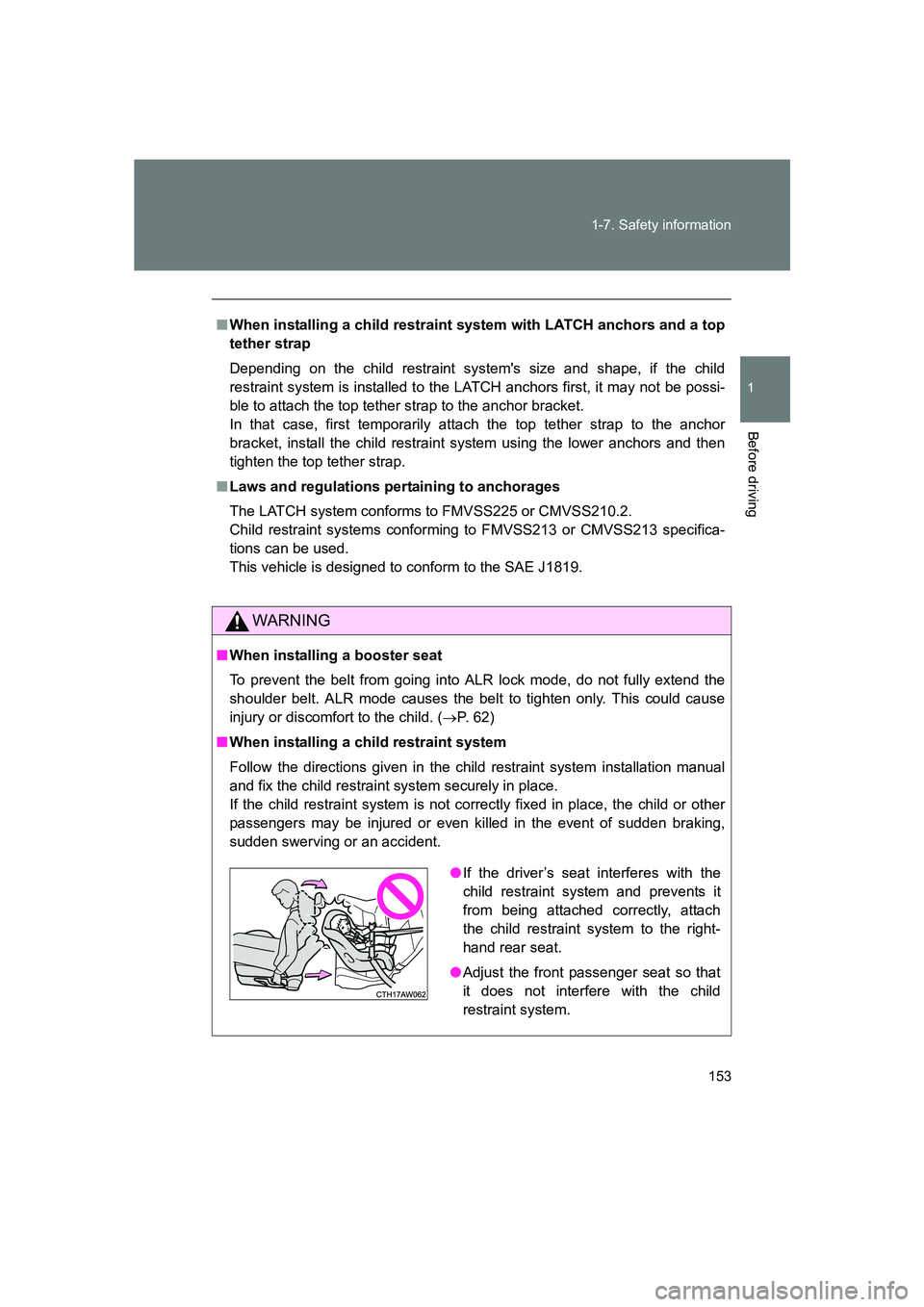
●If the driver’s seat interferes with the
child restraint system and prevents it
from being attached correctly, attach
the child restraint system to the right-
hand rear seat.
● Adjust the front passenger seat so that
it does not interfere with the child
restraint system.
Page 154 of 560
154 1-7. Safety information
BRZ_U
WARNING
■When installing a child restraint system
●Ensure that the belt and plate are securely locked and the seatbelt is not
twisted.
● Shake the child restraint system left and right, and forward and backward
to ensure that it has been securely installed.
● When adjusting the front passenger seat position after installing a child
restraint system, do so slowly.
● Follow all installation instructions provided by the child restraint system
manufacturer.
■ To correctly attach a child r estraint system to the anchors
When using the LATCH anchors, be sure that there are no foreign objects
around the anchors and that the seatbelt is not caught behind the child
restraint. Make sure the child restraint system is securely attached, or it may
cause death or serious injury to the child or other passengers in the event of
sudden braking, sudden swerve or an accident.
Page 155 of 560
When driving2
155
BRZ_U
2-1. Driving proceduresDriving the vehicle............ 156
Push-button ignition switch (vehicles with a keyless
access with push button
start system) .................. 172
Engine (ignition) switch (vehicles without a
keyless access with push
button start system) ....... 182
Automatic transmission................... 185
Manual Transmission ....... 192
Turn signal lever .............. 195
Parking brake ................... 197
Horn ................................. 198
2-2. Instrument cluster Gauges and meters ......... 199
Indicators and warning lights .............................. 203
Multi-information display (monochrome
display) .......................... 210
Multi-information display (color display) ................ 218 2-3. Operating the lights and
windshield wipers
Headlight switch ............... 233
Fog light switch ................ 239
Windshield wipers and washer ........................... 240
2-4. Using other driving systems
Cruise control ................... 243
Rear view camera ............ 248
Driving assist systems ..... 257
Hill start assist .................. 264
2-5. Driving information Cargo and luggage .......... 269
Vehicle load limits ............ 273
Winter driving tips ............ 274
Trailer towing ................... 279
Dinghy towing .................. 280
Page 161 of 560
161
2-1. Driving procedures
2
When driving
BRZ_U
■
After the engine starts
In order to secure a rich exhaust sound when starting the vehicle and envi-
ronmental performance, air intake and exhaust sounds become loud and
vibrations may increase for a little while after the engine starts. This is not a
malfunction.
■ Operating your vehicle in a foreign country
Comply with the relevant vehicle registration laws and confirm the availability
of the correct fuel. ( →P. 489)
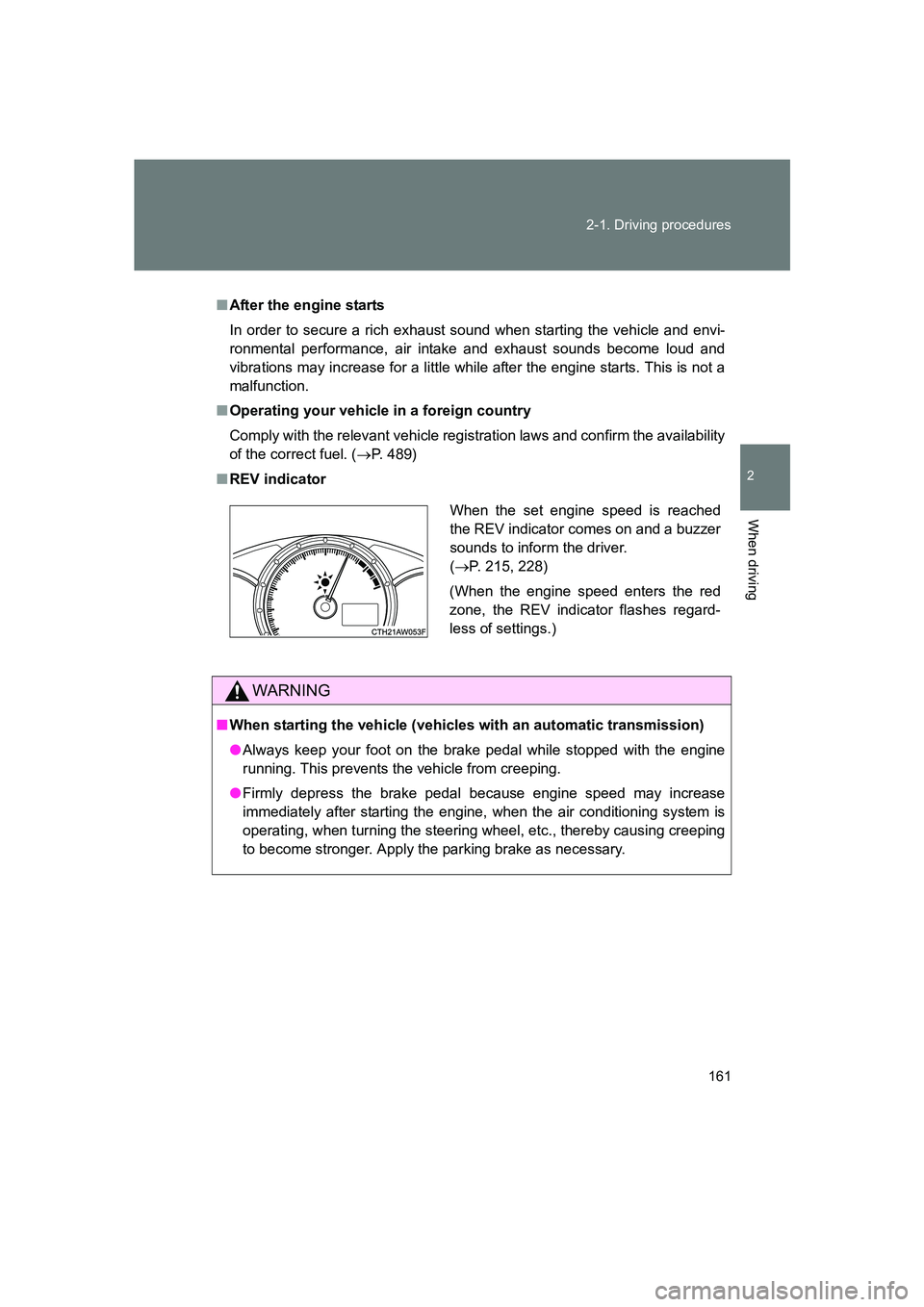
■ REV indicator
WARNING
■When starting the vehicle (vehicles with an automatic transmission)
● Always keep your foot on the brake pedal while stopped with the engine
running. This prevents the vehicle from creeping.
● Firmly depress the brake pedal because engine speed may increase
immediately after starting the engine, when the air conditioning system is
operating, when turning the steering wheel, etc., thereby causing creeping
to become stronger. Apply the parking brake as necessary.
When the set engine speed is reached
the REV indicator comes on and a buzzer
sounds to inform the driver.
(→ P. 215, 228)
(When the engine speed enters the red
zone, the REV indicator flashes regard-
less of settings.)
Page 162 of 560
162 2-1. Driving procedures
BRZ_U
WARNING
■When driving the vehicle
●Do not drive if you are unfamiliar with the location of the brake and accel-
erator pedals to avoid depressing the wrong pedal.
• Accidentally depressing the accelerator pedal instead of the brake
pedal will result in sudden acceleration that may lead to an accident
that could result in death or serious injury.
• When backing up, you may twist your body around, leading to a diffi- culty in operating the pedals. Make sure to operate the pedals properly.
• Make sure to keep a correct driving posture even when moving the vehicle only slightly. This allows you to depress the brake and acceler-
ator pedals properly.
• Depress the brake pedal using your right foot. Depressing the brake pedal using your left foot may delay response in an emergency, result-
ing in an accident.
● Do not drive the vehicle over or stop the vehicle near flammable materials.
The exhaust system and exhaust gases can be extremely hot. These hot
parts may cause a fire if there is any flammable material nearby.
● On vehicles with an automatic transmission, do not let the vehicle roll
backward while the select lever is in a driving position, or roll forward while
the select lever is in R.
Doing so may cause the engine to stall or lead to poor brake and steering
performance, resulting in an accident or damage to the vehicle.
● If the smell of exhaust is noticed inside the vehicle, open the windows and
check that the trunk lid is closed. Large amounts of exhaust in the vehicle
can cause driver drowsiness and an accident, resulting in death or a seri-
ous health hazard. Have the vehicle inspected by your SUBARU dealer
immediately.
● On vehicles with a manual transmission, do not shift the shift lever to R
while the vehicle is moving forward.
Doing so can damage the transmission and may result in a loss of vehicle
control.
● Do not shift the select lever to a driving position while the vehicle is moving
backward.
Doing so can damage the transmission and may result in a loss of vehicle
control.
Page 163 of 560
163
2-1. Driving procedures
2
When driving
BRZ_U
WARNING
●
On vehicles with a manual transmission, do not release the clutch pedal
too quickly. Doing so may propel the vehicle forward, possibly causing an
accident.
● Moving the select lever to N (vehicles with an automatic transmission) or
shift lever to neutral (vehicles with a manual transmission) while the vehi-
cle is moving will disengage the engine from the transmission. Engine
braking is not available when N or neutral is selected.
● During normal driving, do not turn off the engine. Turning the engine off
while driving will not cause loss of steering or braking control, but the
power assist to these systems will be lost. This will make it more difficult to
steer and brake, so you should pull over and stop the vehicle as soon as it
is safe to do so.
● Use engine braking (downshift) to maintain a safe speed when driving
down a steep hill.
Using the brakes continuously may cause the brakes to overheat and lose
effectiveness. ( →P. 186, 192)
● Do not adjust the position of the steering wheel, the seat, or the inside or
outside rear view mirrors while driving.
Doing so may result in a loss of vehicle control that can cause accidents,
resulting in death or serious injury.
● Always check that all passengers' arms, heads or other parts of their body
are not outside the vehicle, as this may result in death or serious injury.
● Do not drive in excess of the speed limit. Even if the legal speed limit per-
mits it, do not drive over 85 mph (140 km/h) unless your vehicle has high-
speed capability tires. Driving over 85 mph (140 km/h) may result in tire
failure, loss of control and possible injury. Be sure to consult a tire dealer
to determine whether the tires on y our vehicle are high-speed capability
tires or not before driving at such speeds.