service SUBARU BRZ 2020 User Guide
[x] Cancel search | Manufacturer: SUBARU, Model Year: 2020, Model line: BRZ, Model: SUBARU BRZ 2020Pages: 560, PDF Size: 9.54 MB
Page 347 of 560
347
4-2. Maintenance
4
Maintenance and care
BRZ_U
General maintenance
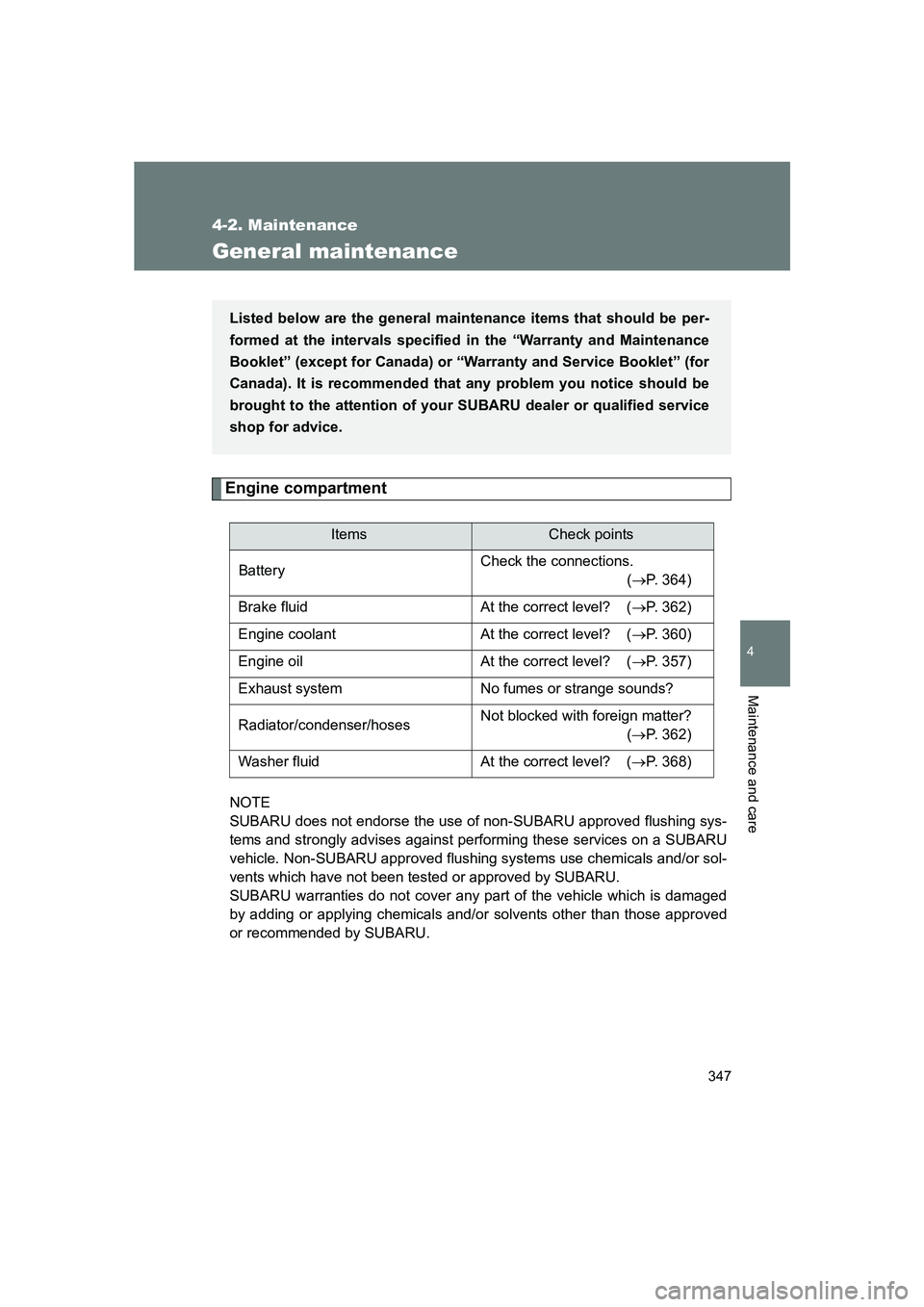
Engine compartment
NOTE
SUBARU does not endorse the use of non-SUBARU approved flushing sys-
tems and strongly advises against performing these services on a SUBARU
vehicle. Non-SUBARU approved flushing systems use chemicals and/or sol-
vents which have not been tested or approved by SUBARU.
SUBARU warranties do not cover any part of the vehicle which is damaged
by adding or applying chemicals and/or solvents other than those approved
or recommended by SUBARU.
ItemsCheck points
Battery Check the connections.
(→ P. 364)
Brake fluid At the correct level? ( →P. 362)
Engine coolant At the correct level? ( →P. 360)
Engine oil At the correct level? ( →P. 357)
Exhaust system No fumes or strange sounds?
Radiator/condenser/hoses Not blocked with foreign matter?
(
→P. 362)
Washer fluid At the correct level? ( →P. 368)
Listed below are the general maintenance items that should be per-
formed at the intervals specified in the “Warranty and Maintenance
Booklet” (except for Canada) or “Warranty and Service Booklet” (for
Canada). It is recommended that any problem you notice should be
brought to the attention of your SUBARU dealer or qualified service
shop for advice.
Page 350 of 560
350
4-2. Maintenance
BRZ_U
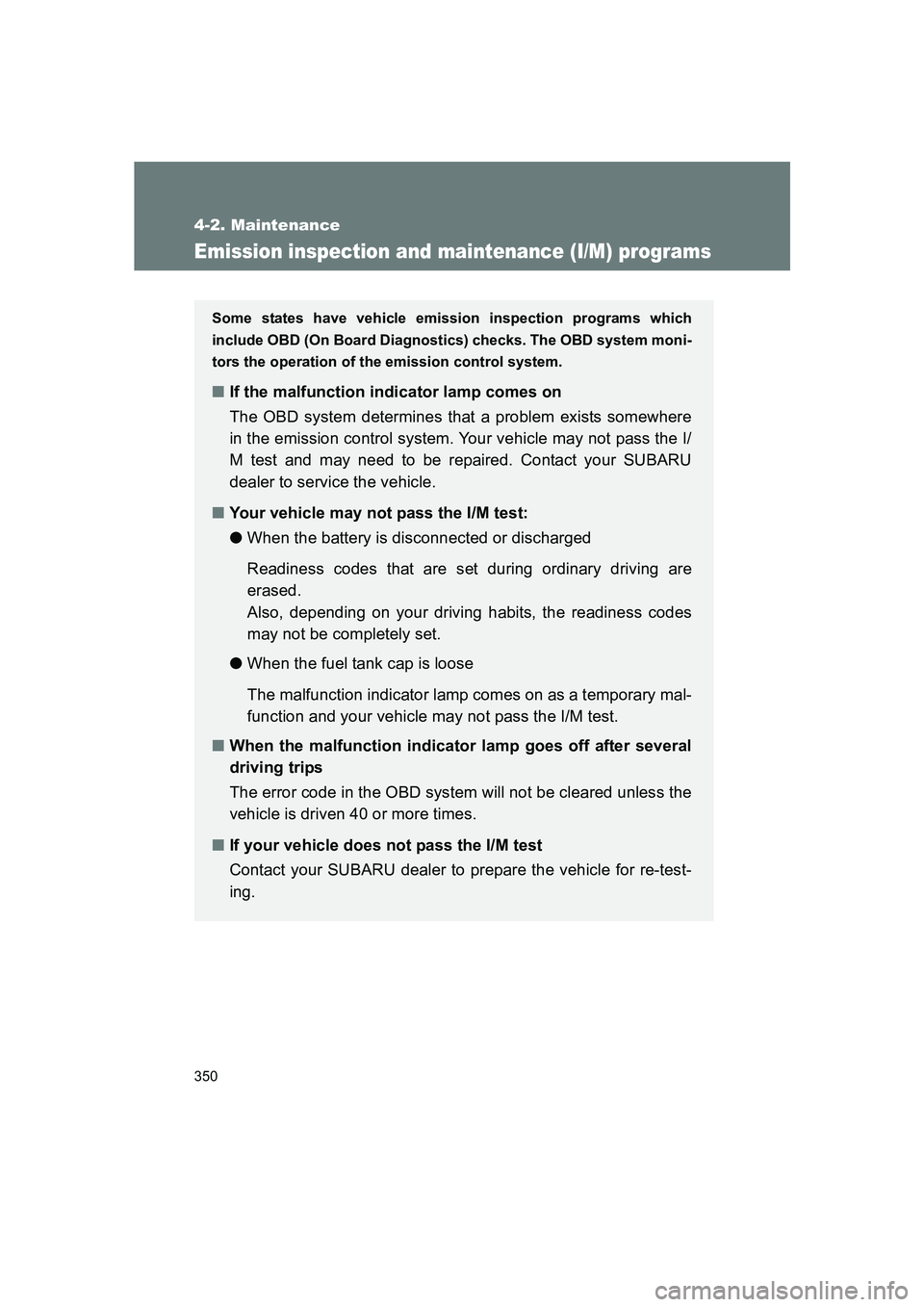
Emission inspection and maintenance (I/M) programs
Some states have vehicle emission inspection programs which
include OBD (On Board Diagnostics) checks. The OBD system moni-
tors the operation of th e emission control system.
■If the malfunction indicator lamp comes on
The OBD system determines that a problem exists somewhere
in the emission control system. Your vehicle may not pass the I/
M test and may need to be repaired. Contact your SUBARU
dealer to service the vehicle.
■ Your vehicle may not pass the I/M test:
● When the battery is disconnected or discharged
Readiness codes that are set during ordinary driving are
erased.
Also, depending on your driving habits, the readiness codes
may not be completely set.
● When the fuel tank cap is loose
The malfunction indicator lamp comes on as a temporary mal-
function and your vehicle may not pass the I/M test.
■ When the malfunction indicator lamp goes off after several
driving trips
The error code in the OBD system will not be cleared unless the
vehicle is driven 40 or more times.
■ If your vehicle does not pass the I/M test
Contact your SUBARU dealer to prepare the vehicle for re-test-
ing.
Page 359 of 560
359
4-3. Do-it-yourself maintenance
4
Maintenance and care
BRZ_U
●
When the engine is operated at high engine speeds (for extended peri-
ods of time)
● When the engine is operated under heavy loads (for extended periods of
time)
● When the engine idles for extended periods of time
● When the vehicle is operated in stop and go and/or heavy traffic situa-
tions
● When the vehicle is used under severe thermal conditions
● When the vehicle accelerates and decelerates frequently
Under these or similar conditions, you should check your oil at least every
2nd fuel fill-up and change your engine oi l more frequently. Different drivers
in the same car may experience different results. If your oil consumption rate
is greater than expected, contact y our authorized SUBARU retailer who may
perform a test under controlled conditions.
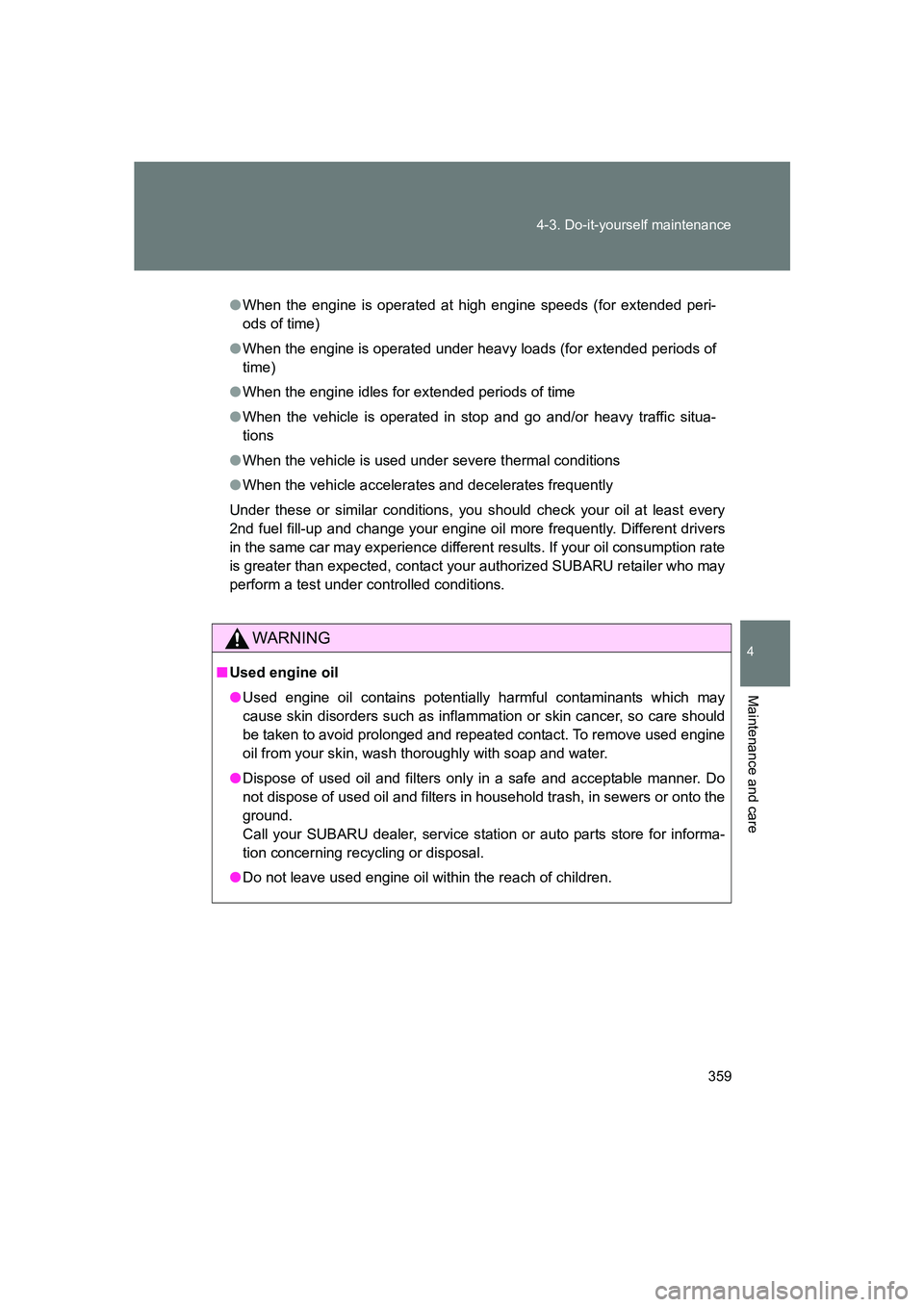
WARNING
■ Used engine oil
● Used engine oil contains potentially harmful contaminants which may
cause skin disorders such as inflammation or skin cancer, so care should
be taken to avoid prolonged and repeated contact. To remove used engine
oil from your skin, wash thoroughly with soap and water.
● Dispose of used oil and filters only in a safe and acceptable manner. Do
not dispose of used oil and filters in household trash, in sewers or onto the
ground.
Call your SUBARU dealer, service station or auto parts store for informa-
tion concerning recycling or disposal.
● Do not leave used engine oil within the reach of children.
Page 384 of 560
384 4-3. Do-it-yourself maintenance
BRZ_U
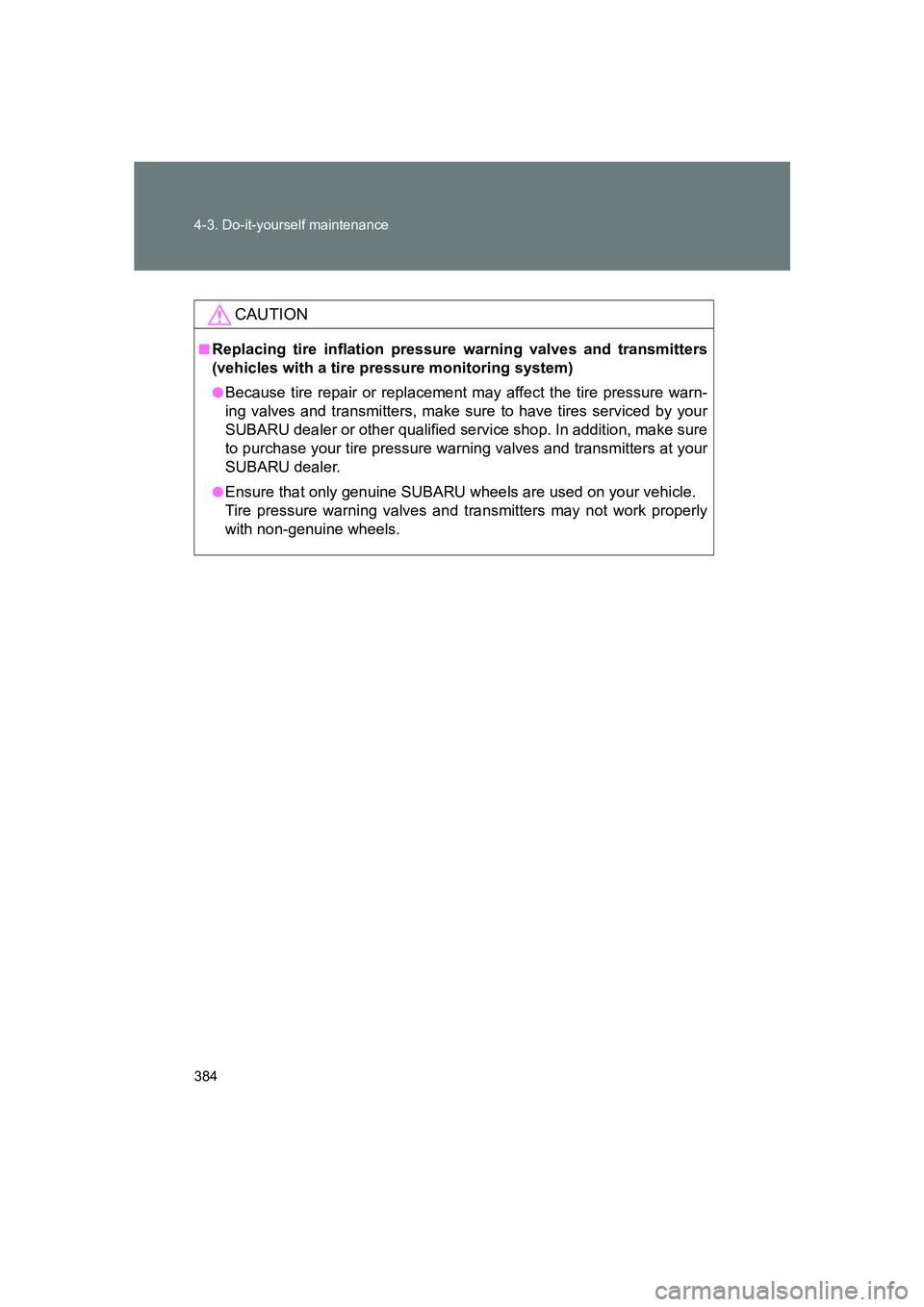
CAUTION
■Replacing tire inflation pressure warning valves and transmitters
(vehicles with a tire pressure monitoring system)
●Because tire repair or replacement may affect the tire pressure warn-
ing valves and transmitters, make sure to have tires serviced by your
SUBARU dealer or other qualified service shop. In addition, make sure
to purchase your tire pressure warning valves and transmitters at your
SUBARU dealer.
●Ensure that only genuine SUBARU wheels are used on your vehicle.
Tire pressure warning valves and transmitters may not work properly
with non-genuine wheels.
Page 387 of 560
387
4-3. Do-it-yourself maintenance
4
Maintenance and care
BRZ_U
■
Checking interval
Inspect and replace the air conditioning filter according to the maintenance
schedule. In dusty areas or areas with heavy traffic flow, early replacement
may be required. (For scheduled maintenance information, please refer to
the “Warranty and Maintenance Booklet” [except for Canada] or “Warranty
and Service Booklet” [for Canada].)
■ If air flow from the vents decreases dramatically
The filter may be clogged. Check the filter and replace if necessary.
CAUTION
■When removing the glove box
Do not forcibly pull the glove box. Otherwise, the lower claws or the lower
claw engagement points may be deformed, making it difficult to reinstall or
close the glove box.
■ When using the air conditioning system
Make sure that a filter is always installed.
Using the air conditioning system without a filter may cause damage to the
system.
Page 415 of 560
5
When trouble arises
415
5-1. Essential information
BRZ_U
If your vehicle needs to be towed
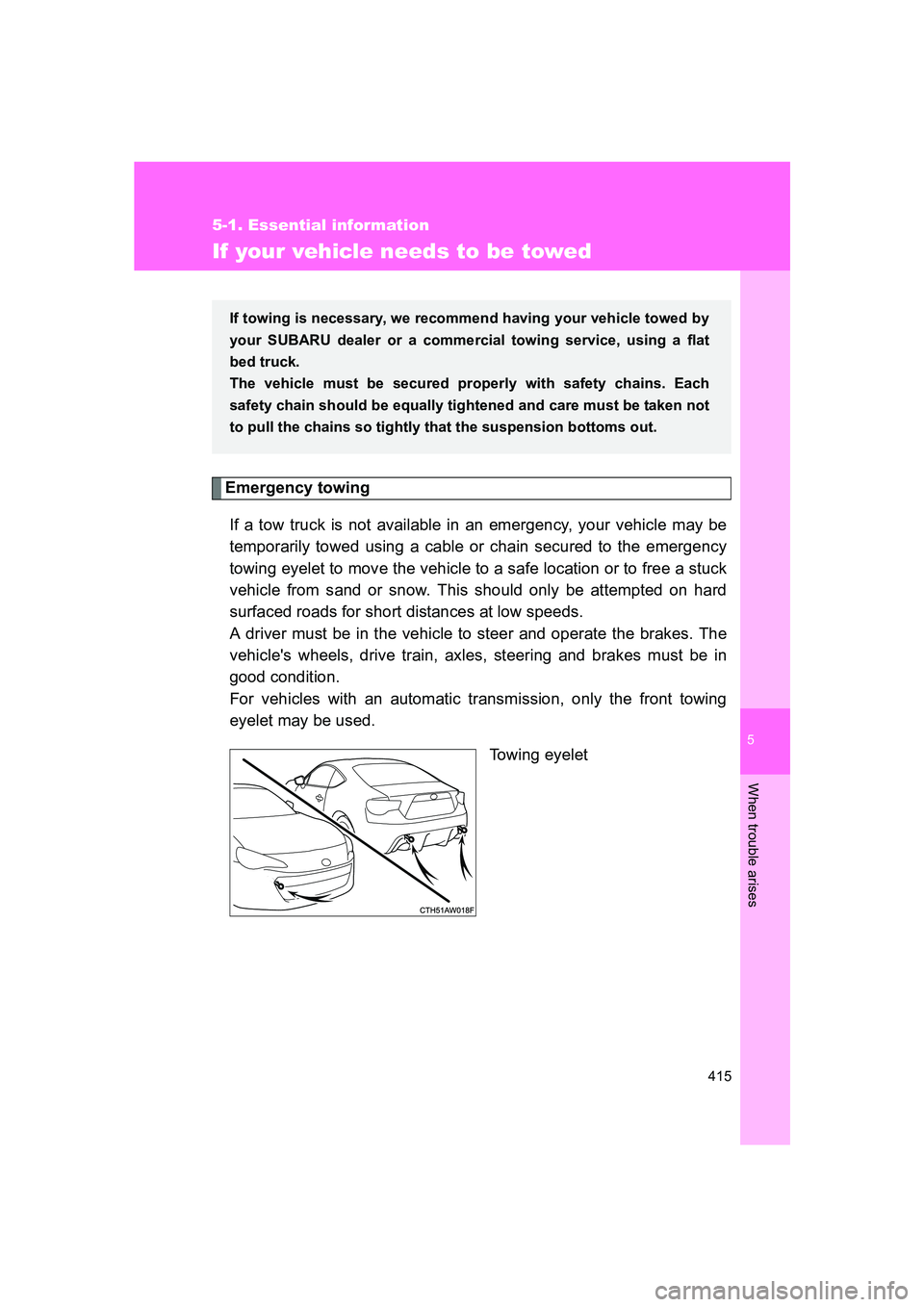
Emergency towingIf a tow truck is not available in an emergency, your vehicle may be
temporarily towed using a cable or chain secured to the emergency
towing eyelet to move the vehicle to a safe location or to free a stuck
vehicle from sand or snow. This should only be attempted on hard
surfaced roads for short distances at low speeds.
A driver must be in the vehicle to steer and operate the brakes. The
vehicle's wheels, drive train, axles, steering and brakes must be in
good condition.
For vehicles with an automatic transmission, only the front towing
eyelet may be used. Towing eyelet
If towing is necessary, we recommend having your vehicle towed by
your SUBARU dealer or a comme rcial towing service, using a flat
bed truck.
The vehicle must be secured properly with safety chains. Each
safety chain should be equally tightened and care must be taken not
to pull the chains so tightly that the suspension bottoms out.
Page 466 of 560
466 5-2. Steps to take in an emergency
BRZ_U
CAUTION
■When replacing the tires (vehicles with a tire pressure monitoring
system)
When removing or fitting the wheels, tires or the tire pressure warning
valve and transmitter, contact your SUBARU dealer as the tire pressure
warning valve and transmitter may be damaged if not handled correctly.
■To avoid damage to the tire pressure warning valves and transmit-
ters (vehicles with a tire pressure monitoring system)
When a tire is repaired with liquid sealants, the tire pressure warning
valve and transmitter may not operate properly. If a liquid sealant is
used, contact your SUBARU dealer or other qualified service shop as
soon as possible. Make sure to replace the tire pressure warning valve
and transmitter when replacing the tire. (→P. 371)
■Replacing a flat tire
Do not hit and bend the disc rotor backing plate when removing and
installing the tire. A bent backing plate may scrape against the disc rotor
and cause noise while the vehicle is in motion.
■Stowing the jack
When stowing the jack in the jack holder, make sure that the part that the
jack handle attaches to is pointing towards the inside of the trunk. Failure
to do so may damage the vehicle body.
Page 493 of 560
493
6-1. Specifications
6
Vehicle specifications
BRZ_U
Oil viscosity (0W-20 is explained here as an example):
• The 0W in 0W-20 indicates the characteristic of the oil which allows
cold startability. Oils with a lower value before the W allow for easier
starting of the engine in cold weather.
• The 20 in 0W-20 indicates the viscosity characteristic of the oil when the oil is at high temperature. An oil with a higher viscosity (one with a
higher value) may be better suited if the vehicle is operated at high
speeds, or under extreme load conditions.
How to read oil container labels:
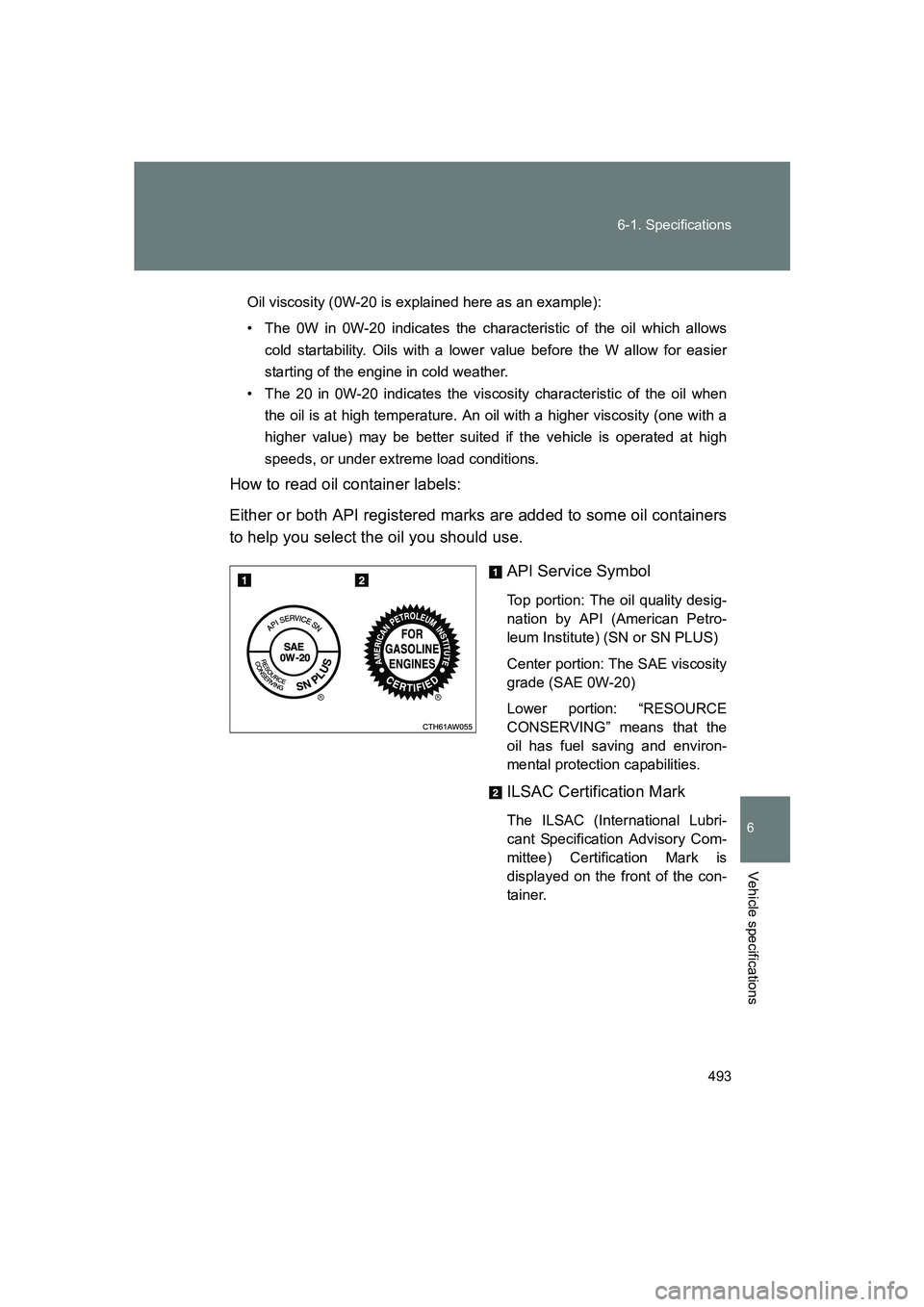
Either or both API registered marks are added to some oil containers
to help you select the oil you should use.
API Service Symbol
Top portion: The oil quality desig-
nation by API (American Petro-
leum Institute) (SN or SN PLUS)
Center portion: The SAE viscosity
grade (SAE 0W-20)
Lower portion: “RESOURCE
CONSERVING” means that the
oil has fuel saving and environ-
mental protection capabilities.
ILSAC Certification Mark
The ILSAC (International Lubri-
cant Specification Advisory Com-
mittee) Certification Mark is
displayed on the front of the con-
tainer.
Page 503 of 560
503
6-1. Specifications
6
Vehicle specifications
BRZ_U
■
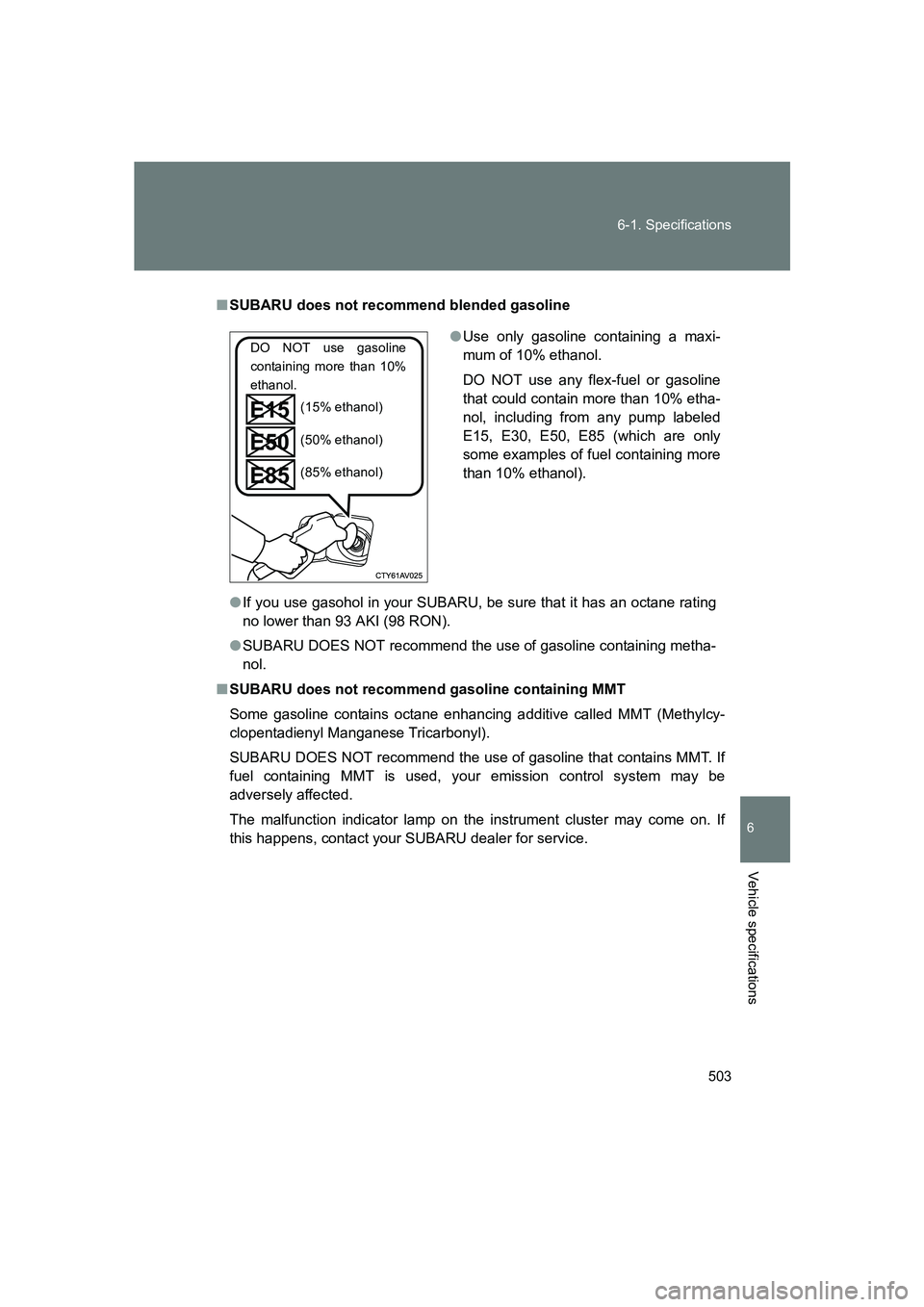
SUBARU does not recommend blended gasoline
● If you use gasohol in your SUBARU, be sure that it has an octane rating
no lower than 93 AKI (98 RON).
● SUBARU DOES NOT recommend the use of gasoline containing metha-
nol.
■ SUBARU does not recommend gasoline containing MMT
Some gasoline contains octane enhancing additive called MMT (Methylcy-
clopentadienyl Manganese Tricarbonyl).
SUBARU DOES NOT recommend the use of gasoline that contains MMT. If
fuel containing MMT is used, your emission control system may be
adversely affected.
The malfunction indicator lamp on the instrument cluster may come on. If
this happens, contact your SUBARU dealer for service. ●
Use only gasoline containing a maxi-
mum of 10% ethanol.
DO NOT use any flex-fuel or gasoline
that could contain more than 10% etha-
nol, including from any pump labeled
E15, E30, E50, E85 (which are only
some examples of fuel containing more
than 10% ethanol).
DO NOT use gasoline
containing more than 10%
ethanol.
(15% ethanol)
(50% ethanol)
(85% ethanol)
Page 510 of 560
510 6-1. Specifications
BRZ_U■
Tre ad w ea r
The treadwear grade is a comparative rating based on the wear
rate of the tire when tested under controlled conditions on a speci-
fied government test course.
For example, a tire graded 150 would wear one and a half (1 - 1/2)
times as well on the government course as a tire graded 100.
The relative performance of tires depends upon the actual conditions
of their use. Performance may differ significantly from the norm due
to variations in driving habits, service practices and differences in
road characteristics and climate.
■Traction AA, A, B, C
The traction grades, from highest to lowest, are AA, A, B and C,
and they represent the tire’s ability to stop on wet pavement as
measured under controlled conditions on specified government
test surfaces of asphalt and concrete.
A tire marked C may have poor traction performance.
Warning: The traction grade assigned to this tire is based on braking
(straight ahead) traction tests and does not include cornering (turn-
ing) traction.
■Temperature A, B, C
The temperature grades are A (the highest), B, and C, represent-
ing the tire’s resistance to the generation of heat and its ability to
dissipate heat when tested under controlled conditions on a speci-
fied indoor laboratory test wheel.
Sustained high temperature can cause the material of the tire to
degenerate and reduce tire life, and excessive temperature can lead
to sudden tire failure.
Grade C corresponds to a level of performance which all passenger
car tires must meet under the Federal Motor Vehicle Safety Standard
No. 109.
Grades B and A represent higher levels of performance on the labo-
ratory test wheel than the minimum required by law.