air condition SUBARU BRZ 2020 Service Manual
[x] Cancel search | Manufacturer: SUBARU, Model Year: 2020, Model line: BRZ, Model: SUBARU BRZ 2020Pages: 560, PDF Size: 9.54 MB
Page 372 of 560
372 4-3. Do-it-yourself maintenance
BRZ_U
Registering ID codes (vehicles with a tire pressure monitoring
system)
The tire pressure warning valve and transmitter is equipped with a
unique ID code. When replacing a tire pressure warning valve and
transmitter, it is necessary to register the ID code. Have the ID code
registered by your SUBARU dealer.
■When to replace your vehicle’s tires
Tires should be replaced if:
●You have tire damage such as cuts, splits, cracks deep enough to
expose the fabric or bulges indicating internal damage
●A tire goes flat repeatedly or cannot be properly repaired due to the
size or location of a cut or other damage
If you are not sure, consult with your SUBARU dealer.
■Replacing tires and wheels (vehicles with a tire pressure monitor-
ing system)
If the ID code of the tire pressure warning valve and transmitter is not
registered, the tire pressure monitoring system will not work properly.
After driving for about 20 minutes, the tire pressure warning light comes
on after blinking for 1 minute to indicate a system malfunction.
■Tire life
Any tire over 6 years old must be checked by a qualified technician even
if they have seldom or never been used or damage is not obvious.
■If the tread wears down below 0.16 in. (4 mm) on snow tires
The effectiveness of snow tires is lost.
■Low profile tires
Generally, low profile tires will wear more rapidly and tire grip perfor-
mance will be reduced on snowy and/or icy roads when compared to
standard tires. Be sure to use snow tires or tire chains on snowy and/or
icy roads and drive carefully at a speed appropriate for road and weather
conditions.
Page 376 of 560
376 4-3. Do-it-yourself maintenance
BRZ_U
CAUTION
■Repairing or replacing tires, wheels, tire pressure warning valves,
transmitters and tire valve caps (vehicles with a tire pressure moni-
toring system)
●When removing or fitting the wheels, tires or the tire pressure warning
valves and transmitters, contact your SUBARU dealer as the tire pres-
sure warning valves and transmitters may be damaged if not handled
correctly.
●When replacing tire valve caps, do not use tire valve caps other than
those specified. The cap may become stuck.
■Replacing a flat tire
Do not hit and bend the disc rotor backing plate when removing and
installing the tire. A bent backing plate may scrape against the disc rotor
and cause noise while the vehicle is in motion.
■Driving on rough roads
Take particular care when driving on roads with loose surfaces or pot
holes.
These conditions may cause losses in tire inflation pressure, reducing
the cushioning ability of the tires. In addition, driving on rough roads may
cause damage to the tires themselves, as well as the vehicle’s wheels
and body.
■Low profile tires and wheels
Low profile tires may cause greater damage than usual to the wheel
when receiving impact from the road surface. Therefore pay attention to
the following:
●Be sure to use proper tire inflation pressure. If tires are under-inflated,
they may be damaged more severely.
●Avoid pot holes, uneven pavement, curbs and other road hazards.
Failure to do so may lead to severe tire and wheel damage.
Page 381 of 560
381
4-3. Do-it-yourself maintenance
4
Maintenance and care
BRZ_U
WARNING
■Proper inflation is critical
to save tire performance
Keep your tires properly inflated.
If the tires are not properly inflated, the following conditions may occur
which could lead to an accident resulting in death or serious injury:
●Excessive wear
●Uneven wear
●Poor handling
●Possibility of blowouts resulting from overheated tires
●Air leaking from between tire and wheel
●Wheel deformation and/or tire damage
●Greater possibility of tire damage while driving (due to road hazards,
expansion joints, sharp edges in the road, etc.)
CAUTION
■When inspecting and adjusting tire inflation pressure
Be sure to reinstall the tire valve caps.
If a valve cap is not installed, dirt or moisture may get into the valve and
cause an air leak, resulting in decreased tire inflation pressure.
Page 385 of 560
385
4-3. Do-it-yourself maintenance
4
Maintenance and care
BRZ_U
Air conditioning filter
The air conditioning filter must be changed regularly to maintain air
conditioning efficiency.
■Removal method
Vehicles without a keyless access with push button
start system
Turn the engine switch off.
Vehicles with a keyless access with push button start
system
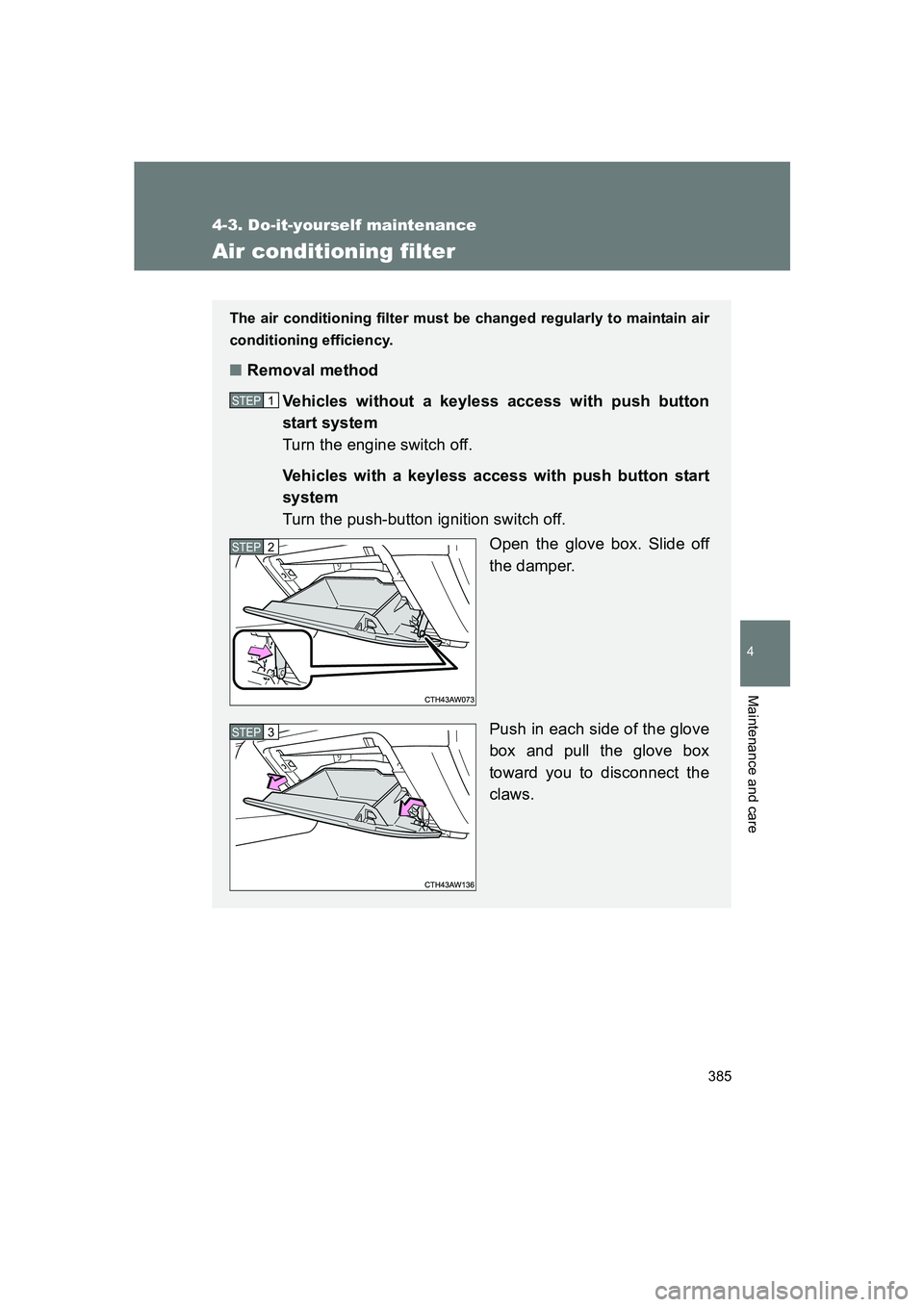
Turn the push-button ignition switch off. Open the glove box. Slide off
the damper.
Push in each side of the glove
box and pull the glove box
toward you to disconnect the
claws.
STEP 1
STEP 2
STEP 3
Page 386 of 560
386 4-3. Do-it-yourself maintenance
BRZ_U
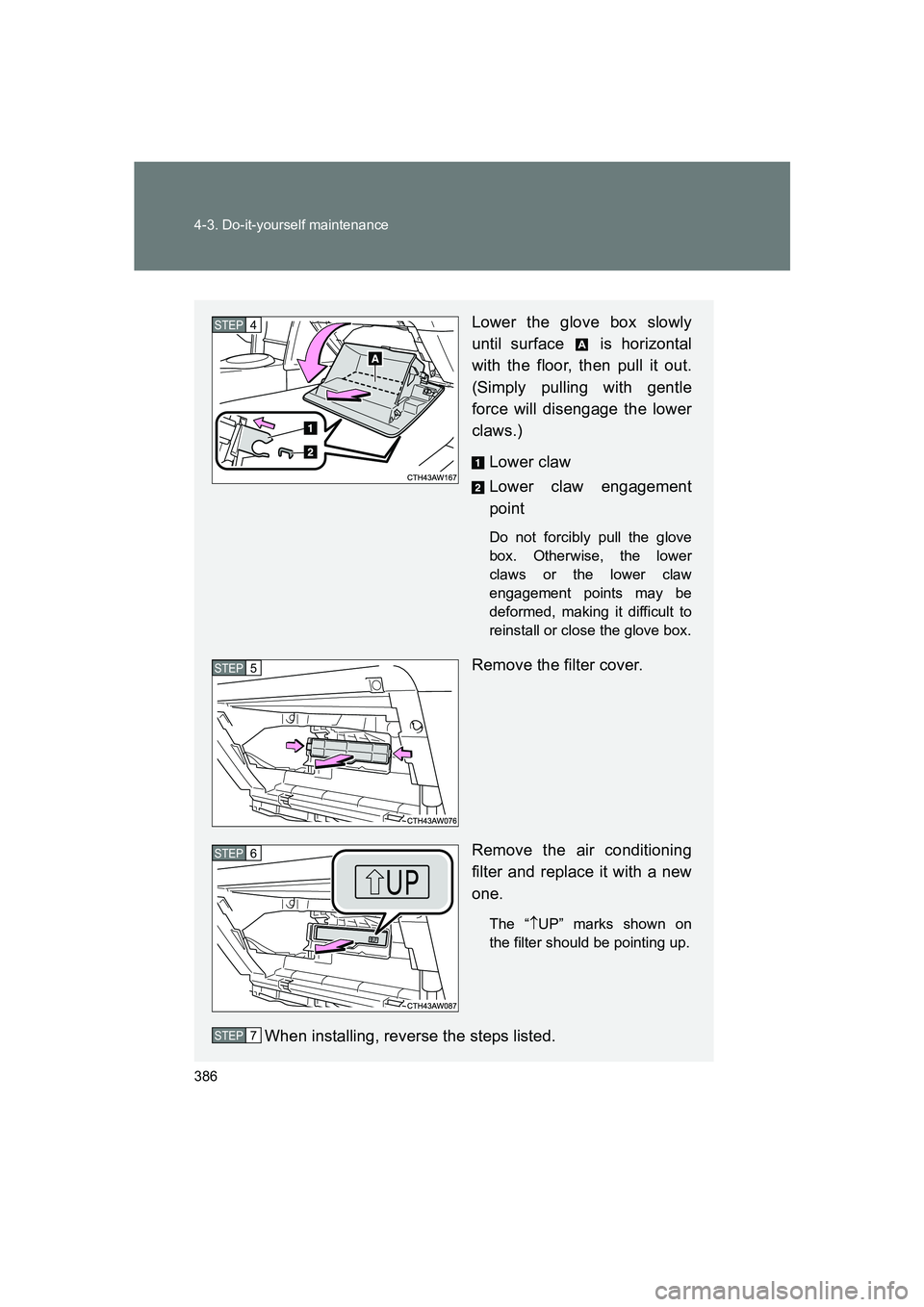
Lower the glove box slowly
until surface is horizontal
with the floor, then pull it out.
(Simply pulling with gentle
force will disengage the lower
claws.)Lower claw
Lower claw engagement
point
Do not forcibly pull the glove
box. Otherwise, the lower
claws or the lower claw
engagement points may be
deformed, making it difficult to
reinstall or close the glove box.
Remove the filter cover.
Remove the air conditioning
filter and replace it with a new
one.
The “ ↑UP” marks shown on
the filter should be pointing up.
When installing, reverse the steps listed.
STEP 4
STEP 5
STEP 6
STEP 7
Page 387 of 560
387
4-3. Do-it-yourself maintenance
4
Maintenance and care
BRZ_U
■
Checking interval
Inspect and replace the air conditioning filter according to the maintenance
schedule. In dusty areas or areas with heavy traffic flow, early replacement
may be required. (For scheduled maintenance information, please refer to
the “Warranty and Maintenance Booklet” [except for Canada] or “Warranty
and Service Booklet” [for Canada].)
■ If air flow from the vents decreases dramatically
The filter may be clogged. Check the filter and replace if necessary.
CAUTION
■When removing the glove box
Do not forcibly pull the glove box. Otherwise, the lower claws or the lower
claw engagement points may be deformed, making it difficult to reinstall or
close the glove box.
■ When using the air conditioning system
Make sure that a filter is always installed.
Using the air conditioning system without a filter may cause damage to the
system.
Page 396 of 560
396 4-3. Do-it-yourself maintenance
BRZ_U
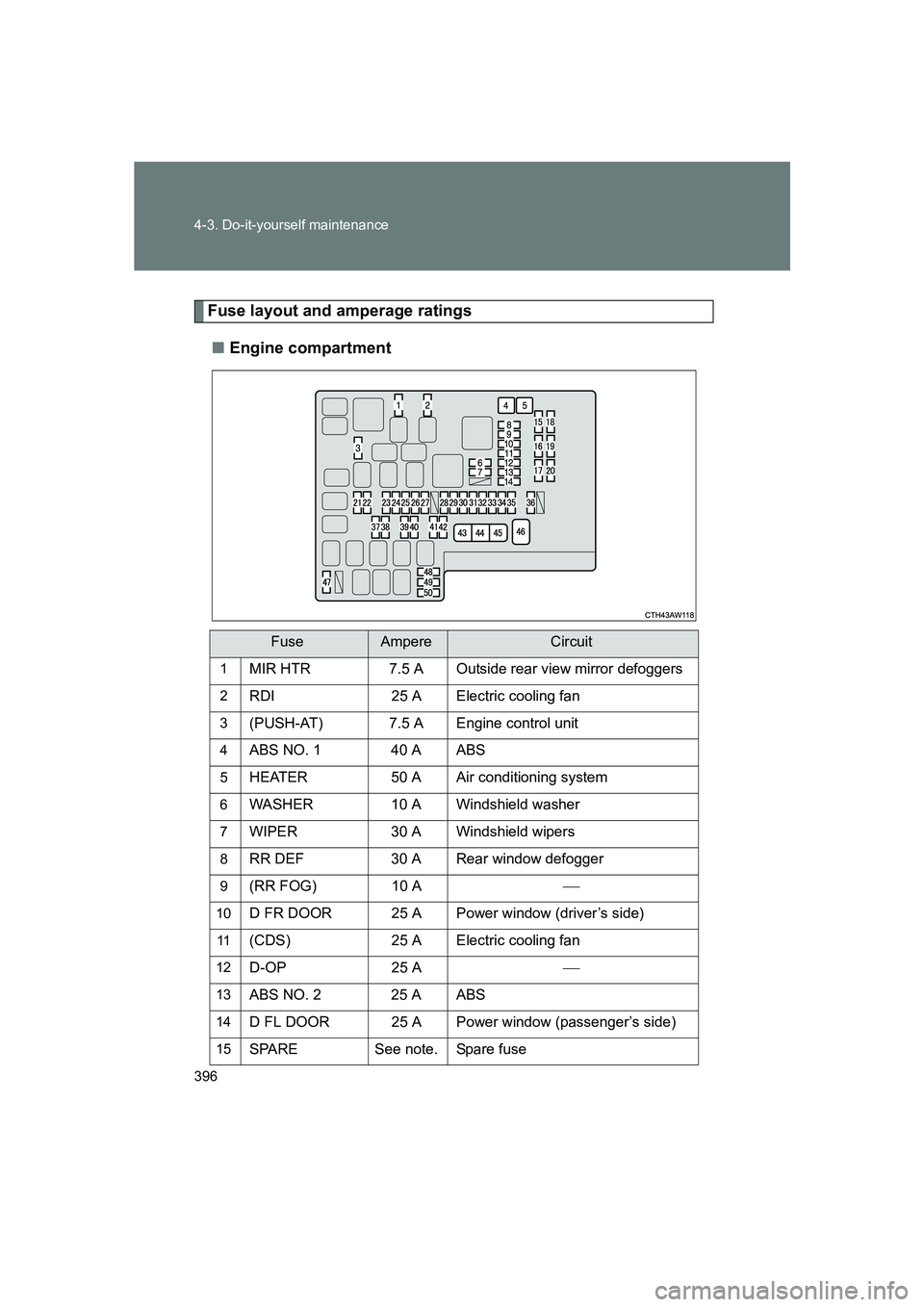
Fuse layout and amperage ratings■ Engine compartment
FuseAmpereCircuit
1MIR HTR 7.5 A Outside rear view mirror defoggers
2RDI 25 A Electric cooling fan
3(PUSH-AT) 7.5 A Engine control unit
4ABS NO. 1 40 A ABS
5HEATER 50 A Air conditioning system
6WASHER 10 A Windshield washer
7WIPER 30 A Windshield wipers
8RR DEF 30 A Rear window defogger
9(RR FOG) 10 A
10D FR DOOR 25 A Power window (driver’s side)
11(CDS) 25 A Electric cooling fan
12D-OP 25 A
13ABS NO. 2 25 A ABS
14D FL DOOR 25 A Power window (passenger’s side)
15SPARE See note. Spare fuse
Page 399 of 560
399
4-3. Do-it-yourself maintenance
4
Maintenance and care
BRZ_U
■
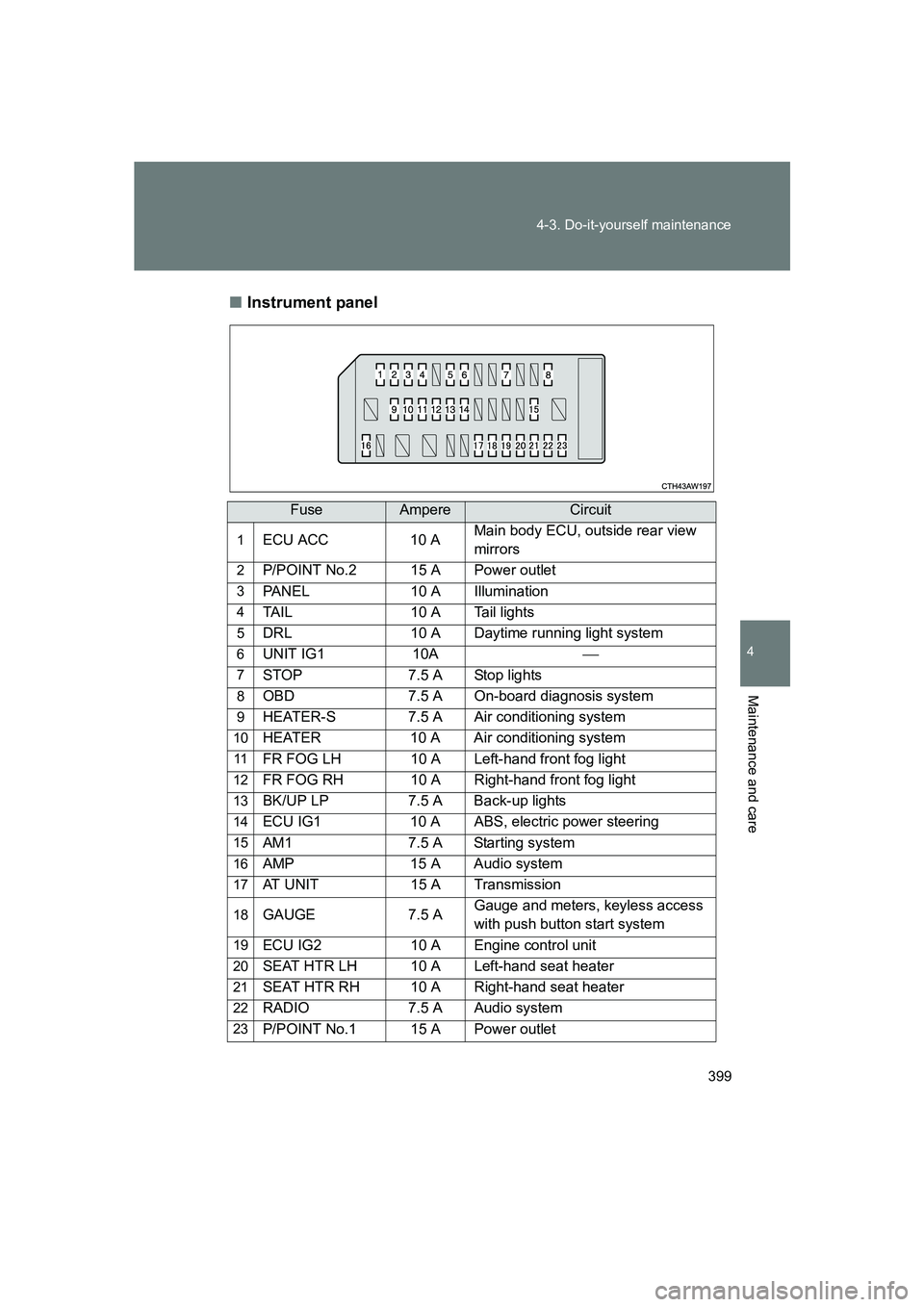
Instrument panel
FuseAmpereCircuit
1ECU ACC 10 A Main body ECU, outside rear view
mirrors
2P/POINT No.2 15 A Power outlet
3PANEL 10 A Illumination
4TAIL 10 A Tail lights
5DRL 10 A Daytime running light system
6UNIT IG1 10A
7STOP 7.5 A Stop lights
8OBD 7.5 A On-board diagnosis system
9HEATER-S 7.5 A Air conditioning system
10HEATER 10 A Air conditioning system
11FR FOG LH 10 A Left-hand front fog light
12FR FOG RH 10 A Right-hand front fog light
13BK/UP LP 7.5 A Back-up lights
14ECU IG1 10 A ABS, electric power steering
15AM1 7.5 A Starting system
16AMP 15 A Audio system
17AT UNIT 15 A Transmission
18GAUGE 7.5 AGauge and meters, keyless access
with push button start system
19ECU IG2 10 A Engine control unit
20SEAT HTR LH 10 A Left-hand seat heater
21SEAT HTR RH 10 A Right-hand seat heater
22RADIO 7.5 A Audio system
23P/POINT No.1 15 A Power outlet
Page 422 of 560
422
5-1. Essential information
BRZ_U
If you think something is wrong
If you notice any of the following symptoms, your vehicle probably
needs adjustment or repair. Contact your SUBARU dealer as soon as
possible.
■Visible symptoms
● Fluid leaks under the vehicle
(Water dripping from the air conditioning after use is normal.)
● Flat-looking tires or uneven tire wear
● Vehicles with a monochrome multi-information display: The
engine coolant temperature gauge needle continually points
higher than normal
● Vehicles with a color multi-information display: The high
engine coolant temperature warning light flashes or illumi-
nates
■ Audible symptoms
● Changes in exhaust sound
● Excessive tire squeal when cornering
● Strange noises related to the suspension system
● Pinging or other noises related to the engine
■ Operational symptoms
● Engine missing, stumbling or running rough
● Appreciable loss of power
● Vehicle pulls heavily to one side when braking
● Vehicle pulls heavily to one side when driving on a level road
● Loss of brake effectiveness, spongy feeling, pedal almost
touches the floor
Page 478 of 560
478 5-2. Steps to take in an emergency
BRZ_U
■Starting the engine when the battery is discharged
The engine cannot be started by push-starting.
■ Avoiding a discharged battery
●Turn off the headlights and the air conditioning system while the engine is
off.
● Turn off any unnecessary electrical components when the vehicle is run-
ning at a low speed for an extended period, such as in heavy traffic, etc.
■ Charging the battery
The electricity stored in the battery will discharge gradually even when the
vehicle is not in use, due to natural discharge and the draining effects of cer-
tain electrical appliances. If the vehicle is left for a long time, the battery may
discharge, and the engine may be unable to start. (The battery recharges
automatically during driving.)
■ Precautions when the battery is discharged (vehicles with a keyless
access with push button start system)
●In some cases, it may not be possible to unlock the doors using the key-
less access with push button start system when the battery is dis-
charged. Use the remote keyless entry system or the mechanical key to
lock or unlock the doors.
● The engine may not start on the first attempt after the battery has
recharged but will start normally after the second attempt. This is not a
malfunction.
● The push-button ignition switch mode is memorized by the vehicle. When
the battery is reconnected, the system will return to the mode it was in
before the battery was discharged. Before disconnecting the battery, turn
the push-button ignition switch off.
If you are unsure what mode the push-button ignition switch was in
before the battery discharged, be especially careful when reconnecting
the battery.