flat tire SUBARU BRZ 2023 User Guide
[x] Cancel search | Manufacturer: SUBARU, Model Year: 2023, Model line: BRZ, Model: SUBARU BRZ 2023Pages: 432, PDF Size: 16.56 MB
Page 234 of 432
Preparing to Drive
228have implemented emission inspection of
the OBDII system.
The inspection of the OBDII system
consists of a visual operational check of
the “ CHECK ENGINE ” warning light/
malfunction indicator light (MIL) and an
examination of the OBDII system with an
electronic scan tool.
A vehicle passes
the OBDII system
inspection if proper operation of the
“ CHECK ENGINE ” warning light is
observed, there are no stored diagnostic
trouble codes, and the OBDII readiness
monitors are all complete.
A vehicle fails
the OBDII inspection if
the “ CHECK ENGINE ” warning light is not
properly operating (light is illuminated or is
not working due to a burned out bulb) or
there is one or more diagnostic trouble
codes stored in the vehicle’s computer.
A state emission in spection may reject
(not pass or fail) a vehicle if the number of
OBDII system readiness monitors “ NOT
READY ” is greater than one. If the
vehicle’s battery has been recently
replaced or disconnected, the OBDII
system inspection may indicate that the
vehicle is not ready for the emission test.
Under this condition, the vehicle driver
should be instructed to drive his/her
vehicle for a few days to reset the readi-
ness monitors and return for an emission
re-inspection.
Owners of rejected or failing vehicles
should contact their SUBARU Dealer for
service.
7-3. Preparing to DriveYou should perform the following checks
and adjustments every day before you
start driving.
1. Check that all windows, mirrors, and
lights are clean and unobstructed.
2. Check the appearance and condition
of the tires. Also check tires for proper
inflation.
3. Look under the vehicle for any sign of
leaks.
4. Check that no small animals enter the
engine compartment.
5. Check that the hood and trunk are fully
closed.
6. Check the adjustment of the seat.
7. Check the adjustment of the inside
and outside mirrors.
8. Fasten your seatbelt. Check that your
passengers have fastened their seatbelts.
9. Check the operation of the warning
and indicator lights when the ignition
switch is turned to the “ON” position.
10. Check the gauges, indicator and
warning lights after starting the engine.
BRZ_U.book 228 ページ 2022年3月29日 火曜日 午後3時59分
Page 254 of 432
Vehicle Stability Control (VSC)/TRAC System
248
NOTEThe Vehicle Stability Control (VSC)
system and TRAC system may be con-
sidered normal when the following
conditions occur.
Slight twitching of the brake pedal is
felt.
The vehicle or steering wheel
shakes to a small degree.
An operating noise from the engine
compartment is heard briefly when
starting the engine and when driving
off after starti ng the engine.
The brake pedal seems to jolt when
driving off after st arting the engine.
■Vehicle Stability Control
(VSC) System MonitorRefer to "Vehicle Stability Control (VSC)
Warning Light/Vehicle Stability Control
(VSC) Operation Indicator Light" P142
and "Vehicle Stability Control (VSC) OFF
Indicator Light" P143.■ Vehicle Stability Control
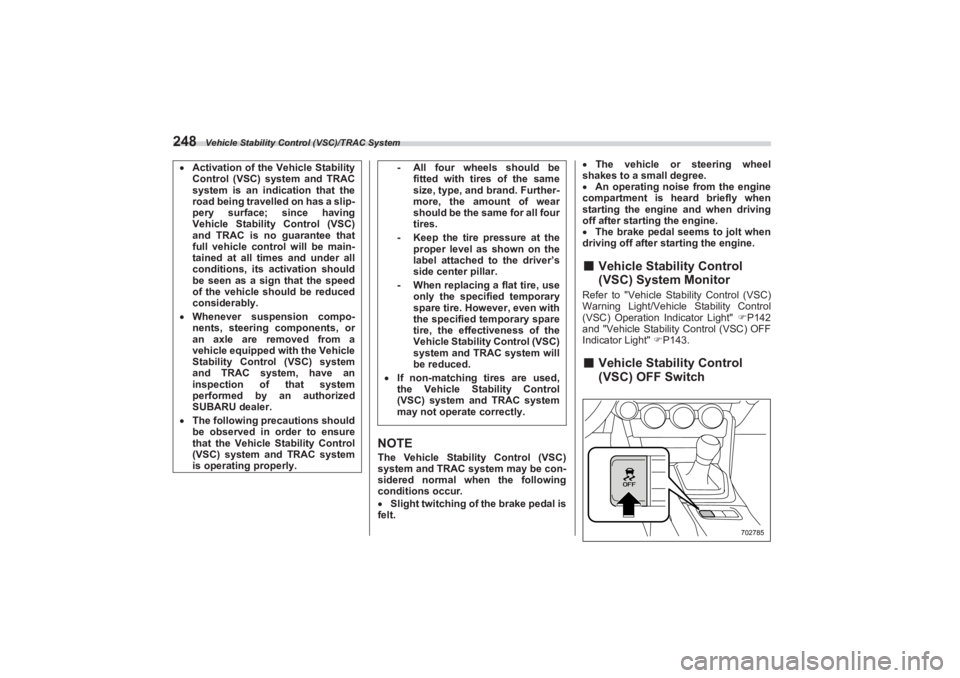
(VSC) OFF Switch
Activation of the Vehicle Stability
Control (VSC) system and TRAC
system is an indication that the
road being travelled on has a slip-
pery surface; since having
Vehicle Stability Control (VSC)
and TRAC is no guarantee that
full vehicle control will be main-
tained at all times and under all
conditions, its activation should
be seen as a sign that the speed
of the vehicle should be reduced
considerably. Whenever suspension compo-
nents, steering components, or
an axle are removed from a
vehicle equipped with the Vehicle
Stability Control (VSC) system
and TRAC system, have an
inspection of that system
performed by an authorized
SUBARU dealer. The following precautions should
be observed in order to ensure
that the Vehicle Stability Control
(VSC) system and TRAC system
is operating properly.
- All four wheels should be
fitted with tires of the same
size, type, and brand. Further-
more, the amount of wear
should be the same for all four
tires.- Keep the tire pressure at the
proper level as shown on the
label attached to the driver’s
side center pillar.- When replacing a flat tire, use
only the specified temporary
spare tire. However, even with
the specified temporary spare
tire, the effectiveness of the
Vehicle Stability Control (VSC)
system and TRAC system will
be reduced.
If non-matching tires are used,
the Vehicle Stability Control
(VSC) system and TRAC system
may not operate correctly.
702785
BRZ_U.book 248 ページ 2022年3月29日 火曜日 午後3時59分
Page 258 of 432
Tire Pressure Monitoring System (TPMS) (If Equipped)
252
WARNING
If the low tire pressure warning
light illuminates while driving,
never brake suddenly. Instead,
perform the following procedure.
Otherwise an accident involving
serious vehicle damage and
serious personal injury could
occur.
(1) Keep driving straight ahead
while gradually reducing
speed.(2) Slowly pull off the road to a
safe place.(3) Check the pressure for all
four tires and adjust the pres-
sure to the COLD tire pres-
sure shown on the tire
inflation pressure label on the
center pillar on the driver’s
side.
Even when the vehicle is driven a
very short distance, the tires get
warm and their pressures
increase accordingly. Be sure to
let the tires cool thoroughly
before adjusting their pressures
to the standard values shown on
the tire inflatio n pressure label.
Refer to "Tires and Wheels"
P358. The tire pressure moni-
toring system does not function
when the vehicle is stationary.
After adjusting the tire pressures,
increase the vehicle speed to at
least 25 mph (40 km/h) to start the
TPMS rechecking of the tire infla-
tion pressures. If the tire pres-
sures are now above the severe
low pressure threshold, the low
tire pressure warning light should
turn off a few minutes later.
If this light still illuminates while
driving after adjusting the tire
pressure, a tire may have signifi-
cant damage and a fast leak that
causes the tire to lose air rapidly.
For details, refer to "Flat Tires"
P303.
When a spare tire is mounted or a
wheel rim is replaced without the
original pressure sensor/trans-
mitter being transferred, the low
tire pressure warning light will
illuminate steadily after blinking
for approximately one minute.
This indicates the TPMS is unable
to monitor all fo ur road wheels.
Contact your SUBARU dealer as
soon as possible for tire and
sensor replacement and/or
system resetting.
BRZ_U.book 252 ページ 2022年3月29日 火曜日 午後3時59分
Page 260 of 432
Tire Pressure Monitoring System (TPMS) (If Equipped)
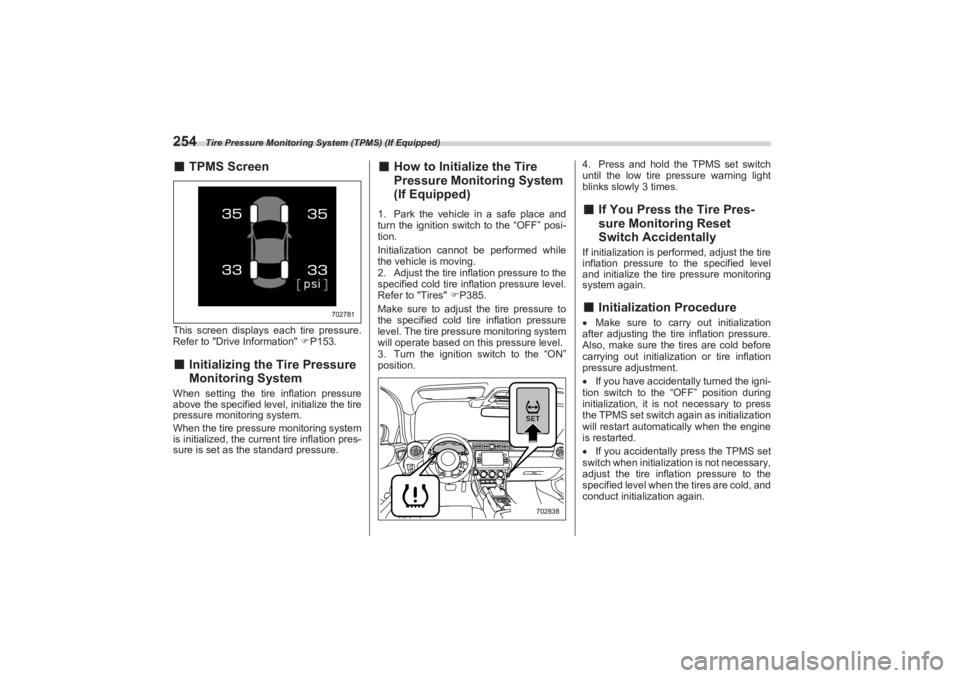
254■TPMS ScreenThis screen displays ea ch tire pressure.
Refer to "Drive Information" P153.■ Initializing the Tire Pressure
Monitoring SystemWhen setting the tire inflation pressure
above the specified level, initialize the tire
pressure monitoring system.
When the tire pressure monitoring system
is initialized, the current tire inflation pres-
sure is set as the standard pressure.
■ How to Initialize the Tire
Pressure Monitoring System
(If Equipped)1. Park the vehicle in a safe place and
turn the ignition switch to the “OFF” posi-
tion.
Initialization cannot be performed while
the vehicle is moving.
2. Adjust the tire infl ation pressure to the
specified cold tire inflation pressure level.
Refer to "Tires" P385.
Make sure to adjust the tire pressure to
the specified cold tire inflation pressure
level. The tire pre ssure monitoring system
will operate based on this pressure level.
3. Turn the ignition switch to the “ON”
position. 4. Press and hold the TPMS set switch
until the low tire pressure warning light
blinks slowly 3 times.
■ If You Press the Tire Pres -
sure Monitoring Reset
Switch AccidentallyIf initialization is perf ormed, adjust the tire
inflation pressure to the specified level
and initialize the tire pressure monitoring
system again.■ Initialization ProcedureMake sure to carry out initialization
after adjusting the tire inflation pressure.
Also, make sure the tires are cold before
carrying out initialization or tire inflation
pressure adjustment.
If you have accidentally turned the igni-
tion switch to the “OFF” position during
initialization, it is not necessary to press
the TPMS set switch again as initialization
will restart automatically when the engine
is restarted.
If you accidentally press the TPMS set
switch when initialization is not necessary,
adjust the tire inflation pressure to the
specified level when the tires are cold, and
conduct initialization again.
702781
702838
BRZ_U.book 254 ページ 2022年3月29日 火曜日 午後3時59分
Page 261 of 432
Parking Your Vehicle
255
Starting and Operating7
– CONTINUED –
■When Initialization of the Tire
Pressure Monitoring System
has FailedInitialization can be completed in a few
minutes. However, in the following case,
the settings have not been recorded and
the system will not o perate properly. If
repeated attempts to record tire inflation
pressure settings ar e unsuccessful, have
the vehicle checked at your SUBARU
dealer.
When operating the TPMS set switch,
low tire pressure warning light does not
blink 3 times.
After carrying out the initialization
procedure, the low tire pressure warning
light blinks for 1 minute then stays on after
driving for 20 minutes.
■ Registering ID CodesEvery tire pressure warning valve and
transmitter has a unique ID code. In addi-
tion to the set of tire pressure monitoring
system sensor ID code s initially registered
to the vehicle, a second set of ID codes
can be registered.
A second set of tire pressure monitoring
system sensor ID codes can be registered
at your SUBARU dealer. When 2 sets of
ID codes have been registered, either ID
code set can be selected.■ Changing the ID code set1. Park the vehicle in a safe place and
turn the ignition swit ch to the “ON” posi-
tion.
2. Press the TPMS set switch 3 times
within 3 seconds.
3. The low tire pressure warning light will
illuminate for 3 seconds and then blink 3
times.
4. The low tire pressure warning light will
blink for 1 minute and then illuminate.
5. When the ID code change has
completed, the tire pressure monitoring
light will turn off.
Check that tire pressures are displayed on
the TPMS screen.
7-16. Parking Your Vehicle■ Parking BrakeTo set the parking brake, depress the
brake pedal firmly and hold it down until
the parking brake lever is fully pulled up.
WARNING
Do not operate the TPMS set switch
without first adjust ing the tire infla-
tion pressure to the specified level.
Otherwise, the low tire pressure
warning light may not come on even
if the tire inflation pressure is low,
or it may come on when the tire
inflation pressure is actually nor-
mal.
WARNING
Never leave unattended children
or pets in the vehicle. They could
accidentally injure themselves or
others through inadvertent oper-
ation of the vehicle. Also, on hot
or sunny days, the temperature in
a closed vehicle could quickly
become high enough to cause
severe or possibly fatal injuries to
people. Do not park the vehicle over flam-
mable materials such as dry
grass, waste paper or rags, as
they may burn easily if they come
near hot engine or exhaust
system parts. Be sure to stop the engine if you
take a nap in the vehicle. If engine
exhaust gas enters the passenger
compartment, occupants in the
vehicle could die from carbon
monoxide (CO) contained in the
exhaust gas.
BRZ_U.book 255 ページ 2022年3月29日 火曜日 午後3時59分
Page 296 of 432
New Vehicle Break-In Driving – the First 1,000 miles (1,600 km)
2908-1. New Vehicle Break-In
Driving – the First 1,000 miles (1,600 km)The performance and long life of your
vehicle are dependent on how you handle
and care for your vehicle while it is new.
Follow these instructions during the first
1,000 miles (1,600 km):
Do not race the engine. And do not
allow engine speed to exceed 4,000 rpm
except in an emergency.
Do not drive at one constant engine or
vehicle speed for a long time, either fast or
slow.
Avoid starting suddenly and rapid
acceleration, except in an emergency.
Avoid hard braking, except in an emer-
gency.
The same break-in procedures should be
applied to a newly installed or overhauled
engine or when brake pads are replaced
with new ones.
8-2. Fuel Economy HintsThe following suggestions will help to
save your fuel.
Select the proper gear position for the
speed and road conditions.
Avoid sudden acceleration or decelera-
tion. Always accelerate gently until you
reach the desired speed. Then try to main-
tain that speed for as long as possible.
Do not pump the accelerator and avoid
racing the engine.
Avoid unnecessary engine idling.
Keep the engine properly tuned.
Keep the tires inflated to the correct
pressure shown on the tire inflation pres-
sure label, which is located on the driver’s
center pillar. Low pressure will increase
tire wear and fuel consumption.
Use the air conditioner only when
necessary.
Keep the front and rear wheels in
proper alignment.
Avoid carrying unnecessary luggage or
cargo.
8-3. Engine Exhaust Gas (Carbon Monoxide)
WARNING
Never inhale engine exhaust gas.
Engine exhaust gas contains
carbon monoxide, a colorless
and odorless gas which is
dangerous, or even lethal, if
inhaled. Always properly maintain the
engine exhaust system to prevent
engine exhaust gas from entering
the vehicle. Never run the engine in a closed
space, such as a garage, except
for the brief time needed to drive
the vehicle in or out of it. Avoid remaining in a parked
vehicle for a long time while the
engine is running. If that is
unavoidable, then use the ventila-
tion fan to force fresh air into the
vehicle. Always keep the front ventilator
inlet grille free from snow, leaves
or other obstructions to ensure
that the ventilation system
always works properly.
BRZ_U.book 290 ページ 2022年3月29日 火曜日 午後3時59分
Page 298 of 432
Periodic Inspections
2928-5. Periodic InspectionsTo keep your vehicle in the best condition
at all times, always have the recom-
mended maintenance services listed in
the maintenance schedule in the
“Warranty and Maintenance Booklet”
performed at the specified time or mileage
intervals.
8-6. Driving in Foreign Coun-triesWhen planning to use your vehicle in
another country:
Confirm the availability of the correct
fuel. Refer to "F uel Requirements"
P223.
Comply with all regulations and
requirements of each country.
8-7. Driving Tips
WARNING
Always maintain a safe driving
speed according to the road and
weather conditions in order to
avoid having an accident on a
sharp turn, during sudden
braking or under other similar
conditions. When replacing or installing
tire(s), all four tires must be the
same for the following items.
(a) Size(b) Speed symbol(c) Load index(d) Circumference(e) Construction(f) Manufacturer(g) Brand (tread pattern)(h) Degrees of wearFor items (a) to (c), you must
obey the specification that is
printed on the ti re inflation pres-
sure label. The tire inflation pres-
sure label is located on the
driver’s center pillar.
BRZ_U.book 292 ページ 2022年3月29日 火曜日 午後3時59分
Page 302 of 432
Winter Driving
296warning flasher to alert other drivers.
Refer to "Hazard Warning Flasher"
P127.
We recommend use of non-freezing type
wiper blades (winter blades) during the
seasons you could have snow and
freezing temperatures. Blades of this type
give superior wiping performance in
snowy conditions. Be sure to use blades
that are suitable for your vehicle.NOTEWhen the season requiring non-freez-
ing type wiper blades is over, replace
them with standard wiper blades.■ Corrosion ProtectionRefer to "Corrosion Protection" P334.
■ Snow Tires
In winter, it may be possible to enhance
performance through use of tires
designed specifically for winter driving
conditions.
If you choose to install winter tires on your
vehicle, be sure to use the correct tire size
and type.
You must install four winter tires that are of
the same size, construction, brand and
load range and you should never mix
radial, belted bias or bias tires since this
may result in dangerous handling charac-
teristics. When you choose a tire, make
sure that there is enough clearance
between the tire and vehicle body.
CAUTION
During high-speed driving, non-
freezing type wiper blades may not
perform as well as standard wiper
blades. If this happens, reduce the
vehicle speed.
WARNING
When replacing or installing
winter tire(s), all four tires must
be the same for the following
items.
(a) Size(b) Speed symbol(c) Load index(d) Circumference(e) Construction(f) Manufacturer(g) Brand (tread pattern)(h) Degrees of wearFor items (a) to (c), you must
obey the specification that is
printed on the tire inflation pres-
sure label. The ti re inflation pres-
sure label is located on the
driver’s center pillar.If all four tires are not the same in
items (a) to (h), serious mechani-
cal damage could be caused to
the drivetrain of the car, and
affect the followings.
-Ride-Handling- Braking- Speedometer/Odometer cali-
bration- Clearance between the body
and the tires
It also may be dangerous and
lead to loss of vehicle control,
and it can lead to an accident.
Do not use a combination of
radial, belted bias or bias tires
since it may cause dangerous
handling characteristics and lead
to an accident.
BRZ_U.book 296 ページ 2022年3月29日 火曜日 午後3時59分
Page 307 of 432
In Case of Emergency9
In Case of Emergency
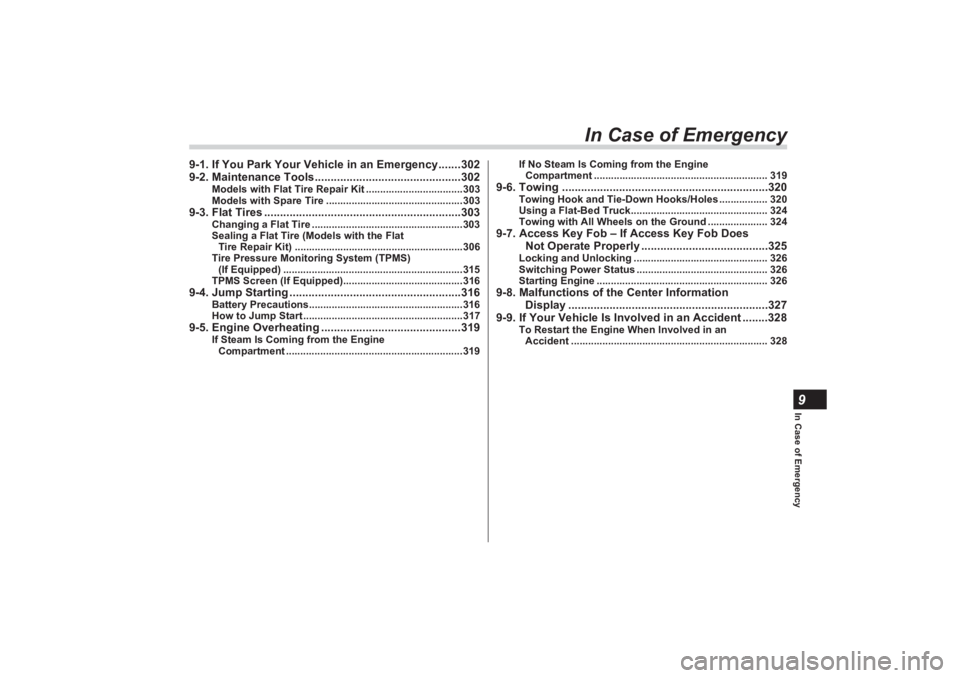
9-1. If You Park Your Vehicle in an Emergency.......302
9-2. Maintenance Tools..............................................302
Models with Flat Tire Repair Kit ..................................303
Models with Spare Tire ................................................303
9-3. Flat Tires ..............................................................303
Changing a Flat Tire .....................................................303
Sealing a Flat Tire (Models with the Flat
Tire Repair Kit) ...........................................................306
Tire Pressure Monitoring System (TPMS)
(If Equipped) ...............................................................315
TPMS Screen (If Equipped)..........................................316
9-4. Jump Starting ......................................................316
Battery Precautions......................................................316
How to Jump Start ........................................................317
9-5. Engine Overheating ............................................319
If Steam Is Coming from the Engine
Compartment ..............................................................319 If No Steam Is Coming from the Engine
Compartment ............................................................. 319
9-6. Towing .................................................................320
Towing Hook and Tie-Down Hooks/Holes ................. 320
Using a Flat-Bed Truck................................................ 324
Towing with All Wheels on the Ground ..................... 324
9-7. Access Key Fob – If Access Key Fob Does
Not Operate Properly ...... ..................................325
Locking and Unlocking ............................................... 326
Switching Power Status .............................................. 326
Starting Engine ............................................................ 326
9-8. Malfunctions of the Center Information
Display ...............................................................327
9-9. If Your Vehicle Is Invo lved in an Accident ........328
To Restart the Engine When Involved in an
Accident ..................................................................... 328
BRZ_U.book 301 ページ 2022年3月29日 火曜日 午後3時59分
Page 309 of 432

Flat Tires
303
In Case of Emergency9
– CONTINUED –
■Models with Flat Tire Repair
Kit1) Under-floor storage compartment
2) Jack handle
3) Wheel nut wrench
4) Jack
5) Towing hook (eye bolt) 6) Screwdriver
7) Flat tire repair kit
■
Models with Spare Tire1) Spare tire
2) Jack handle
3) Wheel nut wrench
4) Jack
5) Towing hook (eye bolt)
6) Screwdriver
9-3. Flat TiresIf you have a flat tire while driving, never
brake suddenly; keep driving straight
ahead while gradually reducing speed.
Then slowly pull off the road to a safe
place.■ Changing a Flat Tire
1
6
4
7
5
2
3901198
1
6
45
2
3901216
WARNING
Use only the jack and the jack
handle provided with your
vehicle. The jack supplied with
the vehicle is designed only for
changing a tire. Never get under
the vehicle while supporting the
vehicle with this jack. Do not jack up the vehicle on an
incline or a loose road surface.
The jack can come out of the
jacking point or sink into the
ground and this can result in
serious injury or death. Before jacking up the vehicle, be
sure that there are no occupants
or cargo on board. Do not jack up the vehicle with an
object on or underneath the jack.
The jack can be unstable and this
can result in a severe accident.
BRZ_U.book 303 ページ 2022年3月29日 火曜日 午後3時59分