power steering SUBARU BRZ 2023 User Guide
[x] Cancel search | Manufacturer: SUBARU, Model Year: 2023, Model line: BRZ, Model: SUBARU BRZ 2023Pages: 432, PDF Size: 16.56 MB
Page 227 of 432
Starting and Operating7
Starting and Operating
7-1. Fuel.......................................................................223
Fuel Requirements .......................................................223
Fuel Filler Lid and Cap .................................................224
7-2. State Emission Testing (U.S. Only) ...................227
7-3. Preparing to Drive ...............................................228
7-4. Starting and Stopping Engine ...........................229
Safety Precautions ............................................ ...........229
Operating Range for Push-Button Start System .......229
General Precautions When St arting Engine ..............229
Starting Engine .............................................................230
Stopping Engine ...........................................................232
When Access Key Fob Does Not Operate
Properly.......................................................................232
Steering Lock ................................................................232
7-5. Manual Transmission .........................................233
Shifting Speeds ............................................................234
Driving Tips ...................................................................235
7-6. Automatic Transmission ....................................235
Select Lever ..... .......................................... ...................236
Adaptive Control...........................................................237
Shift Lock Function ......................................................238
Selection of Manual Mode ...........................................239
Driving Tips ...................................................................240
7-7. Driving Mode Select Switch (If Equipped) ........241
Normal Mode .................................................................241
Sport Mode ....................................................................241
Snow Mode....................................................................241
Driving Mode Select Switch.........................................241
7-8. Active Sound Control .........................................242
7-9. Power Steering ....................................................242
7-10. Braking...............................................................243
Braking Tips ..................................................................243 Brake System ............................................................... 244
Disc Brake Pad Wear Warning Indicators ................. 245
7-11. ABS (Anti-Lock Brake System) ........................245
ABS Self-Check............................................................ 245
ABS Warning Light ...................................................... 245
7-12. Electronic Brake Force Distribution (EBD)
System ...............................................................246
EBD System Malfunctions .......................................... 246
7-13. Vehicle Stability Control (VSC)/TRAC
System ...............................................................247
Vehicle Stability Control (VSC) System ..................... 247
TRAC System ............................................................... 247
Vehicle Stability Control (VSC) System Monitor....... 248
Vehicle Stability Control (VSC) OFF Switch .............. 248
7-14. TRACK Mode .....................................................250
TRACK Mode ................................................................ 250
Selecting TRAC Mode and Ve hicle Stability Control
(VSC) Mode ............................................................... 251
7-15. Tire Pressure Monitoring System (TPMS)
(If Equipped) ......................................................251
Certification for the Transmitter ................................. 253
Certification for the Receiver...................................... 253
TPMS Screen ................................................................ 254
Initializing the Tire Pressure Monitoring System ..... 254
How to Initialize the Tire Pressure Monitoring
System (If Equipped) ................................................. 254
If You Press the Tire Pressure Monitoring Reset
Switch Accidentally................................................... 254
Initialization Procedure ............................................... 254
When Initialization of the Tire Pressure Monitoring System has Failed ..................................................... 255
Registering ID Codes .................................................. 255
BRZ_U.book 221 ページ 2022年3月29日 火曜日 午後3時59分
Page 236 of 432
Starting and Stopping Engine
230On rare occasions, it may be difficult
to start the engine depending on the
fuel and the usage condition (repeated
driving of a distance in which the
engine has not warmed up suffi-
ciently). In such a case, it is recom-
mended that you change to a different
brand of fuel.
On rare occasions, transient
knocking may be heard from the
engine when the accelerator is oper-
ated rapidly such as a rapid start-up
and a rapid acceleration. This is not a
malfunction.
The engine starts more easily when
the headlights, air conditioner and rear
window defogger are turned off.■ Starting Engine
NOTEWhen pressing the push-button
ignition switch while depressing the
clutch pedal (MT models) or the brake
pedal (AT models): - The engine starter operates for a
maximum of 10 seconds and after
starting the engine, the starter stops
automatically.
- The engine can be started
regardless of the power status.
If the engine does not start, check
the security indicator light. Then press
the push-button ignition switch
without depressing the clutch pedal
(MT models) or the brake pedal (AT
models) to switch the power to “OFF”. - If the light had illuminated, try to
start the engine again.
- If the light had been off, press the
push-button ignition switch while
depressing the clutch pedal (MT
models) or the brake pedal (AT
models) more forcefully.
The engine start procedures may
not function depending on the radio
wave conditions around the vehicle. In
such a case, refer to "Starting Engine"
P326.
If the vehicle battery is discharged,
the steering cannot be unlocked.
Charge the battery.
WARNING
There are some general precau-
tions when starting the engine.
Carefully read the precautions
described in "General Precau-
tions When Starting Engine"
P229. If the steering lock cannot be
released after the engine has
started, never drive the vehicle.
The steering is still locked, and it
may result in an accident.
CAUTION
If a system malfunction warning
message is displayed on the
combination meter, there may be
a malfunction with the vehicle.
Contact a SUBARU dealer imme-
diately. If a steering lock warning
message is displayed on the
combination me ter after the
engine has started, it means that
the steering is still locked. While
moving the steering wheel right
and left, depress the brake pedal,
and press the push-button igni-
tion switch. Do not continue pressing the
push-button ignition switch for
more than 10 seconds. Doing so
could cause a malfunction. If the
engine does not start, stop
pressing the push -button ignition
switch. Instead, press the push-
button ignition switch without
depressing the clutch pedal (MT
models) or the brake pedal (AT
models) to switch the power
status to “OFF”. Wait 10 seconds,
and then press the push-button
ignition switch to start the
engine.
BRZ_U.book 230 ページ 2022年3月29日 火曜日 午後3時59分
Page 238 of 432
Starting and Stopping Engine
232■Stopping Engine1. Stop the vehicle completely.
2. Move the shift lever to neutral (MT
models) or select leve r to the “P” position
(AT models).
3. Press the push-button ignition switch.
The engine will stop, and the power will be
switched off.
NOTEAlthough you can stop the engine by
operating the push -button ignition
switch, do not stop the engine during
driving except in an emergency.■ When Access Key Fob Does
Not Operate ProperlyRefer to "Access Key Fob – If Access Key
Fob Does Not Operate Properly" P325.■ Steering LockAfter stopping the engine and any door is
opened, the steering wheel will be locked
due to the steering lock function.
When the engine is restarted, the steering
lock will be automatically released.
WARNING
Do not touch the push-button
ignition switch during driving.
When the push-button ignition
switch is operated as follows, the
engine will stop.–The switch is pressed and held
for 2 seconds or longer.–The switch is pressed briefly 3
times or more in succession.When the engine stops, the brake
booster will not function. A
greater foot pressure will be
required on the brake pedal.The power steering system will
not operate either. A greater
force will be required to steer,
and it may result in an accident.
If the engine stops during driving,
do not operate the push-button
ignition switch or open any of the
doors until the vehicle is stopped
in a safe location. It is dangerous
because the steering lock may be
activated. Stop the vehicle in a
safe place, and contact a
SUBARU dealer immediately.
CAUTION
For AT models:Do not stop the engine while the
select lever is in a position other
than the “P” position. If the engine is stopped while the
select lever is in a position other
than the “P” position, the power
will be in “ACC”. If the vehicle is
left in this cond ition, the battery
may be discharged.
BRZ_U.book 232 ページ 2022年3月29日 火曜日 午後3時59分
Page 248 of 432
Active Sound Control
242NOTEIn the following situations, the driving
mode will automatically change to nor-
mal mode:
When the engine is turned off after
driving in Sport mode or Snow mode.
When adaptive cruise control/cruise
control is activated while driving in
Sport mode.
If a malfunction occurs in the engine
or automatic transmission electrical
control system while Sport mode or
Snow mode is selected.
When in Sport mode and the idling
speed is high during warm-up or when
the road surface is slippery and stop-
ping/starting off is automatically
performed in second gear.
7-8. Active Sound ControlThe active sound control provides
dynamic engine sounds. When driving
with Sport mode selected, the engine
sounds will be particularly loud.NOTEThe operational/non-operational set-
ting of the Active Sound Control can
be changed by a SUBARU dealer. Con-
tact your SUBARU dealer for details.
When the driving mode is changed,
the sound of the active sound control
will be stopped for approximately 1
second, this is not a malfunction.
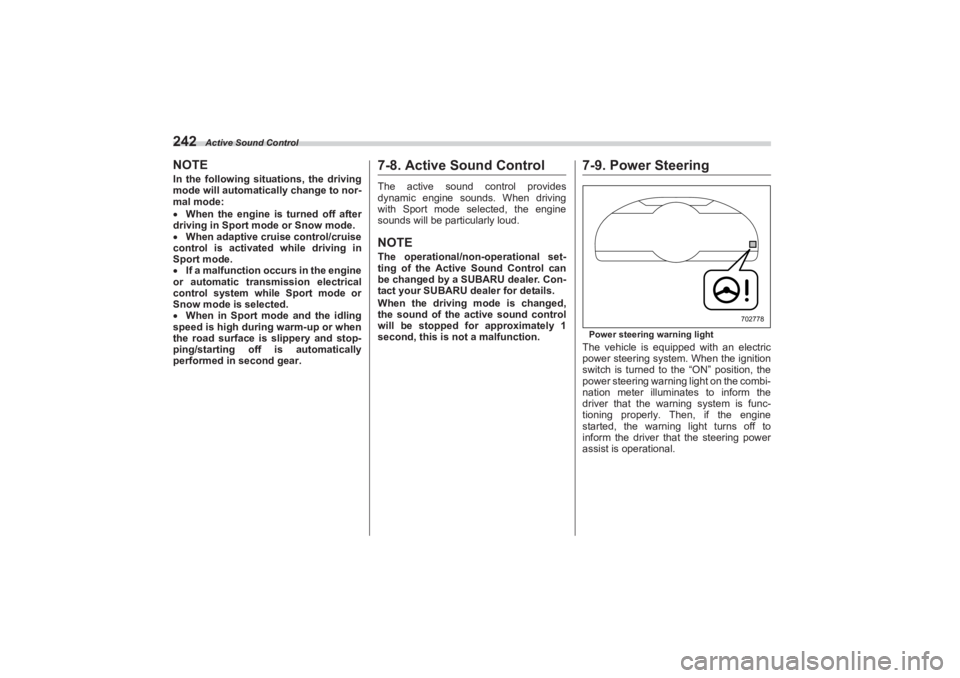
7-9. Power SteeringPower steering warning lightThe vehicle is equipped with an electric
power steering system. When the ignition
switch is turned to the “ON” position, the
power steering warning light on the combi-
nation meter illuminates to inform the
driver that the warn ing system is func-
tioning properly. Then, if the engine
started, the warni ng light turns off to
inform the driver that the steering power
assist is operational.
702778
BRZ_U.book 242 ページ 2022年3月29日 火曜日 午後3時59分
Page 249 of 432
Braking
243
Starting and Operating7
– CONTINUED –
NOTEIf the steering wheel is operated in the
following ways, the power steering
control system may temporarily limit
the power assist in order to prevent
the system components, such as the
control computer and drive motor,
from overheating.
The steering wheel is operated
frequently and turned sharply while the
vehicle is maneuvered at extremely low
speeds, such as while frequently
turning the steering wheel during
parallel parking.
The steering wheel remains in the
fully turned position for a long period
of time.
At this time, there will be more resis-
tance when steering. However this is
not a malfunction. Normal steering
force will be restored after the steering
wheel is not operated for a while and the power steering control system has
an opportunity to cool down. However,
if the power steering is operated in a
non-standard way which causes
power assist limitation to occur too
frequently, this may result in a mal-
function of the power steering control
system.
7-10. Braking■ Braking Tips▼ When the brakes get wet
When driving in rain or after washing the
vehicle, the brakes may get wet. As a
result, brake stopping distance will be
longer. To dry the brakes, drive the
vehicle at a safe speed while lightly
depressing the brake pedal to heat up the
brakes.
▼ Use of engine brakingRemember to make use of engine braking
in addition to foot braking. When
descending a grade, if only the foot brake
is used, the brakes may start working
improperly because of brake fluid over-
heating, caused by overheated brake
pads. To help prevent this, shift into a
lower gear to get stronger engine braking.
CAUTION
While the power steering warning
light is illuminated, there may be
more resistance when the steering
wheel is operated. Drive carefully to
the nearest SUBARU dealer and
have the vehicle inspected immedi-
ately.
WARNING
Never rest your foot on the brake
pedal while driving. This can cause
dangerous overheating of the
brakes and needless wear on the
brake pads.
BRZ_U.book 243 ページ 2022年3月29日 火曜日 午後3時59分
Page 253 of 432
Vehicle Stability Control (VSC)/TRAC System
247
Starting and Operating7
– CONTINUED –
7-13. Vehicle Stability Control (VSC)/TRAC System■Vehicle Stability Control
(VSC) SystemIn the event of wheelspin and/or skidding
on a slippery road surface and/or during
cornering and/or an evasive maneuver,
the Vehicle Stability Control (VSC) system
adjusts the engine’s output and the
wheels’ respective braking forces to help
maintain traction and directional control.
The skid suppression function is designed
to help maintain directional stability by
suppressing the wheels’ tendency to slide
sideways during steering operations. Acti-
vation of this function is indicated by
flashing of the Vehicle Stability Control
(VSC) operation indicator light.NOTE In the following circumstances, the
vehicle may be less stable than it feels
to the driver. The Vehicle Stability
Control (VSC) system may therefore
operate. Such operation does not indi-
cate a system malfunction. - On gravel-covered or rutted
roads
- On unfinished roads
- When the vehicle is fitted with
snow tires or winter tires
Activation of the Vehicle Stability
Control (VSC) system will cause opera-
tion of the steering wheel to feel
slightly different compared to that for
normal conditions.
It is always important to reduce
speed when approaching a corner,
even if the vehicle is equipped with
Vehicle Stability Control (VSC) system.
Always turn off the engine before
replacing a tire as failure to do so may
render the Vehicle Stability Control
(VSC) system unable to operate
correctly.
■ TRAC SystemThe TRAC system is designed to prevent
spinning of the driving wheels on slippery
road surfaces, thereby helping to maintain
traction and directional control. Activation
of this function is indicated by flashing of
the Vehicle Stability Control (VSC) opera-
tion indicator light. The TRAC system is
also equipped with the brake LSD func-
tion.
WARNING
Directional control and power
may not be achievable while
driving on slippery road surfaces,
even if the TRAC system is oper-
ating. Do not drive the vehicle in
conditions where stability and
power may be lost. Always use the utmost care in
driving – overconfidence
because you are driving with a
Vehicle Stability Control (VSC)
system and TRAC system
equipped vehicle could easily
lead to a serious accident.
CAUTION
Even if your vehicle is equipped
with Vehicle Stability Control
(VSC) system and TRAC system,
winter tires should be used when
driving on snow-covered or icy
roads; in addition, vehicle speed
should be reduced considerably.
Simply having a Vehicle Stability
Control (VSC) system and TRAC
system does not guarantee that
the vehicle will be able to avoid
accidents in any situation.
BRZ_U.book 247 ページ 2022年3月29日 火曜日 午後3時59分
Page 262 of 432
Parking Your Vehicle
256To release the parking brake, pull the
lever up slightly, press the release button,
then lower the lever while keeping the
button pressed.
When the parking brake is set while the
engine is running, the parking brake
warning light illuminates. After starting the
vehicle, be sure that the warning light has
turned off before the vehicle is driven.
Refer to "Brake System Warning Light"
P140.
■ Parking TipsWhen parking your vehicle, always
perform the following items.
Apply the parking brake firmly.
For MT models, put the shift lever in the
“1” (1st) for upgrade or “R” (Reverse) for a
downgrade.
For AT models, put the select lever in
the “P” (Park) position.
Never rely on the mechanical friction of
the transmission alone to hold the vehicle.
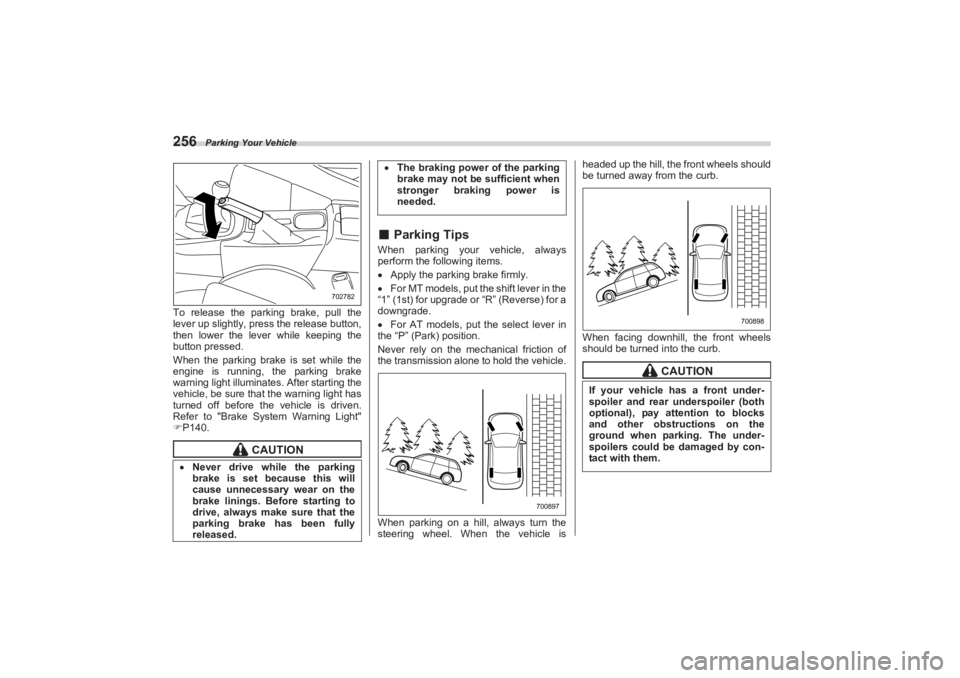
When parking on a hill, always turn the
steering wheel. When the vehicle is headed up the hill, the front wheels should
be turned away from the curb.
When facing downhill, the front wheels
should be turned into the curb.
CAUTION
Never drive while the parking
brake is set because this will
cause unnecessary wear on the
brake linings. Before starting to
drive, always make sure that the
parking brake has been fully
released.
702782
The braking power of the parking
brake may not be sufficient when
stronger braking power is
needed.
700897
CAUTION
If your vehicle has a front under-
spoiler and rear underspoiler (both
optional), pay attention to blocks
and other obstructions on the
ground when parking. The under-
spoilers could be damaged by con-
tact with them.
700898
BRZ_U.book 256 ページ 2022年3月29日 火曜日 午後3時59分
Page 330 of 432
Towing
324holes, return the plugs to their original
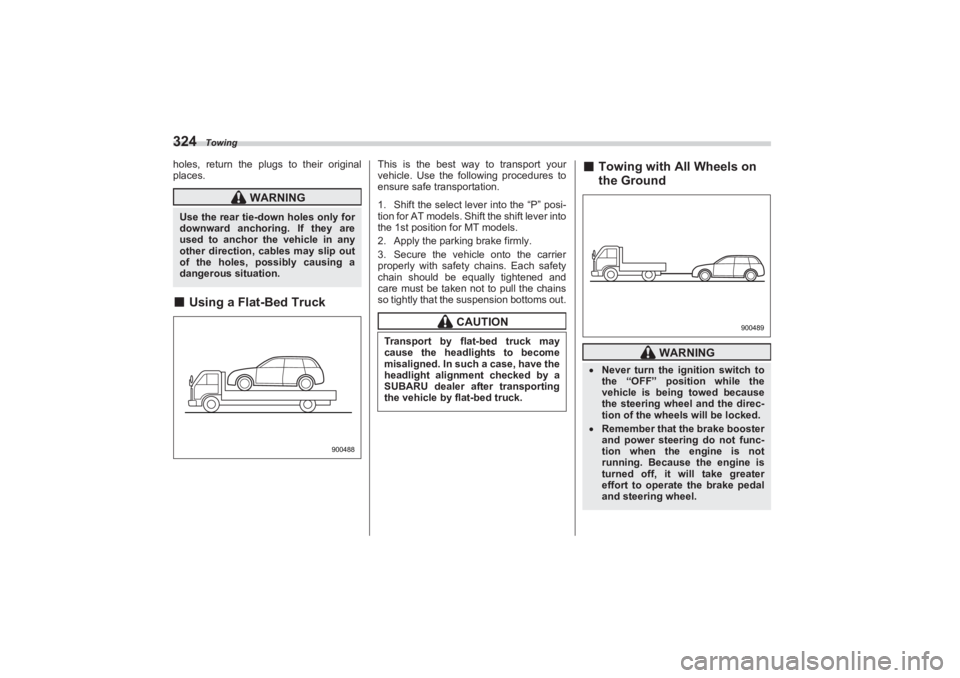
places.■Using a Flat-Bed Truck
This is the best way to transport your
vehicle. Use the following procedures to
ensure safe transportation.
1. Shift the select lever into the “P” posi-
tion for AT models. Sh ift the shift lever into
the 1st position for MT models.
2. Apply the parking brake firmly.
3. Secure the vehicle onto the carrier
properly with safety chains. Each safety
chain should be equally tightened and
care must be taken not to pull the chains
so tightly that the suspension bottoms out.
■ Towing with All Wheels on
the Ground
WARNING
Use the rear tie-down holes only for
downward anchoring. If they are
used to anchor the vehicle in any
other direction, cables may slip out
of the holes, possibly causing a
dangerous situation.
900488
CAUTION
Transport by flat -bed truck may
cause the headlights to become
misaligned. In such a case, have the
headlight alignment checked by a
SUBARU dealer after transporting
the vehicle by flat-bed truck.
WARNING
Never turn the ignition switch to
the “OFF” position while the
vehicle is being towed because
the steering wheel and the direc-
tion of the wheels will be locked. Remember that the brake booster
and power steering do not func-
tion when the engine is not
running. Because the engine is
turned off, it w ill take greater
effort to operate the brake pedal
and steering wheel.
900489
BRZ_U.book 324 ページ 2022年3月29日 火曜日 午後3時59分
Page 338 of 432
Exterior Care
33210-1. Exterior Care■Washing
NOTE
When having your vehicle washed in
an automatic car wash, make sure
beforehand that the car wash is of
suitable type.
The best way to preserve your vehicle’s
beauty is frequent washing. Wash the
vehicle at least once a month to avoid
contamination by road grime.
Wash dirt off with a wet sponge and plenty
of lukewarm or cold water. Do not wash
the vehicle with hot water and in direct
sunlight.
Salt, chemicals, insects, tar, soot, tree
sap, and bird droppings should be washed
off by using a light detergent, as required.
If you use a light detergent, make certain
that it is a neutral detergent. Do not use
strong soap or chemical detergents. All
cleaning agents should be promptly
flushed from the surface and not allowed
to dry there. Rinse the vehicle thoroughly with plenty of lukewarm water. Wipe the
remaining water off with a chamois or soft
cloth. Wear rubber gloves and use a hand
brush when washing down underbody,
inner fenders and suspension to effec-
tively remove mud and dirt off.
▼ Washing the underbody
Chemicals, salts and gravel used for
deicing road surfaces are extremely corro-
sive, accelerating the corrosion of under-
body components, such as the exhaust
system, fuel and brake lines, brake
cables, floor pan and fenders, and
suspension.
Thoroughly flush the underbody and
inside of the fenders with lukewarm or
cold water at frequent intervals to reduce
the harmful effects of such agents.
Mud and sand adhering to the underbody
components may accelerate their corro-
sion.
After driving off-road or on muddy or
sandy roads, wash the mud and sand off
the underbody.
Carefully flush the suspension and axle
parts, as they are particularly prone to
mud and sand buildup. Do not use a
sharp-edged tool to remove caked mud.
CAUTION
When washing the vehicle, the
brakes may get wet. As a result,
the brake stopping distance will
be longer. To dry the brakes,
drive the vehicle at a safe speed
while lightly pressing the brake
pedal to heat up the brakes. Do not wash the engine compart-
ment and areas adjacent to it. If
water enters the engine air intake
or electrical parts, it will cause
engine trouble or a malfunction of
the power steering. When washing inner fenders,
underbody, bumpers and
protruding objects such as
exhaust pipes and exhaust
finishers, be careful to prevent
injuries from contacting sharp
ends.
Do not use any organic solvents
when washing the surface of the
bulb assembly cover. However, if
a detergent with organic solvents
is used to wash the cover surface,
completely rinse off the detergent
with water. Otherwise, the cover
surface may be damaged.
BRZ_U.book 332 ページ 2022年3月29日 火曜日 午後3時59分
Page 403 of 432
Tire Information
397
Consumer Information and Reporting Safety Defects13
– CONTINUED –
The vehicle placard shows original
tire size, recommended cold tire
inflation pressure on each tire at
maximum loaded vehicle weight,
seating capacity and loading infor-
mation.▼ Adverse safety consequences
of under-inflation
Driving at high speeds with exces-
sively low tire pressures can cause
the tires to flex severely and to
rapidly become hot. A sharp
increase in temperature could
cause tread separation, and failure
of the tire(s). Possible resulting loss
of vehicle control could lead to an
accident.
▼ Measuring and adjusting air
pressure to achieve proper
inflation
Check and, if necessary, adjust the
pressure of each tire (including the
spare) at least once a month and
before any long journey. Check the
tire pressures when the tires are
cold. Use a pressure gauge to adjust the tire pressures to the
specific values. Driving even a short
distance warms up the tires and
increases the tire pressures. Also,
the tire pressures are affected by
the outside temperature. It is best to
check tire pressure outdoors before
driving the vehicle. When a tire
becomes warm, t he air inside it
expands, causing the tire pressure
to increase. Be careful not to
mistakenly release air from a warm
tire to reduce its pressure.
■ Glossary of Tire TerminologyAccessory weight
The combined weight (in excess of
those standard items which may be
replaced) of automatic transmis-
sion, power steering, power brakes,
power windows, power seats, radio,
and heater, to the extent that these
items are available as factory-
installed equipment (whether
installed or not).
Bead
The part of the tire that is made of
steel wires, wrapped or reinforced by ply cords and that is shaped to fit
the rim.
Bead separation
A breakdown of the bond between
components in the bead.
Bias ply tire
A pneumatic tire in which the ply
cords that extend to the beads are
laid at alternate an gles substantially
less than 90 degrees to the
centerline of the tread.
Carcass
The tire structure, except tread and
sidewall rubber which, when
inflated, bears the load.
Chunking
The breaking away of pieces of the
tread or sidewall.
Cold tire pressure
The pressure in a tire that has been
driven less than 1 mile or has been
standing for three hours or more.
Cord
The strands forming the plies in the
tire.
BRZ_U.book 397 ページ 2022年3月29日 火曜日 午後3時59分