radio SUBARU BRZ 2023 User Guide
[x] Cancel search | Manufacturer: SUBARU, Model Year: 2023, Model line: BRZ, Model: SUBARU BRZ 2023Pages: 432, PDF Size: 16.56 MB
Page 274 of 432
BSD/RCTA (If Equipped)
2687-20. BSD/RCTA (If Equipped)The BSD/RCTA consists of rear corner
radars with Blind Spot Detection and Rear
Cross Traffic Alert.
These functions of BSD/RCTA are the
systems that detect objects and vehicles
to the rear and draw attention to the driver
when changing a lane or when driving in
reverse.
■ System FeaturesBSD/RCTA consists of the following func-
tions.
To detect a vehicle in a blind spot on an
adjacent lane or a vehicle approaching at
high speed while driving the vehicle (Blind
Spot Detection)
To detect a vehicle approaching from
the right or left while reversing the vehicle
(Rear Cross Traffic Alert) The system uses radar sensors for the
following features.
NOTEThe BSD/RCTA radar sensor has been
certified by the radio wave related laws
of the U.S. and other FCC compliant
countries, Canada and Mexico. When
driving in other countries, certifica-
tion of the country where the vehicle is
driven must be obtained. For certifica-
tion in the U.S. and other FCC compli-
ant countries, Canada and Mexico,
refer to "Certification for the BSD/
RCTA" P274.
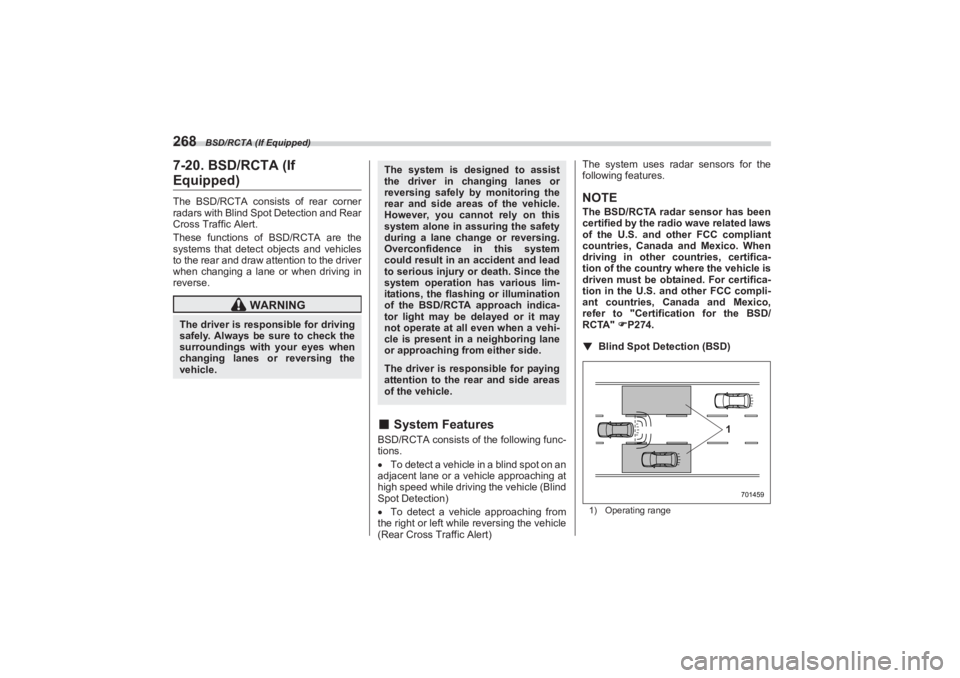
▼ Blind Spot Detection (BSD)1) Operating range
WARNING
The driver is responsible for driving
safely. Always be sure to check the
surroundings with your eyes when
changing lanes or reversing the
vehicle.
The system is designed to assist
the driver in changing lanes or
reversing safely by monitoring the
rear and side areas of the vehicle.
However, you cannot rely on this
system alone in assuring the safety
during a lane change or reversing.
Overconfidence in this system
could result in an accident and lead
to serious injury or death. Since the
system operation has various lim-
itations, the flashing or illumination
of the BSD/RCTA approach indica-
tor light may be delayed or it may
not operate at all even when a vehi-
cle is present in a neighboring lane
or approaching from either side.The driver is responsible for paying
attention to the rear and side areas
of the vehicle.
701459
1
BRZ_U.book 268 ページ 2022年3月29日 火曜日 午後3時59分
Page 286 of 432
Reverse Automatic Braking (RAB) System (If Equipped)
280
- The rear bumper is exposed to
strong impact, or the rear bumper is
deformed.
On a steep hill, the system’s auto-
matic braking ability will be reduced.
The system is designed to avoid
collisions by automatic hard braking
when the vehicle’s reversing speed is
less than approximately 3 mph (5 km/
h). However, the system does not guar-
antee that the vehicle will be able to
avoid collisions in any situation.
If the vehicle is reversed at an
extremely slow speed, the driver’s
operation may be prioritized. In this
case, automatic braking will not
operate.
The system may not be able to
detect and apply the brake with the
following objects. - Sharp or thin objects such as
poles, fences and ropes which may
not reflect the s ound wave emitted
from the sonar sensor.
- Objects that are too close to the
rear bumper when the select lever is
set to the “R” position.
- Objects with a surface which
may not reflect the sound wave
emitted from the sonar sensor such
as a chain link fence.
Objects the system is not designed
to detect and apply brake. -Pedestrians.
- Moving objects including
moving vehicles.
- Objects which absorbs sound
waves such as cloth or snow.
- Objects whose surface has a
diagonal angle.
- Objects that are low to the
ground such as parking blocks.
- Objects that are high above the
ground such as objects hanging
from above.
- Objects that are out of range of
the center of the vehicle in the hori-
zontal direction.
- Objects that are not perpendic-
ular to the ground.
- The surface of the object is
uneven or wavy.
When reversing the vehicle, the
functions may not be able to work
properly or may cause a system
malfunction if the following conditions
exist.
High frequency sound from other
sources are nearby:
- Horn sound from another
vehicle.
- Engine sound from other vehi-
cles.
- Sound of an air brake.
- Vehicle detection equipment or a
sonar from another vehicle. - A sound wave with a frequency
similar to the vehicle’s system is
transmitted near by.
- A vehicle equipped with the
same system is reversing toward
your reversing direction.
Weather conditions:
- Extremely high or extremely low
temperatures in which the area near
the sonar sensor becomes too hot
or too cold to operate.
- The sonar sensors or the rear
bumper near the sonar sensors are
exposed to heavy rain or a signifi-
cant amount of water.
- Fog, snow or sandstorm, etc.
- Air is moving rapidly such as
when a strong wind is blowing.
Parts attached to the rear bumper
near the sonar sensor:
- Commercial electr onic parts (fog
light, fender pole, radio antenna) or
commercial attachment parts (trailer
hitch, bicycle carrier, bumper guard)
are attached.
- Parts that emit high frequency
sound, such as a horn or speaker,
are attached.
Vehicle conditions:
- Ice, snow or mud is adhered to
the sonar sensors or the rear
bumper near the sonar sensor.
BRZ_U.book 280 ページ 2022年3月29日 火曜日 午後3時59分
Page 331 of 432
Access Key Fob – If Access Key Fob Does Not Operate Properly
325
In Case of Emergency9
– CONTINUED –
1. Release the parking brake and put the
transmission in neutral.
2. The ignition switch should be in the
“ON” position while the vehicle is being
towed.
3. Take up slack in the towline slowly to
prevent damage to the vehicle.
9-7. Access Key Fob – If
Access Key Fob Does Not Operate ProperlyThe following functions may be inoperable
because of strong radio signals in the
surrounding area or a low battery condi-
tion of the access key fob.
Locking/unlocking doors including
trunk
Switching power status
Starting engine
In such cases, perform the following
procedure. When t he battery of the
access key fob is discharged, replace it
with a new one. Refer to "Replacing
Battery of Access Key Fob" P376.
CAUTION
If transmission failure occurs,
transport your vehicle on a flat-
bed truck. Sometime damaged vehicles
cannot be towed because of their
damaged condition. In that case,
use a flat-bed truck for transpor-
tation. The traveling speed must be
limited to less than 20 mph (32
km/h) and the traveling distance
to less than 19 miles (30 km). For
greater speeds and distances,
transport your vehicle on a flat-
bed truck. Use a flat-bed truck if there are
long distance downgrades or
steep slopes. However, do not
apply the brake pedal for a long
time because the engine braking
will not work while towing. Doing
so could overheat the brake. Drive carefully and do not make
an impact on the towing rope by
suddenly starting.
Use a specific towing rope for
towing. If wire ropes and metal
chains are needed to be used for
towing, wrap the contact portion
of the bumper with cloth to
protect it from damage.
CAUTION
Keep metallic objects, magnetic
sources and signal transmitters
away from the area between the
access key fob and the push-button
ignition switch. They may interfere
with the communication between
the access key fob and the push-
button ignition switch.
BRZ_U.book 325 ページ 2022年3月29日 火曜日 午後3時59分
Page 403 of 432
Tire Information
397
Consumer Information and Reporting Safety Defects13
– CONTINUED –
The vehicle placard shows original
tire size, recommended cold tire
inflation pressure on each tire at
maximum loaded vehicle weight,
seating capacity and loading infor-
mation.▼ Adverse safety consequences
of under-inflation
Driving at high speeds with exces-
sively low tire pressures can cause
the tires to flex severely and to
rapidly become hot. A sharp
increase in temperature could
cause tread separation, and failure
of the tire(s). Possible resulting loss
of vehicle control could lead to an
accident.
▼ Measuring and adjusting air
pressure to achieve proper
inflation
Check and, if necessary, adjust the
pressure of each tire (including the
spare) at least once a month and
before any long journey. Check the
tire pressures when the tires are
cold. Use a pressure gauge to adjust the tire pressures to the
specific values. Driving even a short
distance warms up the tires and
increases the tire pressures. Also,
the tire pressures are affected by
the outside temperature. It is best to
check tire pressure outdoors before
driving the vehicle. When a tire
becomes warm, t he air inside it
expands, causing the tire pressure
to increase. Be careful not to
mistakenly release air from a warm
tire to reduce its pressure.
■ Glossary of Tire TerminologyAccessory weight
The combined weight (in excess of
those standard items which may be
replaced) of automatic transmis-
sion, power steering, power brakes,
power windows, power seats, radio,
and heater, to the extent that these
items are available as factory-
installed equipment (whether
installed or not).
Bead
The part of the tire that is made of
steel wires, wrapped or reinforced by ply cords and that is shaped to fit
the rim.
Bead separation
A breakdown of the bond between
components in the bead.
Bias ply tire
A pneumatic tire in which the ply
cords that extend to the beads are
laid at alternate an gles substantially
less than 90 degrees to the
centerline of the tread.
Carcass
The tire structure, except tread and
sidewall rubber which, when
inflated, bears the load.
Chunking
The breaking away of pieces of the
tread or sidewall.
Cold tire pressure
The pressure in a tire that has been
driven less than 1 mile or has been
standing for three hours or more.
Cord
The strands forming the plies in the
tire.
BRZ_U.book 397 ページ 2022年3月29日 火曜日 午後3時59分